LASER BEAM
MACHINING Submitted by
1
Md. Abu Bakar Siddique
Student
Dept. of Industrial and Production Engineering
Rajshahi University of Engineering and
Technology, Rajshahi, Bangladesh
Contents
Laser
Laser Beam
Laser Beam Machining
Laser Application
Laser operations
Advantages
Limitations
References
2
What is Laser
LASER is the acronym for Light Amplification
by Stimulated Emission of Radiation.
Laser is a device which generates or amplifies
light.
Stimulated emission of electromagnetic
radiation.
Coherent, monochromatic, directional and high
power laser beam is used.
3
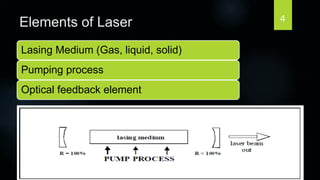
Elements of Laser
Lasing Medium (Gas, liquid, solid)
Pumping process
Optical feedback element
4
5
Video: Laser Principle
Laser Beam Characteristics:
Monochromaticity
Coherence
Very Limited Diffraction
Extremely high Radiance
6
Laser Beam Temporal Modes
Continuous Wave (CW)
commonly results in the
highest cutting speed & better
surface finish. Roughness is
determined by thickness,
alloy content, etc.
Pulsed beam results in the
fewest thermal effects & least
distortion of work piece. With
drilling overlapping holes (see
right), it’s possible to cut with
smoother surface
7
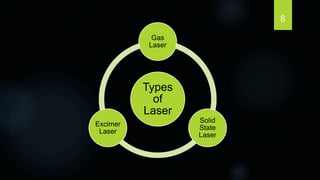
Types
of
Laser
Gas
Laser
Solid
State
Laser
Excimer
Laser
8
Gas Laser 9
The generally used gas lasers are
• Helium – Neon
• Argon
• CO2 etc.
Lasers can be operated in continuous mode or pulsed
mode. Typically CO2 gas laser is operated in continuous
mode and Nd – YAG laser is operated in pulsed mode.
Laser formation: Nd-YAG Laser 10
Solid State Laser 11
Ruby which is a chromium–alumina alloy
having a wavelength of 0.7 μ m
Nd-glass lasers having a wavelength of 1.64
μ m.
Nd-YAG laser having a wavelength of 1.06 μ
m
Solid-state lasers are commonly of the
following type
These solid-state lasers are generally used
in material processing.
Excimer Laser
Uses a combination of an inert
gas and reactive gas
Excimer is form of Ultraviolet
Chemical Laser
Excimer is short for ‘excited
dimer’
12
Source: Google Images
Dye & Semiconductor Laser
Dye Laser
use complex
organic dyes,
such as
rhodamine 6G
Semiconductor
Laser
sometimes
called diode
lasers
very small and
use low
power.
14
Laser Beam Machining
Used light energy from a
laser to remove material by
vaporization and ablation
Energy is concentrated
optically
Laser emits either
continuous or pulsed light
beam
15
Source: Google Images
Laser Application 16
Operation: Laser Cutting
Cutting starts by drilling a hole by moving
beam
Cutting speed depends on material and
thickness
Both pulsed and continuous laser is used
Thickness ranges from 0.5-1 inch
Used for cutting complex geometry and
for clean cutting operation
17
Source: sciencedirect.com
Job variation & effect: 18
Ways of Laser cutting 19
Material Removal Types of Laser
Cutting
20
• low vaporization temperature in
materials.Vaporization
• Material is melted & ejected by an
inert gas jet.Fusion
• dross is no longer a metal, but an
oxide in reactive fusion.Reactive Fusion
• Mechanical snapping along with
scribed line occur simultaneously.Scribing
Laser Cladding
Used to improve surface quality
by applying a corrosion resistant
layer on product
Laser Beam is used to create a
shallow melt pool
Metal powder is supply using an
inert gas flow
Application
Chemical industry
Mining and marine application
21
Advantages
Non Contact
No solvent chemical
Selective material removal
Flexibility
Fully automated
22
Limitations
High maintenance cost
Not for mass metal removal processes
Requires greater control of joint tolerances
Presence of Heat Affected Zone
Consumes much energy
23
Video: Laser Cutting 24
Accuracy 25
References 26
Advance
Machining
Process
Machine Tool
Engineering
•V. K. Jain
•G. R.
Nagpal
THANK YOU ☺
27

Laser Beam Machining | LBM | Explained with Video

  • 1.
    LASER BEAM MACHINING Submittedby 1 Md. Abu Bakar Siddique Student Dept. of Industrial and Production Engineering Rajshahi University of Engineering and Technology, Rajshahi, Bangladesh
  • 2.
    Contents Laser Laser Beam Laser BeamMachining Laser Application Laser operations Advantages Limitations References 2
  • 3.
    What is Laser LASERis the acronym for Light Amplification by Stimulated Emission of Radiation. Laser is a device which generates or amplifies light. Stimulated emission of electromagnetic radiation. Coherent, monochromatic, directional and high power laser beam is used. 3
  • 4.
    Elements of Laser LasingMedium (Gas, liquid, solid) Pumping process Optical feedback element 4
  • 5.
  • 6.
    Laser Beam Characteristics: Monochromaticity Coherence VeryLimited Diffraction Extremely high Radiance 6
  • 7.
    Laser Beam TemporalModes Continuous Wave (CW) commonly results in the highest cutting speed & better surface finish. Roughness is determined by thickness, alloy content, etc. Pulsed beam results in the fewest thermal effects & least distortion of work piece. With drilling overlapping holes (see right), it’s possible to cut with smoother surface 7
  • 8.
  • 9.
    Gas Laser 9 Thegenerally used gas lasers are • Helium – Neon • Argon • CO2 etc. Lasers can be operated in continuous mode or pulsed mode. Typically CO2 gas laser is operated in continuous mode and Nd – YAG laser is operated in pulsed mode.
  • 10.
  • 11.
    Solid State Laser11 Ruby which is a chromium–alumina alloy having a wavelength of 0.7 μ m Nd-glass lasers having a wavelength of 1.64 μ m. Nd-YAG laser having a wavelength of 1.06 μ m Solid-state lasers are commonly of the following type These solid-state lasers are generally used in material processing.
  • 12.
    Excimer Laser Uses acombination of an inert gas and reactive gas Excimer is form of Ultraviolet Chemical Laser Excimer is short for ‘excited dimer’ 12 Source: Google Images
  • 13.
    Dye & SemiconductorLaser Dye Laser use complex organic dyes, such as rhodamine 6G Semiconductor Laser sometimes called diode lasers very small and use low power. 14
  • 14.
    Laser Beam Machining Usedlight energy from a laser to remove material by vaporization and ablation Energy is concentrated optically Laser emits either continuous or pulsed light beam 15 Source: Google Images
  • 15.
  • 16.
    Operation: Laser Cutting Cuttingstarts by drilling a hole by moving beam Cutting speed depends on material and thickness Both pulsed and continuous laser is used Thickness ranges from 0.5-1 inch Used for cutting complex geometry and for clean cutting operation 17 Source: sciencedirect.com
  • 17.
    Job variation &effect: 18
  • 18.
    Ways of Lasercutting 19
  • 19.
    Material Removal Typesof Laser Cutting 20 • low vaporization temperature in materials.Vaporization • Material is melted & ejected by an inert gas jet.Fusion • dross is no longer a metal, but an oxide in reactive fusion.Reactive Fusion • Mechanical snapping along with scribed line occur simultaneously.Scribing
  • 20.
    Laser Cladding Used toimprove surface quality by applying a corrosion resistant layer on product Laser Beam is used to create a shallow melt pool Metal powder is supply using an inert gas flow Application Chemical industry Mining and marine application 21
  • 21.
    Advantages Non Contact No solventchemical Selective material removal Flexibility Fully automated 22
  • 22.
    Limitations High maintenance cost Notfor mass metal removal processes Requires greater control of joint tolerances Presence of Heat Affected Zone Consumes much energy 23
  • 23.
  • 24.
  • 25.
  • 26.