Table of Contents
1. Introduction of Smart Grid.
2. Advanced Metering Infrastructure (AMI).
2.1 Benefits.
3. Smart Meters.
3.1 Definition of Smart Meter
3.2 Smart Meter Benefits.
4. Smart Meter Technologies.
4.1 Basic Types of Smart Meter Systems.
4.3 Power Line Carrier – PLC.
5. Smart Meter Installation.
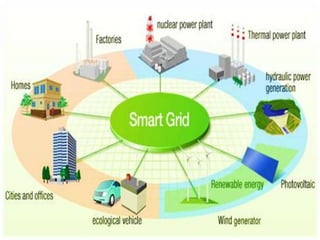
INTRODUCTION OF SMART GRID
ELECTRIC GRID + IT = SMART GRID
• The smart grid involves the application of digital
technologies and information management
practices and is a core ingredient in the ongoing
modernization of the electricity delivery
infrastructure. The rate of smart grid technology
adoption varies across the nation and depends
largely on state policies, incentives, and
technology experience levels.
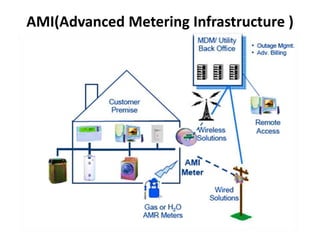
AMI(Advanced Metering Infrastructure )
• Advance metering is a metering system which
record the customer power consumption aloe
with other hourly, the measured data fastly
over communication network to a central
collection point.
AMI(Advanced Metering Infrastructure )
BENEFITS
• Anti theft.
• Two way communication.
• Real time and Automatic billing.
• Improved billing and customer support
operations.
• Improved outage management from meters
that alert utilities when customers lose power.
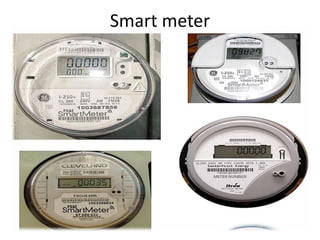
Definition of Smart Meter
• Smart is a new kind of energy meter. This next
generation of meter are a replacement for
your existing meter and send electronics
meter reading to your energy supplier
automatically.
• There are both gas and electricity smart
meters.
Smart meter
BENEFITS
• Distribution automation system.
• Energy management system.
• Intelligent network system.
• Demand side management system
• Grid modeling, simulation and design system.
Smart Meter Technologies
• The Smart Meters collect data locally and transmit
via a Local Area Network (LAN) to a data collector.
This transmission can occur as often as 15 minutes or
as infrequently as daily according to the use of the
data.
• The collector retrieves the data and may or may not
carry out any processing of the data.
• Data is transmitted via a Wide Area Network (WAN)
to the utility central collection point for processing .
• Since the communications path is two -way
Basic Types of Smart Meter Systems
There are two basic categories of Smart Meter
System technologies as defined by their LAN.
 Radio Frequency (RF).
 Power Line Carrier (PLC).
Radio Frequency (RF)
Smart Meter measurements and other data are transmitted
by wireless radio from the meter to a collection point. The
data is then delivered by various methods to the utility data
systems for processing at a central location.
 There are different method of Radio Frequency (RF).
1.Mesh Technology
The smart meters talk to each other to form a LAN cloud to a
collector.
2.Point to Point Technology
The smart meters talk directly to a collector, usually a tower. The tower
collector transmits
Power Line Carrier - PLC
 Smart Meter measurements and other data can
be transmitted across the utility power lines from
the meter to a collection point, usually in the
distribution substation feeding the meter. Some
solutions have the collection point located on the
secondary side of a distribution transformer. The
data is then delivered to the utility data systems
for processing at a central location. The utility
billing, outage management, and other systems
use the data for operational purposes
Smart Meter Installation
 The planning for the installation of Smart Meters is just
as important as the actual installation itself.
 Different organization which install smart meter.
I. The National Electric Safety Code (NESC) for utility
wiring.
II. The National Electric Code (NEC) for home wiring.
III. ASNI C12.1 – Code for Electricity Metering.
Smart energy metering system

Smart energy metering system

  • 1.
    Table of Contents 1.Introduction of Smart Grid. 2. Advanced Metering Infrastructure (AMI). 2.1 Benefits. 3. Smart Meters. 3.1 Definition of Smart Meter 3.2 Smart Meter Benefits. 4. Smart Meter Technologies. 4.1 Basic Types of Smart Meter Systems. 4.3 Power Line Carrier – PLC. 5. Smart Meter Installation.
  • 2.
    INTRODUCTION OF SMARTGRID ELECTRIC GRID + IT = SMART GRID • The smart grid involves the application of digital technologies and information management practices and is a core ingredient in the ongoing modernization of the electricity delivery infrastructure. The rate of smart grid technology adoption varies across the nation and depends largely on state policies, incentives, and technology experience levels.
  • 4.
    AMI(Advanced Metering Infrastructure) • Advance metering is a metering system which record the customer power consumption aloe with other hourly, the measured data fastly over communication network to a central collection point.
  • 5.
  • 6.
    BENEFITS • Anti theft. •Two way communication. • Real time and Automatic billing. • Improved billing and customer support operations. • Improved outage management from meters that alert utilities when customers lose power.
  • 7.
    Definition of SmartMeter • Smart is a new kind of energy meter. This next generation of meter are a replacement for your existing meter and send electronics meter reading to your energy supplier automatically. • There are both gas and electricity smart meters.
  • 8.
  • 9.
    BENEFITS • Distribution automationsystem. • Energy management system. • Intelligent network system. • Demand side management system • Grid modeling, simulation and design system.
  • 10.
    Smart Meter Technologies •The Smart Meters collect data locally and transmit via a Local Area Network (LAN) to a data collector. This transmission can occur as often as 15 minutes or as infrequently as daily according to the use of the data. • The collector retrieves the data and may or may not carry out any processing of the data. • Data is transmitted via a Wide Area Network (WAN) to the utility central collection point for processing . • Since the communications path is two -way
  • 12.
    Basic Types ofSmart Meter Systems There are two basic categories of Smart Meter System technologies as defined by their LAN.  Radio Frequency (RF).  Power Line Carrier (PLC).
  • 13.
    Radio Frequency (RF) SmartMeter measurements and other data are transmitted by wireless radio from the meter to a collection point. The data is then delivered by various methods to the utility data systems for processing at a central location.  There are different method of Radio Frequency (RF). 1.Mesh Technology The smart meters talk to each other to form a LAN cloud to a collector. 2.Point to Point Technology The smart meters talk directly to a collector, usually a tower. The tower collector transmits
  • 14.
    Power Line Carrier- PLC  Smart Meter measurements and other data can be transmitted across the utility power lines from the meter to a collection point, usually in the distribution substation feeding the meter. Some solutions have the collection point located on the secondary side of a distribution transformer. The data is then delivered to the utility data systems for processing at a central location. The utility billing, outage management, and other systems use the data for operational purposes
  • 15.
    Smart Meter Installation The planning for the installation of Smart Meters is just as important as the actual installation itself.  Different organization which install smart meter. I. The National Electric Safety Code (NESC) for utility wiring. II. The National Electric Code (NEC) for home wiring. III. ASNI C12.1 – Code for Electricity Metering.