IOSR Journal of Electronics and Communication Engineering (IOSR-JECE)
e-ISSN: 2278-2834,p- ISSN: 2278-8735.Volume 6, Issue 4 (May. - Jun. 2013), PP 07-11
www.iosrjournals.org
www.iosrjournals.org 7 | Page
Design of Ota-C Filter for Biomedical Applications
CH. D. Mounika 1, CH. Susmitha 2
1.(ECE,K L UNIVERSITY, INDIA),2.(EEE,RVR JC COLLEGE,INDIA)
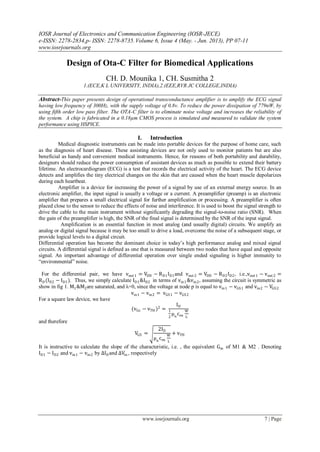
Abstract-This paper presents design of operational transconductance amplifier is to amplify the ECG signal
having low frequency of 300Hz, with the supply voltage of 0.8v. To reduce the power dissipation of 779nW, by
using fifth order low pass filter. The OTA-C filter is to eliminate noise voltage and increases the reliability of
the system. A chip is fabricated in a 0.18µm CMOS process is simulated and measured to validate the system
performance using HSPICE.
I. Introduction
Medical diagnostic instruments can be made into portable devices for the purpose of home care, such
as the diagnosis of heart disease. These assisting devices are not only used to monitor patients but are also
beneficial as handy and convenient medical instruments. Hence, for reasons of both portability and durability,
designers should reduce the power consumption of assistant devices as much as possible to extend their battery
lifetime. An electrocardiogram (ECG) is a test that records the electrical activity of the heart. The ECG device
detects and amplifies the tiny electrical changes on the skin that are caused when the heart muscle depolarizes
during each heartbeat.
Amplifier is a device for increasing the power of a signal by use of an external energy source. In an
electronic amplifier, the input signal is usually a voltage or a current. A preamplifier (preamp) is an electronic
amplifier that prepares a small electrical signal for further amplification or processing. A preamplifier is often
placed close to the sensor to reduce the effects of noise and interference. It is used to boost the signal strength to
drive the cable to the main instrument without significantly degrading the signal-to-noise ratio (SNR). When
the gain of the preamplifier is high, the SNR of the final signal is determined by the SNR of the input signal.
Amplification is an essential function in most analog (and usually digital) circuits. We amplify an
analog or digital signal because it may be too small to drive a load, overcome the noise of a subsequent stage, or
provide logical levels to a digital circuit.
Differential operation has become the dominant choice in today’s high performance analog and mixed signal
circuits. A differential signal is defined as one that is measured between two nodes that have equal and opposite
signal. An important advantage of differential operation over single ended signaling is higher immunity to
“environmental” noise.
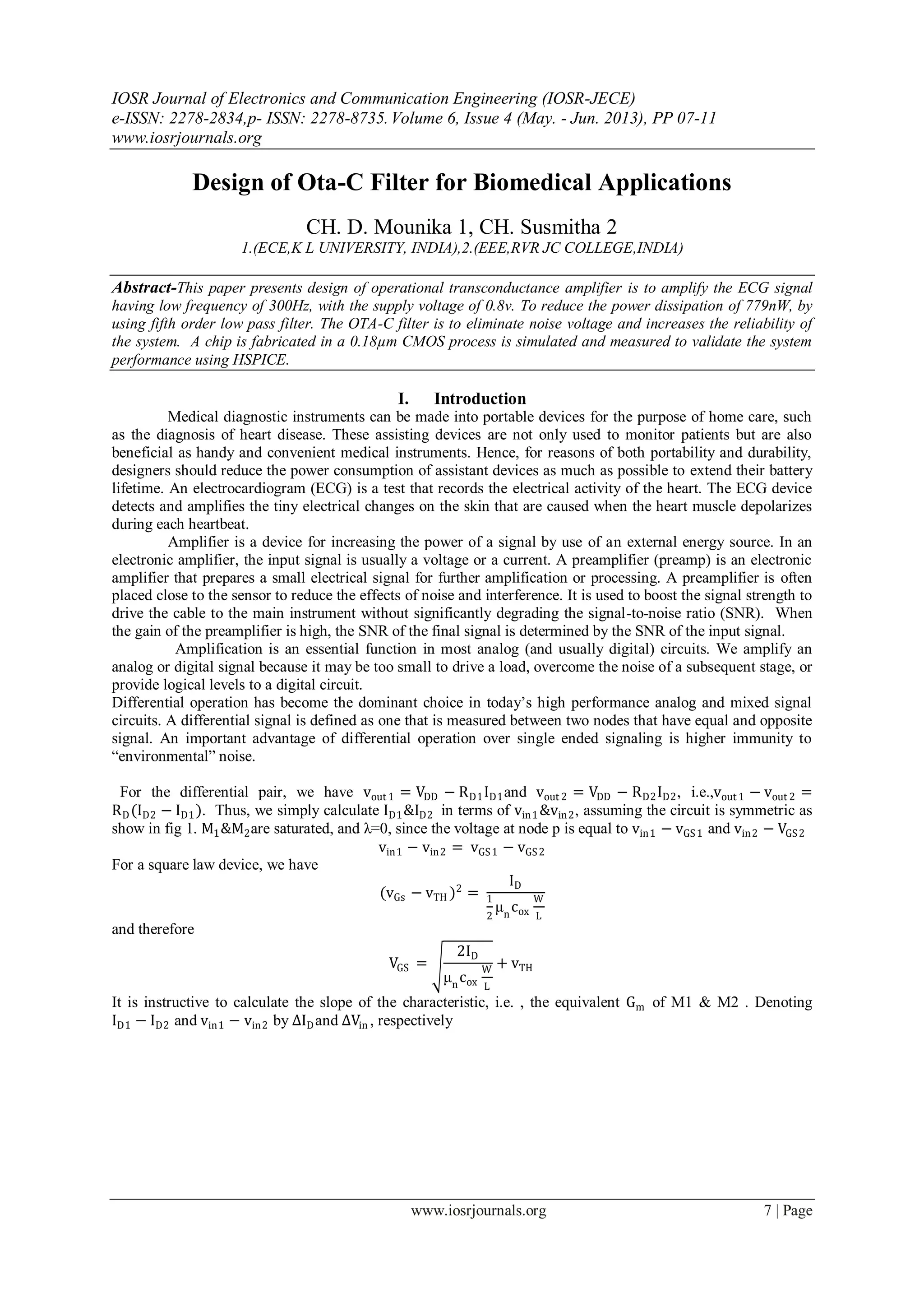
For the differential pair, we have vout 1 = VDD − RD1ID1and vout 2 = VDD − RD2ID2, i.e.,vout 1 − vout 2 =
RD(ID2 − ID1). Thus, we simply calculate ID1&ID2 in terms of vin1&vin2, assuming the circuit is symmetric as
show in fig 1. M1&M2are saturated, and λ=0, since the voltage at node p is equal to vin1 − vGS1 and vin2 − VGS2
vin1 − vin2 = vGS1 − vGS2
For a square law device, we have
(vGs − vTH )2
=
ID
1
2
μn
cox
W
L
and therefore
VGS =
2ID
μn
cox
W
L
+ vTH
It is instructive to calculate the slope of the characteristic, i.e. , the equivalent Gm of M1 & M2 . Denoting
ID1 − ID2 and vin1 − vin2 by ∆IDand ∆Vin , respectively
Design Of Ota-C Filter For Biomedical Applications
www.iosrjournals.org 8 | Page
Fig. 1 Differential Amplifier with source degeneration
The small signal differential voltage gain of the circuit in the equilibrium condition as
Av = μn
cox
W
L
ISS RD
Where 𝜇 𝑛 = mobility of electrons; 𝑐 𝑜𝑥 = oxide capacitance
Source degeneration- In some applications, the square law dependence of the drain current upon the gate
overdrive voltage Introduces excessive non-linearity, 𝑅𝑆 “smoothest” this effect since it takes a portion of the
gate overdrive voltage. At the limit, for 𝑅𝑆 ≫
1
𝑔 𝑚
, the small signal does not depend on 𝑔 𝑚 (and therefore on 𝐼 𝐷𝑠)
anymore.
It is interesting to note that the approximated small signal gain (which can be easily calculated with the small
signal equivalent circuit) can also be calculated as if 𝑅𝑆 and
1
𝑔 𝑚
were two resistors in series.
Small signal gain is
G = −
gm
1 + gm RS
RD
We can see the circuit as two common source stages with degenerated resistor, and superimpose the effects.
Or, even better, we can realize that the point P is (ideally) Ac grounded
vout 1 = −gm RDvin1
vout 2 = −gm RDvin2
vout 1 − vout 2 = −gm RD(vin1 − vin2)
We have seen that ideally in a differential pair the output voltage does not depend on the common mode input
voltage. But in fact the non-infinite output impedance of the current source has an influence, since the point P
does not behave as an AC ground anymore. The symmetry in this circuit suggests that we can see it as two
identical half circuits in parallel.
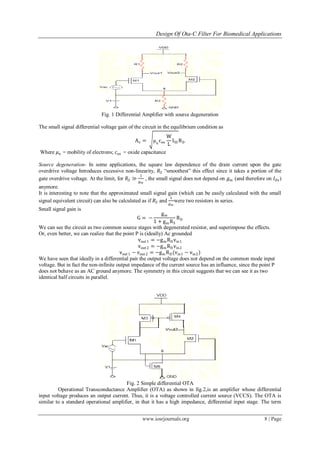
Fig. 2 Simple differential OTA
Operational Transconductance Amplifier (OTA) as shown in fig.2,is an amplifier whose differential
input voltage produces an output current. Thus, it is a voltage controlled current source (VCCS). The OTA is
similar to a standard operational amplifier, in that it has a high impedance, differential input stage. The term
Design Of Ota-C Filter For Biomedical Applications
www.iosrjournals.org 9 | Page
“operational” comes from the fact that it takes the difference of two voltages as the input for the current
conversion.
The ideal transfer characteristics is
Iout = gm (vin+ − vin−)
Or by taking the pre-computed difference as the input
Iout = gm vin
With the ideally constant transconductancegm as the proportionality factor between the two. In reality
the transconductance is a function of the input differential voltage and dependent on temperature. The common
mode input range is also infinite, while the differential signal between these two inputs is used to control an
ideal current source (i.e. the output current does not depend on the output voltage) that functions as an output.
The proportionality factor between output current and input differential voltage is called “Transconductance”.
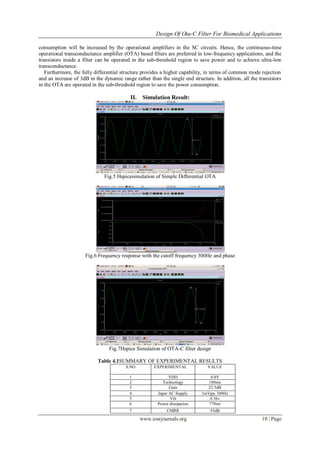
A differential sinusoidal wave with a magnitude of 1mVpp is fed into the chip to measure the frequency
response and the power spectrum with an input frequency of 50Hz. A low pass filter is an electronic filter that
passes low frequency signals, but attenuates signals with frequencies higher than the cut-off frequency.
A fully balanced fifth-order chebyshev low pass filter, which has a 300Hz cut-off frequency and 779nw power
dissipation, is designed by the RC simulation method. The order is equal to the number of reactive components
used in the network.
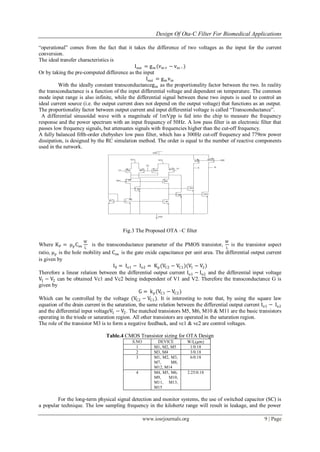
Fig.3 The Proposed OTA –C filter
Where KP = μP
Cox
W
L
is the transconductance parameter of the PMOS transistor,
W
L
is the transistor aspect
ratio, μP
is the hole mobility and Cox is the gate oxide capacitance per unit area. The differential output current
is given by
I0 = Io1 − Io2 = Kp(VC2 − VC1)(V1 − V2)
Therefore a linear relation between the differential output current Io1 − Io2 and the differential input voltage
V1 − V2 can be obtained Vc1 and Vc2 being independent of V1 and V2. Therefore the transconductance G is
given by
G = kp(VC1 − VC2)
Which can be controlled by the voltage (VC2 − VC1). It is interesting to note that, by using the square law
equation of the drain current in the saturation, the same relation between the differential output current Io1 − Io2
and the differential input voltageV1 − V2. The matched transistors M5, M6, M10 & M11 are the basic transistors
operating in the triode or saturation region. All other transistors are operated in the saturation region.
The role of the transistor M3 is to form a negative feedback, and vc1 & vc2 are control voltages.
Table.4 CMOS Transistor sizing for OTA Design
S.NO DEVICE W/L(𝜇𝑚)
1 M1, M2, M5 1/0.18
2 M3, M4 3/0.18
3 M1, M2, M3,
M7, M8,
M12, M14
6/0.18
4 M4, M5, M6,
M9, M10,
M11, M13,
M15
2.25/0.18
For the long-term physical signal detection and monitor systems, the use of switched capacitor (SC) is
a popular technique. The low sampling frequency in the kilohertz range will result in leakage, and the power
Design Of Ota-C Filter For Biomedical Applications
www.iosrjournals.org 10 | Page
consumption will be increased by the operational amplifiers in the SC circuits. Hence, the continuous-time
operational transconductance amplifier (OTA) based filters are preferred in low-frequency applications, and the
transistors inside a filter can be operated in the sub-threshold region to save power and to achieve ultra-low
transconductance.
Furthermore, the fully differential structure provides a higher capability, in terms of common mode rejection
and an increase of 3dB in the dynamic range rather than the single end structure. In addition, all the transistors
in the OTA are operated in the sub-threshold region to save the power consumption.
II. Simulation Result:
Fig.5 Hspicesimulation of Simple Differential OTA
Fig.6 Frequency response with the cutoff frequency 300Hz and phase
Fig.7Hspice Simulation of OTA-C filter design
Table 4.1SUMMARY OF EXPERIMENTAL RESULTS
S.NO EXPERIMENTAL VALUE
1 VDD 0.8V
2 Technology 180nm
3 Gain 22.5dB
4 Input AC Supply 1mVpp, 300Hz
5 Vth 0.36v
6 Power dissipation 779nw
7 CMRR 93dB
Design Of Ota-C Filter For Biomedical Applications
www.iosrjournals.org 11 | Page
III. Conclusion
In this paper, we present “Design of OTA-C Filter for Biomedical Applications”. This method of
building block in SYNOPSYS Hspice tool. By the implementation of a low pass filter with a generic 0.18um
CMOS technology, some significant issues of the intrinsic properties of a real OTA, such as noise reduction and
finite gain. The proposed block and their application have been confirmed using Hspice simulation.
References
[1] Razavi, Behzad “Design of analog CMOS Integrated Circuits.”
[2] R.Jacob Baker, Harry W.Li and David E.Boyce, “CMOS Circuit Design, Layout andSimulation.”
[3] Mohamed O. Shaker , Sollman A. Mahmoud, Ahmed A. Sollman, “A CMOS Fifth-Order Low -Pass Current- Mode Filter Using a
Linear Transconductor.”
[4] KimmoLasanen, “Integrated analogue cmos circuits and structures for heart rate detectors and others low-voltage, low power
applications.”
[5] S. Koziel and S. Szczepanski, “Designof highly linear tunable CMOS-OTA for continuous-time filters.”
[6] “Star-HSPICE User’s Manual,” Avanti! Corp..Fremont. CA. Jun.2002, Release 2002.2.
[7] K.R. Laker and W.M.C. Sansen, Design of Analog Integrated Circuits and Systems. New York: McGraw-Hill. 1994

Design of Ota-C Filter for Biomedical Applications

  • 1.
    IOSR Journal ofElectronics and Communication Engineering (IOSR-JECE) e-ISSN: 2278-2834,p- ISSN: 2278-8735.Volume 6, Issue 4 (May. - Jun. 2013), PP 07-11 www.iosrjournals.org www.iosrjournals.org 7 | Page Design of Ota-C Filter for Biomedical Applications CH. D. Mounika 1, CH. Susmitha 2 1.(ECE,K L UNIVERSITY, INDIA),2.(EEE,RVR JC COLLEGE,INDIA) Abstract-This paper presents design of operational transconductance amplifier is to amplify the ECG signal having low frequency of 300Hz, with the supply voltage of 0.8v. To reduce the power dissipation of 779nW, by using fifth order low pass filter. The OTA-C filter is to eliminate noise voltage and increases the reliability of the system. A chip is fabricated in a 0.18µm CMOS process is simulated and measured to validate the system performance using HSPICE. I. Introduction Medical diagnostic instruments can be made into portable devices for the purpose of home care, such as the diagnosis of heart disease. These assisting devices are not only used to monitor patients but are also beneficial as handy and convenient medical instruments. Hence, for reasons of both portability and durability, designers should reduce the power consumption of assistant devices as much as possible to extend their battery lifetime. An electrocardiogram (ECG) is a test that records the electrical activity of the heart. The ECG device detects and amplifies the tiny electrical changes on the skin that are caused when the heart muscle depolarizes during each heartbeat. Amplifier is a device for increasing the power of a signal by use of an external energy source. In an electronic amplifier, the input signal is usually a voltage or a current. A preamplifier (preamp) is an electronic amplifier that prepares a small electrical signal for further amplification or processing. A preamplifier is often placed close to the sensor to reduce the effects of noise and interference. It is used to boost the signal strength to drive the cable to the main instrument without significantly degrading the signal-to-noise ratio (SNR). When the gain of the preamplifier is high, the SNR of the final signal is determined by the SNR of the input signal. Amplification is an essential function in most analog (and usually digital) circuits. We amplify an analog or digital signal because it may be too small to drive a load, overcome the noise of a subsequent stage, or provide logical levels to a digital circuit. Differential operation has become the dominant choice in today’s high performance analog and mixed signal circuits. A differential signal is defined as one that is measured between two nodes that have equal and opposite signal. An important advantage of differential operation over single ended signaling is higher immunity to “environmental” noise. For the differential pair, we have vout 1 = VDD − RD1ID1and vout 2 = VDD − RD2ID2, i.e.,vout 1 − vout 2 = RD(ID2 − ID1). Thus, we simply calculate ID1&ID2 in terms of vin1&vin2, assuming the circuit is symmetric as show in fig 1. M1&M2are saturated, and λ=0, since the voltage at node p is equal to vin1 − vGS1 and vin2 − VGS2 vin1 − vin2 = vGS1 − vGS2 For a square law device, we have (vGs − vTH )2 = ID 1 2 μn cox W L and therefore VGS = 2ID μn cox W L + vTH It is instructive to calculate the slope of the characteristic, i.e. , the equivalent Gm of M1 & M2 . Denoting ID1 − ID2 and vin1 − vin2 by ∆IDand ∆Vin , respectively
  • 2.
    Design Of Ota-CFilter For Biomedical Applications www.iosrjournals.org 8 | Page Fig. 1 Differential Amplifier with source degeneration The small signal differential voltage gain of the circuit in the equilibrium condition as Av = μn cox W L ISS RD Where 𝜇 𝑛 = mobility of electrons; 𝑐 𝑜𝑥 = oxide capacitance Source degeneration- In some applications, the square law dependence of the drain current upon the gate overdrive voltage Introduces excessive non-linearity, 𝑅𝑆 “smoothest” this effect since it takes a portion of the gate overdrive voltage. At the limit, for 𝑅𝑆 ≫ 1 𝑔 𝑚 , the small signal does not depend on 𝑔 𝑚 (and therefore on 𝐼 𝐷𝑠) anymore. It is interesting to note that the approximated small signal gain (which can be easily calculated with the small signal equivalent circuit) can also be calculated as if 𝑅𝑆 and 1 𝑔 𝑚 were two resistors in series. Small signal gain is G = − gm 1 + gm RS RD We can see the circuit as two common source stages with degenerated resistor, and superimpose the effects. Or, even better, we can realize that the point P is (ideally) Ac grounded vout 1 = −gm RDvin1 vout 2 = −gm RDvin2 vout 1 − vout 2 = −gm RD(vin1 − vin2) We have seen that ideally in a differential pair the output voltage does not depend on the common mode input voltage. But in fact the non-infinite output impedance of the current source has an influence, since the point P does not behave as an AC ground anymore. The symmetry in this circuit suggests that we can see it as two identical half circuits in parallel. Fig. 2 Simple differential OTA Operational Transconductance Amplifier (OTA) as shown in fig.2,is an amplifier whose differential input voltage produces an output current. Thus, it is a voltage controlled current source (VCCS). The OTA is similar to a standard operational amplifier, in that it has a high impedance, differential input stage. The term
  • 3.
    Design Of Ota-CFilter For Biomedical Applications www.iosrjournals.org 9 | Page “operational” comes from the fact that it takes the difference of two voltages as the input for the current conversion. The ideal transfer characteristics is Iout = gm (vin+ − vin−) Or by taking the pre-computed difference as the input Iout = gm vin With the ideally constant transconductancegm as the proportionality factor between the two. In reality the transconductance is a function of the input differential voltage and dependent on temperature. The common mode input range is also infinite, while the differential signal between these two inputs is used to control an ideal current source (i.e. the output current does not depend on the output voltage) that functions as an output. The proportionality factor between output current and input differential voltage is called “Transconductance”. A differential sinusoidal wave with a magnitude of 1mVpp is fed into the chip to measure the frequency response and the power spectrum with an input frequency of 50Hz. A low pass filter is an electronic filter that passes low frequency signals, but attenuates signals with frequencies higher than the cut-off frequency. A fully balanced fifth-order chebyshev low pass filter, which has a 300Hz cut-off frequency and 779nw power dissipation, is designed by the RC simulation method. The order is equal to the number of reactive components used in the network. Fig.3 The Proposed OTA –C filter Where KP = μP Cox W L is the transconductance parameter of the PMOS transistor, W L is the transistor aspect ratio, μP is the hole mobility and Cox is the gate oxide capacitance per unit area. The differential output current is given by I0 = Io1 − Io2 = Kp(VC2 − VC1)(V1 − V2) Therefore a linear relation between the differential output current Io1 − Io2 and the differential input voltage V1 − V2 can be obtained Vc1 and Vc2 being independent of V1 and V2. Therefore the transconductance G is given by G = kp(VC1 − VC2) Which can be controlled by the voltage (VC2 − VC1). It is interesting to note that, by using the square law equation of the drain current in the saturation, the same relation between the differential output current Io1 − Io2 and the differential input voltageV1 − V2. The matched transistors M5, M6, M10 & M11 are the basic transistors operating in the triode or saturation region. All other transistors are operated in the saturation region. The role of the transistor M3 is to form a negative feedback, and vc1 & vc2 are control voltages. Table.4 CMOS Transistor sizing for OTA Design S.NO DEVICE W/L(𝜇𝑚) 1 M1, M2, M5 1/0.18 2 M3, M4 3/0.18 3 M1, M2, M3, M7, M8, M12, M14 6/0.18 4 M4, M5, M6, M9, M10, M11, M13, M15 2.25/0.18 For the long-term physical signal detection and monitor systems, the use of switched capacitor (SC) is a popular technique. The low sampling frequency in the kilohertz range will result in leakage, and the power
  • 4.
    Design Of Ota-CFilter For Biomedical Applications www.iosrjournals.org 10 | Page consumption will be increased by the operational amplifiers in the SC circuits. Hence, the continuous-time operational transconductance amplifier (OTA) based filters are preferred in low-frequency applications, and the transistors inside a filter can be operated in the sub-threshold region to save power and to achieve ultra-low transconductance. Furthermore, the fully differential structure provides a higher capability, in terms of common mode rejection and an increase of 3dB in the dynamic range rather than the single end structure. In addition, all the transistors in the OTA are operated in the sub-threshold region to save the power consumption. II. Simulation Result: Fig.5 Hspicesimulation of Simple Differential OTA Fig.6 Frequency response with the cutoff frequency 300Hz and phase Fig.7Hspice Simulation of OTA-C filter design Table 4.1SUMMARY OF EXPERIMENTAL RESULTS S.NO EXPERIMENTAL VALUE 1 VDD 0.8V 2 Technology 180nm 3 Gain 22.5dB 4 Input AC Supply 1mVpp, 300Hz 5 Vth 0.36v 6 Power dissipation 779nw 7 CMRR 93dB
  • 5.
    Design Of Ota-CFilter For Biomedical Applications www.iosrjournals.org 11 | Page III. Conclusion In this paper, we present “Design of OTA-C Filter for Biomedical Applications”. This method of building block in SYNOPSYS Hspice tool. By the implementation of a low pass filter with a generic 0.18um CMOS technology, some significant issues of the intrinsic properties of a real OTA, such as noise reduction and finite gain. The proposed block and their application have been confirmed using Hspice simulation. References [1] Razavi, Behzad “Design of analog CMOS Integrated Circuits.” [2] R.Jacob Baker, Harry W.Li and David E.Boyce, “CMOS Circuit Design, Layout andSimulation.” [3] Mohamed O. Shaker , Sollman A. Mahmoud, Ahmed A. Sollman, “A CMOS Fifth-Order Low -Pass Current- Mode Filter Using a Linear Transconductor.” [4] KimmoLasanen, “Integrated analogue cmos circuits and structures for heart rate detectors and others low-voltage, low power applications.” [5] S. Koziel and S. Szczepanski, “Designof highly linear tunable CMOS-OTA for continuous-time filters.” [6] “Star-HSPICE User’s Manual,” Avanti! Corp..Fremont. CA. Jun.2002, Release 2002.2. [7] K.R. Laker and W.M.C. Sansen, Design of Analog Integrated Circuits and Systems. New York: McGraw-Hill. 1994