
OPTICAL FIBER
COMMUNICATION
BY SREE NARAYAN CHAKRABORTY
NOAKHALI SCIENCE & TECHNOLOGY UNIVERSITY
OPTICAL FIBER COMMUNICATION
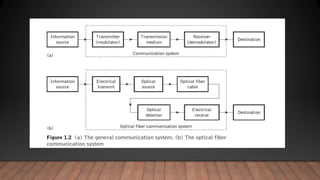
• Optical Fiber Communication is a method of transmitting information from
one place to another by sending light through an optical fiber.
• The light forms an electromagnetic carrier wave that is modulated to carry
information.
WHAT IS OPTICAL FIBER?
• An optical fiber (or fibre) is a glass or plastic fiber that carries light along
its length.
• It consists of a core and cladding that surrounds the core
• A light-emitting diode (LED) or laser diode (LD) can be used for the source
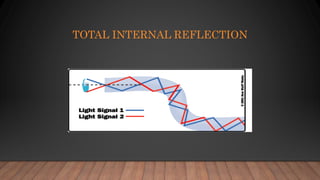
• Light is kept in the "core" of the optical fiber by total internal reflection.
• The index of refraction of the cladding is less than that of the core, causing
rays of light leaving the core to be refracted back into the core
TOTAL INTERNAL REFLECTION
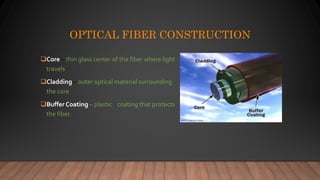
OPTICAL FIBER CONSTRUCTION
Core – thin glass center of the fiber where light
travels.
Cladding – outer optical material surrounding
the core
Buffer Coating – plastic coating that protects
the fiber.
ADVANTAGES OF OPTICAL FIBER:
 Thinner
 Less Expensive :The glass which generally provides the optical fiber transmission
medium is made from sand – not a scarce resource.
 Greater bandwidth than copper:
The optical carrier frequency in the range 10^13 to
10^16 Hz . Thousands of channels can be multiplexed together over one strandard of fiber.
 Safety – Doesn’t transmit electrical signals, making it safe in environments like a gas pipeline.
 Small size and weight. Optical fibers have very small diameters which are often
no greater than the diameter of a human hair. Hence, even when such fibers are covered
with protective coatings they are far smaller and much lighter than corresponding copper
cables.
 Lower loss- Repeaters can be spaced 75 miles apart (fibers can be made to have only 0.2
dB/km of attenuation)
 High Security - Impossible to “tap into.”
 Less Signal Degradation& Digital Signals
 Light Signals
 Immunity to crosstalk:Optical fibers form a dielectric waveguide
and are therefore free from electromagnetic interference (EMI), radio-frequency
interference(RFI) or EMPs.
 Ruggedness and flexibility.
DISADVANTAGES
Disadvantages include the cost of interfacing equipment necessary to
convert electrical signals to optical signals. (optical transmitters, receivers)
Splicing fiber optic cable is also more difficult.
expensive over short distance
requires highly skilled installers
adding additional nodes is difficult
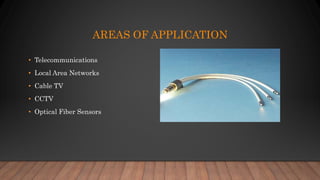
AREAS OF APPLICATION
• Telecommunications
• Local Area Networks
• Cable TV
• CCTV
• Optical Fiber Sensors
CATEGORIES OF OPTICAL FIBER
Two main categories of optical fiber used in fiber optic communications are
multi-mode optical fiber and single-mode optical fiber.
1. Single-mode fibers – used to transmit one signal per fiber (used in
telephone and cable TV). They have small cores(9 microns in diameter)
and transmit infra-red light from laser.
2. Multi-mode fibers – used to transmit many signals per fiber (used in
computer networks). They have larger cores(62.5 microns in diameter)
and transmit infra-red light from LED.
INDEX PROFILE
1. step-index fiber has a central core with a uniform refractive index. An
outside cladding that also has a uniform refractive index surrounds the core;
however, the refractive index of the cladding is less than that of the central
core.
2. graded-index fiber, the index of refraction in the core decreases continuously
between the axis and the cladding. This causes light rays to bend smoothly
as they approach the cladding, rather than reflecting abruptly from the core-
cladding boundary
Optical Fiber Communication

Optical Fiber Communication

  • 1.
    OPTICAL FIBER COMMUNICATION BY SREENARAYAN CHAKRABORTY NOAKHALI SCIENCE & TECHNOLOGY UNIVERSITY
  • 2.
    OPTICAL FIBER COMMUNICATION •Optical Fiber Communication is a method of transmitting information from one place to another by sending light through an optical fiber. • The light forms an electromagnetic carrier wave that is modulated to carry information.
  • 3.
    WHAT IS OPTICALFIBER? • An optical fiber (or fibre) is a glass or plastic fiber that carries light along its length. • It consists of a core and cladding that surrounds the core • A light-emitting diode (LED) or laser diode (LD) can be used for the source • Light is kept in the "core" of the optical fiber by total internal reflection. • The index of refraction of the cladding is less than that of the core, causing rays of light leaving the core to be refracted back into the core
  • 4.
  • 5.
    OPTICAL FIBER CONSTRUCTION Core– thin glass center of the fiber where light travels. Cladding – outer optical material surrounding the core Buffer Coating – plastic coating that protects the fiber.
  • 7.
    ADVANTAGES OF OPTICALFIBER:  Thinner  Less Expensive :The glass which generally provides the optical fiber transmission medium is made from sand – not a scarce resource.  Greater bandwidth than copper: The optical carrier frequency in the range 10^13 to 10^16 Hz . Thousands of channels can be multiplexed together over one strandard of fiber.  Safety – Doesn’t transmit electrical signals, making it safe in environments like a gas pipeline.  Small size and weight. Optical fibers have very small diameters which are often no greater than the diameter of a human hair. Hence, even when such fibers are covered with protective coatings they are far smaller and much lighter than corresponding copper cables.
  • 8.
     Lower loss-Repeaters can be spaced 75 miles apart (fibers can be made to have only 0.2 dB/km of attenuation)  High Security - Impossible to “tap into.”  Less Signal Degradation& Digital Signals  Light Signals  Immunity to crosstalk:Optical fibers form a dielectric waveguide and are therefore free from electromagnetic interference (EMI), radio-frequency interference(RFI) or EMPs.  Ruggedness and flexibility.
  • 9.
    DISADVANTAGES Disadvantages include thecost of interfacing equipment necessary to convert electrical signals to optical signals. (optical transmitters, receivers) Splicing fiber optic cable is also more difficult. expensive over short distance requires highly skilled installers adding additional nodes is difficult
  • 10.
    AREAS OF APPLICATION •Telecommunications • Local Area Networks • Cable TV • CCTV • Optical Fiber Sensors
  • 11.
    CATEGORIES OF OPTICALFIBER Two main categories of optical fiber used in fiber optic communications are multi-mode optical fiber and single-mode optical fiber. 1. Single-mode fibers – used to transmit one signal per fiber (used in telephone and cable TV). They have small cores(9 microns in diameter) and transmit infra-red light from laser. 2. Multi-mode fibers – used to transmit many signals per fiber (used in computer networks). They have larger cores(62.5 microns in diameter) and transmit infra-red light from LED.
  • 12.
    INDEX PROFILE 1. step-indexfiber has a central core with a uniform refractive index. An outside cladding that also has a uniform refractive index surrounds the core; however, the refractive index of the cladding is less than that of the central core. 2. graded-index fiber, the index of refraction in the core decreases continuously between the axis and the cladding. This causes light rays to bend smoothly as they approach the cladding, rather than reflecting abruptly from the core- cladding boundary