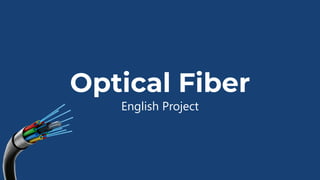
Optical Fiber
English Project
About us
Abdessalam BENHARIRA Laurent PANEK
Summary
1. What is optical fiber ?
2. How it works ?
3. Different types
4. Uses
5. Advantages and disadvantages
6. Conclusion
1
1. What is optical fiber ?
Definition
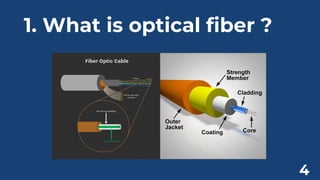
A technology that uses glass (or plastic) threads (fibers)
to transmit data. A fiber optic cable consists of a bundle
of glass threads, each of which is capable
of transmitting messages modulated onto light waves
2
1. What is optical fiber ?
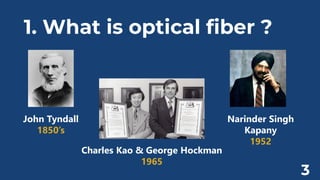
John Tyndall
1850’s
Charles Kao & George Hockman
1965
Narinder Singh
Kapany
1952
3
1. What is optical fiber ?
4
2. How it works ?
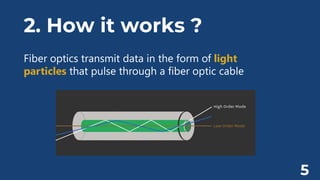
Fiber optics transmit data in the form of light
particles that pulse through a fiber optic cable
5
3. Different types
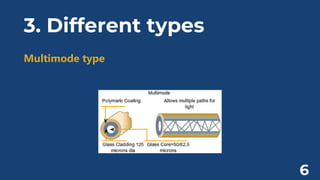
Multimode type
6
3. Different types
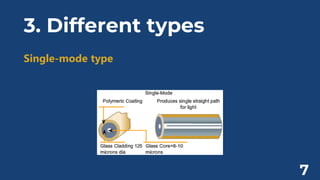
Single-mode type
7
3. Different types
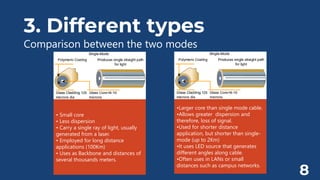
Comparison between the two modes
• Small core
• Less dispersion
• Carry a single ray of light, usually
generated from a laser.
• Employed for long distance
applications (100Km)
• Uses as Backbone and distances of
several thousands meters.
•Larger core than single mode cable.
•Allows greater dispersion and
therefore, loss of signal.
•Used for shorter distance
application, but shorter than single-
mode (up to 2Km)
•It uses LED source that generates
different angles along cable.
•Often uses in LANs or small
distances such as campus networks.
8
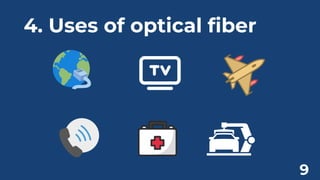
4. Uses of optical fiber
9
5. Advantages & disadvantages
Advantages
•Extremely High Bandwidth
•Longer Distance
•Resistance to Electromagnetic Interference
•Low Security Risk
•Small Size
•Light Weight
•Easy to Accommodate Increasing Bandwidth
10
5. Advantages & disadvantages
Disadvantages
•Fragility
•Difficult to Install
•Cost Is Higher Than Copper Cable
•Special Equipment Is Often Required
11
Conclusion
Overall, optical fiber, which is nowadays use worldwide, brought
several important improvements to data transmission.
However, its high cost seems to be the only brake to its
deployment.
Moreover, optical fiber is still to its beginning, many
improvements are in R&D (research and developement) proceed.
Our data will be faster than ever.
12
References
•Techtarget.com
[http://searchtelecom.techtarget.com/definition/optical-fiber]
•Computer HowStuffWorks
[https://computer.howstuffworks.com/fiber-optic4.htm]
•ARC Electronics [https://www.arcelect.com/fibercable.htm]
13
Thank you !

Optical fiber (Fiber Optics)

  • 1.
  • 2.
  • 3.
    Summary 1. What isoptical fiber ? 2. How it works ? 3. Different types 4. Uses 5. Advantages and disadvantages 6. Conclusion 1
  • 4.
    1. What isoptical fiber ? Definition A technology that uses glass (or plastic) threads (fibers) to transmit data. A fiber optic cable consists of a bundle of glass threads, each of which is capable of transmitting messages modulated onto light waves 2
  • 5.
    1. What isoptical fiber ? John Tyndall 1850’s Charles Kao & George Hockman 1965 Narinder Singh Kapany 1952 3
  • 6.
    1. What isoptical fiber ? 4
  • 7.
    2. How itworks ? Fiber optics transmit data in the form of light particles that pulse through a fiber optic cable 5
  • 8.
  • 9.
  • 10.
    3. Different types Comparisonbetween the two modes • Small core • Less dispersion • Carry a single ray of light, usually generated from a laser. • Employed for long distance applications (100Km) • Uses as Backbone and distances of several thousands meters. •Larger core than single mode cable. •Allows greater dispersion and therefore, loss of signal. •Used for shorter distance application, but shorter than single- mode (up to 2Km) •It uses LED source that generates different angles along cable. •Often uses in LANs or small distances such as campus networks. 8
  • 11.
    4. Uses ofoptical fiber 9
  • 12.
    5. Advantages &disadvantages Advantages •Extremely High Bandwidth •Longer Distance •Resistance to Electromagnetic Interference •Low Security Risk •Small Size •Light Weight •Easy to Accommodate Increasing Bandwidth 10
  • 13.
    5. Advantages &disadvantages Disadvantages •Fragility •Difficult to Install •Cost Is Higher Than Copper Cable •Special Equipment Is Often Required 11
  • 14.
    Conclusion Overall, optical fiber,which is nowadays use worldwide, brought several important improvements to data transmission. However, its high cost seems to be the only brake to its deployment. Moreover, optical fiber is still to its beginning, many improvements are in R&D (research and developement) proceed. Our data will be faster than ever. 12
  • 15.
  • 16.