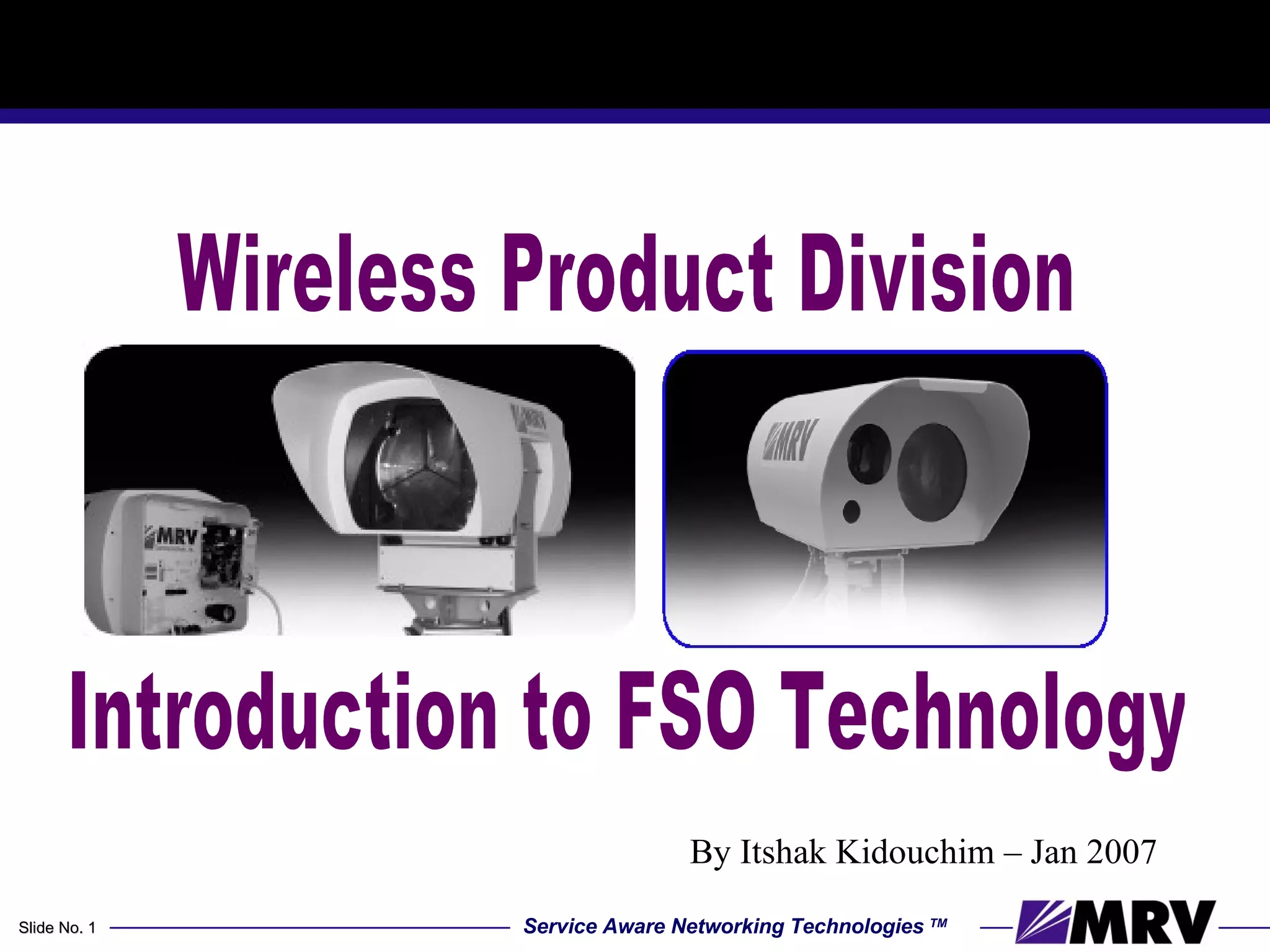
Wireless Product Division Introduction to FSO Technology By Itshak Kidouchim – Jan 2007
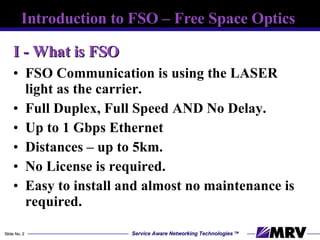
Introduction to FSO – Free Space Optics FSO Communication is using the LASER light as the carrier. Full Duplex, Full Speed AND No Delay.  Up to 1 Gbps Ethernet Distances – up to 5km. No License is required. Easy to install and almost no maintenance is required. I - What is FSO
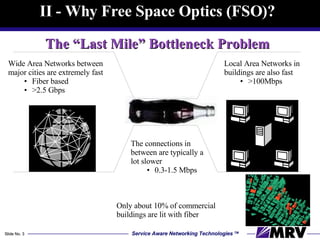
II - Why Free Space Optics (FSO)? The “Last Mile” Bottleneck Problem Only about 10% of commercial buildings are lit with fiber   Wide Area Networks between major cities are extremely fast Fiber based >2.5 Gbps Local Area Networks in buildings are also fast >100Mbps The connections in between are typically a lot slower 0.3-1.5 Mbps
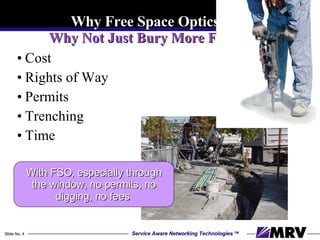
Why Free Space Optics? Why Not Just Bury More Fiber? Cost Rights of Way Permits Trenching Time With FSO, especially through the window, no permits, no digging, no fees
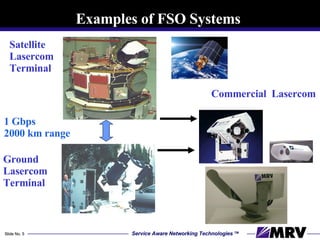
Ground Lasercom Terminal Satellite Lasercom Terminal 1 Gbps 2000 km range Commercial  Lasercom Examples of FSO Systems
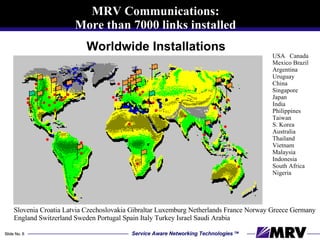
Worldwide Installations USA  Canada Mexico Brazil Argentina Uruguay  China Singapore Japan India Philippines Taiwan  S. Korea Australia Thailand Vietnam Malaysia Indonesia  South Africa Nigeria Slovenia Croatia Latvia Czechoslovakia Gibraltar Luxemburg Netherlands France Norway Greece Germany England Switzerland Sweden Portugal Spain Italy Turkey Israel Saudi Arabia  MRV Communications: More than 7000 links installed
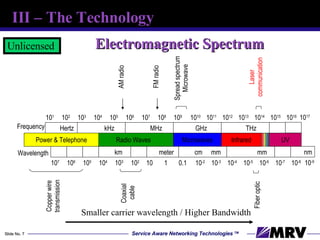
Electromagnetic Spectrum Spread spectrum Microwave 10 1 10 2 10 3 10 4 10 5 10 6 10 7 10 8 10 9 10 10 10 11 10 12 10 13 10 14 10 15 10 16 Hertz kHz MHz GHz THz 10 7 10 6 10 5 10 4 10 3 10 2 10 1 0.1 10 -2 10 -3 10 -4 10 -5 10 -6 10 -7 10 -8 Frequency  Wavelength Radio Waves Microwaves Infrared UV Power & Telephone Copper wire transmission km meter cm mm mm 10 -9 nm 10 17 Coaxial  cable Fiber optic AM radio FM radio Laser communication Unlicensed  III – The Technology Smaller carrier wavelength / Higher Bandwidth
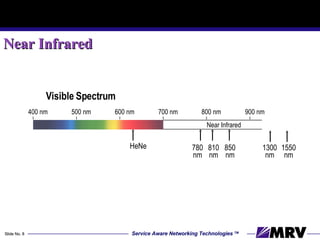
Near Infrared Visible Spectrum 400 nm 500 nm 600 nm 700 nm 800 nm 900 nm HeNe 780 nm 810 nm 850 nm 1550 nm Near Infrared 1300 nm
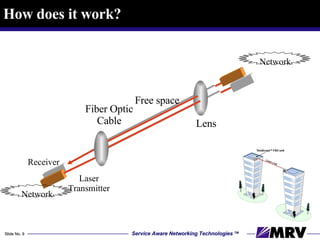
How does it work? Fiber Optic Cable Laser Transmitter Receiver Network Network Lens Free space
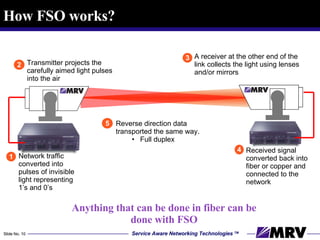
How FSO works? Anything that can be done in fiber can be done with FSO 1 Network traffic converted into pulses of invisible light representing 1’s and 0’s 2 Transmitter projects the carefully aimed light pulses into the air  5 Reverse direction data transported the same way. Full duplex 3 A receiver at the other end of the link collects the light using lenses and/or mirrors 4 Received signal converted back into fiber or copper and connected to the network
IV - Free Space Optics Positioning High Bandwidth Wireless Secure Wireless  Short distances Within Urban areas Eye safe
Bandwidth - Wireless ?   What is the  fiber  technology bandwidth limitation ? Unlimited What is the  radio  technology bandwidth limitation ? Limited (only GHz frequencies)  What is the  FSO  technology bandwidth limitation ? Unlimited FSO ≡ Ultra Bandwidth Wireless  Solutions MRV Leading the Gigabit Wireless Revolution
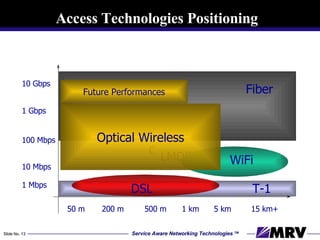
Access Technologies Positioning c 10  Gbps 1  Gbps 100  Mbps 10  Mbps 1  Mbps 200  m 50  m 500  m 1  km 5  km 15  km+ Fiber LMDS WiFi Optical Wireless T-1 DSL Future Performances
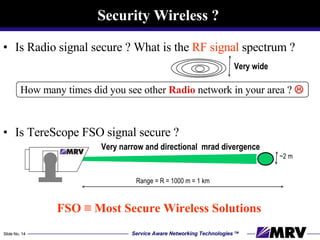
Security Wireless ?  Is Radio signal secure ? What is the  RF signal  spectrum ?  Very wide How many times did you see other  Radio  network in your area ?     FSO ≡ Most Secure Wireless Solutions Very narrow and directional  mrad divergence Range = R = 1000 m = 1 km ~2 m Is TereScope FSO signal secure ?
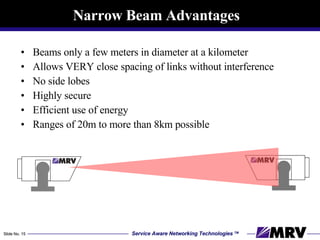
Beams only a few meters in diameter at a kilometer Allows VERY close spacing of links without interference No side lobes Highly secure Efficient use of energy Ranges of 20m to more than 8km possible Narrow Beam Advantages
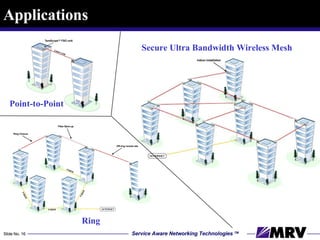
Applications Point-to-Point Ring Secure Ultra Bandwidth Wireless Mesh
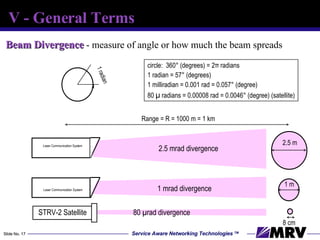
V - General Terms Beam Divergence   - measure of angle or how much the beam spreads circle:  360° (degrees) = 2π radians 1 radian = 57° (degrees) 1 milliradian = 0.001 rad = 0.057° (degree) 80  µ  radians = 0.00008 rad = 0.0046° (degree) (satellite) 2.5 mrad divergence 1 mrad divergence Range = R = 1000 m = 1 km 80 µrad divergence 1 radian Laser Communication System 2.5 m 1 m 8 cm STRV-2 Satellite Laser Communication System
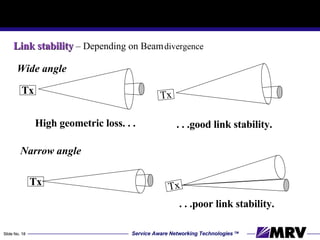
Tx Tx High geometric loss. . . . . .good link stability. Narrow angle Tx . . .poor link stability. Wide angle Link stability   – Depending on Beam  divergence Tx
Geometric loss Beam Area Receiver Lens Area   d B = divergence angle,   d B  =    R  GM (Geometric Loss) = 10 log (Rx lens Area/Beam Area)   = 10 log [d R  /(    R )] 2 d R R (air transmission distance) Tx
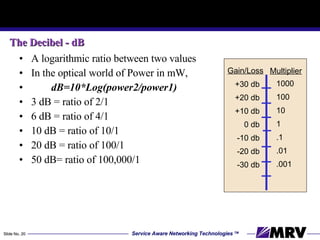
The Decibel - dB A logarithmic ratio between two values In the optical world of Power in mW, dB=10*Log(power2/power1) 3 dB = ratio of 2/1  6 dB = ratio of 4/1 10 dB = ratio of 10/1 20 dB = ratio of 100/1 50 dB= ratio of 100,000/1 Gain/Loss Multiplier +30 db +20 db +10 db 0 db -10 db -20 db -30 db 1000 100 10 1 .1 .01 .001
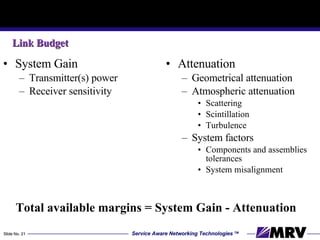
System Gain Transmitter(s) power  Receiver sensitivity Attenuation Geometrical attenuation Atmospheric attenuation Scattering Scintillation Turbulence System factors Components and assemblies tolerances System misalignment Total available margins = System Gain - Attenuation Link Budget
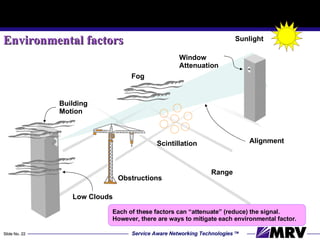
Environmental factors Sunlight Building  Motion Alignment Window Attenuation Fog Each of these factors can “attenuate” (reduce) the signal.  However, there are ways to mitigate each environmental factor. Scintillation Range Obstructions Low Clouds Sunlight
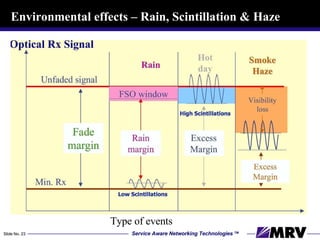
Environmental effects – Rain, Scintillation & Haze Type of events
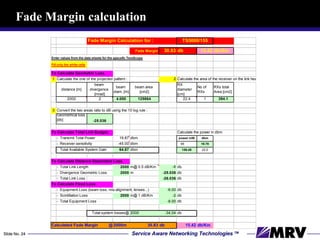
Fade Margin calculation
Effects of the atmosphere on laser beam propagation Atmospheric attenuation absorption scattering Atmospheric turbulence laser beam wander scintillation VI – Effects of the weather on FSO com.
Scattering Major Factor – Haze, Fog, Smog Scintillation   Moderate Factor - Air shimmering off hot surfaces Turbulence / Beam Wander Minor Factor – Different density air layers formed locally by temperature differences Environmental effects – Scattering, Scintillation & Turbulence
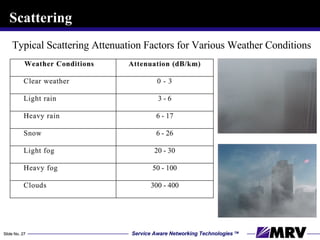
Typical Scattering Attenuation Factors for Various Weather Conditions  Scattering
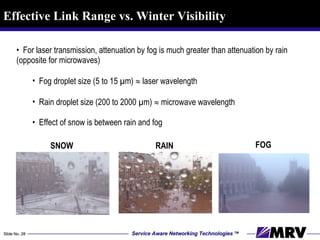
Effective Link Range vs. Winter Visibility For laser transmission, attenuation by fog is much greater than attenuation by rain (opposite for microwaves) Fog droplet size (5 to 15 µm)    laser wavelength Rain droplet size (200 to 2000 µm)    microwave wavelength Effect of snow is between rain and fog FOG RAIN SNOW
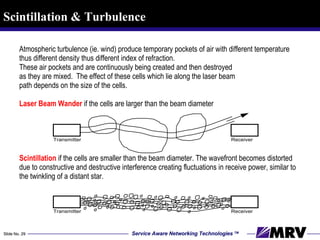
Scintillation & Turbulence Atmospheric turbulence (ie. wind) produce temporary pockets of air with different temperature thus different density thus different index of refraction. These air pockets and are continuously being created and then destroyed as they are mixed.  The effect of these cells which lie along the laser beam  path depends on the size of the cells. Laser Beam Wander  if the cells are larger than the beam diameter Scintillation  if the cells are smaller than the beam diameter. The wavefront becomes distorted due to constructive and destructive interference creating fluctuations in receive power, similar to the twinkling of a distant star.
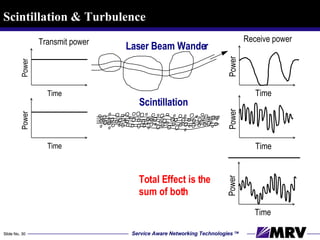
Scintillation & Turbulence Power Time Power Time Laser Beam Wander Transmit power Receive power Power Time Power Time Scintillation Total Effect is the sum of both Power Time
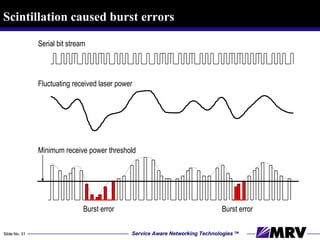
Scintillation caused burst errors Serial bit stream Fluctuating received laser power Minimum receive power threshold Burst error Burst error
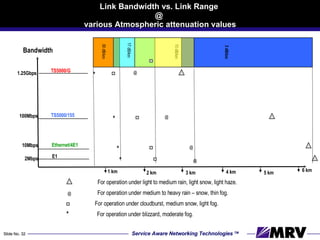
Link Bandwidth vs. Link Range  @  various Atmospheric attenuation values * * TS5000/G TS5000/155 Ethernet/4E1 E1 Bandwidth 1 km 1.25Gbps 100Mbps 10Mbps 2Mbps 2 km 3 km 4 km 5 km * 30 dB/km 17 dB/km 10 dB/km 3 dB/km @ @ @ * @ For operation under light to medium rain, light snow, light haze. * For operation under medium to heavy rain – snow, thin fog. For operation under cloudburst, medium snow, light fog. For operation under blizzard, moderate fog. @ 6 km
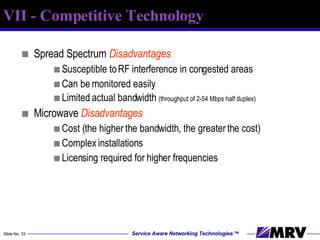
VII - Competitive Technology Spread Spectrum   Disadvantages Susceptible to RF interference in congested areas Can be monitored easily Limited actual bandwidth  (throughput of 2-54 Mbps half duplex) Microwave  Disadvantages Cost (the higher the bandwidth, the greater the cost) Complex installations Licensing required for higher frequencies
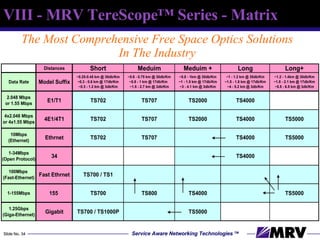
VIII - MRV TereScope™ Series - Matrix The Most Comprehensive Free Space Optics Solutions In The Industry
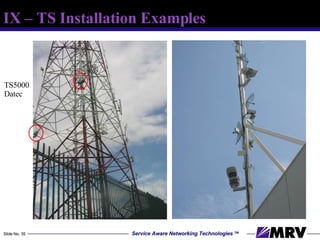
IX – TS Installation Examples   TS5000 Datec
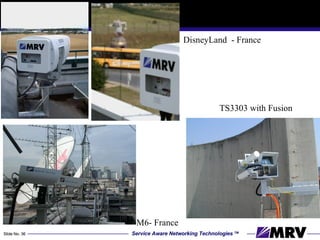
DisneyLand  - France TS3303 with Fusion M6- France
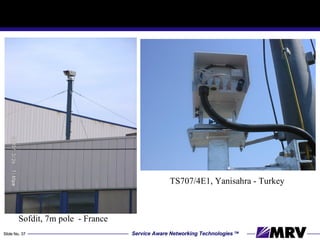
Sofdit, 7m pole  - France TS707/4E1, Yanisahra - Turkey
 
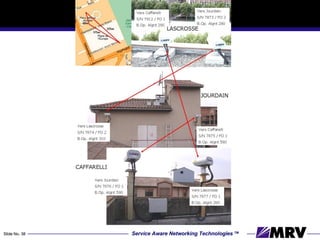
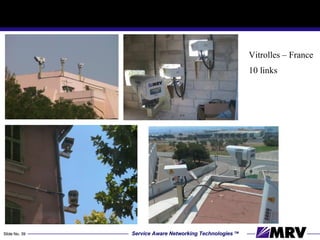
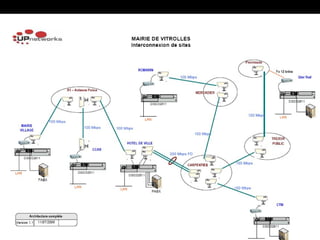
Vitrolles – France  10 links
 
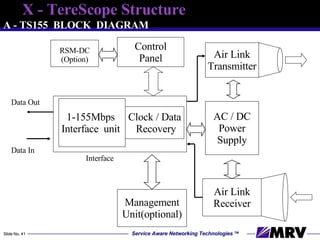
X - TereScope Structure בס " ד A - TS155  BLOCK  DIAGRAM 1-155Mbps  Interface  unit  Control Panel Management Unit(optional) Air Link Transmitter Air Link Receiver AC / DC Power Supply Clock / Data Recovery RSM-DC (Option) Data Out Data In Interface
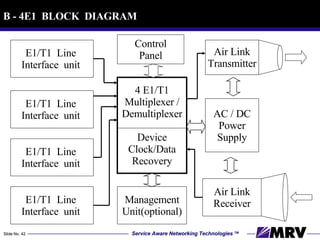
B - 4E1  BLOCK  DIAGRAM E1/T1  Line  Interface  unit  E1/T1  Line  Interface  unit  E1/T1  Line  Interface  unit  E1/T1  Line  Interface  unit  4 E1/T1 Multiplexer / Demultiplexer Device Clock/Data Recovery Control Panel Management Unit(optional) Air Link Transmitter Air Link Receiver AC / DC Power Supply
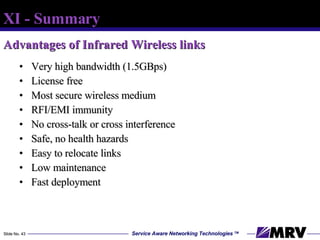
Advantages of Infrared Wireless links Very high bandwidth (1.5GBps) License free Most secure wireless medium  RFI/EMI immunity No cross-talk or cross interference Safe, no health hazards Easy to relocate links Low maintenance Fast deployment XI - Summary
THANK YOU ww.mrv.com [email_address]

Introduction To Fso Technology

  • 1.
    Wireless Product DivisionIntroduction to FSO Technology By Itshak Kidouchim – Jan 2007
  • 2.
    Introduction to FSO– Free Space Optics FSO Communication is using the LASER light as the carrier. Full Duplex, Full Speed AND No Delay. Up to 1 Gbps Ethernet Distances – up to 5km. No License is required. Easy to install and almost no maintenance is required. I - What is FSO
  • 3.
    II - WhyFree Space Optics (FSO)? The “Last Mile” Bottleneck Problem Only about 10% of commercial buildings are lit with fiber Wide Area Networks between major cities are extremely fast Fiber based >2.5 Gbps Local Area Networks in buildings are also fast >100Mbps The connections in between are typically a lot slower 0.3-1.5 Mbps
  • 4.
    Why Free SpaceOptics? Why Not Just Bury More Fiber? Cost Rights of Way Permits Trenching Time With FSO, especially through the window, no permits, no digging, no fees
  • 5.
    Ground Lasercom TerminalSatellite Lasercom Terminal 1 Gbps 2000 km range Commercial Lasercom Examples of FSO Systems
  • 6.
    Worldwide Installations USA Canada Mexico Brazil Argentina Uruguay China Singapore Japan India Philippines Taiwan S. Korea Australia Thailand Vietnam Malaysia Indonesia South Africa Nigeria Slovenia Croatia Latvia Czechoslovakia Gibraltar Luxemburg Netherlands France Norway Greece Germany England Switzerland Sweden Portugal Spain Italy Turkey Israel Saudi Arabia MRV Communications: More than 7000 links installed
  • 7.
    Electromagnetic Spectrum Spreadspectrum Microwave 10 1 10 2 10 3 10 4 10 5 10 6 10 7 10 8 10 9 10 10 10 11 10 12 10 13 10 14 10 15 10 16 Hertz kHz MHz GHz THz 10 7 10 6 10 5 10 4 10 3 10 2 10 1 0.1 10 -2 10 -3 10 -4 10 -5 10 -6 10 -7 10 -8 Frequency Wavelength Radio Waves Microwaves Infrared UV Power & Telephone Copper wire transmission km meter cm mm mm 10 -9 nm 10 17 Coaxial cable Fiber optic AM radio FM radio Laser communication Unlicensed III – The Technology Smaller carrier wavelength / Higher Bandwidth
  • 8.
    Near Infrared VisibleSpectrum 400 nm 500 nm 600 nm 700 nm 800 nm 900 nm HeNe 780 nm 810 nm 850 nm 1550 nm Near Infrared 1300 nm
  • 9.
    How does itwork? Fiber Optic Cable Laser Transmitter Receiver Network Network Lens Free space
  • 10.
    How FSO works?Anything that can be done in fiber can be done with FSO 1 Network traffic converted into pulses of invisible light representing 1’s and 0’s 2 Transmitter projects the carefully aimed light pulses into the air 5 Reverse direction data transported the same way. Full duplex 3 A receiver at the other end of the link collects the light using lenses and/or mirrors 4 Received signal converted back into fiber or copper and connected to the network
  • 11.
    IV - FreeSpace Optics Positioning High Bandwidth Wireless Secure Wireless Short distances Within Urban areas Eye safe
  • 12.
    Bandwidth - Wireless? What is the fiber technology bandwidth limitation ? Unlimited What is the radio technology bandwidth limitation ? Limited (only GHz frequencies) What is the FSO technology bandwidth limitation ? Unlimited FSO ≡ Ultra Bandwidth Wireless Solutions MRV Leading the Gigabit Wireless Revolution
  • 13.
    Access Technologies Positioningc 10 Gbps 1 Gbps 100 Mbps 10 Mbps 1 Mbps 200 m 50 m 500 m 1 km 5 km 15 km+ Fiber LMDS WiFi Optical Wireless T-1 DSL Future Performances
  • 14.
    Security Wireless ? Is Radio signal secure ? What is the RF signal spectrum ? Very wide How many times did you see other Radio network in your area ?  FSO ≡ Most Secure Wireless Solutions Very narrow and directional mrad divergence Range = R = 1000 m = 1 km ~2 m Is TereScope FSO signal secure ?
  • 15.
    Beams only afew meters in diameter at a kilometer Allows VERY close spacing of links without interference No side lobes Highly secure Efficient use of energy Ranges of 20m to more than 8km possible Narrow Beam Advantages
  • 16.
    Applications Point-to-Point RingSecure Ultra Bandwidth Wireless Mesh
  • 17.
    V - GeneralTerms Beam Divergence - measure of angle or how much the beam spreads circle: 360° (degrees) = 2π radians 1 radian = 57° (degrees) 1 milliradian = 0.001 rad = 0.057° (degree) 80 µ radians = 0.00008 rad = 0.0046° (degree) (satellite) 2.5 mrad divergence 1 mrad divergence Range = R = 1000 m = 1 km 80 µrad divergence 1 radian Laser Communication System 2.5 m 1 m 8 cm STRV-2 Satellite Laser Communication System
  • 18.
    Tx Tx Highgeometric loss. . . . . .good link stability. Narrow angle Tx . . .poor link stability. Wide angle Link stability – Depending on Beam divergence Tx
  • 19.
    Geometric loss BeamArea Receiver Lens Area  d B = divergence angle, d B =  R GM (Geometric Loss) = 10 log (Rx lens Area/Beam Area) = 10 log [d R /(  R )] 2 d R R (air transmission distance) Tx
  • 20.
    The Decibel -dB A logarithmic ratio between two values In the optical world of Power in mW, dB=10*Log(power2/power1) 3 dB = ratio of 2/1 6 dB = ratio of 4/1 10 dB = ratio of 10/1 20 dB = ratio of 100/1 50 dB= ratio of 100,000/1 Gain/Loss Multiplier +30 db +20 db +10 db 0 db -10 db -20 db -30 db 1000 100 10 1 .1 .01 .001
  • 21.
    System Gain Transmitter(s)power Receiver sensitivity Attenuation Geometrical attenuation Atmospheric attenuation Scattering Scintillation Turbulence System factors Components and assemblies tolerances System misalignment Total available margins = System Gain - Attenuation Link Budget
  • 22.
    Environmental factors SunlightBuilding Motion Alignment Window Attenuation Fog Each of these factors can “attenuate” (reduce) the signal. However, there are ways to mitigate each environmental factor. Scintillation Range Obstructions Low Clouds Sunlight
  • 23.
    Environmental effects –Rain, Scintillation & Haze Type of events
  • 24.
  • 25.
    Effects of theatmosphere on laser beam propagation Atmospheric attenuation absorption scattering Atmospheric turbulence laser beam wander scintillation VI – Effects of the weather on FSO com.
  • 26.
    Scattering Major Factor– Haze, Fog, Smog Scintillation Moderate Factor - Air shimmering off hot surfaces Turbulence / Beam Wander Minor Factor – Different density air layers formed locally by temperature differences Environmental effects – Scattering, Scintillation & Turbulence
  • 27.
    Typical Scattering AttenuationFactors for Various Weather Conditions Scattering
  • 28.
    Effective Link Rangevs. Winter Visibility For laser transmission, attenuation by fog is much greater than attenuation by rain (opposite for microwaves) Fog droplet size (5 to 15 µm)  laser wavelength Rain droplet size (200 to 2000 µm)  microwave wavelength Effect of snow is between rain and fog FOG RAIN SNOW
  • 29.
    Scintillation & TurbulenceAtmospheric turbulence (ie. wind) produce temporary pockets of air with different temperature thus different density thus different index of refraction. These air pockets and are continuously being created and then destroyed as they are mixed. The effect of these cells which lie along the laser beam path depends on the size of the cells. Laser Beam Wander if the cells are larger than the beam diameter Scintillation if the cells are smaller than the beam diameter. The wavefront becomes distorted due to constructive and destructive interference creating fluctuations in receive power, similar to the twinkling of a distant star.
  • 30.
    Scintillation & TurbulencePower Time Power Time Laser Beam Wander Transmit power Receive power Power Time Power Time Scintillation Total Effect is the sum of both Power Time
  • 31.
    Scintillation caused bursterrors Serial bit stream Fluctuating received laser power Minimum receive power threshold Burst error Burst error
  • 32.
    Link Bandwidth vs.Link Range @ various Atmospheric attenuation values * * TS5000/G TS5000/155 Ethernet/4E1 E1 Bandwidth 1 km 1.25Gbps 100Mbps 10Mbps 2Mbps 2 km 3 km 4 km 5 km * 30 dB/km 17 dB/km 10 dB/km 3 dB/km @ @ @ * @ For operation under light to medium rain, light snow, light haze. * For operation under medium to heavy rain – snow, thin fog. For operation under cloudburst, medium snow, light fog. For operation under blizzard, moderate fog. @ 6 km
  • 33.
    VII - CompetitiveTechnology Spread Spectrum Disadvantages Susceptible to RF interference in congested areas Can be monitored easily Limited actual bandwidth (throughput of 2-54 Mbps half duplex) Microwave Disadvantages Cost (the higher the bandwidth, the greater the cost) Complex installations Licensing required for higher frequencies
  • 34.
    VIII - MRVTereScope™ Series - Matrix The Most Comprehensive Free Space Optics Solutions In The Industry
  • 35.
    IX – TSInstallation Examples TS5000 Datec
  • 36.
    DisneyLand -France TS3303 with Fusion M6- France
  • 37.
    Sofdit, 7m pole - France TS707/4E1, Yanisahra - Turkey
  • 38.
  • 39.
  • 40.
  • 41.
    X - TereScopeStructure בס " ד A - TS155 BLOCK DIAGRAM 1-155Mbps Interface unit Control Panel Management Unit(optional) Air Link Transmitter Air Link Receiver AC / DC Power Supply Clock / Data Recovery RSM-DC (Option) Data Out Data In Interface
  • 42.
    B - 4E1 BLOCK DIAGRAM E1/T1 Line Interface unit E1/T1 Line Interface unit E1/T1 Line Interface unit E1/T1 Line Interface unit 4 E1/T1 Multiplexer / Demultiplexer Device Clock/Data Recovery Control Panel Management Unit(optional) Air Link Transmitter Air Link Receiver AC / DC Power Supply
  • 43.
    Advantages of InfraredWireless links Very high bandwidth (1.5GBps) License free Most secure wireless medium RFI/EMI immunity No cross-talk or cross interference Safe, no health hazards Easy to relocate links Low maintenance Fast deployment XI - Summary
  • 44.
    THANK YOU ww.mrv.com[email_address]