Communication :
➢The Englishword “communication” is derived from the Greek word Comminicare which
means exchange of information.
➢For as long as humans have been on this planet, we’ve invented forms of
communication—from Cave Paintings, Symbols, Smoke Signals, Carrier Pigeon, Postal
System, Newspapers, Radio, Telegraph, Telephone, Television, Internet, E-mail,
TextMessage, Social Media like Facebook, Messenger, WhatsUp, Twitter, Instagram and
Telegram etc., that have constantly evolved how we interact with each other.
➢Technology has indeed redefined communication. People no longer have to wait for
years, months, weeks, and days to receive information or message. Today, texts, e-mails,
tweets, and personal messages can reach the recipient in just a matter of seconds. i.e. ,we
communicate in a fingersnap.
Now, we can send information in forms : 1)Audio, 2) Video, 3) Data
3.
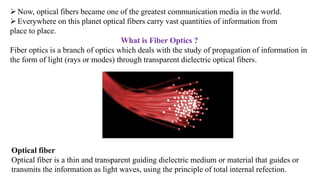
➢Now, optical fibersbecame one of the greatest communication media in the world.
➢Everywhere on this planet optical fibers carry vast quantities of information from
place to place.
What is Fiber Optics ?
Fiber optics is a branch of optics which deals with the study of propagation of information in
the form of light (rays or modes) through transparent dielectric optical fibers.
Optical fiber
Optical fiber is a thin and transparent guiding dielectric medium or material that guides or
transmits the information as light waves, using the principle of total internal refection.
4.
Optical fiber
Optical fiberis a thin and transparent guiding dielectric medium or material that guides or
transmits information as light waves, using the principle of total internal reflection.
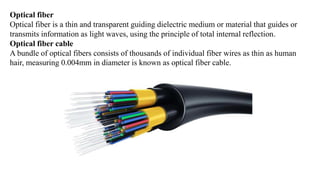
Optical fiber cable
A bundle of optical fibers consists of thousands of individual fiber wires as thin as human
hair, measuring 0.004mm in diameter is known as optical fiber cable.
5.
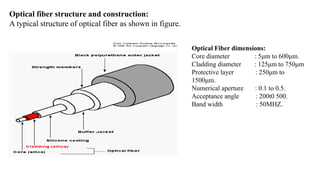
Optical fiber structureand construction:
A typical structure of optical fiber as shown in figure.
Optical Fiber dimensions:
Core diameter : 5μm to 600μm.
Cladding diameter : 125μm to 750μm
Protective layer : 250μm to
1500μm.
Numerical aperture : 0.1 to 0.5.
Acceptance angle : 200t0 500.
Band width : 50MHZ.
6.
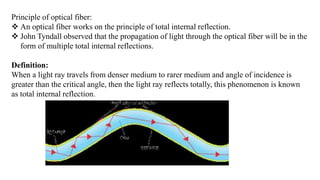
Principle of opticalfiber:
❖ An optical fiber works on the principle of total internal reflection.
❖ John Tyndall observed that the propagation of light through the optical fiber will be in the
form of multiple total internal reflections.
Definition:
When a light ray travels from denser medium to rarer medium and angle of incidence is
greater than the critical angle, then the light ray reflects totally, this phenomenon is known
as total internal reflection.
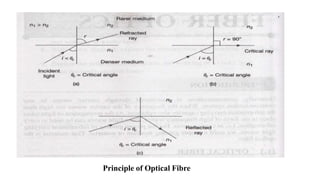
Conditions for totalinternal reflection:
1. The light ray should move from denser to a rarer medium.
2. When i < Ѳc, then the light ray refracts into a rarer medium.
3. When I = Ѳc, then the refracted light ray passes along the
interface of the two media.
4. When i > Ѳc, then the light ray is reflected back into the denser
medium and we get total internal reflection.
10.
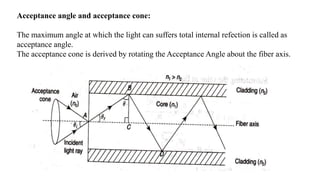
Acceptance angle andacceptance cone:
The maximum angle at which the light can suffers total internal refection is called as
acceptance angle.
The acceptance cone is derived by rotating the Acceptance Angle about the fiber axis.
11.
Numerical aperture (N.A):
➢Numerical aperture represents the light-gathering power of an optical fiber. It is a
measure of the amount of light that can be accepted by a fiber.
➢ The value of NA ranges from 0.13 to 0.50.
➢ Numerical aperture is proportional to the acceptance angle. So, numerical aperture is
equal to the sine of the acceptance angle.
Types of optical fibers:
Optical fibers are classified into 2 major categories based on
1.Number of modes transmitted into the optical fibers and
2.Refractive index profile of the fibers.
12.
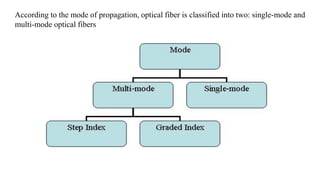
According to themode of propagation, optical fiber is classified into two: single-mode and
multi-mode optical fibers
13.
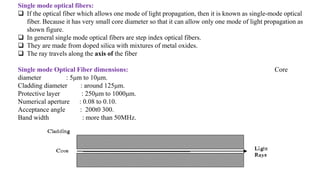
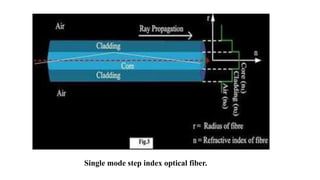
Single mode opticalfibers:
❑ If the optical fiber which allows one mode of light propagation, then it is known as single-mode optical
fiber. Because it has very small core diameter so that it can allow only one mode of light propagation as
shown figure.
❑ In general single mode optical fibers are step index optical fibers.
❑ They are made from doped silica with mixtures of metal oxides.
❑ The ray travels along the axis of the fiber
Single mode Optical Fiber dimensions: Core
diameter : 5μm to 10μm.
Cladding diameter : around 125μm.
Protective layer : 250μm to 1000μm.
Numerical aperture : 0.08 to 0.10.
Acceptance angle : 200t0 300.
Band width : more than 50MHz.
14.
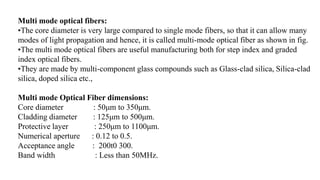
Multi mode opticalfibers:
•The core diameter is very large compared to single mode fibers, so that it can allow many
modes of light propagation and hence, it is called multi-mode optical fiber as shown in fig.
•The multi mode optical fibers are useful manufacturing both for step index and graded
index optical fibers.
•They are made by multi-component glass compounds such as Glass-clad silica, Silica-clad
silica, doped silica etc.,
Multi mode Optical Fiber dimensions:
Core diameter : 50μm to 350μm.
Cladding diameter : 125μm to 500μm.
Protective layer : 250μm to 1100μm.
Numerical aperture : 0.12 to 0.5.
Acceptance angle : 200t0 300.
Band width : Less than 50MHz.
15.
Step index opticalfibers and graded index optical fibers:
Based on the variation in the refractive index of the core and the cladding, the fibers
are classified into two types. They are.
1) Step index optical fibers (multimode, single mode)and
2) Graded index optical fibers(multimode).
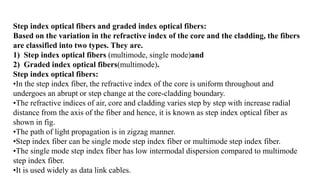
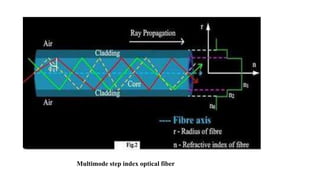
Step index optical fibers:
•In the step index fiber, the refractive index of the core is uniform throughout and
undergoes an abrupt or step change at the core-cladding boundary.
•The refractive indices of air, core and cladding varies step by step with increase radial
distance from the axis of the fiber and hence, it is known as step index optical fiber as
shown in fig.
•The path of light propagation is in zigzag manner.
•Step index fiber can be single mode step index fiber or multimode step index fiber.
•The single mode step index fiber has low intermodal dispersion compared to multimode
step index fiber.
•It is used widely as data link cables.
16.
Applications:
Because of itsless band width, they are used in short haul communication systems
(data and audio/video applications in LANs)
A local area network (LAN)is a computer networkthat interconnects computers in a
limited area such as a home, school, computer laboratory, or office building using network
mediaAdvantages:
•Launching of light is easy.
•Connecting two fibers is easy.
•Fabrication is easy.
•Cost is low.
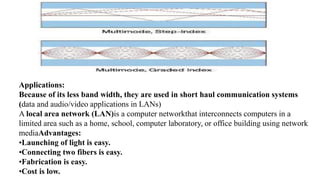
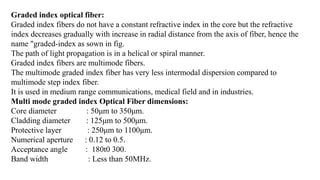
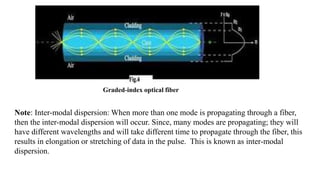
Graded index opticalfiber:
Graded index fibers do not have a constant refractive index in the core but the refractive
index decreases gradually with increase in radial distance from the axis of fiber, hence the
name "graded-index as sown in fig.
The path of light propagation is in a helical or spiral manner.
Graded index fibers are multimode fibers.
The multimode graded index fiber has very less intermodal dispersion compared to
multimode step index fiber.
It is used in medium range communications, medical field and in industries.
Multi mode graded index Optical Fiber dimensions:
Core diameter : 50μm to 350μm.
Cladding diameter : 125μm to 500μm.
Protective layer : 250μm to 1100μm.
Numerical aperture : 0.12 to 0.5.
Acceptance angle : 180t0 300.
Band width : Less than 50MHz.
20.
Note: Inter-modal dispersion:When more than one mode is propagating through a fiber,
then the inter-modal dispersion will occur. Since, many modes are propagating; they will
have different wavelengths and will take different time to propagate through the fiber, this
results in elongation or stretching of data in the pulse. This is known as inter-modal
dispersion.
Graded-index optical fiber
21.
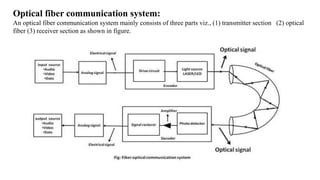
Optical fiber communicationsystem:
An optical fiber communication system mainly consists of three parts viz., (1) transmitter section (2) optical
fiber (3) receiver section as shown in figure.
22.
Advantages of opticalfiber communication:
• Optical fibers have largely replaced copper wire communications in core networks in the
developed world, because of its advantages over electrical transmission. Here are the
main advantages of fiber optic transmission.
• Safety
▪ The fiber is non-conducting, and is therefore safe in all environments.
▪ It uses light waves for communication hence it is shockproof.
▪ Since it is shockproof, it is very useful in sensitive areas like petroleum industries, oil
and natural gas industries, cotton industries etc.
Weight
Fiberoptic cables are made of glass or plastic, and they are thinner than copper
cables.These make them lighter weight and easy to install.
Low Power Loss
An optical fiber offer slow power loss, which allows for longer transmission distances
than comparison to copper cable.
23.
Bandwidth
Fiber optic cableshave a much greater bandwidth than metal cables. The amount of
information that can be transmitted per unit time of fiber over other transmission media is
far greater than copper cables.
Security :
1. It CANNOT be tapped unlike copper cables.
2. There is NO leakage of signals so communication is secured.
3. It is very strong, flexible and can work on high temperature.
4. It does NOT have corrosion due to water, chemicals and high humidity etc
5. It is cost effective and maintenance free.
6. It is very easy to install. It does NOT requires labor.
24.
Attenuation
Dispersion-intermodel, Intramodel,
Bending loss-micro,macro
scattering losses-Linear, Non linear,
Absorption-Intrinsic, Extrinsic
Coupling
Losses in Fiber Optics
Attenuation
Attenuation means loss of light energy as the light pulse travels from one end of the
cable to the other.
It is also called signal loss or fiber loss.
It also decides the number of repeaters required between transmitter and receiver.
Attenuation is directly proportional to the length of the cable.
25.
Attenuation is definedas the ratio of optical output power to the
input power in the fiber of length L.
α= 10log10Pi/Po [in db/km]
where,
Pi= Input Power
Po= Output Power, α is attenuation constant
The various losses in th e cable are due to
• Absorption
• Scattering
• Dispersion
• Bending
Attenuation
26.
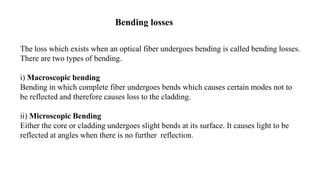
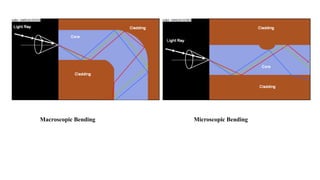
The loss whichexists when an optical fiber undergoes bending is called bending losses.
There are two types of bending.
i) Macroscopic bending
Bending in which complete fiber undergoes bends which causes certain modes not to
be reflected and therefore causes loss to the cladding.
ii) Microscopic Bending
Either the core or cladding undergoes slight bends at its surface. It causes light to be
reflected at angles when there is no further reflection.
Bending losses
Absorption of lightenergy due to heating of ion impurities results in dimming of light at
the end of the fiber.
Two types:
1.Intrinsic Absorption
2.Extrinsic Absorption
Intrinsic Absorption:
Caused by the interaction with one or more components of the glass
Occurs when photon interacts with an electron in the valence band & excites it to a higher
energy level near the UV region.
Extrinsic Absorption:
Also called impurity absorption.
Results from the presence of transition metal ions like iron, chromium, cobalt, copper &
from OH ions i.e. from water
Absorption Loss
29.
As an opticalsignal travels along the fiber, it becomes increasingly distorted.
This distortion is a sequence of intermodal and intramodal dispersion.
Two types:
1.Intermodal Dispersion
2.IntramodalDispersion
Intermodal Dispersion:
Pulse broadening due to intermodal dispersion results from the propagation delay
differences between modes within a multimode fiber.
Intramodal Dispersion:
It is the pulse spreading that occurs within a single mode.
Material Dispersion
Waveguide Dispersion
Dispersion Loss
30.
Scattering Losses
It occursdue to microscopic variations in the material density, compositional
fluctuations, structural in homogeneities and manufacturing defects.
Coupling Losses
The mechanical losses due to the coupling of optical fiber cables is called coupling
losses


![Attenuation is defined as the ratio of optical output power to the
input power in the fiber of length L.
α= 10log10Pi/Po [in db/km]
where,
Pi= Input Power
Po= Output Power, α is attenuation constant
The various losses in th e cable are due to
• Absorption
• Scattering
• Dispersion
• Bending
Attenuation](https://image.slidesharecdn.com/unit-7fibreoptics-250907193427-ce323528/85/Fibre-Optics-application-with-example-in-detail-25-320.jpg)