1
WDM Benefits and
Performance Parameters
MEC
2
Contents
• Introduction.
• General WDM System Block Diagram.
• WDM Features.
• WDM Types.
• WDM Benefits.
• WDM Performance Parameters.
• Sample Eye Diagrams.
3
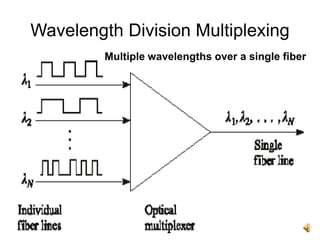
Wavelength Division Multiplexing
Multiple wavelengths over a single fiber
4
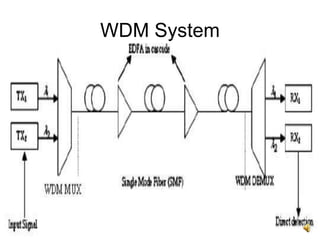
WDM System
5
WDM System
• A number of multiplexers at the transmitter
end.
• Multiplexing more than one optical signal
onto a single fibre.
• Transmitter consists of a laser and a
modulator.
• Light source generates an optical carrier
signal at either fixed or a tuneable
wavelength.
• Amplification provided by looped EDFA
amplifier with adequate gain.
6
WDM System
• Demultiplexers at the receiver to split
signals apart.
• Receiver photodiode detector converts
optical signal to electrical signal.
• Filtering of respective wavelengths at the
receiver after proper opto-electronic
conversion.
7
Wavelength Division Multiplexing
• Carries multiple optical carrier signals on a
single fibre using different wavelengths of
laser light.
• Allows bidirectional communication over
one standard fibre with increased capacity.
• Splits network bandwidth into a number of
small bandwidth optical channels.
• Multiple data stream transfer along the
same fibre at the same time.
8
Wavelength Division Multiplexing
• Increase in network capacity without laying
more fibres.
• More secure compared to other types of
communication from tapping.
• Immune to crosstalk.
• Efficient utilization of available optical fiber
bandwidth capabilities.
9
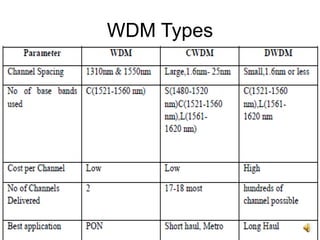
WDM Types
• Utilizes 1300nm -1550nm window of low
attenuation.
• 3 Types:
- WDM (Wavelength Channel
Multiplexing).
- CWDM (Coarse Wavelength Division
Multiplexing).
- DWDM (Dense Wavelength Division
Multiplexing).
10
WDM Types
11
WDM Benefits
• Capacity Upgradation:
- efficient utilisation of available bandwidth.
- more data transmitted over the same
fiber.
- different wavelengths multiplexed onto a
single optical fibre.
- increase in system capability.
12
WDM Benefits
• Transparency:
- data transmission at different bit rates.
- supports multiple protocols.
- no constraint on how we want to send
the data.
- high speed data transmission.
13
WDM Benefits
• Wavelength Reuse:
- allows for wavelength routing.
- same wavelength may be used again in
a different fibre link.
- wavelength reuse increases capacity.
• Scalability:
- flexibility.
- modify the network when required.
- can add/drop extra processing units if
required.
- help serve more users.
14
WDM Benefits
• Reliability:
- extremely reliable and secure.
- low cross talk.
- secure, less chance of tapping data.
- recovery from network failure.
- provision for path rerouting.
- less chance of data loss.
15
Performance Parameters
• Give a measure of how good or bad the
transmission is.
• Bit Error Rate:
- percentage of bits in error relative to the
total number of bits received.
- expressed as ten to a negative power.
• Optical Signal to Noise Ratio (OSNR):
- ratio of optical signal power to the noise
power within the system.
- Higher the OSNR better the signal reception.
16
Performance Parameters
• Q-Factor:
- compares the frequency at which a system
oscillates to the rate at which it dissipates
its energy.
- Q is 2π times ratio of total energy stored
to the energy lost in a single cycle.
- ratio of stored energy to the energy
dissipated per one radian of oscillation.
17
Performance Parameters
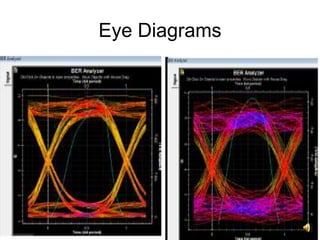
• Eye Height:
- show parametric information about the
signal.
- height of the eye diagram from bottom to
top.
- larger the eye height, the better the
transmission.
- won’t show protocol/logical problems/bit
errors.
18
Eye Diagrams
19
Thank You

Wdm benefits and performance parameters

  • 1.
  • 2.
    2 Contents • Introduction. • GeneralWDM System Block Diagram. • WDM Features. • WDM Types. • WDM Benefits. • WDM Performance Parameters. • Sample Eye Diagrams.
  • 3.
    3 Wavelength Division Multiplexing Multiplewavelengths over a single fiber
  • 4.
  • 5.
    5 WDM System • Anumber of multiplexers at the transmitter end. • Multiplexing more than one optical signal onto a single fibre. • Transmitter consists of a laser and a modulator. • Light source generates an optical carrier signal at either fixed or a tuneable wavelength. • Amplification provided by looped EDFA amplifier with adequate gain.
  • 6.
    6 WDM System • Demultiplexersat the receiver to split signals apart. • Receiver photodiode detector converts optical signal to electrical signal. • Filtering of respective wavelengths at the receiver after proper opto-electronic conversion.
  • 7.
    7 Wavelength Division Multiplexing •Carries multiple optical carrier signals on a single fibre using different wavelengths of laser light. • Allows bidirectional communication over one standard fibre with increased capacity. • Splits network bandwidth into a number of small bandwidth optical channels. • Multiple data stream transfer along the same fibre at the same time.
  • 8.
    8 Wavelength Division Multiplexing •Increase in network capacity without laying more fibres. • More secure compared to other types of communication from tapping. • Immune to crosstalk. • Efficient utilization of available optical fiber bandwidth capabilities.
  • 9.
    9 WDM Types • Utilizes1300nm -1550nm window of low attenuation. • 3 Types: - WDM (Wavelength Channel Multiplexing). - CWDM (Coarse Wavelength Division Multiplexing). - DWDM (Dense Wavelength Division Multiplexing).
  • 10.
  • 11.
    11 WDM Benefits • CapacityUpgradation: - efficient utilisation of available bandwidth. - more data transmitted over the same fiber. - different wavelengths multiplexed onto a single optical fibre. - increase in system capability.
  • 12.
    12 WDM Benefits • Transparency: -data transmission at different bit rates. - supports multiple protocols. - no constraint on how we want to send the data. - high speed data transmission.
  • 13.
    13 WDM Benefits • WavelengthReuse: - allows for wavelength routing. - same wavelength may be used again in a different fibre link. - wavelength reuse increases capacity. • Scalability: - flexibility. - modify the network when required. - can add/drop extra processing units if required. - help serve more users.
  • 14.
    14 WDM Benefits • Reliability: -extremely reliable and secure. - low cross talk. - secure, less chance of tapping data. - recovery from network failure. - provision for path rerouting. - less chance of data loss.
  • 15.
    15 Performance Parameters • Givea measure of how good or bad the transmission is. • Bit Error Rate: - percentage of bits in error relative to the total number of bits received. - expressed as ten to a negative power. • Optical Signal to Noise Ratio (OSNR): - ratio of optical signal power to the noise power within the system. - Higher the OSNR better the signal reception.
  • 16.
    16 Performance Parameters • Q-Factor: -compares the frequency at which a system oscillates to the rate at which it dissipates its energy. - Q is 2π times ratio of total energy stored to the energy lost in a single cycle. - ratio of stored energy to the energy dissipated per one radian of oscillation.
  • 17.
    17 Performance Parameters • EyeHeight: - show parametric information about the signal. - height of the eye diagram from bottom to top. - larger the eye height, the better the transmission. - won’t show protocol/logical problems/bit errors.
  • 18.
  • 19.