Chapter 02 - Simplex method introduction
2
nn xcxcxcZ  ...2211
0,...,0,0
0,...,0,0
...
;
.
...
...
21
21
2211
22222121
11212111





m
n
mnmnmm
nn
nn
bbb
xxx
bxaxaxa
bxaxaxa
bxaxaxa
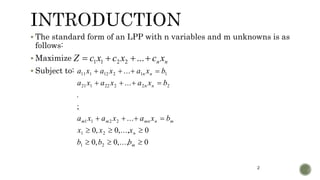
 The standard form of an LPP with n variables and m unknowns is as
follows:
 Maximize
 Subject to:
3
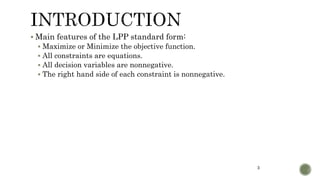
 Main features of the LPP standard form:
 Maximize or Minimize the objective function.
 All constraints are equations.
 All decision variables are nonnegative.
 The right hand side of each constraint is nonnegative.
4
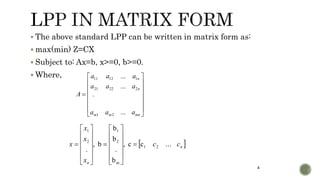
 The above standard LPP can be written in matrix form as:
 max(min) Z=CX
 Subject to: Ax=b, x>=0, b>=0.
 Where,















mnmm
n
n
aaa
aaa
aaa
A
...
.
...
...
21
22221
11211
 n
n
cc
x
x
x
x ...cc,
b
.
b
b
b,
.
21
m
2
1
2
1



























5
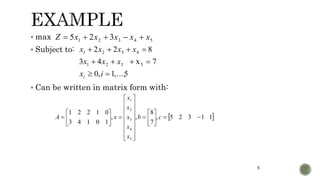
 max
 Subject to:
 Can be written in matrix form with:
54321 325 xxxxxZ 
5,...,1,0
7x43
822
5321
4321



ix
xxx
xxxx
i
 11325,
7
8
,,
10143
01221
5
4
3
2
1





























 cb
x
x
x
x
x
xA
6
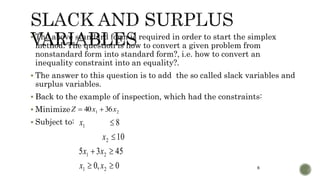
 The above standard form is required in order to start the simplex
method. The question is how to convert a given problem from
nonstandard form into standard form?, i.e. how to convert an
inequality constraint into an equality?.
 The answer to this question is to add the so called slack variables and
surplus variables.
 Back to the example of inspection, which had the constraints:
 Minimize
 Subject to:
21 3640 xxZ 
0,0
4535
10
8
21
21
2
1




xx
xx
x
x
7
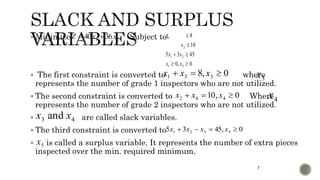
 Minimize Subject to:
 The first constraint is converted to where
represents the number of grade 1 inspectors who are not utilized.
 The second constraint is converted to Where
represents the number of grade 2 inspectors who are not utilized.
 are called slack variables.
 The third constraint is converted to
 is called a surplus variable. It represents the number of extra pieces
inspected over the min. required minimum.
21 3640 xxZ 
0,0
4535
10
8
21
21
2
1




xx
xx
x
x
0,8 331  xxx 3x
0,10 442  xxx 4x
43 and xx
0,4535 5521  xxxx
5x
8
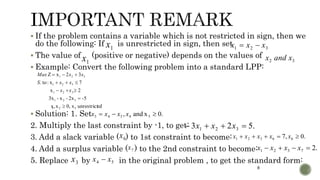
 If the problem contains a variable which is not restricted in sign, then we
do the following: If is unrestricted in sign, then set
 The value of (positive or negative) depends on the values of
 Example: Convert the following problem into a standard LPP:
 Solution: 1. Set
2. Multiply the last constraint by -1, to get:
3. Add a slack variable ( ) to 1st constraint to become:
4. Add a surplus variable ( ) to the 2nd constraint to become:
5. Replace by in the original problem , to get the standard form:
1x 321 xxx 
1x 32 xandx
edunrestrictx0,x,x
-52x-x-3x
2x
7x:to.
32xZ
321
321
321
321
321





xx
xxS
xxMax
.0xand, 54543  xxxx
.523 321  xxx
6x .0,7 66321  xxxxx
7x .27321  xxxx
3x 54 xx 
9
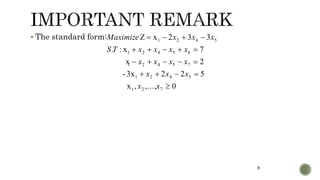
 The standard form:
0,...,,x
5223x-
2x
7x:.
332xZ
721
5421
75421
65421
5421





xx
xxx
xxxx
xxxxTS
xxxMaximize
10
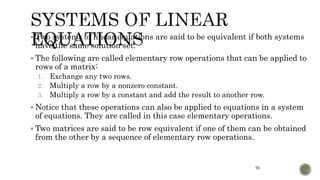
 Two systems of linear equations are said to be equivalent if both systems
have the same solution set.
 The following are called elementary row operations that can be applied to
rows of a matrix:
1. Exchange any two rows.
2. Multiply a row by a nonzero constant.
3. Multiply a row by a constant and add the result to another row.
 Notice that these operations can also be applied to equations in a system
of equations. They are called in this case elementary operations.
 Two matrices are said to be row equivalent if one of them can be obtained
from the other by a sequence of elementary row operations.
11
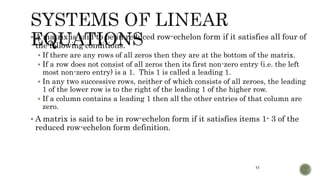
 A matrix is said to be in reduced row-echelon form if it satisfies all four of
the following conditions.
 If there are any rows of all zeros then they are at the bottom of the matrix.
 If a row does not consist of all zeros then its first non-zero entry (i.e. the left
most non-zero entry) is a 1. This 1 is called a leading 1.
 In any two successive rows, neither of which consists of all zeroes, the leading
1 of the lower row is to the right of the leading 1 of the higher row.
 If a column contains a leading 1 then all the other entries of that column are
zero.
 A matrix is said to be in row-echelon form if it satisfies items 1- 3 of the
reduced row-echelon form definition.
12
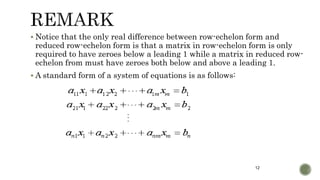
 Notice that the only real difference between row-echelon form and
reduced row-echelon form is that a matrix in row-echelon form is only
required to have zeroes below a leading 1 while a matrix in reduced row-
echelon from must have zeroes both below and above a leading 1.
 A standard form of a system of equations is as follows:
13
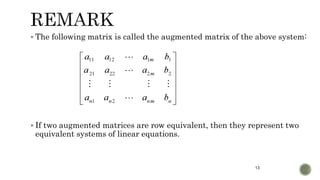
 The following matrix is called the augmented matrix of the above system:
 If two augmented matrices are row equivalent, then they represent two
equivalent systems of linear equations.
14
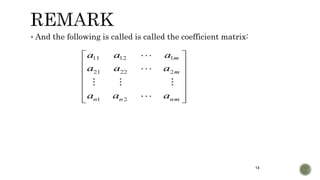
 And the following is called is called the coefficient matrix:

Operations Research - Simplex Method Introduction

  • 1.
    Chapter 02 -Simplex method introduction
  • 2.
    2 nn xcxcxcZ ...2211 0,...,0,0 0,...,0,0 ... ; . ... ... 21 21 2211 22222121 11212111      m n mnmnmm nn nn bbb xxx bxaxaxa bxaxaxa bxaxaxa  The standard form of an LPP with n variables and m unknowns is as follows:  Maximize  Subject to:
  • 3.
    3  Main featuresof the LPP standard form:  Maximize or Minimize the objective function.  All constraints are equations.  All decision variables are nonnegative.  The right hand side of each constraint is nonnegative.
  • 4.
    4  The abovestandard LPP can be written in matrix form as:  max(min) Z=CX  Subject to: Ax=b, x>=0, b>=0.  Where,                mnmm n n aaa aaa aaa A ... . ... ... 21 22221 11211  n n cc x x x x ...cc, b . b b b, . 21 m 2 1 2 1                           
  • 5.
    5  max  Subjectto:  Can be written in matrix form with: 54321 325 xxxxxZ  5,...,1,0 7x43 822 5321 4321    ix xxx xxxx i  11325, 7 8 ,, 10143 01221 5 4 3 2 1                               cb x x x x x xA
  • 6.
    6  The abovestandard form is required in order to start the simplex method. The question is how to convert a given problem from nonstandard form into standard form?, i.e. how to convert an inequality constraint into an equality?.  The answer to this question is to add the so called slack variables and surplus variables.  Back to the example of inspection, which had the constraints:  Minimize  Subject to: 21 3640 xxZ  0,0 4535 10 8 21 21 2 1     xx xx x x
  • 7.
    7  Minimize Subjectto:  The first constraint is converted to where represents the number of grade 1 inspectors who are not utilized.  The second constraint is converted to Where represents the number of grade 2 inspectors who are not utilized.  are called slack variables.  The third constraint is converted to  is called a surplus variable. It represents the number of extra pieces inspected over the min. required minimum. 21 3640 xxZ  0,0 4535 10 8 21 21 2 1     xx xx x x 0,8 331  xxx 3x 0,10 442  xxx 4x 43 and xx 0,4535 5521  xxxx 5x
  • 8.
    8  If theproblem contains a variable which is not restricted in sign, then we do the following: If is unrestricted in sign, then set  The value of (positive or negative) depends on the values of  Example: Convert the following problem into a standard LPP:  Solution: 1. Set 2. Multiply the last constraint by -1, to get: 3. Add a slack variable ( ) to 1st constraint to become: 4. Add a surplus variable ( ) to the 2nd constraint to become: 5. Replace by in the original problem , to get the standard form: 1x 321 xxx  1x 32 xandx edunrestrictx0,x,x -52x-x-3x 2x 7x:to. 32xZ 321 321 321 321 321      xx xxS xxMax .0xand, 54543  xxxx .523 321  xxx 6x .0,7 66321  xxxxx 7x .27321  xxxx 3x 54 xx 
  • 9.
    9  The standardform: 0,...,,x 5223x- 2x 7x:. 332xZ 721 5421 75421 65421 5421      xx xxx xxxx xxxxTS xxxMaximize
  • 10.
    10  Two systemsof linear equations are said to be equivalent if both systems have the same solution set.  The following are called elementary row operations that can be applied to rows of a matrix: 1. Exchange any two rows. 2. Multiply a row by a nonzero constant. 3. Multiply a row by a constant and add the result to another row.  Notice that these operations can also be applied to equations in a system of equations. They are called in this case elementary operations.  Two matrices are said to be row equivalent if one of them can be obtained from the other by a sequence of elementary row operations.
  • 11.
    11  A matrixis said to be in reduced row-echelon form if it satisfies all four of the following conditions.  If there are any rows of all zeros then they are at the bottom of the matrix.  If a row does not consist of all zeros then its first non-zero entry (i.e. the left most non-zero entry) is a 1. This 1 is called a leading 1.  In any two successive rows, neither of which consists of all zeroes, the leading 1 of the lower row is to the right of the leading 1 of the higher row.  If a column contains a leading 1 then all the other entries of that column are zero.  A matrix is said to be in row-echelon form if it satisfies items 1- 3 of the reduced row-echelon form definition.
  • 12.
    12  Notice thatthe only real difference between row-echelon form and reduced row-echelon form is that a matrix in row-echelon form is only required to have zeroes below a leading 1 while a matrix in reduced row- echelon from must have zeroes both below and above a leading 1.  A standard form of a system of equations is as follows:
  • 13.
    13  The followingmatrix is called the augmented matrix of the above system:  If two augmented matrices are row equivalent, then they represent two equivalent systems of linear equations.
  • 14.
    14  And thefollowing is called is called the coefficient matrix: