QUANTIFIERS
QUANTIFIERS
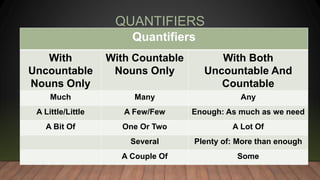
Quantifiers
With
Uncountable
Nouns Only
With Countable
Nouns Only
With Both
Uncountable And
Countable
Much Many Any
A Little/Little A Few/Few Enough: As much as we need
A Bit Of One Or Two A Lot Of
Several Plenty of: More than enough
A Couple Of Some
QUANTIFIERS
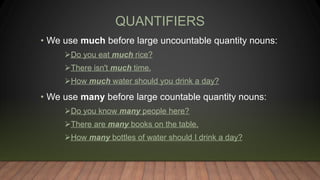
• We use much before large uncountable quantity nouns:
Do you eat much rice?
There isn't much time.
How much water should you drink a day?
• We use many before large countable quantity nouns:
Do you know many people here?
There are many books on the table.
How many bottles of water should I drink a day?
QUANTIFIERS
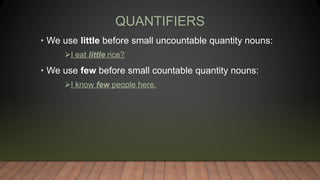
• We use little before small uncountable quantity nouns:
I eat little rice?
• We use few before small countable quantity nouns:
I know few people here.
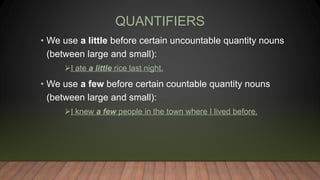
QUANTIFIERS
• We use a little before certain uncountable quantity nouns
(between large and small):
I ate a little rice last night.
• We use a few before certain countable quantity nouns
(between large and small):
I knew a few people in the town where I lived before.
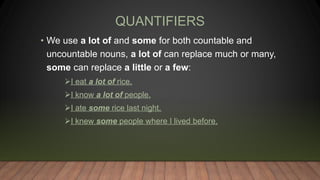
QUANTIFIERS
• We use a lot of and some for both countable and
uncountable nouns, a lot of can replace much or many,
some can replace a little or a few:
I eat a lot of rice.
I know a lot of people.
I ate some rice last night.
I knew some people where I lived before.
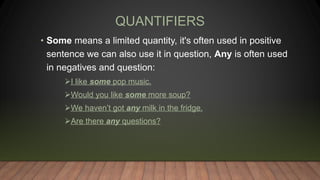
QUANTIFIERS
• Some means a limited quantity, it's often used in positive
sentence we can also use it in question, Any is often used
in negatives and question:
I like some pop music.
Would you like some more soup?
We haven’t got any milk in the fridge.
Are there any questions?
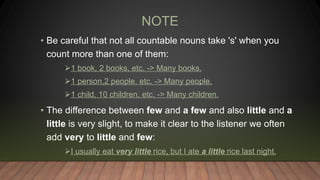
NOTE
• Be careful that not all countable nouns take 's' when you
count more than one of them:
1 book, 2 books, etc. -> Many books.
1 person,2 people, etc. -> Many people.
1 child, 10 children, etc. -> Many children.
• The difference between few and a few and also little and a
little is very slight, to make it clear to the listener we often
add very to little and few:
I usually eat very little rice, but I ate a little rice last night.
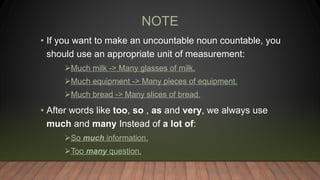
NOTE
• If you want to make an uncountable noun countable, you
should use an appropriate unit of measurement:
Much milk -> Many glasses of milk.
Much equipment -> Many pieces of equipment.
Much bread -> Many slices of bread.
• After words like too, so , as and very, we always use
much and many Instead of a lot of:
So much information.
Too many question.
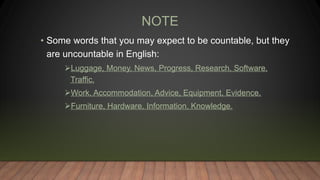
NOTE
• Some words that you may expect to be countable, but they
are uncountable in English:
Luggage, Money, News, Progress, Research, Software,
Traffic.
Work, Accommodation, Advice, Equipment, Evidence.
Furniture, Hardware, Information, Knowledge.
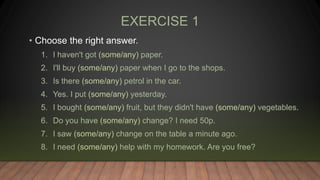
EXERCISE 1
• Choose the right answer.
1. I haven't got (some/any) paper.
2. I'll buy (some/any) paper when I go to the shops.
3. Is there (some/any) petrol in the car.
4. Yes. I put (some/any) yesterday.
5. I bought (some/any) fruit, but they didn't have (some/any) vegetables.
6. Do you have (some/any) change? I need 50p.
7. I saw (some/any) change on the table a minute ago.
8. I need (some/any) help with my homework. Are you free?
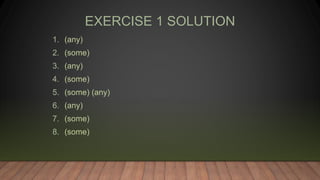
EXERCISE 1 SOLUTION
1. (any)
2. (some)
3. (any)
4. (some)
5. (some) (any)
6. (any)
7. (some)
8. (some)
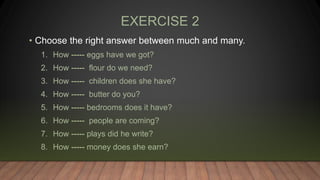
EXERCISE 2
• Choose the right answer between much and many.
1. How ----- eggs have we got?
2. How ----- flour do we need?
3. How ----- children does she have?
4. How ----- butter do you?
5. How ----- bedrooms does it have?
6. How ----- people are coming?
7. How ----- plays did he write?
8. How ----- money does she earn?
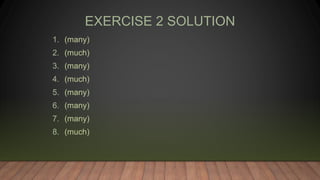
EXERCISE 2 SOLUTION
1. (many)
2. (much)
3. (many)
4. (much)
5. (many)
6. (many)
7. (many)
8. (much)
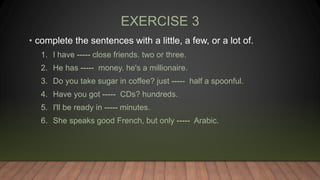
EXERCISE 3
• complete the sentences with a little, a few, or a lot of.
1. I have ----- close friends. two or three.
2. He has ----- money. he's a millionaire.
3. Do you take sugar in coffee? just ----- half a spoonful.
4. Have you got ----- CDs? hundreds.
5. I'll be ready in ----- minutes.
6. She speaks good French, but only ----- Arabic.
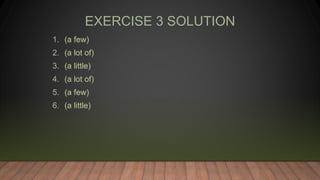
EXERCISE 3 SOLUTION
1. (a few)
2. (a lot of)
3. (a little)
4. (a lot of)
5. (a few)
6. (a little)

Quantifiers

  • 1.
  • 2.
    QUANTIFIERS Quantifiers With Uncountable Nouns Only With Countable NounsOnly With Both Uncountable And Countable Much Many Any A Little/Little A Few/Few Enough: As much as we need A Bit Of One Or Two A Lot Of Several Plenty of: More than enough A Couple Of Some
  • 3.
    QUANTIFIERS • We usemuch before large uncountable quantity nouns: Do you eat much rice? There isn't much time. How much water should you drink a day? • We use many before large countable quantity nouns: Do you know many people here? There are many books on the table. How many bottles of water should I drink a day?
  • 4.
    QUANTIFIERS • We uselittle before small uncountable quantity nouns: I eat little rice? • We use few before small countable quantity nouns: I know few people here.
  • 5.
    QUANTIFIERS • We usea little before certain uncountable quantity nouns (between large and small): I ate a little rice last night. • We use a few before certain countable quantity nouns (between large and small): I knew a few people in the town where I lived before.
  • 6.
    QUANTIFIERS • We usea lot of and some for both countable and uncountable nouns, a lot of can replace much or many, some can replace a little or a few: I eat a lot of rice. I know a lot of people. I ate some rice last night. I knew some people where I lived before.
  • 7.
    QUANTIFIERS • Some meansa limited quantity, it's often used in positive sentence we can also use it in question, Any is often used in negatives and question: I like some pop music. Would you like some more soup? We haven’t got any milk in the fridge. Are there any questions?
  • 8.
    NOTE • Be carefulthat not all countable nouns take 's' when you count more than one of them: 1 book, 2 books, etc. -> Many books. 1 person,2 people, etc. -> Many people. 1 child, 10 children, etc. -> Many children. • The difference between few and a few and also little and a little is very slight, to make it clear to the listener we often add very to little and few: I usually eat very little rice, but I ate a little rice last night.
  • 9.
    NOTE • If youwant to make an uncountable noun countable, you should use an appropriate unit of measurement: Much milk -> Many glasses of milk. Much equipment -> Many pieces of equipment. Much bread -> Many slices of bread. • After words like too, so , as and very, we always use much and many Instead of a lot of: So much information. Too many question.
  • 10.
    NOTE • Some wordsthat you may expect to be countable, but they are uncountable in English: Luggage, Money, News, Progress, Research, Software, Traffic. Work, Accommodation, Advice, Equipment, Evidence. Furniture, Hardware, Information, Knowledge.
  • 11.
    EXERCISE 1 • Choosethe right answer. 1. I haven't got (some/any) paper. 2. I'll buy (some/any) paper when I go to the shops. 3. Is there (some/any) petrol in the car. 4. Yes. I put (some/any) yesterday. 5. I bought (some/any) fruit, but they didn't have (some/any) vegetables. 6. Do you have (some/any) change? I need 50p. 7. I saw (some/any) change on the table a minute ago. 8. I need (some/any) help with my homework. Are you free?
  • 12.
    EXERCISE 1 SOLUTION 1.(any) 2. (some) 3. (any) 4. (some) 5. (some) (any) 6. (any) 7. (some) 8. (some)
  • 13.
    EXERCISE 2 • Choosethe right answer between much and many. 1. How ----- eggs have we got? 2. How ----- flour do we need? 3. How ----- children does she have? 4. How ----- butter do you? 5. How ----- bedrooms does it have? 6. How ----- people are coming? 7. How ----- plays did he write? 8. How ----- money does she earn?
  • 14.
    EXERCISE 2 SOLUTION 1.(many) 2. (much) 3. (many) 4. (much) 5. (many) 6. (many) 7. (many) 8. (much)
  • 15.
    EXERCISE 3 • completethe sentences with a little, a few, or a lot of. 1. I have ----- close friends. two or three. 2. He has ----- money. he's a millionaire. 3. Do you take sugar in coffee? just ----- half a spoonful. 4. Have you got ----- CDs? hundreds. 5. I'll be ready in ----- minutes. 6. She speaks good French, but only ----- Arabic.
  • 16.
    EXERCISE 3 SOLUTION 1.(a few) 2. (a lot of) 3. (a little) 4. (a lot of) 5. (a few) 6. (a little)