Inequalities and Modulus
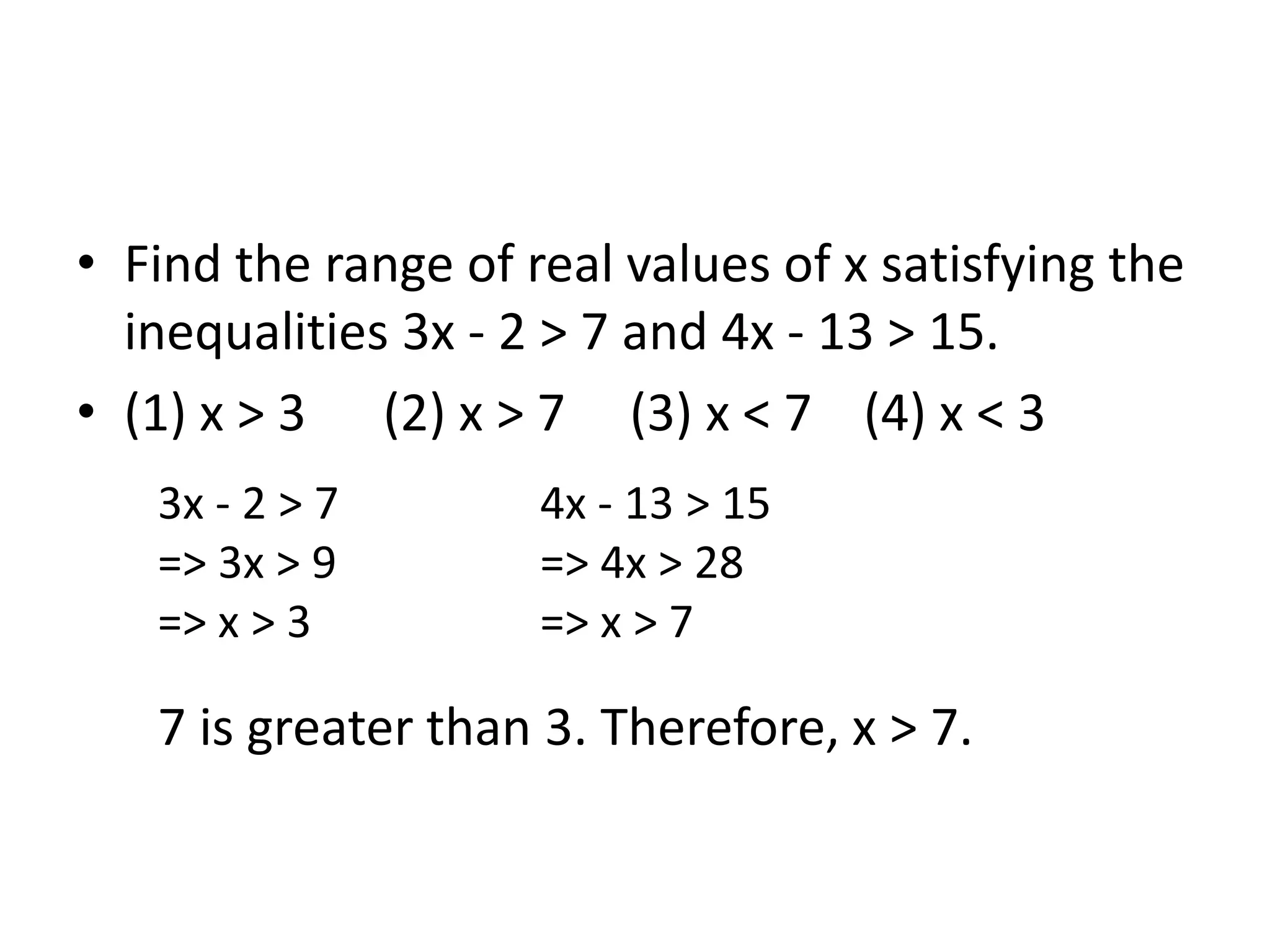
• Find the range of real values of x satisfying the
inequalities 3x - 2 > 7 and 4x - 13 > 15.
• (1) x > 3 (2) x > 7 (3) x < 7 (4) x < 3
3x - 2 > 7
=> 3x > 9
=> x > 3
4x - 13 > 15
=> 4x > 28
=> x > 7
7 is greater than 3. Therefore, x > 7.
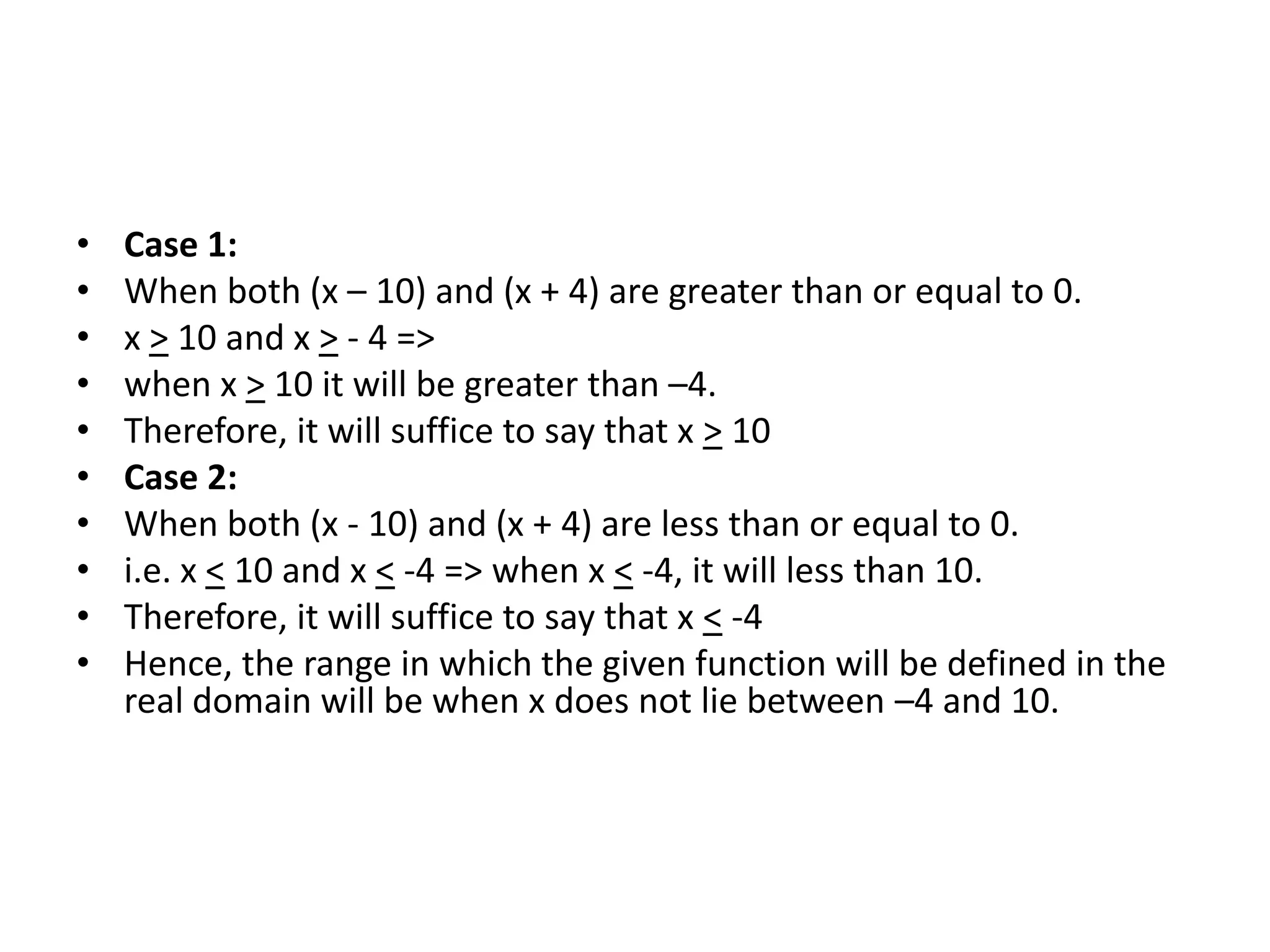
• Case 1:
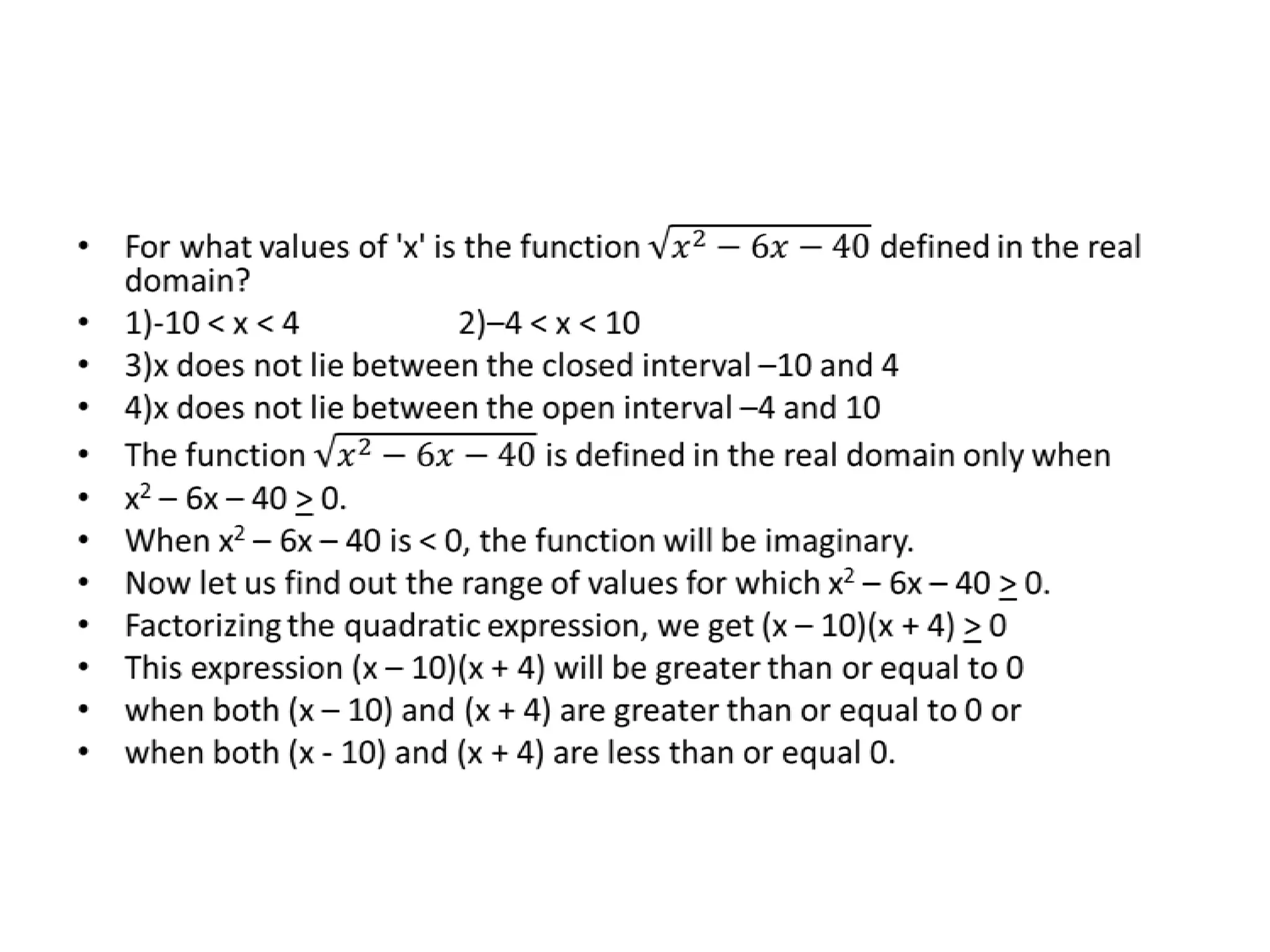
• When both (x – 10) and (x + 4) are greater than or equal to 0.
• x > 10 and x > - 4 =>
• when x > 10 it will be greater than –4.
• Therefore, it will suffice to say that x > 10
• Case 2:
• When both (x - 10) and (x + 4) are less than or equal to 0.
• i.e. x < 10 and x < -4 => when x < -4, it will less than 10.
• Therefore, it will suffice to say that x < -4
• Hence, the range in which the given function will be defined in the
real domain will be when x does not lie between –4 and 10.
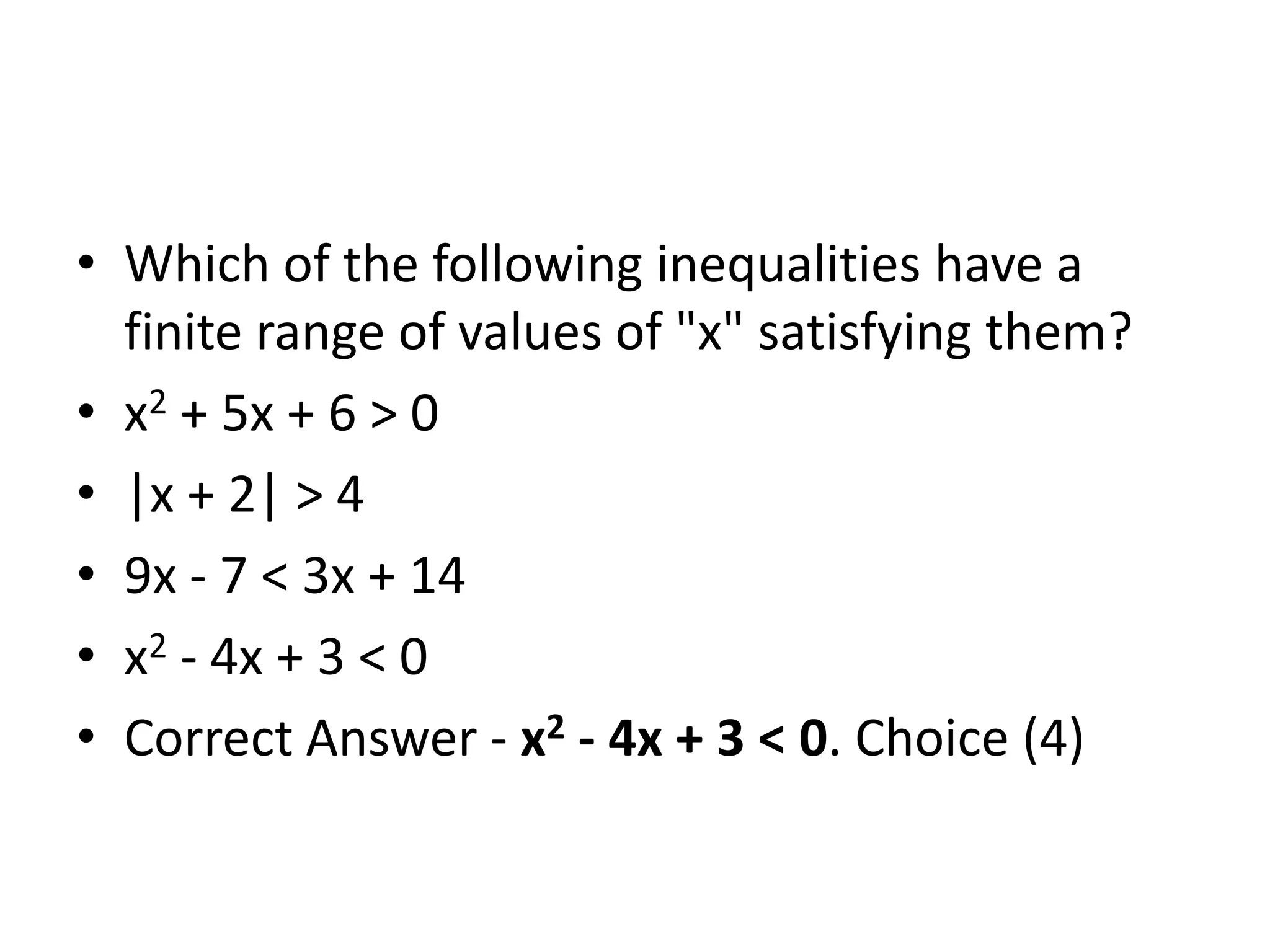
• Which of the following inequalities have a
finite range of values of "x" satisfying them?
• x2 + 5x + 6 > 0
• |x + 2| > 4
• 9x - 7 < 3x + 14
• x2 - 4x + 3 < 0
• Correct Answer - x2 - 4x + 3 < 0. Choice (4)
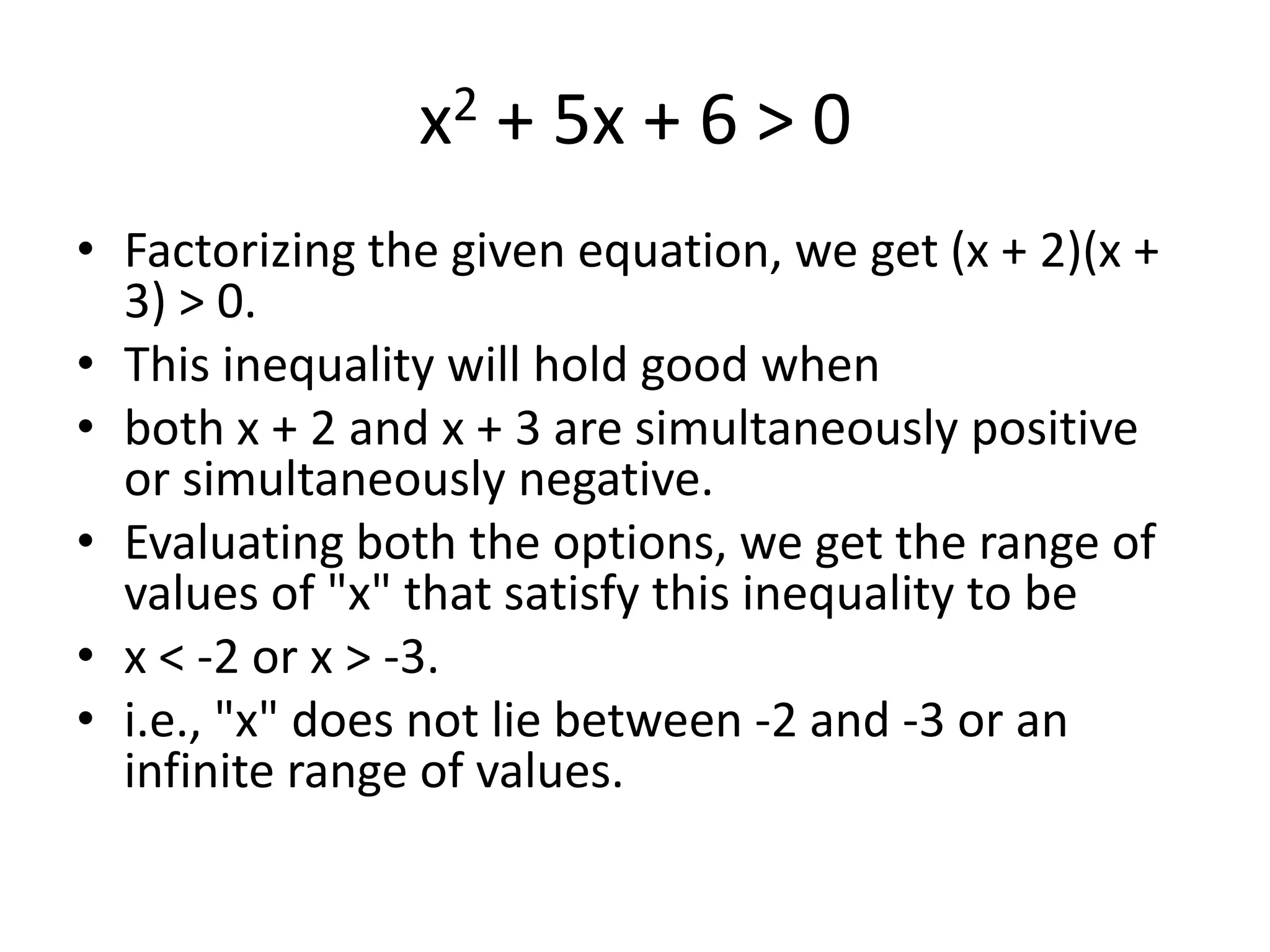
x2 + 5x + 6 > 0
• Factorizing the given equation, we get (x + 2)(x +
3) > 0.
• This inequality will hold good when
• both x + 2 and x + 3 are simultaneously positive
or simultaneously negative.
• Evaluating both the options, we get the range of
values of "x" that satisfy this inequality to be
• x < -2 or x > -3.
• i.e., "x" does not lie between -2 and -3 or an
infinite range of values.
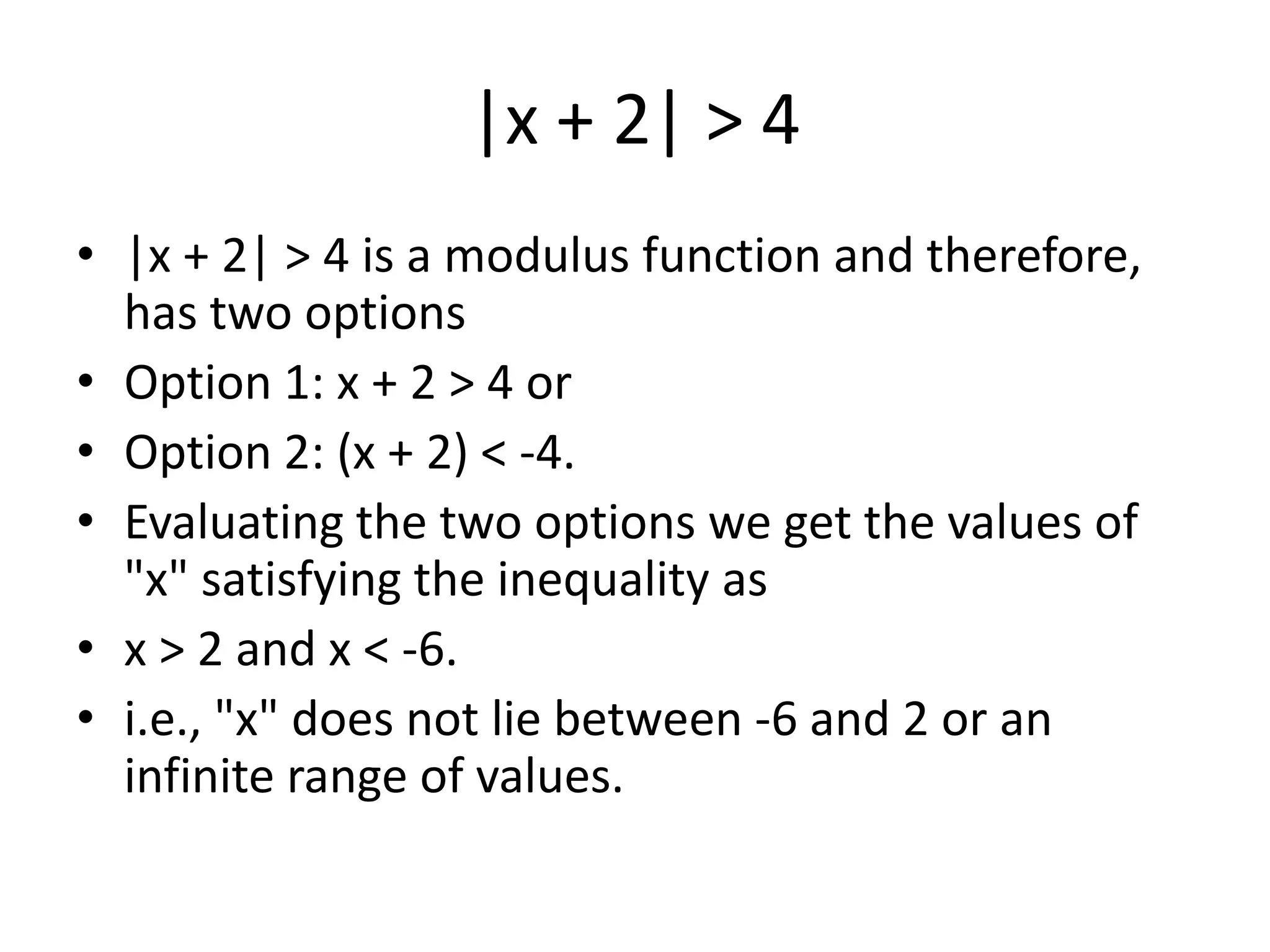
|x + 2| > 4
• |x + 2| > 4 is a modulus function and therefore,
has two options
• Option 1: x + 2 > 4 or
• Option 2: (x + 2) < -4.
• Evaluating the two options we get the values of
"x" satisfying the inequality as
• x > 2 and x < -6.
• i.e., "x" does not lie between -6 and 2 or an
infinite range of values.
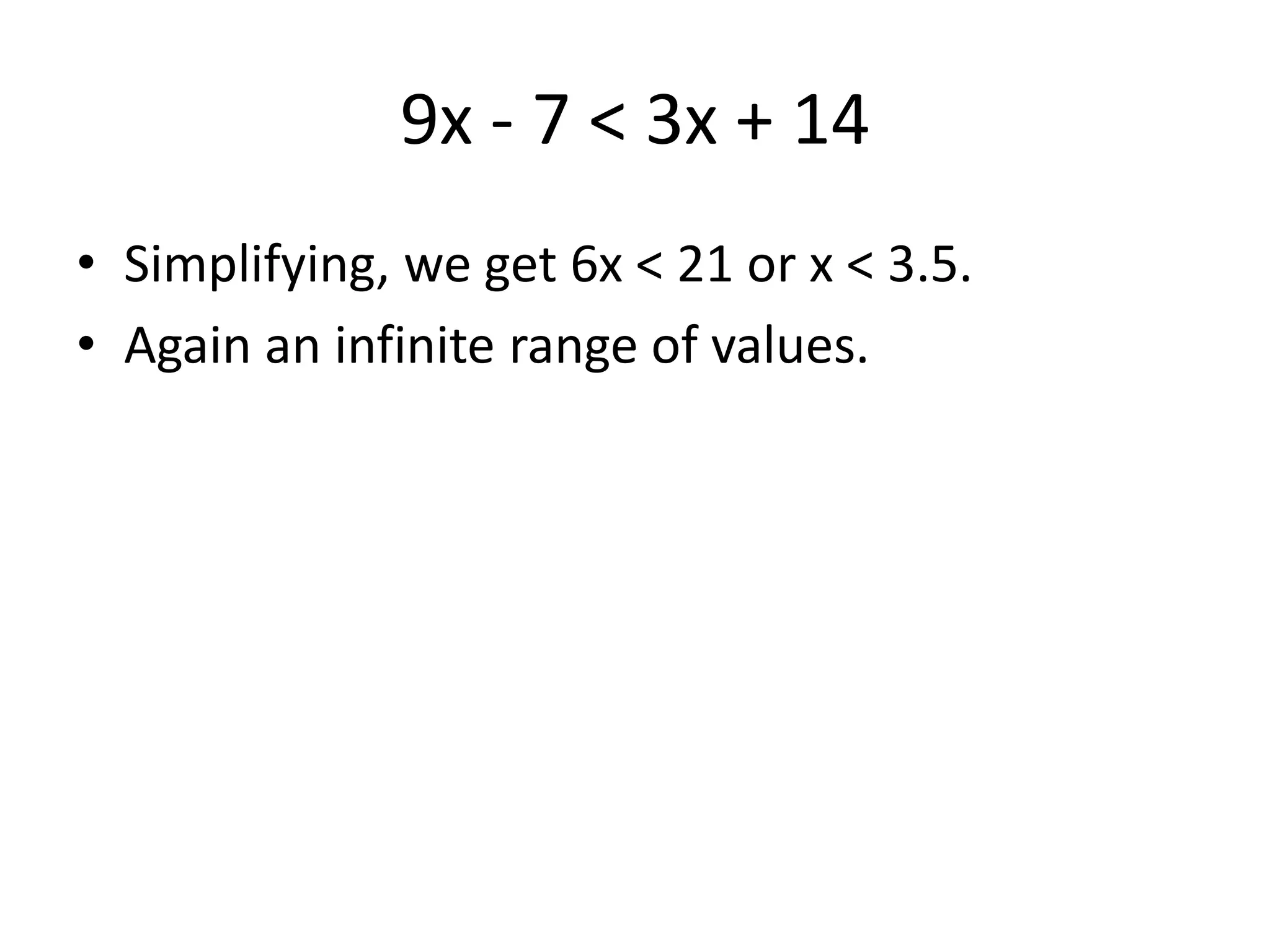
9x - 7 < 3x + 14
• Simplifying, we get 6x < 21 or x < 3.5.
• Again an infinite range of values.
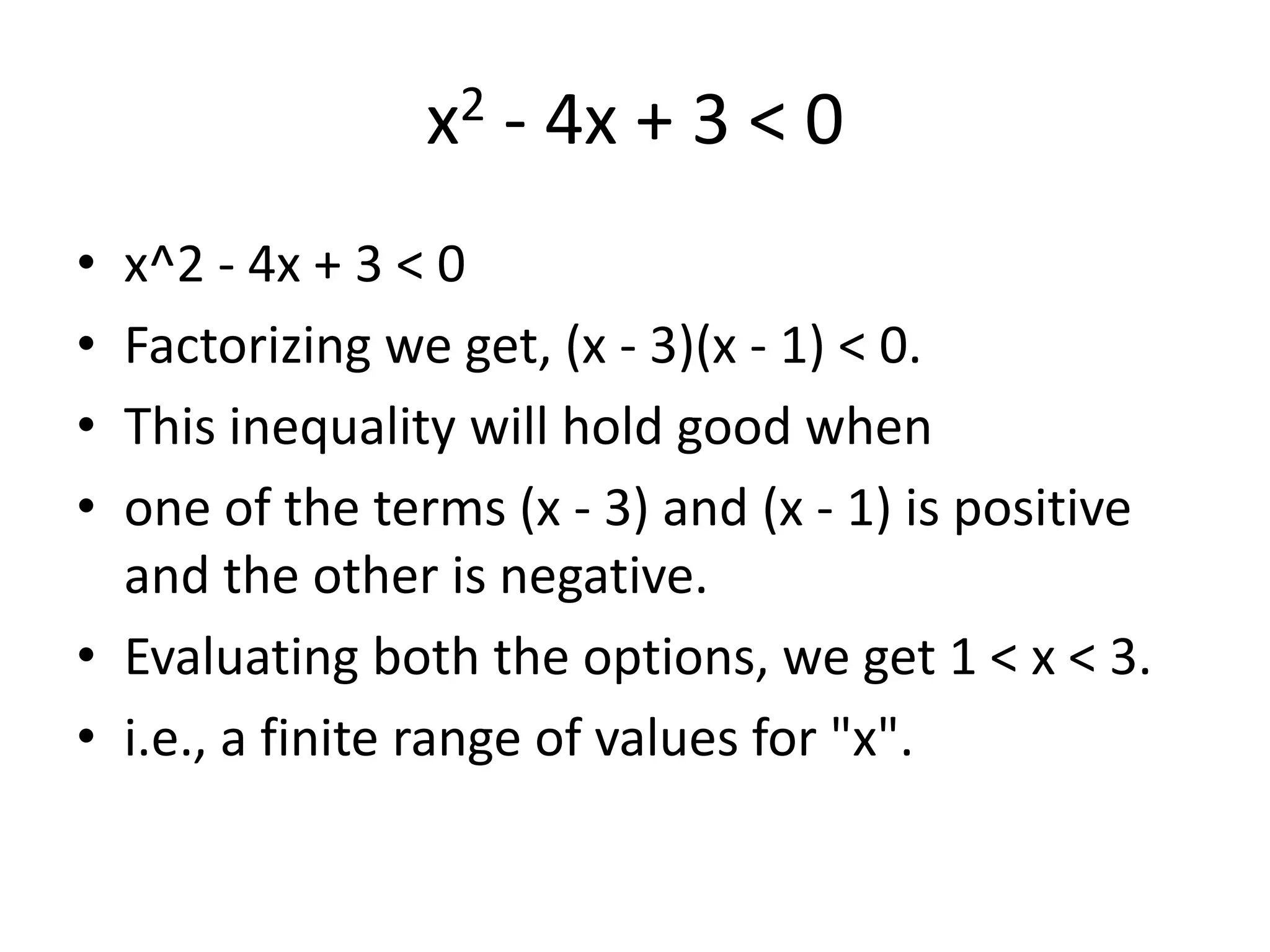
x2 - 4x + 3 < 0
• x^2 - 4x + 3 < 0
• Factorizing we get, (x - 3)(x - 1) < 0.
• This inequality will hold good when
• one of the terms (x - 3) and (x - 1) is positive
and the other is negative.
• Evaluating both the options, we get 1 < x < 3.
• i.e., a finite range of values for "x".
Inequalities and modulus

Inequalities and modulus

  • 1.
  • 2.
    • Find therange of real values of x satisfying the inequalities 3x - 2 > 7 and 4x - 13 > 15. • (1) x > 3 (2) x > 7 (3) x < 7 (4) x < 3 3x - 2 > 7 => 3x > 9 => x > 3 4x - 13 > 15 => 4x > 28 => x > 7 7 is greater than 3. Therefore, x > 7.
  • 6.
    • Case 1: •When both (x – 10) and (x + 4) are greater than or equal to 0. • x > 10 and x > - 4 => • when x > 10 it will be greater than –4. • Therefore, it will suffice to say that x > 10 • Case 2: • When both (x - 10) and (x + 4) are less than or equal to 0. • i.e. x < 10 and x < -4 => when x < -4, it will less than 10. • Therefore, it will suffice to say that x < -4 • Hence, the range in which the given function will be defined in the real domain will be when x does not lie between –4 and 10.
  • 7.
    • Which ofthe following inequalities have a finite range of values of "x" satisfying them? • x2 + 5x + 6 > 0 • |x + 2| > 4 • 9x - 7 < 3x + 14 • x2 - 4x + 3 < 0 • Correct Answer - x2 - 4x + 3 < 0. Choice (4)
  • 8.
    x2 + 5x+ 6 > 0 • Factorizing the given equation, we get (x + 2)(x + 3) > 0. • This inequality will hold good when • both x + 2 and x + 3 are simultaneously positive or simultaneously negative. • Evaluating both the options, we get the range of values of "x" that satisfy this inequality to be • x < -2 or x > -3. • i.e., "x" does not lie between -2 and -3 or an infinite range of values.
  • 9.
    |x + 2|> 4 • |x + 2| > 4 is a modulus function and therefore, has two options • Option 1: x + 2 > 4 or • Option 2: (x + 2) < -4. • Evaluating the two options we get the values of "x" satisfying the inequality as • x > 2 and x < -6. • i.e., "x" does not lie between -6 and 2 or an infinite range of values.
  • 10.
    9x - 7< 3x + 14 • Simplifying, we get 6x < 21 or x < 3.5. • Again an infinite range of values.
  • 11.
    x2 - 4x+ 3 < 0 • x^2 - 4x + 3 < 0 • Factorizing we get, (x - 3)(x - 1) < 0. • This inequality will hold good when • one of the terms (x - 3) and (x - 1) is positive and the other is negative. • Evaluating both the options, we get 1 < x < 3. • i.e., a finite range of values for "x".