SERVICE SUPPLY CHAIN: AN INTEGRATED
      CONCEPTUAL FRAMEWORK


          SUMIT SAKHUJA AND VIPUL JAIN


      DEPARTMENT OF MECHANICAL ENGINEERING
    INDIAN INSTITUTE OF TECHNOLOGY, DELHI, INDIA   1
MOTIVATION


             2
SERVICES ALL AROUND US


                         3
Services contribution in US


                              4
5
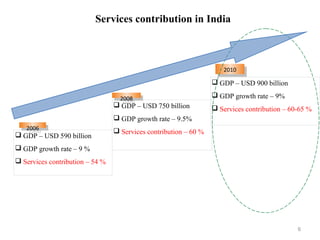
Services contribution in India


                                                                     2010
                                                                      2010
                                                                   GDP – USD 900 billion

                                   2008                            GDP growth rate – 9%
                                    2008
                                  GDP – USD 750 billion           Services contribution – 60-65 %
                                  GDP growth rate – 9.5%
   2006
    2006                          Services contribution – 60 %
 GDP – USD 590 billion
 GDP growth rate – 9 %
 Services contribution – 54 %


                                                                                              6
REASON FOR SUCCESS
          OF
MANUFACTURING COMPANIES
          IS

 SUPPLY CHAIN NETWORK
      MANAGEMENT


                          7
8
h in SSCM
                  Researc

         in SCM
    arch
Rese


                                        9
CAN SERVICES BE VIEWED AS
NETWORK/CHAIN OF ACTIVITIES?


               SERVICES
         N S
      LE
       M
    SC


                               10
INTRODUCTION
• A Service Supply Chain (SSC) is a network of service provider facilities
  (in-house or outsourced), each of which is able to process one or more
  service tasks on an as needed basis.

• Two key characteristics of a SSC are
      (i) the business service is decomposable into several sequential
      tasks that can be processed by different service providers, and
      (ii) the primary capacity resource is skilled labor.

• SSCs are increasingly being developed by companies that experience a
  high variability in the demand for their services (e.g., loan processing,
  analytical consulting services, emergency repair crews, claims
  processing, etc.).

                                                                       11
Service Product Delivered by a Service Supply Chain
                                                          SERVICE JOB


                               SERVICE PRODUCT                     TASK 2   PROVIDER A
 CUSTOMER                          REQUEST       TASK 1


                                                 TASK 3
                                                                            PROVIDER B
                Y RE V L E D
                     I
   C UD ORP E C VRES


                                                                   TASK 4   PROVIDER C
                                                 TASK 5
              I


                                                                                  12
LITERATURE REVIEW

• Services

• Service Operations Management

• Service Supply Chain Management


                                    13
SERVICES


           14
Service Definitions
Author (year)                       Definition
Levitt, 1972                        A service is a personal performance.
Hill, 1977                          A service may be defined as a change in the conditions of a person
                                    or a good belonging to some economic unit, which is brought about
                                    as a result of the activity of some other economic unit with the prior
                                    agreement of the former person or economic unit.


Chase, 1978                         Services are processes involving customer contact.
Berry, 1980                         A service is a deed, act or performance.
Murdick et al., 1990                Define services as "economic activities that produce time, place,
                                    form, or psychological utilities”.
Fitzsimmons     and    Fitzsimmons, Define services as a time-perishable, intangible experience
2004                                performed for a customer acting in the role of co-producer.
Spohrer et al., 2007                Service is typically considered as an application of specialized
                                    knowledge, skills, and experiences, performed for the benefit of
                                    another.

                                                                                                    15
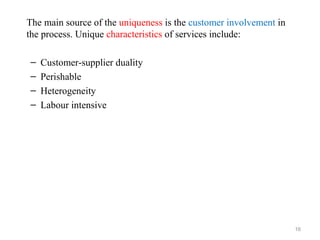
The main source of the uniqueness is the customer involvement in
the process. Unique characteristics of services include:

–   Customer-supplier duality
–   Perishable
–   Heterogeneity
–   Labour intensive


                                                                   16
Several characteristics that have been identified in the literature
include:

–   the degree of labour intensity;
–   the degree of interaction;
–   the degree of customisation;
–   the volume of the output;
–   variety and flexibility of services offered;
–   the length of customer contact time


                                                                 17
Service Typology

         EXTENT OF CUSTOMER CONTACT AND LABOR INTENSITY


          SERVICE FACTORY
           Ex: Transportation,       MASS SERVICES
          Airline, Hotel, Resort,   Ex: Retailing, Schools.
                Recreation


            SERVICE SHOP              PROFESSIONAL
           Ex: Hospitals, Banks,         SERVICES
               Auto Repairs         Ex: Law firms, Doctors,
                                         Accountants


                                                              18
Service Concept
                                    Elements                              Examples
                       Supporting Facilities                 Facilities layout, décor, support
                                                             technology and equipment, branch
                                                             network, kiosks, roller coasters
                       Facilitating goods (physical items)   Food, ATM cards, forms, receipts,
                                                             check-book, golf clubs
                       Facilitating Information              Schedules, fee structures, data,
 Core Services                                               medical records, web page design,
                                                             diagnostics
                       Explicit                   Services Satisfy hunger, transportation,
                       (experimental/sensual)              surgery,    transactions,  and
                                                           entertainment.
                       Implicit Services (psychological Comfort, status, convenience, well
                       benefits)                        being, delight
                                                             Services/facilities that supplement or
                                                             “surround” the core service (e.g.
                 Peripheral Services                         valet parking for hospital services,
                                                             shopping at terminals for air
                                                             transportation services)
                                                                                              19
SERVICES OPERATIONS MANAGEMENT


                             20
Service
                            Service
           provider
           selection &      forecasting
           Outsourcin
           g

 Service                                Demand
 performance                            management
 measurement


                       Service
Service              Operations/          Capacity
quality               Activities          management
measurement


    Customer                       Coordination
    related issues                 &
                                   Collaboratio
                                   n
                 Application of
                 manufacturing
                 principles


                                                       21
SERVICE SUPPLY CHAIN MANAGEMENT


                              22
Reasons why services can be viewed as a part of supply chains
(Giannakis 2011)
• Coordination of processes
  For the design and delivery of services a large number of
  independent stakeholders may be involved, whose processes need
  to be coordinated.

• Improved performance through process integration
  Considering services as part of supply chains offers a holistic
  perspective of the processes involved for their creation and
  provision and the weaknesses that need to be addressed.

• Improvement of the customer interface
  The high level of customer contact in services stresses the
  importance for an organisation to react swiftly to customer
                                                          23
  feedback
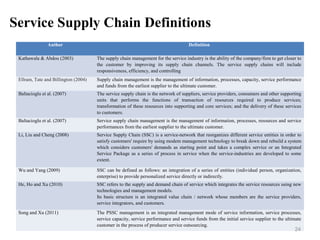
Service Supply Chain Definitions
                Author                                                               Definition

 Kathawala & Abdou (2003)             The supply chain management for the service industry is the ability of the company/firm to get closer to
                                      the customer by improving its supply chain channels. The service supply chains will include
                                      responsiveness, efficiency, and controlling
 Ellram, Tate and Billington (2004)   Supply chain management is the management of information, processes, capacity, service performance
                                      and funds from the earliest supplier to the ultimate customer.
 Baltacioglu et al. (2007)            The service supply chain is the network of suppliers, service providers, consumers and other supporting
                                      units that performs the functions of transaction of resources required to produce services;
                                      transformation of these resources into supporting and core services; and the delivery of these services
                                      to customers.
 Baltacioglu et al. (2007)            Service supply chain management is the management of information, processes, resources and service
                                      performances from the earliest supplier to the ultimate customer.
 Li, Liu and Cheng (2008)             Service Supply Chain (SSC) is a service-network that reorganizes different service entities in order to
                                      satisfy customers' require by using modem management technology to break down and rebuild a system
                                      which considers customers' demands as starting point and takes a complex service or an Integrated
                                      Service Package as a series of process in service when the service-industries are developed to some
                                      extent.

 Wu and Yang (2009)                   SSC can be defined as follows: an integration of a series of entities (individual person, organization,
                                      enterprise) to provide personalized service directly or indirectly.
 He, Ho and Xu (2010)                 SSC refers to the supply and demand chain of service which integrates the service resources using new
                                      technologies and management models.
                                      Its basic structure is an integrated value chain / network whose members are the service providers,
                                      service integrators, and customers.
 Song and Xu (2011)                   The PSSC management is an integrated management mode of service information, service processes,
                                      service capacity, service performance and service funds from the initial service supplier to the ultimate
                                      customer in the process of producer service outsourcing.
                                                                                                                                           24
Structure of Service Supply Chain
   Three key elements of a service supply chain are

  Service Providers
    • provide standardized, single-service types,
    • have a strong ability to cooperate and collaborate,
    • according to the service integrator’s special requirement on
      service capabilities and process, service providers can
      make appropriate adjustments.


                                                                25
 Service Integrators
   • core enterprise in a service supply chain,
   • have a highly efficient information-processing,
   • powerful service design ability to integrate services,
   • coordinate service provider to provide customized services
     on consumer’s demand,
   • through customer demand forecasting and customer
     relationship management service integrators can keep up
     with changes of customer demand so as to create and seek
     the value of new growth points,
   • and service integrators can integrate the resources and
     capabilities of service providers, improve the integration of
     service.


                                                                26
 Customers
   • customer can be an organization or an individual,
   • depending upon the type of customer the operations of SSC
     are initiated,
   • performance of the SSC can be measured from the
     customer perspective,
   • customers are the initial suppliers in a SSC (Sampson
     2000).


                                                            27
Service Supply Chain (Source: Baltacioglu et al. 2007).
                                                          28
Decision Levels in a Service Supply Chain

 Level-one decisions
   • these decisions are in the area of service business planning,
   • have a long term effect on the service supply chain,
   • senior management is frequently the decision maker and
     user of this information,
   • quick response is not the requirement at this level since
     these decisions are not made or revisited every day,
   • examples of level-one decisions are dynamic sourcing,
     service provider selection, capacity planning, service
     delivery, service quality, service productivity etc.


                                                                29
 Level-two decisions
   • these decisions are in the area of tactical planning, and they
     have a shorter life than level-one decisions,
   • detailed information is available, and the data probably are
     very reliable,
   • these decisions are constrained by level-one decisions with
     some leeway to account for sudden change in data,
   • at this level, quick response is nice to have, and
     occasionally a requirement,
   • an example of level-two decision is one that needs to
     commit priority orders and obey commitments made in
     level one, like capacity planning, effectiveness in
     scheduling, supplier cost and pricing issues, forecasting
     accuracy etc.

                                                                  30
 Level-three decisions
   • these decisions are in the area of operational planning and
     scheduling,
   • the effect of these decisions is short term and they are
     constrained by level-one and level-two decisions,
   • quick response is an absolutely necessity,
   • examples are staff scheduling, short term forecasting,
     resource allocation, the service order entry method, the
     customer service order path, capacity utilization, operating
     ratio of actual to planned working hours, etc.


                                                               31
Year wise Publications on Service Supply Chains.


                                                   32
Application Area of Service Supply Chain


                                           33
Examples of SSC


                  34
(Sampson, 2000)   35
LOGISTICS SERVICE SUPPLY CHAIN


                    (Du and Rong, 2010)


                                          36
(Song and Xu, 2011)
(Hu and Xianlong, 2011)


                                                37
TOURISM SUPPLY CHAIN


                       (Zhang et al. 2009)


                                             38
SUPPLY CHAIN OF PROPERTY PURCHASE


                      (Giannikis, 2011)


                                          39
EDUCATION SUPPLY CHAIN


                  (Habib and Jungthirapanich, 2010)


                                                      40
PORT SERVICE SUPPLY CHAIN


                       (Zhang et al. 2009)
                                             41
HOTEL SUPPLY CHAIN


                     42
• Financial Service Supply chains, Legal Service
  Supply Chains, Healthcare Service Supply
  Chains, Telecommunication Service Supply
  Chains and more……….


                                                   43
LEARNING FROM THE LITERATURE


                               44
CUSTOMER     CUSTOMER         CUSTOMER        CUSTOMER


                                                               INFORMATION MANAGEMENT
                                                    SERVICE
      SERVICE                                       DELIVERY
      DEMAND
    MANAGEMENT


                      SERVICE INTEGRATOR
C     SERVICE
O    CAPACITY                        SERVICE
L   MANAGEMENT                    CUSTOMIZATION
L
A
B
O     SERVICE      SERVICE            SERVICE
R    PROVIDER    OUTSOURCING       INTEGRATION
A    SELECTION
T
I
O
N

      SERVICE     SERVICE           SERVICE        SERVICE
     PROVIDER    PROVIDER          PROVIDER       PROVIDER


    Conceptual Framework of Service Supply Chain
                                                                                        45
AN INTEGRATED CONCEPTUAL FRAMEWORK

• The proposed framework highlights the structure of the SSC
  with three basic elements that are customers, service
  integrator as a core and service providers.
• The framework explains the flow of key activities that are
  carried out in a typical SSC.
• It shows that in a SSC, there can be a number of customers,
  each of their individual service demands are forwarded to the
  service integrator.
• The service integrator here is considered as the core element
  of the SSC.
• Service integrator is responsible for managing customer
  demand, through its demand management capability.

                                                             46
• Capacity management is done by selecting service providers
  who are capable of performing the required service tasks.
• These service operations can also be outsourced to different
  service provider using various service outsourcing strategies.
• After the service providers perform their operations and come
  up with service solutions, these services need to be integrated
  and customized depending upon the customer requirements.
• Finally, the customised service package is delivered to the final
  customer through a well managed service delivery system,
  which is again the core activity of the service integrator.


                                                                47
CONCLUSIONS
• The framework provides insights into the conceptualization of
  the service supply chain management (SSCM) field.
• The work enables us to briefly describe SSCM, suggest how it
  should be described and structured and also highlights the
  various decisions that are needed to produce and deliver the
  services to the customer through a SSC network.
• This generic model can fit to different service industries, and
  also provides the vision to the service operation managers to
  carry out their service activities in a systematic and planned
  manner to achieve organizational objectives.


                                                               48
KEY REFERENCES
•   Baltacioglu, T., E. Ada, M.D. Kaplan, O. Yurt and Y.C. Kaplan. ‘A New Framework for
    Service Supply Chains’, The Service Industries Journal, (27:2), 2007, pp.105–124.
•   Ellram, L.M, W.L. Tate and C. Billington, “Understanding and Managing the Services
    Supply Chain’, The Journal of Supply Chain Management A Global Review of Purchasing
    and Supply, (40:4), 2004, pp 17-32.
•   Ellram, L.M, W.L. Tate and C. Billington, “Services Supply Management: the next frontier
    for improved organizational performance”, California Management Review, (49:4), 2007, pp.
    44-66.
•   Giannakis. M. ‘Conceptualizing and managing service supply chains’, The Service Industries
    Journal, (31:11), 2011, pp. 1809–1823.
•   Cho, D.W., Y.H. Lee, S.H. Ahn and M.K. Hwang. ‘A framework for measuring the
    performance of service supply chain management, International Conference on Computers
    and Industrial engineering, 2011.
•   Sampson, S.E. ‘Customer-supplier duality and bidirectional supply chains in service
    organizations’, International Journal of Service Industry Management, (11:4), 2000, pp. 348-
    364.
•   Sengupta. K, D.R. Heiser and L.S. Cook. ‘Manufacturing and Service Supply Chain
    Performance: A Comparative Analysis’, The Journal of Supply Chain Management, (42:4),
    2006, pp. 4-15.


                                                                                           49
THANK YOU


            50

Cie 42

  • 1.
    SERVICE SUPPLY CHAIN:AN INTEGRATED CONCEPTUAL FRAMEWORK SUMIT SAKHUJA AND VIPUL JAIN DEPARTMENT OF MECHANICAL ENGINEERING INDIAN INSTITUTE OF TECHNOLOGY, DELHI, INDIA 1
  • 2.
  • 3.
  • 4.
  • 5.
  • 6.
    Services contribution inIndia 2010 2010  GDP – USD 900 billion 2008  GDP growth rate – 9% 2008  GDP – USD 750 billion  Services contribution – 60-65 %  GDP growth rate – 9.5% 2006 2006  Services contribution – 60 %  GDP – USD 590 billion  GDP growth rate – 9 %  Services contribution – 54 % 6
  • 7.
    REASON FOR SUCCESS OF MANUFACTURING COMPANIES IS SUPPLY CHAIN NETWORK MANAGEMENT 7
  • 8.
  • 9.
    h in SSCM Researc in SCM arch Rese 9
  • 10.
    CAN SERVICES BEVIEWED AS NETWORK/CHAIN OF ACTIVITIES? SERVICES N S LE M SC 10
  • 11.
    INTRODUCTION • A ServiceSupply Chain (SSC) is a network of service provider facilities (in-house or outsourced), each of which is able to process one or more service tasks on an as needed basis. • Two key characteristics of a SSC are (i) the business service is decomposable into several sequential tasks that can be processed by different service providers, and (ii) the primary capacity resource is skilled labor. • SSCs are increasingly being developed by companies that experience a high variability in the demand for their services (e.g., loan processing, analytical consulting services, emergency repair crews, claims processing, etc.). 11
  • 12.
    Service Product Deliveredby a Service Supply Chain SERVICE JOB SERVICE PRODUCT TASK 2 PROVIDER A CUSTOMER REQUEST TASK 1 TASK 3 PROVIDER B Y RE V L E D I C UD ORP E C VRES TASK 4 PROVIDER C TASK 5 I 12
  • 13.
    LITERATURE REVIEW • Services •Service Operations Management • Service Supply Chain Management 13
  • 14.
  • 15.
    Service Definitions Author (year) Definition Levitt, 1972 A service is a personal performance. Hill, 1977 A service may be defined as a change in the conditions of a person or a good belonging to some economic unit, which is brought about as a result of the activity of some other economic unit with the prior agreement of the former person or economic unit. Chase, 1978 Services are processes involving customer contact. Berry, 1980 A service is a deed, act or performance. Murdick et al., 1990 Define services as "economic activities that produce time, place, form, or psychological utilities”. Fitzsimmons and Fitzsimmons, Define services as a time-perishable, intangible experience 2004 performed for a customer acting in the role of co-producer. Spohrer et al., 2007 Service is typically considered as an application of specialized knowledge, skills, and experiences, performed for the benefit of another. 15
  • 16.
    The main sourceof the uniqueness is the customer involvement in the process. Unique characteristics of services include: – Customer-supplier duality – Perishable – Heterogeneity – Labour intensive 16
  • 17.
    Several characteristics thathave been identified in the literature include: – the degree of labour intensity; – the degree of interaction; – the degree of customisation; – the volume of the output; – variety and flexibility of services offered; – the length of customer contact time 17
  • 18.
    Service Typology EXTENT OF CUSTOMER CONTACT AND LABOR INTENSITY SERVICE FACTORY Ex: Transportation, MASS SERVICES Airline, Hotel, Resort, Ex: Retailing, Schools. Recreation SERVICE SHOP PROFESSIONAL Ex: Hospitals, Banks, SERVICES Auto Repairs Ex: Law firms, Doctors, Accountants 18
  • 19.
    Service Concept Elements Examples Supporting Facilities Facilities layout, décor, support technology and equipment, branch network, kiosks, roller coasters Facilitating goods (physical items) Food, ATM cards, forms, receipts, check-book, golf clubs Facilitating Information Schedules, fee structures, data, Core Services medical records, web page design, diagnostics Explicit Services Satisfy hunger, transportation, (experimental/sensual) surgery, transactions, and entertainment. Implicit Services (psychological Comfort, status, convenience, well benefits) being, delight Services/facilities that supplement or “surround” the core service (e.g. Peripheral Services valet parking for hospital services, shopping at terminals for air transportation services) 19
  • 20.
  • 21.
    Service Service provider selection & forecasting Outsourcin g Service Demand performance management measurement Service Service Operations/ Capacity quality Activities management measurement Customer Coordination related issues & Collaboratio n Application of manufacturing principles 21
  • 22.
    SERVICE SUPPLY CHAINMANAGEMENT 22
  • 23.
    Reasons why servicescan be viewed as a part of supply chains (Giannakis 2011) • Coordination of processes For the design and delivery of services a large number of independent stakeholders may be involved, whose processes need to be coordinated. • Improved performance through process integration Considering services as part of supply chains offers a holistic perspective of the processes involved for their creation and provision and the weaknesses that need to be addressed. • Improvement of the customer interface The high level of customer contact in services stresses the importance for an organisation to react swiftly to customer 23 feedback
  • 24.
    Service Supply ChainDefinitions Author Definition Kathawala & Abdou (2003) The supply chain management for the service industry is the ability of the company/firm to get closer to the customer by improving its supply chain channels. The service supply chains will include responsiveness, efficiency, and controlling Ellram, Tate and Billington (2004) Supply chain management is the management of information, processes, capacity, service performance and funds from the earliest supplier to the ultimate customer. Baltacioglu et al. (2007) The service supply chain is the network of suppliers, service providers, consumers and other supporting units that performs the functions of transaction of resources required to produce services; transformation of these resources into supporting and core services; and the delivery of these services to customers. Baltacioglu et al. (2007) Service supply chain management is the management of information, processes, resources and service performances from the earliest supplier to the ultimate customer. Li, Liu and Cheng (2008) Service Supply Chain (SSC) is a service-network that reorganizes different service entities in order to satisfy customers' require by using modem management technology to break down and rebuild a system which considers customers' demands as starting point and takes a complex service or an Integrated Service Package as a series of process in service when the service-industries are developed to some extent. Wu and Yang (2009) SSC can be defined as follows: an integration of a series of entities (individual person, organization, enterprise) to provide personalized service directly or indirectly. He, Ho and Xu (2010) SSC refers to the supply and demand chain of service which integrates the service resources using new technologies and management models. Its basic structure is an integrated value chain / network whose members are the service providers, service integrators, and customers. Song and Xu (2011) The PSSC management is an integrated management mode of service information, service processes, service capacity, service performance and service funds from the initial service supplier to the ultimate customer in the process of producer service outsourcing. 24
  • 25.
    Structure of ServiceSupply Chain Three key elements of a service supply chain are  Service Providers • provide standardized, single-service types, • have a strong ability to cooperate and collaborate, • according to the service integrator’s special requirement on service capabilities and process, service providers can make appropriate adjustments. 25
  • 26.
     Service Integrators • core enterprise in a service supply chain, • have a highly efficient information-processing, • powerful service design ability to integrate services, • coordinate service provider to provide customized services on consumer’s demand, • through customer demand forecasting and customer relationship management service integrators can keep up with changes of customer demand so as to create and seek the value of new growth points, • and service integrators can integrate the resources and capabilities of service providers, improve the integration of service. 26
  • 27.
     Customers • customer can be an organization or an individual, • depending upon the type of customer the operations of SSC are initiated, • performance of the SSC can be measured from the customer perspective, • customers are the initial suppliers in a SSC (Sampson 2000). 27
  • 28.
    Service Supply Chain(Source: Baltacioglu et al. 2007). 28
  • 29.
    Decision Levels ina Service Supply Chain  Level-one decisions • these decisions are in the area of service business planning, • have a long term effect on the service supply chain, • senior management is frequently the decision maker and user of this information, • quick response is not the requirement at this level since these decisions are not made or revisited every day, • examples of level-one decisions are dynamic sourcing, service provider selection, capacity planning, service delivery, service quality, service productivity etc. 29
  • 30.
     Level-two decisions • these decisions are in the area of tactical planning, and they have a shorter life than level-one decisions, • detailed information is available, and the data probably are very reliable, • these decisions are constrained by level-one decisions with some leeway to account for sudden change in data, • at this level, quick response is nice to have, and occasionally a requirement, • an example of level-two decision is one that needs to commit priority orders and obey commitments made in level one, like capacity planning, effectiveness in scheduling, supplier cost and pricing issues, forecasting accuracy etc. 30
  • 31.
     Level-three decisions • these decisions are in the area of operational planning and scheduling, • the effect of these decisions is short term and they are constrained by level-one and level-two decisions, • quick response is an absolutely necessity, • examples are staff scheduling, short term forecasting, resource allocation, the service order entry method, the customer service order path, capacity utilization, operating ratio of actual to planned working hours, etc. 31
  • 32.
    Year wise Publicationson Service Supply Chains. 32
  • 33.
    Application Area ofService Supply Chain 33
  • 34.
  • 35.
  • 36.
    LOGISTICS SERVICE SUPPLYCHAIN (Du and Rong, 2010) 36
  • 37.
    (Song and Xu,2011) (Hu and Xianlong, 2011) 37
  • 38.
    TOURISM SUPPLY CHAIN (Zhang et al. 2009) 38
  • 39.
    SUPPLY CHAIN OFPROPERTY PURCHASE (Giannikis, 2011) 39
  • 40.
    EDUCATION SUPPLY CHAIN (Habib and Jungthirapanich, 2010) 40
  • 41.
    PORT SERVICE SUPPLYCHAIN (Zhang et al. 2009) 41
  • 42.
  • 43.
    • Financial ServiceSupply chains, Legal Service Supply Chains, Healthcare Service Supply Chains, Telecommunication Service Supply Chains and more………. 43
  • 44.
    LEARNING FROM THELITERATURE 44
  • 45.
    CUSTOMER CUSTOMER CUSTOMER CUSTOMER INFORMATION MANAGEMENT SERVICE SERVICE DELIVERY DEMAND MANAGEMENT SERVICE INTEGRATOR C SERVICE O CAPACITY SERVICE L MANAGEMENT CUSTOMIZATION L A B O SERVICE SERVICE SERVICE R PROVIDER OUTSOURCING INTEGRATION A SELECTION T I O N SERVICE SERVICE SERVICE SERVICE PROVIDER PROVIDER PROVIDER PROVIDER Conceptual Framework of Service Supply Chain 45
  • 46.
    AN INTEGRATED CONCEPTUALFRAMEWORK • The proposed framework highlights the structure of the SSC with three basic elements that are customers, service integrator as a core and service providers. • The framework explains the flow of key activities that are carried out in a typical SSC. • It shows that in a SSC, there can be a number of customers, each of their individual service demands are forwarded to the service integrator. • The service integrator here is considered as the core element of the SSC. • Service integrator is responsible for managing customer demand, through its demand management capability. 46
  • 47.
    • Capacity managementis done by selecting service providers who are capable of performing the required service tasks. • These service operations can also be outsourced to different service provider using various service outsourcing strategies. • After the service providers perform their operations and come up with service solutions, these services need to be integrated and customized depending upon the customer requirements. • Finally, the customised service package is delivered to the final customer through a well managed service delivery system, which is again the core activity of the service integrator. 47
  • 48.
    CONCLUSIONS • The frameworkprovides insights into the conceptualization of the service supply chain management (SSCM) field. • The work enables us to briefly describe SSCM, suggest how it should be described and structured and also highlights the various decisions that are needed to produce and deliver the services to the customer through a SSC network. • This generic model can fit to different service industries, and also provides the vision to the service operation managers to carry out their service activities in a systematic and planned manner to achieve organizational objectives. 48
  • 49.
    KEY REFERENCES • Baltacioglu, T., E. Ada, M.D. Kaplan, O. Yurt and Y.C. Kaplan. ‘A New Framework for Service Supply Chains’, The Service Industries Journal, (27:2), 2007, pp.105–124. • Ellram, L.M, W.L. Tate and C. Billington, “Understanding and Managing the Services Supply Chain’, The Journal of Supply Chain Management A Global Review of Purchasing and Supply, (40:4), 2004, pp 17-32. • Ellram, L.M, W.L. Tate and C. Billington, “Services Supply Management: the next frontier for improved organizational performance”, California Management Review, (49:4), 2007, pp. 44-66. • Giannakis. M. ‘Conceptualizing and managing service supply chains’, The Service Industries Journal, (31:11), 2011, pp. 1809–1823. • Cho, D.W., Y.H. Lee, S.H. Ahn and M.K. Hwang. ‘A framework for measuring the performance of service supply chain management, International Conference on Computers and Industrial engineering, 2011. • Sampson, S.E. ‘Customer-supplier duality and bidirectional supply chains in service organizations’, International Journal of Service Industry Management, (11:4), 2000, pp. 348- 364. • Sengupta. K, D.R. Heiser and L.S. Cook. ‘Manufacturing and Service Supply Chain Performance: A Comparative Analysis’, The Journal of Supply Chain Management, (42:4), 2006, pp. 4-15. 49
  • 50.

Editor's Notes

  • #7 Goldman Sachs DB Research AT Kearney PwC
  • #12 Typically, the customer wait time penalty is also very high, to the extent that if the service is not provided within a certain time, the customer service request will abort. As a result, the service provider needs to maintain sufficient processing capacity to meet peak levels of demand.
  • #24 1. Many business services (IT services for example) need to serve a large number of users from different departments of an organisation. This makes the delivery processes more complicated than industrial goods.