Appreciation of Service
   Quality Concept

          David L Jones, Ph.D.
          Associate Professor
School of Hotel & Tourism Management
 The Hong Kong Polytechnic University
Whatever it was
that got you where
   you are today
  is not sufficient
 to keep you there
What We Will Cover
• What makes services different?
• What do we mean by service quality?
• How do we know if we are delivery
  service quality?
• How is the Asian Wave influencing
  service quality?
• How do we bring East and West
  together in service leadership?
Service Definition

Any activity or benefit that one party
      can offer to another that is
  essentially intangible and does not
 result in the ownership of anything.
Services Attributes &
   Characteristics
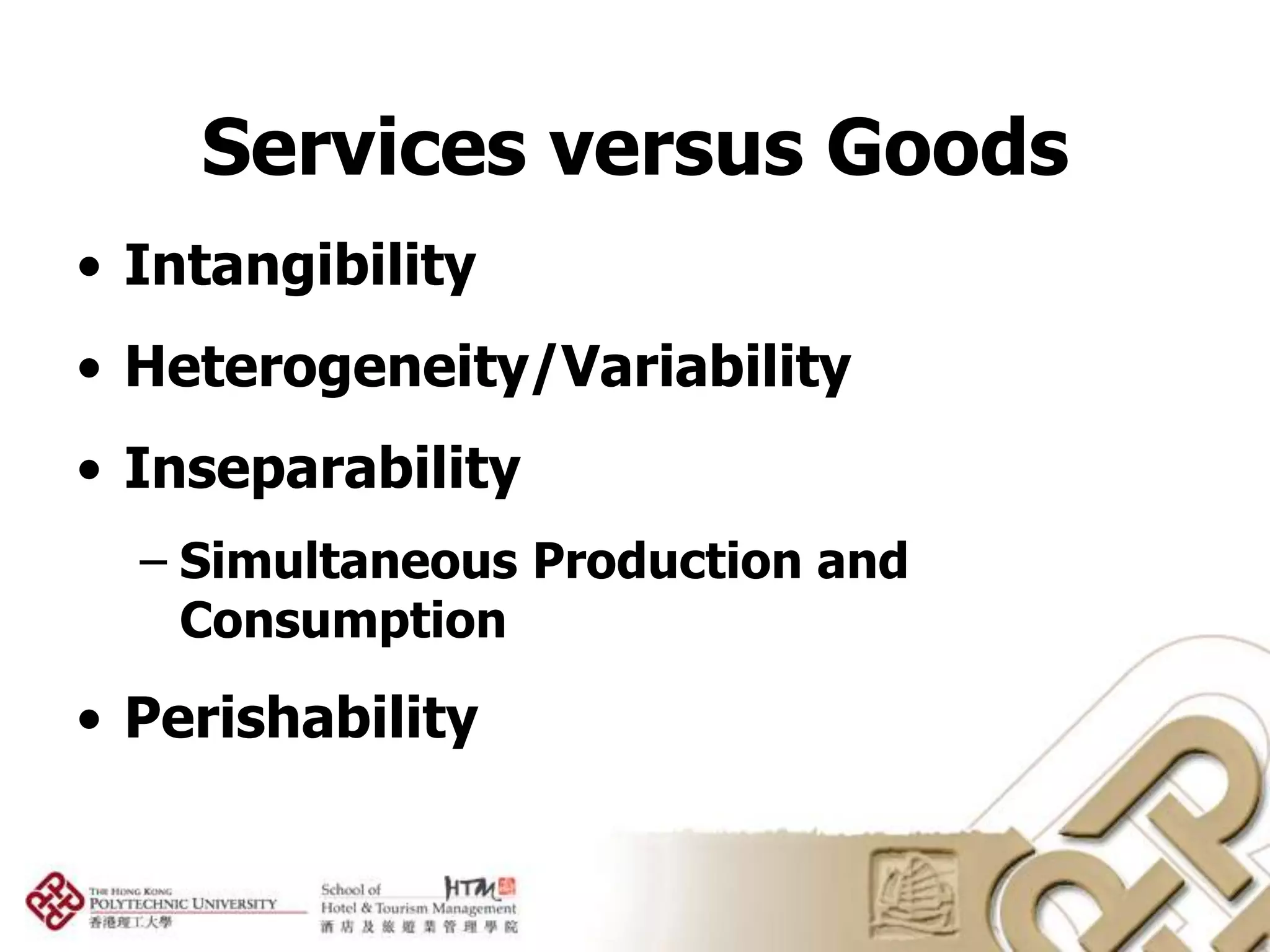
Services versus Goods
• Intangibility
• Heterogeneity/Variability
• Inseparability
  – Simultaneous Production and
    Consumption

• Perishability
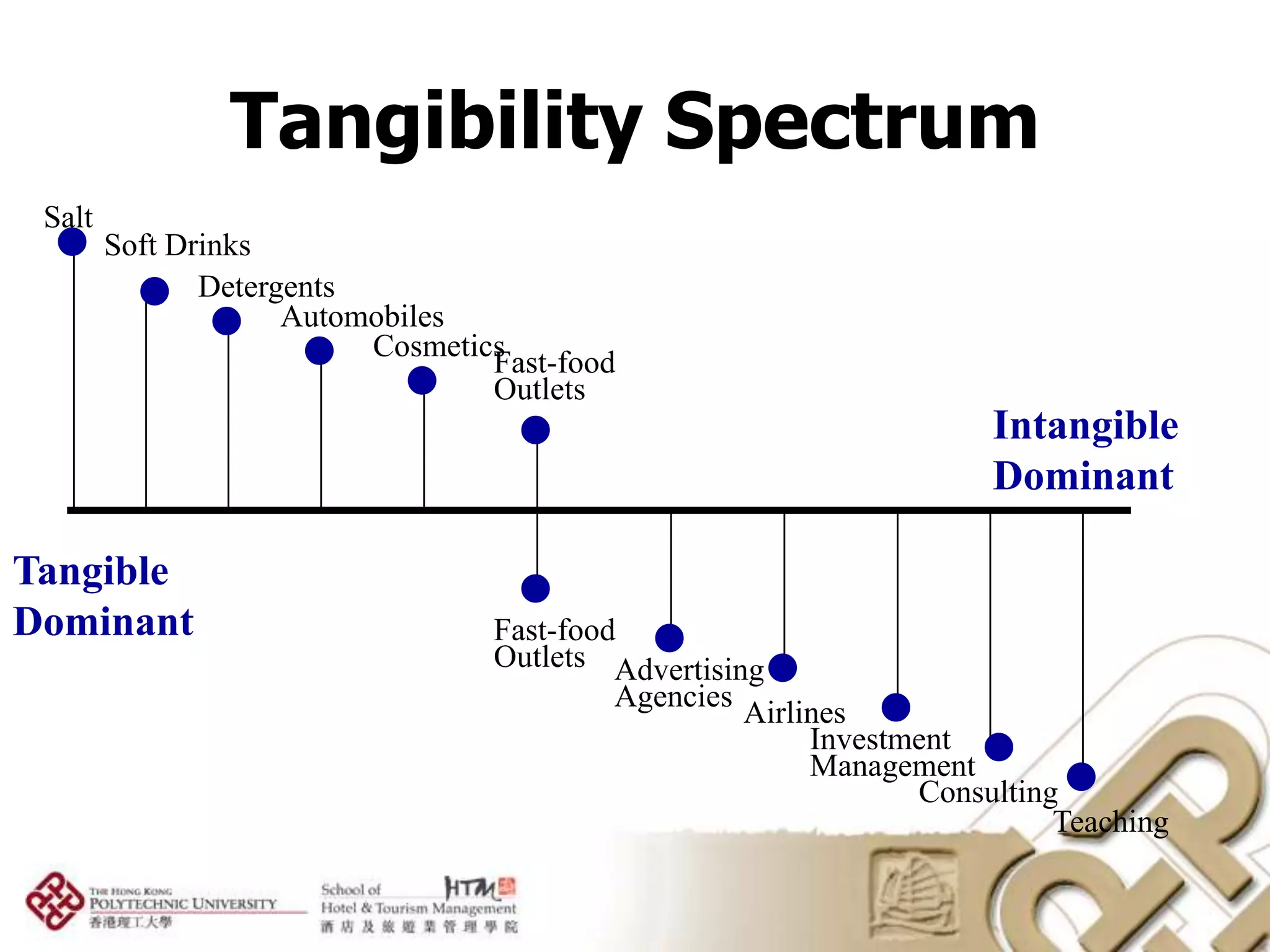
Tangibility Spectrum
 Salt
  Soft Drinks
      Detergents
            Automobiles
                Cosmetics
                         Fast-food
                     Outlets
                                                            Intangible
                                                             Dominant

Tangible
                            
Dominant                  Fast-food 
                          Outlets Advertising
                                             
                                            Airlines 
                                   Agencies
                                                 Investment 
                                                        Consulting 
                                                 Management
                                                                  Teaching
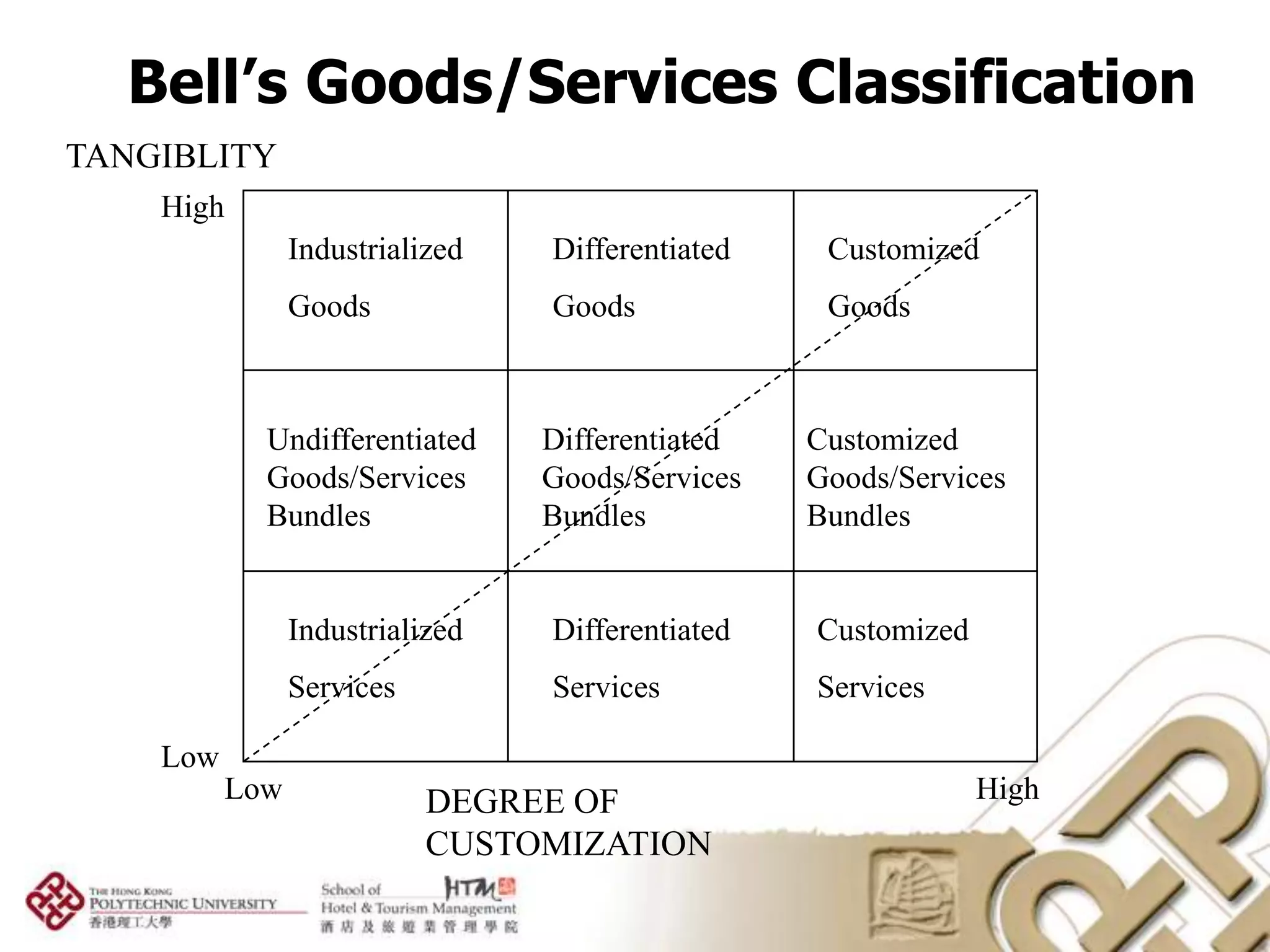
Bell’s Goods/Services Classification
TANGIBLITY
    High
                Industrialized   Differentiated    Customized
                Goods            Goods             Goods


            Undifferentiated     Differentiated   Customized
            Goods/Services       Goods/Services   Goods/Services
            Bundles              Bundles          Bundles


                Industrialized   Differentiated   Customized
                Services         Services         Services

    Low
          Low              DEGREE OF                           High
                           CUSTOMIZATION
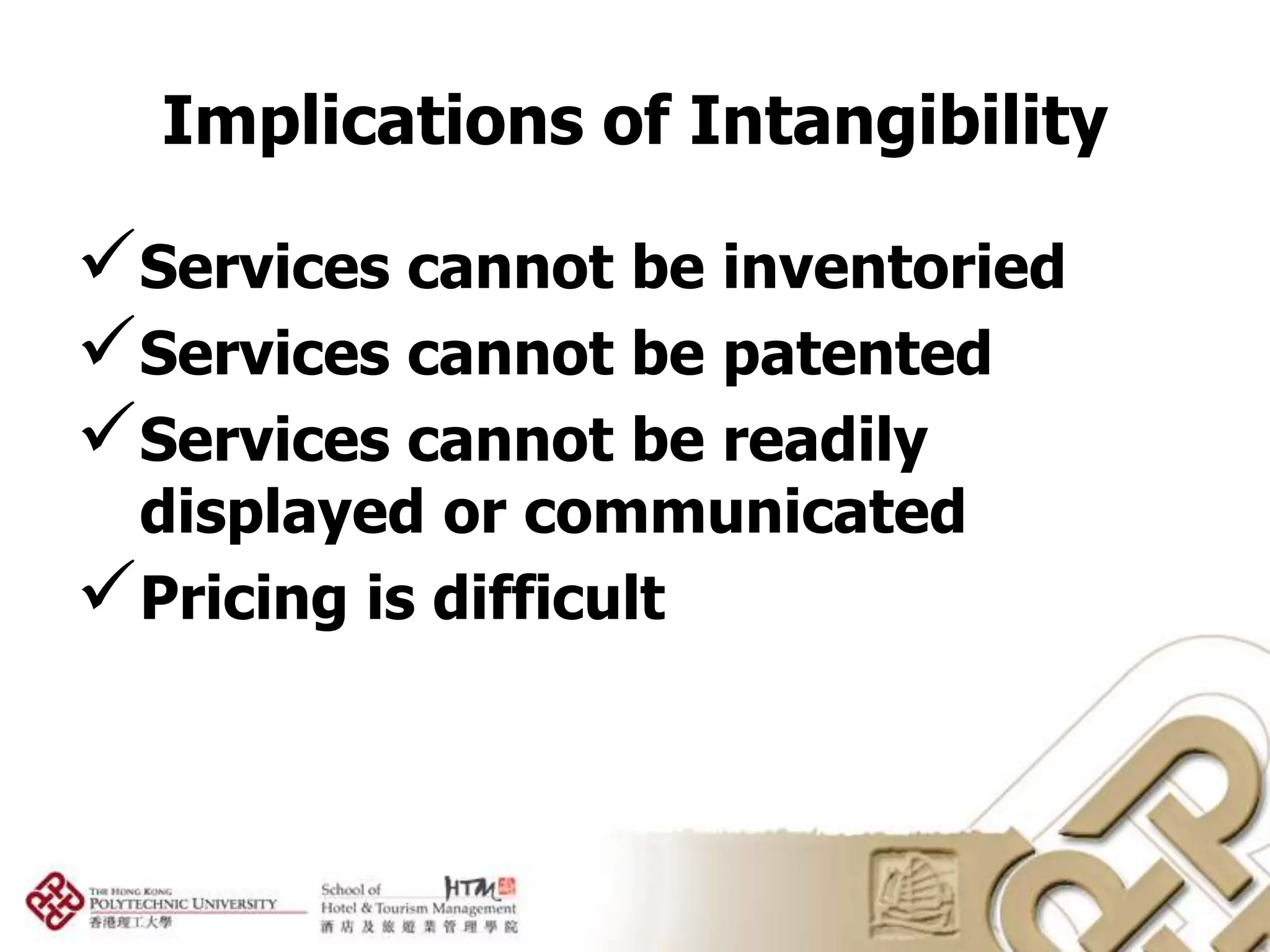
Implications of Intangibility

Services cannot be inventoried
Services cannot be patented
Services cannot be readily
 displayed or communicated
Pricing is difficult
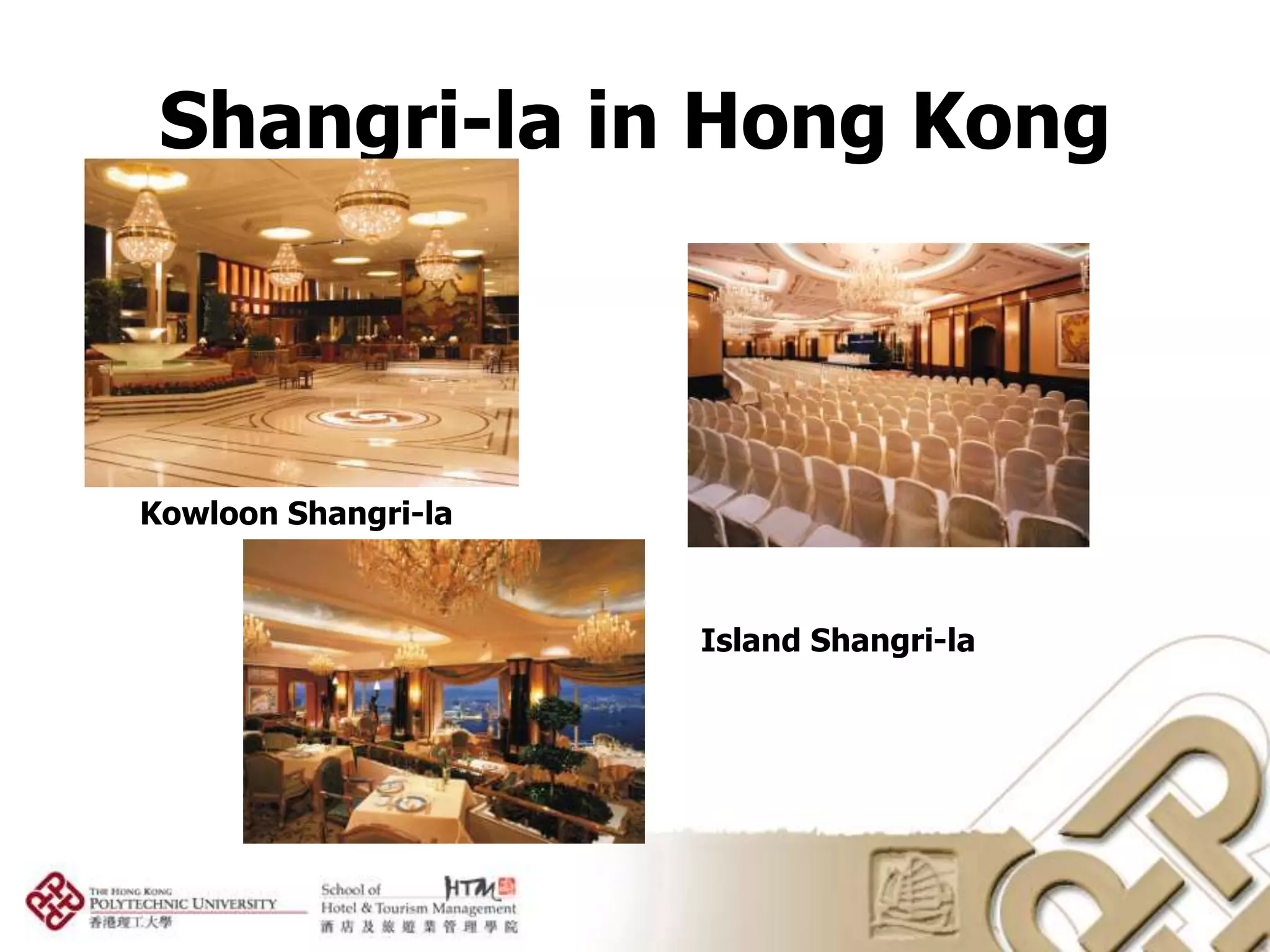
Shangri-la in Hong Kong


Kowloon Shangri-la


                     Island Shangri-la
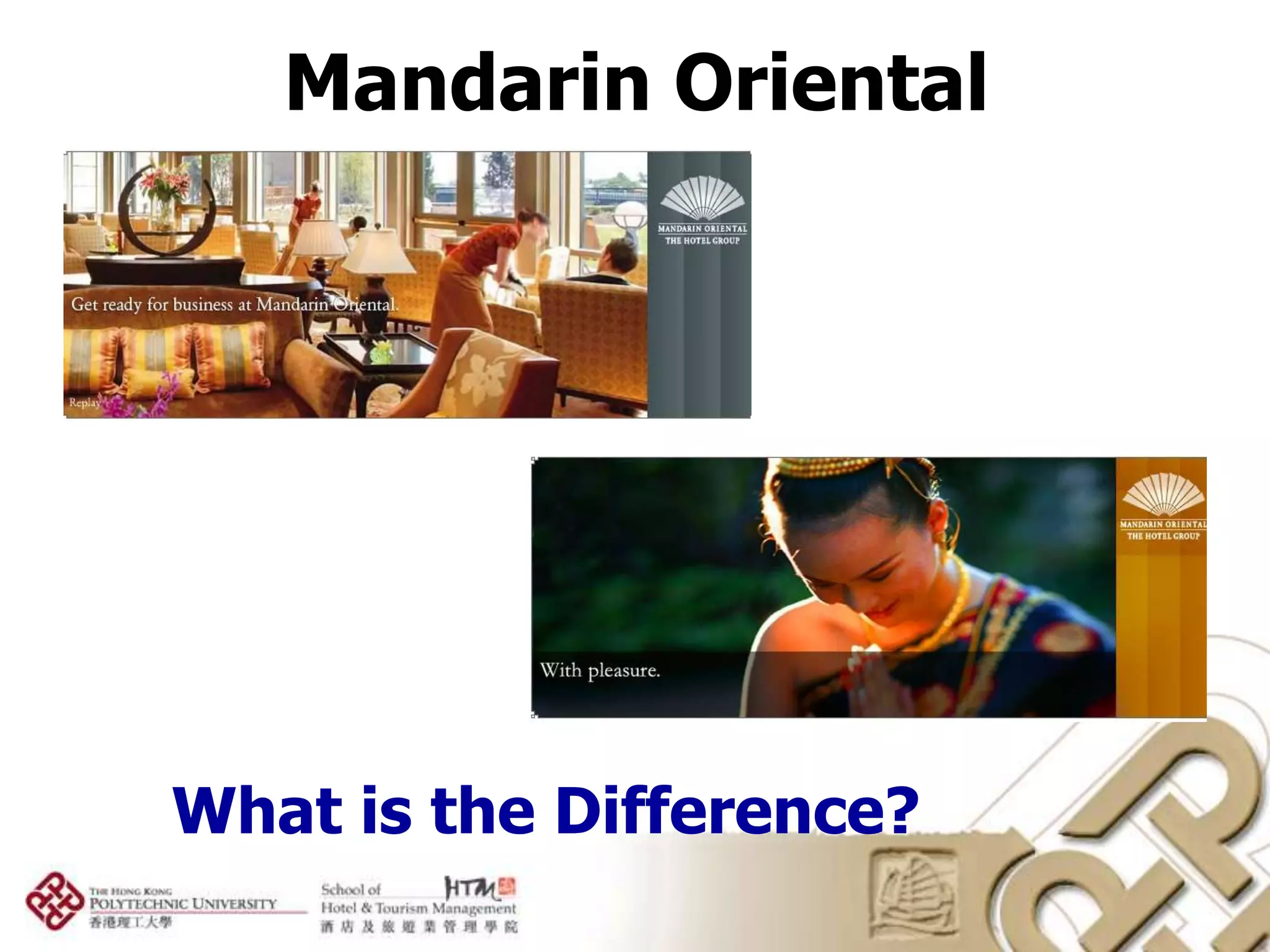
Mandarin Oriental


What is the Difference?
Implications of Heterogeneity
Service delivery and customer
 satisfaction depend on employee
 actions
Service quality depends on many
 uncontrollable factors
There is no sure knowledge that the
 service delivered matches what was
 planned and promoted
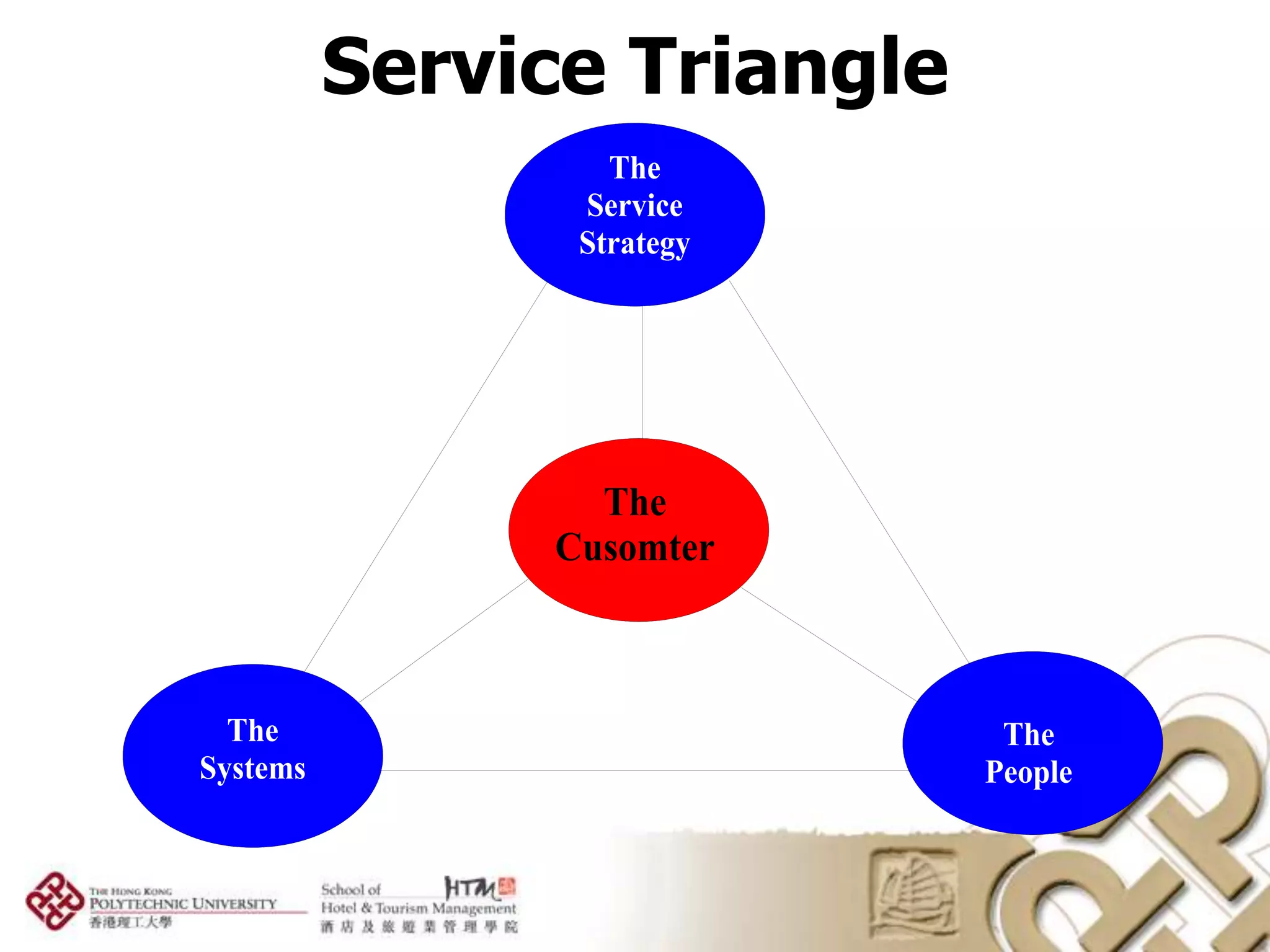
Service Triangle
Implications of Simultaneous
  Production and Consumption
Customers participate in and affect
 the transaction
Customers affect each other
Employees affect the service
 outcome
Decentralization may be essential
Mass production is difficult
Implications of Perishability

It is difficult to synchronize supply
 and demand with services
Services cannot be returned or
 resold
Services Marketing Mix
 • Physical Evidence
 • People – Employees and Customers
 • Process


Zeithaml & Bitner 1996
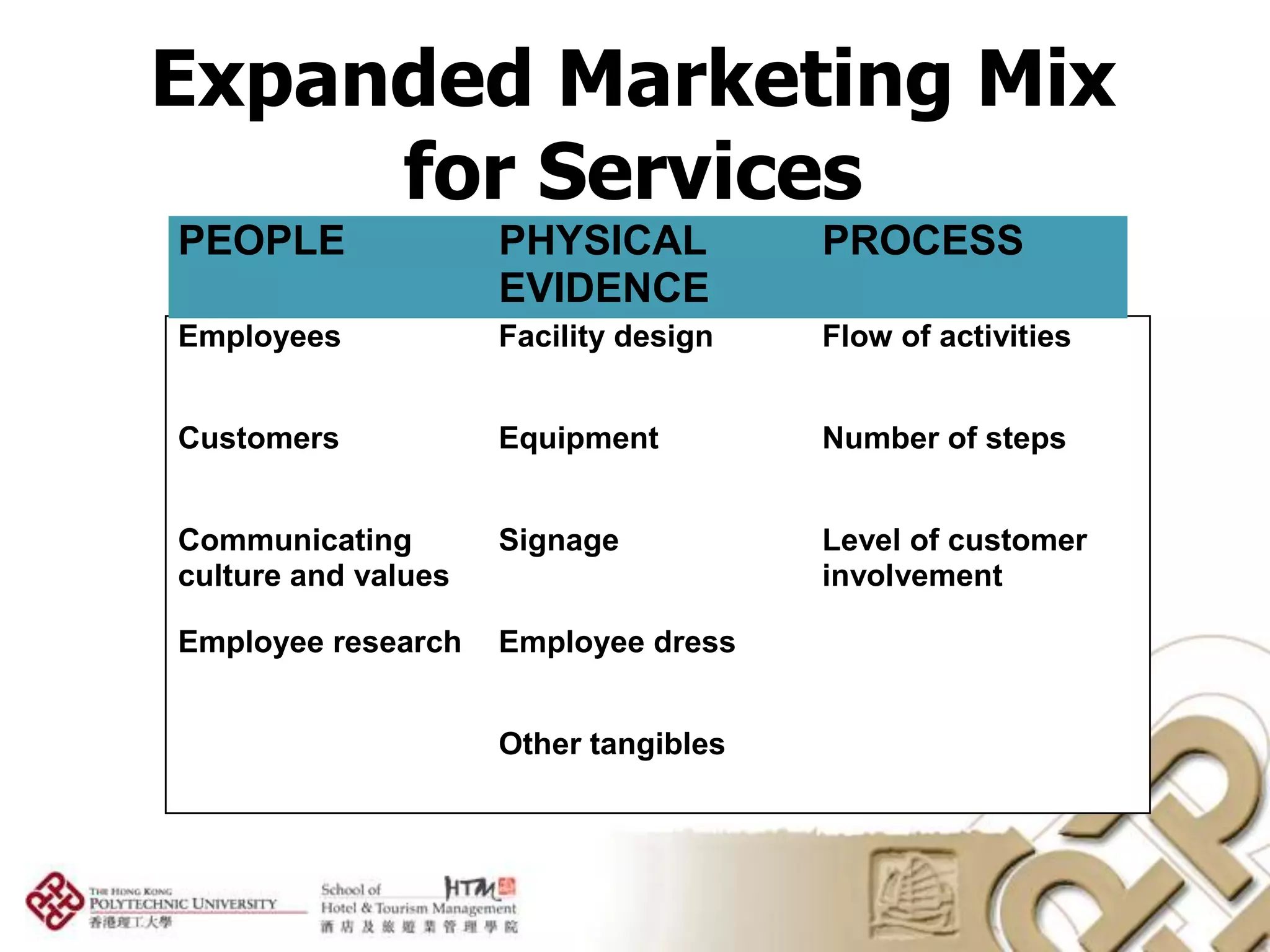
Expanded Marketing Mix
     for Services
PEOPLE               PHYSICAL          PROCESS
                     EVIDENCE
Employees            Facility design   Flow of activities


Customers            Equipment         Number of steps


Communicating        Signage           Level of customer
culture and values                     involvement

Employee research    Employee dress


                     Other tangibles
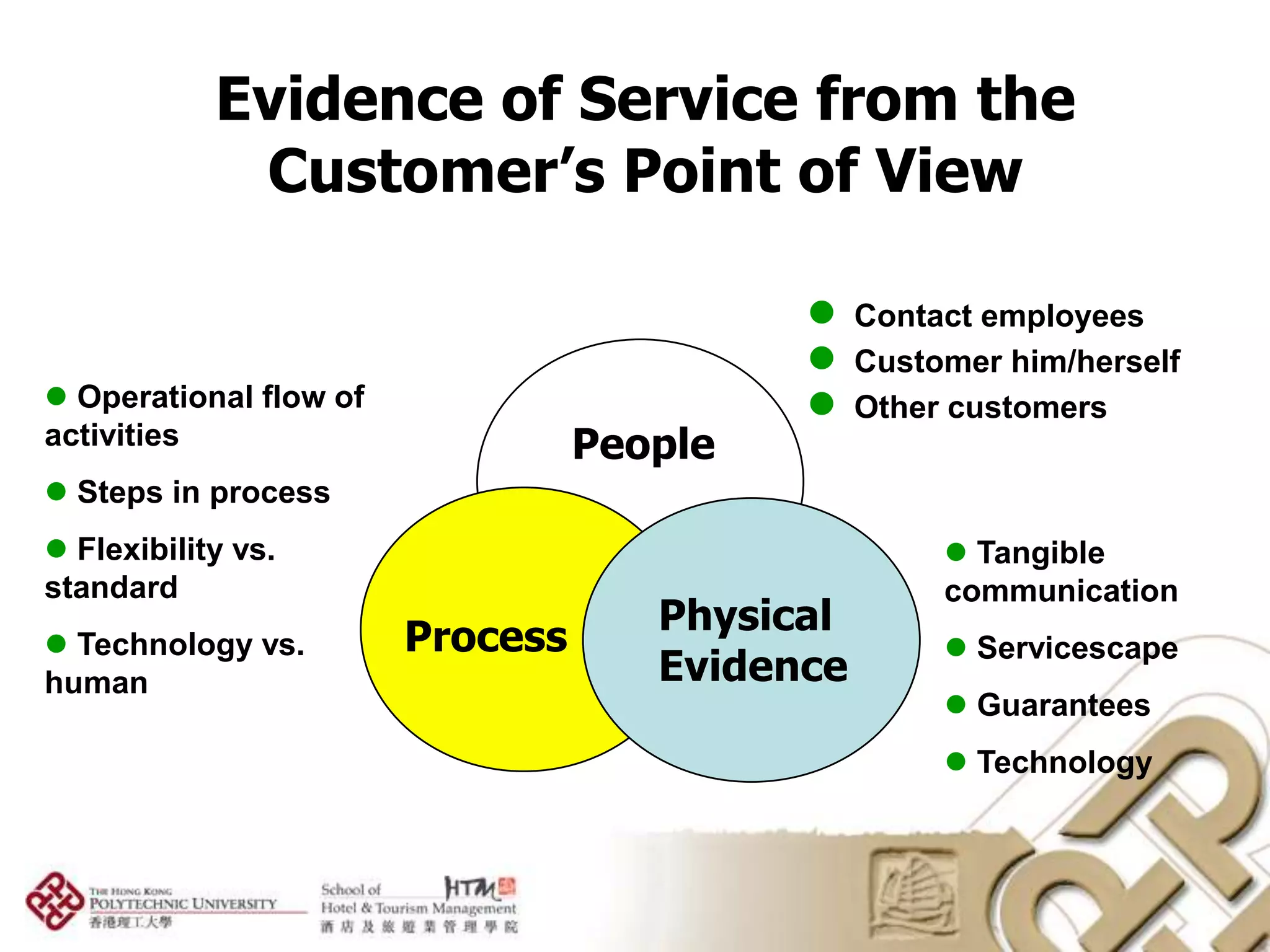
Evidence of Service from the
             Customer’s Point of View

                                               Contact employees
                                               Customer him/herself
 Operational flow of                          Other customers
activities                        People
 Steps in process
 Flexibility vs.                                     Tangible
standard                                             communication
                                     Physical
 Technology vs.        Process                       Servicescape
human                                Evidence
                                                      Guarantees
                                                      Technology
Defining Service Quality
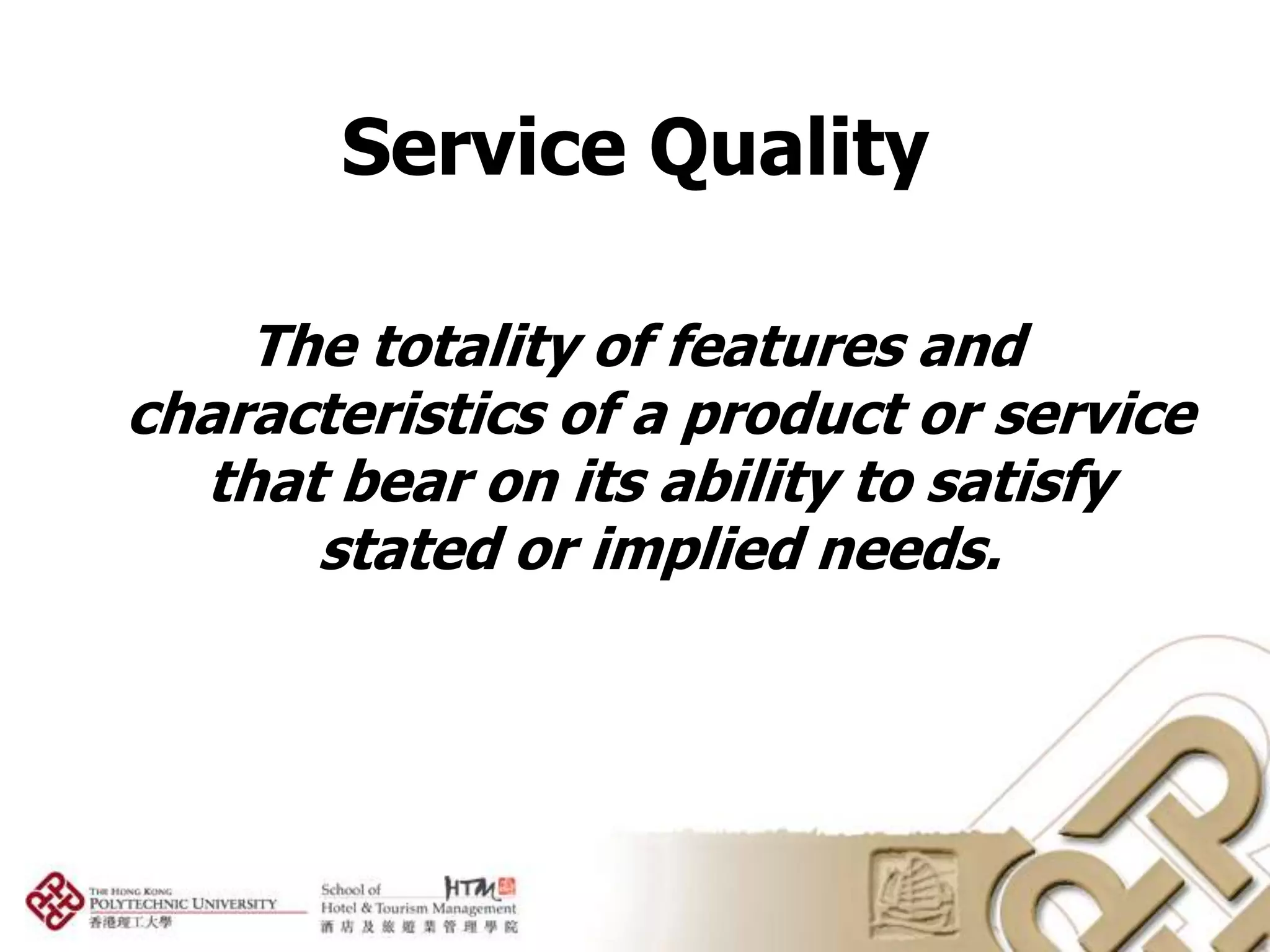
Service Quality

    The totality of features and
characteristics of a product or service
  that bear on its ability to satisfy
      stated or implied needs.
Service Quality
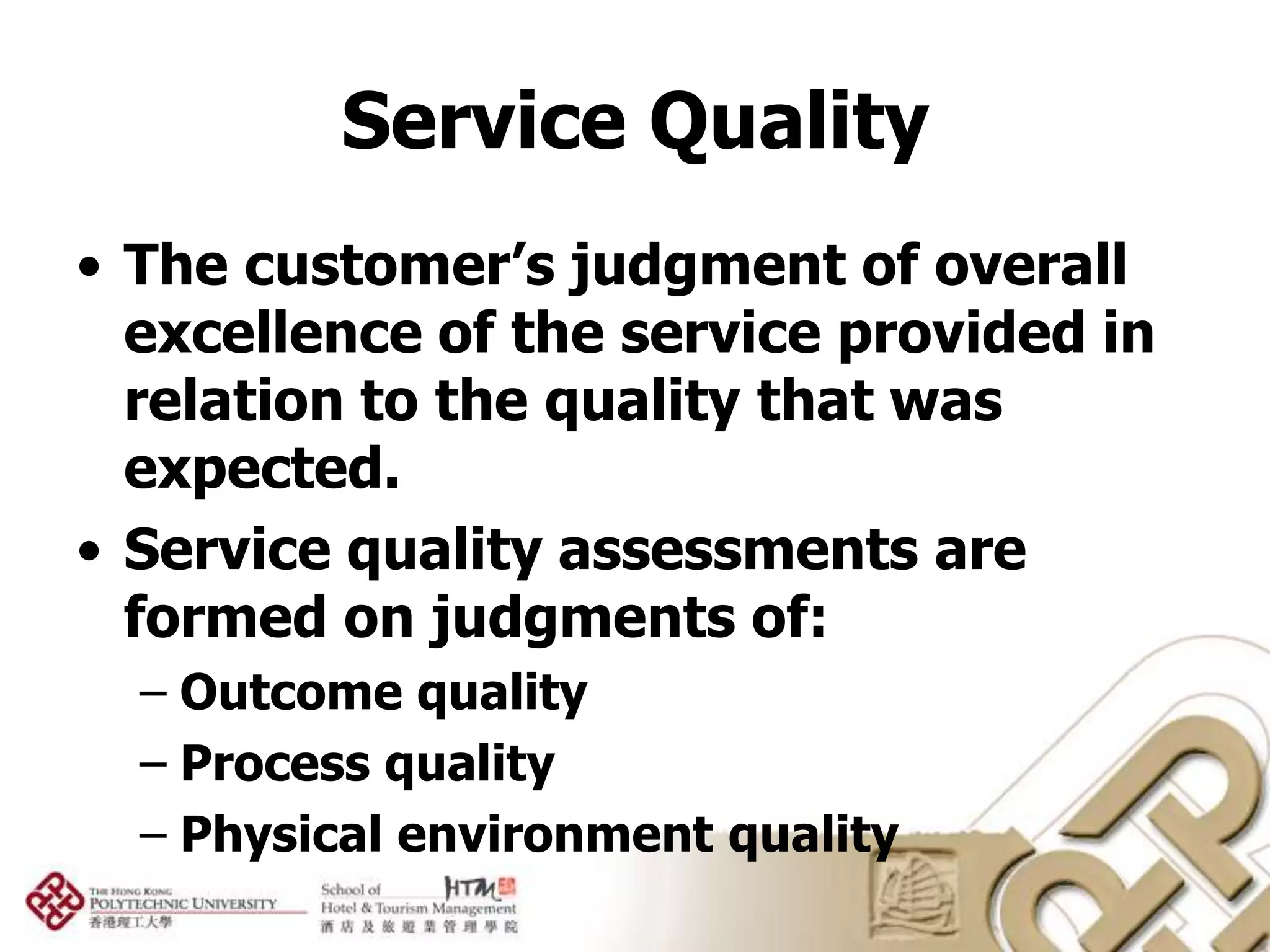
• The customer’s judgment of overall
  excellence of the service provided in
  relation to the quality that was
  expected.
• Service quality assessments are
  formed on judgments of:
  – Outcome quality
  – Process quality
  – Physical environment quality
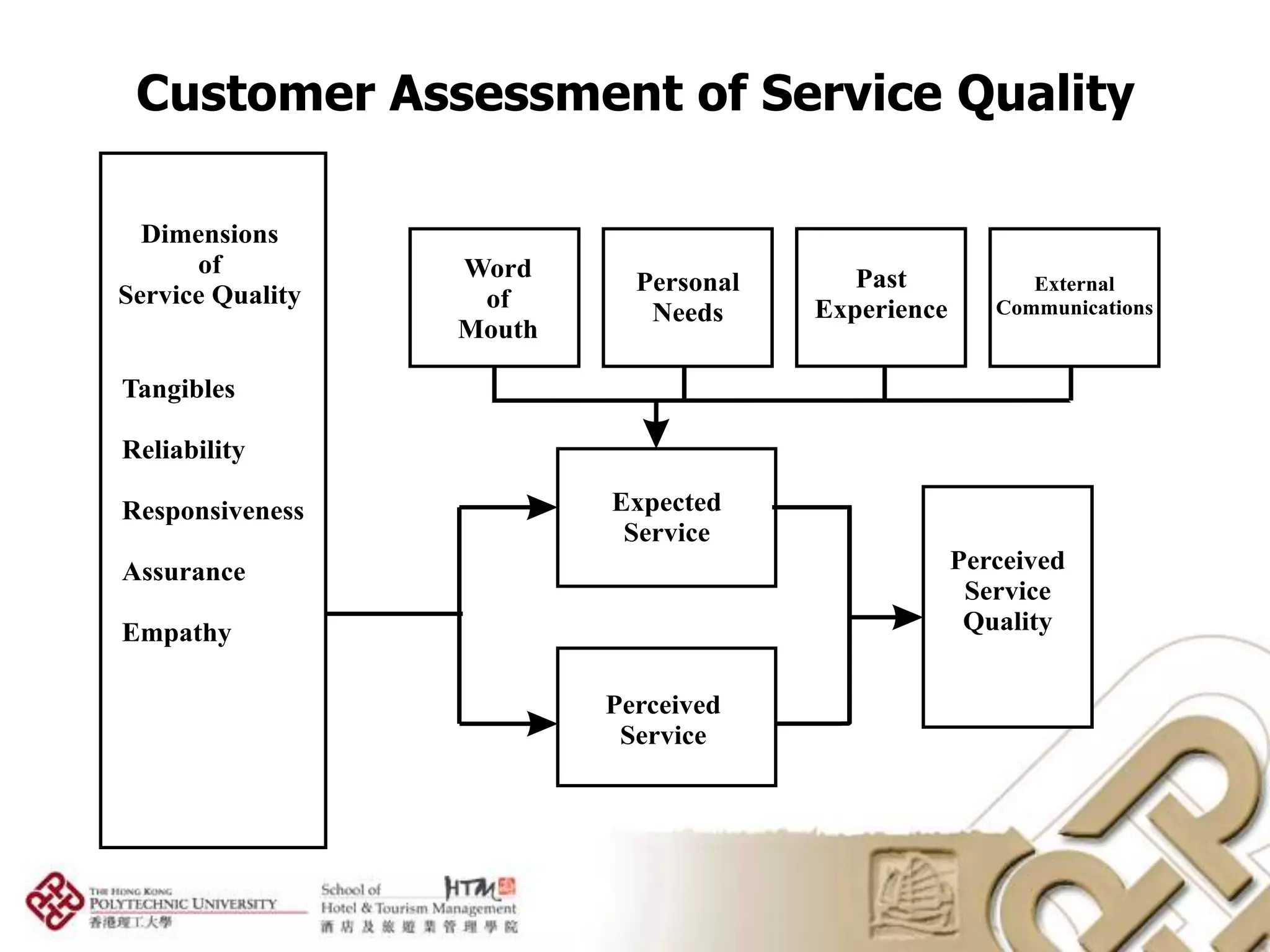
Customer Assessment of Service Quality
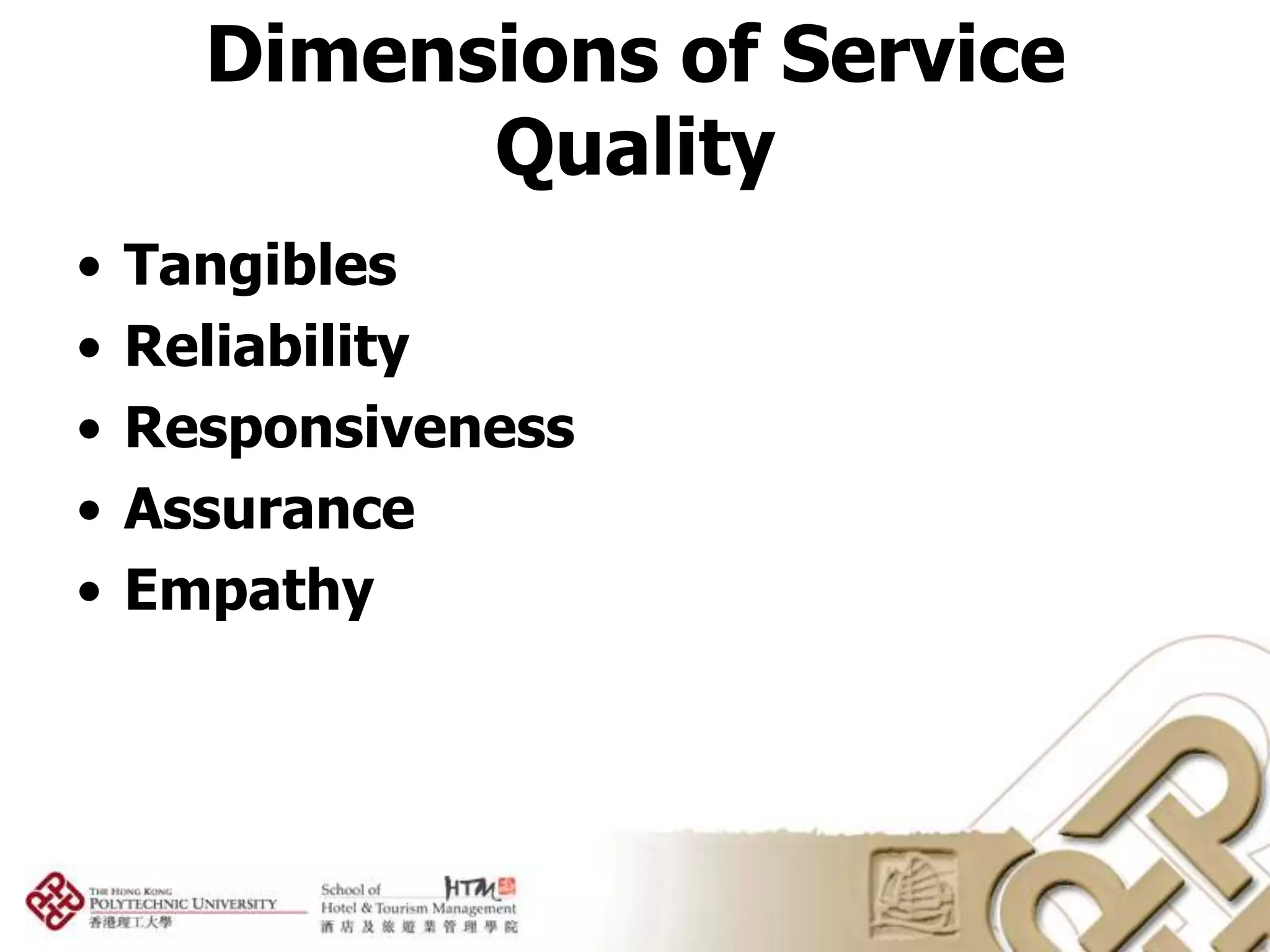
Dimensions of Service
            Quality
•   Tangibles
•   Reliability
•   Responsiveness
•   Assurance
•   Empathy
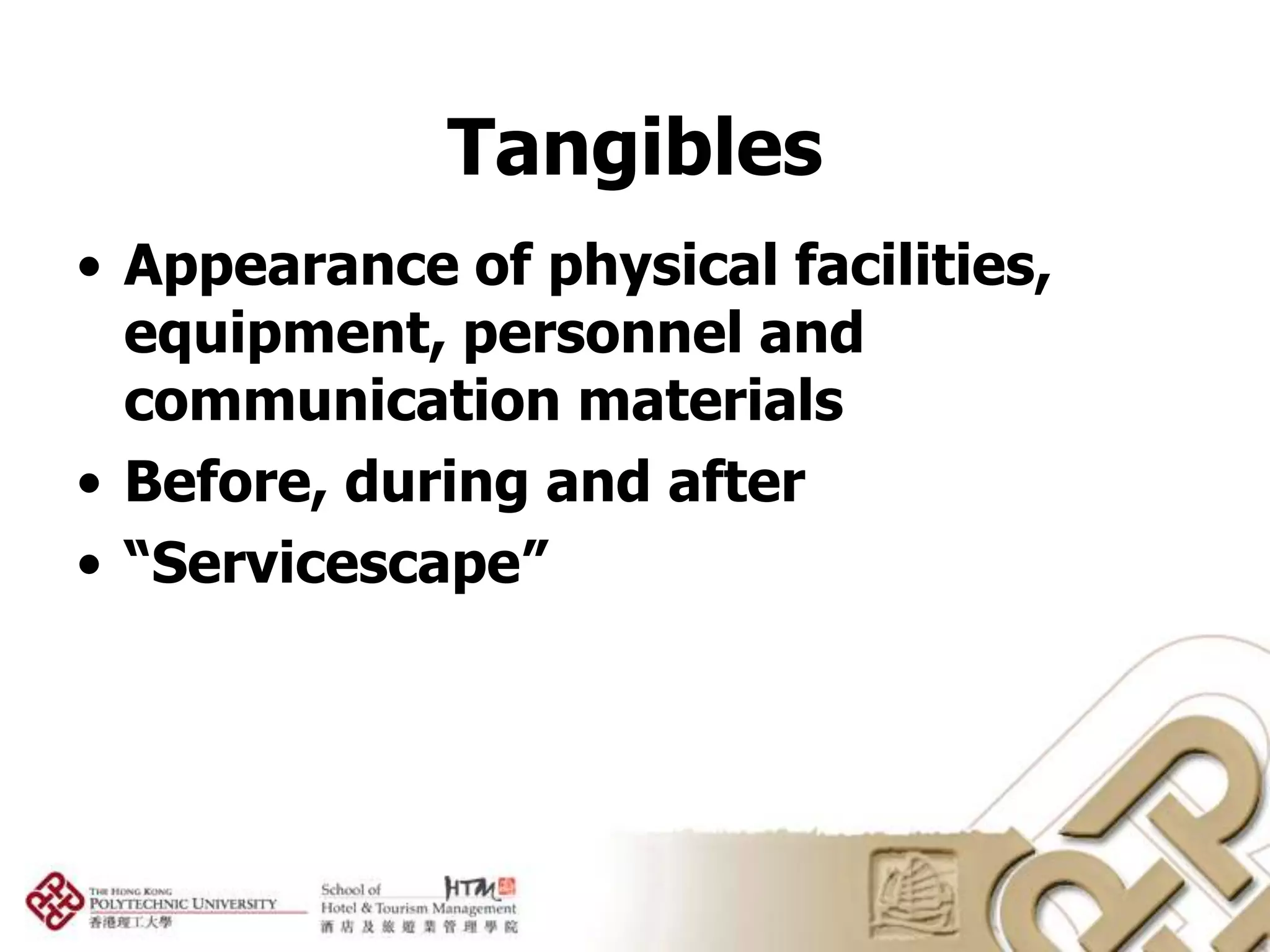
Tangibles
• Appearance of physical facilities,
  equipment, personnel and
  communication materials
• Before, during and after
• “Servicescape”
Reliability
• Ability to perform the promised
  service dependable and accurately
• Most significant
• Promises
  – Personal
  – Organizational
  – Common expectations
• Service Delivery Systems
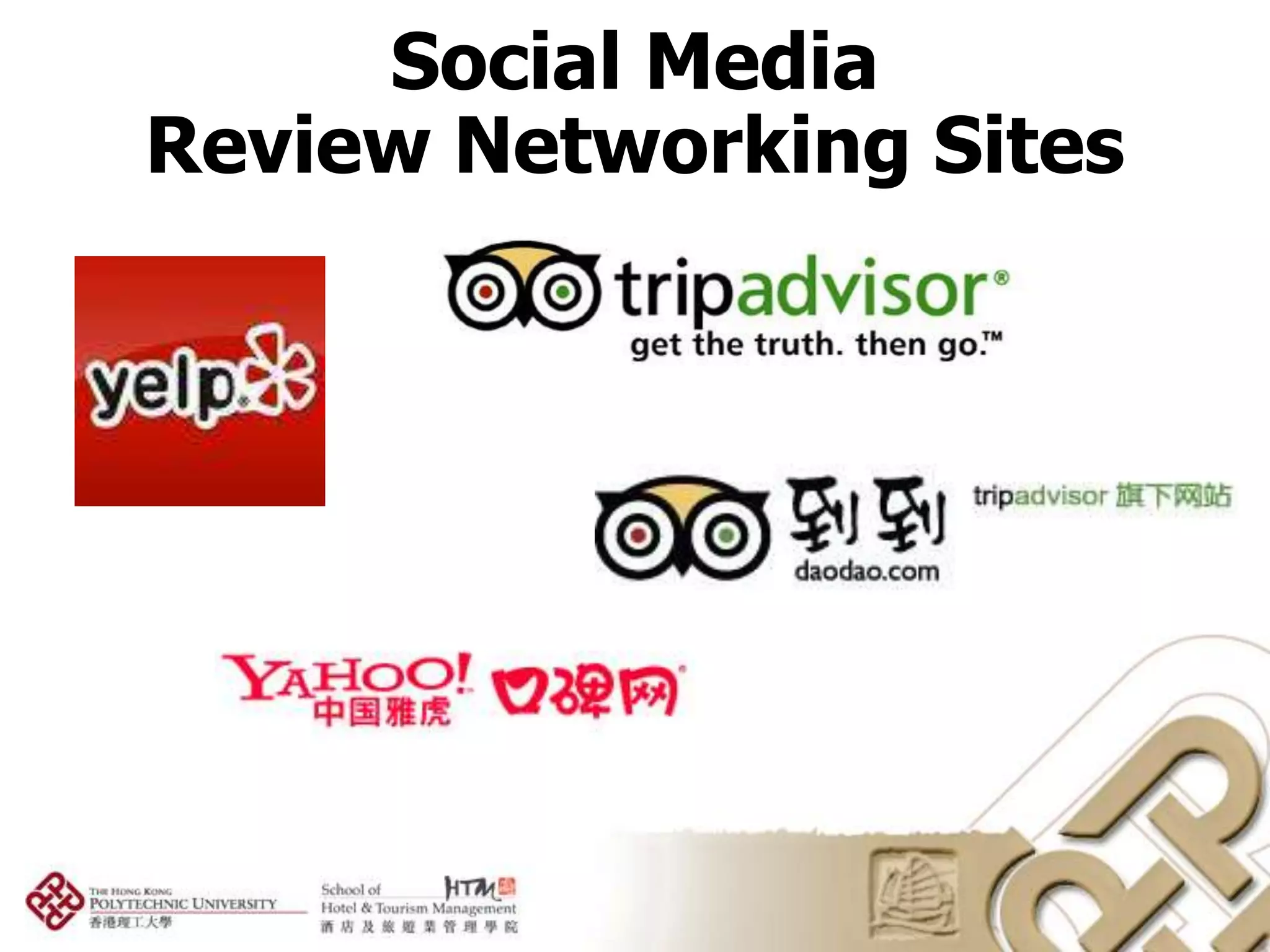
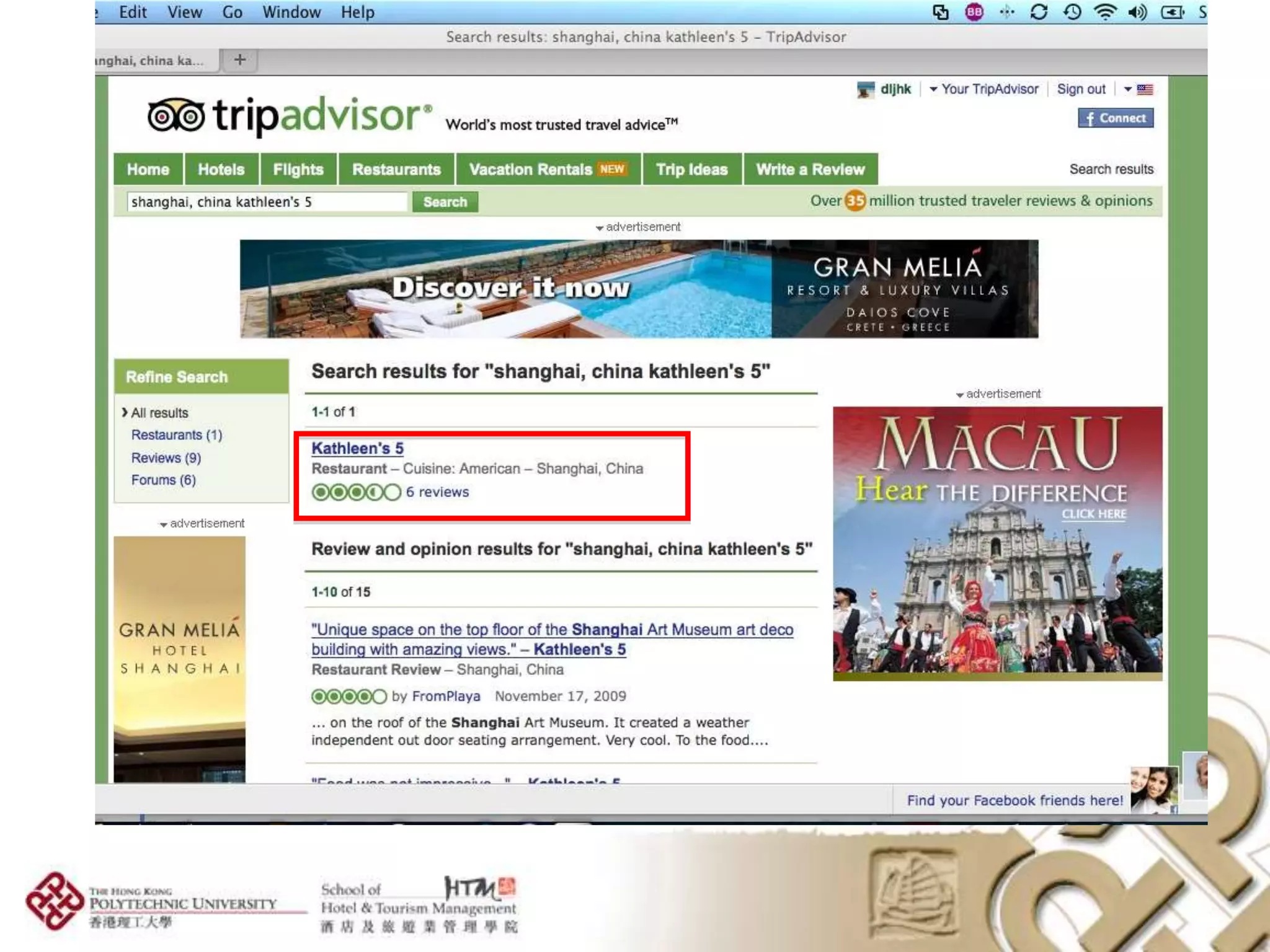
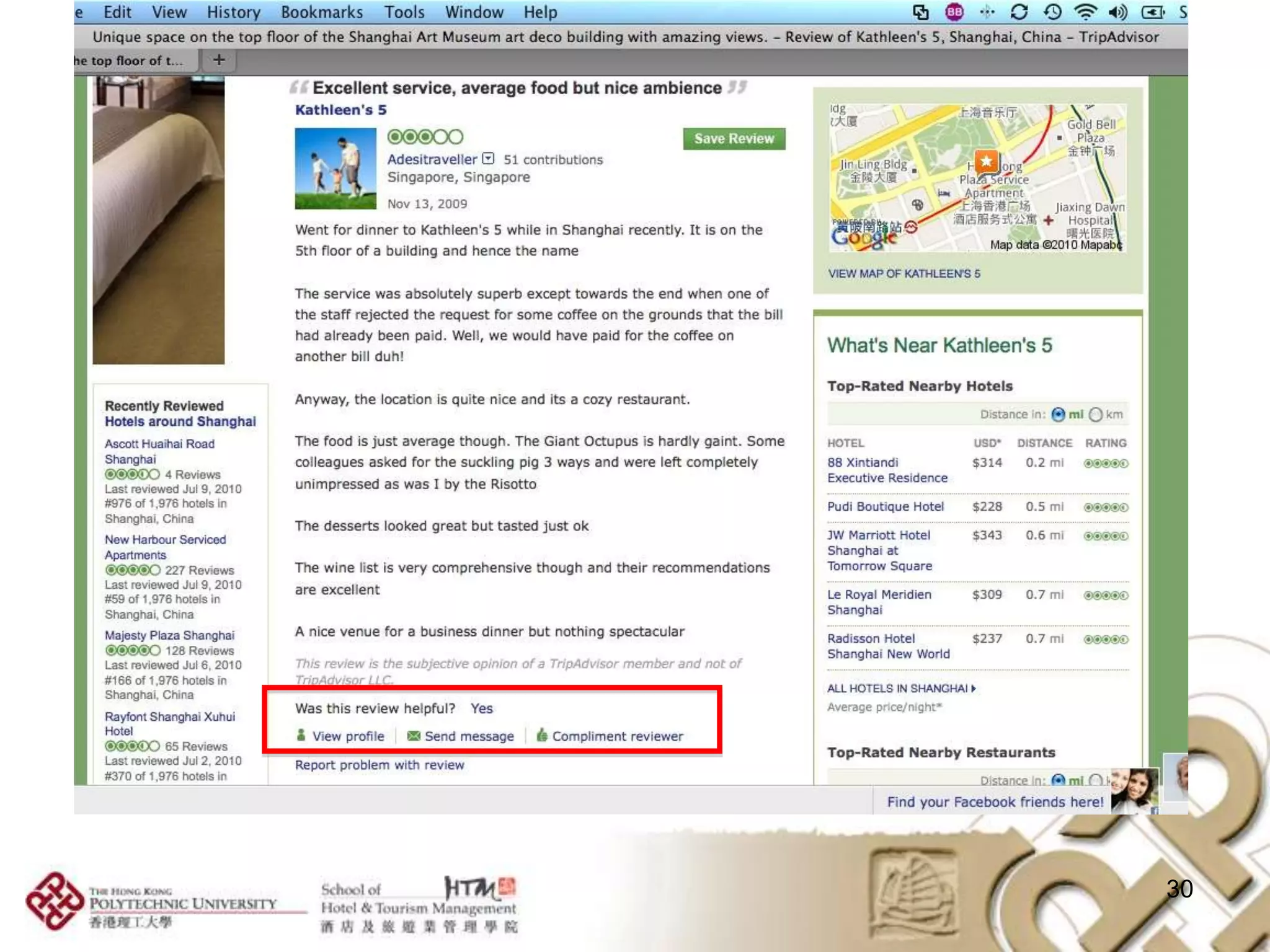
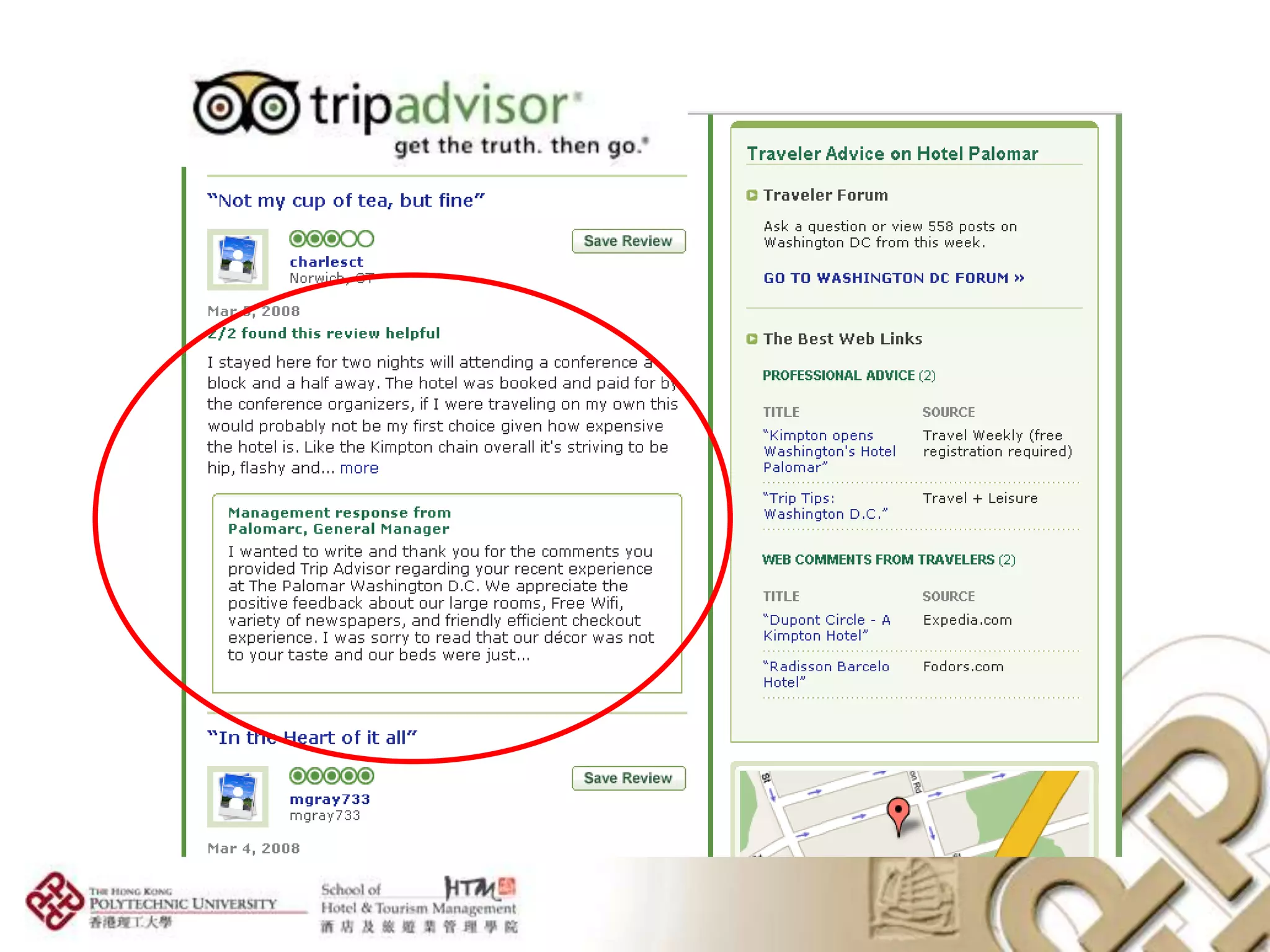
Social Media
Review Networking Sites
Responsiveness
• Willingness to help customers and
  provide prompt service
• Finding out what the customer really
  needs by when
• Customer waits
  – Fast food – 5 minutes
  – Fine dining – 30 minutes
• Service Recovery Systems
30
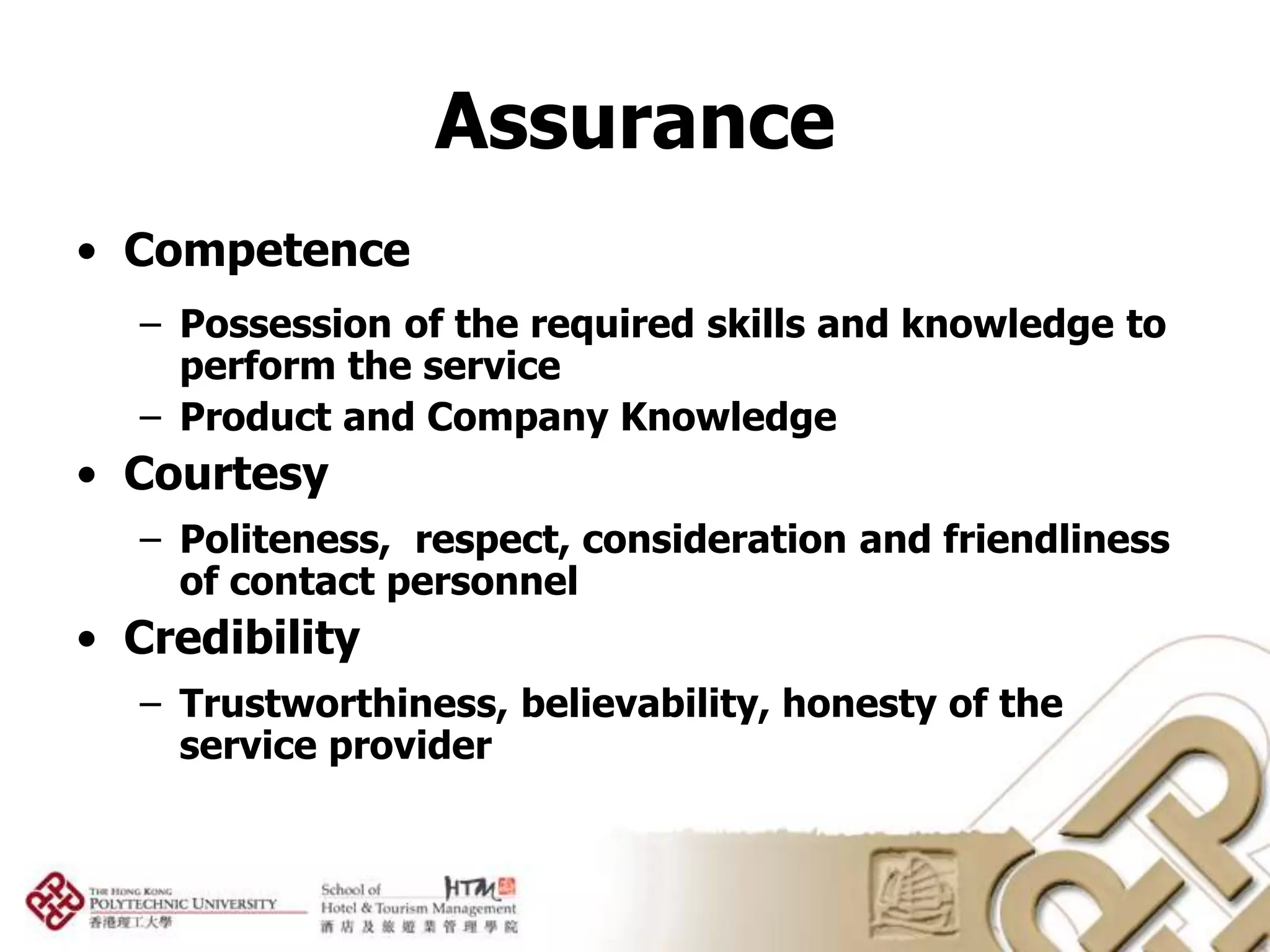
Assurance
• Competence
  – Possession of the required skills and knowledge to
    perform the service
  – Product and Company Knowledge
• Courtesy
  – Politeness, respect, consideration and friendliness
    of contact personnel
• Credibility
  – Trustworthiness, believability, honesty of the
    service provider
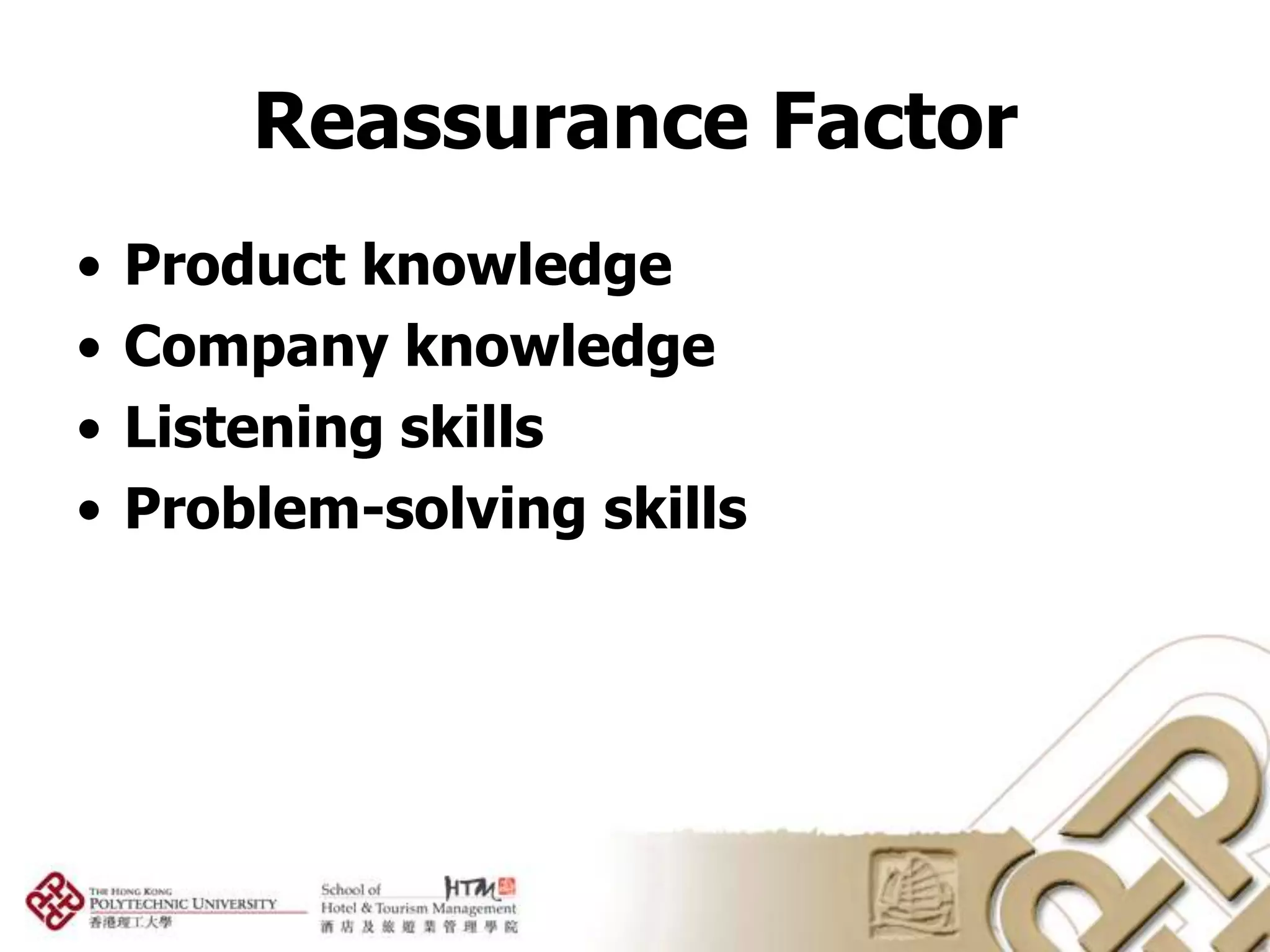
Reassurance Factor
•   Product knowledge
•   Company knowledge
•   Listening skills
•   Problem-solving skills
Empathy
• Caring, individualized attention the firm provides
  its customers
• Access
   – Approachability and ease of contact
• Communication
   – Keeping customers informed in language they
     can understand, and listening to them
• Understanding the customer
   – Making the effort to know customers and their
     needs
• Empathy vs. Sympathy
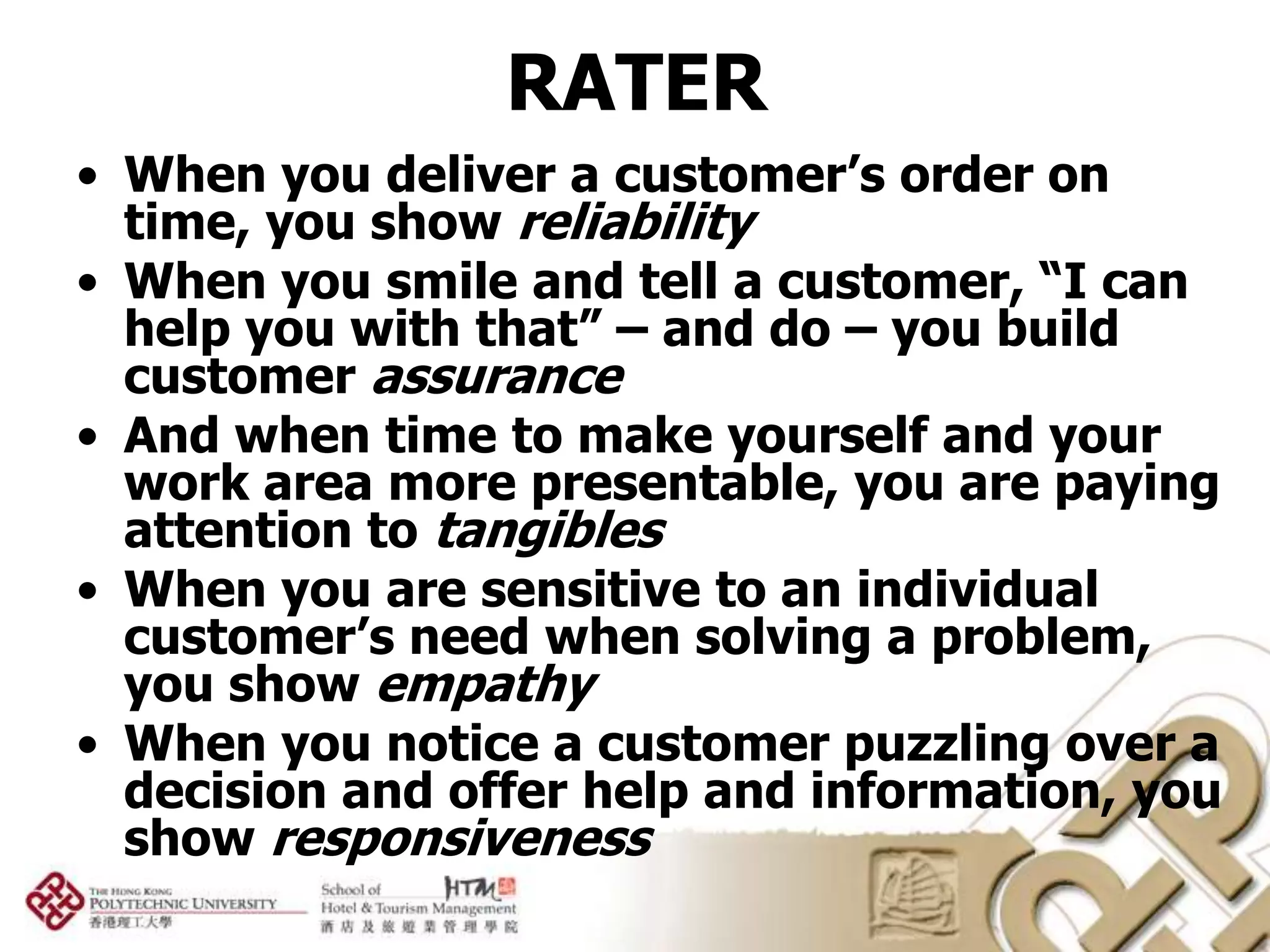
ASSURANCE
                                                    n    Employees who instill confidence in

    Attributes of the
                                                         customers
                                                    n    Making customers feel safe in their

      Dimensions
                                                         transactions
                                                    n    Employees who are consistently courteous
                                                    n    Employees who have the knowledge to
                                                         answer customer questions
RELIABILITY
                                                EMPATHY
n    Providing service as promised              n       Giving customers individual attention
n    Dependability in handling customers’       n       Employees who deal with customers in a
     service problems                                   caring fashion
n    Providing services at the promised time    n       Having the customer’s best interest at heart
n    Performing services right the first time   n       Employees who understand the needs of
n    Maintaining error-free records                     their customers
                                                n       Convenient business hours

    RESPONSIVENESS
                                                TANGIBLES
n    Keeping customers informed as to           n       Modern equipment
     when services will be performed
                                                n       Visually appealing facilities
n    Prompt service to customers
                                                n       Employees who have a neat,
n    Willingness to help customers                      professional appearance
n    Readiness to respond to customers’         n       Visually appealing materials
     requests                                           associated with the service
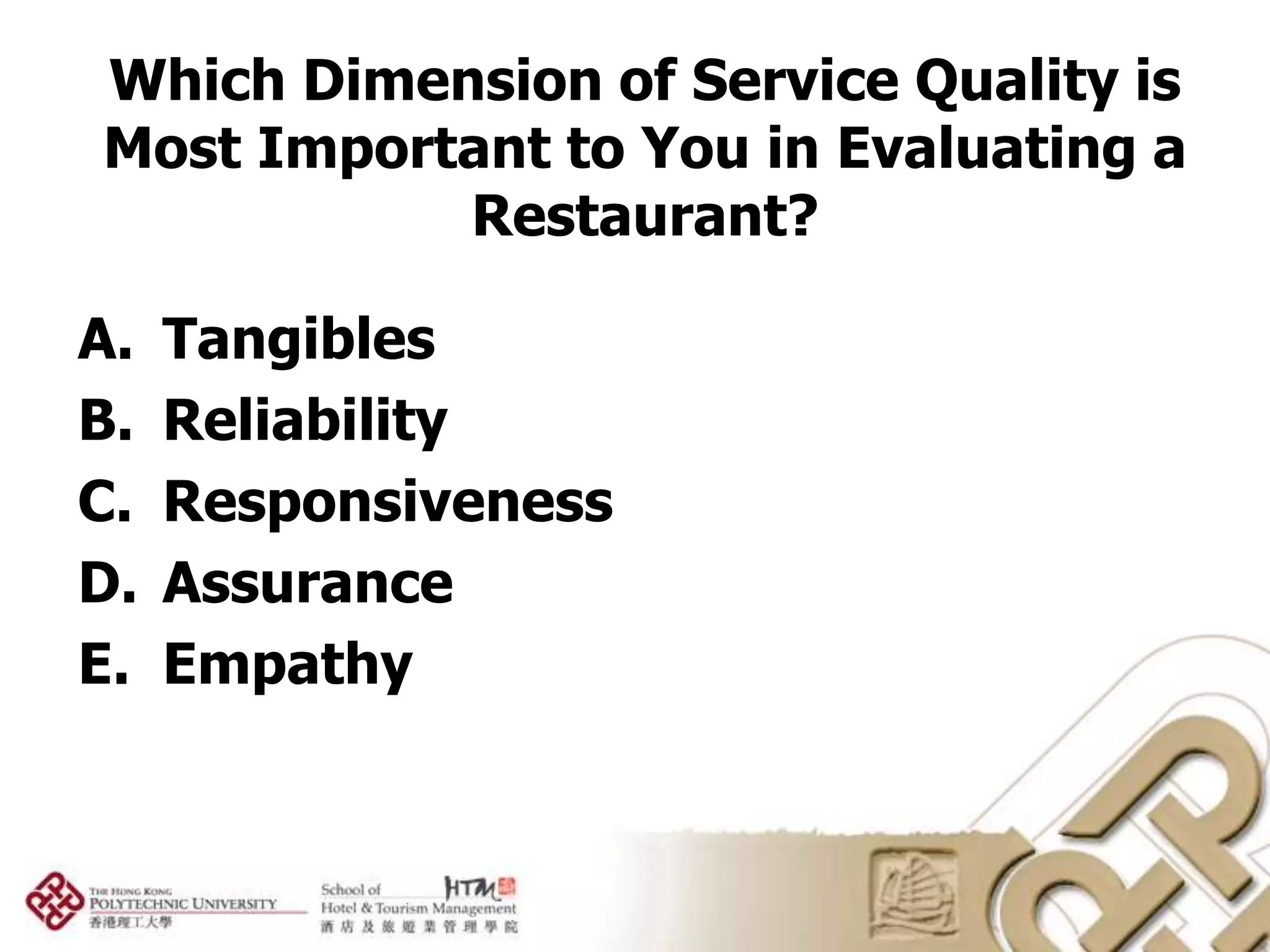
Which Dimension of Service Quality is
Most Important to You in Evaluating a
           Restaurant?

A.   Tangibles
B.   Reliability
C.   Responsiveness
D.   Assurance
E.   Empathy
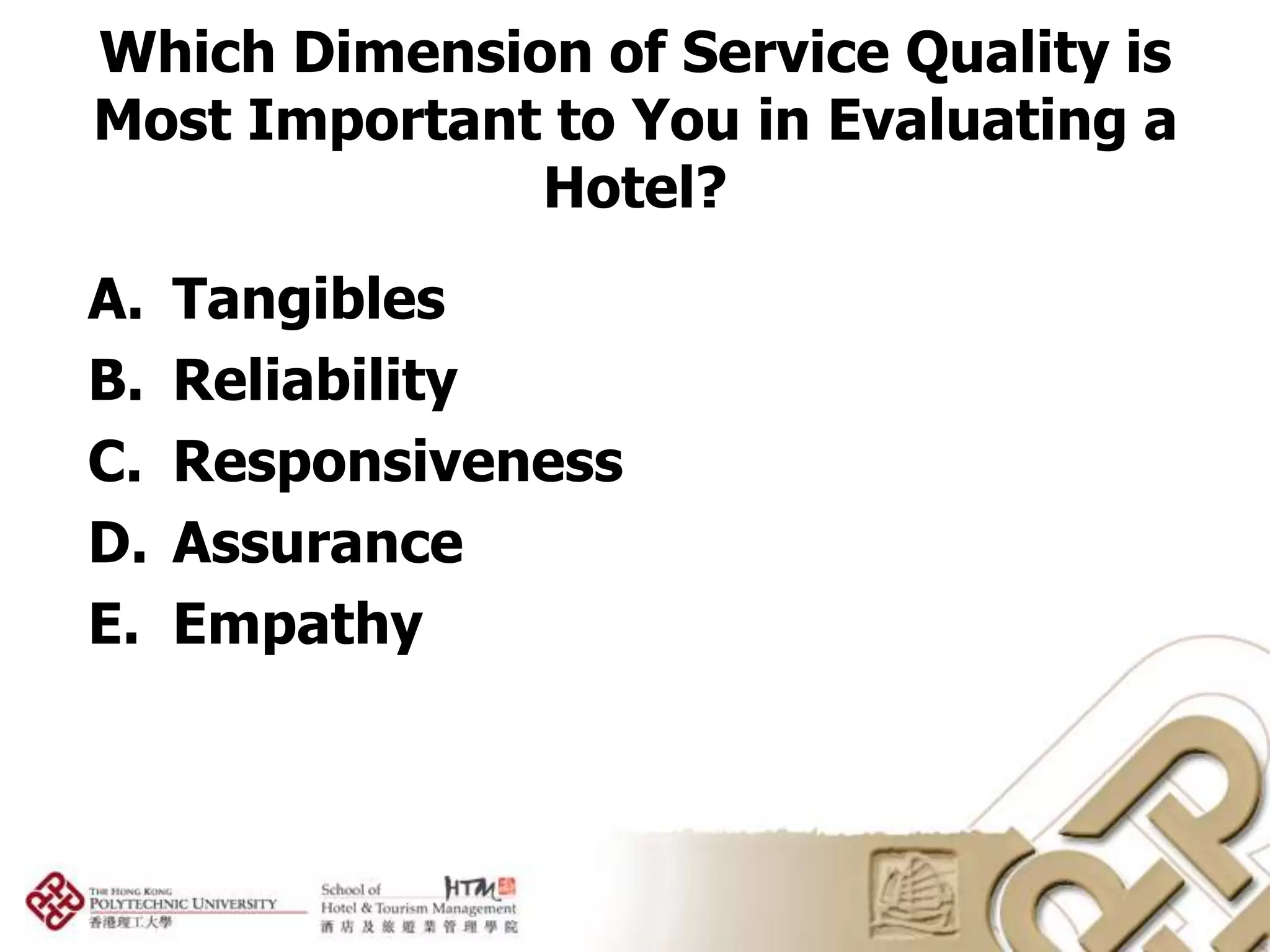
Which Dimension of Service Quality is
Most Important to You in Evaluating a
              Hotel?
A.   Tangibles
B.   Reliability
C.   Responsiveness
D.   Assurance
E.   Empathy
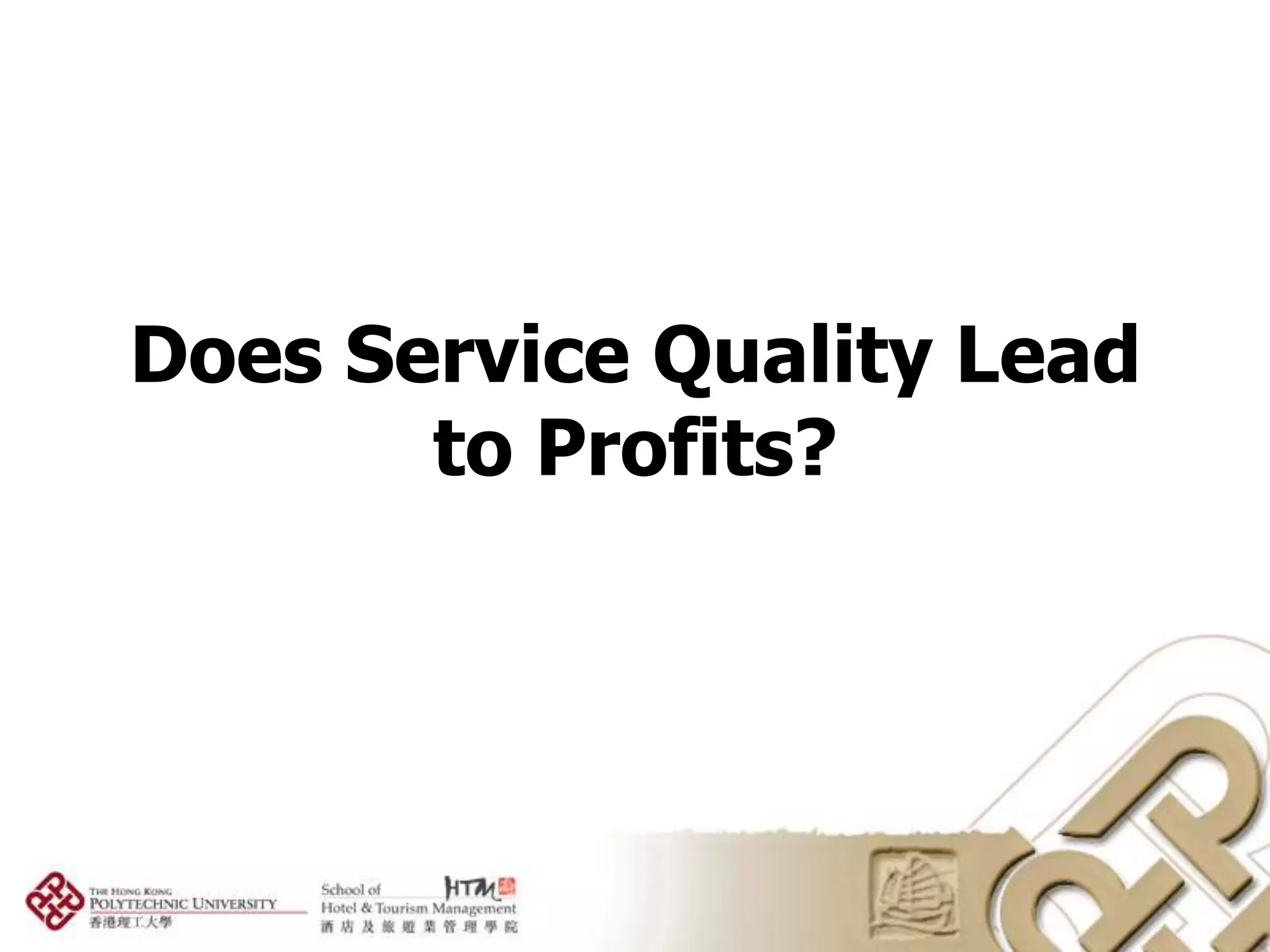
RATER
• When you deliver a customer’s order on
  time, you show reliability
• When you smile and tell a customer, “I can
  help you with that” – and do – you build
  customer assurance
• And when time to make yourself and your
  work area more presentable, you are paying
  attention to tangibles
• When you are sensitive to an individual
  customer’s need when solving a problem,
  you show empathy
• When you notice a customer puzzling over a
  decision and offer help and information, you
  show responsiveness
Does Service Quality Lead
       to Profits?
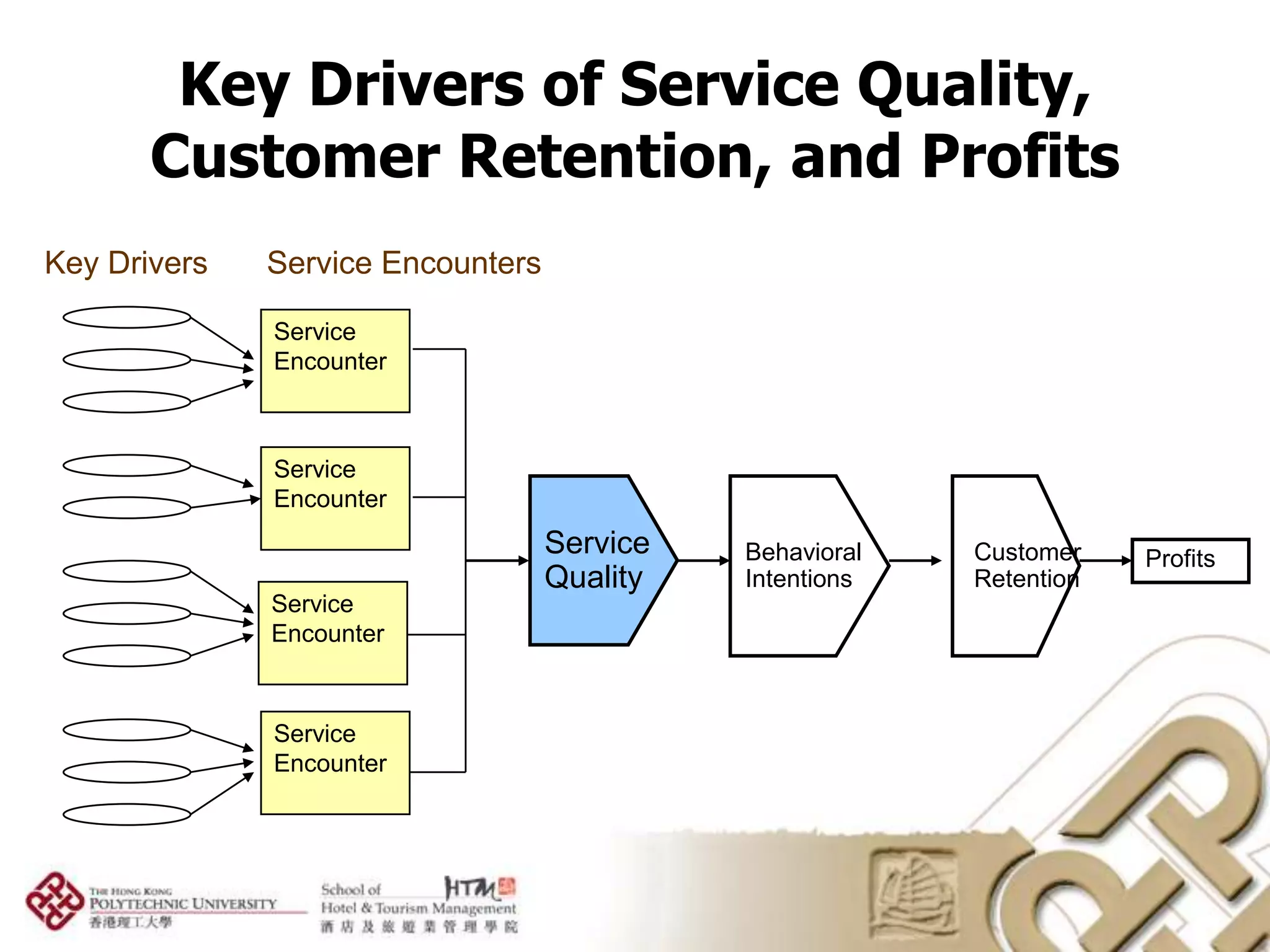
Key Drivers of Service Quality,
       Customer Retention, and Profits
Key Drivers   Service Encounters

              Service
              Encounter


              Service
              Encounter
                                   Service   Behavioral   Customer    Profits
                                   Quality   Intentions   Retention
              Service
              Encounter


              Service
              Encounter
Hotel Service
Delivery Systems
      Process –
Reliability/Assurance
Ritz Carlton

Ladies and Gentlemen Serving
    Ladies and Gentlemen
The Gold Standards of
    Quality Service
VALUES AND OPERATING PHILOSOPHY

    GOLD STANDARDS
              Credo
              Motto
        3 Steps of Service
        12 Service Values
        Employee Promise
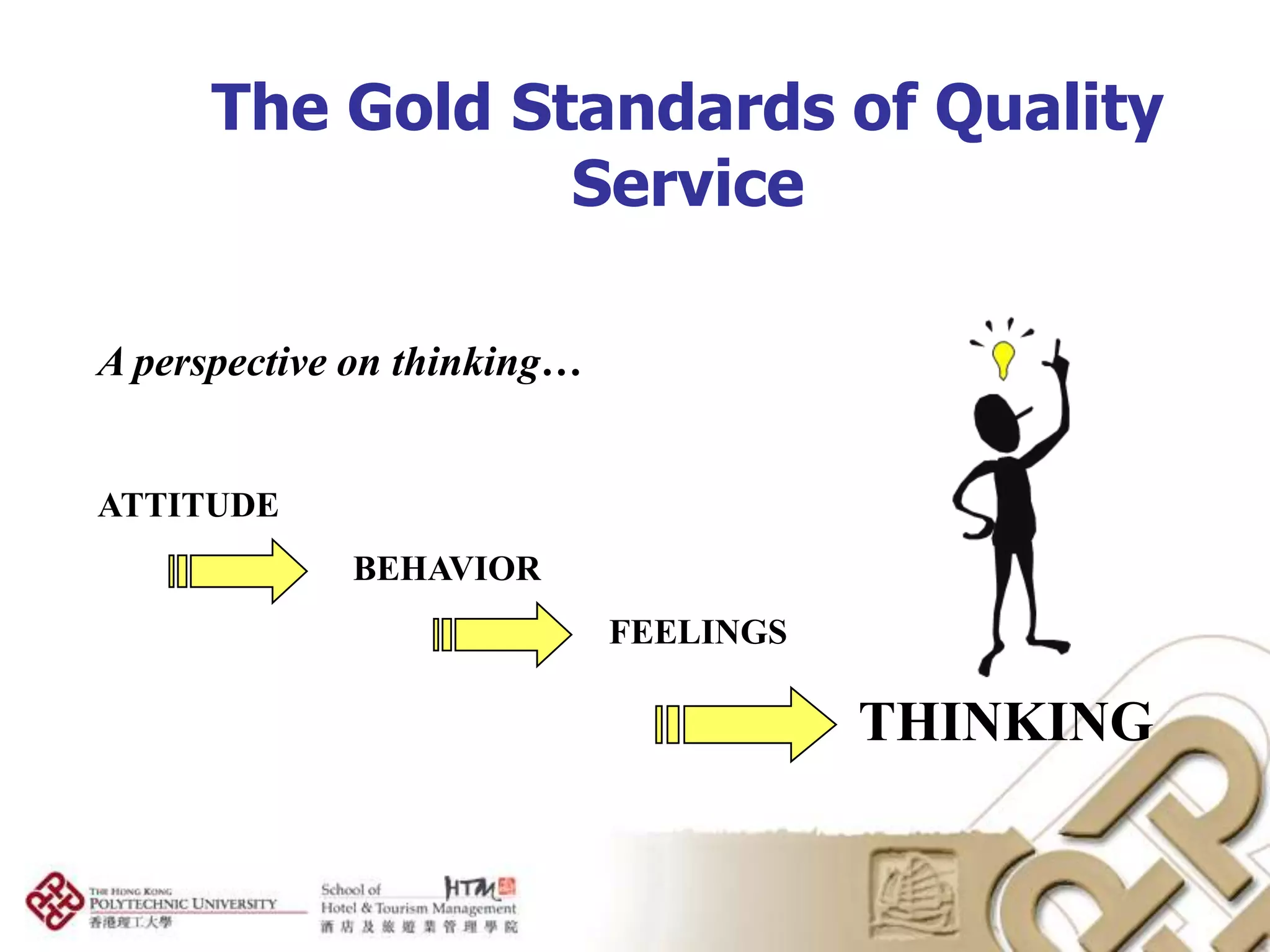
The Gold Standards of Quality
                 Service

A perspective on thinking…


ATTITUDE
             BEHAVIOR
                             FEELINGS

                                        THINKING
Mandarin Oriental - DELIGHT
•   Our mission is to delight our guests and the word delight is the perfect
    acronym for everything that Mandarin Oriental represents.
•   Distinctive
     –   A unique collection of individual hotels and resorts from the elegant charm of 19th century London to the
         futuristic architecture of Miami’s art deco style. Mandarin Oriental hotels and resorts are unique in style
         and design. Each property has its own distinctive flair and charm, while guests are assured unparalleled
         warmth and hospitality in every destination.
•   Exotic
     –   The magic of the orient, with a sense of place. Reflective of local culture and style, each hotel has a strong
         sense of place while oriental touches provide a warm and inviting atmosphere.
•   Lively
     –   A place with energy and momentum. Creating experiences of exceptional quality, Mandarin Oriental hotels
         and resorts are vibrant, popular places from which to enjoy the best in life.
•   Imaginative
     –   Innovative designs and services to excite and entertain. Chic and spacious with innovative architecture,
         interiors and original art, Mandarin Oriental welcomes guests with impeccable surroundings and creative
         spaces.
•   Guest-centred
     –   A service that’s personal, passionate and surprising. With our oriental beginnings, highly personalized
         service comes naturally to us all. Our aim is to delight and surprise you on every occasion, and to
         constantly welcome you back to the warmth that is Mandarin Oriental.
•   Harmonious
     –   Caring service combined with special touches. We welcome you with the utmost in personal attention and
         create a harmonious and holistic environment to ensure total relaxation and enjoyment. Distinctive charm
         and hospitality is provided in elegant and immaculate surroundings.
•   Time giving.
     –   A place which gives time to enjoy, relax and reflect. Gaining cultural insights to an ancient Lanna kingdom,
         languishing by a pool in Florida, watching the breakers in Bermuda, Mandarin Oriental aims to give you the
         time to experience life and all its pleasures.
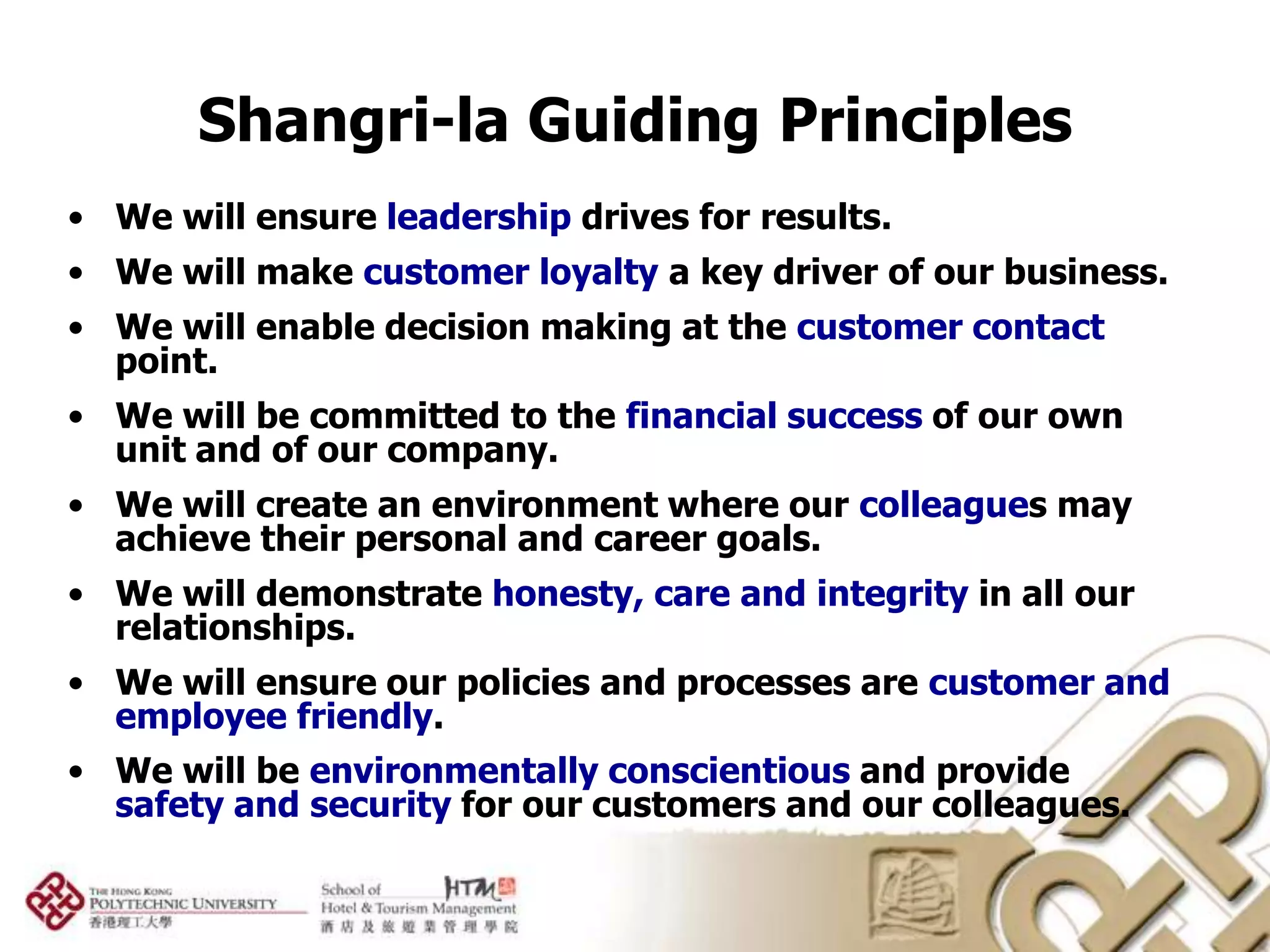
Shangri-la Guiding Principles
• We will ensure leadership drives for results.
• We will make customer loyalty a key driver of our business.
• We will enable decision making at the customer contact
  point.
• We will be committed to the financial success of our own
  unit and of our company.
• We will create an environment where our colleagues may
  achieve their personal and career goals.
• We will demonstrate honesty, care and integrity in all our
  relationships.
• We will ensure our policies and processes are customer and
  employee friendly.
• We will be environmentally conscientious and provide
  safety and security for our customers and our colleagues.
Service Recovery Systems

          Process –
   Responsiveness/Empathy
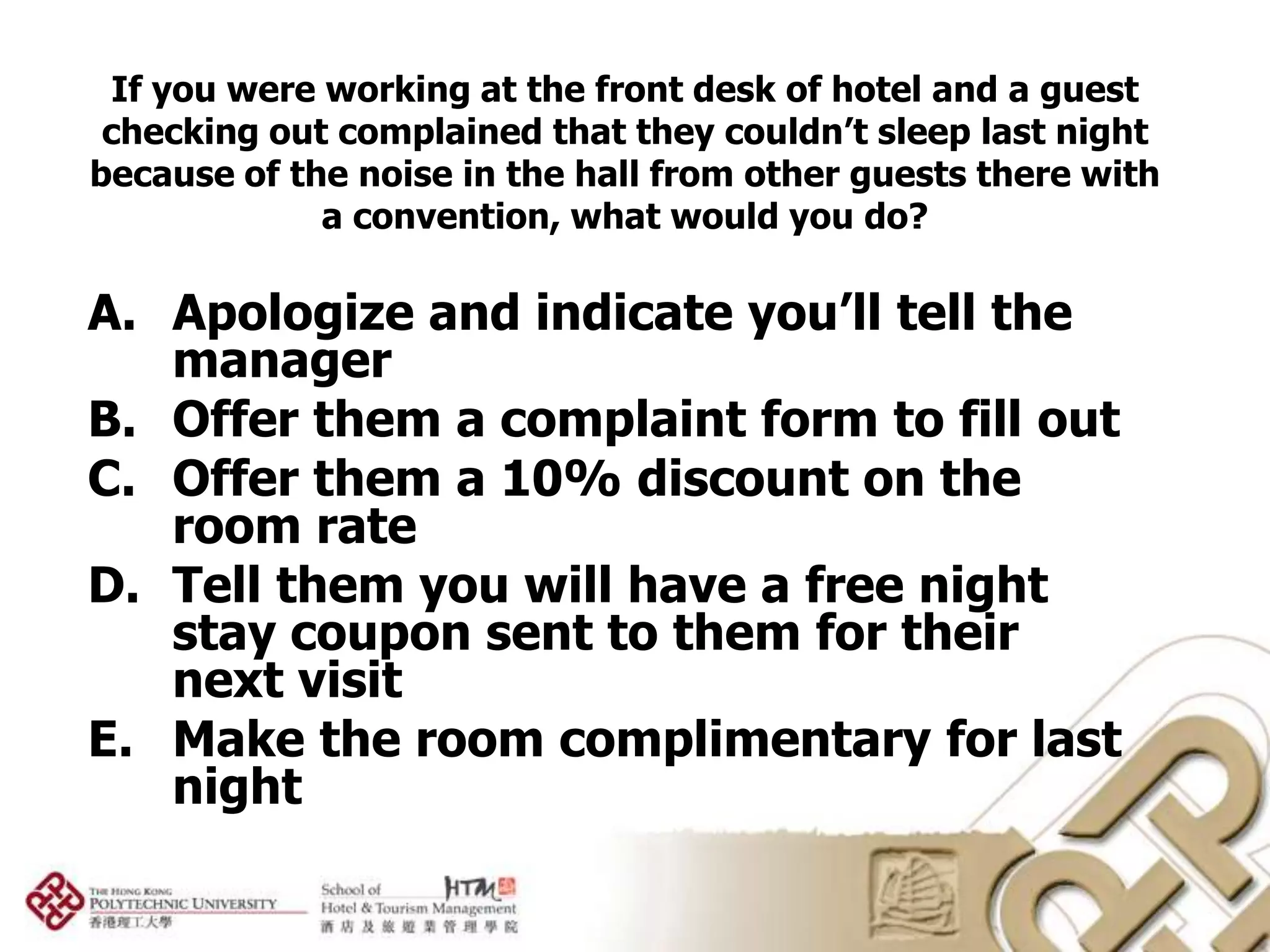
If you were working at the front desk of hotel and a guest
 checking out complained that they couldn’t sleep last night
because of the noise in the hall from other guests there with
             a convention, what would you do?

A. Apologize and indicate you’ll tell the
   manager
B. Offer them a complaint form to fill out
C. Offer them a 10% discount on the
   room rate
D. Tell them you will have a free night
   stay coupon sent to them for their
   next visit
E. Make the room complimentary for last
   night
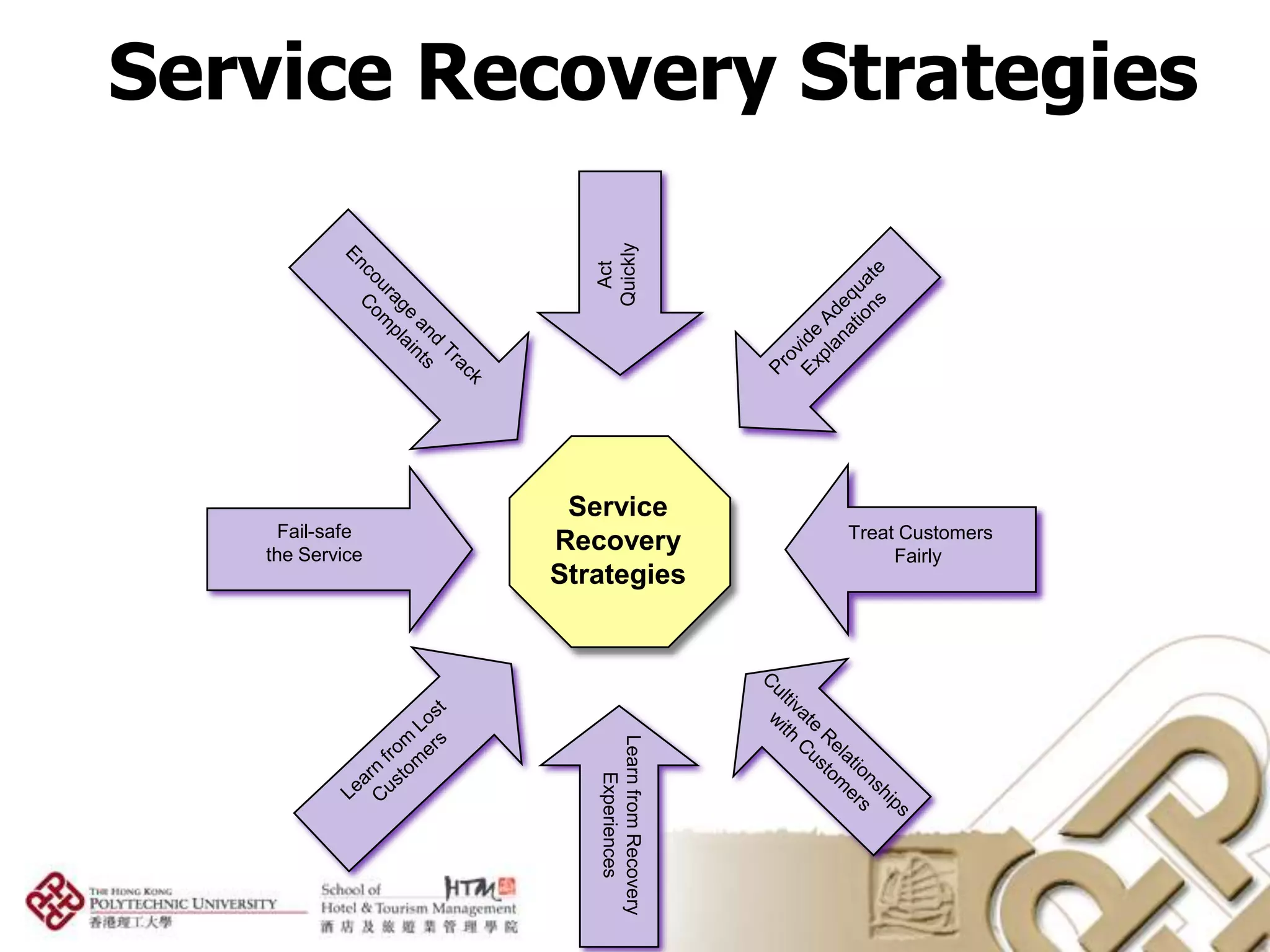
Service Recovery Strategies


                    Quickly
                     Act
                  Service
     Fail-safe                            Treat Customers
   the Service
                 Recovery                      Fairly
                 Strategies
                    Learn from Recovery
                        Experiences
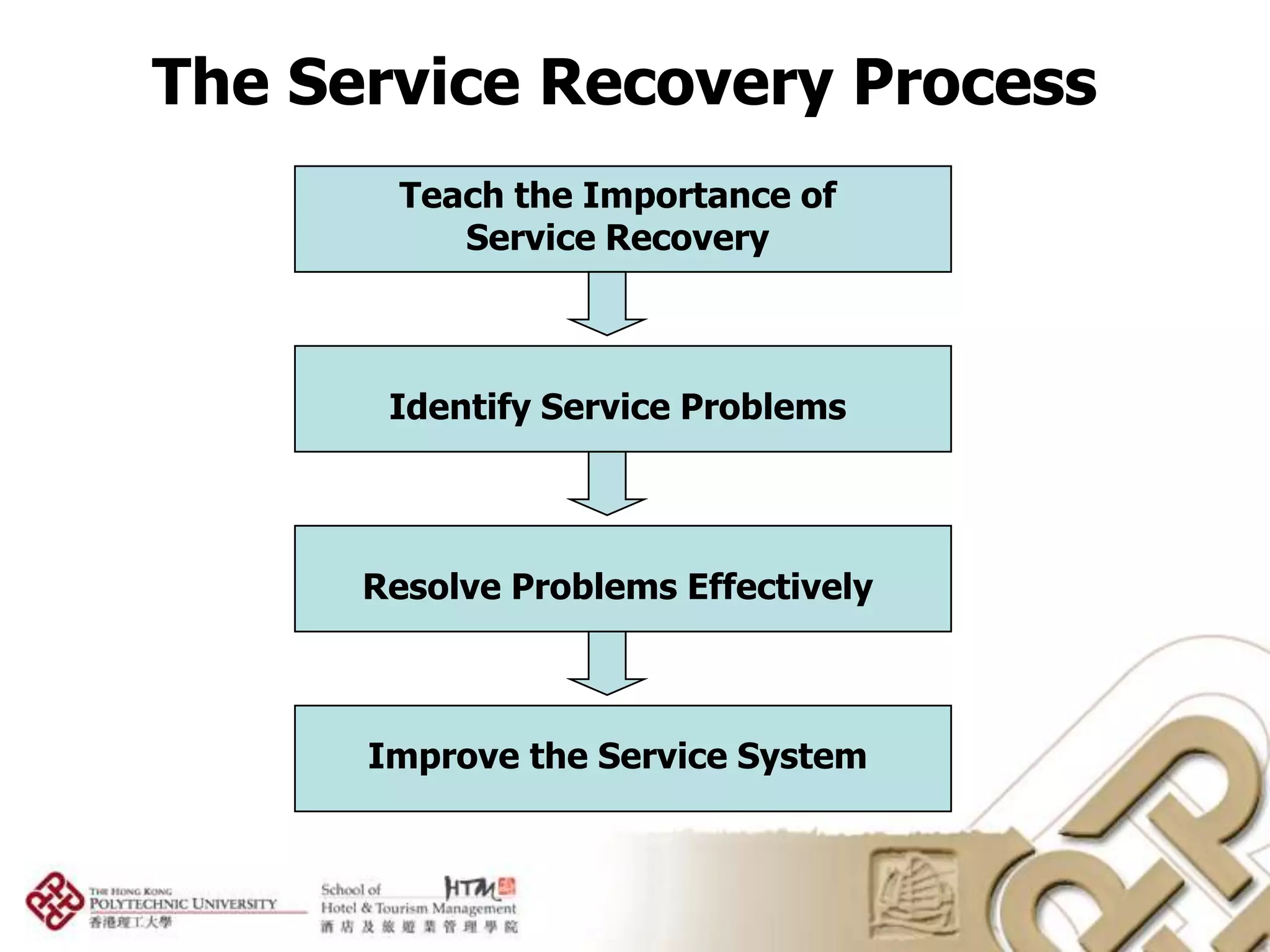
The Service Recovery Process
        Teach the Importance of
           Service Recovery


       Identify Service Problems


      Resolve Problems Effectively


      Improve the Service System
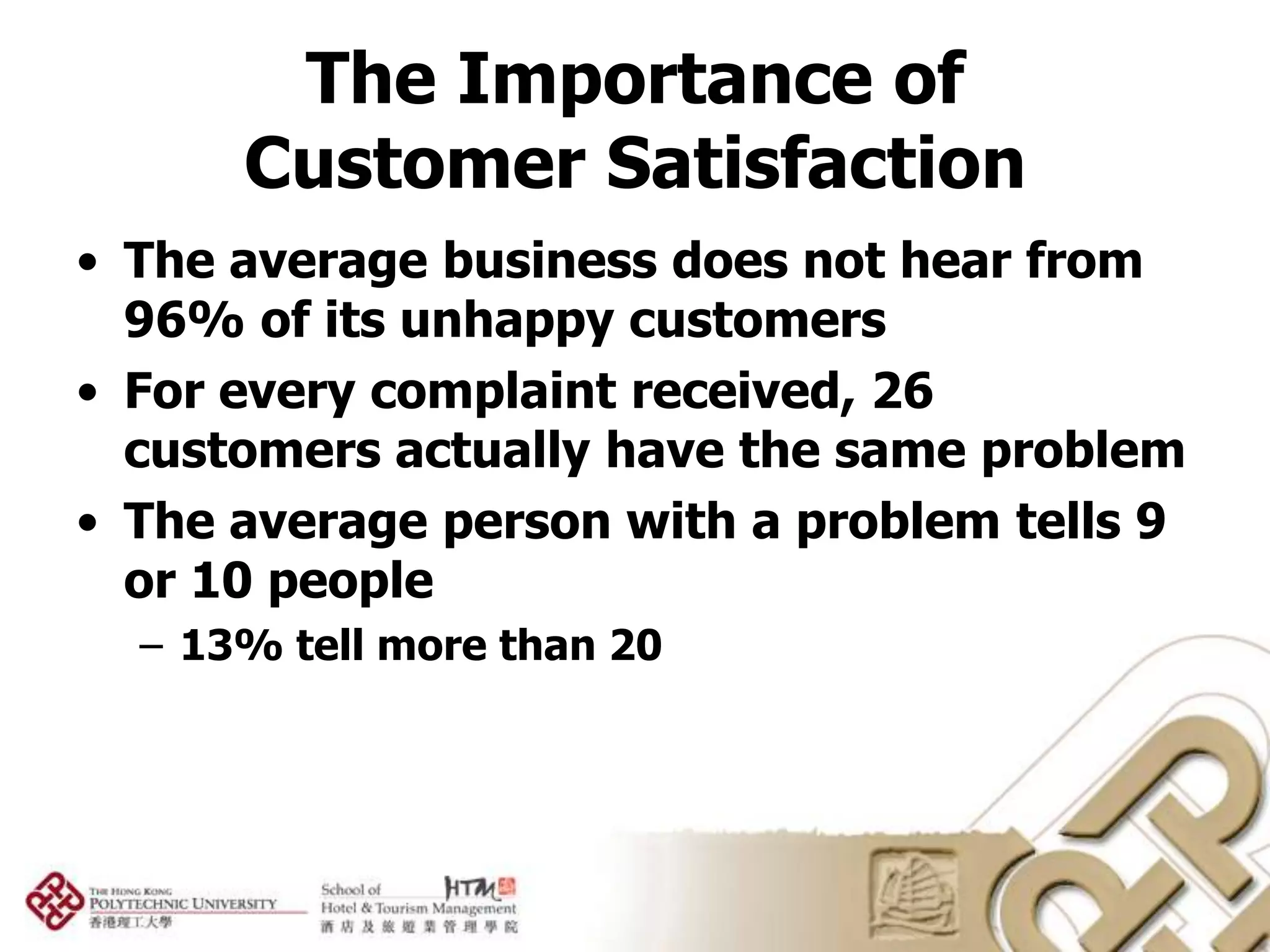
The Importance of
      Customer Satisfaction
• The average business does not hear from
  96% of its unhappy customers
• For every complaint received, 26
  customers actually have the same problem
• The average person with a problem tells 9
  or 10 people
  – 13% tell more than 20
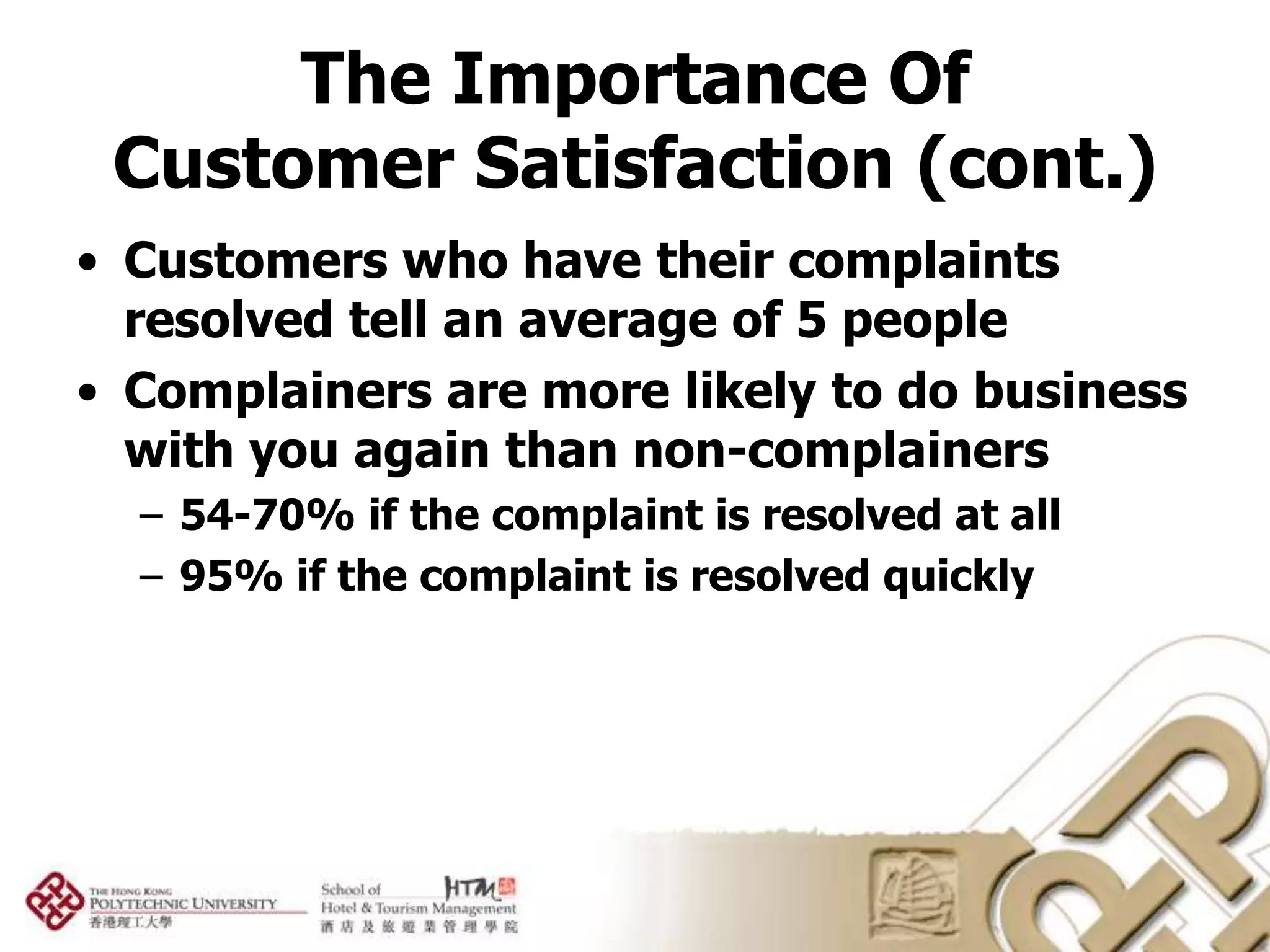
The Importance Of
 Customer Satisfaction (cont.)
• Customers who have their complaints
  resolved tell an average of 5 people
• Complainers are more likely to do business
  with you again than non-complainers
  – 54-70% if the complaint is resolved at all
  – 95% if the complaint is resolved quickly
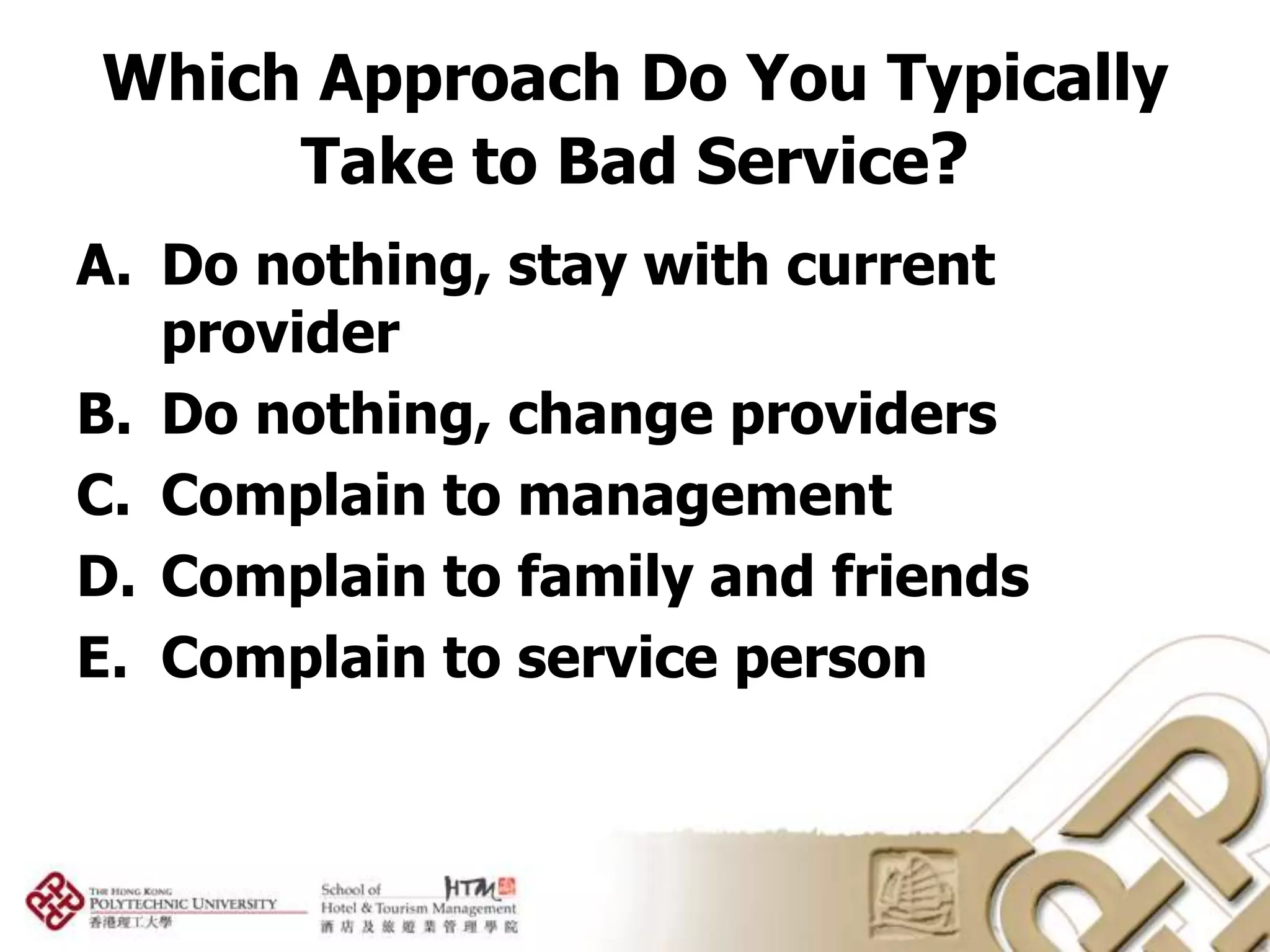
Which Approach Do You Typically
     Take to Bad Service?
A. Do nothing, stay with current
   provider
B. Do nothing, change providers
C. Complain to management
D. Complain to family and friends
E. Complain to service person
Service Problem Reactions
• Complain and it gets resolved
• Complain and it isn’t resolved
• Dissatisfied and don’t complain
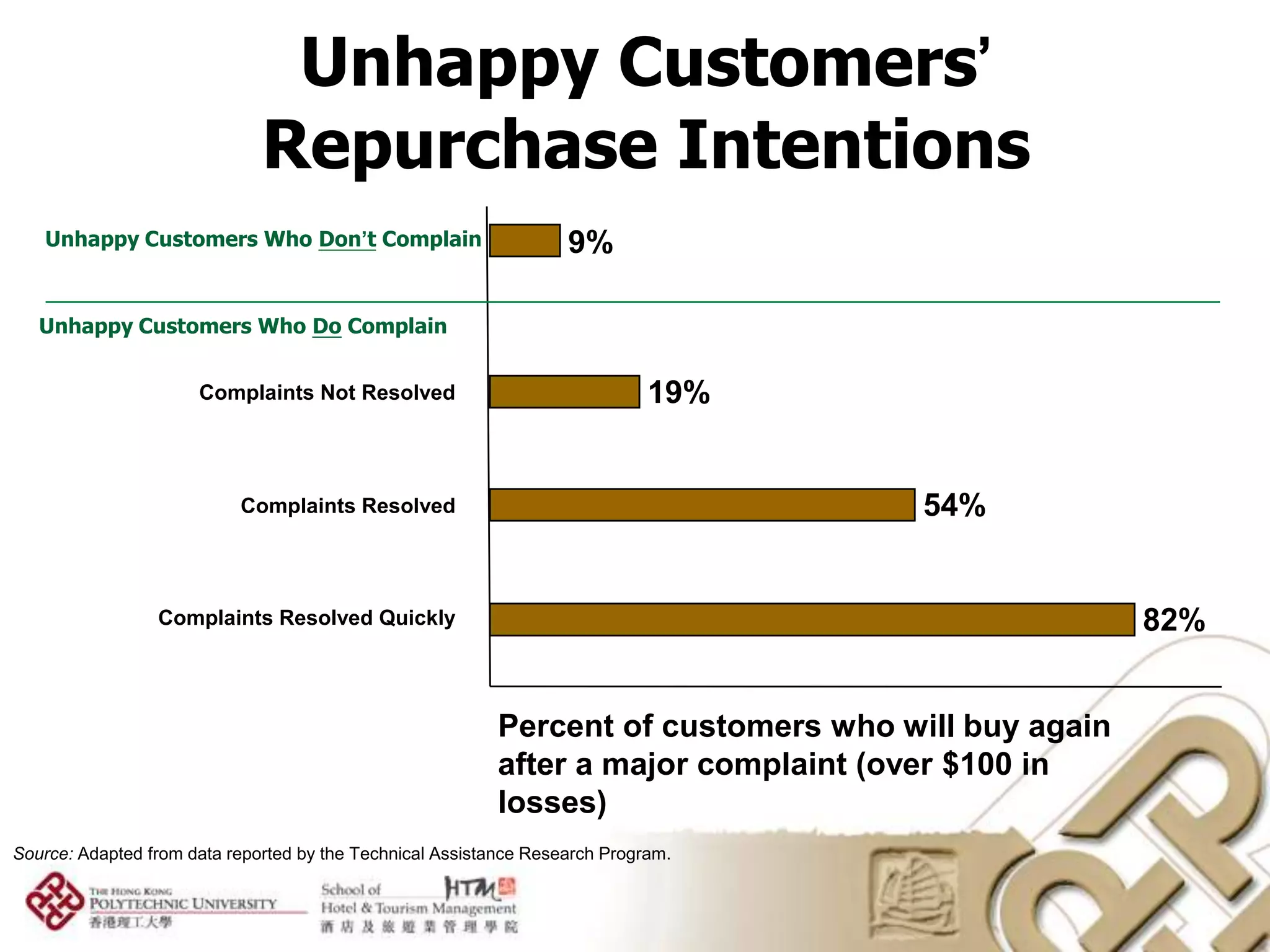
Unhappy Customers’
                              Repurchase Intentions
   Unhappy Customers Who Don’t Complain                            9%

   Unhappy Customers Who Do Complain


                      Complaints Not Resolved                                19%


                           Complaints Resolved                                       54%


                 Complaints Resolved Quickly                                                        82%


                                                          Percent of customers who will buy again
                                                          after a major complaint (over $100 in
                                                          losses)
Source: Adapted from data reported by the Technical Assistance Research Program.
Disney’s Process
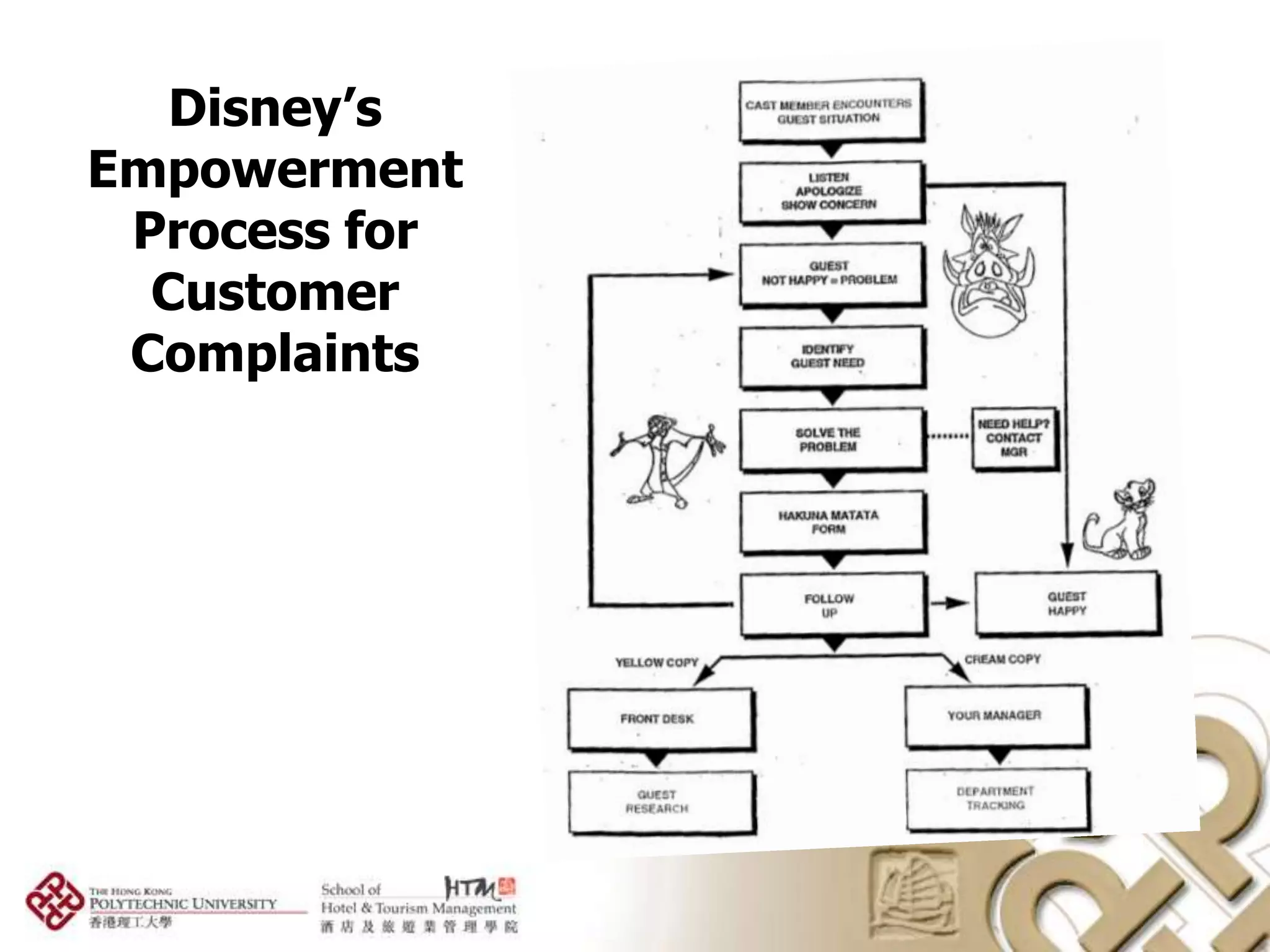
Disney’s
Empowerment
 Process for
  Customer
 Complaints
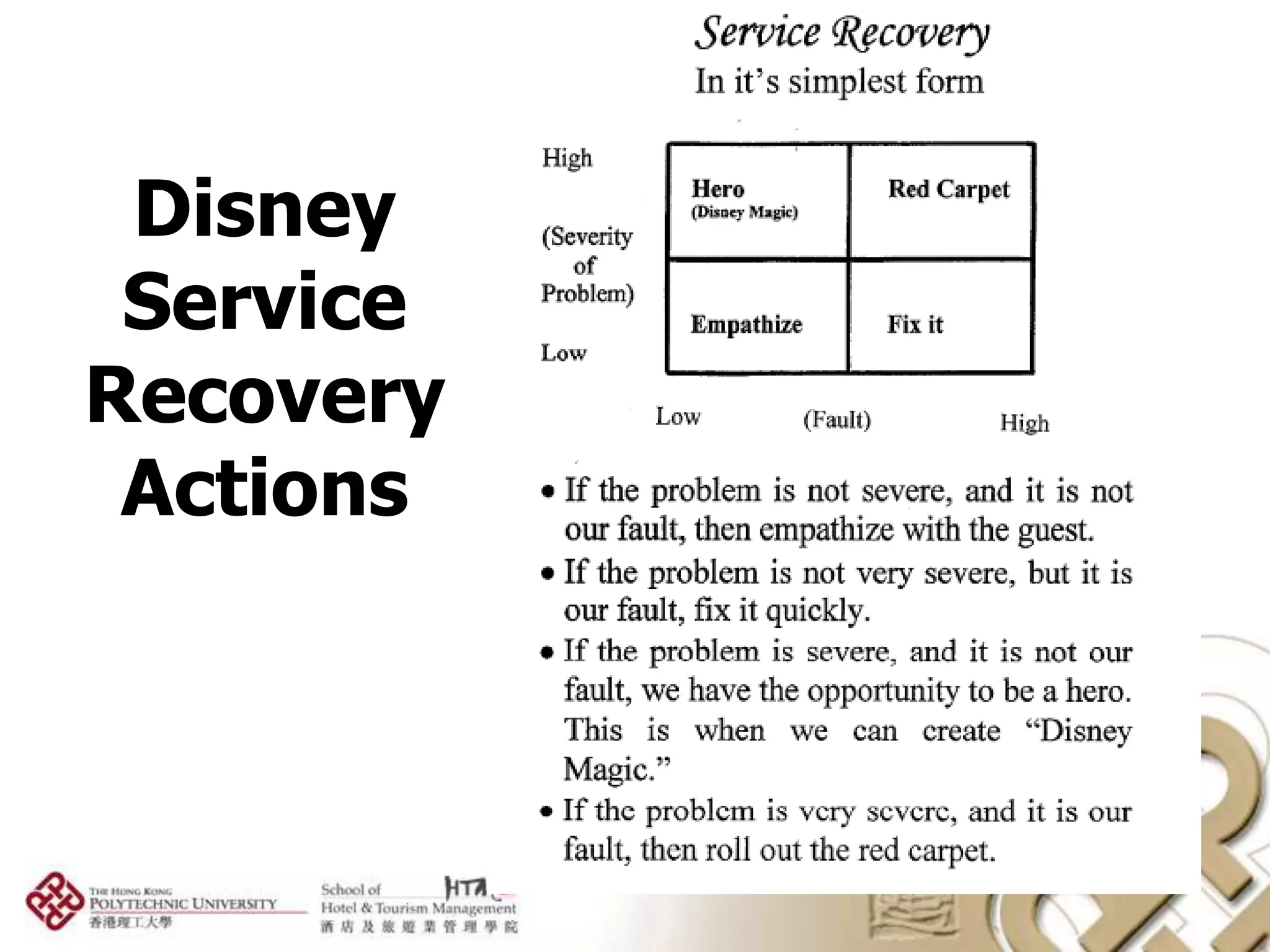
Disney
 Service
Recovery
 Actions
The Benefits Of
        Customer Satisfaction
•   Positive word-of-mouth
•   Purchase more frequently
•   Less likely to be lost to competitors
•   Insulated from price competition
•   Positive work environments
So What Is
Different in Asia?
 Process and People
Asian Wave:
The Service Difference

        Process
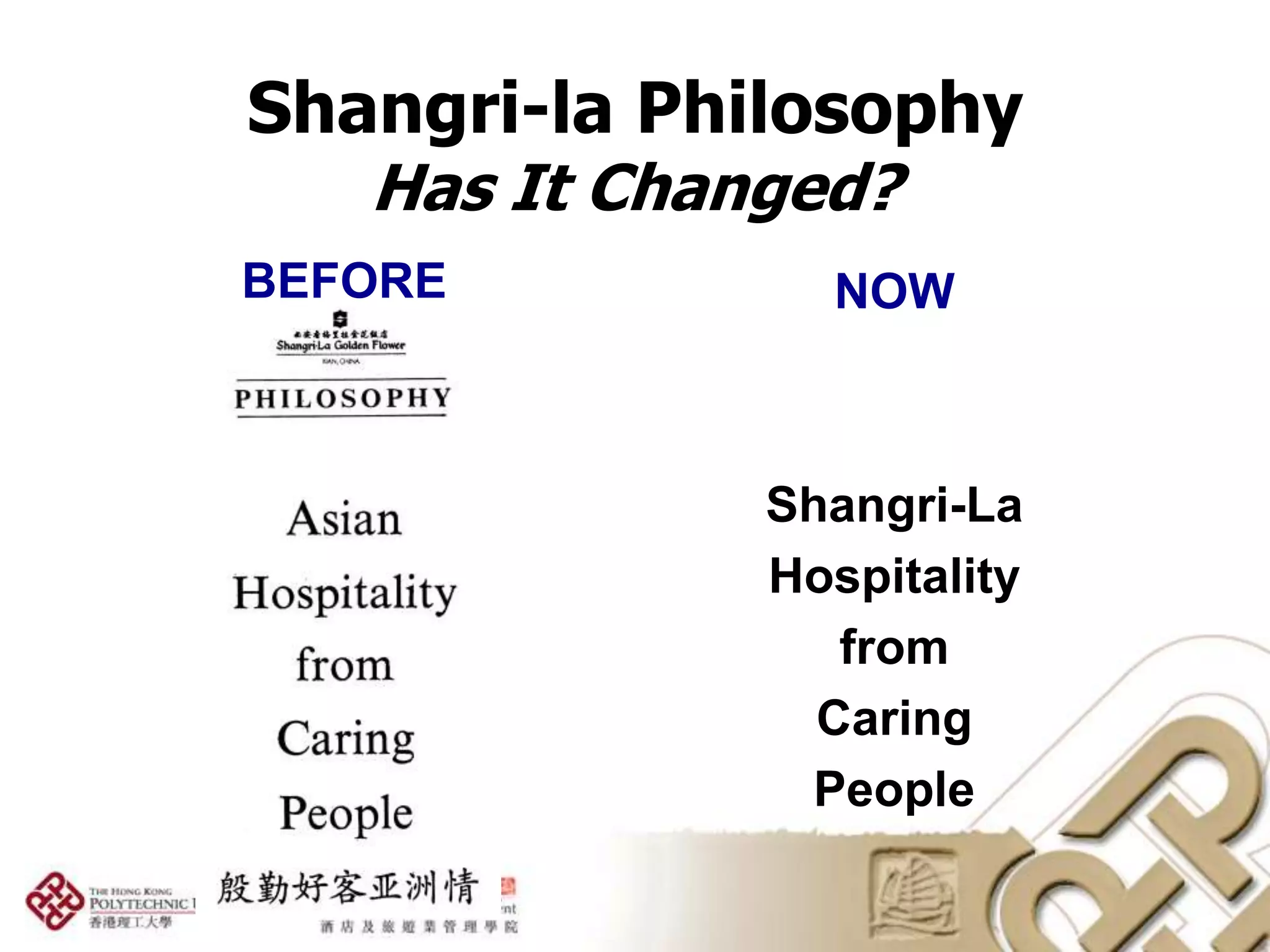
Shangri-la Philosophy
   Has It Changed?
BEFORE          NOW


              Shangri-La
              Hospitality
                 from
                Caring
               People
Shangri-la Commitment
• Unique characteristics encapsulated by
  Asian Hospitality. Our commitment to
  providing guests with distinctive Asian
  standards of hospitality and service
  from caring people remains our major
  point of differentiation from our peers
  and the very cornerstone of our
  reputation as a world-class hotel group.
• “Pride without arrogance”
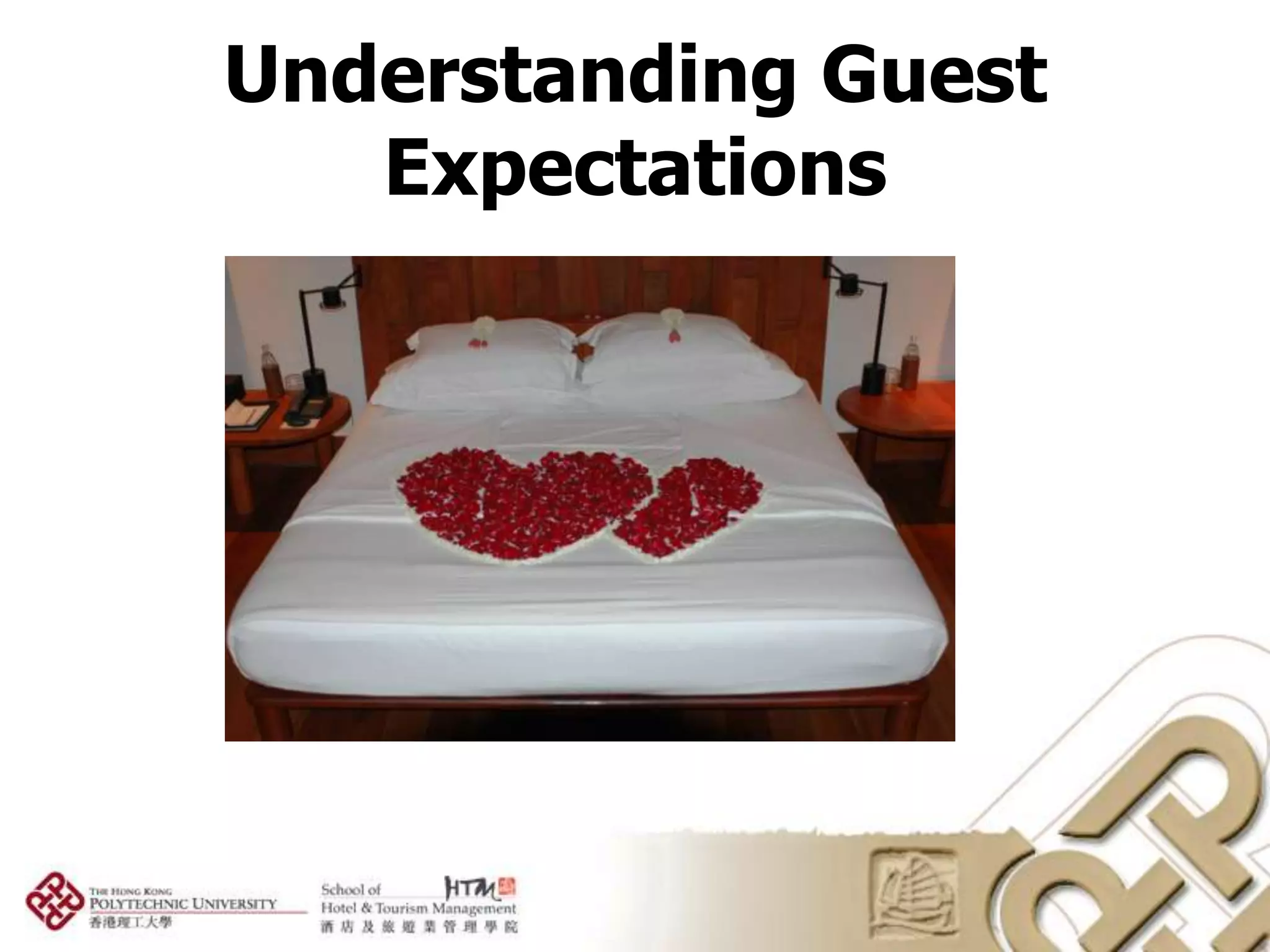
Understanding Guest
   Expectations
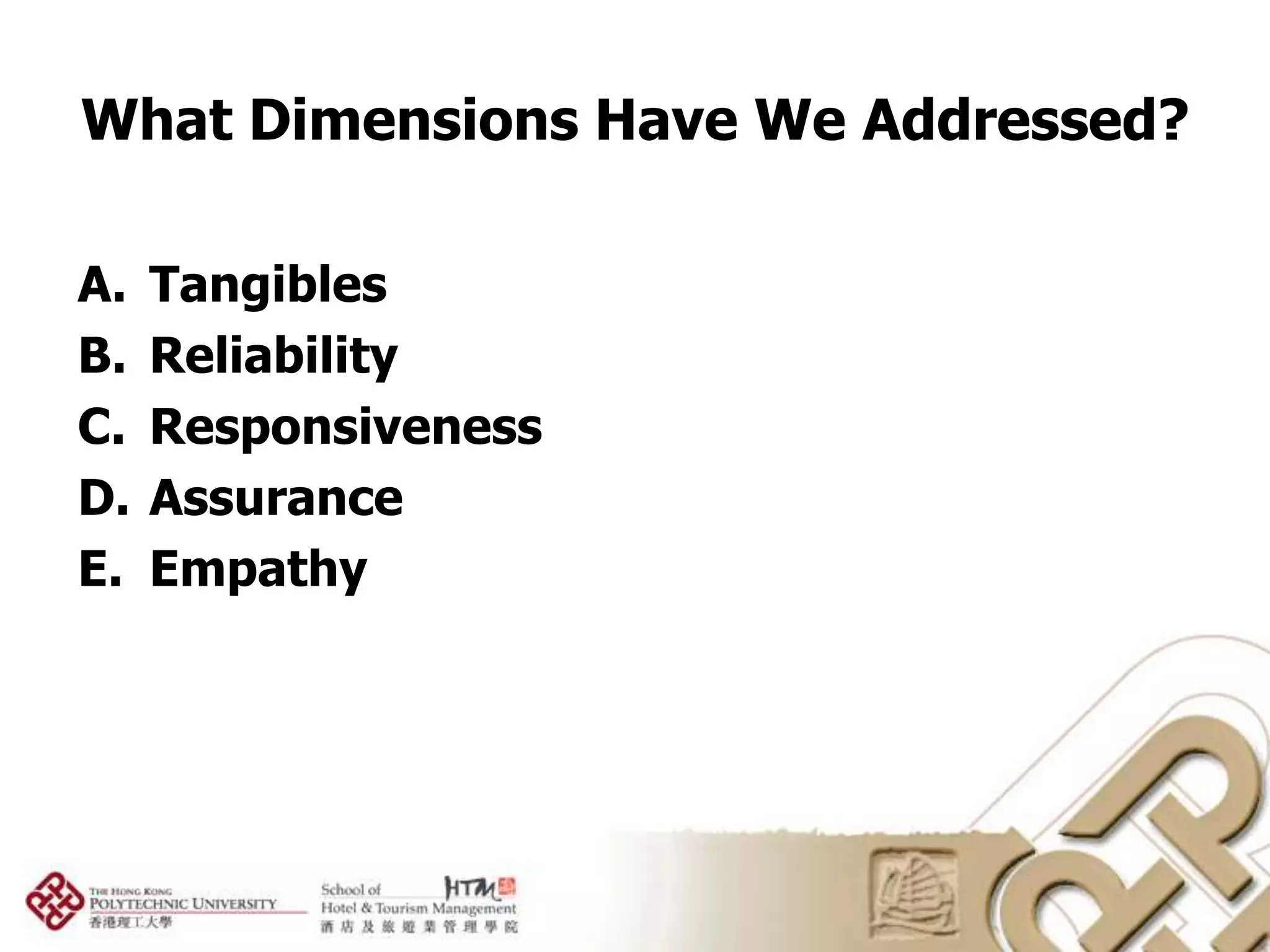
What Dimensions Have We Addressed?

A.   Tangibles
B.   Reliability
C.   Responsiveness
D.   Assurance
E.   Empathy
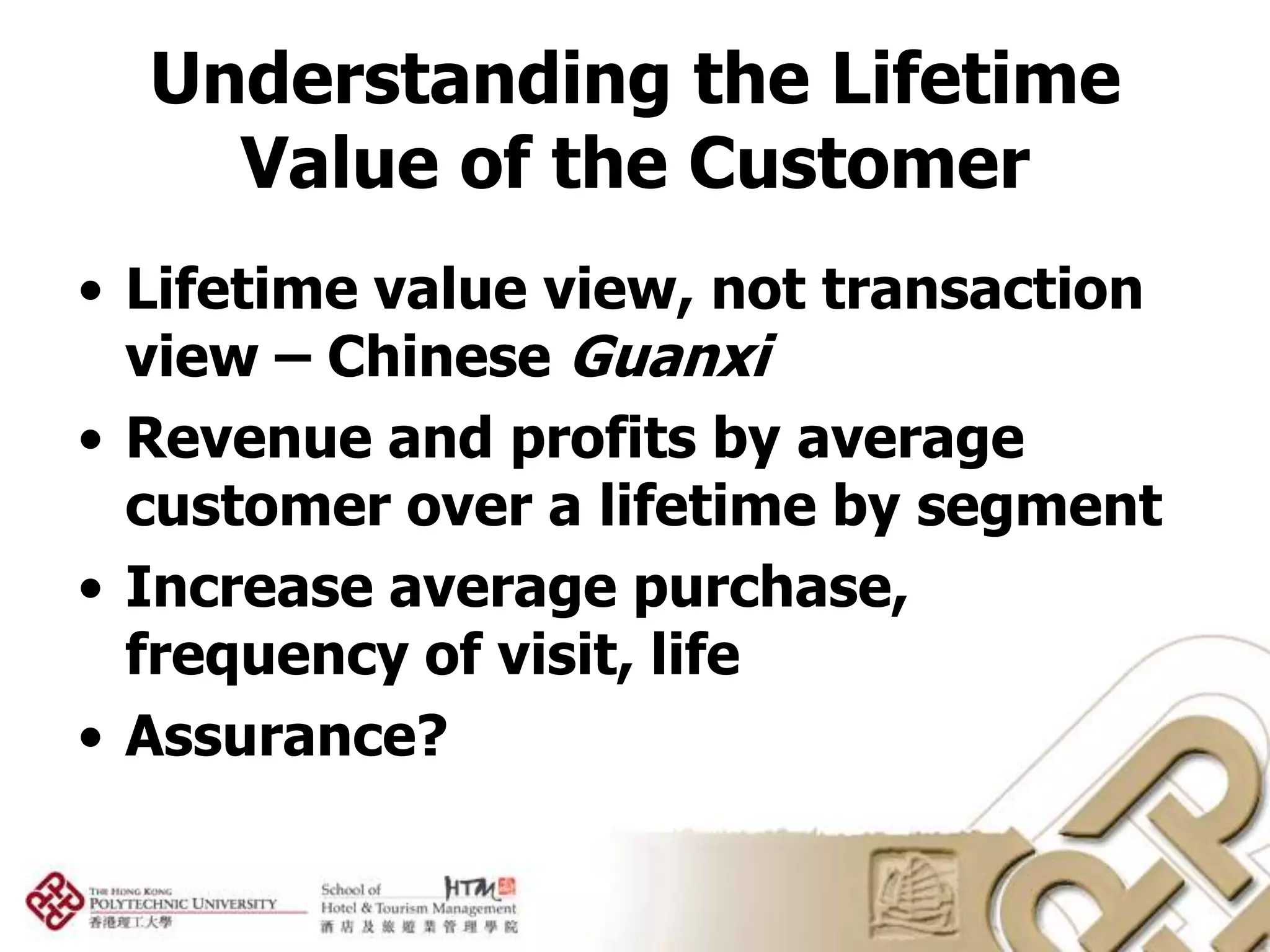
Understanding the Lifetime
    Value of the Customer
• Lifetime value view, not transaction
  view – Chinese Guanxi
• Revenue and profits by average
  customer over a lifetime by segment
• Increase average purchase,
  frequency of visit, life
• Assurance?
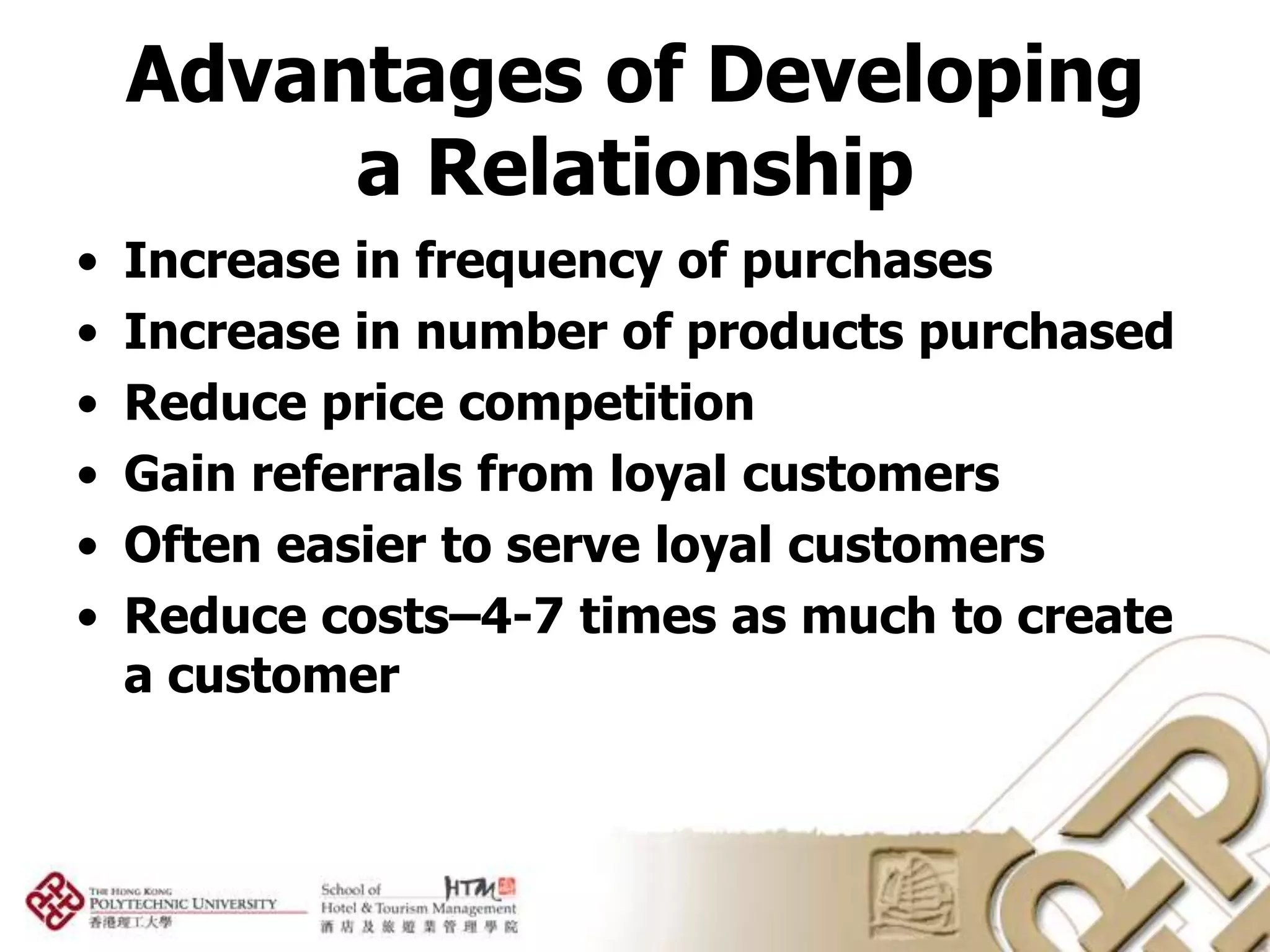
Advantages of Developing
         a Relationship
•   Increase in frequency of purchases
•   Increase in number of products purchased
•   Reduce price competition
•   Gain referrals from loyal customers
•   Often easier to serve loyal customers
•   Reduce costs–4-7 times as much to create
    a customer
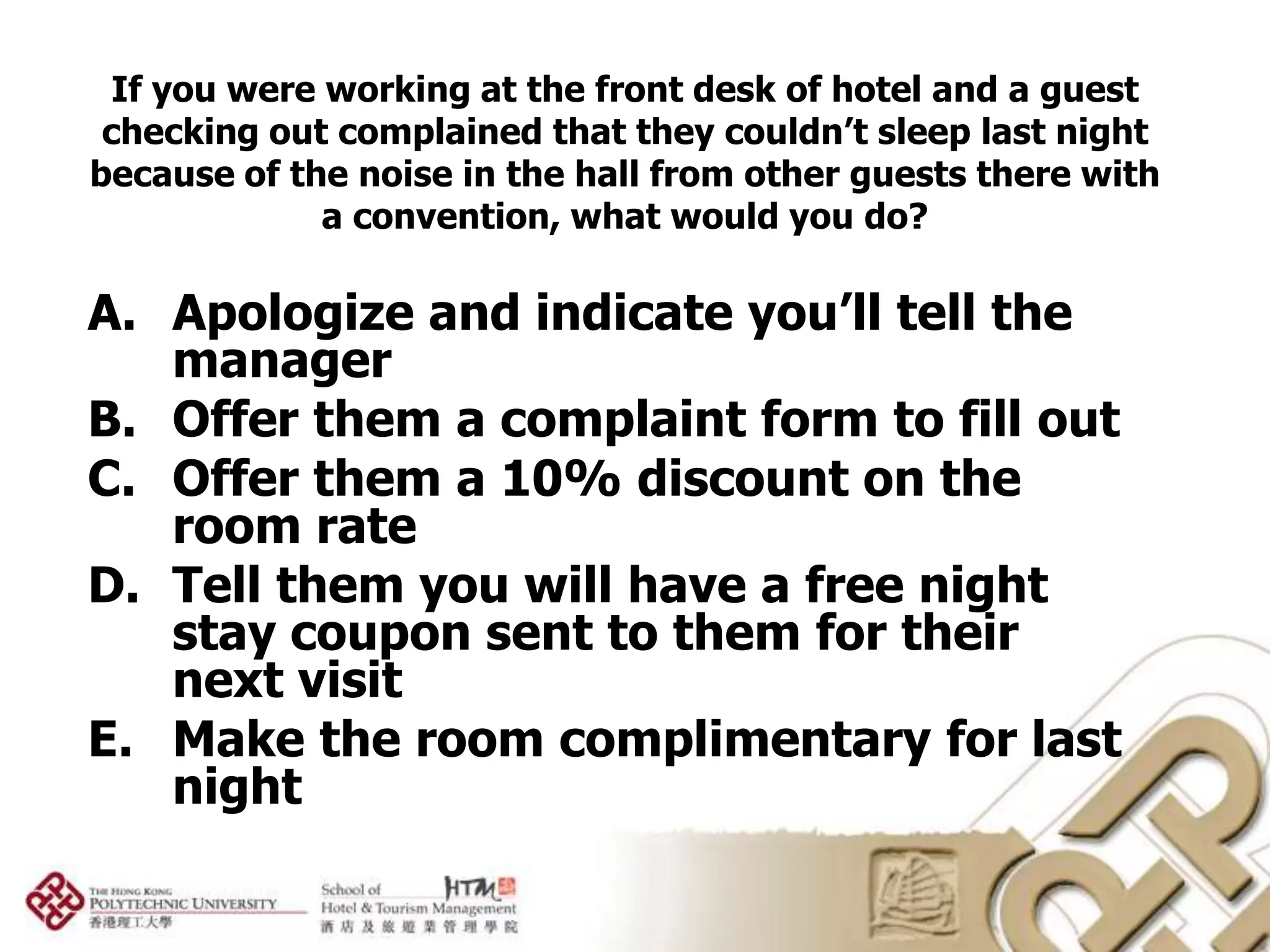
If you were working at the front desk of hotel and a guest
 checking out complained that they couldn’t sleep last night
because of the noise in the hall from other guests there with
             a convention, what would you do?

A. Apologize and indicate you’ll tell the
   manager
B. Offer them a complaint form to fill out
C. Offer them a 10% discount on the
   room rate
D. Tell them you will have a free night
   stay coupon sent to them for their
   next visit
E. Make the room complimentary for last
   night
Asian Wave:
The Service Difference

        People
Asian Principles
          “3 Plus 1 Factor”
• Respect for Elders
• “Face”
  – Giving It
• Work Before Self
  – Importance of the status of working for
    a hotel
• Plus Factor: Educational Sponges
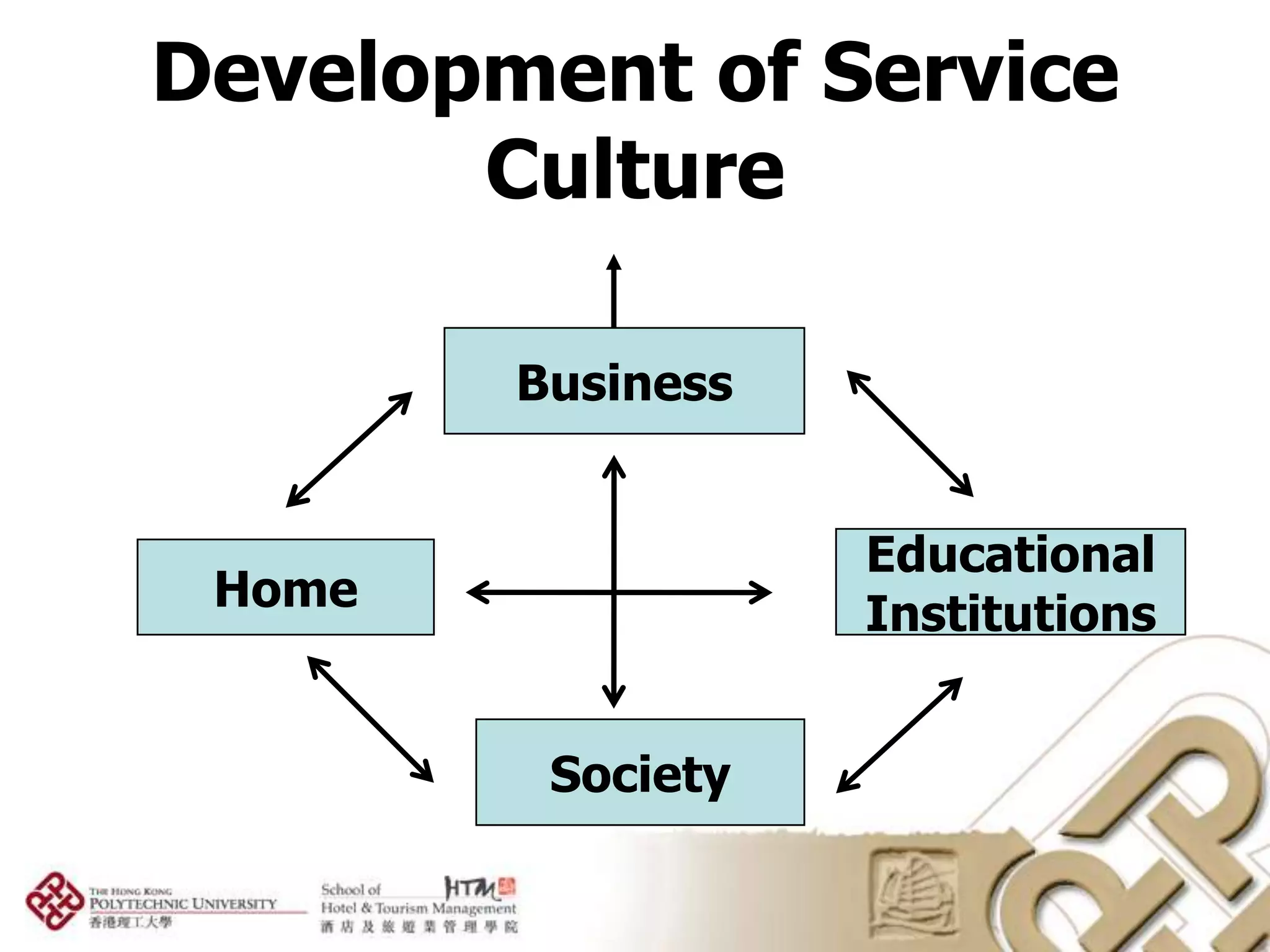
Development of Service
       Culture

        Business


                   Educational
 Home              Institutions


         Society
Service Leadership
    Characteristics
Bringing East and West Together


                                  73
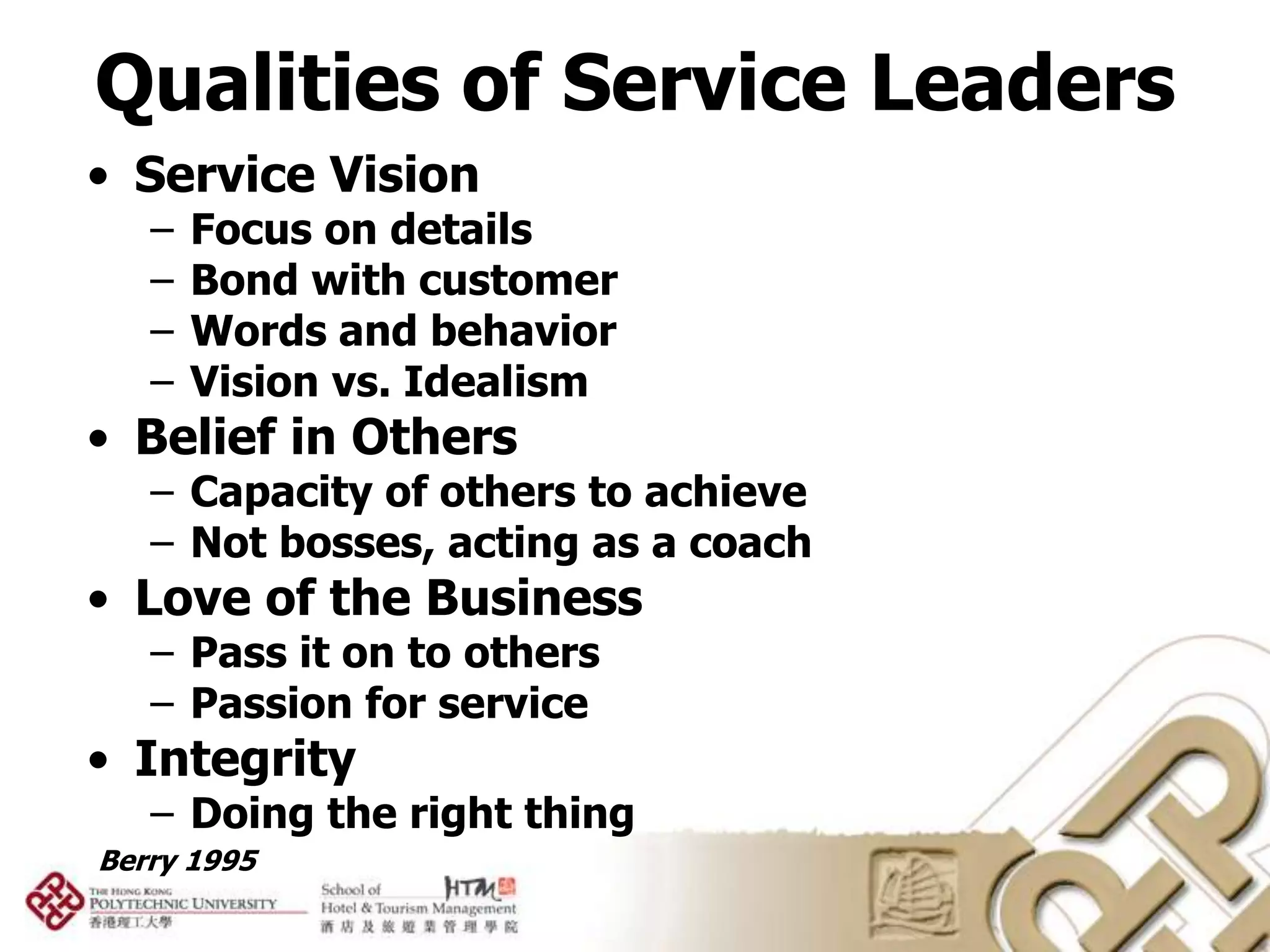
Qualities of Service Leaders
• Service Vision
   –   Focus on details
   –   Bond with customer
   –   Words and behavior
   –   Vision vs. Idealism
• Belief in Others
   – Capacity of others to achieve
   – Not bosses, acting as a coach
• Love of the Business
   – Pass it on to others
   – Passion for service
• Integrity
   – Doing the right thing
Berry 1995
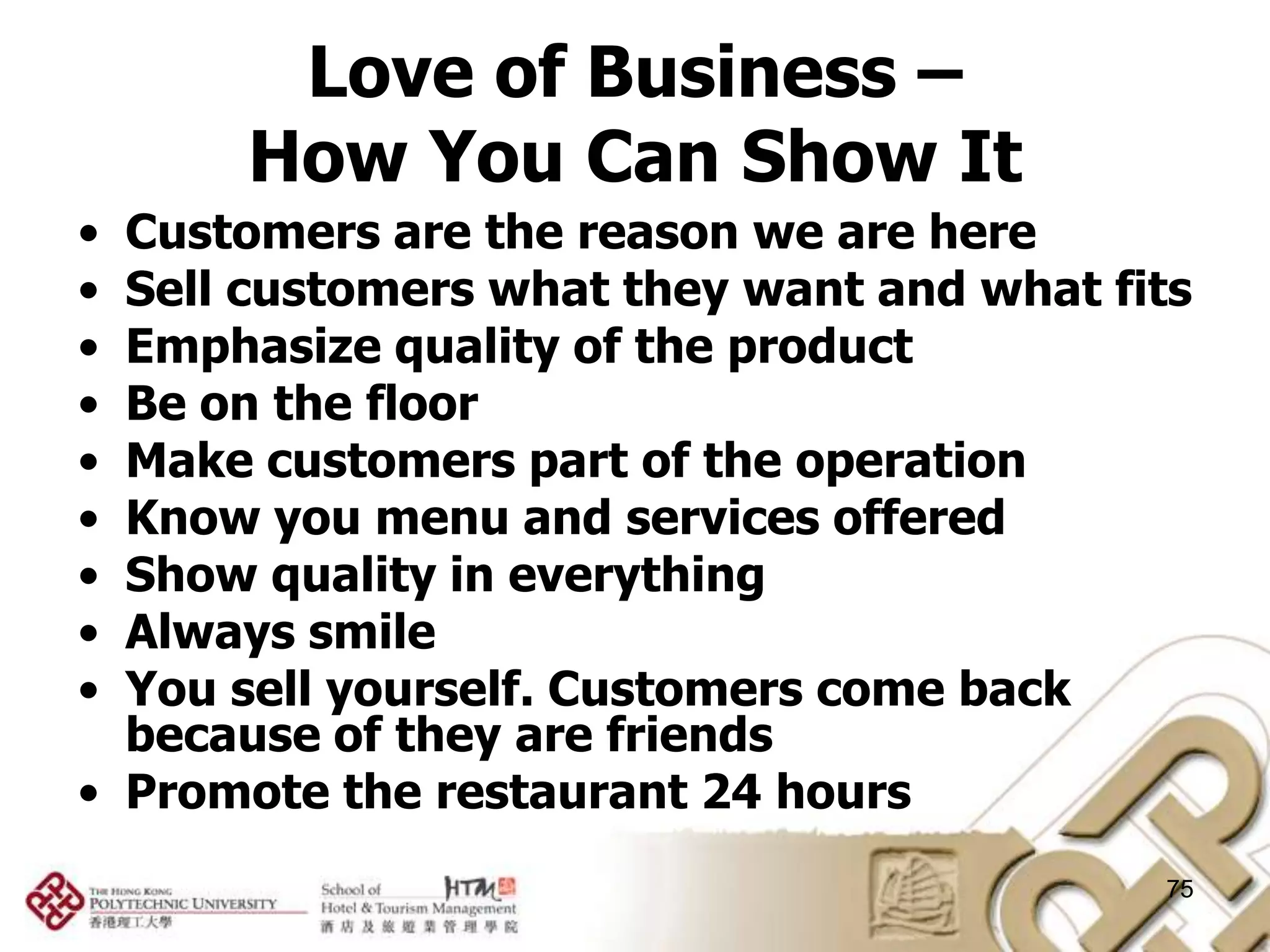
Love of Business –
      How You Can Show It
• Customers are the reason we are here
• Sell customers what they want and what fits
• Emphasize quality of the product
• Be on the floor
• Make customers part of the operation
• Know you menu and services offered
• Show quality in everything
• Always smile
• You sell yourself. Customers come back
  because of they are friends
• Promote the restaurant 24 hours
                                           75
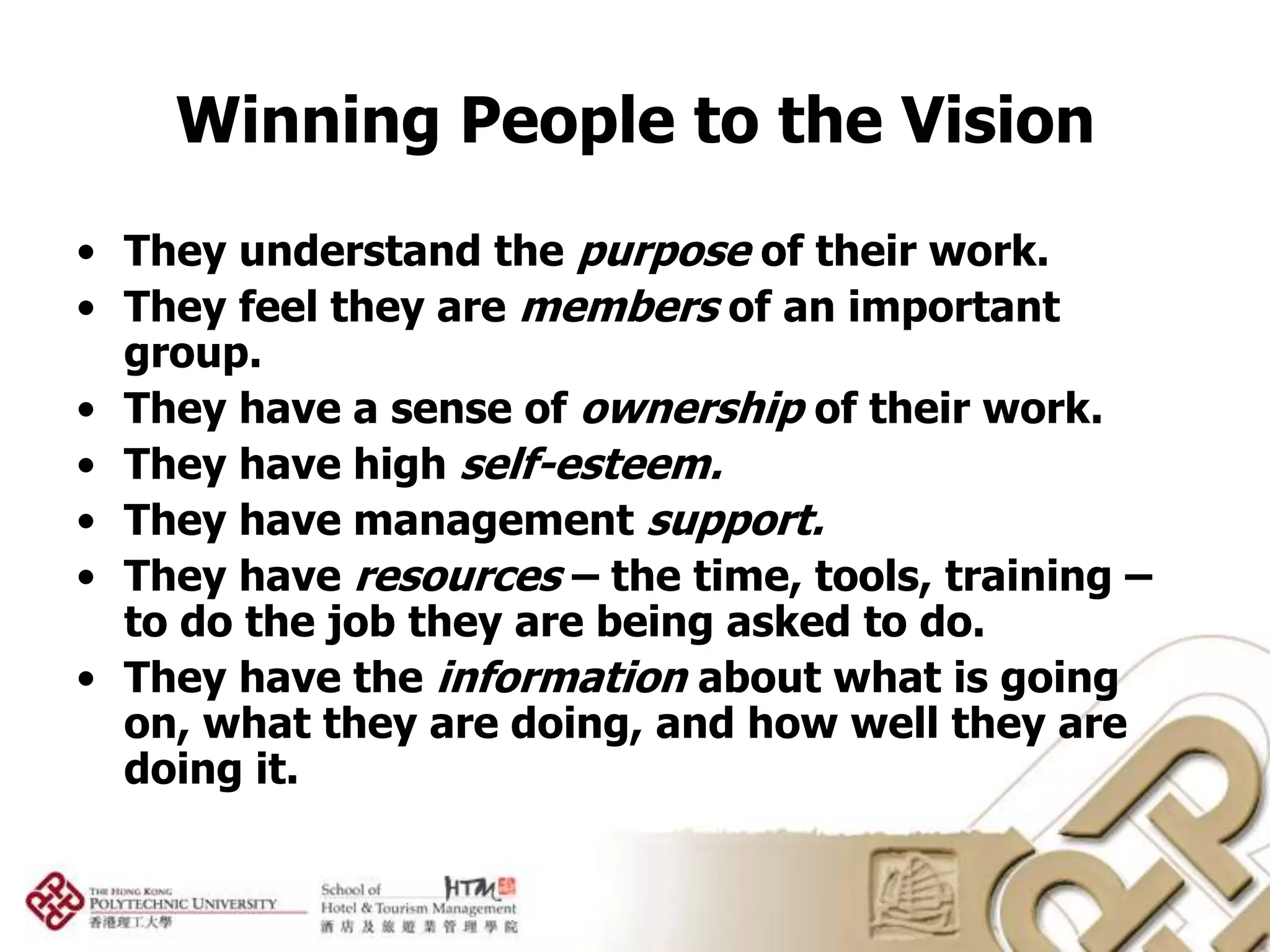
Winning People to the Vision
• They understand the purpose of their work.
• They feel they are members of an important
  group.
• They have a sense of ownership of their work.
• They have high self-esteem.
• They have management support.
• They have resources – the time, tools, training –
  to do the job they are being asked to do.
• They have the information about what is going
  on, what they are doing, and how well they are
  doing it.
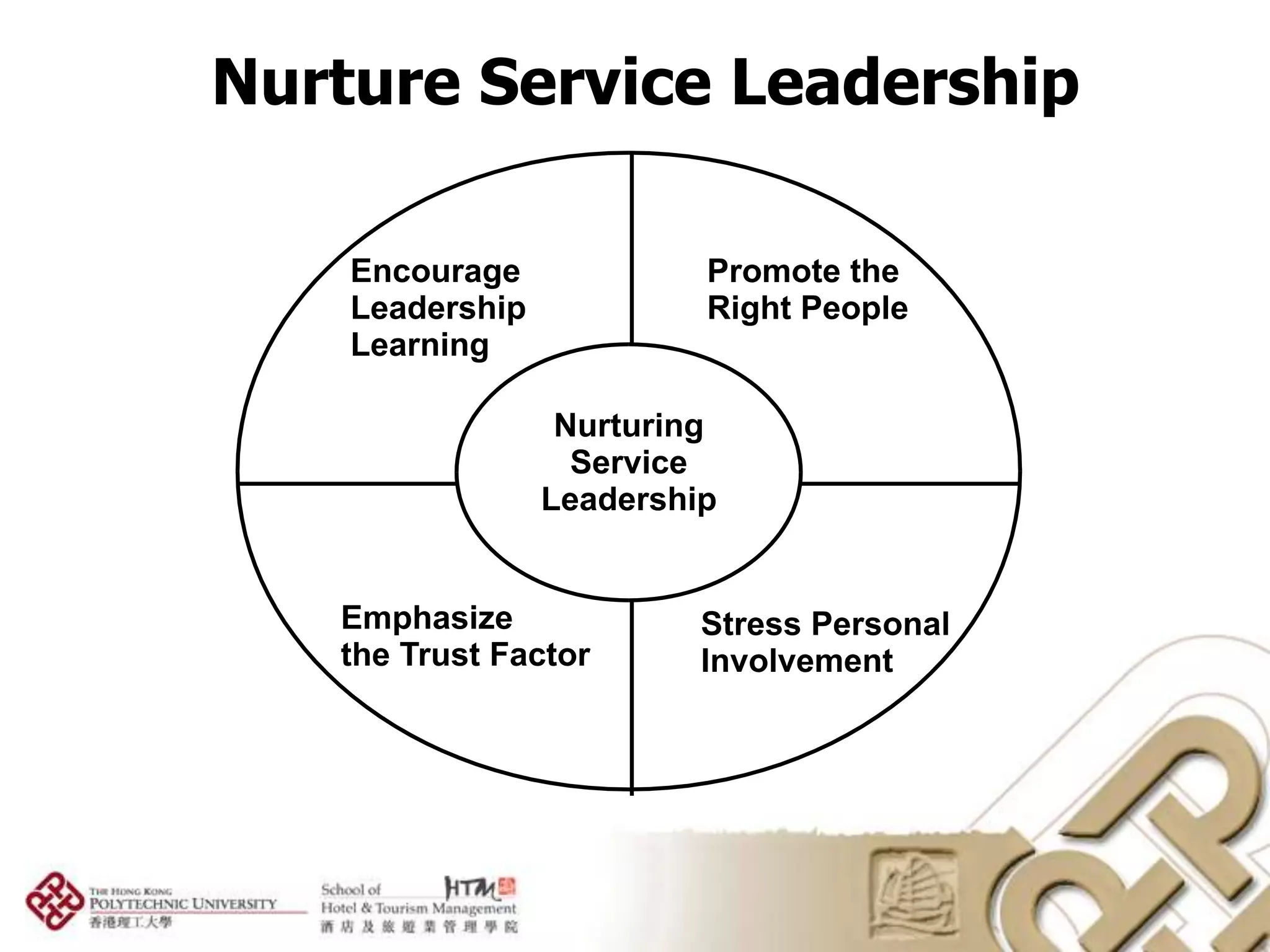
Nurture Service Leadership
Promote Right People
• Footprints-in-the-sand test
  – Past experience predicts future
• Stand for something test
  – Vision of future
• Outside leadership test
  – Volunteer organizations
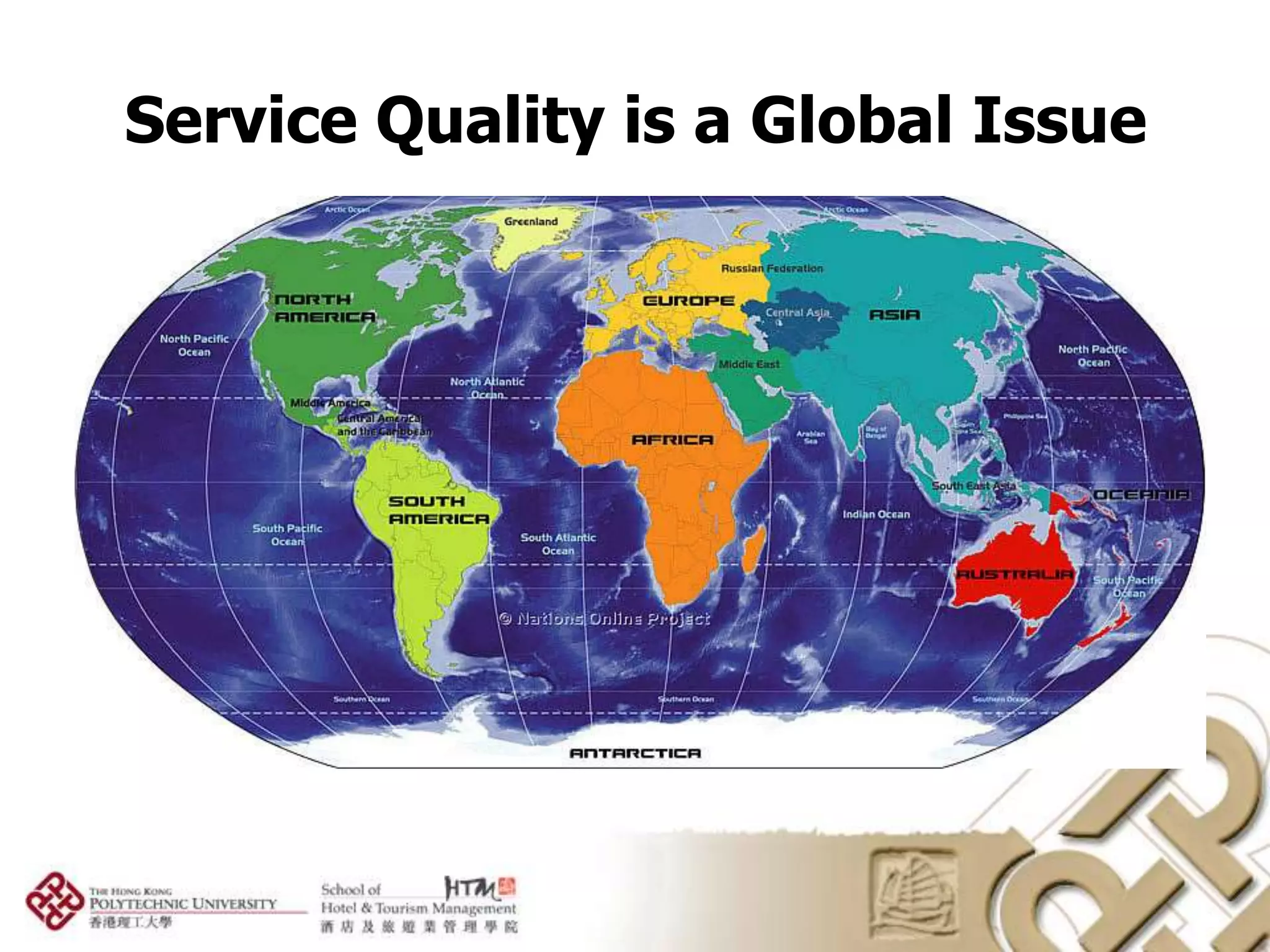
Service Quality is a Global Issue
The Possession of Facts
    is Knowledge,
  the Use of Them is
        Wisdom
    Thomas Jefferson
To Be Fond Of
     Learning
Is Near To Wisdom
    Confucius
Thank You

Appreciation of service quality concept

  • 1.
    Appreciation of Service Quality Concept David L Jones, Ph.D. Associate Professor School of Hotel & Tourism Management The Hong Kong Polytechnic University
  • 2.
    Whatever it was thatgot you where you are today is not sufficient to keep you there
  • 3.
    What We WillCover • What makes services different? • What do we mean by service quality? • How do we know if we are delivery service quality? • How is the Asian Wave influencing service quality? • How do we bring East and West together in service leadership?
  • 4.
    Service Definition Any activityor benefit that one party can offer to another that is essentially intangible and does not result in the ownership of anything.
  • 5.
    Services Attributes & Characteristics
  • 6.
    Services versus Goods •Intangibility • Heterogeneity/Variability • Inseparability – Simultaneous Production and Consumption • Perishability
  • 7.
    Tangibility Spectrum Salt  Soft Drinks  Detergents  Automobiles  Cosmetics Fast-food  Outlets  Intangible Dominant Tangible  Dominant Fast-food  Outlets Advertising  Airlines  Agencies Investment  Consulting  Management Teaching
  • 8.
    Bell’s Goods/Services Classification TANGIBLITY High Industrialized Differentiated Customized Goods Goods Goods Undifferentiated Differentiated Customized Goods/Services Goods/Services Goods/Services Bundles Bundles Bundles Industrialized Differentiated Customized Services Services Services Low Low DEGREE OF High CUSTOMIZATION
  • 9.
    Implications of Intangibility Servicescannot be inventoried Services cannot be patented Services cannot be readily displayed or communicated Pricing is difficult
  • 11.
    Shangri-la in HongKong Kowloon Shangri-la Island Shangri-la
  • 12.
  • 13.
    Implications of Heterogeneity Servicedelivery and customer satisfaction depend on employee actions Service quality depends on many uncontrollable factors There is no sure knowledge that the service delivered matches what was planned and promoted
  • 14.
  • 15.
    Implications of Simultaneous Production and Consumption Customers participate in and affect the transaction Customers affect each other Employees affect the service outcome Decentralization may be essential Mass production is difficult
  • 16.
    Implications of Perishability Itis difficult to synchronize supply and demand with services Services cannot be returned or resold
  • 17.
    Services Marketing Mix • Physical Evidence • People – Employees and Customers • Process Zeithaml & Bitner 1996
  • 18.
    Expanded Marketing Mix for Services PEOPLE PHYSICAL PROCESS EVIDENCE Employees Facility design Flow of activities Customers Equipment Number of steps Communicating Signage Level of customer culture and values involvement Employee research Employee dress Other tangibles
  • 19.
    Evidence of Servicefrom the Customer’s Point of View  Contact employees  Customer him/herself  Operational flow of  Other customers activities People  Steps in process  Flexibility vs.  Tangible standard communication Physical  Technology vs. Process  Servicescape human Evidence  Guarantees  Technology
  • 20.
  • 21.
    Service Quality The totality of features and characteristics of a product or service that bear on its ability to satisfy stated or implied needs.
  • 22.
    Service Quality • Thecustomer’s judgment of overall excellence of the service provided in relation to the quality that was expected. • Service quality assessments are formed on judgments of: – Outcome quality – Process quality – Physical environment quality
  • 23.
    Customer Assessment ofService Quality
  • 24.
    Dimensions of Service Quality • Tangibles • Reliability • Responsiveness • Assurance • Empathy
  • 25.
    Tangibles • Appearance ofphysical facilities, equipment, personnel and communication materials • Before, during and after • “Servicescape”
  • 26.
    Reliability • Ability toperform the promised service dependable and accurately • Most significant • Promises – Personal – Organizational – Common expectations • Service Delivery Systems
  • 27.
  • 29.
    Responsiveness • Willingness tohelp customers and provide prompt service • Finding out what the customer really needs by when • Customer waits – Fast food – 5 minutes – Fine dining – 30 minutes • Service Recovery Systems
  • 30.
  • 32.
    Assurance • Competence – Possession of the required skills and knowledge to perform the service – Product and Company Knowledge • Courtesy – Politeness, respect, consideration and friendliness of contact personnel • Credibility – Trustworthiness, believability, honesty of the service provider
  • 33.
    Reassurance Factor • Product knowledge • Company knowledge • Listening skills • Problem-solving skills
  • 34.
    Empathy • Caring, individualizedattention the firm provides its customers • Access – Approachability and ease of contact • Communication – Keeping customers informed in language they can understand, and listening to them • Understanding the customer – Making the effort to know customers and their needs • Empathy vs. Sympathy
  • 35.
    ASSURANCE n Employees who instill confidence in Attributes of the customers n Making customers feel safe in their Dimensions transactions n Employees who are consistently courteous n Employees who have the knowledge to answer customer questions RELIABILITY EMPATHY n Providing service as promised n Giving customers individual attention n Dependability in handling customers’ n Employees who deal with customers in a service problems caring fashion n Providing services at the promised time n Having the customer’s best interest at heart n Performing services right the first time n Employees who understand the needs of n Maintaining error-free records their customers n Convenient business hours RESPONSIVENESS TANGIBLES n Keeping customers informed as to n Modern equipment when services will be performed n Visually appealing facilities n Prompt service to customers n Employees who have a neat, n Willingness to help customers professional appearance n Readiness to respond to customers’ n Visually appealing materials requests associated with the service
  • 36.
    Which Dimension ofService Quality is Most Important to You in Evaluating a Restaurant? A. Tangibles B. Reliability C. Responsiveness D. Assurance E. Empathy
  • 37.
    Which Dimension ofService Quality is Most Important to You in Evaluating a Hotel? A. Tangibles B. Reliability C. Responsiveness D. Assurance E. Empathy
  • 38.
    RATER • When youdeliver a customer’s order on time, you show reliability • When you smile and tell a customer, “I can help you with that” – and do – you build customer assurance • And when time to make yourself and your work area more presentable, you are paying attention to tangibles • When you are sensitive to an individual customer’s need when solving a problem, you show empathy • When you notice a customer puzzling over a decision and offer help and information, you show responsiveness
  • 39.
    Does Service QualityLead to Profits?
  • 40.
    Key Drivers ofService Quality, Customer Retention, and Profits Key Drivers Service Encounters Service Encounter Service Encounter Service Behavioral Customer Profits Quality Intentions Retention Service Encounter Service Encounter
  • 41.
    Hotel Service Delivery Systems Process – Reliability/Assurance
  • 42.
    Ritz Carlton Ladies andGentlemen Serving Ladies and Gentlemen
  • 43.
    The Gold Standardsof Quality Service VALUES AND OPERATING PHILOSOPHY GOLD STANDARDS Credo Motto 3 Steps of Service 12 Service Values Employee Promise
  • 44.
    The Gold Standardsof Quality Service A perspective on thinking… ATTITUDE BEHAVIOR FEELINGS THINKING
  • 45.
    Mandarin Oriental -DELIGHT • Our mission is to delight our guests and the word delight is the perfect acronym for everything that Mandarin Oriental represents. • Distinctive – A unique collection of individual hotels and resorts from the elegant charm of 19th century London to the futuristic architecture of Miami’s art deco style. Mandarin Oriental hotels and resorts are unique in style and design. Each property has its own distinctive flair and charm, while guests are assured unparalleled warmth and hospitality in every destination. • Exotic – The magic of the orient, with a sense of place. Reflective of local culture and style, each hotel has a strong sense of place while oriental touches provide a warm and inviting atmosphere. • Lively – A place with energy and momentum. Creating experiences of exceptional quality, Mandarin Oriental hotels and resorts are vibrant, popular places from which to enjoy the best in life. • Imaginative – Innovative designs and services to excite and entertain. Chic and spacious with innovative architecture, interiors and original art, Mandarin Oriental welcomes guests with impeccable surroundings and creative spaces. • Guest-centred – A service that’s personal, passionate and surprising. With our oriental beginnings, highly personalized service comes naturally to us all. Our aim is to delight and surprise you on every occasion, and to constantly welcome you back to the warmth that is Mandarin Oriental. • Harmonious – Caring service combined with special touches. We welcome you with the utmost in personal attention and create a harmonious and holistic environment to ensure total relaxation and enjoyment. Distinctive charm and hospitality is provided in elegant and immaculate surroundings. • Time giving. – A place which gives time to enjoy, relax and reflect. Gaining cultural insights to an ancient Lanna kingdom, languishing by a pool in Florida, watching the breakers in Bermuda, Mandarin Oriental aims to give you the time to experience life and all its pleasures.
  • 46.
    Shangri-la Guiding Principles •We will ensure leadership drives for results. • We will make customer loyalty a key driver of our business. • We will enable decision making at the customer contact point. • We will be committed to the financial success of our own unit and of our company. • We will create an environment where our colleagues may achieve their personal and career goals. • We will demonstrate honesty, care and integrity in all our relationships. • We will ensure our policies and processes are customer and employee friendly. • We will be environmentally conscientious and provide safety and security for our customers and our colleagues.
  • 47.
    Service Recovery Systems Process – Responsiveness/Empathy
  • 48.
    If you wereworking at the front desk of hotel and a guest checking out complained that they couldn’t sleep last night because of the noise in the hall from other guests there with a convention, what would you do? A. Apologize and indicate you’ll tell the manager B. Offer them a complaint form to fill out C. Offer them a 10% discount on the room rate D. Tell them you will have a free night stay coupon sent to them for their next visit E. Make the room complimentary for last night
  • 49.
    Service Recovery Strategies Quickly Act Service Fail-safe Treat Customers the Service Recovery Fairly Strategies Learn from Recovery Experiences
  • 50.
    The Service RecoveryProcess Teach the Importance of Service Recovery Identify Service Problems Resolve Problems Effectively Improve the Service System
  • 51.
    The Importance of Customer Satisfaction • The average business does not hear from 96% of its unhappy customers • For every complaint received, 26 customers actually have the same problem • The average person with a problem tells 9 or 10 people – 13% tell more than 20
  • 52.
    The Importance Of Customer Satisfaction (cont.) • Customers who have their complaints resolved tell an average of 5 people • Complainers are more likely to do business with you again than non-complainers – 54-70% if the complaint is resolved at all – 95% if the complaint is resolved quickly
  • 53.
    Which Approach DoYou Typically Take to Bad Service? A. Do nothing, stay with current provider B. Do nothing, change providers C. Complain to management D. Complain to family and friends E. Complain to service person
  • 54.
    Service Problem Reactions •Complain and it gets resolved • Complain and it isn’t resolved • Dissatisfied and don’t complain
  • 55.
    Unhappy Customers’ Repurchase Intentions Unhappy Customers Who Don’t Complain 9% Unhappy Customers Who Do Complain Complaints Not Resolved 19% Complaints Resolved 54% Complaints Resolved Quickly 82% Percent of customers who will buy again after a major complaint (over $100 in losses) Source: Adapted from data reported by the Technical Assistance Research Program.
  • 56.
  • 57.
  • 58.
  • 59.
    The Benefits Of Customer Satisfaction • Positive word-of-mouth • Purchase more frequently • Less likely to be lost to competitors • Insulated from price competition • Positive work environments
  • 60.
    So What Is Differentin Asia? Process and People
  • 61.
    Asian Wave: The ServiceDifference Process
  • 62.
    Shangri-la Philosophy Has It Changed? BEFORE NOW Shangri-La Hospitality from Caring People
  • 63.
    Shangri-la Commitment • Uniquecharacteristics encapsulated by Asian Hospitality. Our commitment to providing guests with distinctive Asian standards of hospitality and service from caring people remains our major point of differentiation from our peers and the very cornerstone of our reputation as a world-class hotel group. • “Pride without arrogance”
  • 65.
  • 66.
    What Dimensions HaveWe Addressed? A. Tangibles B. Reliability C. Responsiveness D. Assurance E. Empathy
  • 67.
    Understanding the Lifetime Value of the Customer • Lifetime value view, not transaction view – Chinese Guanxi • Revenue and profits by average customer over a lifetime by segment • Increase average purchase, frequency of visit, life • Assurance?
  • 68.
    Advantages of Developing a Relationship • Increase in frequency of purchases • Increase in number of products purchased • Reduce price competition • Gain referrals from loyal customers • Often easier to serve loyal customers • Reduce costs–4-7 times as much to create a customer
  • 69.
    If you wereworking at the front desk of hotel and a guest checking out complained that they couldn’t sleep last night because of the noise in the hall from other guests there with a convention, what would you do? A. Apologize and indicate you’ll tell the manager B. Offer them a complaint form to fill out C. Offer them a 10% discount on the room rate D. Tell them you will have a free night stay coupon sent to them for their next visit E. Make the room complimentary for last night
  • 70.
    Asian Wave: The ServiceDifference People
  • 71.
    Asian Principles “3 Plus 1 Factor” • Respect for Elders • “Face” – Giving It • Work Before Self – Importance of the status of working for a hotel • Plus Factor: Educational Sponges
  • 72.
    Development of Service Culture Business Educational Home Institutions Society
  • 73.
    Service Leadership Characteristics Bringing East and West Together 73
  • 74.
    Qualities of ServiceLeaders • Service Vision – Focus on details – Bond with customer – Words and behavior – Vision vs. Idealism • Belief in Others – Capacity of others to achieve – Not bosses, acting as a coach • Love of the Business – Pass it on to others – Passion for service • Integrity – Doing the right thing Berry 1995
  • 75.
    Love of Business– How You Can Show It • Customers are the reason we are here • Sell customers what they want and what fits • Emphasize quality of the product • Be on the floor • Make customers part of the operation • Know you menu and services offered • Show quality in everything • Always smile • You sell yourself. Customers come back because of they are friends • Promote the restaurant 24 hours 75
  • 76.
    Winning People tothe Vision • They understand the purpose of their work. • They feel they are members of an important group. • They have a sense of ownership of their work. • They have high self-esteem. • They have management support. • They have resources – the time, tools, training – to do the job they are being asked to do. • They have the information about what is going on, what they are doing, and how well they are doing it.
  • 77.
  • 78.
    Promote Right People •Footprints-in-the-sand test – Past experience predicts future • Stand for something test – Vision of future • Outside leadership test – Volunteer organizations
  • 79.
    Service Quality isa Global Issue
  • 80.
    The Possession ofFacts is Knowledge, the Use of Them is Wisdom Thomas Jefferson
  • 81.
    To Be FondOf Learning Is Near To Wisdom Confucius
  • 82.

Editor's Notes

  • #2 Service Quality SystemsService MeasurementsService RecoveryAsian Service Quality Leadership