15.778, Summer 2004
                                      Prof. Gabriel Bitran

                        Lecture 3: Service Vision and Characteristics

Class Outline
Understanding and diagnosing a service function
Strategy / Segmentation
Delta / Porter
Differentiation
Main Product x Facilitating Product
Framework
Intangibility
Perishability
Heterogeneity
Simultaneity

   •   Starting today, we’ll discuss the basic principles of service. In the beginning, it may be
       hard for you to make connections to different fields and applications within the value
       network; so we will provide these references and connections when possible.

   •   People have learned to manufacture efficiently, but even today many firms overlook
       services because they’re more subtle or because they think designing and managing
       services are easier problems to tackle. Our view is that Services are indeed a big deal for
       firms today. Recall that a defining and strategic challenge for individual firms or players in
       supply chains and value networks today is not only in the manufacturing and coordination
       component—it often lies squarely in the services component. Recall further that within its
       own sphere of influence a firm can distinguish itself primarily through a service-oriented
       approach, where the goal is to satisfy its customers in the network, and to gain an edge
       over its competitors by delivering this added value through services in an efficient and
       profitable fashion.

   •   Since they involve interactions between human beings, services are not trivial or easy.
       It’s also important to bring what you learn in the classroom into your everyday life, to not
       only be a leader from 9 to 5 but in every aspect of your life. It is much harder to learn or
       indeed create things we cannot see – such as services – because we’ve been
       conditioned to learn through our senses. For example, we usually only notice aspects of
       a service, if they don’t appear or are not part of the expected service. Also for that matter,
       how can we get customers to notice things that we do for them?

   •   On the other hand, all of us are in some form of professional service; it is just a matter of
       degree to a matter of definition. For another example, when we buy a TV, are we simply
       buying a tangible good? Yes, it may be tangible, but it also consumes electricity (a
       service) and it presents advertisements and shows (also services).

   •   It is an accepted fact that many jobs in developed countries are being transformed or
       recast into a service role. Today, services represent nearly ¾ of the economy and this
       figure is only growing: being a product design engineer today is a different job than it
       used to be 20 years ago. It is more service-oriented today; working with suppliers and
       customers is a matter of daily routine, and there is constant interaction and information
       exchange at many levels that is required to complete a design task.

   •   With this elaborate background we have presented so far, we turn now to the
       fundamental problem of characterizing, understanding and diagnosing a service function.
•   The first thing I do to understand a firm’s operations is to walk through their
    manufacturing plant. If I can figure out their flow of goods, usually it means the company
    is in good shape. It is a problem, though, if I walk through and the aisles are blocked; I
    can’t figure out the movement of parts, etc. You can’t do that for a service company,
    though, so what can you do? This question is the motivation for today’s roadmap:

•   Strategy / Segmentation – Strategy and market segmentation together form a loop in
    which one each component tries to rectify the other. For an average firm, segmenting its
    market is an extremely challenging process; still we can begin to think about some of the
    intuitive ways one can do it and the limitations thereof. For example, size, willingness to
    pay, geographic area, customer need, demographics, etc., are fine if you’re selling
    refrigerators or cars, but not useful if customers have frequent interactions with the
    service. For another example: turnover in the early days of internet access providers was
    very high. So, segmentation – which customers to attract to the company – was very
    difficult. The most important criterion, it turned out, was the value people would derive
    from the service (the Internet). Segmentation can also be understood as a form of
    classification. In services, demographic data are not sufficient when dealing with services
    that are consumed with high frequency. In these cases data from transactions can play a
    major role in identifying segments.

•   Delta Model/ Porter’s Model – Delta Model and Porter’s Five Forces could be a basis a
    strategic analysis of a service function or business.

•   Differentiation – How would you sell a can of Coke? How could you differentiate yourself
    if we’re all selling Coke? Price, location, bundling, etc. – we’re only limited by our
    creativity. There are no mature businesses, only mature ways of doing business. Never
    accept the notion that you’re selling a commodity because it is seldom true. Example: a
    mining company that sells the same item as its competitors, but has a more effective
    supply chain to deliver the goods and with greater responsiveness to customers’ needs.
    Differentiation that can be easily copied has less value. But, it is extremely difficult to
    copy a service since it is often embedded in the company’s culture. For example,
    Benihana restaurants were a success, and of course, other restaurants tried to copy their
    style since it seemed easy to do. But the second wave of restaurants was not as
    successful because of the fact that they could not replicate the culture.

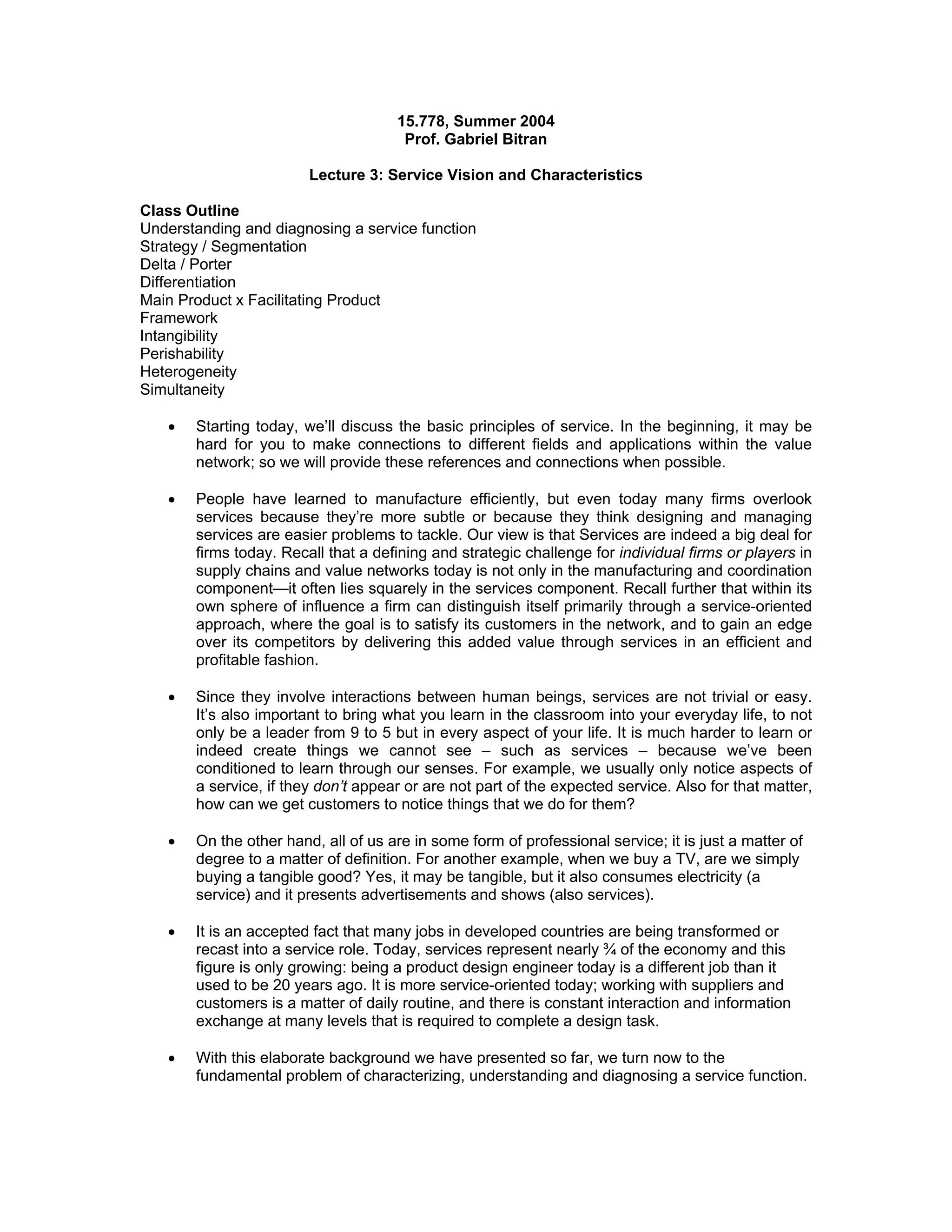
•   Main Product x Facilitating Product – Example: having your home dishwasher fixed.
    The customer wants more than a technician who can repair the dishwasher (see the
    diagram below).


                                                                       Customer Need

                                                                       Customer
                                                                       Expectations


                                                                       Competitor
                                                                       Offering


                                                                       Our Offering
Customer needs their dishwasher fixed (innermost circle), but they expect more: repair to
be done in a timely way, have a clean work area afterwards, pleasant and competent
repair technician. So, the company starts to offer that. If their competitor offers more, in
time the company responds by offering more. Over time customers’ needs also expand
or the needs are expressed differently. This expansion one of the reasons it is difficult to
sustain success or levels of performance in a service organization: it makes it difficult to
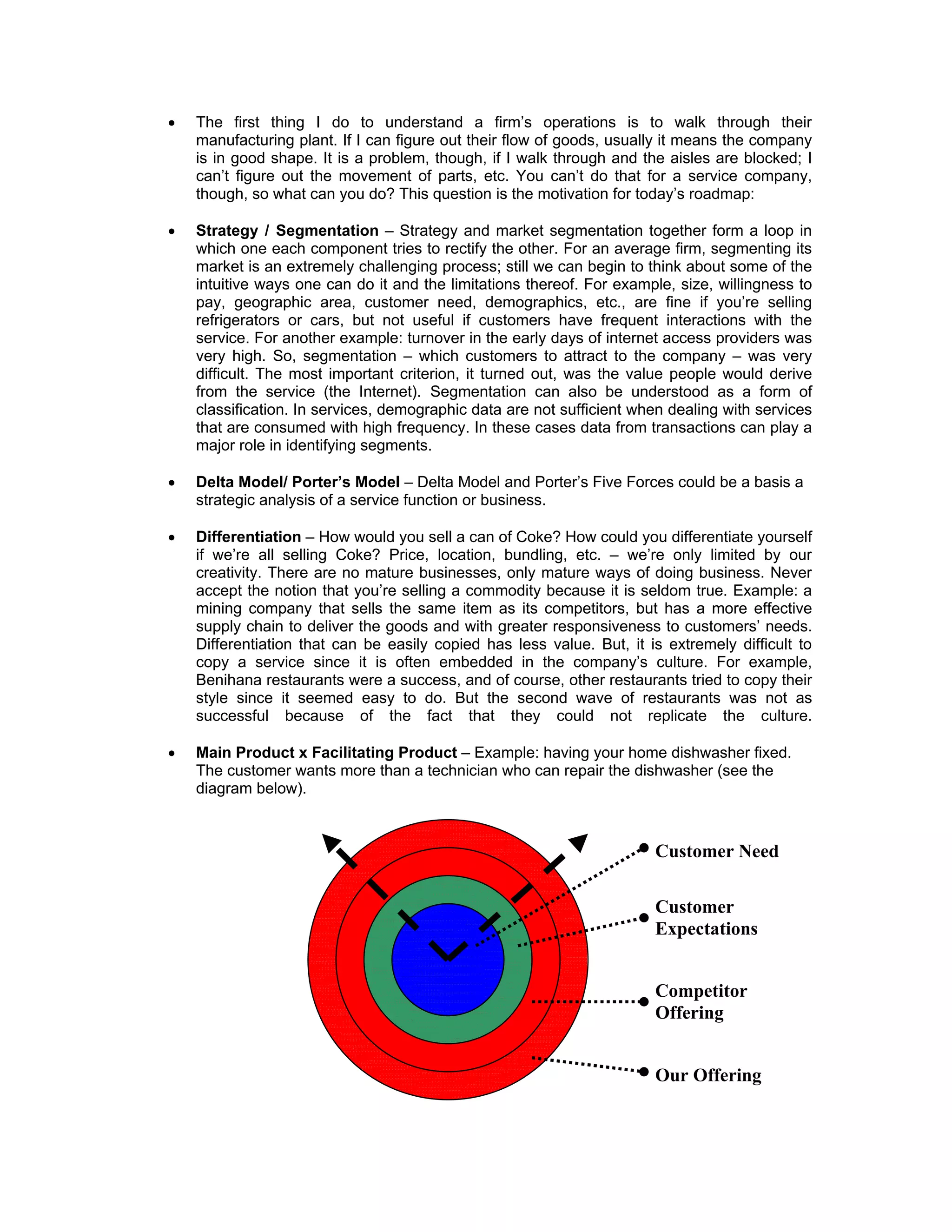
retain profit margins without raising prices too much. The only way to success over time
is to combine customer satisfaction and better productivity: the two go together hand-in-
hand (see diagram below). Productivity needs to be at least as high as customer
satisfaction. “Productivity” involves more than we typically think of: it includes
reengineering the way we do business to stay in the game.


                   Customer
                                                   Productivity
                  Satisfaction
Competitive                                      Strategic                            Financial
        Analysis                                        Analysis                             Analysis


                                                        Manager
                                                                                             Operations
                                                                                            Management
                                                    n
                                               esig
                                   ce   pt d                  Service
                              C on                          Management


                                                                            Orders
        Marketing                                        Server                              Backroom
                                                                           Resources


                Information                                    Service     Dec
                                                                              ou   pling
                about needs                                  Performance

        External                                                                             Internal
      Environment                                                                          Environment
                                                        Customer


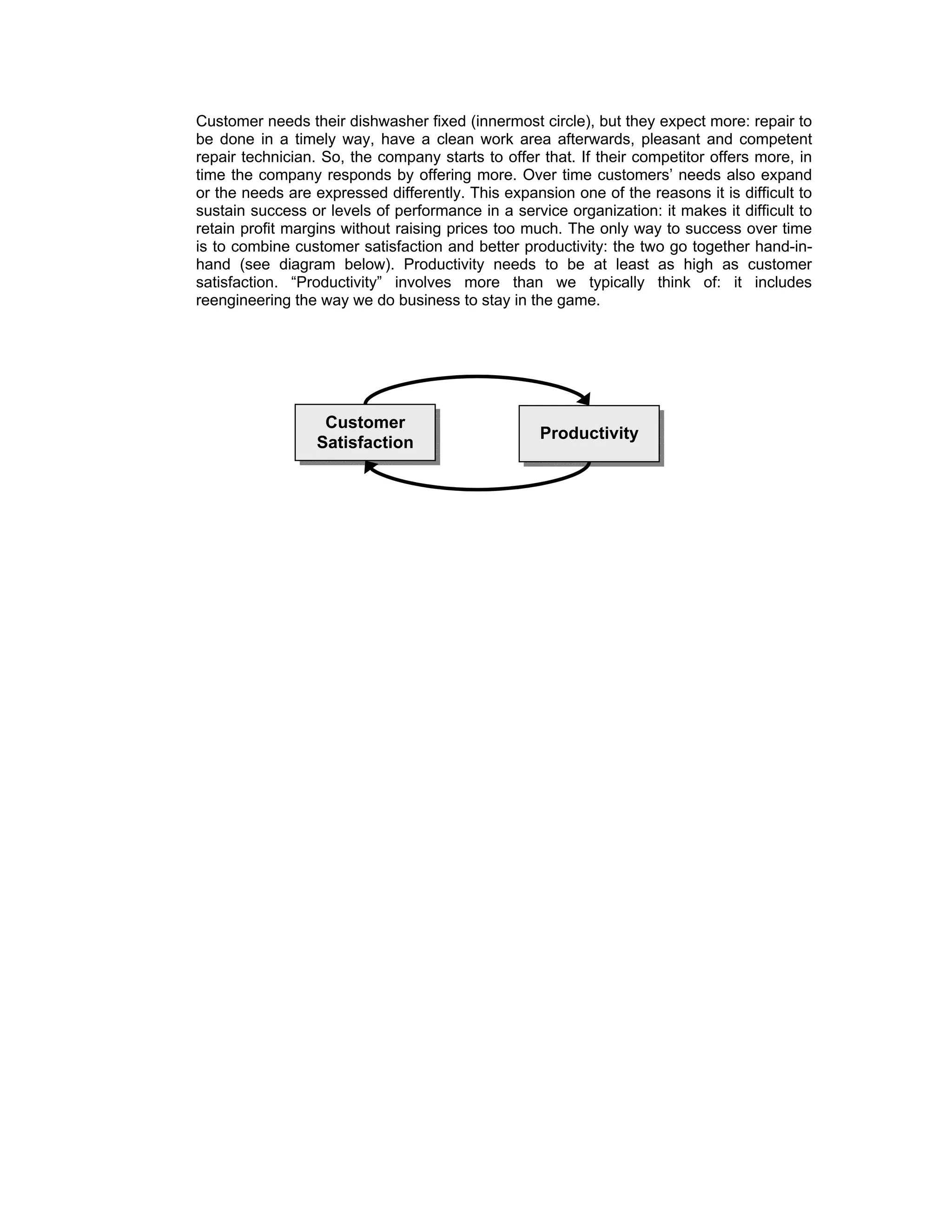
•   Framework: we can divide a company into three environments (see figure above):
       o External: where the company competes; the area in which customers are
          present
       o Internal: where customers are not present, such as the insurance claims
          processing office or the back of a restaurant. (This area most resembles
          manufacturing.)
       o Interface: where the customer and company come together and the customer
          forms an impression of the firm
       o There is also an arrow showing how companies bring their internal environment
          to the interface

    Can we create new services by looking at this framework diagram? How is Benihana
    different from other restaurants? They brought the kitchen to table, and therefore they
    brought an aspect of the internal operations to the interface. What has Dell done? They
    also brought the internal environment of the plant and of the supply chain to the web-
    interface with customers. UPS also does this by allowing customers to track their
    shipments online.

4 services, vision and characteristics

  • 1.
    15.778, Summer 2004 Prof. Gabriel Bitran Lecture 3: Service Vision and Characteristics Class Outline Understanding and diagnosing a service function Strategy / Segmentation Delta / Porter Differentiation Main Product x Facilitating Product Framework Intangibility Perishability Heterogeneity Simultaneity • Starting today, we’ll discuss the basic principles of service. In the beginning, it may be hard for you to make connections to different fields and applications within the value network; so we will provide these references and connections when possible. • People have learned to manufacture efficiently, but even today many firms overlook services because they’re more subtle or because they think designing and managing services are easier problems to tackle. Our view is that Services are indeed a big deal for firms today. Recall that a defining and strategic challenge for individual firms or players in supply chains and value networks today is not only in the manufacturing and coordination component—it often lies squarely in the services component. Recall further that within its own sphere of influence a firm can distinguish itself primarily through a service-oriented approach, where the goal is to satisfy its customers in the network, and to gain an edge over its competitors by delivering this added value through services in an efficient and profitable fashion. • Since they involve interactions between human beings, services are not trivial or easy. It’s also important to bring what you learn in the classroom into your everyday life, to not only be a leader from 9 to 5 but in every aspect of your life. It is much harder to learn or indeed create things we cannot see – such as services – because we’ve been conditioned to learn through our senses. For example, we usually only notice aspects of a service, if they don’t appear or are not part of the expected service. Also for that matter, how can we get customers to notice things that we do for them? • On the other hand, all of us are in some form of professional service; it is just a matter of degree to a matter of definition. For another example, when we buy a TV, are we simply buying a tangible good? Yes, it may be tangible, but it also consumes electricity (a service) and it presents advertisements and shows (also services). • It is an accepted fact that many jobs in developed countries are being transformed or recast into a service role. Today, services represent nearly ¾ of the economy and this figure is only growing: being a product design engineer today is a different job than it used to be 20 years ago. It is more service-oriented today; working with suppliers and customers is a matter of daily routine, and there is constant interaction and information exchange at many levels that is required to complete a design task. • With this elaborate background we have presented so far, we turn now to the fundamental problem of characterizing, understanding and diagnosing a service function.
  • 2.
    The first thing I do to understand a firm’s operations is to walk through their manufacturing plant. If I can figure out their flow of goods, usually it means the company is in good shape. It is a problem, though, if I walk through and the aisles are blocked; I can’t figure out the movement of parts, etc. You can’t do that for a service company, though, so what can you do? This question is the motivation for today’s roadmap: • Strategy / Segmentation – Strategy and market segmentation together form a loop in which one each component tries to rectify the other. For an average firm, segmenting its market is an extremely challenging process; still we can begin to think about some of the intuitive ways one can do it and the limitations thereof. For example, size, willingness to pay, geographic area, customer need, demographics, etc., are fine if you’re selling refrigerators or cars, but not useful if customers have frequent interactions with the service. For another example: turnover in the early days of internet access providers was very high. So, segmentation – which customers to attract to the company – was very difficult. The most important criterion, it turned out, was the value people would derive from the service (the Internet). Segmentation can also be understood as a form of classification. In services, demographic data are not sufficient when dealing with services that are consumed with high frequency. In these cases data from transactions can play a major role in identifying segments. • Delta Model/ Porter’s Model – Delta Model and Porter’s Five Forces could be a basis a strategic analysis of a service function or business. • Differentiation – How would you sell a can of Coke? How could you differentiate yourself if we’re all selling Coke? Price, location, bundling, etc. – we’re only limited by our creativity. There are no mature businesses, only mature ways of doing business. Never accept the notion that you’re selling a commodity because it is seldom true. Example: a mining company that sells the same item as its competitors, but has a more effective supply chain to deliver the goods and with greater responsiveness to customers’ needs. Differentiation that can be easily copied has less value. But, it is extremely difficult to copy a service since it is often embedded in the company’s culture. For example, Benihana restaurants were a success, and of course, other restaurants tried to copy their style since it seemed easy to do. But the second wave of restaurants was not as successful because of the fact that they could not replicate the culture. • Main Product x Facilitating Product – Example: having your home dishwasher fixed. The customer wants more than a technician who can repair the dishwasher (see the diagram below). Customer Need Customer Expectations Competitor Offering Our Offering
  • 3.
    Customer needs theirdishwasher fixed (innermost circle), but they expect more: repair to be done in a timely way, have a clean work area afterwards, pleasant and competent repair technician. So, the company starts to offer that. If their competitor offers more, in time the company responds by offering more. Over time customers’ needs also expand or the needs are expressed differently. This expansion one of the reasons it is difficult to sustain success or levels of performance in a service organization: it makes it difficult to retain profit margins without raising prices too much. The only way to success over time is to combine customer satisfaction and better productivity: the two go together hand-in- hand (see diagram below). Productivity needs to be at least as high as customer satisfaction. “Productivity” involves more than we typically think of: it includes reengineering the way we do business to stay in the game. Customer Productivity Satisfaction
  • 4.
    Competitive Strategic Financial Analysis Analysis Analysis Manager Operations Management n esig ce pt d Service C on Management Orders Marketing Server Backroom Resources Information Service Dec ou pling about needs Performance External Internal Environment Environment Customer • Framework: we can divide a company into three environments (see figure above): o External: where the company competes; the area in which customers are present o Internal: where customers are not present, such as the insurance claims processing office or the back of a restaurant. (This area most resembles manufacturing.) o Interface: where the customer and company come together and the customer forms an impression of the firm o There is also an arrow showing how companies bring their internal environment to the interface Can we create new services by looking at this framework diagram? How is Benihana different from other restaurants? They brought the kitchen to table, and therefore they brought an aspect of the internal operations to the interface. What has Dell done? They also brought the internal environment of the plant and of the supply chain to the web- interface with customers. UPS also does this by allowing customers to track their shipments online.