Theory of ConstraintsPresented ByUpma JoshiMohd.Arish
TOC - History1970s and 1980sIncrease in Computer PowerTremendous effort in line balancingMore balanced => more problemsDr. Eli Goldratt showed:How to perfectly balance lineThat a perfectly balanced line led to bankruptcyLed to development of Theory of Constraints
Theory of constraintsTheory of Constraints (TOC) is an overall management philosophy introduced by Dr. Eliyahu M. Goldratt in his 1984 book titled The Goal, that is geared to help organizations continually achieve their goal.
The title helps in achieving more of its goal by a very small number of constraints, and that there is always at least one constraints.DefinitionsA bottleneck is any resource with a capacity equal to or less than the demand placed upon it
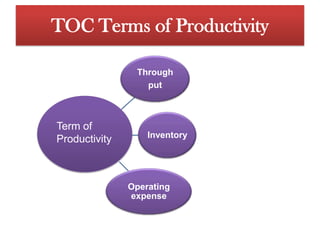
A constraint is anything that limits a system’s performance, relative to the system goalCore of TOC There is a constraint in the systemIf you don’t impact the constraint, you have no effectThe rest is commentaryAssumptions of TocThe underlying assumption of Theory of Constraints is that organizations can be measured and controlled by variations on three measures: Throughput
Operating expense
inventory TOC Terms of ProductivityTerm of Productivity
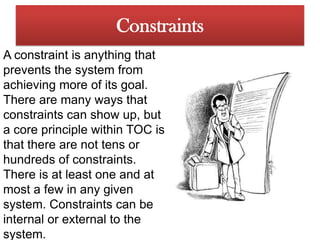
ConstraintsA constraint is anything that prevents the system from achieving more of its goal. There are many ways that constraints can show up, but a core principle within TOC is that there are not tens or hundreds of constraints. There is at least one and at most a few in any given system. Constraints can be internal or external to the system.
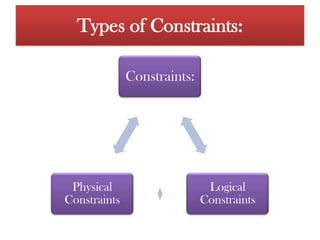
Types of Constraints:
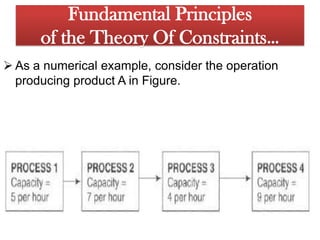
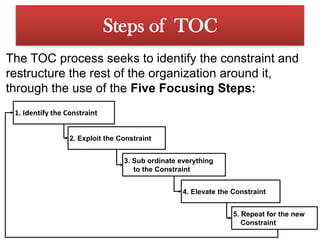
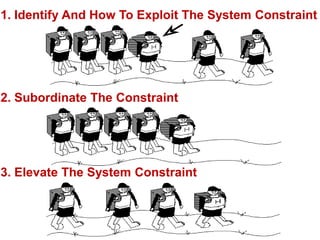
Fundamental Principlesof the Theory Of Constraints…As a numerical example, consider the operation producing product A in Figure. Steps of  TOCThe TOC process seeks to identify the constraint and restructure the rest of the organization around it, through the use of the Five Focusing Steps:1. Identify the Constraint2. Exploit the Constraint3. Sub ordinate everything	to the Constraint4. Elevate the Constraint5. Repeat for the new	Constraint
Improving the Process using TOC Principles…Identify the ConstraintThis implies the need to examine the entire process to determine which process limits the throughput. For example, in the example on slide 10, suppose the sales department was only selling the product output at the rate of 3 per hour.
Exploit the ConstraintFind methods to maximize the utilization of theconstraint toward productive throughput.
For example, in many operationsall processes are shut down during lunchtime or during breaks.
If aprocess is a constraint, the operation should consider rotating lunch periodsso that the constraint is never allowed to be idle. Subordinate Everything to the ConstraintEffective utilization of theconstraint is the most important issue. Everything else is secondary.Elevate the ConstraintEssentially this means to find ways to increasethe available hours of the constraint, including adding more of it.Once the constraint is a constraint no longer, find the new one and repeatthe stepsAs the constraint effective utilization increases, it may cease to be a constraint as another process becomes one.
In that case the emphasis shifts to the new process constraint.
It is also possible that a sales-related change in the product mix will cause a different process to become the constraint.  Understanding and ManagingThe ConstraintsA system Optimal performance is not the sum of local Optima. Anysystem that is performing as well as possible usually implies that not morethan one part of the system is performing at an optimallevel.
1. Identify And How To Exploit The System Constraint2. Subordinate The Constraint3. Elevate The System Constraint
Buffers They appear as part of the EXPLOIT and SUBORDINATE steps of the five focusing steps.
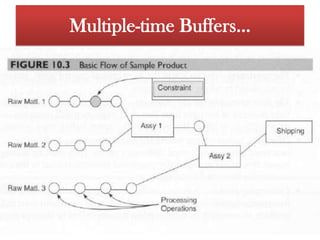
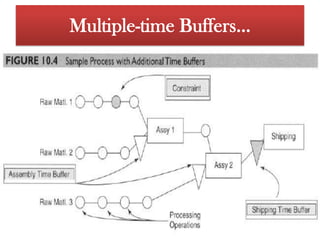
Buffers are placed before the key constraint, thus ensuring that the constraint is never starved. Buffers used in this way protect the constraint and should allow for normal variation of processing time and the occasional upset  before the constraint.Multiple-time BuffersTime buffers are used to make sure the constraint is not "starved," but other time buffers are also necessary. An example may help to Illustrate: Suppose you have a product made from three      components.
Component 1 is processed from raw material and then assembled with component 2 after it is processed from raw materialafter that Processing Operation is start in component 3Multiple-time Buffers…
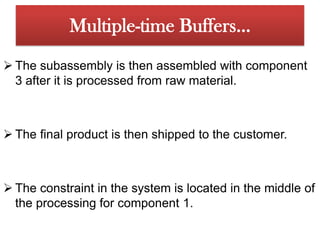
Multiple-time Buffers…The subassembly is then assembled with component 3 after it is processed from raw material.
The final product is then shipped to the customer.
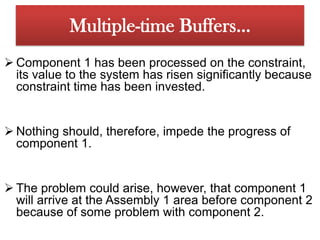
The constraint in the system is located in the middle of the processing for component 1. Multiple-time Buffers…Component 1 has been processed on the constraint, its value to thesystem has risen significantly because constraint time has been invested.
Nothingshould, therefore, impede the progress of component 1.
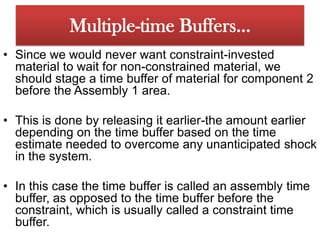
The problem could arise, however, that component 1 will arrive at the Assembly 1 area before component 2 because of some problem with component 2. Multiple-time Buffers…Since we wouldnever want constraint-invested material to wait for non-constrained material,we should stage a time buffer of material for component 2 before the Assembly1 area. This is done by releasing it earlier-the amount earlier dependingon the time buffer based on the time estimate needed to overcome any unanticipatedshock in the system. In this case the time buffer is called an assemblytime buffer, as opposed to the time buffer before the constraint, which is usuallycalled a constraint time buffer.
Multiple-time Buffers…The same argument applies to the Assembly 2 area.
The subassembly fromcomponents 1 and 2 have constraint time invested, so we would not want themwaiting for component 3.
This calls for another assembly time buffer to begenerated at the Assembly 2 area.
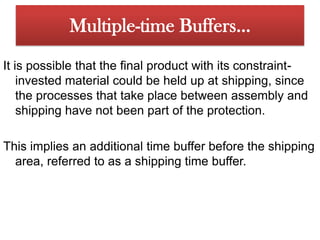
Unfortunately, the need for buffers has not been fulfilled.Multiple-time Buffers…It is possiblethat the final product with its constraint-invested material could be held up atshipping, since the processes that take place between assembly and shippinghave not been part of the protection. This implies an additional time buffer before the shipping area, referred to as a shipping time buffer.
Multiple-time Buffers…
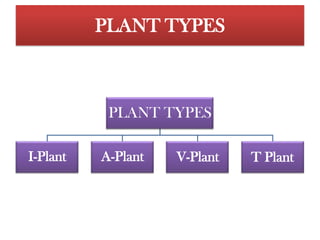
PLANT TYPEST Plant

Theory of constraints

  • 1.
    Theory of ConstraintsPresentedByUpma JoshiMohd.Arish
  • 2.
    TOC - History1970sand 1980sIncrease in Computer PowerTremendous effort in line balancingMore balanced => more problemsDr. Eli Goldratt showed:How to perfectly balance lineThat a perfectly balanced line led to bankruptcyLed to development of Theory of Constraints
  • 3.
    Theory of constraintsTheoryof Constraints (TOC) is an overall management philosophy introduced by Dr. Eliyahu M. Goldratt in his 1984 book titled The Goal, that is geared to help organizations continually achieve their goal.
  • 4.
    The title helpsin achieving more of its goal by a very small number of constraints, and that there is always at least one constraints.DefinitionsA bottleneck is any resource with a capacity equal to or less than the demand placed upon it
  • 5.
    A constraint isanything that limits a system’s performance, relative to the system goalCore of TOC There is a constraint in the systemIf you don’t impact the constraint, you have no effectThe rest is commentaryAssumptions of TocThe underlying assumption of Theory of Constraints is that organizations can be measured and controlled by variations on three measures: Throughput
  • 6.
  • 7.
    inventory TOC Termsof ProductivityTerm of Productivity
  • 8.
    ConstraintsA constraint isanything that prevents the system from achieving more of its goal. There are many ways that constraints can show up, but a core principle within TOC is that there are not tens or hundreds of constraints. There is at least one and at most a few in any given system. Constraints can be internal or external to the system.
  • 9.
  • 10.
    Fundamental Principlesof theTheory Of Constraints…As a numerical example, consider the operation producing product A in Figure. Steps of TOCThe TOC process seeks to identify the constraint and restructure the rest of the organization around it, through the use of the Five Focusing Steps:1. Identify the Constraint2. Exploit the Constraint3. Sub ordinate everything to the Constraint4. Elevate the Constraint5. Repeat for the new Constraint
  • 11.
    Improving the Processusing TOC Principles…Identify the ConstraintThis implies the need to examine the entire process to determine which process limits the throughput. For example, in the example on slide 10, suppose the sales department was only selling the product output at the rate of 3 per hour.
  • 12.
    Exploit the ConstraintFindmethods to maximize the utilization of theconstraint toward productive throughput.
  • 13.
    For example, inmany operationsall processes are shut down during lunchtime or during breaks.
  • 14.
    If aprocess isa constraint, the operation should consider rotating lunch periodsso that the constraint is never allowed to be idle. Subordinate Everything to the ConstraintEffective utilization of theconstraint is the most important issue. Everything else is secondary.Elevate the ConstraintEssentially this means to find ways to increasethe available hours of the constraint, including adding more of it.Once the constraint is a constraint no longer, find the new one and repeatthe stepsAs the constraint effective utilization increases, it may cease to be a constraint as another process becomes one.
  • 15.
    In that casethe emphasis shifts to the new process constraint.
  • 16.
    It is alsopossible that a sales-related change in the product mix will cause a different process to become the constraint. Understanding and ManagingThe ConstraintsA system Optimal performance is not the sum of local Optima. Anysystem that is performing as well as possible usually implies that not morethan one part of the system is performing at an optimallevel.
  • 17.
    1. Identify AndHow To Exploit The System Constraint2. Subordinate The Constraint3. Elevate The System Constraint
  • 18.
    Buffers They appearas part of the EXPLOIT and SUBORDINATE steps of the five focusing steps.
  • 19.
    Buffers are placedbefore the key constraint, thus ensuring that the constraint is never starved. Buffers used in this way protect the constraint and should allow for normal variation of processing time and the occasional upset before the constraint.Multiple-time BuffersTime buffers are used to make sure the constraint is not "starved," but other time buffers are also necessary. An example may help to Illustrate: Suppose you have a product made from three components.
  • 20.
    Component 1 isprocessed from raw material and then assembled with component 2 after it is processed from raw materialafter that Processing Operation is start in component 3Multiple-time Buffers…
  • 21.
    Multiple-time Buffers…The subassemblyis then assembled with component 3 after it is processed from raw material.
  • 22.
    The final productis then shipped to the customer.
  • 23.
    The constraint inthe system is located in the middle of the processing for component 1. Multiple-time Buffers…Component 1 has been processed on the constraint, its value to thesystem has risen significantly because constraint time has been invested.
  • 24.
    Nothingshould, therefore, impedethe progress of component 1.
  • 25.
    The problem couldarise, however, that component 1 will arrive at the Assembly 1 area before component 2 because of some problem with component 2. Multiple-time Buffers…Since we wouldnever want constraint-invested material to wait for non-constrained material,we should stage a time buffer of material for component 2 before the Assembly1 area. This is done by releasing it earlier-the amount earlier dependingon the time buffer based on the time estimate needed to overcome any unanticipatedshock in the system. In this case the time buffer is called an assemblytime buffer, as opposed to the time buffer before the constraint, which is usuallycalled a constraint time buffer.
  • 26.
    Multiple-time Buffers…The sameargument applies to the Assembly 2 area.
  • 27.
    The subassembly fromcomponents1 and 2 have constraint time invested, so we would not want themwaiting for component 3.
  • 28.
    This calls foranother assembly time buffer to begenerated at the Assembly 2 area.
  • 29.
    Unfortunately, the needfor buffers has not been fulfilled.Multiple-time Buffers…It is possiblethat the final product with its constraint-invested material could be held up atshipping, since the processes that take place between assembly and shippinghave not been part of the protection. This implies an additional time buffer before the shipping area, referred to as a shipping time buffer.
  • 30.
  • 31.
  • 32.
    Applications of Theoryof ConstraintsThere are various applications of toc:Operations
  • 33.
  • 34.
  • 35.
    Marketing and salesRealbusiness exampleThe Lessons plant of Baxter International makes medical products such as sterile bags. Management of the plant is actually aware of the necessity to actively manage its constraints. For example, when materials are a constraint, management may go to a secondary vendor and purchase material at a higher cost than normal. When a machine is the constraint, a weekend shift is often added on the machine. If a particular machine is chronically the constraint and management has exhausted the possibilities of using it more effectively, then additional capacity is purchased. For example when the constraint was the plastic extruding machines, a new extruding machine was ordered. However even before the machine arrived, management had determined that the constraint would shift to the blenders once the new extruding capacity was added. Therefore a new blender was already planned. By thinking ahead and focusing on the constraints, management is able to increase the plant's real capacity at the lowest possible cost.
  • 36.
    ConclusionWhat is theTheory of Constraints and How Should it be Implemented?","Beyond The Goal". That is acknowledges the sources of information and inspiration for the Thinking Processes and Critical Chain methodologies. Theory of Constraints referenced foundational materials. "Standing on the Shoulders of Giants" .