Dr. (CA) Ankita Jain
Meaning
 Capital structure is the combination of capitals from
different sources of finance.
 The capital of a company consists of
 equity share holders’ fund,
 preference share capital
 long term external debts.
Capital structure
 The source and quantum of capital is decided keeping
in mind the following factors:
 Control
 Capital structure should be designed in such a
manner that existing shareholders continue to hold
majority stake.
 Risk
 Capital structure should be designed in such a manner
that financial risk of a company does not increase
beyond tolerable limit.
 Cost
 Overall cost of capital remains minimum
Factors affecting Capital structure
 Size and nature of capital requirement
 Size and nature of business
 Stability and adequacy of earning
 Attitude of management
 Cash position
 Future plans
 Market condition
 Government regulations
 Interest level
 Floatation cost
 Taxation
Optimal Capital structure
 It means perfect mix of debt and Equity Capital that
helps in maximizing the Value of the firm and at the
same time minimizes overall cost of capital.
 However capital structure varies for company to
company.
Optimal Capital structure
 EBIT-EPS analysis
 Indifference Point analysis
EBIT-EPS analysis
 We consider possible fluctuation in EBIT and examine
their impact on EPS.
 If the probability of earning a rate of return on firm’s
asset is more than the cost of debt, large amount of
debt can be used.
 On the other hand, if the probability of earning a rate
of return on firms asset is less than the cost of debt.
The firm should refrain from employee debt.
 The greater the level of EBIT, lower the probability of
downward fluctuations.
EBIT-EPS analysis
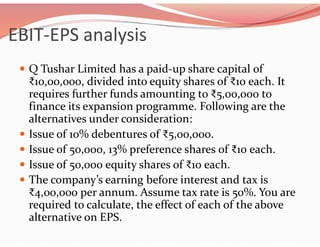
 Q Tushar Limited has a paid-up share capital of
₹10,00,000, divided into equity shares of ₹10 each. It
requires further funds amounting to ₹5,00,000 to
finance its expansion programme. Following are the
alternatives under consideration:
 Issue of 10% debentures of ₹5,00,000.
 Issue of 50,000, 13% preference shares of ₹10 each.
 Issue of 50,000 equity shares of ₹10 each.
 The company’s earning before interest and tax is
₹4,00,000 per annum. Assume tax rate is 50%. You are
required to calculate, the effect of each of the above
alternative on EPS.
EBIT-EPS analysis
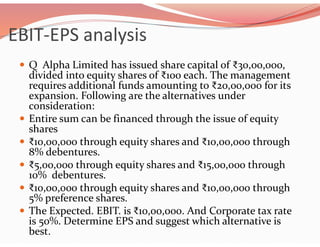
 Q Alpha Limited has issued share capital of ₹30,00,000,
divided into equity shares of ₹100 each. The management
requires additional funds amounting to ₹20,00,000 for its
expansion. Following are the alternatives under
consideration:
 Entire sum can be financed through the issue of equity
shares
 ₹10,00,000 through equity shares and ₹10,00,000 through
8% debentures.
 ₹5,00,000 through equity shares and ₹15,00,000 through
10% debentures.
 ₹10,00,000 through equity shares and ₹10,00,000 through
5% preference shares.
 The Expected. EBIT. is ₹10,00,000. And Corporate tax rate
is 50%. Determine EPS and suggest which alternative is
best.
Point of indifference
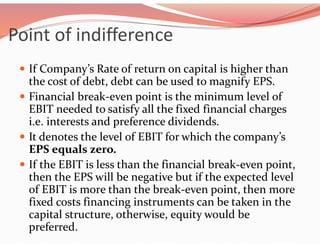
 If Company’s Rate of return on capital is higher than
the cost of debt, debt can be used to magnify EPS.
 Financial break-even point is the minimum level of
EBIT needed to satisfy all the fixed financial charges
i.e. interests and preference dividends.
 It denotes the level of EBIT for which the company’s
EPS equals zero.
 If the EBIT is less than the financial break-even point,
then the EPS will be negative but if the expected level
of EBIT is more than the break-even point, then more
fixed costs financing instruments can be taken in the
capital structure, otherwise, equity would be
preferred.
Point of indifference
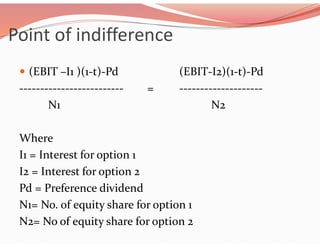
 (EBIT –I1 )(1-t)-Pd (EBIT-I2)(1-t)-Pd
------------------------- = --------------------
N1 N2
Where
I1 = Interest for option 1
I2 = Interest for option 2
Pd = Preference dividend
N1= No. of equity share for option 1
N2= No of equity share for option 2
Point of indifference
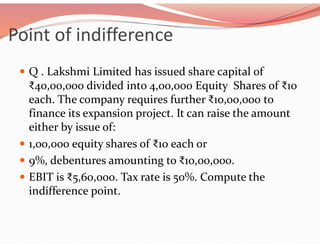
 Q . Lakshmi Limited has issued share capital of
₹40,00,000 divided into 4,00,000 Equity Shares of ₹10
each. The company requires further ₹10,00,000 to
finance its expansion project. It can raise the amount
either by issue of:
 1,00,000 equity shares of ₹10 each or
 9%, debentures amounting to ₹10,00,000.
 EBIT is ₹5,60,000. Tax rate is 50%. Compute the
indifference point.
Point of indifference
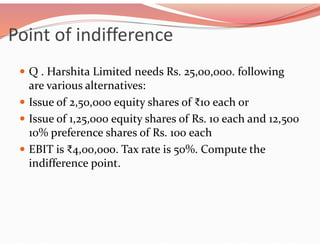
 Q . Harshita Limited needs Rs. 25,00,000. following
are various alternatives:
 Issue of 2,50,000 equity shares of ₹10 each or
 Issue of 1,25,000 equity shares of Rs. 10 each and 12,500
10% preference shares of Rs. 100 each
 EBIT is ₹4,00,000. Tax rate is 50%. Compute the
indifference point.
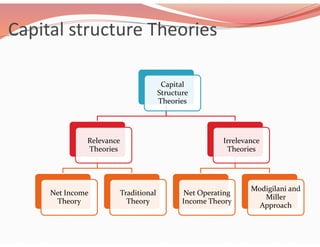
Capital structure Theories
Capital
Structure
Theories
Relevance
Theories
Net Income
Theory
Traditional
Theory
Irrelevance
Theories
Net Operating
Income Theory
Modigilani and
Miller
Approach
Net Income Approach
 According to this approach, capital structure decision
is relevant to the value of the firm.
 An increase in financial leverage will lead to decline
in the weighted average cost of capital (WACC),
while the value of the firm as well as market price of
ordinary share will increase.
Assumption
 There are only two kinds of funds used by a firm i.e.
debt and equity.
 The Cost of debt is less than the cost of equity.
 The increase in the proportion of debt does not change
the risk perception of equity share holder.
 Taxes are not considered.
Net Income Approach
 From the diagram, Ke and Kd are assumed not to
change with leverage.
 As debt increases, it causes weighted average cost of
capital (WACC) to decrease.
Net Income Approach
 Value of Firm (V) = Eq + D
 Where,
 V = Value of the firm
 Eq = Market value of equity
 D = Market value of debt
 The overall cost of capital under this approach
 Overall cost of capital = EBIT/Value of the firm
Net Income Approach
 Q.1 Ruby Ltd.’s EBIT is Rs.5,00,000. The company has
10%, Rs. 20 lakh debentures. The equity capitalization
rate (Ke) is 16%. Under Net Income Approach,
calculate:
 1. Market value of equity and value of firm
 2. Overall cost of capital
Net Operating Income Approach
 NOI means Earnings before interest and tax (EBIT).
 According to this approach, capital structure
decisions of the firm are irrelevant.
 Any change in the leverage will not lead to any change
in the total value of the firm and the market price of
shares.
 As per this approach, an increase in the use of debt
which is apparently cheaper is offset by an increase in
the equity capitalisation rate.
 This happens because equity investors seek higher
compensation as they are opposed to greater risk due
to the existence of fixed return securities in the capital
structure.
Assumption of NOI Approach
 There is no corporate tax.
 The change in the proportion of debt in the capital
structure leads to change in the risk perception of the
shareholder.
 The overall cost of capital remains constant for all
degree of debt equity mix.
 The value of equity is residual value, which is
determined by deducting the total value of the debt
from the total value of the company.
 The cost of debt is constant.
Net Operating Income Approach
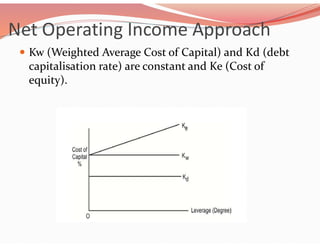
 Kw (Weighted Average Cost of Capital) and Kd (debt
capitalisation rate) are constant and Ke (Cost of
equity).
Net Operating Income Approach
 Value of Equity = Value of Firm (V) - D
 Where,
 V = Value of the firm
 Eq = Market value of equity
 D = Market value of debt
 The overall cost of capital under this approach
 Overall cost of equity = EBT/Value of the equity
Net Operating Income Approach
 Q. Amita Ltd.’s operating income (EBIT) is
Rs.5,00,000. The firm’s cost of debt is 10% and
currently the firm employs Rs.15,00,000 of debt. The
overall cost of capital of the firm is 15%. You are
required to Calculate the following under NOI
Approach:
 1. Total value of the firm
 2. Cost of equity
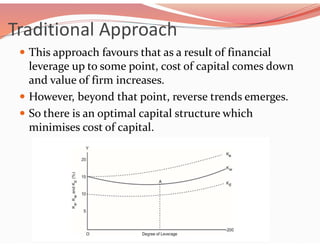
Traditional Approach
 This approach favours that as a result of financial
leverage up to some point, cost of capital comes down
and value of firm increases.
 However, beyond that point, reverse trends emerges.
 So there is an optimal capital structure which
minimises cost of capital.
Assumption of Traditional Approach
 Under this approach:
 The rate of interest on debt remains constant for a
certain period and thereafter with an increase in
leverage, it increases.
 The expected rate by equity shareholders remains
constant or increase gradually. After that, the equity
shareholders starts perceiving a financial risk and then
from the optimal point, the expected rate increases
speedily.
 As a result of the activity of rate of interest and
expected rate of return, the WACC first decreases and
then increases. The lowest point on the curve is
optimal capital structure.
Modigillani and Miller Approach
 It is refinement od NOI Approach.
Assumption of MM Approach
 Cost of Equity is always more than of Cost of debt.
 The cost of debt remains constant.
 The overall cost of capital remains constant for all degree of
debt equity mix.
 The change in the proportion of debt in the capital
structure leads to change in the risk perception of the
shareholder.
 Capital markets are perfect. All information is freely
available and there are no transaction costs.
 All investors are rational.
 Firms can be grouped into ‘Equivalent risk classes’ on the
basis of their business risk.
 Non-existence of corporate taxes.
MM Approach
 Value of levered firm (Vg) = Value of unlevered firm
(Vu)
 A firm having debt in its capital structure has higher
cost of equity than an unlevered firm.
The cost of equity in a levered firm is determined as
under
 Ke = Ko + (Ko – Kd) *Debt / Equity
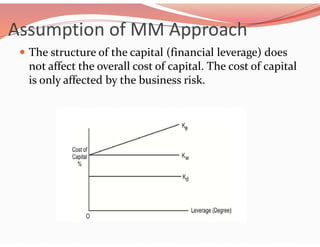
Assumption of MM Approach
 The structure of the capital (financial leverage) does
not affect the overall cost of capital. The cost of capital
is only affected by the business risk.

Capital Structure.pdf

  • 1.
  • 2.
    Meaning  Capital structureis the combination of capitals from different sources of finance.  The capital of a company consists of  equity share holders’ fund,  preference share capital  long term external debts.
  • 3.
    Capital structure  Thesource and quantum of capital is decided keeping in mind the following factors:  Control  Capital structure should be designed in such a manner that existing shareholders continue to hold majority stake.  Risk  Capital structure should be designed in such a manner that financial risk of a company does not increase beyond tolerable limit.  Cost  Overall cost of capital remains minimum
  • 4.
    Factors affecting Capitalstructure  Size and nature of capital requirement  Size and nature of business  Stability and adequacy of earning  Attitude of management  Cash position  Future plans  Market condition  Government regulations  Interest level  Floatation cost  Taxation
  • 5.
    Optimal Capital structure It means perfect mix of debt and Equity Capital that helps in maximizing the Value of the firm and at the same time minimizes overall cost of capital.  However capital structure varies for company to company.
  • 6.
    Optimal Capital structure EBIT-EPS analysis  Indifference Point analysis
  • 7.
    EBIT-EPS analysis  Weconsider possible fluctuation in EBIT and examine their impact on EPS.  If the probability of earning a rate of return on firm’s asset is more than the cost of debt, large amount of debt can be used.  On the other hand, if the probability of earning a rate of return on firms asset is less than the cost of debt. The firm should refrain from employee debt.  The greater the level of EBIT, lower the probability of downward fluctuations.
  • 8.
    EBIT-EPS analysis  QTushar Limited has a paid-up share capital of ₹10,00,000, divided into equity shares of ₹10 each. It requires further funds amounting to ₹5,00,000 to finance its expansion programme. Following are the alternatives under consideration:  Issue of 10% debentures of ₹5,00,000.  Issue of 50,000, 13% preference shares of ₹10 each.  Issue of 50,000 equity shares of ₹10 each.  The company’s earning before interest and tax is ₹4,00,000 per annum. Assume tax rate is 50%. You are required to calculate, the effect of each of the above alternative on EPS.
  • 9.
    EBIT-EPS analysis  QAlpha Limited has issued share capital of ₹30,00,000, divided into equity shares of ₹100 each. The management requires additional funds amounting to ₹20,00,000 for its expansion. Following are the alternatives under consideration:  Entire sum can be financed through the issue of equity shares  ₹10,00,000 through equity shares and ₹10,00,000 through 8% debentures.  ₹5,00,000 through equity shares and ₹15,00,000 through 10% debentures.  ₹10,00,000 through equity shares and ₹10,00,000 through 5% preference shares.  The Expected. EBIT. is ₹10,00,000. And Corporate tax rate is 50%. Determine EPS and suggest which alternative is best.
  • 10.
    Point of indifference If Company’s Rate of return on capital is higher than the cost of debt, debt can be used to magnify EPS.  Financial break-even point is the minimum level of EBIT needed to satisfy all the fixed financial charges i.e. interests and preference dividends.  It denotes the level of EBIT for which the company’s EPS equals zero.  If the EBIT is less than the financial break-even point, then the EPS will be negative but if the expected level of EBIT is more than the break-even point, then more fixed costs financing instruments can be taken in the capital structure, otherwise, equity would be preferred.
  • 11.
    Point of indifference (EBIT –I1 )(1-t)-Pd (EBIT-I2)(1-t)-Pd ------------------------- = -------------------- N1 N2 Where I1 = Interest for option 1 I2 = Interest for option 2 Pd = Preference dividend N1= No. of equity share for option 1 N2= No of equity share for option 2
  • 12.
    Point of indifference Q . Lakshmi Limited has issued share capital of ₹40,00,000 divided into 4,00,000 Equity Shares of ₹10 each. The company requires further ₹10,00,000 to finance its expansion project. It can raise the amount either by issue of:  1,00,000 equity shares of ₹10 each or  9%, debentures amounting to ₹10,00,000.  EBIT is ₹5,60,000. Tax rate is 50%. Compute the indifference point.
  • 13.
    Point of indifference Q . Harshita Limited needs Rs. 25,00,000. following are various alternatives:  Issue of 2,50,000 equity shares of ₹10 each or  Issue of 1,25,000 equity shares of Rs. 10 each and 12,500 10% preference shares of Rs. 100 each  EBIT is ₹4,00,000. Tax rate is 50%. Compute the indifference point.
  • 14.
    Capital structure Theories Capital Structure Theories Relevance Theories NetIncome Theory Traditional Theory Irrelevance Theories Net Operating Income Theory Modigilani and Miller Approach
  • 15.
    Net Income Approach According to this approach, capital structure decision is relevant to the value of the firm.  An increase in financial leverage will lead to decline in the weighted average cost of capital (WACC), while the value of the firm as well as market price of ordinary share will increase.
  • 16.
    Assumption  There areonly two kinds of funds used by a firm i.e. debt and equity.  The Cost of debt is less than the cost of equity.  The increase in the proportion of debt does not change the risk perception of equity share holder.  Taxes are not considered.
  • 17.
    Net Income Approach From the diagram, Ke and Kd are assumed not to change with leverage.  As debt increases, it causes weighted average cost of capital (WACC) to decrease.
  • 18.
    Net Income Approach Value of Firm (V) = Eq + D  Where,  V = Value of the firm  Eq = Market value of equity  D = Market value of debt  The overall cost of capital under this approach  Overall cost of capital = EBIT/Value of the firm
  • 19.
    Net Income Approach Q.1 Ruby Ltd.’s EBIT is Rs.5,00,000. The company has 10%, Rs. 20 lakh debentures. The equity capitalization rate (Ke) is 16%. Under Net Income Approach, calculate:  1. Market value of equity and value of firm  2. Overall cost of capital
  • 20.
    Net Operating IncomeApproach  NOI means Earnings before interest and tax (EBIT).  According to this approach, capital structure decisions of the firm are irrelevant.  Any change in the leverage will not lead to any change in the total value of the firm and the market price of shares.  As per this approach, an increase in the use of debt which is apparently cheaper is offset by an increase in the equity capitalisation rate.  This happens because equity investors seek higher compensation as they are opposed to greater risk due to the existence of fixed return securities in the capital structure.
  • 21.
    Assumption of NOIApproach  There is no corporate tax.  The change in the proportion of debt in the capital structure leads to change in the risk perception of the shareholder.  The overall cost of capital remains constant for all degree of debt equity mix.  The value of equity is residual value, which is determined by deducting the total value of the debt from the total value of the company.  The cost of debt is constant.
  • 22.
    Net Operating IncomeApproach  Kw (Weighted Average Cost of Capital) and Kd (debt capitalisation rate) are constant and Ke (Cost of equity).
  • 23.
    Net Operating IncomeApproach  Value of Equity = Value of Firm (V) - D  Where,  V = Value of the firm  Eq = Market value of equity  D = Market value of debt  The overall cost of capital under this approach  Overall cost of equity = EBT/Value of the equity
  • 24.
    Net Operating IncomeApproach  Q. Amita Ltd.’s operating income (EBIT) is Rs.5,00,000. The firm’s cost of debt is 10% and currently the firm employs Rs.15,00,000 of debt. The overall cost of capital of the firm is 15%. You are required to Calculate the following under NOI Approach:  1. Total value of the firm  2. Cost of equity
  • 25.
    Traditional Approach  Thisapproach favours that as a result of financial leverage up to some point, cost of capital comes down and value of firm increases.  However, beyond that point, reverse trends emerges.  So there is an optimal capital structure which minimises cost of capital.
  • 26.
    Assumption of TraditionalApproach  Under this approach:  The rate of interest on debt remains constant for a certain period and thereafter with an increase in leverage, it increases.  The expected rate by equity shareholders remains constant or increase gradually. After that, the equity shareholders starts perceiving a financial risk and then from the optimal point, the expected rate increases speedily.  As a result of the activity of rate of interest and expected rate of return, the WACC first decreases and then increases. The lowest point on the curve is optimal capital structure.
  • 27.
    Modigillani and MillerApproach  It is refinement od NOI Approach.
  • 28.
    Assumption of MMApproach  Cost of Equity is always more than of Cost of debt.  The cost of debt remains constant.  The overall cost of capital remains constant for all degree of debt equity mix.  The change in the proportion of debt in the capital structure leads to change in the risk perception of the shareholder.  Capital markets are perfect. All information is freely available and there are no transaction costs.  All investors are rational.  Firms can be grouped into ‘Equivalent risk classes’ on the basis of their business risk.  Non-existence of corporate taxes.
  • 29.
    MM Approach  Valueof levered firm (Vg) = Value of unlevered firm (Vu)  A firm having debt in its capital structure has higher cost of equity than an unlevered firm. The cost of equity in a levered firm is determined as under  Ke = Ko + (Ko – Kd) *Debt / Equity
  • 30.
    Assumption of MMApproach  The structure of the capital (financial leverage) does not affect the overall cost of capital. The cost of capital is only affected by the business risk.