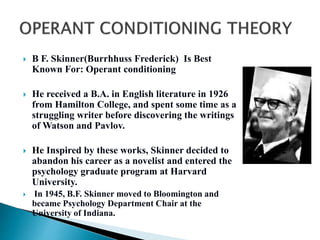
 B F. Skinner(Burrhhuss Frederick) Is Best
Known For: Operant conditioning
 He received a B.A. in English literature in 1926
from Hamilton College, and spent some time as a
struggling writer before discovering the writings
of Watson and Pavlov.
 He Inspired by these works, Skinner decided to
abandon his career as a novelist and entered the
psychology graduate program at Harvard
University.
 In 1945, B.F. Skinner moved to Bloomington and
became Psychology Department Chair at the
University of Indiana.
 In 1948, he joined the psychology department
at Harvard University where he remained for
the rest of his life.
 He became one of the leaders of
BEHAVIORISM and his work contributed
immensely to experimental psychology. He
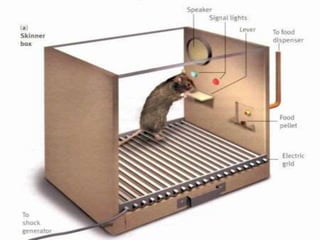
also invented the 'Skinner box,' in which a rat
learns to obtain food by pressing a lever.
 Skinner introduced a behavioral technique called
operant conditioning.
 Operant conditioning (also called "instrumental
conditioning") is a learning process through which
the strength of a behavior is modified by reward or
punishment.
Positive reinforcement (reinforcement):
This occurs when a behavior (response) is
rewarding or the behavior is followed by
another stimulus that is rewarding, increasing
the frequency of that behavior.
 For example, if a rat in a Skinner box gets
food when it presses a lever, its rate of
pressing will go up. This procedure is
usually called simply reinforcement.
Negative reinforcement (escape): This occurs
when a behavior (response) is followed by the
removal of an aversive stimulus, thereby
increasing that behavior's frequency.
 In the Skinner box experiment, the aversive
stimulus might be a loud noise continuously
sounding inside the box; negative
reinforcement would happen when the rat
presses a lever, turning off the noise.
 Ex:- Thomas has wet hands after washing them. He
rubs them in the towel and the water is now removed
from them. He knows that every time he doesn’t want
his hands to remain wet he can use a towel to get rid
of the water. He now uses a towel every time he
wants to remove the water from his hands.
Positive punishment :-
Positive punishment can be defined as
“presenting a negative consequence after an
undesired behaviour is exhibited, making the
behaviour less likely to happen in the future.”
This occurs when a behavior (response) is
followed by an aversive stimulus, such as pain
from a spanking, which results in a decrease in
that behavior.
Negative punishment (penalty) :-
Occurs when a behavior (response) is followed by
the removal of a stimulus, such as taking away a child's
toy following an undesired behavior, resulting in a
decrease in that behavior.
 Behaviour modification is a set of therapies /
techniques based on operant conditioning (Skinner,
1938).
 The main principle comprises changing
environmental events that are related to a person's
behaviour. For example, the reinforcement of desired
behaviours and ignoring or punishing undesired ones.
 Examples of behaviour modification therapy include
token economy and behaviour shaping.
This programme involves giving token rewards
for appropriate or desired target behaviors
performed by the patient.In token economy
the desired behaviour is reinforced by
offering tokens that can be exchanged for
special food, games, comics or other
rewards.
For example; a patient with schizophrenia does
not maintain personal hygiene. The day he
maintains he gets a token as reinforce that he can
watch T.V. when he desire.
 In shaping the components of a particular skill, the
behavior is reinforced step by step.
 The therapist starts shaping by reinforcing the
existing behavior.
 Once it is established he reinforces the responses
which are closest to the desired behavior, & ignores
other response.
 For ex:- to establish eye to eye contact, the therapist
sits opposite the patient & reinforces him even if he
moves upper body towards him.
 Once this is established, he reinforces the person’s
head movement in his direction & this procedure
continues till eye to eye contact is established.
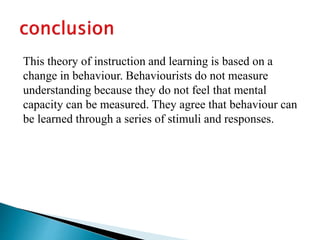
This theory of instruction and learning is based on a
change in behaviour. Behaviourists do not measure
understanding because they do not feel that mental
capacity can be measured. They agree that behaviour can
be learned through a series of stimuli and responses.

Operant conditioning theory

  • 2.
     B F.Skinner(Burrhhuss Frederick) Is Best Known For: Operant conditioning  He received a B.A. in English literature in 1926 from Hamilton College, and spent some time as a struggling writer before discovering the writings of Watson and Pavlov.  He Inspired by these works, Skinner decided to abandon his career as a novelist and entered the psychology graduate program at Harvard University.  In 1945, B.F. Skinner moved to Bloomington and became Psychology Department Chair at the University of Indiana.
  • 3.
     In 1948,he joined the psychology department at Harvard University where he remained for the rest of his life.  He became one of the leaders of BEHAVIORISM and his work contributed immensely to experimental psychology. He also invented the 'Skinner box,' in which a rat learns to obtain food by pressing a lever.
  • 5.
     Skinner introduceda behavioral technique called operant conditioning.  Operant conditioning (also called "instrumental conditioning") is a learning process through which the strength of a behavior is modified by reward or punishment.
  • 6.
    Positive reinforcement (reinforcement): Thisoccurs when a behavior (response) is rewarding or the behavior is followed by another stimulus that is rewarding, increasing the frequency of that behavior.  For example, if a rat in a Skinner box gets food when it presses a lever, its rate of pressing will go up. This procedure is usually called simply reinforcement.
  • 7.
    Negative reinforcement (escape):This occurs when a behavior (response) is followed by the removal of an aversive stimulus, thereby increasing that behavior's frequency.  In the Skinner box experiment, the aversive stimulus might be a loud noise continuously sounding inside the box; negative reinforcement would happen when the rat presses a lever, turning off the noise.
  • 8.
     Ex:- Thomashas wet hands after washing them. He rubs them in the towel and the water is now removed from them. He knows that every time he doesn’t want his hands to remain wet he can use a towel to get rid of the water. He now uses a towel every time he wants to remove the water from his hands.
  • 9.
    Positive punishment :- Positivepunishment can be defined as “presenting a negative consequence after an undesired behaviour is exhibited, making the behaviour less likely to happen in the future.” This occurs when a behavior (response) is followed by an aversive stimulus, such as pain from a spanking, which results in a decrease in that behavior.
  • 10.
    Negative punishment (penalty):- Occurs when a behavior (response) is followed by the removal of a stimulus, such as taking away a child's toy following an undesired behavior, resulting in a decrease in that behavior.
  • 11.
     Behaviour modificationis a set of therapies / techniques based on operant conditioning (Skinner, 1938).  The main principle comprises changing environmental events that are related to a person's behaviour. For example, the reinforcement of desired behaviours and ignoring or punishing undesired ones.  Examples of behaviour modification therapy include token economy and behaviour shaping.
  • 12.
    This programme involvesgiving token rewards for appropriate or desired target behaviors performed by the patient.In token economy the desired behaviour is reinforced by offering tokens that can be exchanged for special food, games, comics or other rewards.
  • 13.
    For example; apatient with schizophrenia does not maintain personal hygiene. The day he maintains he gets a token as reinforce that he can watch T.V. when he desire.
  • 14.
     In shapingthe components of a particular skill, the behavior is reinforced step by step.  The therapist starts shaping by reinforcing the existing behavior.  Once it is established he reinforces the responses which are closest to the desired behavior, & ignores other response.
  • 15.
     For ex:-to establish eye to eye contact, the therapist sits opposite the patient & reinforces him even if he moves upper body towards him.  Once this is established, he reinforces the person’s head movement in his direction & this procedure continues till eye to eye contact is established.
  • 16.
    This theory ofinstruction and learning is based on a change in behaviour. Behaviourists do not measure understanding because they do not feel that mental capacity can be measured. They agree that behaviour can be learned through a series of stimuli and responses.