Decoding Behavior_ MaxLearn’s Guide to Skinner’s Operant Conditioning _ MaxLearn.pdf
1.
Decoding Behavior: MaxLearn’sGuide to
Skinner’s Operant Conditioning | MaxLearn
Decoding Behavior: Skinner’s Operant Conditioning and Its
Transformative Power (MaxLearn)
In the ongoing quest to understand the complexities of human and
animal behavior, few frameworks have proven as robust and
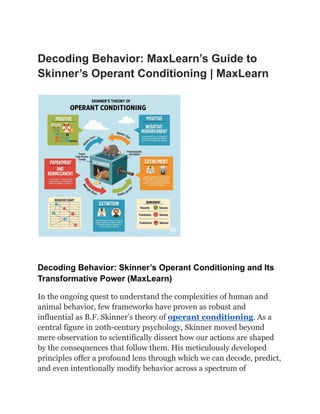
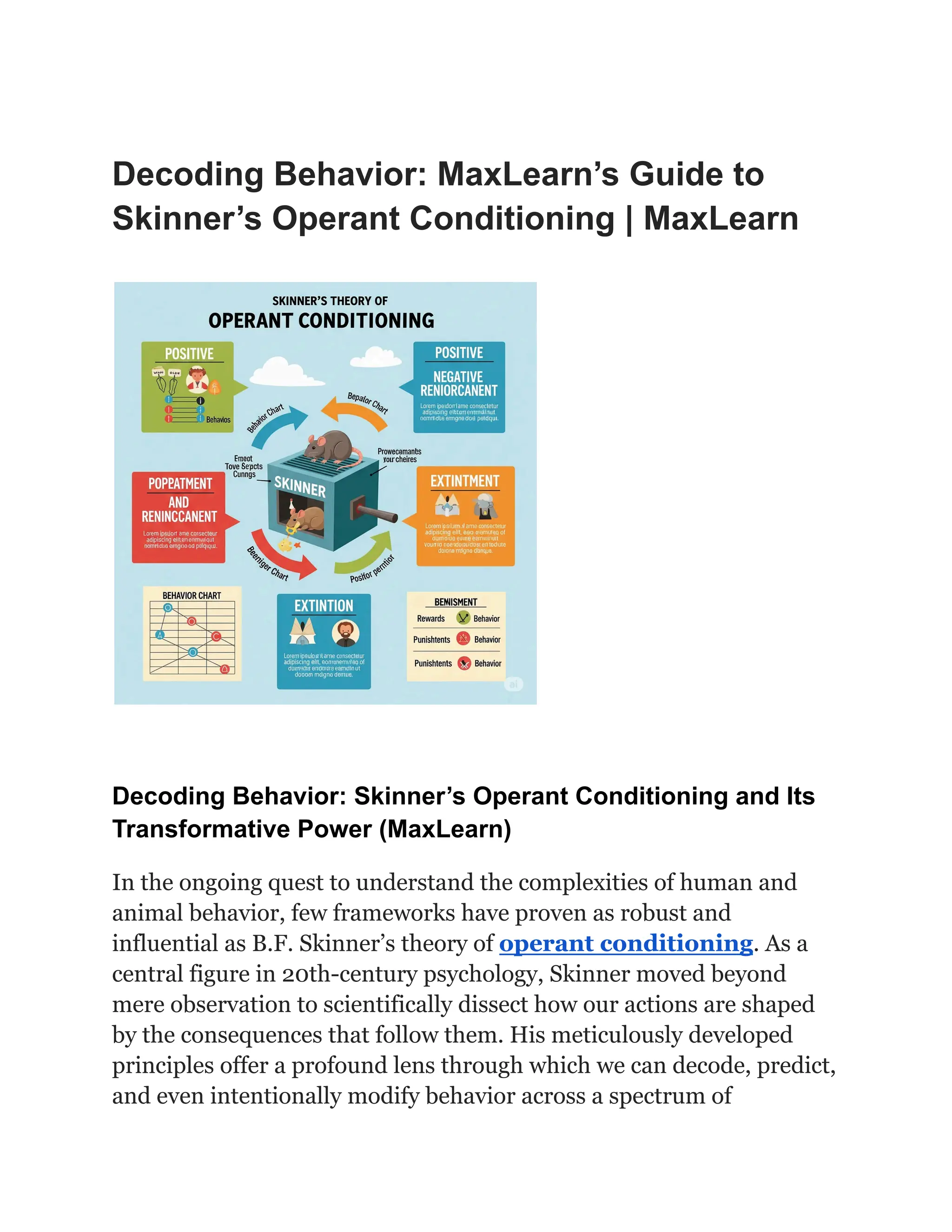
influential as B.F. Skinner’s theory of operant conditioning. As a
central figure in 20th-century psychology, Skinner moved beyond
mere observation to scientifically dissect how our actions are shaped
by the consequences that follow them. His meticulously developed
principles offer a profound lens through which we can decode, predict,
and even intentionally modify behavior across a spectrum of
2.
environments, from theclassroom and clinic to our own daily lives.
For learners at MaxLearn, grasping operant conditioning is key to
unlocking a deeper understanding of learning, motivation, and habit
formation.
The Essence of Operant Learning: Responding to Consequences
At its heart, operant conditioning differentiates itself from classical
conditioning (think Pavlov’s dogs) by focusing on voluntary
behaviors — those we “operate” on our environment to achieve an
outcome. Unlike a reflexive blink to a puff of air, deciding to study for
an exam or greeting a friend are operant behaviors. Skinner’s genius
lay in his systematic investigation of the relationship between these
voluntary actions and the environmental events that occur after them.
He argued that the likelihood of a behavior being repeated is directly
determined by its consequences. This fundamental premise forms the
bedrock of a powerful and widely applicable psychological theory.
The Dynamic Duo: Reinforcement and Punishment
Skinner identified two primary types of consequences, each serving to
either strengthen or weaken the future occurrence of a behavior:
reinforcement and punishment. Understanding their precise
definitions is paramount.
Reinforcement: The Engine of Behavioral Increase
Reinforcement always aims to increase the probability of a behavior.
3.
● Positive Reinforcement:This involves the addition of a
desirable stimulus following a behavior. It’s about “giving
something good” to encourage repetition.
● Example: A child tidies their toys (behavior) and their parent
offers enthusiastic praise and a high-five (desirable stimulus
added). The child learns that tidying leads to positive
attention and is more likely to repeat it.
● Example: An artist completes a challenging painting
(behavior) and receives a commission for their next piece
(desirable stimulus added). This reinforces their artistic
effort.
● Negative Reinforcement: This involves the removal of
an undesirable (aversive) stimulus following a behavior. It’s
about “taking something bad away” to encourage the
behavior that removes it.
● Example: A car emits a persistent beeping sound when the
seatbelt is unbuckled (undesirable stimulus). You fasten your
seatbelt (behavior), and the beeping stops (undesirable
stimulus removed). This increases your likelihood of buckling
up in the future to avoid the annoying sound.
● Example: A student struggles with a concept (aversive
situation) and seeks tutoring (behavior), which helps them
understand the material and reduces their anxiety (aversive
stimulus removed). They are more likely to seek help when
confused again.
A crucial distinction to remember: Negative reinforcement is not
punishment. It increases a behavior by removing something
unpleasant, while punishment decreases a behavior.
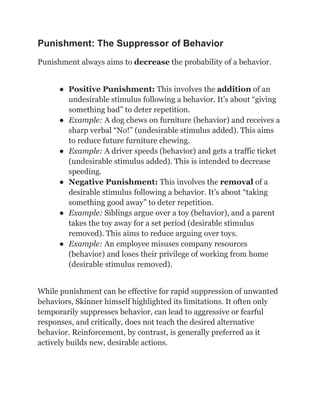
4.
Punishment: The Suppressorof Behavior
Punishment always aims to decrease the probability of a behavior.
● Positive Punishment: This involves the addition of an
undesirable stimulus following a behavior. It’s about “giving
something bad” to deter repetition.
● Example: A dog chews on furniture (behavior) and receives a
sharp verbal “No!” (undesirable stimulus added). This aims
to reduce future furniture chewing.
● Example: A driver speeds (behavior) and gets a traffic ticket
(undesirable stimulus added). This is intended to decrease
speeding.
● Negative Punishment: This involves the removal of a
desirable stimulus following a behavior. It’s about “taking
something good away” to deter repetition.
● Example: Siblings argue over a toy (behavior), and a parent
takes the toy away for a set period (desirable stimulus
removed). This aims to reduce arguing over toys.
● Example: An employee misuses company resources
(behavior) and loses their privilege of working from home
(desirable stimulus removed).
While punishment can be effective for rapid suppression of unwanted
behaviors, Skinner himself highlighted its limitations. It often only
temporarily suppresses behavior, can lead to aggressive or fearful
responses, and critically, does not teach the desired alternative
behavior. Reinforcement, by contrast, is generally preferred as it
actively builds new, desirable actions.
5.
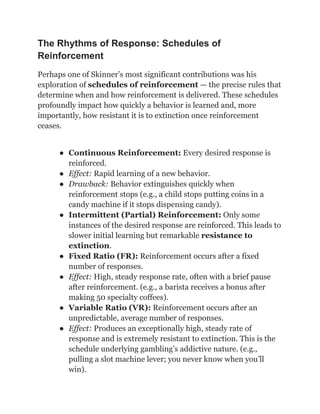
The Rhythms ofResponse: Schedules of
Reinforcement
Perhaps one of Skinner’s most significant contributions was his
exploration of schedules of reinforcement — the precise rules that
determine when and how reinforcement is delivered. These schedules
profoundly impact how quickly a behavior is learned and, more
importantly, how resistant it is to extinction once reinforcement
ceases.
● Continuous Reinforcement: Every desired response is
reinforced.
● Effect: Rapid learning of a new behavior.
● Drawback: Behavior extinguishes quickly when
reinforcement stops (e.g., a child stops putting coins in a
candy machine if it stops dispensing candy).
● Intermittent (Partial) Reinforcement: Only some
instances of the desired response are reinforced. This leads to
slower initial learning but remarkable resistance to
extinction.
● Fixed Ratio (FR): Reinforcement occurs after a fixed
number of responses.
● Effect: High, steady response rate, often with a brief pause
after reinforcement. (e.g., a barista receives a bonus after
making 50 specialty coffees).
● Variable Ratio (VR): Reinforcement occurs after an
unpredictable, average number of responses.
● Effect: Produces an exceptionally high, steady rate of
response and is extremely resistant to extinction. This is the
schedule underlying gambling’s addictive nature. (e.g.,
pulling a slot machine lever; you never know when you’ll
win).
6.
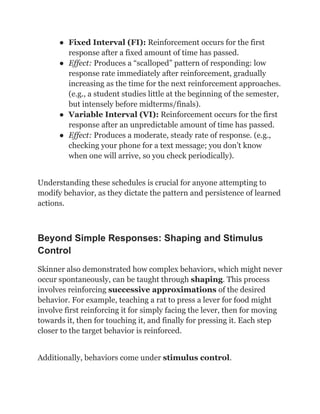
● Fixed Interval(FI): Reinforcement occurs for the first
response after a fixed amount of time has passed.
● Effect: Produces a “scalloped” pattern of responding: low
response rate immediately after reinforcement, gradually
increasing as the time for the next reinforcement approaches.
(e.g., a student studies little at the beginning of the semester,
but intensely before midterms/finals).
● Variable Interval (VI): Reinforcement occurs for the first
response after an unpredictable amount of time has passed.
● Effect: Produces a moderate, steady rate of response. (e.g.,
checking your phone for a text message; you don’t know
when one will arrive, so you check periodically).
Understanding these schedules is crucial for anyone attempting to
modify behavior, as they dictate the pattern and persistence of learned
actions.
Beyond Simple Responses: Shaping and Stimulus
Control
Skinner also demonstrated how complex behaviors, which might never
occur spontaneously, can be taught through shaping. This process
involves reinforcing successive approximations of the desired
behavior. For example, teaching a rat to press a lever for food might
involve first reinforcing it for simply facing the lever, then for moving
towards it, then for touching it, and finally for pressing it. Each step
closer to the target behavior is reinforced.
Additionally, behaviors come under stimulus control.
7.
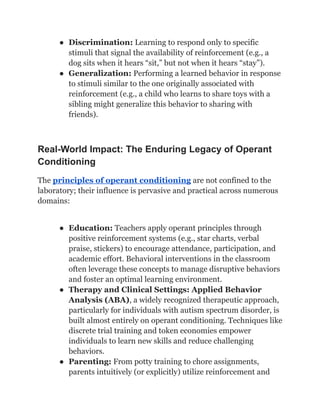
● Discrimination: Learningto respond only to specific
stimuli that signal the availability of reinforcement (e.g., a
dog sits when it hears “sit,” but not when it hears “stay”).
● Generalization: Performing a learned behavior in response
to stimuli similar to the one originally associated with
reinforcement (e.g., a child who learns to share toys with a
sibling might generalize this behavior to sharing with
friends).
Real-World Impact: The Enduring Legacy of Operant
Conditioning
The principles of operant conditioning are not confined to the
laboratory; their influence is pervasive and practical across numerous
domains:
● Education: Teachers apply operant principles through
positive reinforcement systems (e.g., star charts, verbal
praise, stickers) to encourage attendance, participation, and
academic effort. Behavioral interventions in the classroom
often leverage these concepts to manage disruptive behaviors
and foster an optimal learning environment.
● Therapy and Clinical Settings: Applied Behavior
Analysis (ABA), a widely recognized therapeutic approach,
particularly for individuals with autism spectrum disorder, is
built almost entirely on operant conditioning. Techniques like
discrete trial training and token economies empower
individuals to learn new skills and reduce challenging
behaviors.
● Parenting: From potty training to chore assignments,
parents intuitively (or explicitly) utilize reinforcement and
8.
punishment. Rewarding goodbehavior with privileges and
implementing consequences like grounding are direct
applications.
● Organizational Management: Workplace incentive
programs, performance bonuses, and sales commissions are
sophisticated applications of operant conditioning designed
to motivate employees, increase productivity, and reinforce
desired professional conduct.
● Self-Improvement: Individuals seeking to form new habits
(e.g., exercise, healthy eating) or break old ones (e.g.,
procrastination, smoking) can consciously apply operant
principles by setting up personal reinforcement systems or
identifying environmental triggers.
Critiques and the Cognitive Evolution
Despite its undeniable success and empirical backing, Skinner’s
radical behaviorism faced significant critiques, notably from the
cognitive revolution in psychology. Critics argued that focusing
exclusively on observable behaviors and external consequences
neglected the crucial role of internal mental processes — thoughts,
emotions, intentions, and expectations — which they believed
profoundly influence human action. The theory was sometimes
perceived as deterministic, implying a lack of free will.
However, modern psychology, while incorporating cognitive
perspectives, has not abandoned operant conditioning. Instead, it has
integrated these principles into a more comprehensive understanding
of behavior. Cognitive-behavioral therapy (CBT), for instance, often
combines the modification of thought patterns with behavioral
techniques rooted in operant conditioning.
9.
Conclusion
B.F. Skinner’s Theoryof Operant Conditioning remains a
cornerstone of psychological understanding. By systematically
elucidating how behavior is shaped by its consequences, Skinner
provided a powerful and practical framework for analyzing, predicting,
and influencing actions. Its principles continue to offer invaluable
insights for anyone seeking to foster learning, modify habits, manage
behavior, or simply understand why we do what we do. The enduring
legacy of operant conditioning reminds us that by understanding the
patterns of reinforcement and punishment in our lives, we gain
significant agency over our own behavior and the behaviors of others,
paving the way for more effective learning, healthier habits, and
ultimately, a more adaptable existence.