OPERANT CONDITIONING
- B.F.SKINNER
2
BEHAVIOURISM
 The learner is viewed as passively adapting to their
environment.
 It emphasizes that all behaviours are learned
through interaction with the environment.
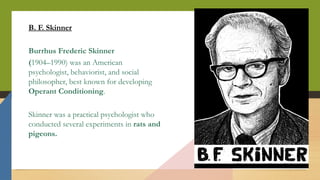
B. F. Skinner
Burrhus Frederic Skinner
(1904–1990) was an American
psychologist, behaviorist, and social
philosopher, best known for developing
Operant Conditioning.
Skinner was a practical psychologist who
conducted several experiments in rats and
pigeons.
4
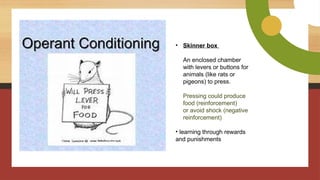
• Skinner box
An enclosed chamber
with levers or buttons for
animals (like rats or
pigeons) to press.
Pressing could produce
food (reinforcement)
or avoid shock (negative
reinforcement)
• learning through rewards
and punishments
6
Operant conditioning
• The concept of the reflex in description of the
behavior.
• A method of learning based on consequences of
behavior.
• Built on Thorndike’s Law of Effect and Watson’s
behaviorism.
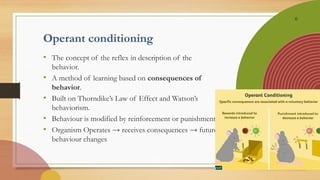
• Behaviour is modified by reinforcement or punishment
• Organism Operates → receives consequences → future
behaviour changes
7
EXPERIMENT
• Skinner at first tested this theory with rats.
• Later he experimented the test with pigeons.
• With bar and tray, he constructed a puzzle box and drove a hungry rat into the
puzzle box. The hungry rat wandered here and there and pushed the bar. The bar
and the food tray had its connection. When the rat pushed the bar down a food
pellet fell into the tray and it ate the food.
• The rat learned the task of pressing to get food on needs from which can
understand reinforcement is needed to achieve task.
8
• In the theory of Skinner’s Operant Conditioning, giving correct response is more
important.
• This type of conditioning is called instrument conditioning since responds is
instrumental in drawing unconditioned stimulus (naturally causes a reflexive
response).
• Here stimulus is only one. In Pavlo’s Classical Conditioning theory, we have two
stimuli which precede the response whereas in Skinner’s operant conditioning
theory. It is one conditioning stimulus which come late, desired response is
reinforced by unconditioned stimulus.
9
 From Skinner’s experiment:
• Positive Reinforcement → The rat gets food when it presses the
lever. This adds a pleasant stimulus, so the rat repeats the
behaviour more often.
• Negative Reinforcement → The rat presses the lever to stop the
electric shock. This removes an unpleasant stimulus, so the rat
still repeats the behaviour more often.
• Both increase behaviour — the difference is whether you’re
adding something good or removing something bad.
10
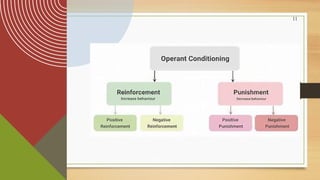
• Punishment is a consequence that decreases the likelihood of a behaviour being
repeated.
• Skinner identified two types:
• Positive Punishment → Adding an unpleasant stimulus after a behaviour.
• Example: If the rat presses the lever at the wrong time (or performs an unwanted
action) and immediately gets a mild electric shock, that shock is positive punishment.
• Negative Punishment → Removing a pleasant stimulus after a behaviour.
• Example: Taking away food when the rat presses the lever in the wrong way.
• Key difference from reinforcement:
• Reinforcement increases behaviour (by adding good or removing bad). Punishment
decreases behaviour (by adding bad or removing good).
11
12
POSITIVE REINFORCEMENT
• Skinner showed how positive reinforcement worked by
placing a hungry rat in his skinner box.
• Positive reinforcement strengthens a behavior by
providing a consequence an individual finds rewarding.
• Adding something pleasant after a behavior
• Eg: Giving a child chocolate for doing homework.
13
NEGATIVE REINFORCEMENT
• The removal of unpleasant reinforce can also
strengthen behavior.
• This is known a Negative reinforcement because it is
the removal of an adverse stimulus which is rewarding
to animal or person.
• Negative reinforcement strengthens the behavior
because it stops or remove unpleasant experience.
• Eg: Stopping a loud alarm when you wake up.
14
PUNISHMENT
 Punishment is defined as the opposite of reinforcement since it is designed to
weaken or eliminate a response rather than increase it.
 It is an adverse event that decrease the behavior that it follows.
 POSITIVE PUNISHMENT :
 adding something unpleasant
 E.g. Scolding a student for talking in class.
 NEGATIVE PUNISHMENT:
 removing something pleasant
 E.g: Taking away phone privileges for not doing chores.
15
TO SUM UP
1. Positive reinforcement
2. Negative reinforcement
3. Positive punishment
4. Negative punishment
- Adding something pleasant
- Remove something unpleasant
- Adding something unpleasant
- Removing something pleasant
Click to add picture
16
Educational Applications
• POSITIVE : Using rewards to increase desired student behavior.
• Rewarding students for correct answers.
• Using praise, grades or privileges to encourage desired behaviours.
• Minimizing punishment, focusing instead on reinforcing positive behaviour.
• NEGATIVE: If you finish your homework every day this week, you won’t
have to do the Friday quiz.
• The student works hard all week to avoid the quiz.
• Here: Unpleasant stimulus = Quiz
Removed when desired behaviour occurs (doing homework daily)
• This increases the likelihood of the student doing homework in the future.
17
MERITS DEMERITS
1. Effective behaviour
modification.
2. Practical application.
3. Clear cause and effect.
4. Encourage positive
behaviour.
5. Flexible and adaptable
1. Over reliance on external rewards.
2. Ethical concerns (punishment)
3. Limited to observable behaviour
4. Extinction and spontaneous
recovery.
5. Not always suitable for complex
behaviours.
Click to add picture
Thank you
Arundhathi M
Option: English

Arundhathi PPT AMV.pptxbbvbbbhhhhbhhhgghh

  • 1.
  • 2.
    2 BEHAVIOURISM  The learneris viewed as passively adapting to their environment.  It emphasizes that all behaviours are learned through interaction with the environment.
  • 3.
    B. F. Skinner BurrhusFrederic Skinner (1904–1990) was an American psychologist, behaviorist, and social philosopher, best known for developing Operant Conditioning. Skinner was a practical psychologist who conducted several experiments in rats and pigeons.
  • 4.
  • 5.
    • Skinner box Anenclosed chamber with levers or buttons for animals (like rats or pigeons) to press. Pressing could produce food (reinforcement) or avoid shock (negative reinforcement) • learning through rewards and punishments
  • 6.
    6 Operant conditioning • Theconcept of the reflex in description of the behavior. • A method of learning based on consequences of behavior. • Built on Thorndike’s Law of Effect and Watson’s behaviorism. • Behaviour is modified by reinforcement or punishment • Organism Operates → receives consequences → future behaviour changes
  • 7.
    7 EXPERIMENT • Skinner atfirst tested this theory with rats. • Later he experimented the test with pigeons. • With bar and tray, he constructed a puzzle box and drove a hungry rat into the puzzle box. The hungry rat wandered here and there and pushed the bar. The bar and the food tray had its connection. When the rat pushed the bar down a food pellet fell into the tray and it ate the food. • The rat learned the task of pressing to get food on needs from which can understand reinforcement is needed to achieve task.
  • 8.
    8 • In thetheory of Skinner’s Operant Conditioning, giving correct response is more important. • This type of conditioning is called instrument conditioning since responds is instrumental in drawing unconditioned stimulus (naturally causes a reflexive response). • Here stimulus is only one. In Pavlo’s Classical Conditioning theory, we have two stimuli which precede the response whereas in Skinner’s operant conditioning theory. It is one conditioning stimulus which come late, desired response is reinforced by unconditioned stimulus.
  • 9.
    9  From Skinner’sexperiment: • Positive Reinforcement → The rat gets food when it presses the lever. This adds a pleasant stimulus, so the rat repeats the behaviour more often. • Negative Reinforcement → The rat presses the lever to stop the electric shock. This removes an unpleasant stimulus, so the rat still repeats the behaviour more often. • Both increase behaviour — the difference is whether you’re adding something good or removing something bad.
  • 10.
    10 • Punishment isa consequence that decreases the likelihood of a behaviour being repeated. • Skinner identified two types: • Positive Punishment → Adding an unpleasant stimulus after a behaviour. • Example: If the rat presses the lever at the wrong time (or performs an unwanted action) and immediately gets a mild electric shock, that shock is positive punishment. • Negative Punishment → Removing a pleasant stimulus after a behaviour. • Example: Taking away food when the rat presses the lever in the wrong way. • Key difference from reinforcement: • Reinforcement increases behaviour (by adding good or removing bad). Punishment decreases behaviour (by adding bad or removing good).
  • 11.
  • 12.
    12 POSITIVE REINFORCEMENT • Skinnershowed how positive reinforcement worked by placing a hungry rat in his skinner box. • Positive reinforcement strengthens a behavior by providing a consequence an individual finds rewarding. • Adding something pleasant after a behavior • Eg: Giving a child chocolate for doing homework.
  • 13.
    13 NEGATIVE REINFORCEMENT • Theremoval of unpleasant reinforce can also strengthen behavior. • This is known a Negative reinforcement because it is the removal of an adverse stimulus which is rewarding to animal or person. • Negative reinforcement strengthens the behavior because it stops or remove unpleasant experience. • Eg: Stopping a loud alarm when you wake up.
  • 14.
    14 PUNISHMENT  Punishment isdefined as the opposite of reinforcement since it is designed to weaken or eliminate a response rather than increase it.  It is an adverse event that decrease the behavior that it follows.  POSITIVE PUNISHMENT :  adding something unpleasant  E.g. Scolding a student for talking in class.  NEGATIVE PUNISHMENT:  removing something pleasant  E.g: Taking away phone privileges for not doing chores.
  • 15.
    15 TO SUM UP 1.Positive reinforcement 2. Negative reinforcement 3. Positive punishment 4. Negative punishment - Adding something pleasant - Remove something unpleasant - Adding something unpleasant - Removing something pleasant Click to add picture
  • 16.
    16 Educational Applications • POSITIVE: Using rewards to increase desired student behavior. • Rewarding students for correct answers. • Using praise, grades or privileges to encourage desired behaviours. • Minimizing punishment, focusing instead on reinforcing positive behaviour. • NEGATIVE: If you finish your homework every day this week, you won’t have to do the Friday quiz. • The student works hard all week to avoid the quiz. • Here: Unpleasant stimulus = Quiz Removed when desired behaviour occurs (doing homework daily) • This increases the likelihood of the student doing homework in the future.
  • 17.
    17 MERITS DEMERITS 1. Effectivebehaviour modification. 2. Practical application. 3. Clear cause and effect. 4. Encourage positive behaviour. 5. Flexible and adaptable 1. Over reliance on external rewards. 2. Ethical concerns (punishment) 3. Limited to observable behaviour 4. Extinction and spontaneous recovery. 5. Not always suitable for complex behaviours. Click to add picture
  • 18.