What is Behaviour
Behaviour or behavior is the actions and mannerisms
made by individuals, organisms, systems or artificial
entities in conjunction with themselves or their
environment , which includes the other systems or
organisms around as well as the physical environment
. It is the computed response of the system or
organism to various stimuli or inputs, whether
internal or external, conscious or subconscious , overt
or covert and voluntary or involuntary.
Root causes of behaviour differences
Individual differences.
Differences in family patterns.
Impairment / disabilities
Environmental factors.
Psychological factors.
What is behavior modification
Behavior modification is defined
as “ the alteration of behavioral
patterns through the use of such
learning techniques as
biofeedback and positive or
negative reinforcement.” More
simply , you can modify your
child’s behavior with positive
consequences and negative
consequences . Behaviour
modification is based on the idea
that good behaviour should lead
to good consequences and bad
behaviour should lead to bad
consequences.
Characteristics of behaviour modification
 Behaviour modification procedures are
designed to change behaviour, not a
personal characteristics or trait .
Therefore, behaviour modification
deemphasizes labelling.
 Behaviour modification is not used to
change autism ; rather , behaviour
modification is used to change
problem behaviours exhibited by
children with autism.
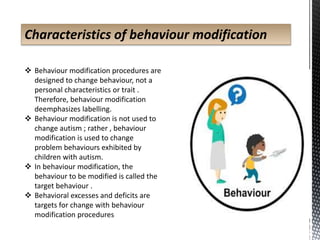
 In behaviour modification, the
behaviour to be modified is called the
target behaviour .
 Behavioral excesses and deficits are
targets for change with behaviour
modification procedures
Theories of behaviour modification
There are mainly to theories which are related
to the behaviour modification :
1.Classical conditioning.
2.Operant conditioning.
Classical conditioning
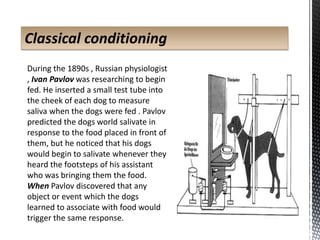
During the 1890s , Russian physiologist
, Ivan Pavlov was researching to begin
fed. He inserted a small test tube into
the cheek of each dog to measure
saliva when the dogs were fed . Pavlov
predicted the dogs world salivate in
response to the food placed in front of
them, but he noticed that his dogs
would begin to salivate whenever they
heard the footsteps of his assistant
who was bringing them the food.
When Pavlov discovered that any
object or event which the dogs
learned to associate with food would
trigger the same response.
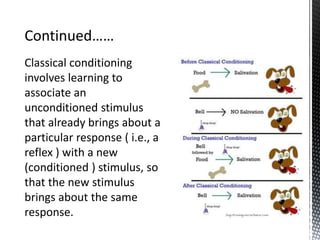
Classical conditioning
involves learning to
associate an
unconditioned stimulus
that already brings about a
particular response ( i.e., a
reflex ) with a new
(conditioned ) stimulus, so
that the new stimulus
brings about the same
response.
Continued……
Operant conditioning
• B.F. Skinner is regarded as the father of operant conditioning ,but his work
was based on Thorndike’s law of effect. According to this principle ,
behavior that is followed by pleasant consequences is likely to be
repeated , and behavior followed by unpleasant consequences is less
likely to be repeated .
• Skinner introduced a new term into the law of effect – Reinforcement.
Behavior which is reinforced tends to be repeated ; behavior which is not
reinforced tends to die out or be extinguished.
• During his experiment ,Skinner identified three types of responses , or
operant , that can follow behavior .
1. Neutral operants – Responses from the environment that neither
increase nor decrease the probability of a behavior being repeated.
2. Reinforcers - Responses from the environment that increase the
probability of a behavior being repeated. It can be positive or negative.
3. Punishers – Responses from the environment that decrease the likelihood
of a behavior being repeated .Punishment weakens behavior
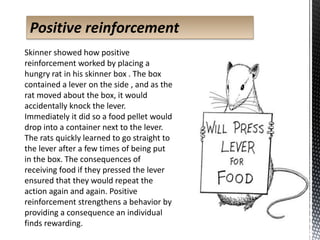
Positive reinforcement
Skinner showed how positive
reinforcement worked by placing a
hungry rat in his skinner box . The box
contained a lever on the side , and as the
rat moved about the box, it would
accidentally knock the lever.
Immediately it did so a food pellet would
drop into a container next to the lever.
The rats quickly learned to go straight to
the lever after a few times of being put
in the box. The consequences of
receiving food if they pressed the lever
ensured that they would repeat the
action again and again. Positive
reinforcement strengthens a behavior by
providing a consequence an individual
finds rewarding.
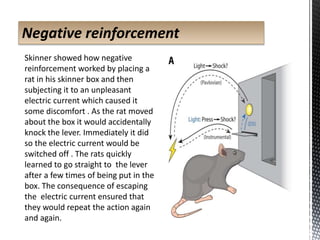
Negative reinforcement
Skinner showed how negative
reinforcement worked by placing a
rat in his skinner box and then
subjecting it to an unpleasant
electric current which caused it
some discomfort . As the rat moved
about the box it would accidentally
knock the lever. Immediately it did
so the electric current would be
switched off . The rats quickly
learned to go straight to the lever
after a few times of being put in the
box. The consequence of escaping
the electric current ensured that
they would repeat the action again
and again.
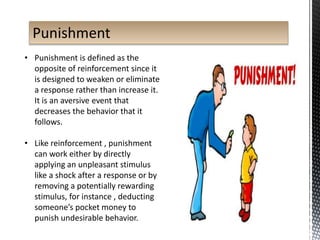
Punishment
• Punishment is defined as the
opposite of reinforcement since it
is designed to weaken or eliminate
a response rather than increase it.
It is an aversive event that
decreases the behavior that it
follows.
• Like reinforcement , punishment
can work either by directly
applying an unpleasant stimulus
like a shock after a response or by
removing a potentially rewarding
stimulus, for instance , deducting
someone’s pocket money to
punish undesirable behavior.
theoriesofbehaviourmodification-200531142737.pdf

theoriesofbehaviourmodification-200531142737.pdf

  • 2.
    What is Behaviour Behaviouror behavior is the actions and mannerisms made by individuals, organisms, systems or artificial entities in conjunction with themselves or their environment , which includes the other systems or organisms around as well as the physical environment . It is the computed response of the system or organism to various stimuli or inputs, whether internal or external, conscious or subconscious , overt or covert and voluntary or involuntary.
  • 3.
    Root causes ofbehaviour differences Individual differences. Differences in family patterns. Impairment / disabilities Environmental factors. Psychological factors.
  • 4.
    What is behaviormodification Behavior modification is defined as “ the alteration of behavioral patterns through the use of such learning techniques as biofeedback and positive or negative reinforcement.” More simply , you can modify your child’s behavior with positive consequences and negative consequences . Behaviour modification is based on the idea that good behaviour should lead to good consequences and bad behaviour should lead to bad consequences.
  • 5.
    Characteristics of behaviourmodification  Behaviour modification procedures are designed to change behaviour, not a personal characteristics or trait . Therefore, behaviour modification deemphasizes labelling.  Behaviour modification is not used to change autism ; rather , behaviour modification is used to change problem behaviours exhibited by children with autism.  In behaviour modification, the behaviour to be modified is called the target behaviour .  Behavioral excesses and deficits are targets for change with behaviour modification procedures
  • 6.
    Theories of behaviourmodification There are mainly to theories which are related to the behaviour modification : 1.Classical conditioning. 2.Operant conditioning.
  • 7.
    Classical conditioning During the1890s , Russian physiologist , Ivan Pavlov was researching to begin fed. He inserted a small test tube into the cheek of each dog to measure saliva when the dogs were fed . Pavlov predicted the dogs world salivate in response to the food placed in front of them, but he noticed that his dogs would begin to salivate whenever they heard the footsteps of his assistant who was bringing them the food. When Pavlov discovered that any object or event which the dogs learned to associate with food would trigger the same response.
  • 8.
    Classical conditioning involves learningto associate an unconditioned stimulus that already brings about a particular response ( i.e., a reflex ) with a new (conditioned ) stimulus, so that the new stimulus brings about the same response. Continued……
  • 9.
    Operant conditioning • B.F.Skinner is regarded as the father of operant conditioning ,but his work was based on Thorndike’s law of effect. According to this principle , behavior that is followed by pleasant consequences is likely to be repeated , and behavior followed by unpleasant consequences is less likely to be repeated . • Skinner introduced a new term into the law of effect – Reinforcement. Behavior which is reinforced tends to be repeated ; behavior which is not reinforced tends to die out or be extinguished. • During his experiment ,Skinner identified three types of responses , or operant , that can follow behavior . 1. Neutral operants – Responses from the environment that neither increase nor decrease the probability of a behavior being repeated. 2. Reinforcers - Responses from the environment that increase the probability of a behavior being repeated. It can be positive or negative. 3. Punishers – Responses from the environment that decrease the likelihood of a behavior being repeated .Punishment weakens behavior
  • 10.
    Positive reinforcement Skinner showedhow positive reinforcement worked by placing a hungry rat in his skinner box . The box contained a lever on the side , and as the rat moved about the box, it would accidentally knock the lever. Immediately it did so a food pellet would drop into a container next to the lever. The rats quickly learned to go straight to the lever after a few times of being put in the box. The consequences of receiving food if they pressed the lever ensured that they would repeat the action again and again. Positive reinforcement strengthens a behavior by providing a consequence an individual finds rewarding.
  • 11.
    Negative reinforcement Skinner showedhow negative reinforcement worked by placing a rat in his skinner box and then subjecting it to an unpleasant electric current which caused it some discomfort . As the rat moved about the box it would accidentally knock the lever. Immediately it did so the electric current would be switched off . The rats quickly learned to go straight to the lever after a few times of being put in the box. The consequence of escaping the electric current ensured that they would repeat the action again and again.
  • 12.
    Punishment • Punishment isdefined as the opposite of reinforcement since it is designed to weaken or eliminate a response rather than increase it. It is an aversive event that decreases the behavior that it follows. • Like reinforcement , punishment can work either by directly applying an unpleasant stimulus like a shock after a response or by removing a potentially rewarding stimulus, for instance , deducting someone’s pocket money to punish undesirable behavior.