Behaviorism:
Pavlov,
Thorndike,
Watson, Skinner
In this lesson, challenge yourself to attain the
following learning outcomes:
•explain the basic principles of
behaviorism.
•make a simple plan applying the primary
laws of learning.
•determine how to use rewards in the
learning process more effectively.
How do you feel upon looking on the pictures?
• The theory of behaviorism focuses on the
study of observable and measurable
behavior. It emphasizes that behavior is
mostly learned through conditioning and
reinforcement (rewards and punishment).
• It does not give much attention to the
mind and the possibility of thought
processes occurring in the mind.
Shaping of
Behavior
Law of Readiness
Law of Exercise
Law of Effect
Primary Laws
Operant Conditioning
(Skinner)
Connectionism
(Thorndike)
Classicial
Conditioning
(Pavlov/ Watson)
Behaviorism
Reinforcement
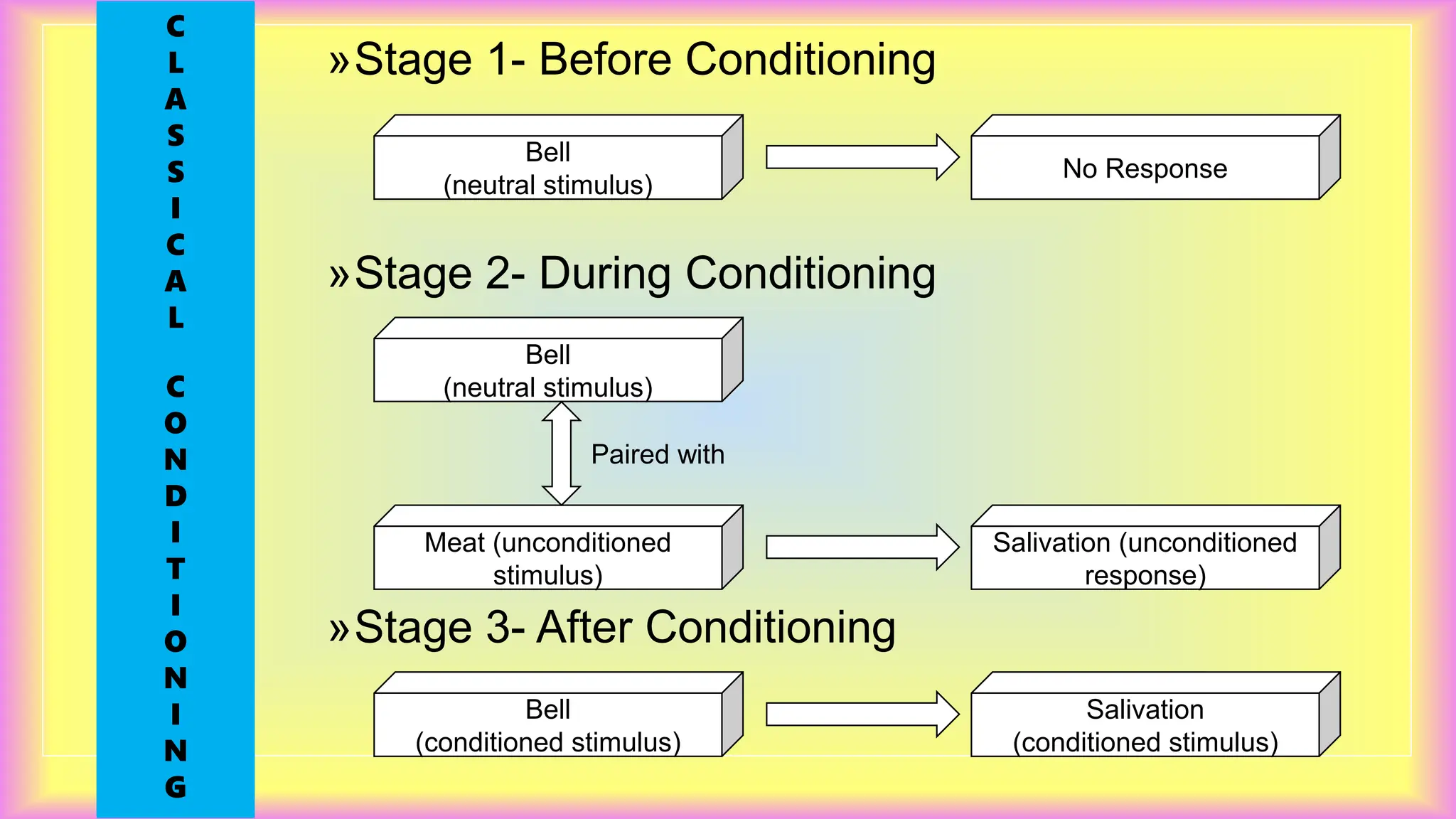
»Stage 1- Before Conditioning
»Stage 2- During Conditioning
»Stage 3- After Conditioning
Bell
(neutral stimulus)
No Response
Bell
(conditioned stimulus)
Salivation
(conditioned stimulus)
Bell
(neutral stimulus)
Meat (unconditioned
stimulus)
Salivation (unconditioned
response)
Paired with
C
L
A
S
S
I
C
A
L
C
O
N
D
I
T
I
O
N
I
N
G
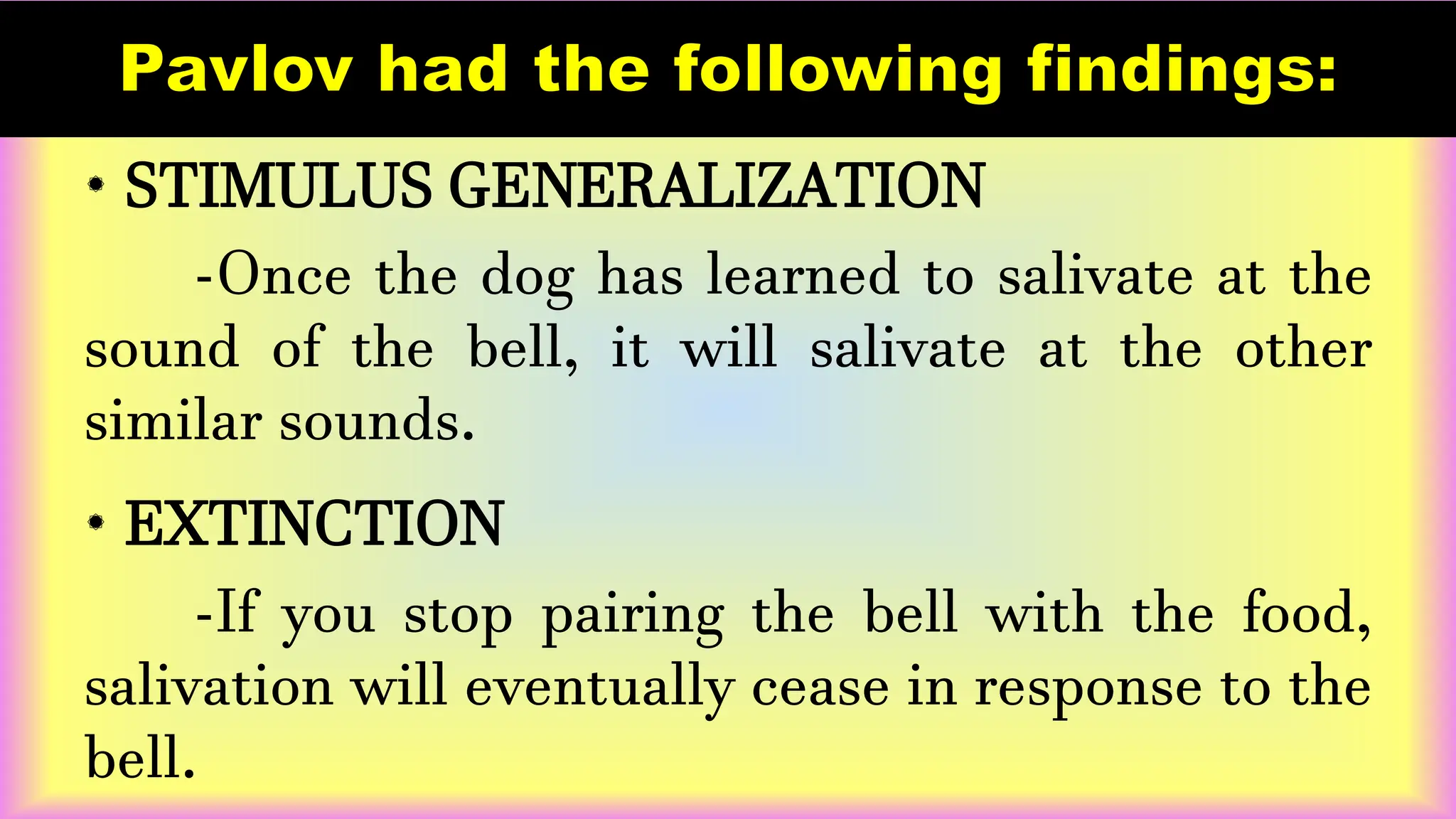
• STIMULUS GENERALIZATION
-Once the dog has learned to salivate at the
sound of the bell, it will salivate at the other
similar sounds.
• EXTINCTION
-If you stop pairing the bell with the food,
salivation will eventually cease in response to the
bell.
• SPONTANEOUS RECOVERY
-Extinguished responses can be “recovered”
after an elapsed time, but will soon extinguish
again if the dog is not presented with food.
• DISCRIMINATION
-The dog could learn to discriminate
between similar bells (stimuli) and discern which
bell would result in the presentation of food and
which would not.
• HIGHER-ORDER CONDITIONING
-Once the dog has been conditioned to
associate the bell with food, another
unconditioned stimulus, such as a light may
be flashed at the same time that the bell is
rung. Eventually, the dog will salivate at the
flash of the light without the sound of the
bell.
John
Watson
• He considered that humans are born with a few
reflexes and the emotional reactions of love and
rage. All other behavior is learned through stimulus-
response associations through conditioning. He
believed in the power of conditioning so much that
he said that if he is given a dozen healthy infants
he can make them into anything you want them to
be, basically through making stimulus- response
connections through conditioning.
• EXPERIMENT ON ALBERT. Watson applied classical
conditioning in his experiment concerning Albert, a
young child and a white rat. In the beginning, Albert was
not afraid of the rat; but Watson made a sudden loud
noise each time Albert touched the rat. Because Albert
was frightened by the loud noise, he soon became
conditioned to fear and avoid the rat. Later, the child’s
response was generalized to other small animals. Now,
he was also afraid of small animals. Watson then
“extinguished” or made the child “unlearned” fear by
showing the rat without the loud noise.
• Thorndike's theory on connectionism, states
that learning has taken place when a strong
connection or bond between stimulus and
response is formed.
• LAW OF EFFECT
-The law of effect states that a connection between a
stimulus and response is strengthened when the
consequence is positive (reward) and the connection
between the stimulus and the response is weakened when
the consequence is negative. Thorndike later on, revised
this “law” when he found that negative rewards
(punishment) do not necessarily weaken bonds, and that
some seemingly pleasurable consequences do not
necessarily motivate performance.
• LAW OF EXERCISE
-This tells that the more S-R (stimulus-
response) bond is practiced the stronger it will
become. “Practice makes perfect” seem to be
associated with this. However, like the law of
effect, the law of exercise also had to be
revised when Thorndike found that practice
without feedback does not necessarily enhance
performance.
• LAW OF READINESS
-This states that the more readiness the
learner has to respond to the stimulus, the
stronger will bbe the bond between them.
When a person is ready to respond to a
stimulus and is not made to respond, it
becomes annoying to the person.
1. Learning requires both practice and rewards (law of
effectiveness/ exercise)
2. A series of S-R connections can be chained together if
they belong to the same action sequence (law of
readiness)
3. Transfer of learning occurs because of previously
encountered situations.
4. Intelligence is a function of the number of connections
learned.
OPERANT
CONDITIONING
(Burrhus Frederick
Skinner)
• Like Pavlov, Watson and Thorndike, Skinner
believed in the stimulus- response pattern of
conditioned behavior. His theory zeroed in only on
changes in observable behavior, excluding any
likelihood of any processes taking place in the mind.
• Skinner's work differs from that of the three
behaviorist before him in that he studied operant
behavior (voluntary behaviors used in operating on
the environment. Thus his theory came to be known
as OPERANT CONDITIONING.
• Operant Conditioning is based upon the notion
that learning is a result of change in overt behavior.
Changes in behavior are the result of an individual's
response to events (stimuli) that occur in the
environment. A response produces a consequence
such as defining a word, hitting a ball, or solving a
math problem. When a particular Stimulus-
Response (S-R) pattern is reinforced (rewarded), the
individual is conditioned to respond.
• Reinforcement is the key element in
Skinner's S-R theory. A reinforcer is
anything that strengthens the desired
response.
• A positive reinforcer is any stimulus that
is given or added to increase the response.
• A negative reinforcer is any stimulus that
results in the increased frequency of a response
when it is withdrawn or removed. A negative
reinforcement is not a punishment, in fact it
is a reward.
• A negative reinforcement is different from a
punishment because a punishment is a
consequence intended to result in reduced
responses.
• SHAPING OF BEHAVIOR
-An animal on a cage may take a very long
time to figure out that pressing a lever will produce
food. To accomplish such behavior, successive
approximations of the behavior are rewarded until
the animal learned the association between the
lever and the food reward. To begin shaping, the
animal may be rewarded for simply turning in the
direction of the lever, then for moving toward the
lever, for brushing against the lever, and finally for
pressing the lever.
• Behavioral chaining comes about when a
series of steps are needed to be learned. The
animal would master each step in sequence
until the entire is learned. This can be
applied to a child being taught to tie a
shoelace. The child can be given
reinforcement (rewards) until the entire
process of tying the shoelace is learned.
• REINFORCEMENT SCHEDULES
-Once the desired behavioral response is
accomplished, reinforcement does not have to be
100%; in fact, it can be maintained more
successfully through what Skinner referred to as
partial reinforcement schedules. Partial
reinforcement schedules include interval
schedules and ratio schedules.
• FIXED INTERVAL SCHEDULES
-The target is reinforced after a fixed
amount of time has passed since the last
reinforcement.
• VARIABLE INTERVAL SCHEDULES
-This is similar to fixed interval schedules
but the amount of time that must pass between
reinforcement varies.
• FIXED RATIO SCHEDULES
-A fixed number of correct responses
may occur before reinforcement may
occur.
• VARIABLE RATIO SCHEDULES
-The number of correct repetitions of
the correct response for reinforcement
varies.
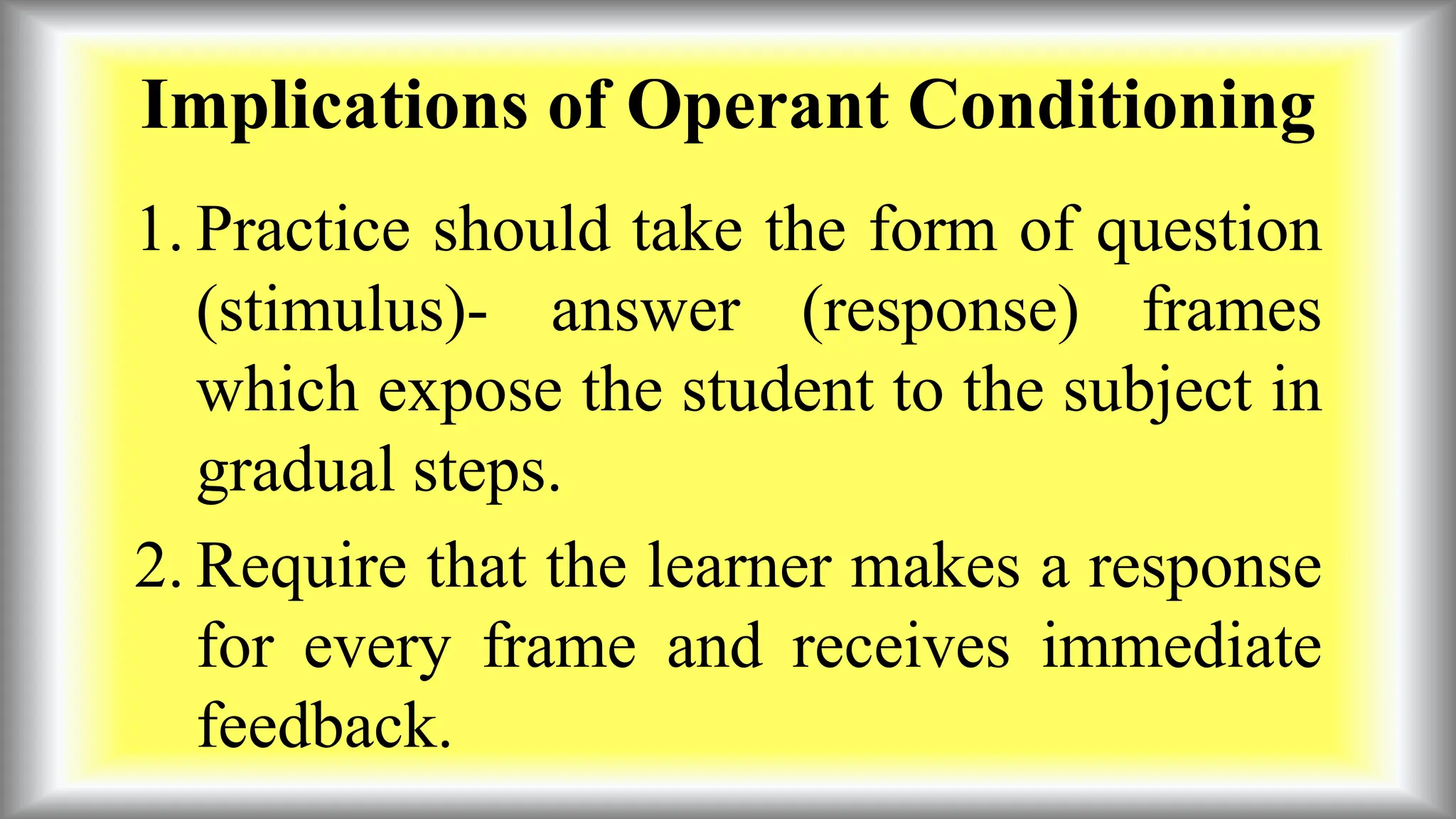
Implications of Operant Conditioning
1. Practice should take the form of question
(stimulus)- answer (response) frames
which expose the student to the subject in
gradual steps.
2. Require that the learner makes a response
for every frame and receives immediate
feedback.
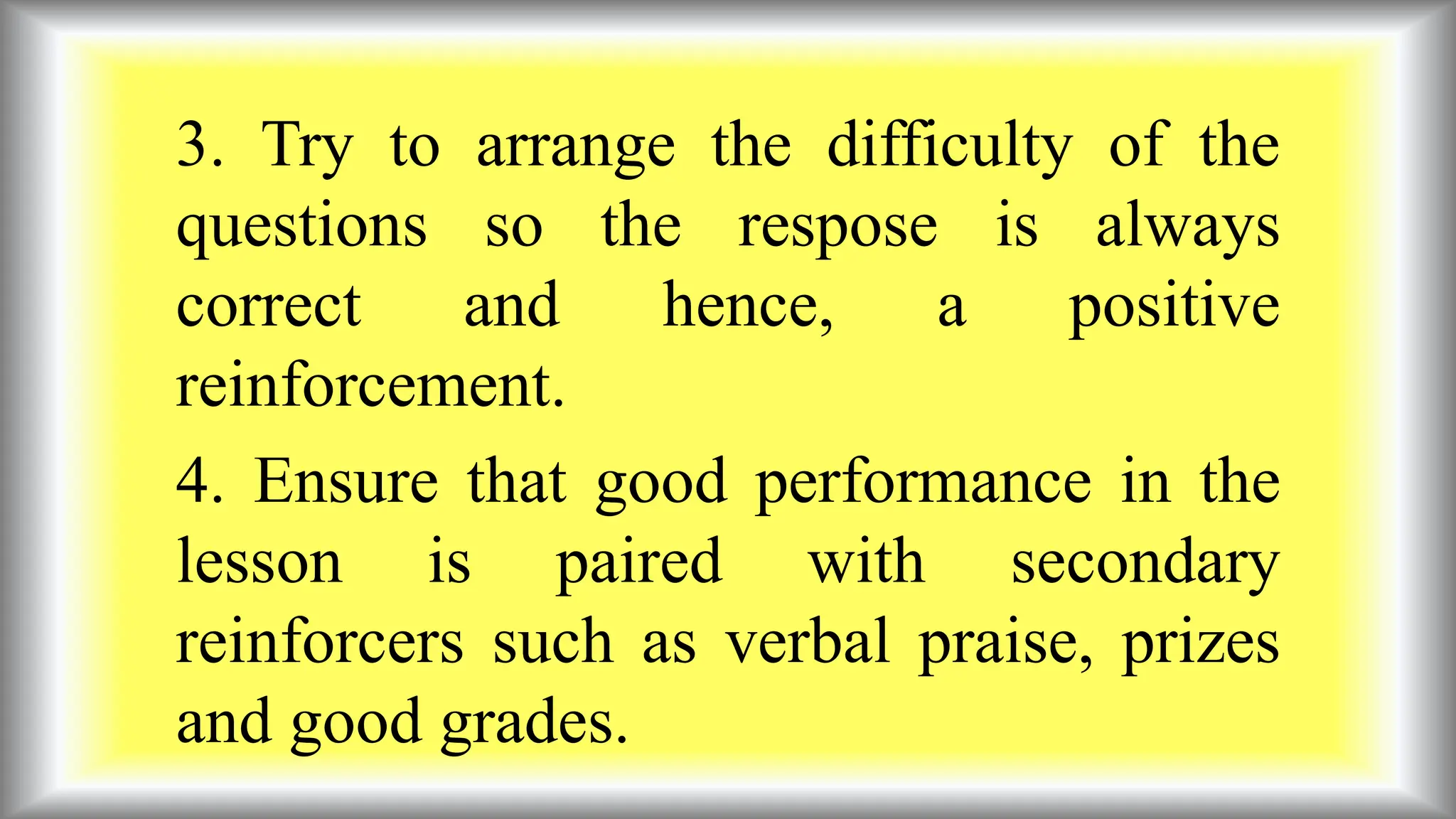
3. Try to arrange the difficulty of the
questions so the respose is always
correct and hence, a positive
reinforcement.
4. Ensure that good performance in the
lesson is paired with secondary
reinforcers such as verbal praise, prizes
and good grades.
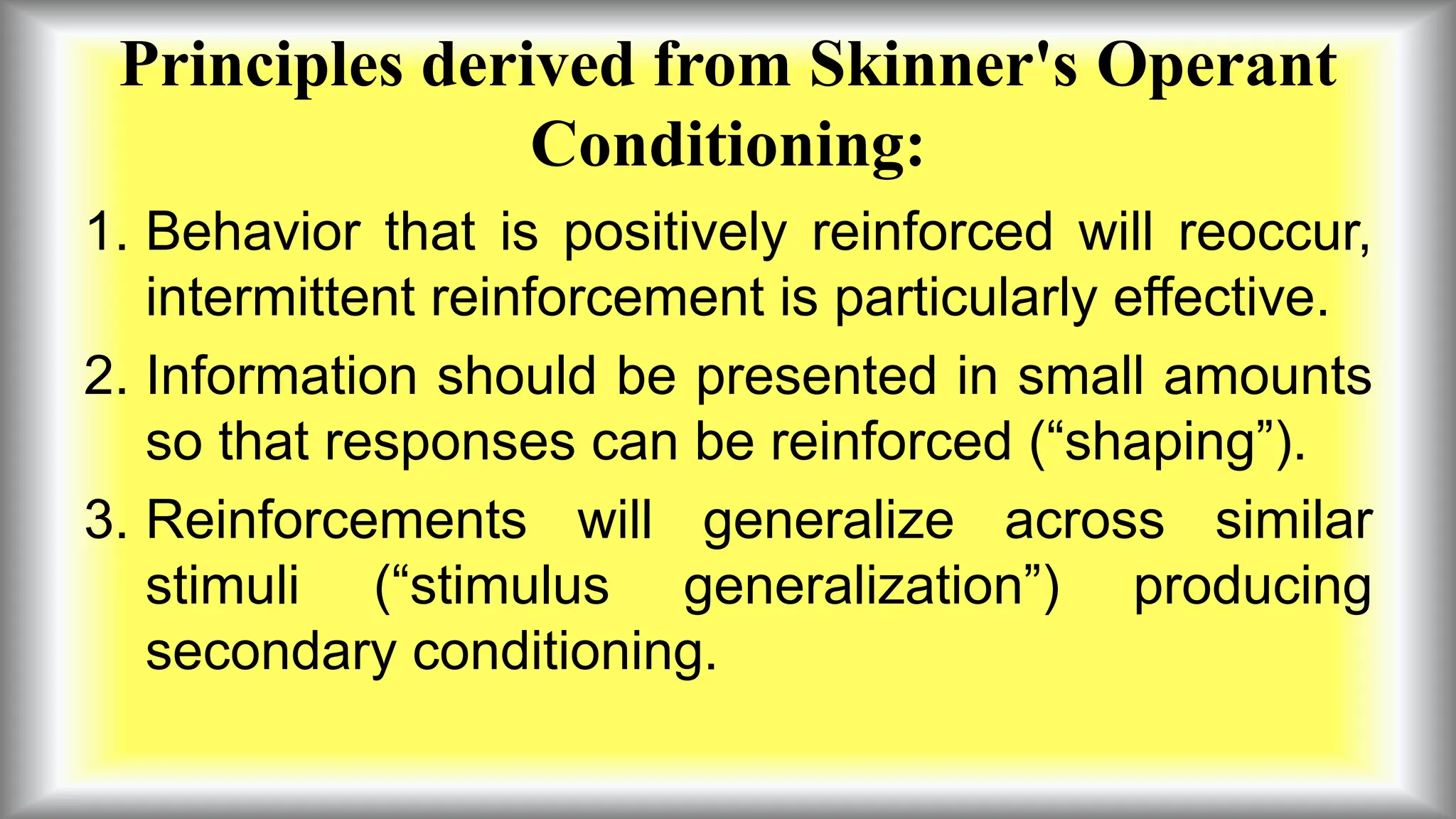
Principles derived from Skinner's Operant
Conditioning:
1. Behavior that is positively reinforced will reoccur,
intermittent reinforcement is particularly effective.
2. Information should be presented in small amounts
so that responses can be reinforced (“shaping”).
3. Reinforcements will generalize across similar
stimuli (“stimulus generalization”) producing
secondary conditioning.

shina Baculi - Topic 6.1 Behaviorsim.pdf

  • 1.
  • 2.
    In this lesson,challenge yourself to attain the following learning outcomes: •explain the basic principles of behaviorism. •make a simple plan applying the primary laws of learning. •determine how to use rewards in the learning process more effectively.
  • 3.
    How do youfeel upon looking on the pictures?
  • 4.
    • The theoryof behaviorism focuses on the study of observable and measurable behavior. It emphasizes that behavior is mostly learned through conditioning and reinforcement (rewards and punishment). • It does not give much attention to the mind and the possibility of thought processes occurring in the mind.
  • 5.
    Shaping of Behavior Law ofReadiness Law of Exercise Law of Effect Primary Laws Operant Conditioning (Skinner) Connectionism (Thorndike) Classicial Conditioning (Pavlov/ Watson) Behaviorism Reinforcement
  • 7.
    »Stage 1- BeforeConditioning »Stage 2- During Conditioning »Stage 3- After Conditioning Bell (neutral stimulus) No Response Bell (conditioned stimulus) Salivation (conditioned stimulus) Bell (neutral stimulus) Meat (unconditioned stimulus) Salivation (unconditioned response) Paired with C L A S S I C A L C O N D I T I O N I N G
  • 9.
    • STIMULUS GENERALIZATION -Oncethe dog has learned to salivate at the sound of the bell, it will salivate at the other similar sounds. • EXTINCTION -If you stop pairing the bell with the food, salivation will eventually cease in response to the bell.
  • 10.
    • SPONTANEOUS RECOVERY -Extinguishedresponses can be “recovered” after an elapsed time, but will soon extinguish again if the dog is not presented with food. • DISCRIMINATION -The dog could learn to discriminate between similar bells (stimuli) and discern which bell would result in the presentation of food and which would not.
  • 11.
    • HIGHER-ORDER CONDITIONING -Oncethe dog has been conditioned to associate the bell with food, another unconditioned stimulus, such as a light may be flashed at the same time that the bell is rung. Eventually, the dog will salivate at the flash of the light without the sound of the bell.
  • 12.
  • 13.
    • He consideredthat humans are born with a few reflexes and the emotional reactions of love and rage. All other behavior is learned through stimulus- response associations through conditioning. He believed in the power of conditioning so much that he said that if he is given a dozen healthy infants he can make them into anything you want them to be, basically through making stimulus- response connections through conditioning.
  • 14.
    • EXPERIMENT ONALBERT. Watson applied classical conditioning in his experiment concerning Albert, a young child and a white rat. In the beginning, Albert was not afraid of the rat; but Watson made a sudden loud noise each time Albert touched the rat. Because Albert was frightened by the loud noise, he soon became conditioned to fear and avoid the rat. Later, the child’s response was generalized to other small animals. Now, he was also afraid of small animals. Watson then “extinguished” or made the child “unlearned” fear by showing the rat without the loud noise.
  • 16.
    • Thorndike's theoryon connectionism, states that learning has taken place when a strong connection or bond between stimulus and response is formed.
  • 17.
    • LAW OFEFFECT -The law of effect states that a connection between a stimulus and response is strengthened when the consequence is positive (reward) and the connection between the stimulus and the response is weakened when the consequence is negative. Thorndike later on, revised this “law” when he found that negative rewards (punishment) do not necessarily weaken bonds, and that some seemingly pleasurable consequences do not necessarily motivate performance.
  • 18.
    • LAW OFEXERCISE -This tells that the more S-R (stimulus- response) bond is practiced the stronger it will become. “Practice makes perfect” seem to be associated with this. However, like the law of effect, the law of exercise also had to be revised when Thorndike found that practice without feedback does not necessarily enhance performance.
  • 19.
    • LAW OFREADINESS -This states that the more readiness the learner has to respond to the stimulus, the stronger will bbe the bond between them. When a person is ready to respond to a stimulus and is not made to respond, it becomes annoying to the person.
  • 20.
    1. Learning requiresboth practice and rewards (law of effectiveness/ exercise) 2. A series of S-R connections can be chained together if they belong to the same action sequence (law of readiness) 3. Transfer of learning occurs because of previously encountered situations. 4. Intelligence is a function of the number of connections learned.
  • 21.
  • 22.
    • Like Pavlov,Watson and Thorndike, Skinner believed in the stimulus- response pattern of conditioned behavior. His theory zeroed in only on changes in observable behavior, excluding any likelihood of any processes taking place in the mind. • Skinner's work differs from that of the three behaviorist before him in that he studied operant behavior (voluntary behaviors used in operating on the environment. Thus his theory came to be known as OPERANT CONDITIONING.
  • 23.
    • Operant Conditioningis based upon the notion that learning is a result of change in overt behavior. Changes in behavior are the result of an individual's response to events (stimuli) that occur in the environment. A response produces a consequence such as defining a word, hitting a ball, or solving a math problem. When a particular Stimulus- Response (S-R) pattern is reinforced (rewarded), the individual is conditioned to respond.
  • 24.
    • Reinforcement isthe key element in Skinner's S-R theory. A reinforcer is anything that strengthens the desired response. • A positive reinforcer is any stimulus that is given or added to increase the response.
  • 25.
    • A negativereinforcer is any stimulus that results in the increased frequency of a response when it is withdrawn or removed. A negative reinforcement is not a punishment, in fact it is a reward. • A negative reinforcement is different from a punishment because a punishment is a consequence intended to result in reduced responses.
  • 26.
    • SHAPING OFBEHAVIOR -An animal on a cage may take a very long time to figure out that pressing a lever will produce food. To accomplish such behavior, successive approximations of the behavior are rewarded until the animal learned the association between the lever and the food reward. To begin shaping, the animal may be rewarded for simply turning in the direction of the lever, then for moving toward the lever, for brushing against the lever, and finally for pressing the lever.
  • 27.
    • Behavioral chainingcomes about when a series of steps are needed to be learned. The animal would master each step in sequence until the entire is learned. This can be applied to a child being taught to tie a shoelace. The child can be given reinforcement (rewards) until the entire process of tying the shoelace is learned.
  • 28.
    • REINFORCEMENT SCHEDULES -Oncethe desired behavioral response is accomplished, reinforcement does not have to be 100%; in fact, it can be maintained more successfully through what Skinner referred to as partial reinforcement schedules. Partial reinforcement schedules include interval schedules and ratio schedules.
  • 29.
    • FIXED INTERVALSCHEDULES -The target is reinforced after a fixed amount of time has passed since the last reinforcement. • VARIABLE INTERVAL SCHEDULES -This is similar to fixed interval schedules but the amount of time that must pass between reinforcement varies.
  • 30.
    • FIXED RATIOSCHEDULES -A fixed number of correct responses may occur before reinforcement may occur. • VARIABLE RATIO SCHEDULES -The number of correct repetitions of the correct response for reinforcement varies.
  • 31.
    Implications of OperantConditioning 1. Practice should take the form of question (stimulus)- answer (response) frames which expose the student to the subject in gradual steps. 2. Require that the learner makes a response for every frame and receives immediate feedback.
  • 32.
    3. Try toarrange the difficulty of the questions so the respose is always correct and hence, a positive reinforcement. 4. Ensure that good performance in the lesson is paired with secondary reinforcers such as verbal praise, prizes and good grades.
  • 33.
    Principles derived fromSkinner's Operant Conditioning: 1. Behavior that is positively reinforced will reoccur, intermittent reinforcement is particularly effective. 2. Information should be presented in small amounts so that responses can be reinforced (“shaping”). 3. Reinforcements will generalize across similar stimuli (“stimulus generalization”) producing secondary conditioning.