GROUP DYNAMICS
Presented by:-
Archana tripathy
Msc N tutor
SNC
INTRODUCTION
• Dynamic=Force
• It refers to the forces operating in the group.
• Its concerned with dynamic interaction of
individuals in face to face relationships.
• As a leader understanding the group dynamic
is essential in order to both compose & guide
the individuals within a group for the purpose
of successfully & efficiently completing an
assignment.
GROUP
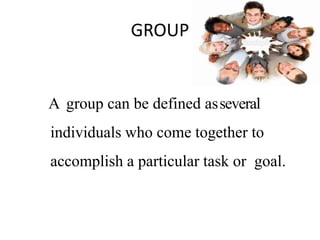
A group can be defined asseveral
individuals who come together to
accomplish a particular task or goal.
GROUP DYNAMICS
• It is the social process by which
people interact face to face in small
groups.
• Group dynamics refers to the attitudinal and
behavioral characteristics of a group.
• It’s an interaction that influence the attitudes
& behavior of people when they are grouped
with others through either choice or
accidental circumstances.
PRINCIPLES
• The members of the group must have a strong
sense of belonging to the group.
• Changes in one part of the group may produce
stress in other person, which can be reduced only
by eliminating or allowing the change by bringing
about readjustment in the related parts.
• Group survives by placing the members into
functional hierarchy & facilitating the actions
towards the goals.
Principle cont…
• The intergroup relations, group organization &
member participation are essential for
effectiveness of a group.
• Information relating to need for change, plan for
change & consequences of changes must be shared
by members of a group.
Group formation
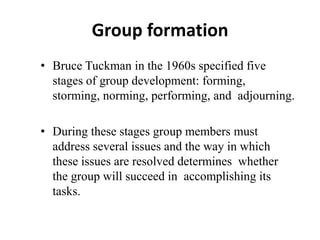
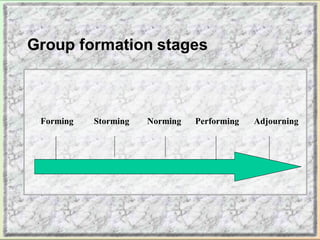
• Bruce Tuckman in the 1960s specified five
stages of group development: forming,
storming, norming, performing, and adjourning.
• During these stages group members must
address several issues and the way in which
these issues are resolved determines whether
the group will succeed in accomplishing its
tasks.
Group formation stages
© PhotoDisc
Forming Storming Norming Performing Adjourning
Group development stages
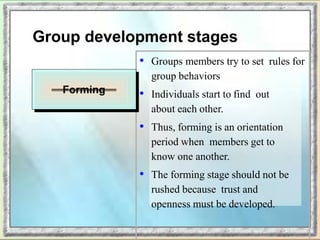
• Groups members try to set rules for
group behaviors
• Individuals start to find out
about each other.
• Thus, forming is an orientation
period when members get to
know one another.
• The forming stage should not be
rushed because trust and
openness must be developed.
Forming
Group development stages
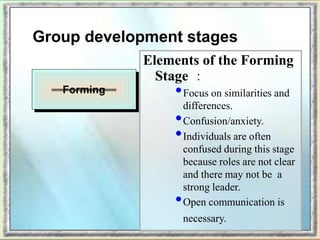
Elements of the Forming
Stage :
•Focus on similarities and
differences.
•Confusion/anxiety.
•Individuals are often
confused during this stage
because roles are not clear
and there may not be a
strong leader.
•Open communication is
necessary.
Forming
Group development stages
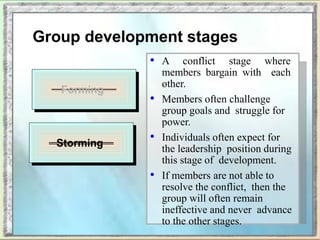
• A conflict stage where
members bargain with each
other.
• Members often challenge
group goals and struggle for
power.
• Individuals often expect for
the leadership position during
this stage of development.
• If members are not able to
resolve the conflict, then the
group will often remain
ineffective and never advance
to the other stages.
Forming
Storming
Group development stages
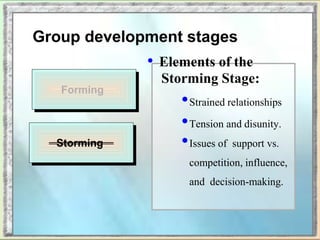
• Elements of the
Storming Stage:
•Strained relationships
•Tension and disunity.
•Issues of support vs.
competition, influence,
and decision-making.
Forming
Storming
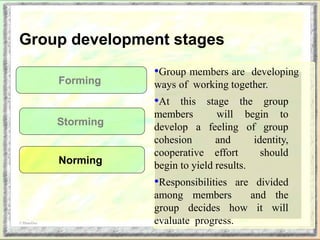
•Group members are developing
ways of working together.
•At this stage the group
members will begin to
develop a feeling of group
cohesion and identity,
cooperative effort should
begin to yield results.
•Responsibilities are divided
among members and the
group decides how it will
evaluate progress.
Forming
Storming
Norming
© PhotoDisc
Group development stages
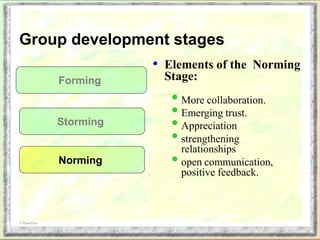
• Elements of the Norming
Stage:
• More collaboration.
• Emerging trust.
• Appreciation
• strengthening
relationships
• open communication,
positive feedback.
Forming
Storming
Norming
© PhotoDisc
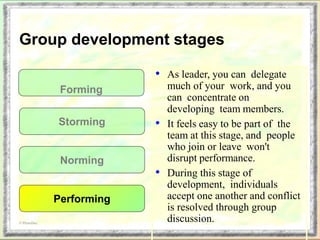
Group development stages
• As leader, you can delegate
much of your work, and you
can concentrate on
developing team members.
• It feels easy to be part of the
team at this stage, and people
who join or leave won't
disrupt performance.
• During this stage of
development, individuals
accept one another and conflict
is resolved through group
discussion.
Forming
Storming
Norming
Performing
© PhotoDisc
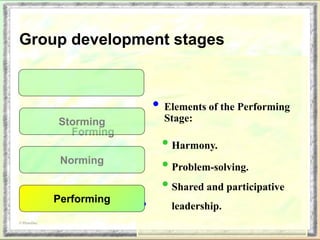
Group development stages
• Harmony.
• Problem-solving.
• Shared and participative
leadership.•
• Elements of the Performing
Stage:
Forming
Storming
Norming
Performing
© PhotoDisc
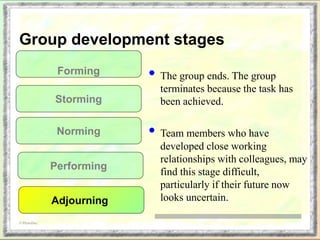
Group development stages
• The group ends. The group
terminates because the task has
been achieved.
• Team members who have
developed close working
relationships with colleagues, may
find this stage difficult,
particularly if their future now
looks uncertain.
Forming
Storming
Norming
Group development stages
Adjourning
© PhotoDisc
Performing
ROLE OF NURSE MANAGER IN GROUP
DYNAMICS
• Knowledge of group dynamics is needed by nurse
managers to improve leadership competencies and
facilitates group discussions and communication.
• Other roles are outcome management, team co-
ordination and teaching of students, patients and
families.
Cont…
 The nurse leader provides an atmosphere that allows open
communication members.
 Supervise and manage the overall performance of staff in
department.
 Analyzing, reporting, giving recommendations and
developing strategies on how to improve quality and
quantity of nursing care.
 Achieve business and organization goals, visions and
objectives.
 Involved in employee selection, career development,
succession planning and periodic training.
Copyright © 2002 by Harcourt, Inc. All rights reserved.

Group dynamics

  • 1.
    GROUP DYNAMICS Presented by:- Archanatripathy Msc N tutor SNC
  • 2.
    INTRODUCTION • Dynamic=Force • Itrefers to the forces operating in the group. • Its concerned with dynamic interaction of individuals in face to face relationships. • As a leader understanding the group dynamic is essential in order to both compose & guide the individuals within a group for the purpose of successfully & efficiently completing an assignment.
  • 3.
    GROUP A group canbe defined asseveral individuals who come together to accomplish a particular task or goal.
  • 4.
    GROUP DYNAMICS • Itis the social process by which people interact face to face in small groups. • Group dynamics refers to the attitudinal and behavioral characteristics of a group. • It’s an interaction that influence the attitudes & behavior of people when they are grouped with others through either choice or accidental circumstances.
  • 5.
    PRINCIPLES • The membersof the group must have a strong sense of belonging to the group. • Changes in one part of the group may produce stress in other person, which can be reduced only by eliminating or allowing the change by bringing about readjustment in the related parts. • Group survives by placing the members into functional hierarchy & facilitating the actions towards the goals.
  • 6.
    Principle cont… • Theintergroup relations, group organization & member participation are essential for effectiveness of a group. • Information relating to need for change, plan for change & consequences of changes must be shared by members of a group.
  • 8.
    Group formation • BruceTuckman in the 1960s specified five stages of group development: forming, storming, norming, performing, and adjourning. • During these stages group members must address several issues and the way in which these issues are resolved determines whether the group will succeed in accomplishing its tasks.
  • 9.
    Group formation stages ©PhotoDisc Forming Storming Norming Performing Adjourning
  • 10.
    Group development stages •Groups members try to set rules for group behaviors • Individuals start to find out about each other. • Thus, forming is an orientation period when members get to know one another. • The forming stage should not be rushed because trust and openness must be developed. Forming
  • 11.
    Group development stages Elementsof the Forming Stage : •Focus on similarities and differences. •Confusion/anxiety. •Individuals are often confused during this stage because roles are not clear and there may not be a strong leader. •Open communication is necessary. Forming
  • 12.
    Group development stages •A conflict stage where members bargain with each other. • Members often challenge group goals and struggle for power. • Individuals often expect for the leadership position during this stage of development. • If members are not able to resolve the conflict, then the group will often remain ineffective and never advance to the other stages. Forming Storming
  • 13.
    Group development stages •Elements of the Storming Stage: •Strained relationships •Tension and disunity. •Issues of support vs. competition, influence, and decision-making. Forming Storming
  • 14.
    •Group members aredeveloping ways of working together. •At this stage the group members will begin to develop a feeling of group cohesion and identity, cooperative effort should begin to yield results. •Responsibilities are divided among members and the group decides how it will evaluate progress. Forming Storming Norming © PhotoDisc Group development stages
  • 15.
    • Elements ofthe Norming Stage: • More collaboration. • Emerging trust. • Appreciation • strengthening relationships • open communication, positive feedback. Forming Storming Norming © PhotoDisc Group development stages
  • 16.
    • As leader,you can delegate much of your work, and you can concentrate on developing team members. • It feels easy to be part of the team at this stage, and people who join or leave won't disrupt performance. • During this stage of development, individuals accept one another and conflict is resolved through group discussion. Forming Storming Norming Performing © PhotoDisc Group development stages
  • 17.
    • Harmony. • Problem-solving. •Shared and participative leadership.• • Elements of the Performing Stage: Forming Storming Norming Performing © PhotoDisc Group development stages
  • 18.
    • The groupends. The group terminates because the task has been achieved. • Team members who have developed close working relationships with colleagues, may find this stage difficult, particularly if their future now looks uncertain. Forming Storming Norming Group development stages Adjourning © PhotoDisc Performing
  • 19.
    ROLE OF NURSEMANAGER IN GROUP DYNAMICS • Knowledge of group dynamics is needed by nurse managers to improve leadership competencies and facilitates group discussions and communication. • Other roles are outcome management, team co- ordination and teaching of students, patients and families.
  • 20.
    Cont…  The nurseleader provides an atmosphere that allows open communication members.  Supervise and manage the overall performance of staff in department.  Analyzing, reporting, giving recommendations and developing strategies on how to improve quality and quantity of nursing care.  Achieve business and organization goals, visions and objectives.  Involved in employee selection, career development, succession planning and periodic training.
  • 21.
    Copyright © 2002by Harcourt, Inc. All rights reserved.