COMMUNICATION
 Communication is the basic element of human
interactions that allows nurses to establish,
maintain and improve contacts with others.
 Communication is “a process by which two or more
people exchange ideas, facts, feelings or
impressions in ways that each gains a ‘common
understanding’ of meaning, intent and use of a
message.
CONT>>>>>
Increases in nursing communication can lessen medical
errors and make a difference in positive patient
outcomes. to enhance and standardize communication.
According to Ros Wright, “increased recovery rates, a
sense of safety and protection, improved levels of
patient satisfaction and greater adherence totreatment
options” as well-documented results of effective
communication
Purpose of communication in
nursing
1. To exchange information between nursing personnel
As nursing report at end of shift to personal comingon
duty
2. To initiate action as to initiate nursing care be the issue
of doctor order
3. To interpret or explain as interpret or explain techniques
and procedure through the use of nursing procedure
manuals
4. To solve problem
communication
process
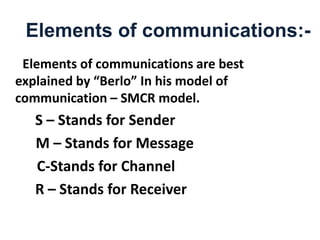
Elements of communications:-
Elements of communications are best
explained by “Berlo” In his model of
communication – SMCR model.
S – Stands for Sender
M – Stands for Message
C-Stands for Channel
R – Stands for Receiver
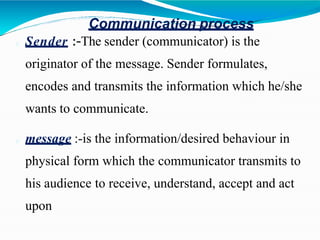
Communication process
Sender :-The sender (communicator) is the
originator of the message. Sender formulates,
encodes and transmits the information which he/she
wants to communicate.
message :-is the information/desired behaviour in
physical form which the communicator transmits to
his audience to receive, understand, accept and act
upon
Channel
The medium used to convey the message is
the channel.
Face to face interaction is more effective than
telephonic or written message.
Communication process
CONT>>>>>
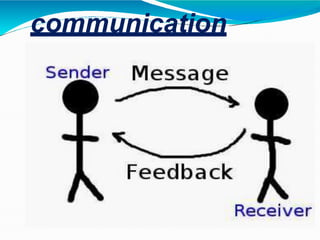
Receiver:-Who receives messages from the
sender, decoding, interprets the meaning and
giving feedback.
Feed back :- It is the flow of information
from receiver to the sender, the reaction to
the message.
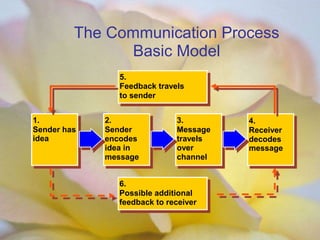
The Communication Process
Basic Model
2.
Sender
encodes
idea in
message
3.
Message
travels
over
channel
1.
Sender has
idea
4.
Receiver
decodes
message
6.
Possible additional
feedback to receiver
5.
Feedback travels
to sender
Types of communications:-
Types of communication based on
the communication channel:-
a. Verbal Communication :-
-It is an exchange of
informations using words and
includes both the spoken and written
word.
- Verbal is further divided in to 2
types:-
1) Oral
2) written
Verbal communication
1. Write:-
• Directives :- are administrative order orgives
instruction
• Manuals of operation :- writtenprocedure
and technique are develop in each
department and kept on file as drug formula
and diet manual
Reports and record :-as patient record,
personnel records and administrative reports
Requisition :- requisitionfor equipment
and supplies
1.Oral communication:-
• In oral communication spoken words are used.
It includes face-to-face conversations, speech,
telephonic conversation, video, radio,
television, voice over internet.
Advantages of Oral communication:-
It brings quick feedback.
In a face-to-face conversation, by facial
expression and body language one can
understand easily.
Disadvantages:-
In this user is unable to deeply think about
what he delivering.
2.Written communication:-
• In written communication, written signs or
symbols are used to communicate. A written
message may be printed or hand written. In
written communication message can be
transmitted via email, letter, report, Message
etc.
Advantages:-
Message can be edited and revised many time
before it is actually sent.
A written message enables receiver to fully
understand it and send appropriate feedback.
Disadvantages:-
It does not bring instant feedback.
It take more time in composing a written
message.
b.Nonverbal communications:-
It is sending or receiving of wordless messages. We
can say that communication other than oral and
written, such as gesture, body language, posture,
tone of voice or facial expressions, is called
nonverbal communication.
Types of communication based on purpose and
style:-
a.Formal communication:-
 It is the communication between officials on various
positions in any organization or institutions.
 e.g-between nursing superitendent and staff nurse.
b.Informal communication:-
 It is the communication between two people,
may be in social system.
 It is just a casual or informal talk.
 E.g.-Interaction between two friends.
Barriers of communication:-
If nurse does not give importance to the factors affecting
communications and communication skills, these all will be
considered as the barriers of communications.
Following points also interfere to communication process:-
 Excessive questioning –It place too much pressure on the
client and is upsetting particularly when more than one
question is asked at a time.
 Making judgment –It labels a client as good or bad and
doesn’t accept him as individual. A client needs to be
encouraged to make independent decision.
 Giving position –It takes decision making away from the
client. Often a client simply needs an opportunity to
express feelings, giving opinion the client from developing
solutions to problem. At times client may require
suggestion.
cont…
 Offering false assurance –It is not factual
information that makes the nurse feel good, but
may harm the client’s feelings. Truthful
reassurance is important and helps a client self
worth and sense of hope.
 Using highly emotional words –(Angry,
crazy,guilty) these should be avoided becoz
many clients will not admit to having these
strong feelings.
 Focusing on self –It is one way, some nurses
maintain distance from client.
Other physiological and environmental
barriers are:-
Physiological Barriers:-
- Difficulty in hearing
- Difficulty in vision
Environmental Barriers:-
- Lack of light
- Extreme temperature
- Extreme noise
- Lack of privacy
Skills for effective communications:-
In order to communicate effectively one should have
following skills :-
Confidence:-
 It is very important for developing and maintaining a trust with
others. Nurse will be confident if she has upto date
knowledge, skillful and as well as having the self concepts.
Critical Thinker:-
 Nurse must have this quality for the effective communication.
 She must collect the information, analyze it, then interpret it.
 Nurse must think critically about the message wants to
communicate.
Analytical:-
 It means ability to examine the impact of message on listener/
receipients. For effective communication, nurse must be able
to examine the verbal & nonverbal response of client.
Cont…Active Listener:-
 It is the best quality of a good communicator. This can be
done by nodding the head, maintaining eye contact,
saying “yes” / “no” in between the conversation.
Empathetic:-
 Empathy means perceiving the client’s feelings.
 Being empathetic enable the nurse to help the client,
Simultaneously client also develop trust on the nurse.
Honest:-
 Honesty is the very important in any of the communication
whether it is formal, informal, inter personal or intra personal.
 Knowledgeble:-
 Having a professional knowledge, is important skill in effective
communication.
 Knowledge regarding what to ask and how to ask is also
essential.
 Systematic:-
 Being systematic is important because good communicators tend
to seek and provide information in an organized and focused way.
To deal with stress during
communication:
1. Recognize when you’re becoming stressed.
2. Take a moment to calmdown
3. Bring your senses to the rescue and
quickly manage stress by taking a few
deep breaths
4. Look for humor in the situation.
Effect on use communication
skill at Different level
1.Nurse – nurse
2.Nurse –superiors
3.Nurse - subordinates
4.Nurse – client
1. Reduce conflicts
2. It is for the delivery of quality and safe
care
3. Depends on the type of care practices
,nurses needs to handover reports of
client to next person involved.
Nurse – nurse
The nurse manager ,doctors and
specialist are the to the nurses by the
virtue of hierarchical level in the
organization, it means that Each
Member Should Maintain Respect
Nurse –supervisor
subordinates means the juniors, aids
or other hospital assistance
much of the communication at
this level is for directing and
delegation the work
Nurse - subordinates
1 It is the core of nursing services
2Needs to be aware about different levels or age group of
the client
3Choose appropriate mode of communication to
convey message
Should be aware that what can be communicatedand
what should be kept confidential
Nurse - client
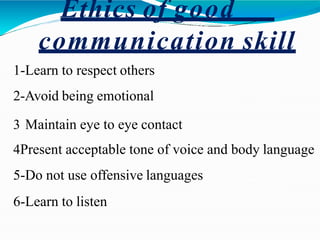
Ethics of good
communication skill
1-Learn to respect others
2-Avoid being emotional
3 Maintain eye to eye contact
4Present acceptable tone of voice and body language
5-Do not use offensive languages
6-Learn to listen
Effectivecommunicationskill

Effectivecommunicationskill

  • 2.
    COMMUNICATION  Communication isthe basic element of human interactions that allows nurses to establish, maintain and improve contacts with others.  Communication is “a process by which two or more people exchange ideas, facts, feelings or impressions in ways that each gains a ‘common understanding’ of meaning, intent and use of a message.
  • 3.
    CONT>>>>> Increases in nursingcommunication can lessen medical errors and make a difference in positive patient outcomes. to enhance and standardize communication. According to Ros Wright, “increased recovery rates, a sense of safety and protection, improved levels of patient satisfaction and greater adherence totreatment options” as well-documented results of effective communication
  • 4.
    Purpose of communicationin nursing 1. To exchange information between nursing personnel As nursing report at end of shift to personal comingon duty 2. To initiate action as to initiate nursing care be the issue of doctor order 3. To interpret or explain as interpret or explain techniques and procedure through the use of nursing procedure manuals 4. To solve problem
  • 5.
  • 6.
    Elements of communications:- Elementsof communications are best explained by “Berlo” In his model of communication – SMCR model. S – Stands for Sender M – Stands for Message C-Stands for Channel R – Stands for Receiver
  • 7.
    Communication process Sender :-Thesender (communicator) is the originator of the message. Sender formulates, encodes and transmits the information which he/she wants to communicate. message :-is the information/desired behaviour in physical form which the communicator transmits to his audience to receive, understand, accept and act upon
  • 8.
    Channel The medium usedto convey the message is the channel. Face to face interaction is more effective than telephonic or written message.
  • 9.
    Communication process CONT>>>>> Receiver:-Who receivesmessages from the sender, decoding, interprets the meaning and giving feedback. Feed back :- It is the flow of information from receiver to the sender, the reaction to the message.
  • 10.
    The Communication Process BasicModel 2. Sender encodes idea in message 3. Message travels over channel 1. Sender has idea 4. Receiver decodes message 6. Possible additional feedback to receiver 5. Feedback travels to sender
  • 11.
    Types of communications:- Typesof communication based on the communication channel:- a. Verbal Communication :- -It is an exchange of informations using words and includes both the spoken and written word. - Verbal is further divided in to 2 types:- 1) Oral 2) written
  • 12.
    Verbal communication 1. Write:- •Directives :- are administrative order orgives instruction • Manuals of operation :- writtenprocedure and technique are develop in each department and kept on file as drug formula and diet manual
  • 13.
    Reports and record:-as patient record, personnel records and administrative reports Requisition :- requisitionfor equipment and supplies
  • 14.
    1.Oral communication:- • Inoral communication spoken words are used. It includes face-to-face conversations, speech, telephonic conversation, video, radio, television, voice over internet. Advantages of Oral communication:- It brings quick feedback. In a face-to-face conversation, by facial expression and body language one can understand easily. Disadvantages:- In this user is unable to deeply think about what he delivering.
  • 15.
    2.Written communication:- • Inwritten communication, written signs or symbols are used to communicate. A written message may be printed or hand written. In written communication message can be transmitted via email, letter, report, Message etc. Advantages:- Message can be edited and revised many time before it is actually sent. A written message enables receiver to fully understand it and send appropriate feedback. Disadvantages:- It does not bring instant feedback. It take more time in composing a written message.
  • 16.
    b.Nonverbal communications:- It issending or receiving of wordless messages. We can say that communication other than oral and written, such as gesture, body language, posture, tone of voice or facial expressions, is called nonverbal communication. Types of communication based on purpose and style:- a.Formal communication:-  It is the communication between officials on various positions in any organization or institutions.  e.g-between nursing superitendent and staff nurse.
  • 17.
    b.Informal communication:-  Itis the communication between two people, may be in social system.  It is just a casual or informal talk.  E.g.-Interaction between two friends.
  • 18.
    Barriers of communication:- Ifnurse does not give importance to the factors affecting communications and communication skills, these all will be considered as the barriers of communications. Following points also interfere to communication process:-  Excessive questioning –It place too much pressure on the client and is upsetting particularly when more than one question is asked at a time.  Making judgment –It labels a client as good or bad and doesn’t accept him as individual. A client needs to be encouraged to make independent decision.  Giving position –It takes decision making away from the client. Often a client simply needs an opportunity to express feelings, giving opinion the client from developing solutions to problem. At times client may require suggestion.
  • 19.
    cont…  Offering falseassurance –It is not factual information that makes the nurse feel good, but may harm the client’s feelings. Truthful reassurance is important and helps a client self worth and sense of hope.  Using highly emotional words –(Angry, crazy,guilty) these should be avoided becoz many clients will not admit to having these strong feelings.  Focusing on self –It is one way, some nurses maintain distance from client.
  • 20.
    Other physiological andenvironmental barriers are:- Physiological Barriers:- - Difficulty in hearing - Difficulty in vision Environmental Barriers:- - Lack of light - Extreme temperature - Extreme noise - Lack of privacy
  • 21.
    Skills for effectivecommunications:- In order to communicate effectively one should have following skills :- Confidence:-  It is very important for developing and maintaining a trust with others. Nurse will be confident if she has upto date knowledge, skillful and as well as having the self concepts. Critical Thinker:-  Nurse must have this quality for the effective communication.  She must collect the information, analyze it, then interpret it.  Nurse must think critically about the message wants to communicate. Analytical:-  It means ability to examine the impact of message on listener/ receipients. For effective communication, nurse must be able to examine the verbal & nonverbal response of client.
  • 22.
    Cont…Active Listener:-  Itis the best quality of a good communicator. This can be done by nodding the head, maintaining eye contact, saying “yes” / “no” in between the conversation. Empathetic:-  Empathy means perceiving the client’s feelings.  Being empathetic enable the nurse to help the client, Simultaneously client also develop trust on the nurse. Honest:-  Honesty is the very important in any of the communication whether it is formal, informal, inter personal or intra personal.  Knowledgeble:-  Having a professional knowledge, is important skill in effective communication.  Knowledge regarding what to ask and how to ask is also essential.  Systematic:-  Being systematic is important because good communicators tend to seek and provide information in an organized and focused way.
  • 23.
    To deal withstress during communication: 1. Recognize when you’re becoming stressed. 2. Take a moment to calmdown 3. Bring your senses to the rescue and quickly manage stress by taking a few deep breaths 4. Look for humor in the situation.
  • 24.
    Effect on usecommunication skill at Different level 1.Nurse – nurse 2.Nurse –superiors 3.Nurse - subordinates 4.Nurse – client
  • 25.
    1. Reduce conflicts 2.It is for the delivery of quality and safe care 3. Depends on the type of care practices ,nurses needs to handover reports of client to next person involved. Nurse – nurse
  • 26.
    The nurse manager,doctors and specialist are the to the nurses by the virtue of hierarchical level in the organization, it means that Each Member Should Maintain Respect Nurse –supervisor
  • 27.
    subordinates means thejuniors, aids or other hospital assistance much of the communication at this level is for directing and delegation the work Nurse - subordinates
  • 28.
    1 It isthe core of nursing services 2Needs to be aware about different levels or age group of the client 3Choose appropriate mode of communication to convey message Should be aware that what can be communicatedand what should be kept confidential Nurse - client
  • 29.
    Ethics of good communicationskill 1-Learn to respect others 2-Avoid being emotional 3 Maintain eye to eye contact 4Present acceptable tone of voice and body language 5-Do not use offensive languages 6-Learn to listen