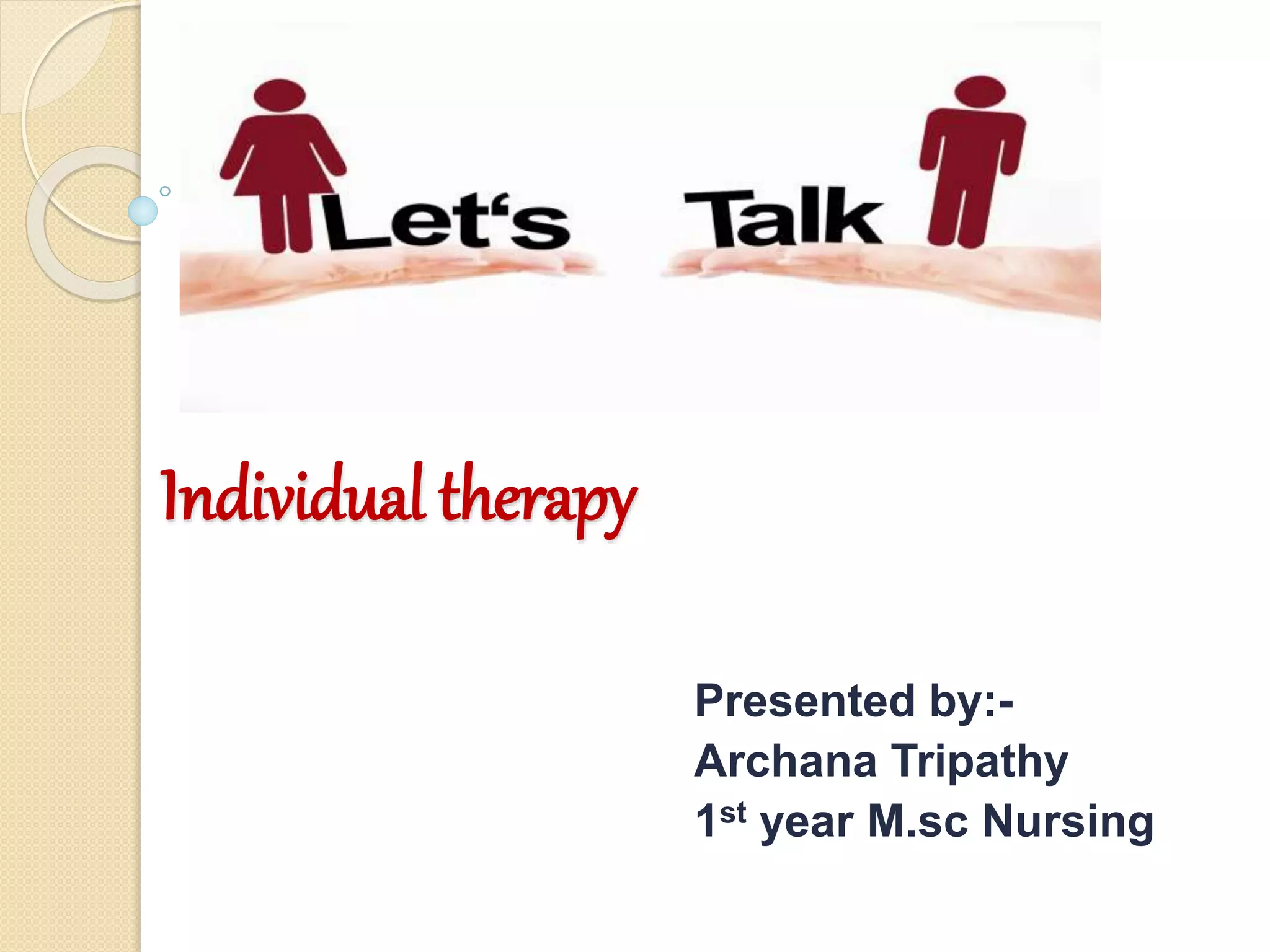
Individual therapy
Presented by:-
Archana Tripathy
1st year M.sc Nursing
INTRODUCTION
 Individual therapy is a psychotherapy
implemented by a trained professional,
usually a therapist or psychologist, to
help a client work through a problem.
 The ways that individual therapy is
implemented varies widely depending
upon the psychological problem
experienced by the client, the personal
beliefs and practices of the therapist,
and the individual needs of the client.
MEANING:-
 Individual therapy is a joint process
between a therapist and a person in
therapy. Common goals of therapy can be
to inspire change or improve quality of life.
 Individual therapy is also called
psychotherapy, psychosocial therapy, talk
therapy, and counseling.
 This therapy can help people overcome
obstacles to their well-being. It can
increase positive feelings, like self-esteem.
People in therapy can learn skills for
handling difficult situations, making healthy
decisions, and reaching goals.
DEFINITION:
 Individual therapy (sometimes called “psychotherapy”
or “counseling”) is a process through which clients
work one-on-one with a trained therapist—in a safe,
caring, and confidential environment—to
 explore their feelings, beliefs, or behaviors,
• identify aspects of their lives that they would
like to change,
•better understand themselves and others, &
•set personal goals of their life.
PURPOSE OF INDIVIDUAL
THERAPY
Therapy is conducted on one-to-one basis, i.e.
the therapist treats one patient at a time.
Such therapy helps to:-
 Understand themselves and their behaviour.
 Make personal changes.
 Improve interpersonal relationships.
 Get relief from emotional pain or unhappiness.
INDICATION OF INDIVIDUAL
THERAPY
This therapy can treat specific, diagnosable
mental health conditions such as :-
 ADHD(Attention deficit hyperactivity
disorder )
 Depression and anxiety.
 Powerful emotions or strong emotion
 Building self-esteem.
 Trauma.
 Addictions.
Cont.….
 Parent-child conflict.
 Eating and body issues.
 Stress related disorders,
 alcohol and drug dependence,
 sexual disorders and
 Marital disharmony.
TYPES OF INDIVIDUAL PSYCHOTHERAPY
1. Psychoanalysis-
Psychoanalytical therapy was developed by Sigmund
Freud.
It focus on unconscious forces such as repressed
emotions & memories, internal conflicts & childhood
trauma on mental life & adjustment of the individual.
The aim of therapy is to bring all repressed emotions
and experiences to conscious awareness, so that the
patient can work towards a healthy resolution of his
problems, which are causing the symptoms.
Cont…
 Psychotherapy is used primarily in
bringing about basic modification in the
personality. This is done by establishing a
constructive therapeutic relationship.
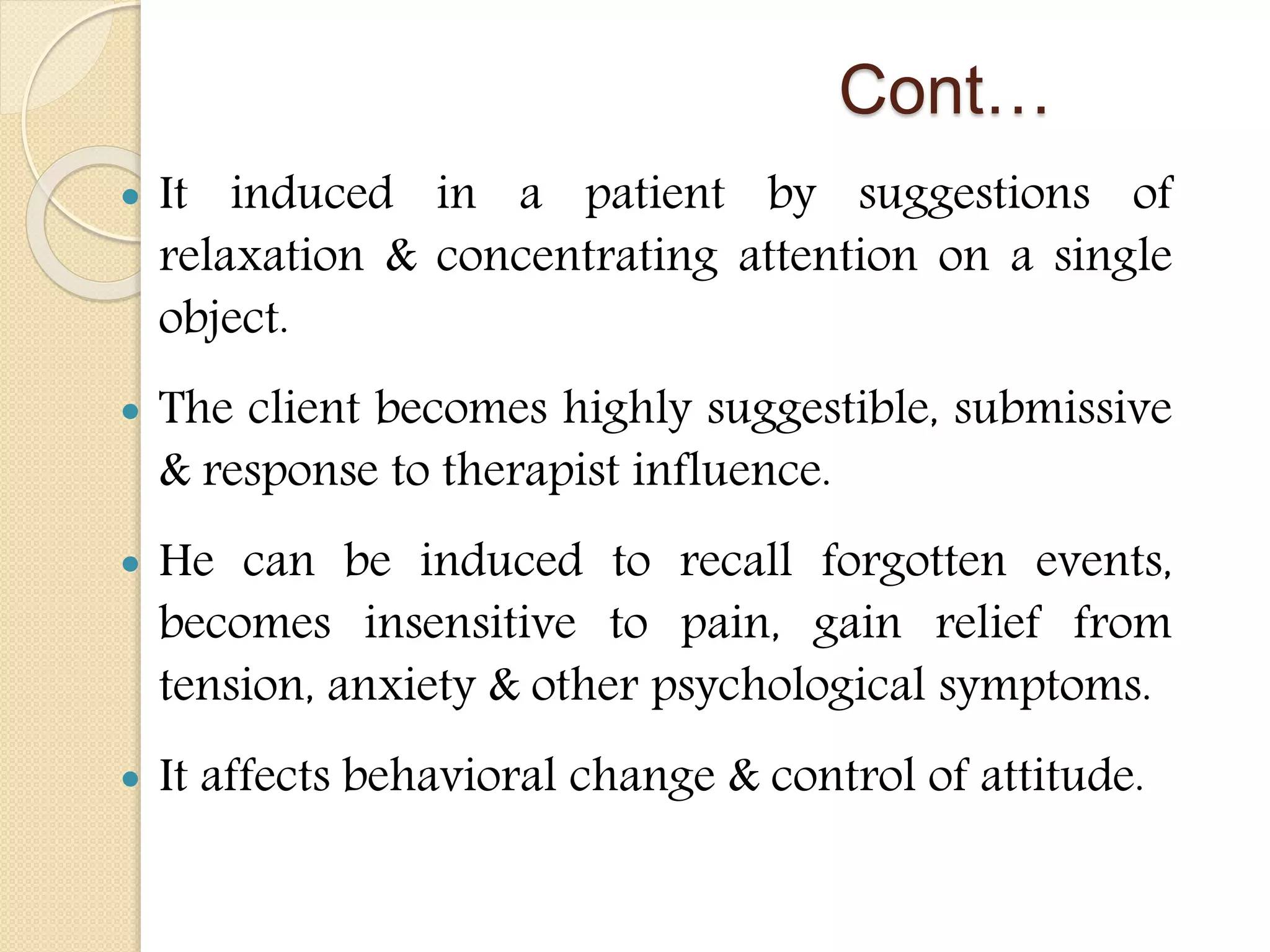
2. Hypnosis-
 the induction of a state of
consciousness in which a person
apparently loses the power of
voluntary action and is highly
responsive to suggestion or
direction. Its use in therapy,
typically to recover suppressed
memories or to allow modification
of behavior,
Cont…
 It induced in a patient by suggestions of
relaxation & concentrating attention on a single
object.
 The client becomes highly suggestible, submissive
& response to therapist influence.
 He can be induced to recall forgotten events,
becomes insensitive to pain, gain relief from
tension, anxiety & other psychological symptoms.
 It affects behavioral change & control of attitude.
Changes that occur during
hypnosis:
The person becomes highly suggestible to
the commands of the therapist.
There is an ability to produce or remove
symptoms or perceptions.
Amnesia for the events that occurred during
the hypnotic state.
3. Abreaction-
 Abreaction is a process by which repressed
material, particularly a painful experience or
conflict is brought back to consciousness.
 Abreaction, the dramatic reliving of traumatic
events under hypnosis, is a powerful
therapeutic intervention useful in the
treatment of victims of trauma.
 It is most useful in acute neurotic conditions
caused by extreme stress (Posttraumatic
Stress Disorder(PTSD) like terrorist
incidents, serious accidents, or physical or
sexual assault in adult or childhood, etc).
Cont…
METHODS:-
 Abreaction can be brought about by
strong encouragement to relieve the
stressful events.
 The procedure is begun with neutral
topics at first, & gradually approaches
area of conflict.
 Abreaction can be done with or
without the use of medication.
4. Reality therapy-
 Reality therapy (RT) is an approach to
psychotherapy and counseling, Developed by
William Glasser in the 1960s.
 This is a psycho therapeutic technique which focuses on the
present behavior & development of patient’s ability to cope with
the stress of reality & take a greater responsibility for the
fulfillment of his needs.
CONT…
 To achieve these purposes the therapist
becomes involved in an active
relationship with patient, rejects his
unrealistic behavior & teaches better
ways to meet his need in the real world.
 The patient need to be stressed on that
the past cannot be changed, so he must
take responsibility of right or wrong
actions of present.
5. Uncovering-
 This technique is used to break through the
patient’s repressed conflict and The patient
explores different methods to cope with problem.
It helps the patient in gaining an insight.
 The patient explores different methods to cope
with problem, once he gain an insight into his
conflict or problem.
6. Supportive Psychotherapy-
 The therapist helps the patient to
relieve emotional distress.
 It is a form of “surface therapy”.
 The therapist reinforces the
existing defenses used by the
client symptoms without probing
in to past or attempting to
change or alter the basic
personality of the individual.
APPROACH OR TECHNIQUES
 There are four main approaches to individual therapy which include
psychodynamics therapy, humanistic therapy, behavioral therapy
and cognitive therapy.
A. PSYCHODYNAMICS THERAPY:-
is primarily based on psychoanalytic theory, the assumption that
when a patient has insight into early relationships and experiences as
the source of his or her problems they can be resolved.
CONT…
B.HUMANISTIC THERAPY:-
centres on the patients view of the world and his or her
problems. The goal is to help patients realize their full potential
through the therapist’s genuineness, unconditional positive regard,
which fosters the patient’s sense of self worth and empathetic
understanding of the patient’s point of view. This therapy is
nondirective but focuses on helping the patient to explore and clarify
his or her own feelings and choices.
CONT…
C. BEHAVIOUR THERAPY
does not foster awareness but emphasizes the principles of learning
with positive and negative reinforcement and observational modelling.
D. COGNITIVE THERAPY
focuses on identifying and correcting distorted thinking patterns that
can lead to emotional distress and problem behaviours. Cognitive therapists
believe that patients change their behaviours by changing their maladaptive
thinking about themselves and their experiences. Patients are taught problem
solving skills and stress reducing methods. They learn that their psychological
difficulties or problems can be solved through cognitive processing.
GOAL OF INDIVIDUAL THERAPY
In every type of psychotherapy, the psychologist will help you develop specific
goals for the therapy. This will include a broad overall goal as well
as more focused goals that may change from session to session.
 The therapist will also help you to:
A. Identify coping strategies :- These may be coping strategies that have
helped in the past. The psychologist will teach to adapt these strategies to the
current situation. If the coping strategies have been unsuccessful in the past,
the therapist will guide in the development of new ones.
Cont…
B. Rearrange life priorities:-
Sometimes people have psychological problems
because they have an irrational expectation of themselves
and others. This increases the pressure on everyone and can
lead to stress, anxiety and depression. By rearranging the
expectations and priorities you may be able to avoid
unnecessary stress.
CONT….
C. Focus on meaningful pursuits.
D. Identify personal strengths:
Sometimes during times of psychological
crisis it is easy to focus on the weaknesses and what
you do not have, instead of the strengths and the
wonderful things one do have. Psychologists will
draw the attention to positive aspects about oneself,
and help you rediscover and bring them out again.
This will help to believe in oneself.
Individual therapy

Individual therapy

  • 2.
    Individual therapy Presented by:- ArchanaTripathy 1st year M.sc Nursing
  • 3.
    INTRODUCTION  Individual therapyis a psychotherapy implemented by a trained professional, usually a therapist or psychologist, to help a client work through a problem.  The ways that individual therapy is implemented varies widely depending upon the psychological problem experienced by the client, the personal beliefs and practices of the therapist, and the individual needs of the client.
  • 4.
    MEANING:-  Individual therapyis a joint process between a therapist and a person in therapy. Common goals of therapy can be to inspire change or improve quality of life.  Individual therapy is also called psychotherapy, psychosocial therapy, talk therapy, and counseling.  This therapy can help people overcome obstacles to their well-being. It can increase positive feelings, like self-esteem. People in therapy can learn skills for handling difficult situations, making healthy decisions, and reaching goals.
  • 5.
    DEFINITION:  Individual therapy(sometimes called “psychotherapy” or “counseling”) is a process through which clients work one-on-one with a trained therapist—in a safe, caring, and confidential environment—to  explore their feelings, beliefs, or behaviors, • identify aspects of their lives that they would like to change, •better understand themselves and others, & •set personal goals of their life.
  • 6.
    PURPOSE OF INDIVIDUAL THERAPY Therapyis conducted on one-to-one basis, i.e. the therapist treats one patient at a time. Such therapy helps to:-  Understand themselves and their behaviour.  Make personal changes.  Improve interpersonal relationships.  Get relief from emotional pain or unhappiness.
  • 7.
    INDICATION OF INDIVIDUAL THERAPY Thistherapy can treat specific, diagnosable mental health conditions such as :-  ADHD(Attention deficit hyperactivity disorder )  Depression and anxiety.  Powerful emotions or strong emotion  Building self-esteem.  Trauma.  Addictions.
  • 8.
    Cont.….  Parent-child conflict. Eating and body issues.  Stress related disorders,  alcohol and drug dependence,  sexual disorders and  Marital disharmony.
  • 9.
    TYPES OF INDIVIDUALPSYCHOTHERAPY 1. Psychoanalysis- Psychoanalytical therapy was developed by Sigmund Freud. It focus on unconscious forces such as repressed emotions & memories, internal conflicts & childhood trauma on mental life & adjustment of the individual. The aim of therapy is to bring all repressed emotions and experiences to conscious awareness, so that the patient can work towards a healthy resolution of his problems, which are causing the symptoms.
  • 10.
    Cont…  Psychotherapy isused primarily in bringing about basic modification in the personality. This is done by establishing a constructive therapeutic relationship.
  • 11.
    2. Hypnosis-  theinduction of a state of consciousness in which a person apparently loses the power of voluntary action and is highly responsive to suggestion or direction. Its use in therapy, typically to recover suppressed memories or to allow modification of behavior,
  • 12.
    Cont…  It inducedin a patient by suggestions of relaxation & concentrating attention on a single object.  The client becomes highly suggestible, submissive & response to therapist influence.  He can be induced to recall forgotten events, becomes insensitive to pain, gain relief from tension, anxiety & other psychological symptoms.  It affects behavioral change & control of attitude.
  • 13.
    Changes that occurduring hypnosis: The person becomes highly suggestible to the commands of the therapist. There is an ability to produce or remove symptoms or perceptions. Amnesia for the events that occurred during the hypnotic state.
  • 14.
    3. Abreaction-  Abreactionis a process by which repressed material, particularly a painful experience or conflict is brought back to consciousness.  Abreaction, the dramatic reliving of traumatic events under hypnosis, is a powerful therapeutic intervention useful in the treatment of victims of trauma.  It is most useful in acute neurotic conditions caused by extreme stress (Posttraumatic Stress Disorder(PTSD) like terrorist incidents, serious accidents, or physical or sexual assault in adult or childhood, etc).
  • 15.
    Cont… METHODS:-  Abreaction canbe brought about by strong encouragement to relieve the stressful events.  The procedure is begun with neutral topics at first, & gradually approaches area of conflict.  Abreaction can be done with or without the use of medication.
  • 16.
    4. Reality therapy- Reality therapy (RT) is an approach to psychotherapy and counseling, Developed by William Glasser in the 1960s.  This is a psycho therapeutic technique which focuses on the present behavior & development of patient’s ability to cope with the stress of reality & take a greater responsibility for the fulfillment of his needs.
  • 17.
    CONT…  To achievethese purposes the therapist becomes involved in an active relationship with patient, rejects his unrealistic behavior & teaches better ways to meet his need in the real world.  The patient need to be stressed on that the past cannot be changed, so he must take responsibility of right or wrong actions of present.
  • 18.
    5. Uncovering-  Thistechnique is used to break through the patient’s repressed conflict and The patient explores different methods to cope with problem. It helps the patient in gaining an insight.  The patient explores different methods to cope with problem, once he gain an insight into his conflict or problem.
  • 19.
    6. Supportive Psychotherapy- The therapist helps the patient to relieve emotional distress.  It is a form of “surface therapy”.  The therapist reinforces the existing defenses used by the client symptoms without probing in to past or attempting to change or alter the basic personality of the individual.
  • 20.
    APPROACH OR TECHNIQUES There are four main approaches to individual therapy which include psychodynamics therapy, humanistic therapy, behavioral therapy and cognitive therapy. A. PSYCHODYNAMICS THERAPY:- is primarily based on psychoanalytic theory, the assumption that when a patient has insight into early relationships and experiences as the source of his or her problems they can be resolved.
  • 21.
    CONT… B.HUMANISTIC THERAPY:- centres onthe patients view of the world and his or her problems. The goal is to help patients realize their full potential through the therapist’s genuineness, unconditional positive regard, which fosters the patient’s sense of self worth and empathetic understanding of the patient’s point of view. This therapy is nondirective but focuses on helping the patient to explore and clarify his or her own feelings and choices.
  • 22.
    CONT… C. BEHAVIOUR THERAPY doesnot foster awareness but emphasizes the principles of learning with positive and negative reinforcement and observational modelling. D. COGNITIVE THERAPY focuses on identifying and correcting distorted thinking patterns that can lead to emotional distress and problem behaviours. Cognitive therapists believe that patients change their behaviours by changing their maladaptive thinking about themselves and their experiences. Patients are taught problem solving skills and stress reducing methods. They learn that their psychological difficulties or problems can be solved through cognitive processing.
  • 23.
    GOAL OF INDIVIDUALTHERAPY In every type of psychotherapy, the psychologist will help you develop specific goals for the therapy. This will include a broad overall goal as well as more focused goals that may change from session to session.  The therapist will also help you to: A. Identify coping strategies :- These may be coping strategies that have helped in the past. The psychologist will teach to adapt these strategies to the current situation. If the coping strategies have been unsuccessful in the past, the therapist will guide in the development of new ones.
  • 24.
    Cont… B. Rearrange lifepriorities:- Sometimes people have psychological problems because they have an irrational expectation of themselves and others. This increases the pressure on everyone and can lead to stress, anxiety and depression. By rearranging the expectations and priorities you may be able to avoid unnecessary stress.
  • 25.
    CONT…. C. Focus onmeaningful pursuits. D. Identify personal strengths: Sometimes during times of psychological crisis it is easy to focus on the weaknesses and what you do not have, instead of the strengths and the wonderful things one do have. Psychologists will draw the attention to positive aspects about oneself, and help you rediscover and bring them out again. This will help to believe in oneself.