Introduction   Stinespring Dilation Theorem   Private Quantum Codes   Connection with QEC and Beyond   Conclusion


                              On Complementarity In QEC
                              And Quantum Cryptography

                                                 David Kribs

                                            Professor & Chair
                                  Department of Mathematics & Statistics
                                          University of Guelph
                                               Associate Member
                                       Institute for Quantum Computing
                                             University of Waterloo


                                QEC II — USC — December 2011
Introduction   Stinespring Dilation Theorem   Private Quantum Codes   Connection with QEC and Beyond   Conclusion


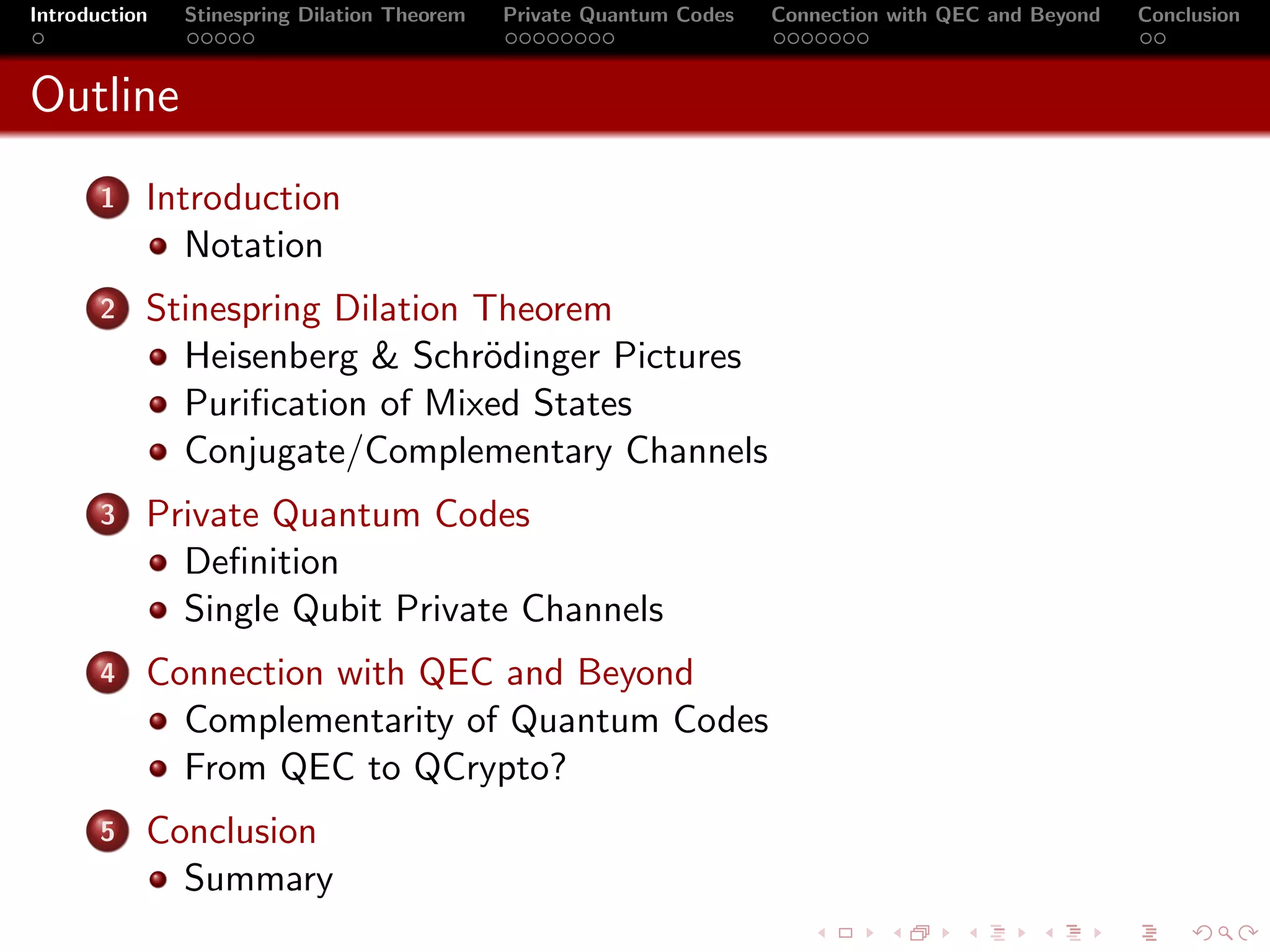
Outline
       1   Introduction
              Notation
       2   Stinespring Dilation Theorem
             Heisenberg & Schr¨dinger Pictures
                                o
             Purification of Mixed States
             Conjugate/Complementary Channels
       3   Private Quantum Codes
             Definition
             Single Qubit Private Channels
       4   Connection with QEC and Beyond
             Complementarity of Quantum Codes
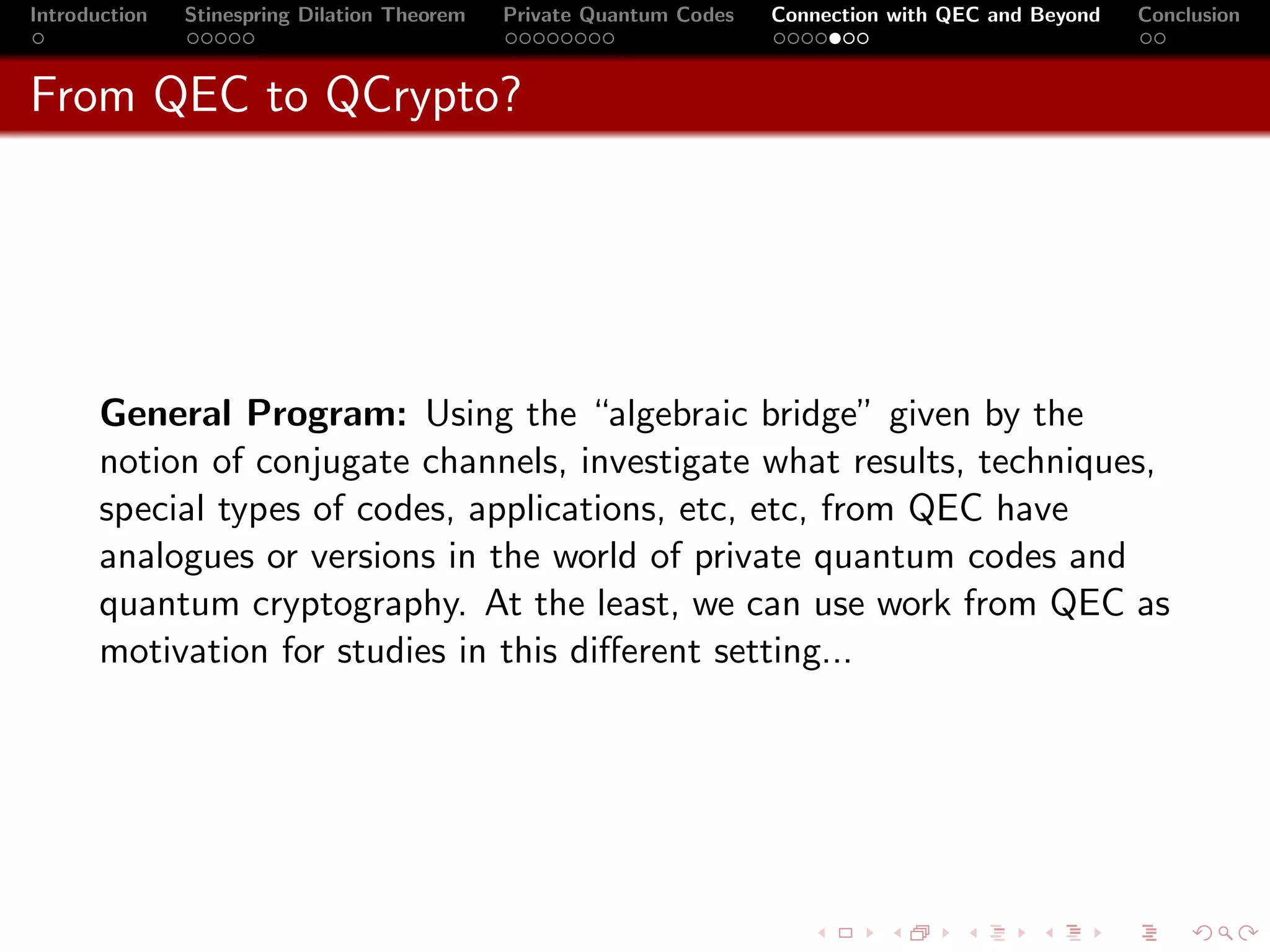
             From QEC to QCrypto?
       5   Conclusion
             Summary
Introduction   Stinespring Dilation Theorem   Private Quantum Codes   Connection with QEC and Beyond   Conclusion


Notation

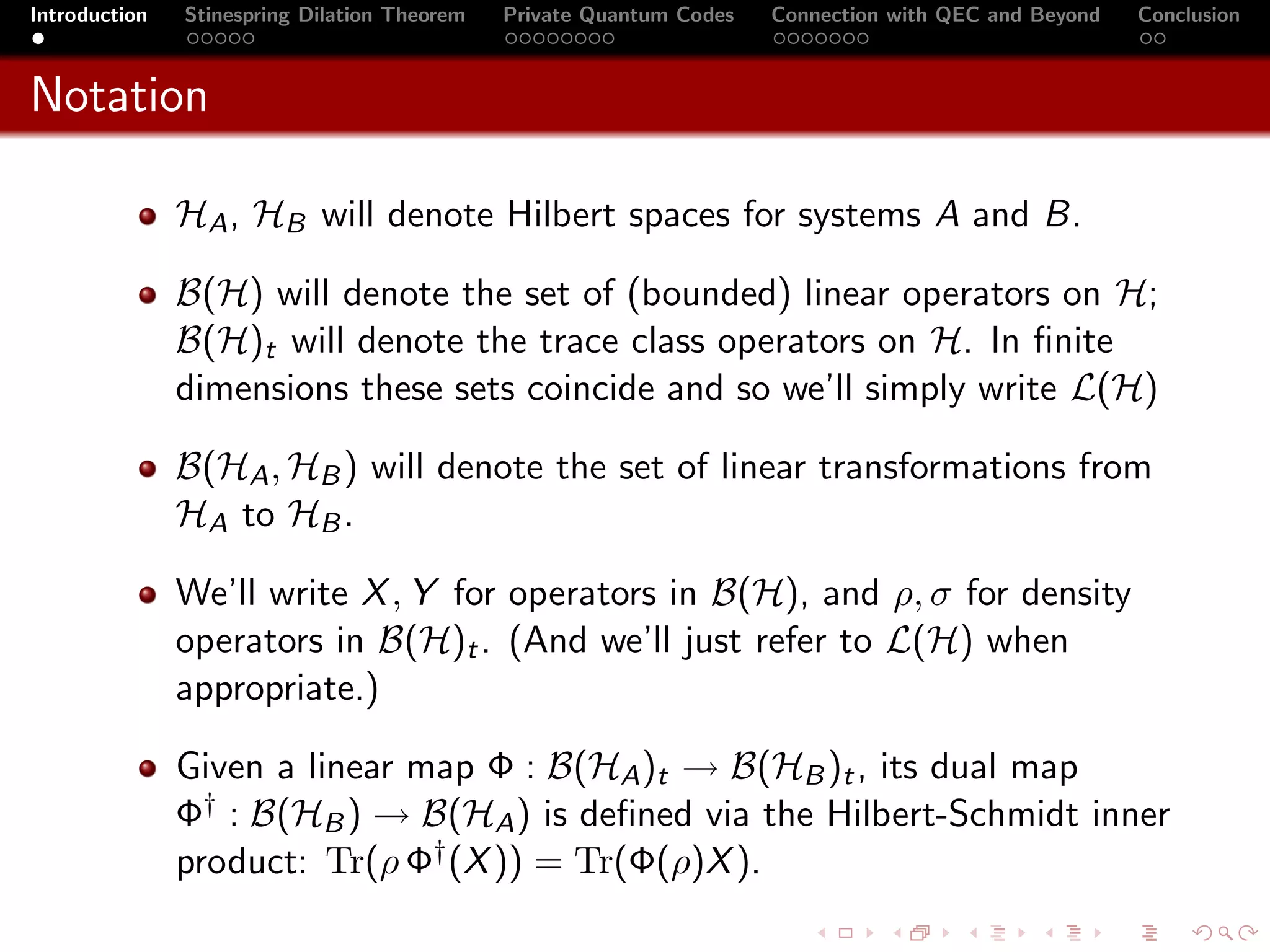
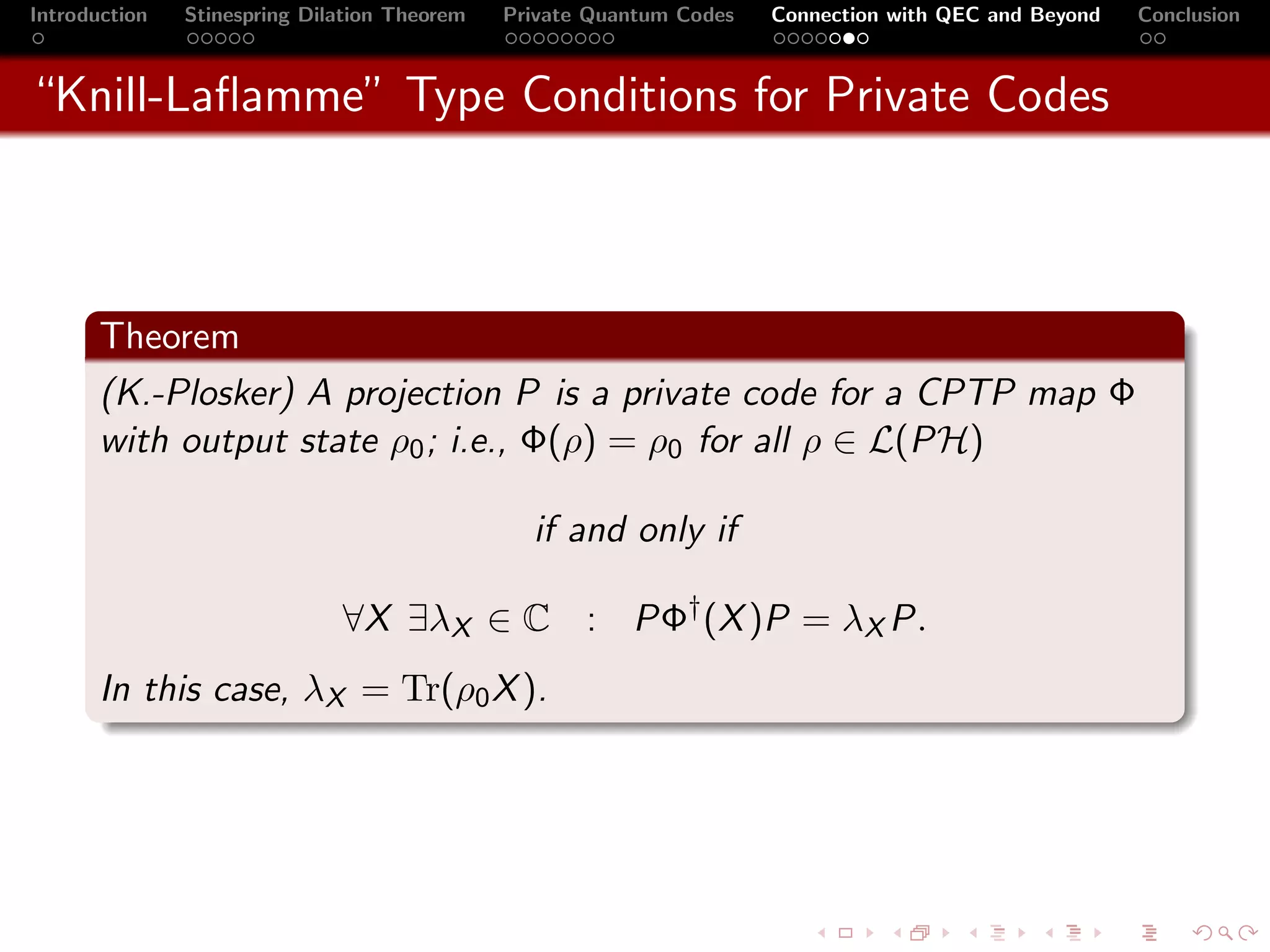
               HA , HB will denote Hilbert spaces for systems A and B.

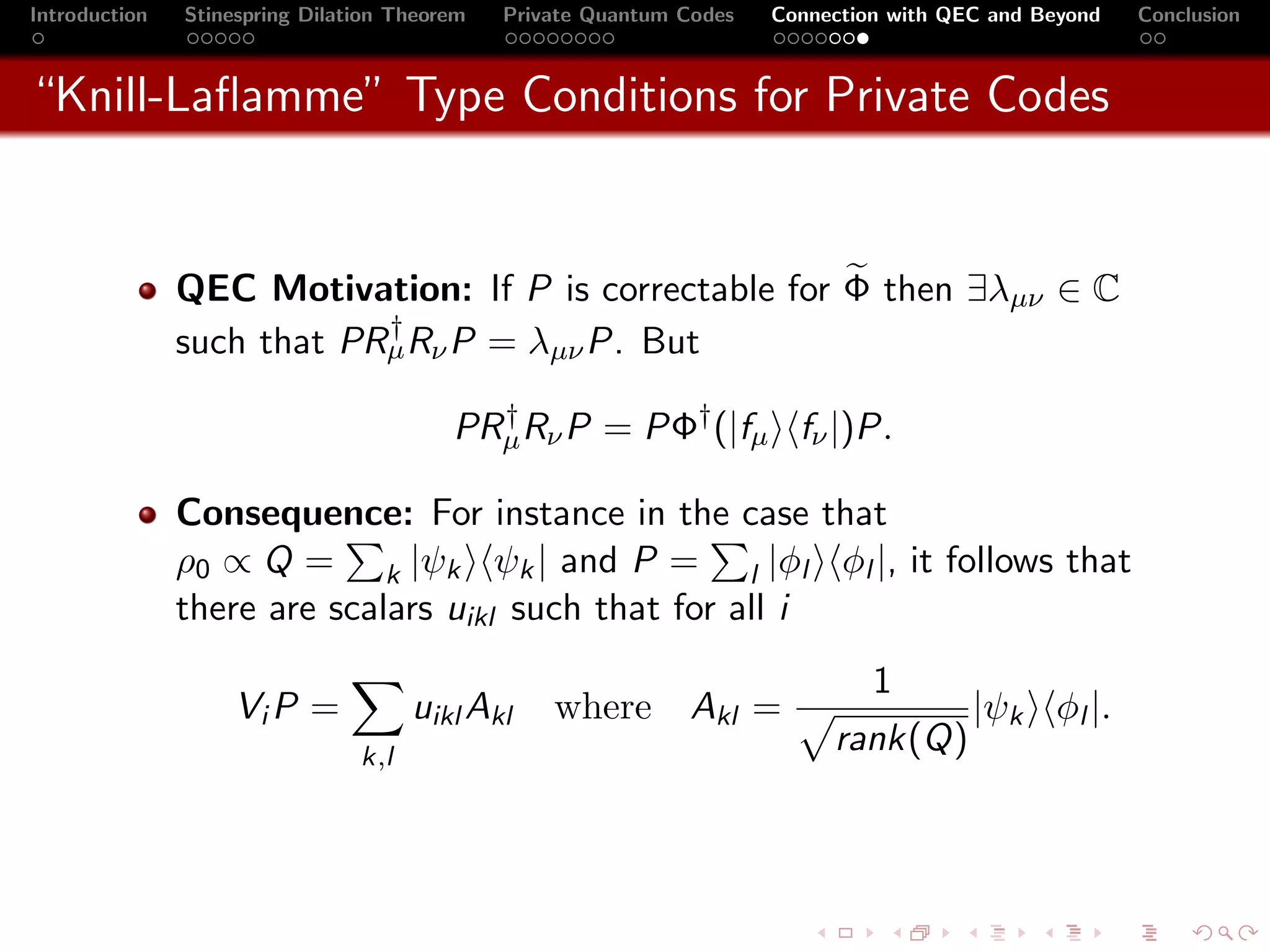
               B(H) will denote the set of (bounded) linear operators on H;
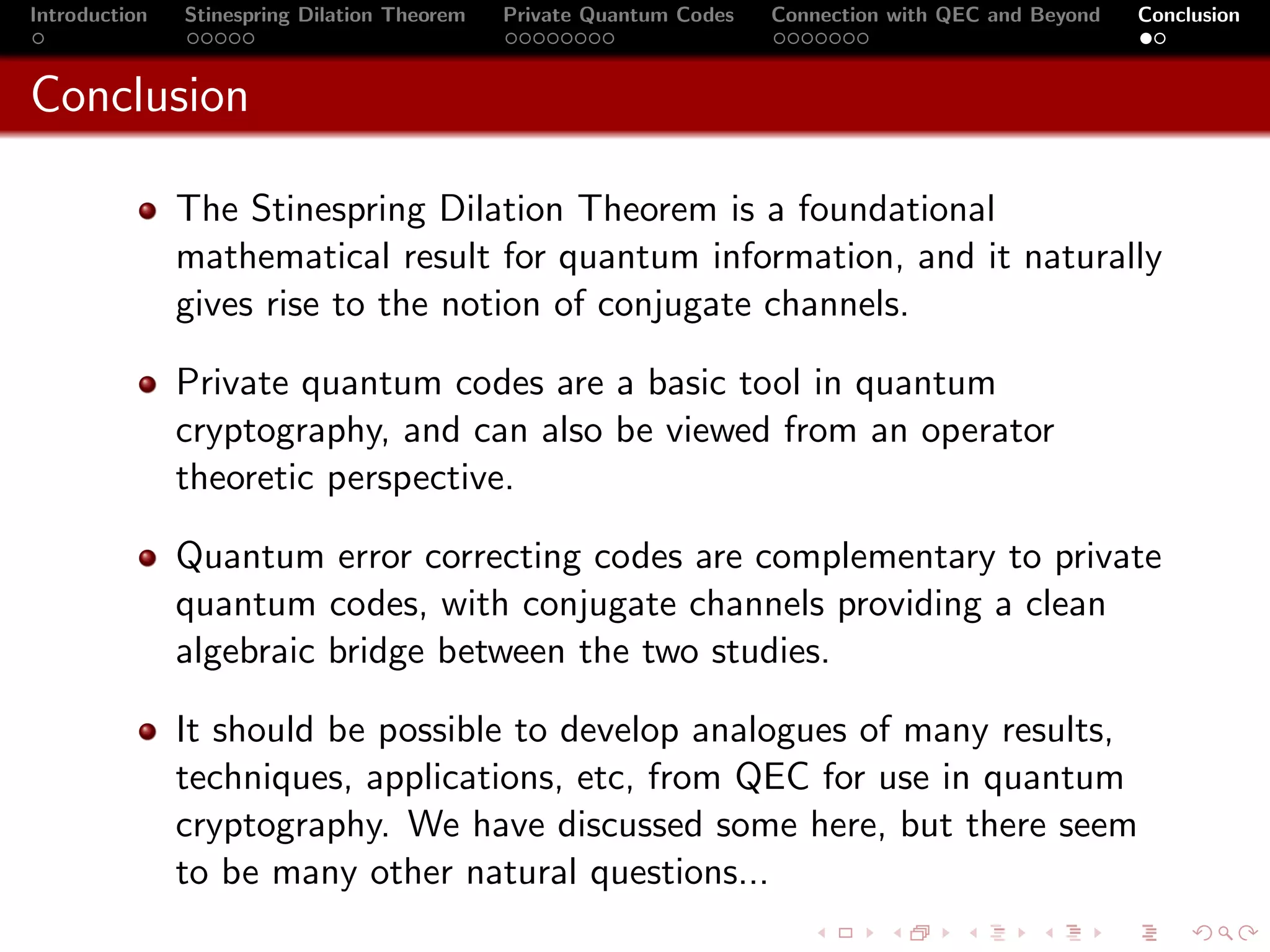
               B(H)t will denote the trace class operators on H. In finite
               dimensions these sets coincide and so we’ll simply write L(H)

               B(HA , HB ) will denote the set of linear transformations from
               HA to HB .

               We’ll write X , Y for operators in B(H), and ρ, σ for density
               operators in B(H)t . (And we’ll just refer to L(H) when
               appropriate.)

               Given a linear map Φ : B(HA )t → B(HB )t , its dual map
               Φ† : B(HB ) → B(HA ) is defined via the Hilbert-Schmidt inner
               product: Tr(ρ Φ† (X )) = Tr(Φ(ρ)X ).
Introduction   Stinespring Dilation Theorem   Private Quantum Codes   Connection with QEC and Beyond   Conclusion


Heisenberg Picture
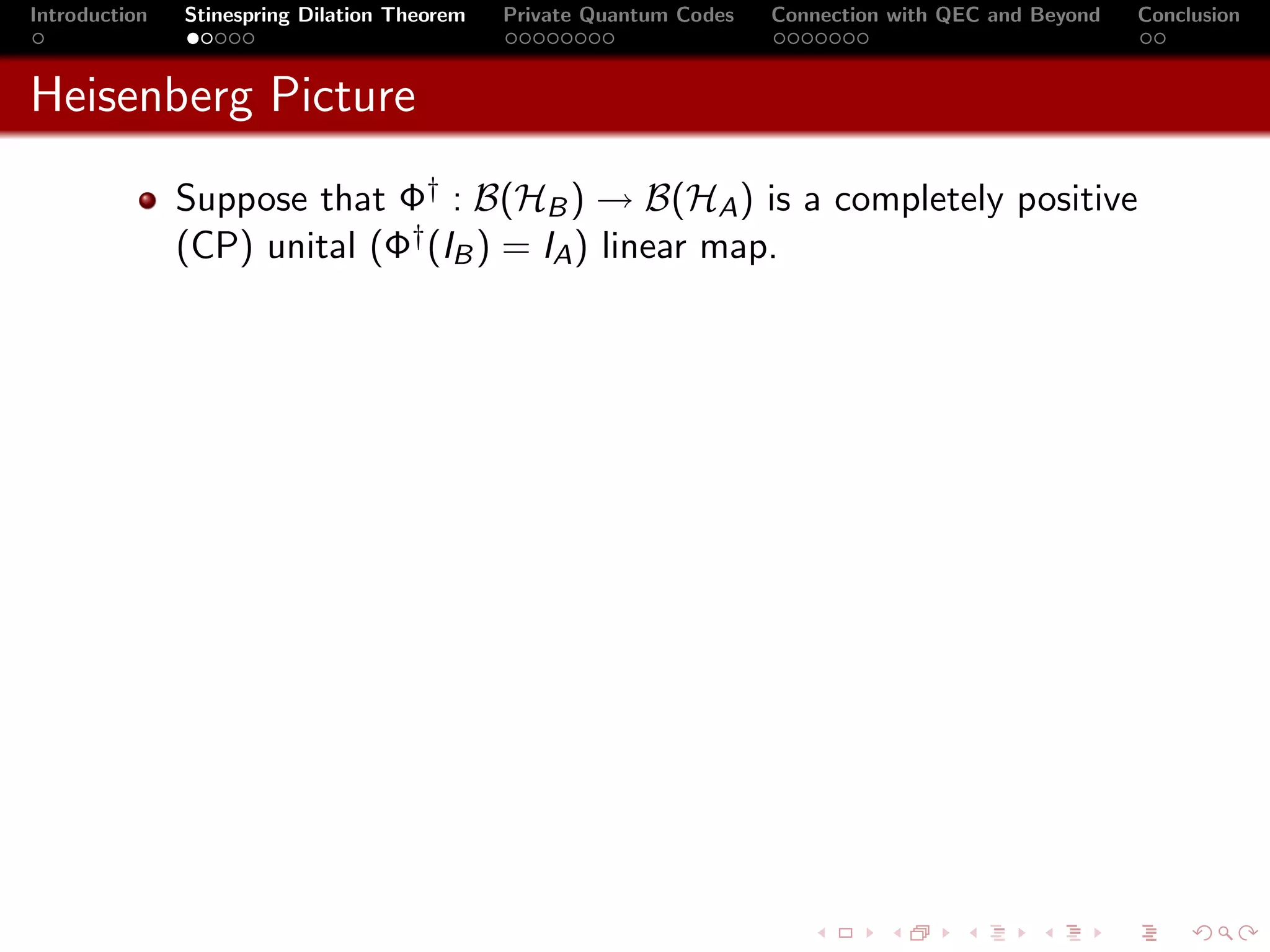
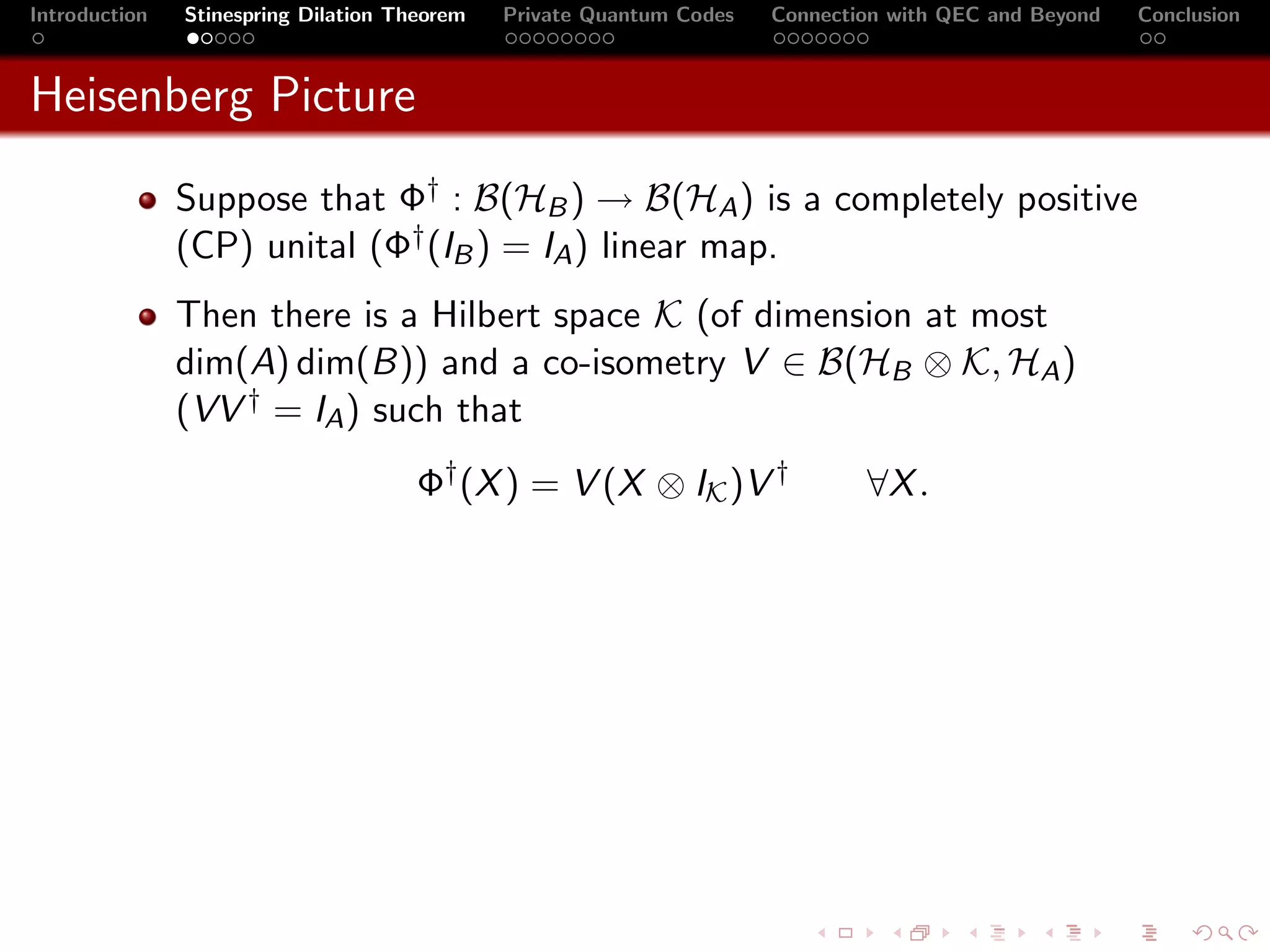
               Suppose that Φ† : B(HB ) → B(HA ) is a completely positive
               (CP) unital (Φ† (IB ) = IA ) linear map.
Introduction   Stinespring Dilation Theorem   Private Quantum Codes   Connection with QEC and Beyond   Conclusion


Heisenberg Picture
               Suppose that Φ† : B(HB ) → B(HA ) is a completely positive
               (CP) unital (Φ† (IB ) = IA ) linear map.
               Then there is a Hilbert space K (of dimension at most
               dim(A) dim(B)) and a co-isometry V ∈ B(HB ⊗ K, HA )
               (VV † = IA ) such that
                                      Φ† (X ) = V (X ⊗ IK )V †                ∀X .
Introduction   Stinespring Dilation Theorem   Private Quantum Codes   Connection with QEC and Beyond   Conclusion


Heisenberg Picture
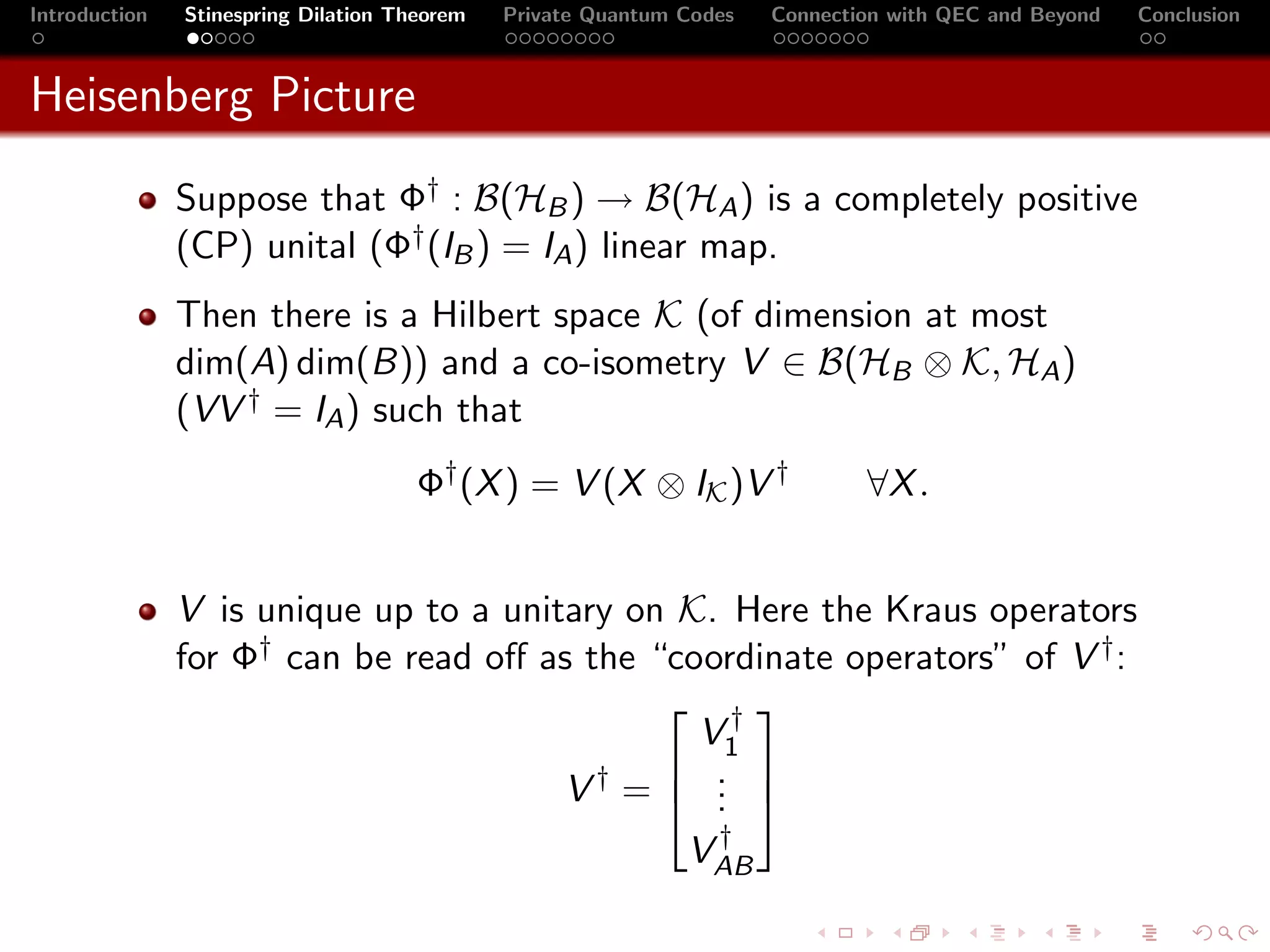
               Suppose that Φ† : B(HB ) → B(HA ) is a completely positive
               (CP) unital (Φ† (IB ) = IA ) linear map.
               Then there is a Hilbert space K (of dimension at most
               dim(A) dim(B)) and a co-isometry V ∈ B(HB ⊗ K, HA )
               (VV † = IA ) such that
                                      Φ† (X ) = V (X ⊗ IK )V †                ∀X .


               V is unique up to a unitary on K. Here the Kraus operators
               for Φ† can be read off as the “coordinate operators” of V † :
                                              †
                                               V1
                                         †    . 
                                       V = .  .
                                                               †
                                                              VAB
Introduction   Stinespring Dilation Theorem   Private Quantum Codes   Connection with QEC and Beyond   Conclusion


Schr¨dinger Picture
    o
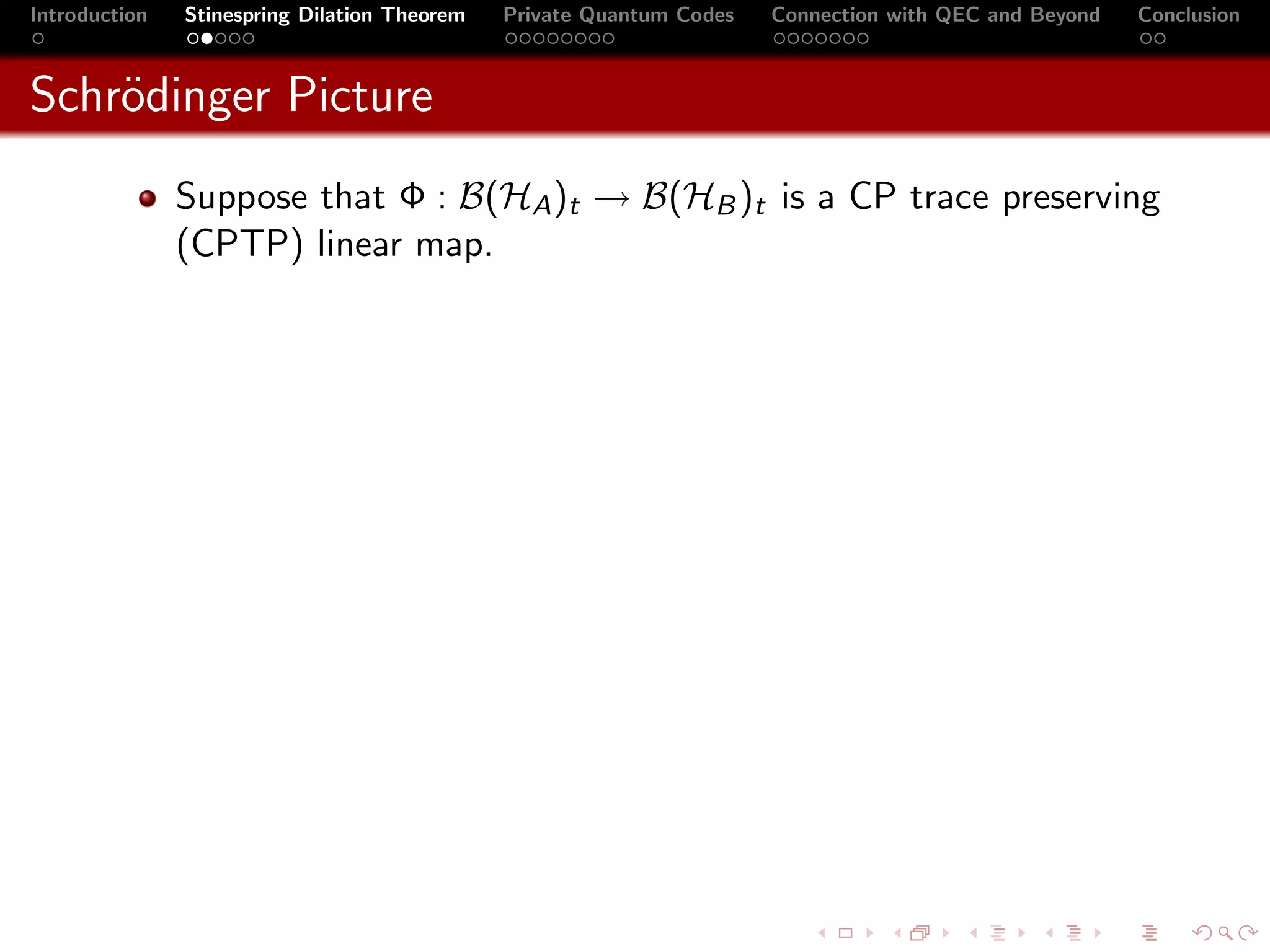
               Suppose that Φ : B(HA )t → B(HB )t is a CP trace preserving
               (CPTP) linear map.
Introduction   Stinespring Dilation Theorem   Private Quantum Codes   Connection with QEC and Beyond   Conclusion


Schr¨dinger Picture
    o
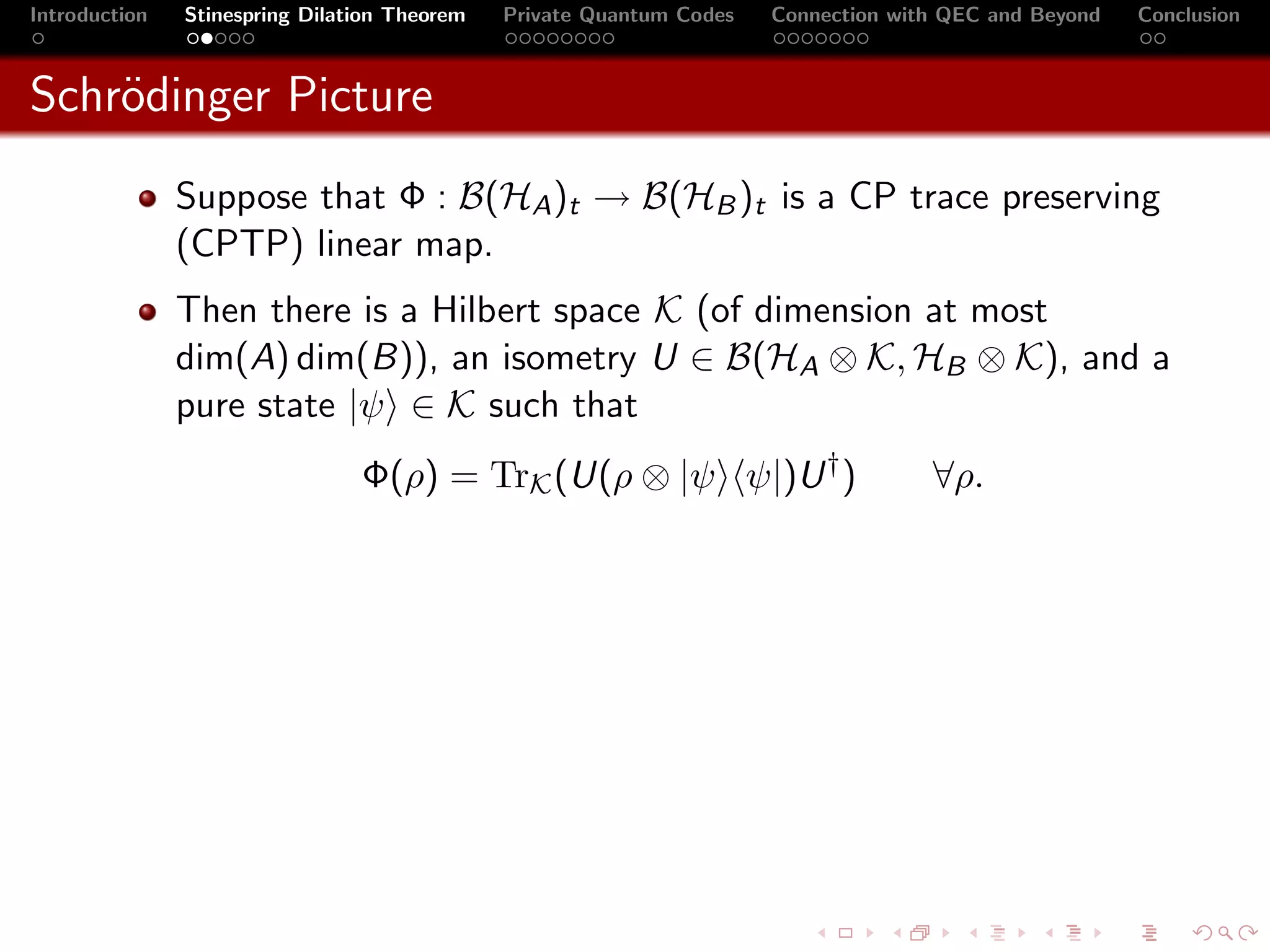
               Suppose that Φ : B(HA )t → B(HB )t is a CP trace preserving
               (CPTP) linear map.
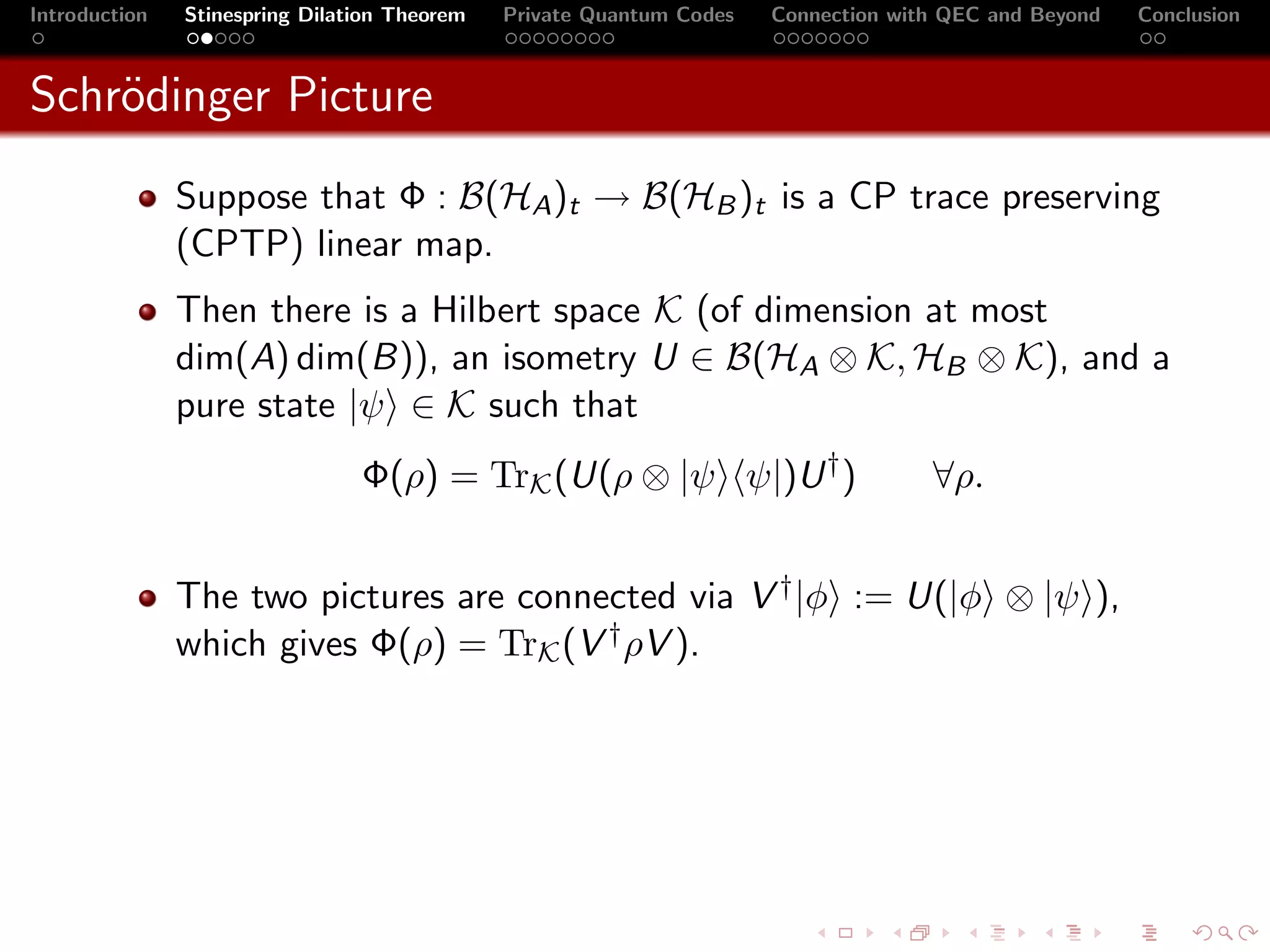
               Then there is a Hilbert space K (of dimension at most
               dim(A) dim(B)), an isometry U ∈ B(HA ⊗ K, HB ⊗ K), and a
               pure state |ψ ∈ K such that
                                Φ(ρ) = TrK (U(ρ ⊗ |ψ ψ|)U † )                       ∀ρ.
Introduction   Stinespring Dilation Theorem   Private Quantum Codes   Connection with QEC and Beyond   Conclusion


Schr¨dinger Picture
    o
               Suppose that Φ : B(HA )t → B(HB )t is a CP trace preserving
               (CPTP) linear map.
               Then there is a Hilbert space K (of dimension at most
               dim(A) dim(B)), an isometry U ∈ B(HA ⊗ K, HB ⊗ K), and a
               pure state |ψ ∈ K such that
                                Φ(ρ) = TrK (U(ρ ⊗ |ψ ψ|)U † )                       ∀ρ.


               The two pictures are connected via V † |φ := U(|φ ⊗ |ψ ),
               which gives Φ(ρ) = TrK (V † ρV ).
Introduction   Stinespring Dilation Theorem   Private Quantum Codes   Connection with QEC and Beyond   Conclusion


Schr¨dinger Picture
    o
               Suppose that Φ : B(HA )t → B(HB )t is a CP trace preserving
               (CPTP) linear map.
               Then there is a Hilbert space K (of dimension at most
               dim(A) dim(B)), an isometry U ∈ B(HA ⊗ K, HB ⊗ K), and a
               pure state |ψ ∈ K such that
                                Φ(ρ) = TrK (U(ρ ⊗ |ψ ψ|)U † )                       ∀ρ.


               The two pictures are connected via V † |φ := U(|φ ⊗ |ψ ),
               which gives Φ(ρ) = TrK (V † ρV ).
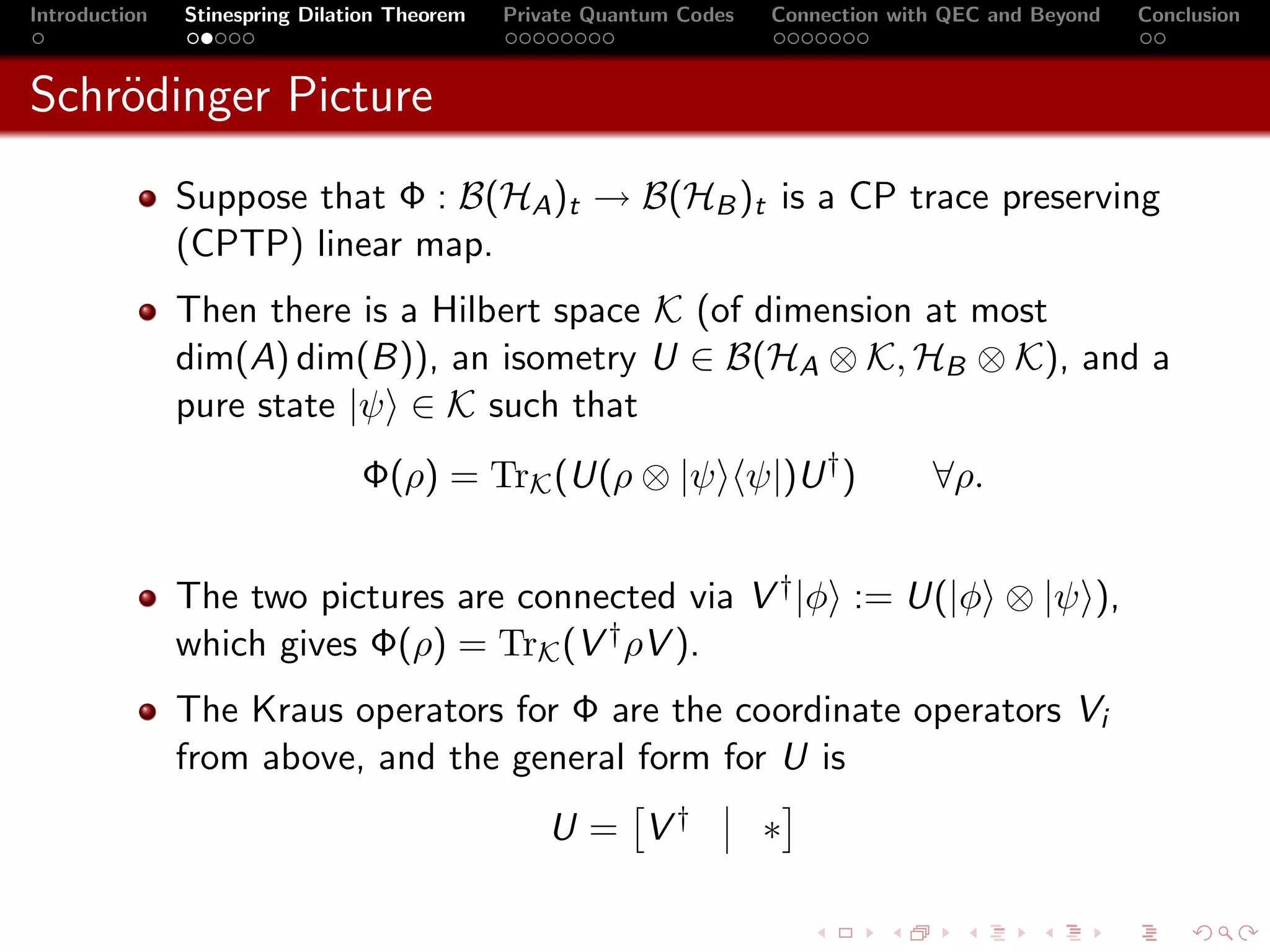
               The Kraus operators for Φ are the coordinate operators Vi
               from above, and the general form for U is
                                                  U = V†              ∗
Introduction   Stinespring Dilation Theorem   Private Quantum Codes   Connection with QEC and Beyond   Conclusion


Purification of Mixed States


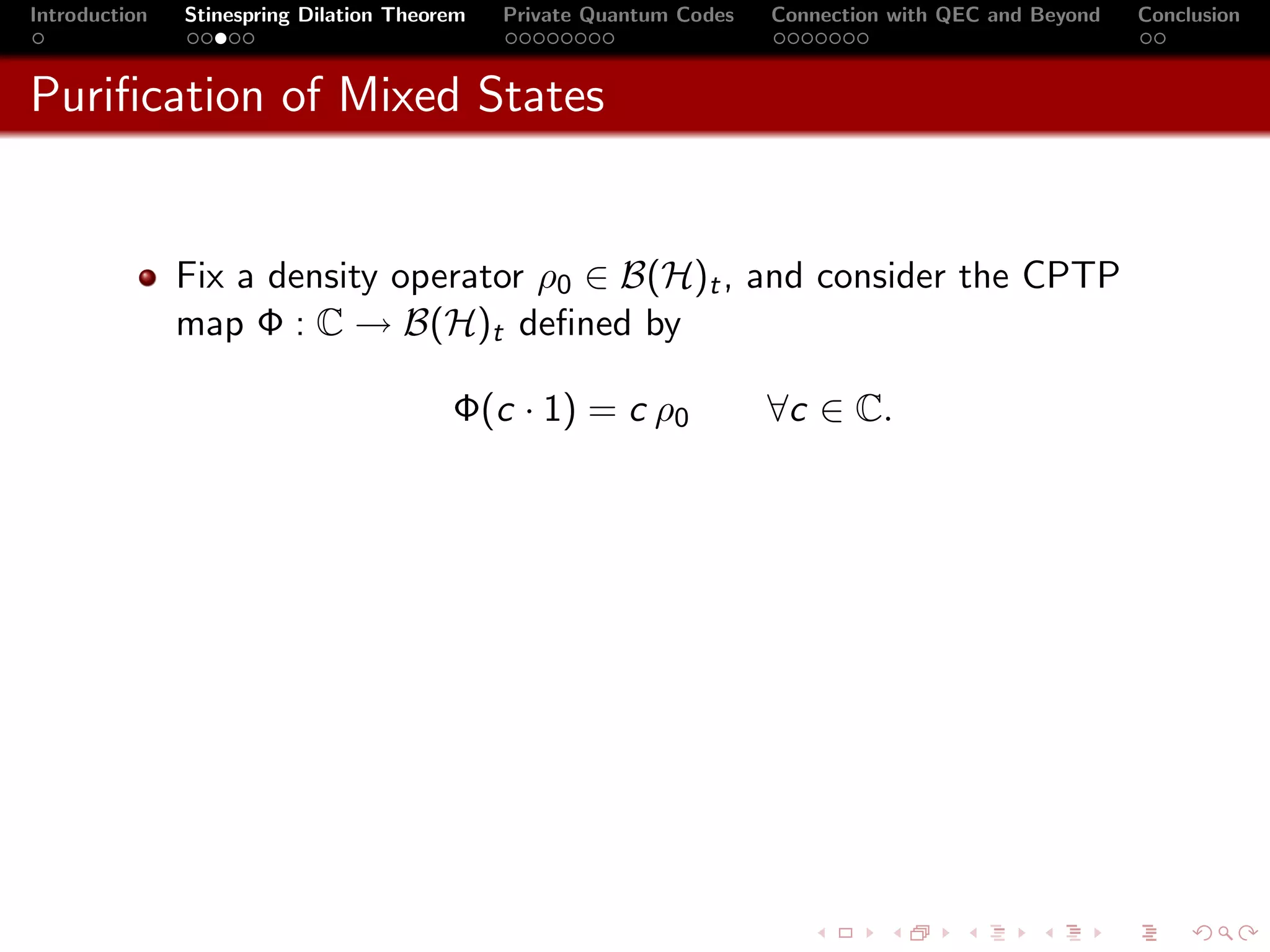
               Fix a density operator ρ0 ∈ B(H)t , and consider the CPTP
               map Φ : C → B(H)t defined by

                                         Φ(c · 1) = c ρ0              ∀c ∈ C.
Introduction   Stinespring Dilation Theorem   Private Quantum Codes   Connection with QEC and Beyond   Conclusion


Purification of Mixed States


               Fix a density operator ρ0 ∈ B(H)t , and consider the CPTP
               map Φ : C → B(H)t defined by

                                         Φ(c · 1) = c ρ0              ∀c ∈ C.


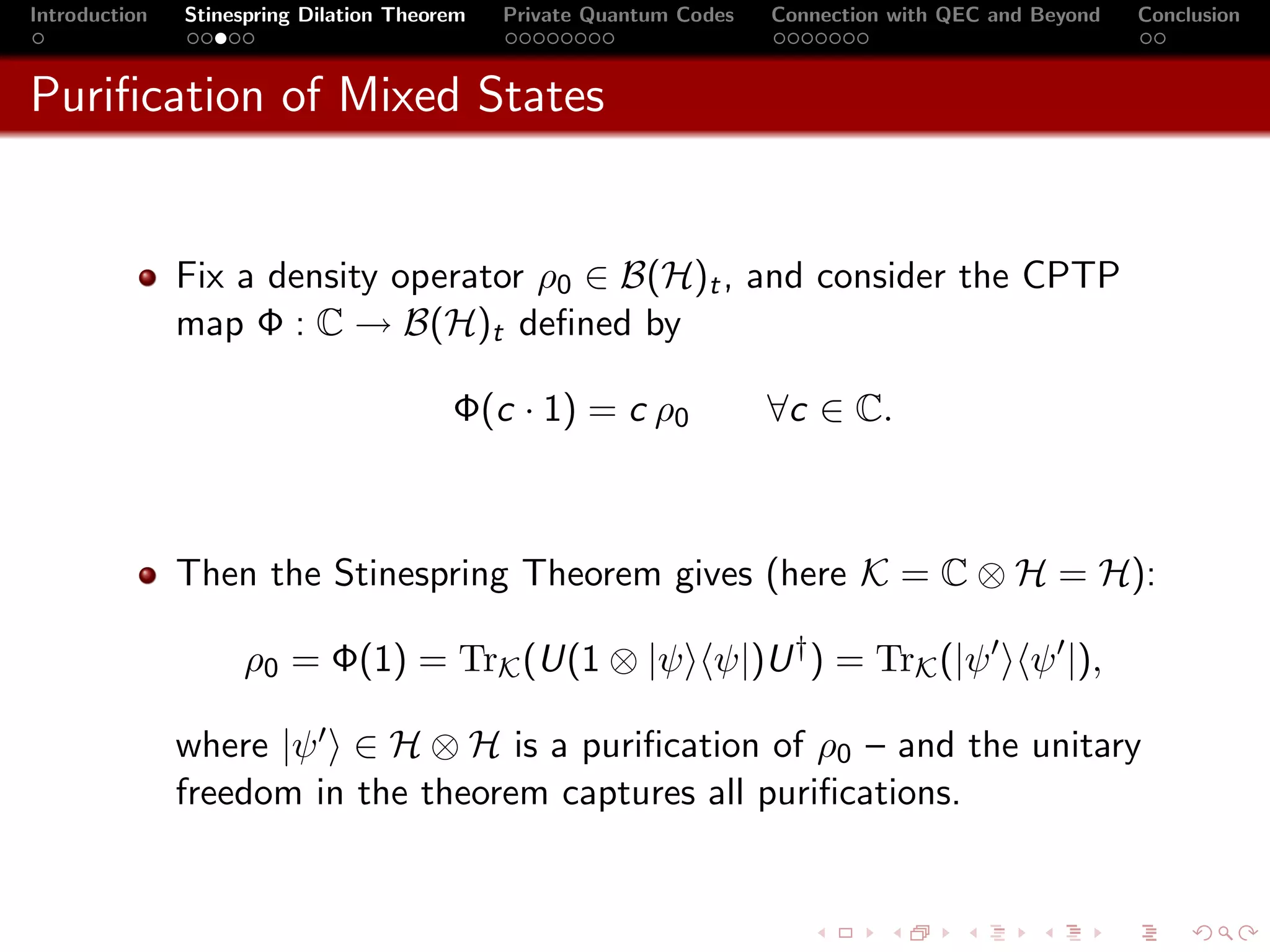
               Then the Stinespring Theorem gives (here K = C ⊗ H = H):

                    ρ0 = Φ(1) = TrK (U(1 ⊗ |ψ ψ|)U † ) = TrK (|ψ                             ψ |),

               where |ψ ∈ H ⊗ H is a purification of ρ0 – and the unitary
               freedom in the theorem captures all purifications.
Introduction   Stinespring Dilation Theorem     Private Quantum Codes   Connection with QEC and Beyond   Conclusion


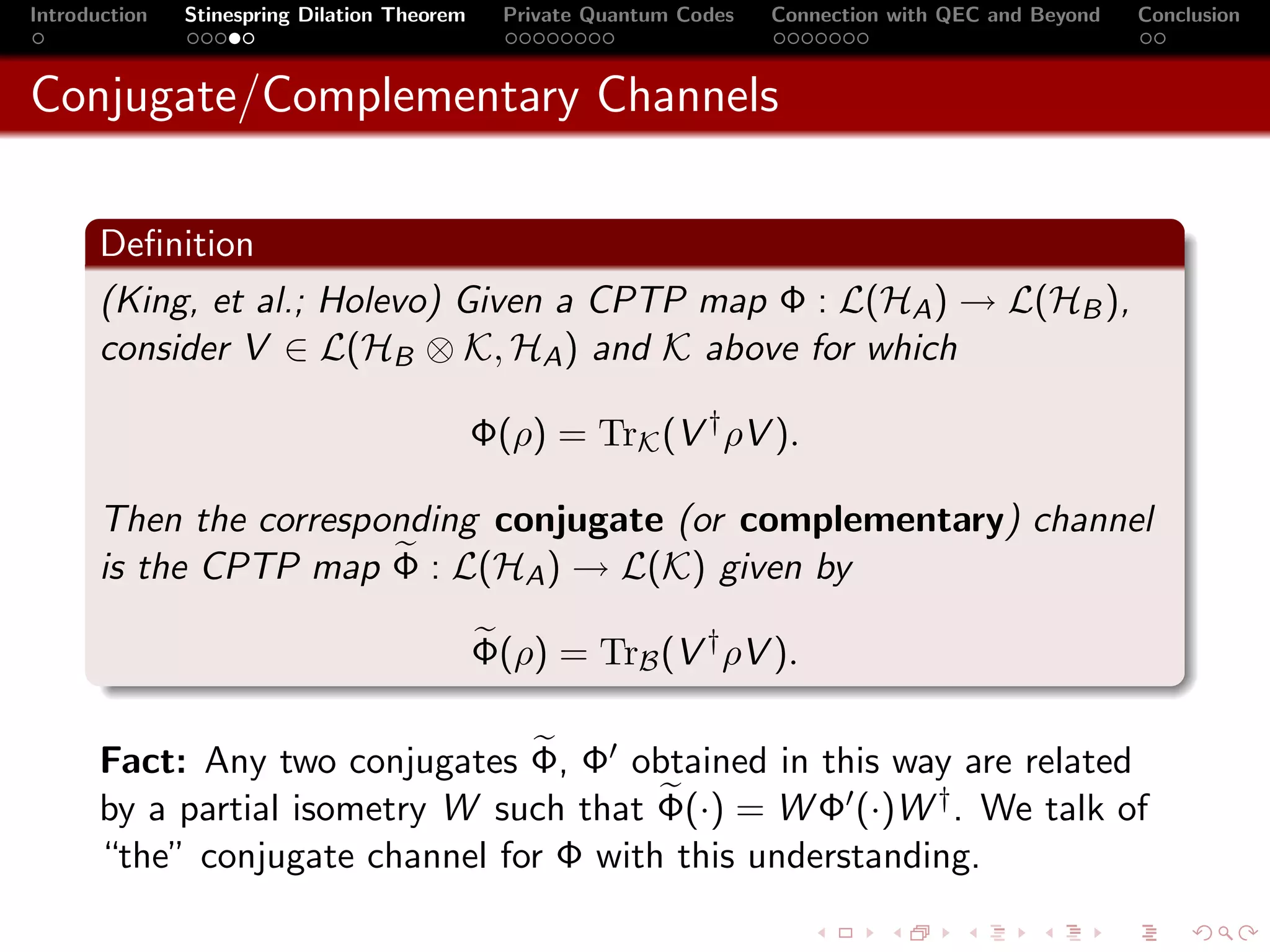
Conjugate/Complementary Channels

       Definition
       (King, et al.; Holevo) Given a CPTP map Φ : L(HA ) → L(HB ),
       consider V ∈ L(HB ⊗ K, HA ) and K above for which

                                              Φ(ρ) = TrK (V † ρV ).

       Then the corresponding conjugate (or complementary) channel
       is the CPTP map Φ : L(HA ) → L(K) given by

                                              Φ(ρ) = TrB (V † ρV ).

       Fact: Any two conjugates Φ, Φ obtained in this way are related
       by a partial isometry W such that Φ(·) = W Φ (·)W † . We talk of
       “the” conjugate channel for Φ with this understanding.
Introduction   Stinespring Dilation Theorem   Private Quantum Codes   Connection with QEC and Beyond   Conclusion


Computing Kraus Operators for Conjugates

               Suppose that Vi ∈ L(HA , HB ) are the Kraus operators for
               Φ : L(HA ) → L(HB ). Then we can obtain Kraus operators
               {Rµ } for Φ as follows.
Introduction   Stinespring Dilation Theorem         Private Quantum Codes   Connection with QEC and Beyond   Conclusion


Computing Kraus Operators for Conjugates

               Suppose that Vi ∈ L(HA , HB ) are the Kraus operators for
               Φ : L(HA ) → L(HB ). Then we can obtain Kraus operators
               {Rµ } for Φ as follows.

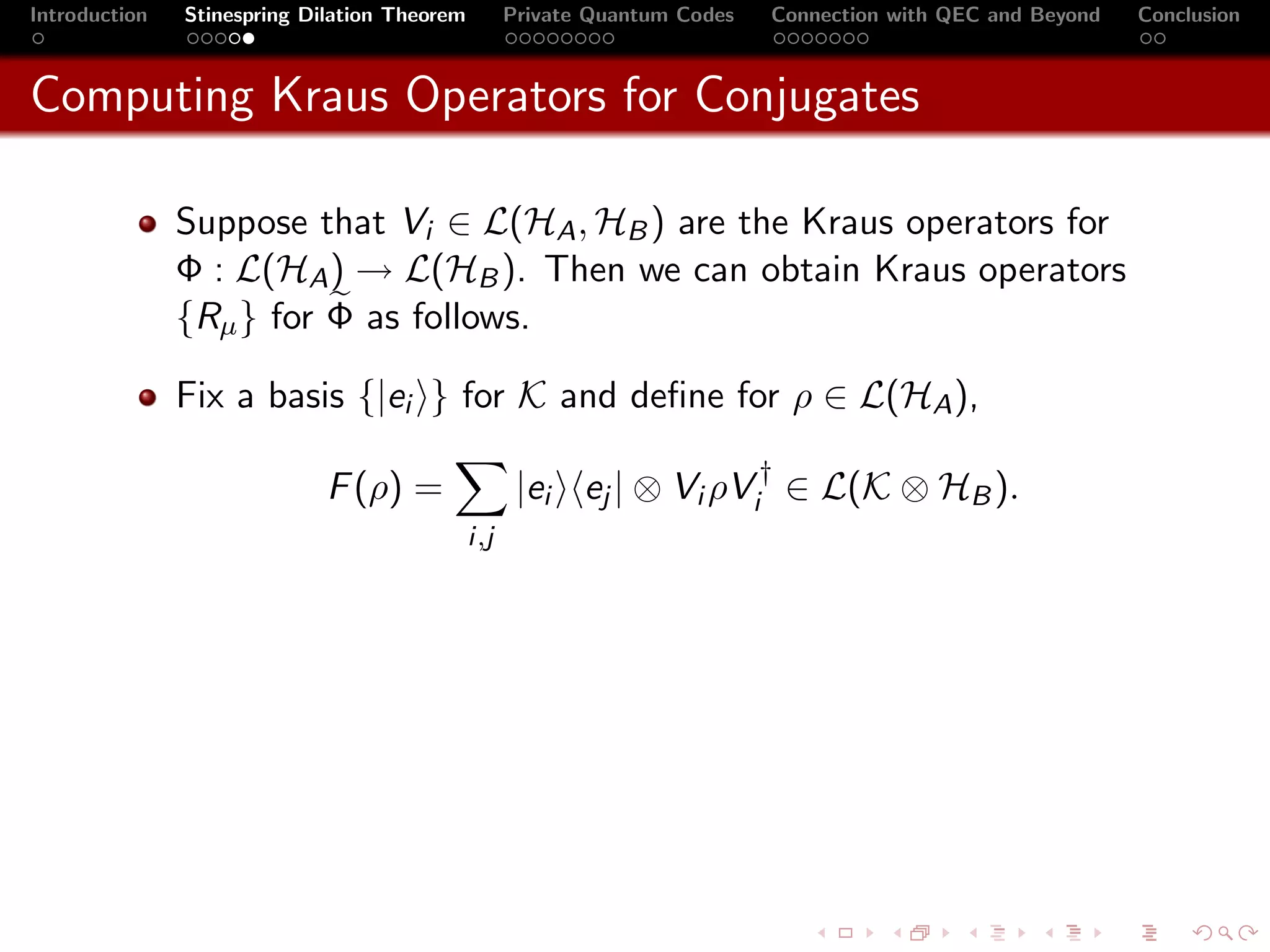
               Fix a basis {|ei } for K and define for ρ ∈ L(HA ),

                             F (ρ) =                 |ei ej | ⊗ Vi ρVi† ∈ L(K ⊗ HB ).
                                              i,j
Introduction   Stinespring Dilation Theorem         Private Quantum Codes   Connection with QEC and Beyond   Conclusion


Computing Kraus Operators for Conjugates

               Suppose that Vi ∈ L(HA , HB ) are the Kraus operators for
               Φ : L(HA ) → L(HB ). Then we can obtain Kraus operators
               {Rµ } for Φ as follows.

               Fix a basis {|ei } for K and define for ρ ∈ L(HA ),

                             F (ρ) =                 |ei ej | ⊗ Vi ρVi† ∈ L(K ⊗ HB ).
                                              i,j


               Then Φ(ρ) = TrK F (ρ) and

                   Φ(ρ) = TrB F (ρ) =                         Tr(Vi ρVj† )|ei ej | =                 †
                                                                                                Rµ ρRµ ,
                                                        i,j                                 µ

                      †     †      †
               where Rµ = [V1 |fµ V2 |fµ · · · ] and {|fµ } is a basis for HB .
Introduction   Stinespring Dilation Theorem   Private Quantum Codes   Connection with QEC and Beyond   Conclusion


Private Quantum Codes


       Definition
       (Ambainis, et al.) Let S ⊆ H be a set of pure states, let
       Φ : L(HA ) → L(HB ) be a CPTP map, and let ρ0 ∈ L(H). Then
       [S, Φ, ρ0 ] is a private quantum channel if we have

                                     Φ(|ψ ψ|) = ρ0             ∀|ψ ∈ S.

       Motivating class of examples: random unitary channels, where
       Φ(ρ) = i pi Ui ρUi† .
Introduction   Stinespring Dilation Theorem   Private Quantum Codes   Connection with QEC and Beyond   Conclusion


Single Qubit Private Codes

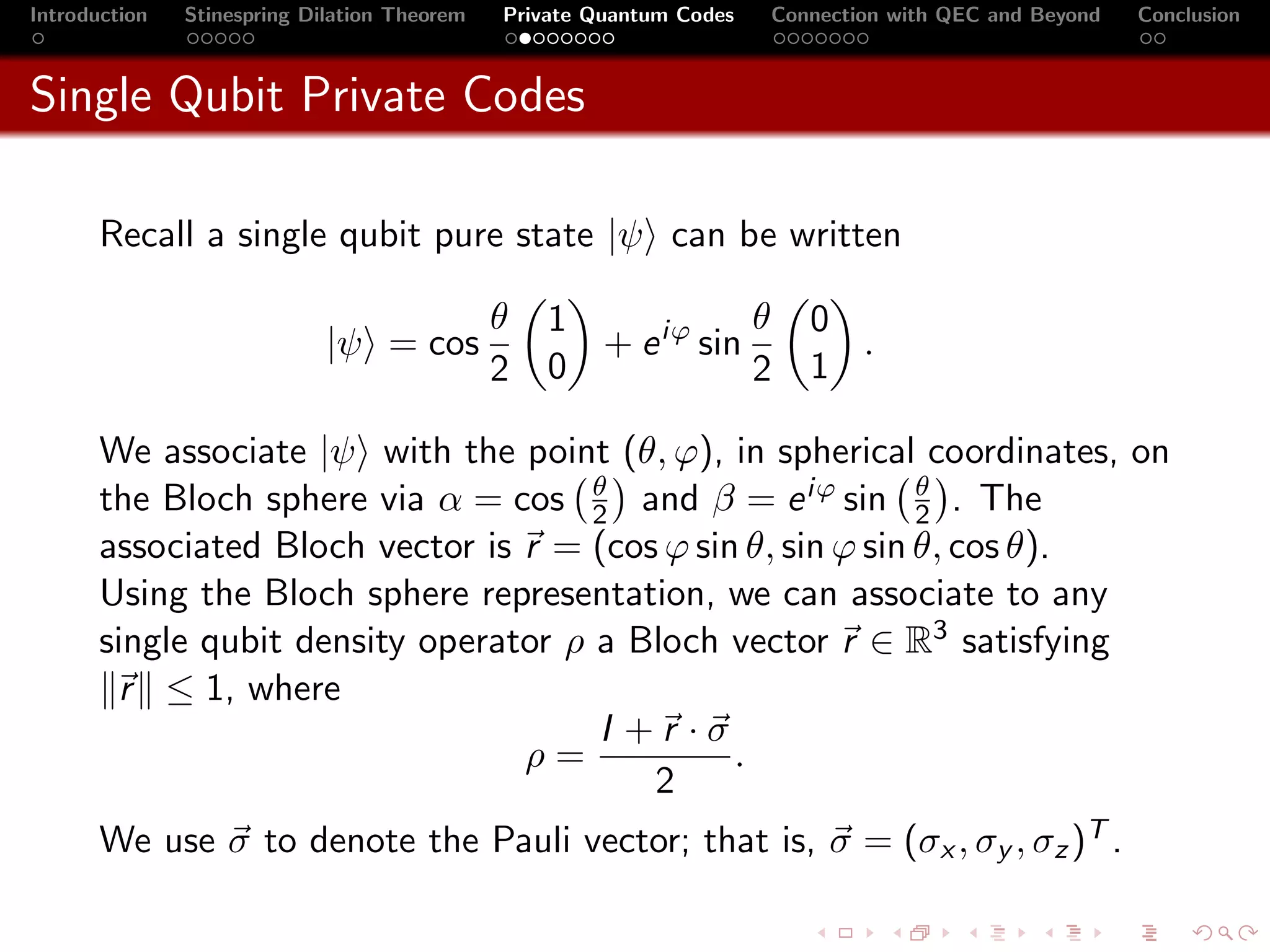
       Recall a single qubit pure state |ψ can be written

                                              θ   1            θ         0
                             |ψ = cos               + e iϕ sin             .
                                              2   0            2         1

       We associate |ψ with the point (θ, ϕ), in spherical coordinates, on
                                       θ                      θ
       the Bloch sphere via α = cos 2 and β = e iϕ sin 2 . The
       associated Bloch vector is r = (cos ϕ sin θ, sin ϕ sin θ, cos θ).
       Using the Bloch sphere representation, we can associate to any
       single qubit density operator ρ a Bloch vector r ∈ R3 satisfying
        r ≤ 1, where
                                        I +r ·σ
                                  ρ=            .
                                           2
       We use σ to denote the Pauli vector; that is, σ = (σx , σy , σz )T .
Introduction   Stinespring Dilation Theorem   Private Quantum Codes   Connection with QEC and Beyond   Conclusion


Single Qubit Private Codes


       Every unital qubit channel Φ can be represented as

                                     1                       1
                              Φ        [I + r · σ]       =     [I + (T r ) · σ] ,
                                     2                       2

       where T is a 3 × 3 real matrix that represents a deformation of the
       Bloch sphere.
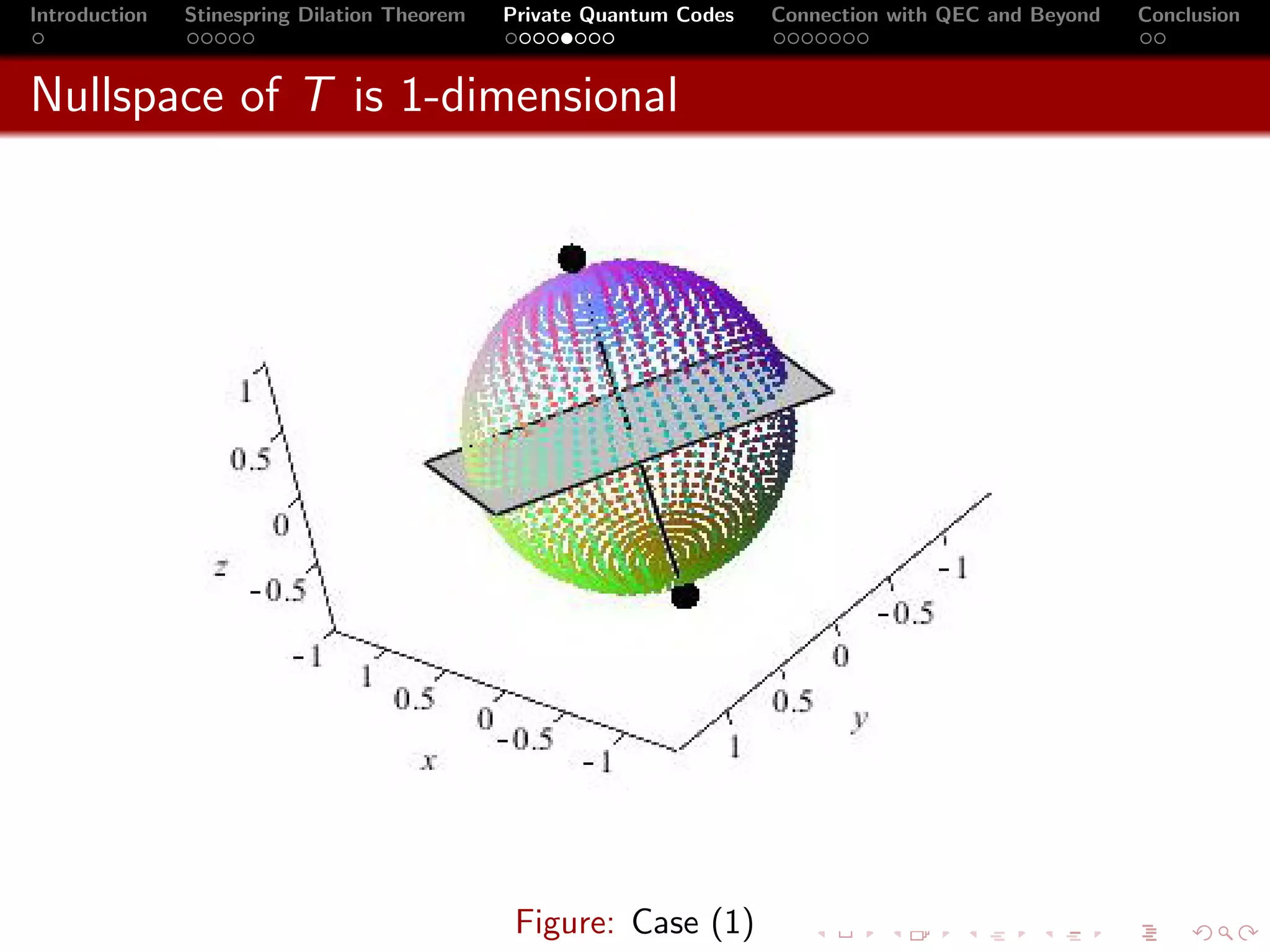
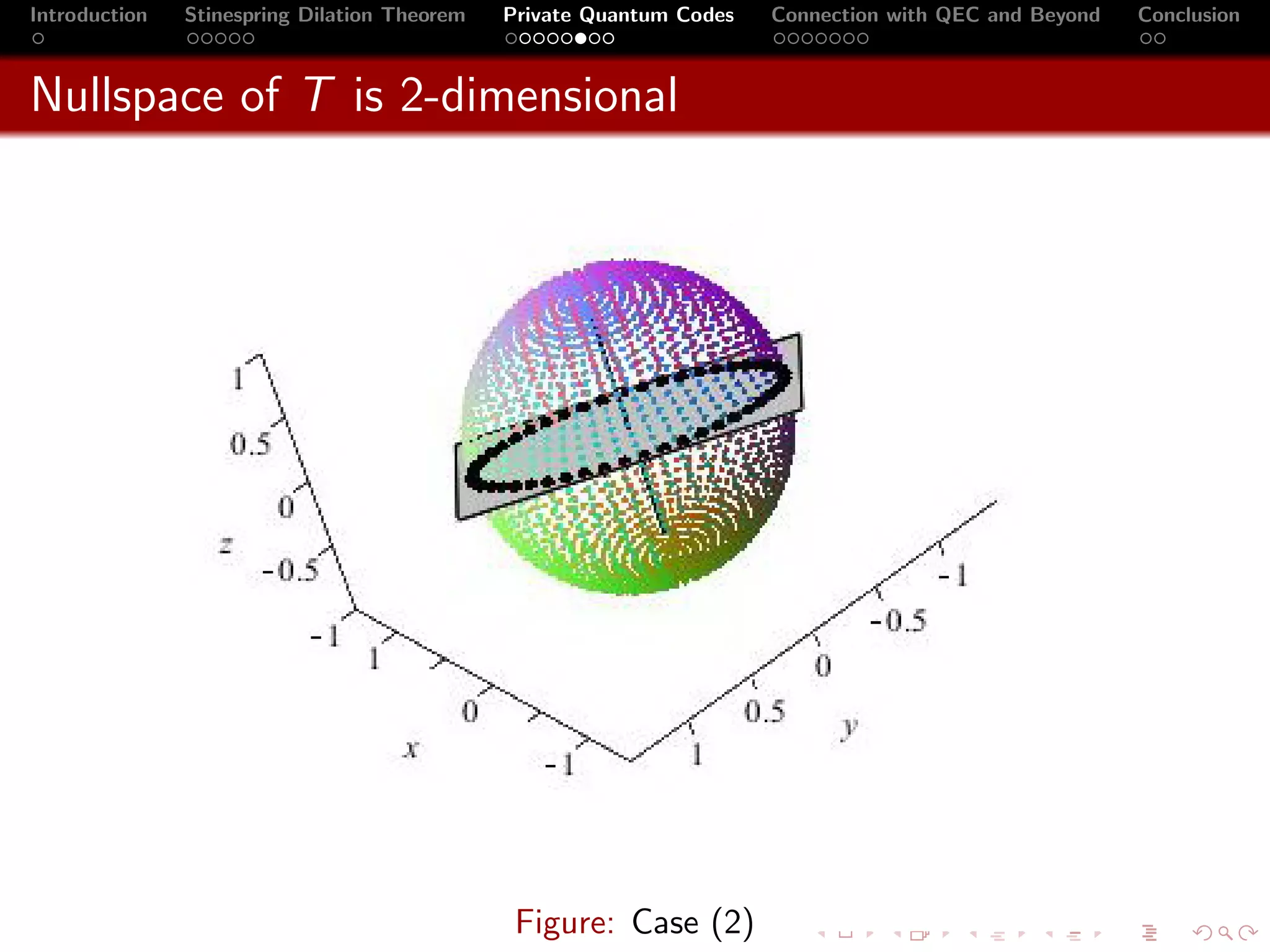
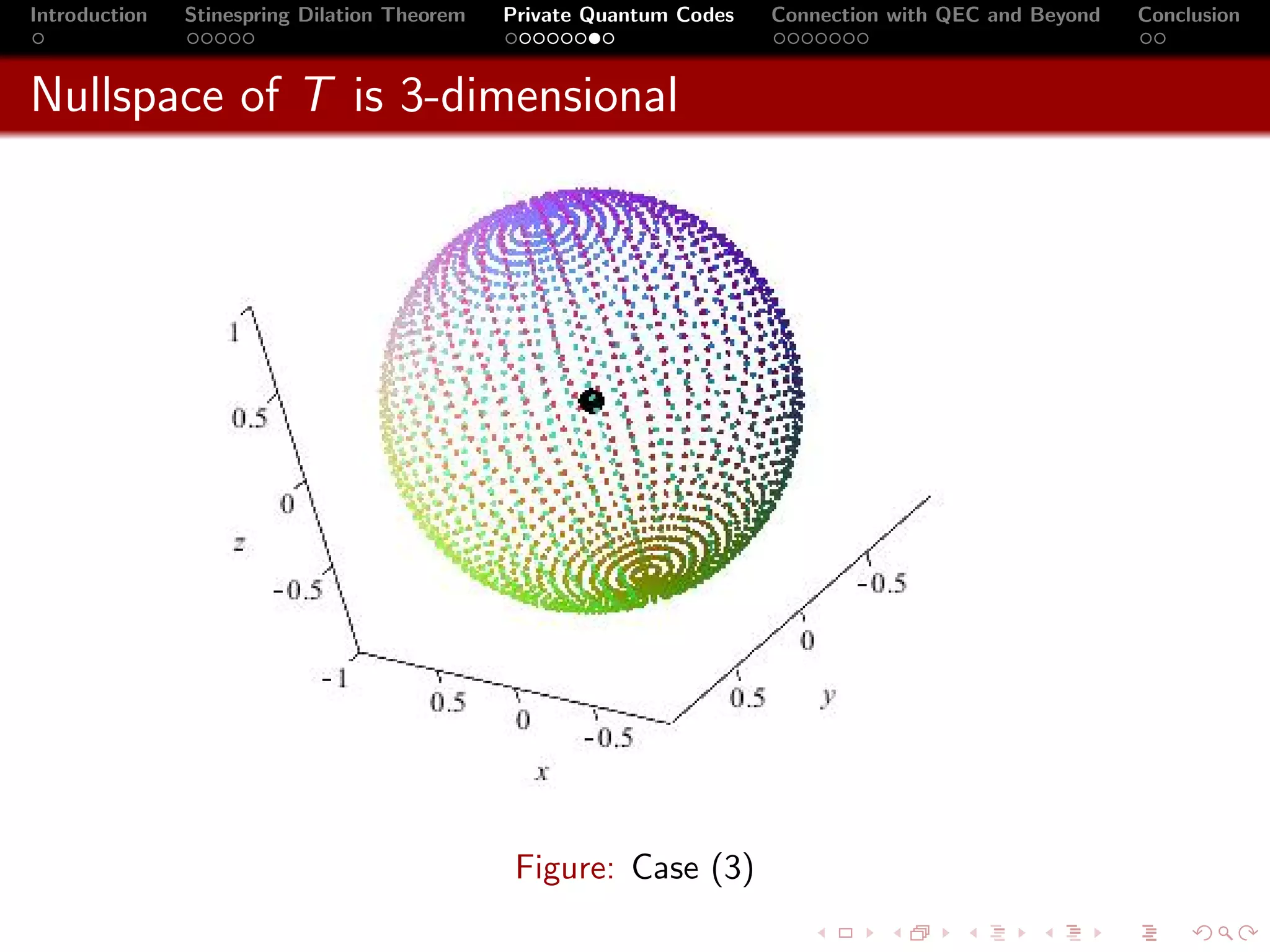
       We are interested in cases where S is nonempty. So we consider
       the cases in which T has non-trivial nullspace; that is, the subspace
       of vectors r such that T r = 0 is one, two, or three-dimensional.
Introduction   Stinespring Dilation Theorem   Private Quantum Codes   Connection with QEC and Beyond   Conclusion


Single Qubit Private Codes

       Theorem
       Let Φ : M2 → M2 be a unital qubit channel, with T the mapping
       induced by Φ as above. Then there are three possibilities for a
       private quantum channel [S, Φ, 1 I ] with S nonempty:
                                      2
          1    If the nullspace of T is 1-dimensional, then S consists of a
               pair of orthonormal states.
          2    If the nullspace of T is 2-dimensional, then the set S is the
               set of all trace vectors (see below) of the subalgebra U † ∆2 U
               of 2 × 2 diagonal matrices up to a unitary equivalence.
          3    If the nullspace of T is 3-dimensional, then Φ is the
               completely depolarizing channel and S is the set of all unit
               vectors. In other words, S is the set of all trace vectors of
               C · I2 .
Introduction   Stinespring Dilation Theorem   Private Quantum Codes   Connection with QEC and Beyond   Conclusion


Nullspace of T is 1-dimensional


                                               Figure: Case (1)
Introduction   Stinespring Dilation Theorem   Private Quantum Codes   Connection with QEC and Beyond   Conclusion


Nullspace of T is 2-dimensional


                                               Figure: Case (2)
Introduction   Stinespring Dilation Theorem   Private Quantum Codes   Connection with QEC and Beyond   Conclusion


Nullspace of T is 3-dimensional


                                               Figure: Case (3)
Introduction   Stinespring Dilation Theorem   Private Quantum Codes   Connection with QEC and Beyond   Conclusion


Private Code Side-Bar


       Note: There are interesting connections between private quantum
       codes and the notions of conditional expectations and trace vectors
       in the theory of operator algebras – maybe as far back as eighty
       years ago. For more on this see:
       A. Church, D.W. Kribs, R. Pereira, S. Plosker, Private Quantum
       Channels, Conditional Expectations, and Trace Vectors. Quantum
       Information & Computation, 11 (2011), no. 9 & 10, 774 - 783.
Introduction   Stinespring Dilation Theorem   Private Quantum Codes   Connection with QEC and Beyond   Conclusion


Complementarity of Quantum Codes


       Theorem
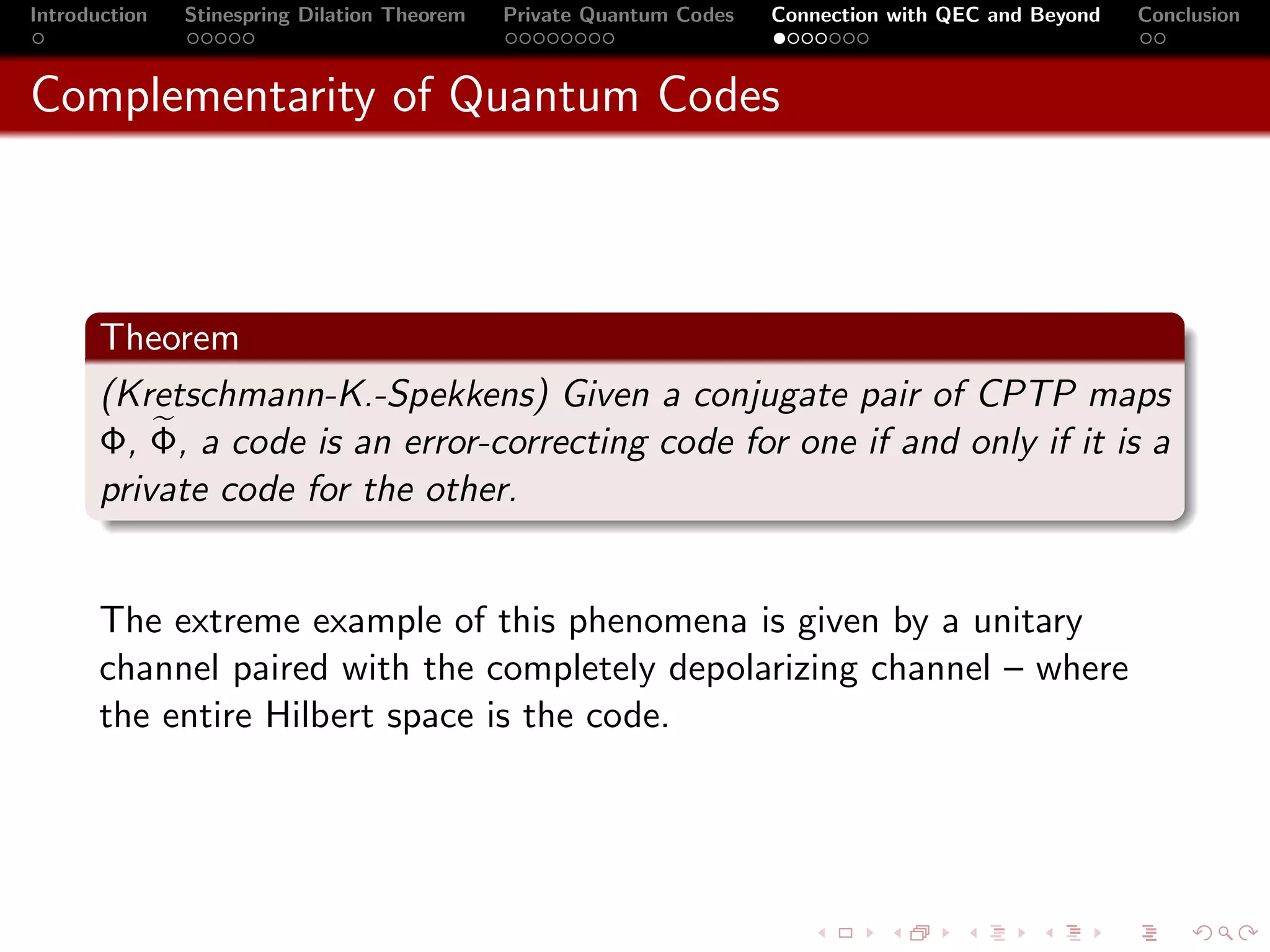
       (Kretschmann-K.-Spekkens) Given a conjugate pair of CPTP maps
       Φ, Φ, a code is an error-correcting code for one if and only if it is a
       private code for the other.


       The extreme example of this phenomena is given by a unitary
       channel paired with the completely depolarizing channel – where
       the entire Hilbert space is the code.
Introduction   Stinespring Dilation Theorem   Private Quantum Codes   Connection with QEC and Beyond   Conclusion


Example 4.1


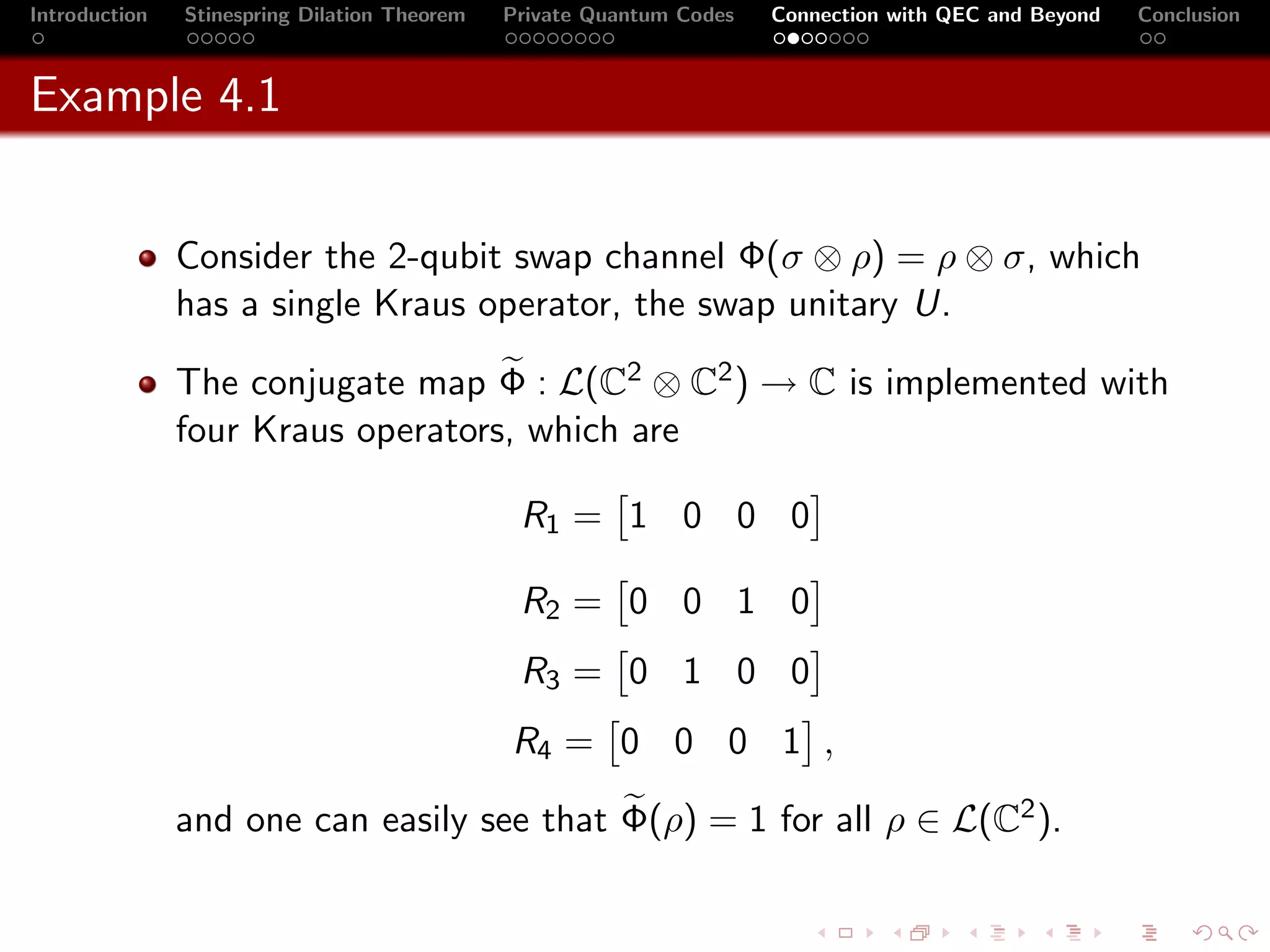
               Consider the 2-qubit swap channel Φ(σ ⊗ ρ) = ρ ⊗ σ, which
               has a single Kraus operator, the swap unitary U.

               The conjugate map Φ : L(C2 ⊗ C2 ) → C is implemented with
               four Kraus operators, which are

                                               R1 = 1 0 0 0

                                               R2 = 0 0 1 0
                                               R3 = 0 1 0 0
                                              R4 = 0 0 0 1 ,

               and one can easily see that Φ(ρ) = 1 for all ρ ∈ L(C2 ).
Introduction   Stinespring Dilation Theorem   Private Quantum Codes   Connection with QEC and Beyond   Conclusion


Example 4.2


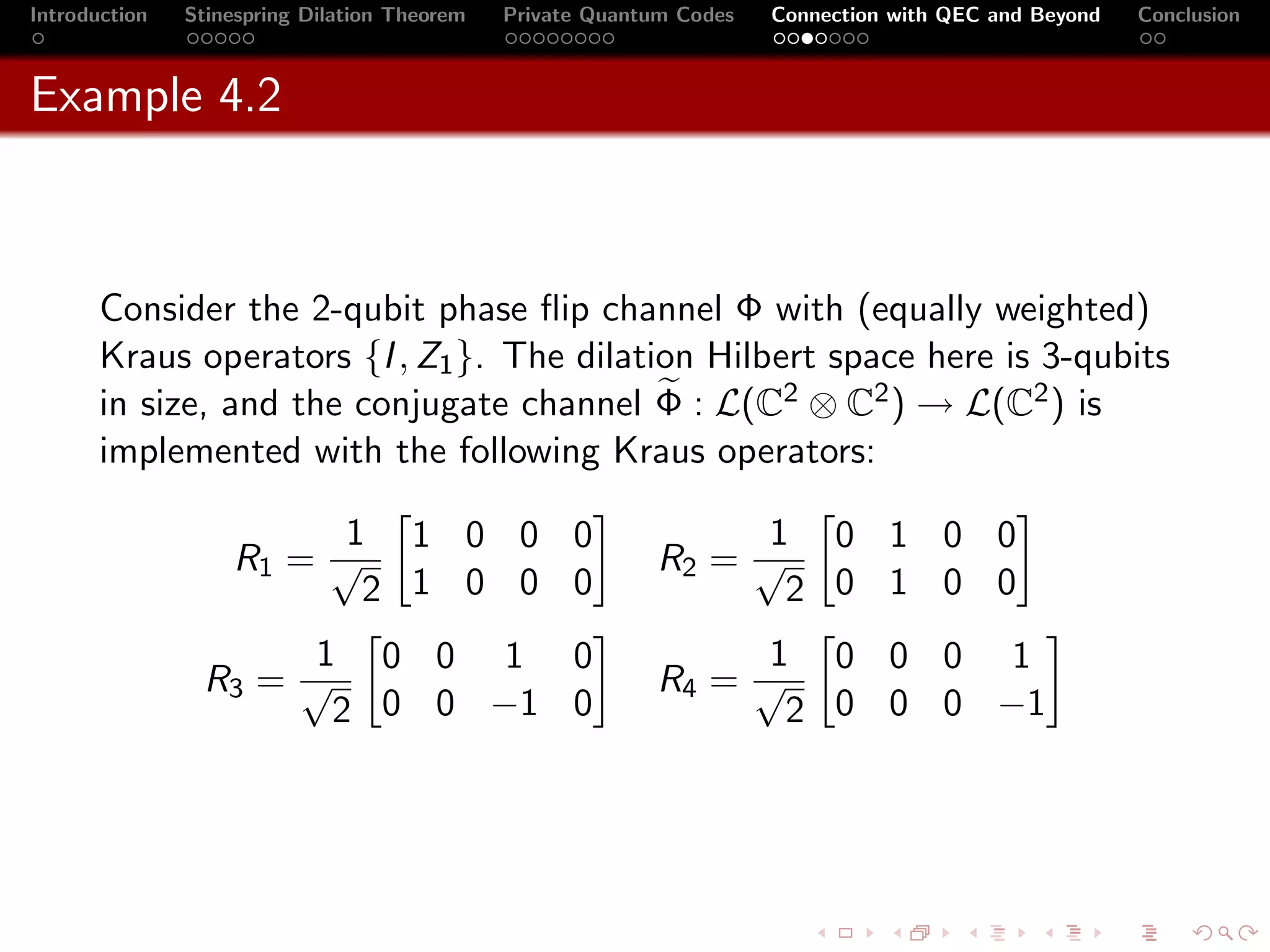
       Consider the 2-qubit phase flip channel Φ with (equally weighted)
       Kraus operators {I , Z1 }. The dilation Hilbert space here is 3-qubits
       in size, and the conjugate channel Φ : L(C2 ⊗ C2 ) → L(C2 ) is
       implemented with the following Kraus operators:

                         1 1 0 0 0                               1 0 1 0 0
                   R1 = √                                   R2 = √
                          2 1 0 0 0                                2 0 1 0 0
                      1 0 0 1 0                                  1 0 0 0 1
                R3 = √                                      R4 = √
                       2 0 0 −1 0                                  2 0 0 0 −1
Introduction   Stinespring Dilation Theorem   Private Quantum Codes   Connection with QEC and Beyond     Conclusion


Example 4.2


                                                                                   4        †
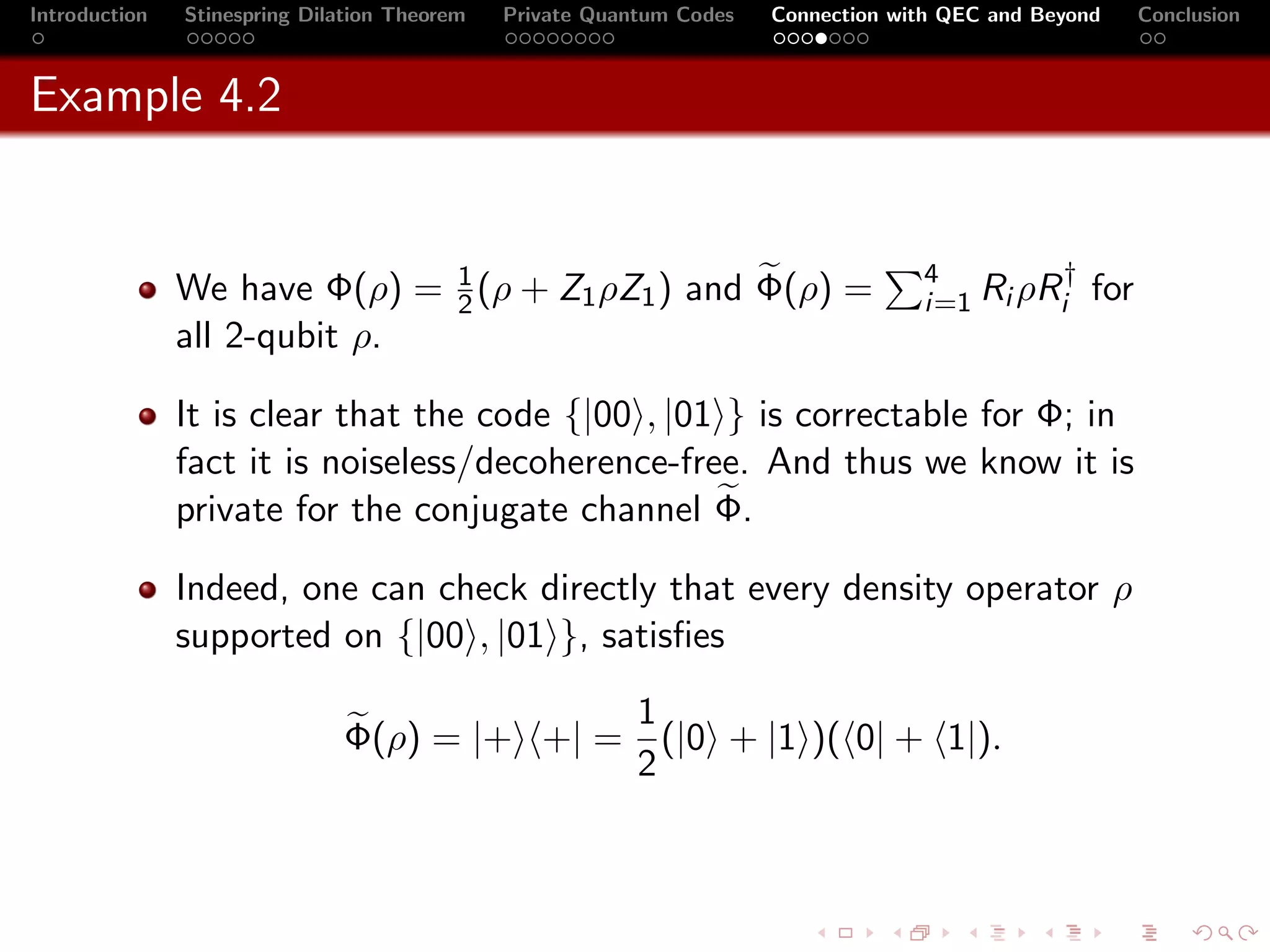
               We have Φ(ρ) = 1 (ρ + Z1 ρZ1 ) and Φ(ρ) =
                              2                                                    i=1 Ri ρRi      for
               all 2-qubit ρ.

               It is clear that the code {|00 , |01 } is correctable for Φ; in
               fact it is noiseless/decoherence-free. And thus we know it is
               private for the conjugate channel Φ.

               Indeed, one can check directly that every density operator ρ
               supported on {|00 , |01 }, satisfies

                                            1
                              Φ(ρ) = |+ +| = (|0 + |1 )( 0| + 1|).
                                            2
Introduction   Stinespring Dilation Theorem   Private Quantum Codes   Connection with QEC and Beyond   Conclusion


From QEC to QCrypto?


       General Program: Using the “algebraic bridge” given by the
       notion of conjugate channels, investigate what results, techniques,
       special types of codes, applications, etc, etc, from QEC have
       analogues or versions in the world of private quantum codes and
       quantum cryptography. At the least, we can use work from QEC as
       motivation for studies in this different setting...
Introduction   Stinespring Dilation Theorem   Private Quantum Codes   Connection with QEC and Beyond   Conclusion


“Knill-Laflamme” Type Conditions for Private Codes


       Theorem
       (K.-Plosker) A projection P is a private code for a CPTP map Φ
       with output state ρ0 ; i.e., Φ(ρ) = ρ0 for all ρ ∈ L(PH)

                                                if and only if

                              ∀X ∃λX ∈ C : PΦ† (X )P = λX P.
       In this case, λX = Tr(ρ0 X ).
Introduction   Stinespring Dilation Theorem   Private Quantum Codes   Connection with QEC and Beyond   Conclusion


“Knill-Laflamme” Type Conditions for Private Codes


               QEC Motivation: If P is correctable for Φ then ∃λµν ∈ C
                           †
               such that PRµ Rν P = λµν P. But

                                         PRµ Rν P = PΦ† (|fµ fν |)P.
                                           †


               Consequence: For instance in the case that
               ρ0 ∝ Q = k |ψk ψk | and P = l |φl φl |, it follows that
               there are scalars uikl such that for all i
                                                                               1
                    Vi P =            uikl Akl    where       Akl =                     |ψk φl |.
                                k,l
                                                                           rank(Q)
Introduction   Stinespring Dilation Theorem   Private Quantum Codes   Connection with QEC and Beyond   Conclusion


Conclusion

               The Stinespring Dilation Theorem is a foundational
               mathematical result for quantum information, and it naturally
               gives rise to the notion of conjugate channels.

               Private quantum codes are a basic tool in quantum
               cryptography, and can also be viewed from an operator
               theoretic perspective.

               Quantum error correcting codes are complementary to private
               quantum codes, with conjugate channels providing a clean
               algebraic bridge between the two studies.

               It should be possible to develop analogues of many results,
               techniques, applications, etc, from QEC for use in quantum
               cryptography. We have discussed some here, but there seem
               to be many other natural questions...
Introduction   Stinespring Dilation Theorem   Private Quantum Codes   Connection with QEC and Beyond   Conclusion


                                     THANK YOU !

On complementarity in qec and quantum cryptography

  • 1.
    Introduction Stinespring Dilation Theorem Private Quantum Codes Connection with QEC and Beyond Conclusion On Complementarity In QEC And Quantum Cryptography David Kribs Professor & Chair Department of Mathematics & Statistics University of Guelph Associate Member Institute for Quantum Computing University of Waterloo QEC II — USC — December 2011
  • 2.
    Introduction Stinespring Dilation Theorem Private Quantum Codes Connection with QEC and Beyond Conclusion Outline 1 Introduction Notation 2 Stinespring Dilation Theorem Heisenberg & Schr¨dinger Pictures o Purification of Mixed States Conjugate/Complementary Channels 3 Private Quantum Codes Definition Single Qubit Private Channels 4 Connection with QEC and Beyond Complementarity of Quantum Codes From QEC to QCrypto? 5 Conclusion Summary
  • 3.
    Introduction Stinespring Dilation Theorem Private Quantum Codes Connection with QEC and Beyond Conclusion Notation HA , HB will denote Hilbert spaces for systems A and B. B(H) will denote the set of (bounded) linear operators on H; B(H)t will denote the trace class operators on H. In finite dimensions these sets coincide and so we’ll simply write L(H) B(HA , HB ) will denote the set of linear transformations from HA to HB . We’ll write X , Y for operators in B(H), and ρ, σ for density operators in B(H)t . (And we’ll just refer to L(H) when appropriate.) Given a linear map Φ : B(HA )t → B(HB )t , its dual map Φ† : B(HB ) → B(HA ) is defined via the Hilbert-Schmidt inner product: Tr(ρ Φ† (X )) = Tr(Φ(ρ)X ).
  • 4.
    Introduction Stinespring Dilation Theorem Private Quantum Codes Connection with QEC and Beyond Conclusion Heisenberg Picture Suppose that Φ† : B(HB ) → B(HA ) is a completely positive (CP) unital (Φ† (IB ) = IA ) linear map.
  • 5.
    Introduction Stinespring Dilation Theorem Private Quantum Codes Connection with QEC and Beyond Conclusion Heisenberg Picture Suppose that Φ† : B(HB ) → B(HA ) is a completely positive (CP) unital (Φ† (IB ) = IA ) linear map. Then there is a Hilbert space K (of dimension at most dim(A) dim(B)) and a co-isometry V ∈ B(HB ⊗ K, HA ) (VV † = IA ) such that Φ† (X ) = V (X ⊗ IK )V † ∀X .
  • 6.
    Introduction Stinespring Dilation Theorem Private Quantum Codes Connection with QEC and Beyond Conclusion Heisenberg Picture Suppose that Φ† : B(HB ) → B(HA ) is a completely positive (CP) unital (Φ† (IB ) = IA ) linear map. Then there is a Hilbert space K (of dimension at most dim(A) dim(B)) and a co-isometry V ∈ B(HB ⊗ K, HA ) (VV † = IA ) such that Φ† (X ) = V (X ⊗ IK )V † ∀X . V is unique up to a unitary on K. Here the Kraus operators for Φ† can be read off as the “coordinate operators” of V † :  † V1 †  .  V = .  . † VAB
  • 7.
    Introduction Stinespring Dilation Theorem Private Quantum Codes Connection with QEC and Beyond Conclusion Schr¨dinger Picture o Suppose that Φ : B(HA )t → B(HB )t is a CP trace preserving (CPTP) linear map.
  • 8.
    Introduction Stinespring Dilation Theorem Private Quantum Codes Connection with QEC and Beyond Conclusion Schr¨dinger Picture o Suppose that Φ : B(HA )t → B(HB )t is a CP trace preserving (CPTP) linear map. Then there is a Hilbert space K (of dimension at most dim(A) dim(B)), an isometry U ∈ B(HA ⊗ K, HB ⊗ K), and a pure state |ψ ∈ K such that Φ(ρ) = TrK (U(ρ ⊗ |ψ ψ|)U † ) ∀ρ.
  • 9.
    Introduction Stinespring Dilation Theorem Private Quantum Codes Connection with QEC and Beyond Conclusion Schr¨dinger Picture o Suppose that Φ : B(HA )t → B(HB )t is a CP trace preserving (CPTP) linear map. Then there is a Hilbert space K (of dimension at most dim(A) dim(B)), an isometry U ∈ B(HA ⊗ K, HB ⊗ K), and a pure state |ψ ∈ K such that Φ(ρ) = TrK (U(ρ ⊗ |ψ ψ|)U † ) ∀ρ. The two pictures are connected via V † |φ := U(|φ ⊗ |ψ ), which gives Φ(ρ) = TrK (V † ρV ).
  • 10.
    Introduction Stinespring Dilation Theorem Private Quantum Codes Connection with QEC and Beyond Conclusion Schr¨dinger Picture o Suppose that Φ : B(HA )t → B(HB )t is a CP trace preserving (CPTP) linear map. Then there is a Hilbert space K (of dimension at most dim(A) dim(B)), an isometry U ∈ B(HA ⊗ K, HB ⊗ K), and a pure state |ψ ∈ K such that Φ(ρ) = TrK (U(ρ ⊗ |ψ ψ|)U † ) ∀ρ. The two pictures are connected via V † |φ := U(|φ ⊗ |ψ ), which gives Φ(ρ) = TrK (V † ρV ). The Kraus operators for Φ are the coordinate operators Vi from above, and the general form for U is U = V† ∗
  • 11.
    Introduction Stinespring Dilation Theorem Private Quantum Codes Connection with QEC and Beyond Conclusion Purification of Mixed States Fix a density operator ρ0 ∈ B(H)t , and consider the CPTP map Φ : C → B(H)t defined by Φ(c · 1) = c ρ0 ∀c ∈ C.
  • 12.
    Introduction Stinespring Dilation Theorem Private Quantum Codes Connection with QEC and Beyond Conclusion Purification of Mixed States Fix a density operator ρ0 ∈ B(H)t , and consider the CPTP map Φ : C → B(H)t defined by Φ(c · 1) = c ρ0 ∀c ∈ C. Then the Stinespring Theorem gives (here K = C ⊗ H = H): ρ0 = Φ(1) = TrK (U(1 ⊗ |ψ ψ|)U † ) = TrK (|ψ ψ |), where |ψ ∈ H ⊗ H is a purification of ρ0 – and the unitary freedom in the theorem captures all purifications.
  • 13.
    Introduction Stinespring Dilation Theorem Private Quantum Codes Connection with QEC and Beyond Conclusion Conjugate/Complementary Channels Definition (King, et al.; Holevo) Given a CPTP map Φ : L(HA ) → L(HB ), consider V ∈ L(HB ⊗ K, HA ) and K above for which Φ(ρ) = TrK (V † ρV ). Then the corresponding conjugate (or complementary) channel is the CPTP map Φ : L(HA ) → L(K) given by Φ(ρ) = TrB (V † ρV ). Fact: Any two conjugates Φ, Φ obtained in this way are related by a partial isometry W such that Φ(·) = W Φ (·)W † . We talk of “the” conjugate channel for Φ with this understanding.
  • 14.
    Introduction Stinespring Dilation Theorem Private Quantum Codes Connection with QEC and Beyond Conclusion Computing Kraus Operators for Conjugates Suppose that Vi ∈ L(HA , HB ) are the Kraus operators for Φ : L(HA ) → L(HB ). Then we can obtain Kraus operators {Rµ } for Φ as follows.
  • 15.
    Introduction Stinespring Dilation Theorem Private Quantum Codes Connection with QEC and Beyond Conclusion Computing Kraus Operators for Conjugates Suppose that Vi ∈ L(HA , HB ) are the Kraus operators for Φ : L(HA ) → L(HB ). Then we can obtain Kraus operators {Rµ } for Φ as follows. Fix a basis {|ei } for K and define for ρ ∈ L(HA ), F (ρ) = |ei ej | ⊗ Vi ρVi† ∈ L(K ⊗ HB ). i,j
  • 16.
    Introduction Stinespring Dilation Theorem Private Quantum Codes Connection with QEC and Beyond Conclusion Computing Kraus Operators for Conjugates Suppose that Vi ∈ L(HA , HB ) are the Kraus operators for Φ : L(HA ) → L(HB ). Then we can obtain Kraus operators {Rµ } for Φ as follows. Fix a basis {|ei } for K and define for ρ ∈ L(HA ), F (ρ) = |ei ej | ⊗ Vi ρVi† ∈ L(K ⊗ HB ). i,j Then Φ(ρ) = TrK F (ρ) and Φ(ρ) = TrB F (ρ) = Tr(Vi ρVj† )|ei ej | = † Rµ ρRµ , i,j µ † † † where Rµ = [V1 |fµ V2 |fµ · · · ] and {|fµ } is a basis for HB .
  • 17.
    Introduction Stinespring Dilation Theorem Private Quantum Codes Connection with QEC and Beyond Conclusion Private Quantum Codes Definition (Ambainis, et al.) Let S ⊆ H be a set of pure states, let Φ : L(HA ) → L(HB ) be a CPTP map, and let ρ0 ∈ L(H). Then [S, Φ, ρ0 ] is a private quantum channel if we have Φ(|ψ ψ|) = ρ0 ∀|ψ ∈ S. Motivating class of examples: random unitary channels, where Φ(ρ) = i pi Ui ρUi† .
  • 18.
    Introduction Stinespring Dilation Theorem Private Quantum Codes Connection with QEC and Beyond Conclusion Single Qubit Private Codes Recall a single qubit pure state |ψ can be written θ 1 θ 0 |ψ = cos + e iϕ sin . 2 0 2 1 We associate |ψ with the point (θ, ϕ), in spherical coordinates, on θ θ the Bloch sphere via α = cos 2 and β = e iϕ sin 2 . The associated Bloch vector is r = (cos ϕ sin θ, sin ϕ sin θ, cos θ). Using the Bloch sphere representation, we can associate to any single qubit density operator ρ a Bloch vector r ∈ R3 satisfying r ≤ 1, where I +r ·σ ρ= . 2 We use σ to denote the Pauli vector; that is, σ = (σx , σy , σz )T .
  • 19.
    Introduction Stinespring Dilation Theorem Private Quantum Codes Connection with QEC and Beyond Conclusion Single Qubit Private Codes Every unital qubit channel Φ can be represented as 1 1 Φ [I + r · σ] = [I + (T r ) · σ] , 2 2 where T is a 3 × 3 real matrix that represents a deformation of the Bloch sphere. We are interested in cases where S is nonempty. So we consider the cases in which T has non-trivial nullspace; that is, the subspace of vectors r such that T r = 0 is one, two, or three-dimensional.
  • 20.
    Introduction Stinespring Dilation Theorem Private Quantum Codes Connection with QEC and Beyond Conclusion Single Qubit Private Codes Theorem Let Φ : M2 → M2 be a unital qubit channel, with T the mapping induced by Φ as above. Then there are three possibilities for a private quantum channel [S, Φ, 1 I ] with S nonempty: 2 1 If the nullspace of T is 1-dimensional, then S consists of a pair of orthonormal states. 2 If the nullspace of T is 2-dimensional, then the set S is the set of all trace vectors (see below) of the subalgebra U † ∆2 U of 2 × 2 diagonal matrices up to a unitary equivalence. 3 If the nullspace of T is 3-dimensional, then Φ is the completely depolarizing channel and S is the set of all unit vectors. In other words, S is the set of all trace vectors of C · I2 .
  • 21.
    Introduction Stinespring Dilation Theorem Private Quantum Codes Connection with QEC and Beyond Conclusion Nullspace of T is 1-dimensional Figure: Case (1)
  • 22.
    Introduction Stinespring Dilation Theorem Private Quantum Codes Connection with QEC and Beyond Conclusion Nullspace of T is 2-dimensional Figure: Case (2)
  • 23.
    Introduction Stinespring Dilation Theorem Private Quantum Codes Connection with QEC and Beyond Conclusion Nullspace of T is 3-dimensional Figure: Case (3)
  • 24.
    Introduction Stinespring Dilation Theorem Private Quantum Codes Connection with QEC and Beyond Conclusion Private Code Side-Bar Note: There are interesting connections between private quantum codes and the notions of conditional expectations and trace vectors in the theory of operator algebras – maybe as far back as eighty years ago. For more on this see: A. Church, D.W. Kribs, R. Pereira, S. Plosker, Private Quantum Channels, Conditional Expectations, and Trace Vectors. Quantum Information & Computation, 11 (2011), no. 9 & 10, 774 - 783.
  • 25.
    Introduction Stinespring Dilation Theorem Private Quantum Codes Connection with QEC and Beyond Conclusion Complementarity of Quantum Codes Theorem (Kretschmann-K.-Spekkens) Given a conjugate pair of CPTP maps Φ, Φ, a code is an error-correcting code for one if and only if it is a private code for the other. The extreme example of this phenomena is given by a unitary channel paired with the completely depolarizing channel – where the entire Hilbert space is the code.
  • 26.
    Introduction Stinespring Dilation Theorem Private Quantum Codes Connection with QEC and Beyond Conclusion Example 4.1 Consider the 2-qubit swap channel Φ(σ ⊗ ρ) = ρ ⊗ σ, which has a single Kraus operator, the swap unitary U. The conjugate map Φ : L(C2 ⊗ C2 ) → C is implemented with four Kraus operators, which are R1 = 1 0 0 0 R2 = 0 0 1 0 R3 = 0 1 0 0 R4 = 0 0 0 1 , and one can easily see that Φ(ρ) = 1 for all ρ ∈ L(C2 ).
  • 27.
    Introduction Stinespring Dilation Theorem Private Quantum Codes Connection with QEC and Beyond Conclusion Example 4.2 Consider the 2-qubit phase flip channel Φ with (equally weighted) Kraus operators {I , Z1 }. The dilation Hilbert space here is 3-qubits in size, and the conjugate channel Φ : L(C2 ⊗ C2 ) → L(C2 ) is implemented with the following Kraus operators: 1 1 0 0 0 1 0 1 0 0 R1 = √ R2 = √ 2 1 0 0 0 2 0 1 0 0 1 0 0 1 0 1 0 0 0 1 R3 = √ R4 = √ 2 0 0 −1 0 2 0 0 0 −1
  • 28.
    Introduction Stinespring Dilation Theorem Private Quantum Codes Connection with QEC and Beyond Conclusion Example 4.2 4 † We have Φ(ρ) = 1 (ρ + Z1 ρZ1 ) and Φ(ρ) = 2 i=1 Ri ρRi for all 2-qubit ρ. It is clear that the code {|00 , |01 } is correctable for Φ; in fact it is noiseless/decoherence-free. And thus we know it is private for the conjugate channel Φ. Indeed, one can check directly that every density operator ρ supported on {|00 , |01 }, satisfies 1 Φ(ρ) = |+ +| = (|0 + |1 )( 0| + 1|). 2
  • 29.
    Introduction Stinespring Dilation Theorem Private Quantum Codes Connection with QEC and Beyond Conclusion From QEC to QCrypto? General Program: Using the “algebraic bridge” given by the notion of conjugate channels, investigate what results, techniques, special types of codes, applications, etc, etc, from QEC have analogues or versions in the world of private quantum codes and quantum cryptography. At the least, we can use work from QEC as motivation for studies in this different setting...
  • 30.
    Introduction Stinespring Dilation Theorem Private Quantum Codes Connection with QEC and Beyond Conclusion “Knill-Laflamme” Type Conditions for Private Codes Theorem (K.-Plosker) A projection P is a private code for a CPTP map Φ with output state ρ0 ; i.e., Φ(ρ) = ρ0 for all ρ ∈ L(PH) if and only if ∀X ∃λX ∈ C : PΦ† (X )P = λX P. In this case, λX = Tr(ρ0 X ).
  • 31.
    Introduction Stinespring Dilation Theorem Private Quantum Codes Connection with QEC and Beyond Conclusion “Knill-Laflamme” Type Conditions for Private Codes QEC Motivation: If P is correctable for Φ then ∃λµν ∈ C † such that PRµ Rν P = λµν P. But PRµ Rν P = PΦ† (|fµ fν |)P. † Consequence: For instance in the case that ρ0 ∝ Q = k |ψk ψk | and P = l |φl φl |, it follows that there are scalars uikl such that for all i 1 Vi P = uikl Akl where Akl = |ψk φl |. k,l rank(Q)
  • 32.
    Introduction Stinespring Dilation Theorem Private Quantum Codes Connection with QEC and Beyond Conclusion Conclusion The Stinespring Dilation Theorem is a foundational mathematical result for quantum information, and it naturally gives rise to the notion of conjugate channels. Private quantum codes are a basic tool in quantum cryptography, and can also be viewed from an operator theoretic perspective. Quantum error correcting codes are complementary to private quantum codes, with conjugate channels providing a clean algebraic bridge between the two studies. It should be possible to develop analogues of many results, techniques, applications, etc, from QEC for use in quantum cryptography. We have discussed some here, but there seem to be many other natural questions...
  • 33.
    Introduction Stinespring Dilation Theorem Private Quantum Codes Connection with QEC and Beyond Conclusion THANK YOU !