A Graph Syntax for Processes and Services

                   Alberto Lluch Lafuente
    (joint-work with Roberto Bruni and Fabio Gadducci)

         Department of Computer Science, University of Pisa
    Software Engineering for Service-Oriented Overlay Computers


6th Int’l Workshop on Web Services and Formal Methods
             Bologna, September 4-5, 2009
Goal statement


   The spirit of our research is
        ”to conciliate algebraic and graph-based specifications”
Goal statement


   The spirit of our research is
        ”to conciliate algebraic and graph-based specifications”
   In this work we propose a graph syntax to
        ”Equip algebraic specifications with a graphical
           representation that is

                Intuitive
                Easy to define
                Easy to prove correct
Running Example: Sagas


  We shall consider a simple language for transactions with
      sequential composition;
      parallel (split-join) composition;
      compensations;
      saga scoping.
  This example is inspired by the Nested Sagas of [BMM05].
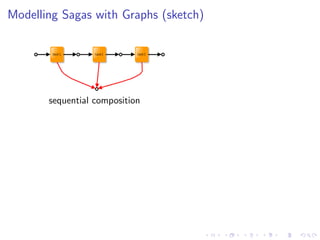
Modelling Sagas with Graphs (sketch)


       sequential composition
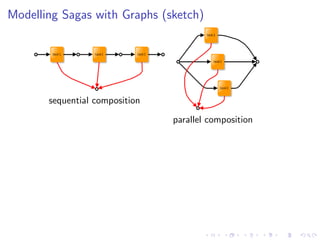
Modelling Sagas with Graphs (sketch)


       sequential composition
                                parallel composition
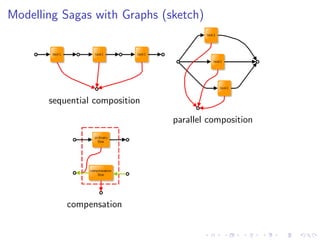
Modelling Sagas with Graphs (sketch)


       sequential composition
                                parallel composition


           compensation
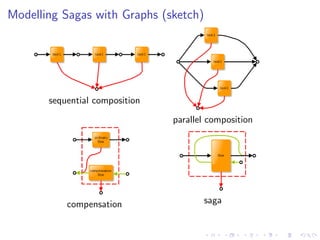
Modelling Sagas with Graphs (sketch)


       sequential composition
                                parallel composition


           compensation                saga
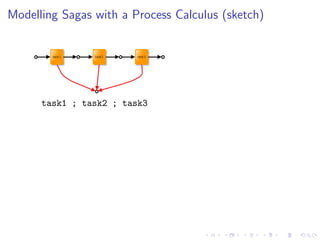
Modelling Sagas with a Process Calculus (sketch)


      task1 ; task2 ; task3
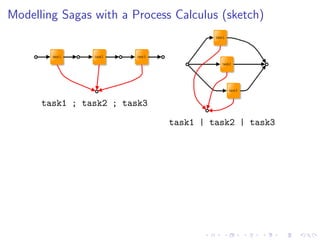
Modelling Sagas with a Process Calculus (sketch)


      task1 ; task2 ; task3
                              task1 | task2 | task3
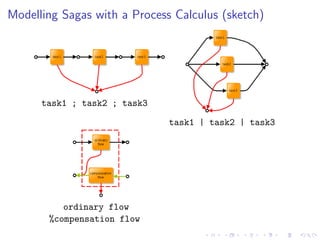
Modelling Sagas with a Process Calculus (sketch)


      task1 ; task2 ; task3
                              task1 | task2 | task3


          ordinary flow
       %compensation flow
Modelling Sagas with a Process Calculus (sketch)


      task1 ; task2 ; task3
                              task1 | task2 | task3


          ordinary flow              [flow]
       %compensation flow
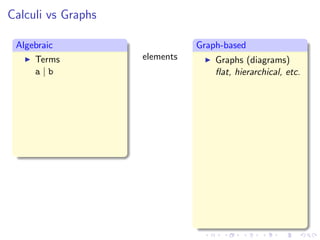
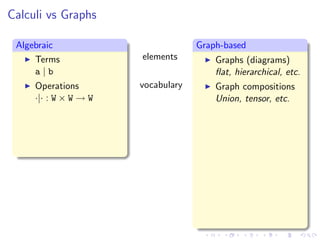
Calculi vs Graphs

 Algebraic                     Graph-based
     Terms          elements       Graphs (diagrams)
     a|b                           flat, hierarchical, etc.
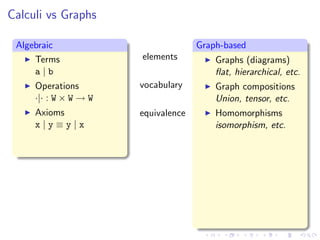
Calculi vs Graphs

 Algebraic                          Graph-based
     Terms             elements         Graphs (diagrams)
     a|b                                flat, hierarchical, etc.
     Operations        vocabulary       Graph compositions
     ·|· : W × W → W                    Union, tensor, etc.
Calculi vs Graphs

 Algebraic                           Graph-based
     Terms             elements          Graphs (diagrams)
     a|b                                 flat, hierarchical, etc.
     Operations        vocabulary        Graph compositions
     ·|· : W × W → W                     Union, tensor, etc.
     Axioms            equivalence       Homomorphisms
     x|y≡y|x                             isomorphism, etc.
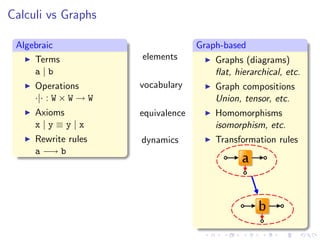
Calculi vs Graphs

 Algebraic                           Graph-based
     Terms             elements          Graphs (diagrams)
     a|b                                 flat, hierarchical, etc.
     Operations        vocabulary        Graph compositions
     ·|· : W × W → W                     Union, tensor, etc.
     Axioms            equivalence       Homomorphisms
     x|y≡y|x                             isomorphism, etc.
     Rewrite rules     dynamics          Transformation rules
     a −→ b
Main technical goal: mapping coherent wrt. equivalence

                                       graph1

  flow1
  a
  | b
  | [ c % d]
Main technical goal: mapping coherent wrt. equivalence

                                       graph1

  flow1
  a
  | b
  | [ c % d]
Main technical goal: mapping coherent wrt. equivalence

                                       graph1

  flow1
  a
  | b
  | [ c % d]


               congruent

  flow2
  b
  | [ c % d ]
  | a
Main technical goal: mapping coherent wrt. equivalence

                                       graph1

  flow1
  a
  | b
  | [ c % d]


               congruent

  flow2                                 graph2
  b
  | [ c % d ]
  | a
Main technical goal: mapping coherent wrt. equivalence

                                       graph1

  flow1
  a
  | b
  | [ c % d]


               congruent                        isomorphic

  flow2                                 graph2
  b
  | [ c % d ]
  | a
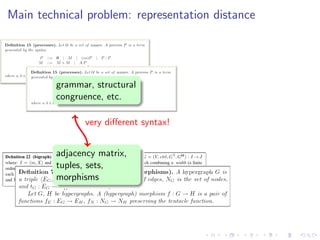
Main technical problem: representation distance


         grammar, structural
         congruence, etc.

               very different syntax!


         adjacency matrix,
         tuples, sets,
         morphisms
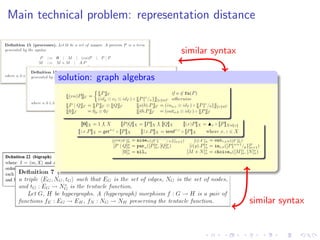
Main technical problem: representation distance

                                    similar syntax

         solution: graph algebras


                                                     similar syntax
Main application: encodings are facilitated

                                         graph1

  flow1
  a
  | b
  | [ c % d]


               congruent                          isomorphic
  flow2                                   graph2

  textttb
  | [ c % d ]
  | a
Main application: encodings are facilitated

                           graphterm1            graph1
                           W[ p q .
  flow1                      b(p)
  a                         | a(p)
  | b                       ...
  | [ c % d]               ]


               congruent             congruent            isomorphic
  flow2                                           graph2
                           graphterm2
  textttb                  W[ p q.
  | [ c % d ]               b(p)
  | a                       ...
                            | a(p)
                           ]
The syntax of the graph algebra


         G, H   ::=   0

                      the empty graph
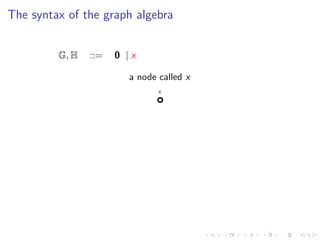
The syntax of the graph algebra


         G, H   ::=   0 |x

                        a node called x
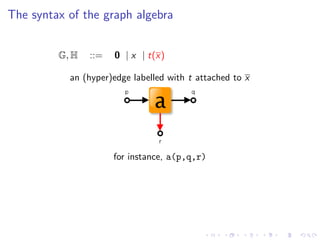
The syntax of the graph algebra


         G, H   ::=   0 | x | t(x)

           an (hyper)edge labelled with t attached to x


                      for instance, a(p,q,r)
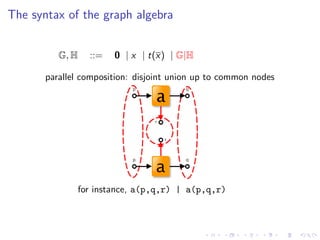
The syntax of the graph algebra


          G, H     ::=   0 | x | t(x) | G|H

       parallel composition: disjoint union up to common nodes


                 for instance, a(p,q,r) | a(p,q,r)
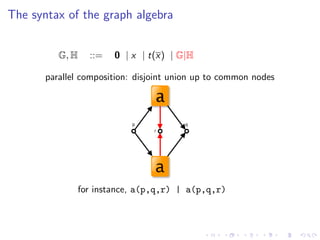
The syntax of the graph algebra


          G, H     ::=   0 | x | t(x) | G|H

       parallel composition: disjoint union up to common nodes


                 for instance, a(p,q,r) | a(p,q,r)
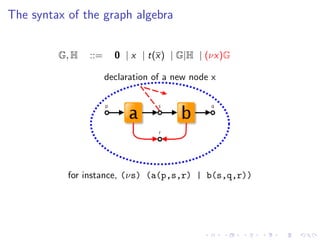
The syntax of the graph algebra


         G, H   ::=     0 | x | t(x) | G|H | (νx)G

                      declaration of a new node x


           for instance, (νs) (a(p,s,r) | b(s,q,r))
The syntax of the graph algebra

            D   ::=   Tx [G]
         G, H   ::=   0 | x | t(x) | G|H | (νx)G
           graph G with interface of type T exposing x


            for instance, Sp,q,s [(νr)flow(p, q, r, q, s)]
The syntax of the graph algebra

            D   ::=   Tx [G]
         G, H   ::=   0 | x | t(x) | G|H | (νx)G | D y

                  a nested graph attached to y


                      for instance, D a,b,c
The syntax of the graph algebra

             D    ::=   Tx [G]
          G, H    ::=   0 | x | t(x) | G|H | (νx)G | D y
                     a nested graph attached to y


     for instance, D a,b,c , with D=Sp,q,s [(νr)flow(p, q, r, q, s)]
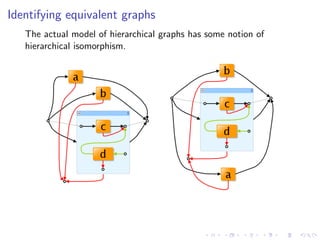
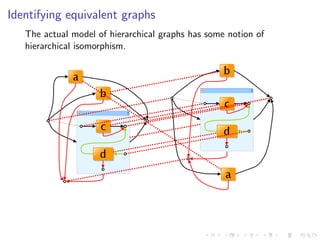
Identifying equivalent graphs
   The actual model of hierarchical graphs has some notion of
   hierarchical isomorphism.
Identifying equivalent graphs
   The actual model of hierarchical graphs has some notion of
   hierarchical isomorphism.
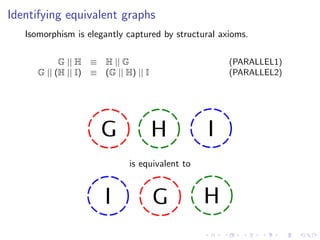
Identifying equivalent graphs
   Isomorphism is elegantly captured by structural axioms.

            G || H ≡ H || G                          (PARALLEL1)
      G || (H || I) ≡ (G || H) || I                  (PARALLEL2)


                             is equivalent to
Identifying equivalent graphs
   Isomorphism is elegantly captured by structural axioms.

            G || H ≡ H || G                                  (PARALLEL1)
      G || (H || I) ≡ (G || H) || I                          (PARALLEL2)

              G || 0   ≡   G                                      (NODES1)
        (νx)(νy )G     ≡   (νy )(νx)G                             (NODES2)
              (νx)0    ≡   0                                      (NODES5)
             (νx)G     ≡   (νy )G{y /x }    if   y ∈ fn(G)        (NODES3)
              Lx [G]   ≡   Ly [G{y /x }]    if   |y | ∩ fn(G) = ∅ (NODES4)
        G || (νx)H     ≡   (νx)(G || H)     if   x ∈ fn(G)        (NODES5)
     Lx [(νy )G](z)    ≡   (νy )Lx [G](z)   if   y ∈ |x| ∪ |z|    (NODES6)
              x || G   ≡   G                if   x ∈ fn(G)        (NODES7)


   These axioms are rather standard and thus intuitive to those
   familiar with algebraic specifications.
Sagas encoding: sagas as calculus


   Let us assume the following syntax for our sagas language

         S    ::=    a | S; S | S|S | [P]          (sagas)
         P    ::=    S%S | P; P | P|P              (processes)
   with the usual following axioms holding
       associativity for sequential composition;
       associativity and commutativity for parallel composition.
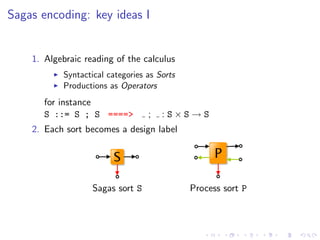
Sagas encoding: key ideas I


    1. Algebraic reading of the calculus
           Syntactical categories as Sorts
           Productions as Operators
       for instance
       S ::= S ; S ====>          ;   :S×S→S
    2. Each sort becomes a design label


                   Sagas sort S              Process sort P
Sagas encoding: key ideas II

    3. Each production becomes a derived operator


               X ; Y def Sp,q,r [(νs)(X p, s, r | Y s, q, r )]
                     =
    4. Some symbols should be material, i.e. represented by graph
       items like edges


                          for instance, an activity
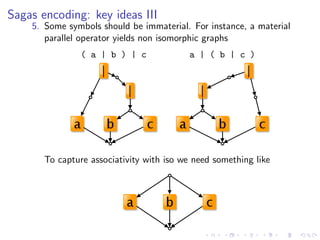
Sagas encoding: key ideas III
    5. Some symbols should be immaterial. For instance, a material
       parallel operator yields non isomorphic graphs
                ( a | b ) | c              a | ( b | c )


       To capture associativity with iso we need something like
Sagas encoding: key ideas IV

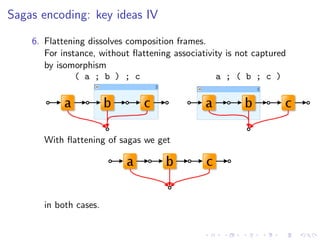
    6. Flattening dissolves composition frames.
       For instance, without flattening associativity is not captured
       by isomorphism
               ( a ; b ) ; c                      a ; ( b ; c )


       With flattening of sagas we get


       in both cases.
Sagas encoding: main productions


                X ; Y def=
   Sp,q,r [(νs)(X p, s, r | Y s, q, r )]
Sagas encoding: main productions


                X ; Y def=
   Sp,q,r [(νs)(X p, s, r | Y s, q, r )]             X | Y def=
                                           Sp,q,r [X p, q, r | Y p, q, r ]
Sagas encoding: main productions


                X ; Y def=
   Sp,q,r [(νs)(X p, s, r | Y s, q, r )]             X | Y def=
                                           Sp,q,r [X p, q, r | Y p, q, r ]


                X % Y def=
    Pp,q,r,s,t [X p, q, s | Y r, s, t ]
Sagas encoding: main productions


                X ; Y def=
   Sp,q,r [(νs)(X p, s, r | Y s, q, r )]             X | Y def=
                                           Sp,q,r [X p, q, r | Y p, q, r ]


                        def
                                                      [X] def
                                                           =
                X%Y =                       Sp,q,r [(νs)X p, q, s, q, r ]
    Pp,q,r,s,t [X p, q, s | Y r, s, t ]
Sagas encoding: coherence proof

   At the end we point at a result like
   Theorem
   Two sagas S and R are congruent exactly when they are isomorphic.

       The proof of soundness is reduced to show that in each axiom
       of the structural congruence the lhs and rhs are isomorphic,
       which is facilitated by the similarity of the axioms.
                      X | Y def Sp,q,r [X p, q, r | Y p, q, r ]
                              =
                             par1
       For instance,          = Sp,q,r [Y p, q, r | X p, q, r ]
                             def
                              =Y | X
       The proof of completeness is done as usual by structural
       induction on the normal form of sagas terms. Still not easy,
       but at least we deal with similar notations.
Outline


   Introduction
       A simple scenario
       Goal statement


   An algebra of hierarchical graphs
      A syntax for hierarchical graphs
      Identifying equivalent graphs
      Example encoding


   Conclusion
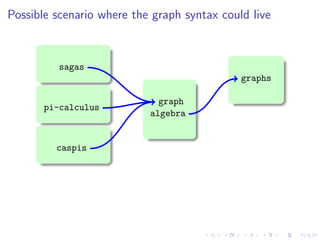
Possible scenario where the graph syntax could live


          sagas
                                             graphs

                             graph
       pi-calculus
                           algebra


         caspis
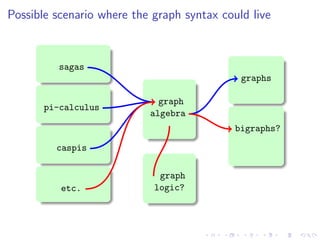
Possible scenario where the graph syntax could live


          sagas
                                             graphs

                             graph
       pi-calculus
                           algebra
                                            bigraphs?

         caspis

                             graph
          etc.              logic?
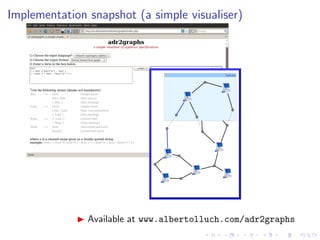
Implementation snapshot (a simple visualiser)


               Available at www.albertolluch.com/adr2graphs
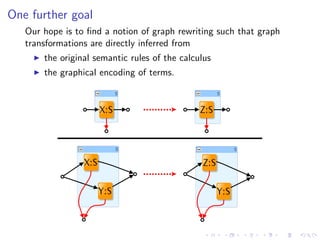
One further goal
   Our hope is to find a notion of graph rewriting such that graph
   transformations are directly inferred from
       the original semantic rules of the calculus
       the graphical encoding of terms.
Concluding remarks

   The graphical syntax . . .
        Grounds on widely-accepted models;
        Simplifies the graphical representation of process calculi;
        Hides the complexity of hierarchical graphs;
        Enables proofs by structural induction;
        Has been evaluated on various calculi;
        Nesting and sharing features suitable for modelling soc
        features such as transactions or sessions.
        Natural implementation in RL/Maude (support for theorem
        proving, model checking, simulation, etc.)
        Offers a technique for complementing textual and visual
        notations in formal tools;
Credits and references I
   [BGL09]    Roberto Bruni, Fabio Gadducci, and Alberto Lluch Lafuente.
              A graph syntax for processes and services.
              In WS-FM’09, 2009.
              To appear.
   [BL09]     Roberto Bruni and Alberto Lluch Lafuente.
              Ten virtues of structured graphs.
              In Invited paper at the 8th International Workshop on Graph Transformation and Visual Modeling
              Techniques (GT-VMT’09), Electronic Communications of the EASST, 2009.
              To appear.
   [BLM08]    Roberto Bruni, Alberto Lluch Lafuente, and Ugo Montanari.
              Hierarchical Design Rewriting with Maude.
              In Proceedings of the 7th International Workshop on Rewriting Logic and its Applications (WRLA’08),
              Electronic Notes in Theoretical Computer Science. Elsevier, 2008.
              To appear.
   [BLME07] Roberto Bruni, Alberto Lluch Lafuente, Ugo Montanari, and Emilio Tuosto.
            Service Oriented Architectural Design.
            In Proceedings of the 3rd International Symposium on Trustworthy Global Computing (TGC’07),
            volume 4912 of Lecture Notes in Computer Science, pages 186–203. Springer, 2007.
   [BMM05]    Roberto Bruni, Hern´n C. Melgratti, and Ugo Montanari.
                                  a
              Theoretical foundations for compensations in flow composition languages.
              In Jens Palsberg and Mart´ Abadi, editors, POPL, pages 209–220. ACM, 2005.
                                        ın
   [CG99]     Andrea Corradini and Fabio Gadducci.
              An algebraic presentation of term graphs, via gs-monoidal categories. applied categorical structures.
              Applied Categorical Structures, 7:7–299, 1999.
   [CMR94]    Andrea Corradini, Ugo Montanari, and Francesca Rossi.
              An abstract machine for concurrent modular systems: CHARM.
              Theoretical Compututer Science, 122(1&2):165–200, 1994.
Credits and references II


   [DHP02]    Frank Drewes, Berthold Hoffmann, and Detlef Plump.
              Hierarchical graph transformation.
              Journal on Computer and System Sciences, 64(2):249–283, 2002.

   [Gad03]    Fabio Gadducci.
              Term graph rewriting for the pi-calculus.
              In Atsushi Ohori, editor, Proceedings of the 1st Asian Symposium on Programming Languages and
              Systems, volume 2895 of Lecture Notes in Computer Science, pages 37–54. Springer, 2003.
   [JM03]     O. H. Jensen and R. Milner.
              Bigraphs and mobile processes.
              Technical Report 570, Computer Laboratory, University of Cambridge, 2003.

   Note: Some figures have been borrowed from the referred papers.
Related work

GS-Graphs [CG99]
    syntactical structure, algebraic
    presentation
    flat (hierarchy-as-tree)
Related work

GS-Graphs [CG99]
    syntactical structure, algebraic
    presentation
    flat (hierarchy-as-tree)
Ranked Graphs [Gad03]
    node sharing, calculi encoding
    no composition interface, flat
Related work

GS-Graphs [CG99]
    syntactical structure, algebraic
    presentation
    flat (hierarchy-as-tree)
Ranked Graphs [Gad03]
    node sharing, calculi encoding
    no composition interface, flat
Hierarchical Graphs [DHP02]
    basic model, composition
    interface
    no node sharing, no algebraic
    syntax
Related Work

Bigraphs [JM03]
    nesting + linking
    2 overlapping structures,
    complex syntax, no composition
    interface, flat
Related Work

Bigraphs [JM03]
    nesting + linking
    2 overlapping structures,
    complex syntax, no composition
    interface, flat
Graph Algebra, SHR [CMR94]
    basic algebra
    flat, no composition interface

A Graph Syntax for Processes and Services @ Workshop WS-FM 2009

  • 1.
    A Graph Syntaxfor Processes and Services Alberto Lluch Lafuente (joint-work with Roberto Bruni and Fabio Gadducci) Department of Computer Science, University of Pisa Software Engineering for Service-Oriented Overlay Computers 6th Int’l Workshop on Web Services and Formal Methods Bologna, September 4-5, 2009
  • 2.
    Goal statement The spirit of our research is ”to conciliate algebraic and graph-based specifications”
  • 3.
    Goal statement The spirit of our research is ”to conciliate algebraic and graph-based specifications” In this work we propose a graph syntax to ”Equip algebraic specifications with a graphical representation that is Intuitive Easy to define Easy to prove correct
  • 4.
    Running Example: Sagas We shall consider a simple language for transactions with sequential composition; parallel (split-join) composition; compensations; saga scoping. This example is inspired by the Nested Sagas of [BMM05].
  • 5.
    Modelling Sagas withGraphs (sketch) sequential composition
  • 6.
    Modelling Sagas withGraphs (sketch) sequential composition parallel composition
  • 7.
    Modelling Sagas withGraphs (sketch) sequential composition parallel composition compensation
  • 8.
    Modelling Sagas withGraphs (sketch) sequential composition parallel composition compensation saga
  • 9.
    Modelling Sagas witha Process Calculus (sketch) task1 ; task2 ; task3
  • 10.
    Modelling Sagas witha Process Calculus (sketch) task1 ; task2 ; task3 task1 | task2 | task3
  • 11.
    Modelling Sagas witha Process Calculus (sketch) task1 ; task2 ; task3 task1 | task2 | task3 ordinary flow %compensation flow
  • 12.
    Modelling Sagas witha Process Calculus (sketch) task1 ; task2 ; task3 task1 | task2 | task3 ordinary flow [flow] %compensation flow
  • 13.
    Calculi vs Graphs Algebraic Graph-based Terms elements Graphs (diagrams) a|b flat, hierarchical, etc.
  • 14.
    Calculi vs Graphs Algebraic Graph-based Terms elements Graphs (diagrams) a|b flat, hierarchical, etc. Operations vocabulary Graph compositions ·|· : W × W → W Union, tensor, etc.
  • 15.
    Calculi vs Graphs Algebraic Graph-based Terms elements Graphs (diagrams) a|b flat, hierarchical, etc. Operations vocabulary Graph compositions ·|· : W × W → W Union, tensor, etc. Axioms equivalence Homomorphisms x|y≡y|x isomorphism, etc.
  • 16.
    Calculi vs Graphs Algebraic Graph-based Terms elements Graphs (diagrams) a|b flat, hierarchical, etc. Operations vocabulary Graph compositions ·|· : W × W → W Union, tensor, etc. Axioms equivalence Homomorphisms x|y≡y|x isomorphism, etc. Rewrite rules dynamics Transformation rules a −→ b
  • 17.
    Main technical goal:mapping coherent wrt. equivalence graph1 flow1 a | b | [ c % d]
  • 18.
    Main technical goal:mapping coherent wrt. equivalence graph1 flow1 a | b | [ c % d]
  • 19.
    Main technical goal:mapping coherent wrt. equivalence graph1 flow1 a | b | [ c % d] congruent flow2 b | [ c % d ] | a
  • 20.
    Main technical goal:mapping coherent wrt. equivalence graph1 flow1 a | b | [ c % d] congruent flow2 graph2 b | [ c % d ] | a
  • 21.
    Main technical goal:mapping coherent wrt. equivalence graph1 flow1 a | b | [ c % d] congruent isomorphic flow2 graph2 b | [ c % d ] | a
  • 22.
    Main technical problem:representation distance grammar, structural congruence, etc. very different syntax! adjacency matrix, tuples, sets, morphisms
  • 23.
    Main technical problem:representation distance similar syntax solution: graph algebras similar syntax
  • 24.
    Main application: encodingsare facilitated graph1 flow1 a | b | [ c % d] congruent isomorphic flow2 graph2 textttb | [ c % d ] | a
  • 25.
    Main application: encodingsare facilitated graphterm1 graph1 W[ p q . flow1 b(p) a | a(p) | b ... | [ c % d] ] congruent congruent isomorphic flow2 graph2 graphterm2 textttb W[ p q. | [ c % d ] b(p) | a ... | a(p) ]
  • 26.
    The syntax ofthe graph algebra G, H ::= 0 the empty graph
  • 27.
    The syntax ofthe graph algebra G, H ::= 0 |x a node called x
  • 28.
    The syntax ofthe graph algebra G, H ::= 0 | x | t(x) an (hyper)edge labelled with t attached to x for instance, a(p,q,r)
  • 29.
    The syntax ofthe graph algebra G, H ::= 0 | x | t(x) | G|H parallel composition: disjoint union up to common nodes for instance, a(p,q,r) | a(p,q,r)
  • 30.
    The syntax ofthe graph algebra G, H ::= 0 | x | t(x) | G|H parallel composition: disjoint union up to common nodes for instance, a(p,q,r) | a(p,q,r)
  • 31.
    The syntax ofthe graph algebra G, H ::= 0 | x | t(x) | G|H | (νx)G declaration of a new node x for instance, (νs) (a(p,s,r) | b(s,q,r))
  • 32.
    The syntax ofthe graph algebra D ::= Tx [G] G, H ::= 0 | x | t(x) | G|H | (νx)G graph G with interface of type T exposing x for instance, Sp,q,s [(νr)flow(p, q, r, q, s)]
  • 33.
    The syntax ofthe graph algebra D ::= Tx [G] G, H ::= 0 | x | t(x) | G|H | (νx)G | D y a nested graph attached to y for instance, D a,b,c
  • 34.
    The syntax ofthe graph algebra D ::= Tx [G] G, H ::= 0 | x | t(x) | G|H | (νx)G | D y a nested graph attached to y for instance, D a,b,c , with D=Sp,q,s [(νr)flow(p, q, r, q, s)]
  • 35.
    Identifying equivalent graphs The actual model of hierarchical graphs has some notion of hierarchical isomorphism.
  • 36.
    Identifying equivalent graphs The actual model of hierarchical graphs has some notion of hierarchical isomorphism.
  • 37.
    Identifying equivalent graphs Isomorphism is elegantly captured by structural axioms. G || H ≡ H || G (PARALLEL1) G || (H || I) ≡ (G || H) || I (PARALLEL2) is equivalent to
  • 38.
    Identifying equivalent graphs Isomorphism is elegantly captured by structural axioms. G || H ≡ H || G (PARALLEL1) G || (H || I) ≡ (G || H) || I (PARALLEL2) G || 0 ≡ G (NODES1) (νx)(νy )G ≡ (νy )(νx)G (NODES2) (νx)0 ≡ 0 (NODES5) (νx)G ≡ (νy )G{y /x } if y ∈ fn(G) (NODES3) Lx [G] ≡ Ly [G{y /x }] if |y | ∩ fn(G) = ∅ (NODES4) G || (νx)H ≡ (νx)(G || H) if x ∈ fn(G) (NODES5) Lx [(νy )G](z) ≡ (νy )Lx [G](z) if y ∈ |x| ∪ |z| (NODES6) x || G ≡ G if x ∈ fn(G) (NODES7) These axioms are rather standard and thus intuitive to those familiar with algebraic specifications.
  • 39.
    Sagas encoding: sagasas calculus Let us assume the following syntax for our sagas language S ::= a | S; S | S|S | [P] (sagas) P ::= S%S | P; P | P|P (processes) with the usual following axioms holding associativity for sequential composition; associativity and commutativity for parallel composition.
  • 40.
    Sagas encoding: keyideas I 1. Algebraic reading of the calculus Syntactical categories as Sorts Productions as Operators for instance S ::= S ; S ====> ; :S×S→S 2. Each sort becomes a design label Sagas sort S Process sort P
  • 41.
    Sagas encoding: keyideas II 3. Each production becomes a derived operator X ; Y def Sp,q,r [(νs)(X p, s, r | Y s, q, r )] = 4. Some symbols should be material, i.e. represented by graph items like edges for instance, an activity
  • 42.
    Sagas encoding: keyideas III 5. Some symbols should be immaterial. For instance, a material parallel operator yields non isomorphic graphs ( a | b ) | c a | ( b | c ) To capture associativity with iso we need something like
  • 43.
    Sagas encoding: keyideas IV 6. Flattening dissolves composition frames. For instance, without flattening associativity is not captured by isomorphism ( a ; b ) ; c a ; ( b ; c ) With flattening of sagas we get in both cases.
  • 44.
    Sagas encoding: mainproductions X ; Y def= Sp,q,r [(νs)(X p, s, r | Y s, q, r )]
  • 45.
    Sagas encoding: mainproductions X ; Y def= Sp,q,r [(νs)(X p, s, r | Y s, q, r )] X | Y def= Sp,q,r [X p, q, r | Y p, q, r ]
  • 46.
    Sagas encoding: mainproductions X ; Y def= Sp,q,r [(νs)(X p, s, r | Y s, q, r )] X | Y def= Sp,q,r [X p, q, r | Y p, q, r ] X % Y def= Pp,q,r,s,t [X p, q, s | Y r, s, t ]
  • 47.
    Sagas encoding: mainproductions X ; Y def= Sp,q,r [(νs)(X p, s, r | Y s, q, r )] X | Y def= Sp,q,r [X p, q, r | Y p, q, r ] def [X] def = X%Y = Sp,q,r [(νs)X p, q, s, q, r ] Pp,q,r,s,t [X p, q, s | Y r, s, t ]
  • 48.
    Sagas encoding: coherenceproof At the end we point at a result like Theorem Two sagas S and R are congruent exactly when they are isomorphic. The proof of soundness is reduced to show that in each axiom of the structural congruence the lhs and rhs are isomorphic, which is facilitated by the similarity of the axioms. X | Y def Sp,q,r [X p, q, r | Y p, q, r ] = par1 For instance, = Sp,q,r [Y p, q, r | X p, q, r ] def =Y | X The proof of completeness is done as usual by structural induction on the normal form of sagas terms. Still not easy, but at least we deal with similar notations.
  • 49.
    Outline Introduction A simple scenario Goal statement An algebra of hierarchical graphs A syntax for hierarchical graphs Identifying equivalent graphs Example encoding Conclusion
  • 50.
    Possible scenario wherethe graph syntax could live sagas graphs graph pi-calculus algebra caspis
  • 51.
    Possible scenario wherethe graph syntax could live sagas graphs graph pi-calculus algebra bigraphs? caspis graph etc. logic?
  • 52.
    Implementation snapshot (asimple visualiser) Available at www.albertolluch.com/adr2graphs
  • 53.
    One further goal Our hope is to find a notion of graph rewriting such that graph transformations are directly inferred from the original semantic rules of the calculus the graphical encoding of terms.
  • 54.
    Concluding remarks The graphical syntax . . . Grounds on widely-accepted models; Simplifies the graphical representation of process calculi; Hides the complexity of hierarchical graphs; Enables proofs by structural induction; Has been evaluated on various calculi; Nesting and sharing features suitable for modelling soc features such as transactions or sessions. Natural implementation in RL/Maude (support for theorem proving, model checking, simulation, etc.) Offers a technique for complementing textual and visual notations in formal tools;
  • 55.
    Credits and referencesI [BGL09] Roberto Bruni, Fabio Gadducci, and Alberto Lluch Lafuente. A graph syntax for processes and services. In WS-FM’09, 2009. To appear. [BL09] Roberto Bruni and Alberto Lluch Lafuente. Ten virtues of structured graphs. In Invited paper at the 8th International Workshop on Graph Transformation and Visual Modeling Techniques (GT-VMT’09), Electronic Communications of the EASST, 2009. To appear. [BLM08] Roberto Bruni, Alberto Lluch Lafuente, and Ugo Montanari. Hierarchical Design Rewriting with Maude. In Proceedings of the 7th International Workshop on Rewriting Logic and its Applications (WRLA’08), Electronic Notes in Theoretical Computer Science. Elsevier, 2008. To appear. [BLME07] Roberto Bruni, Alberto Lluch Lafuente, Ugo Montanari, and Emilio Tuosto. Service Oriented Architectural Design. In Proceedings of the 3rd International Symposium on Trustworthy Global Computing (TGC’07), volume 4912 of Lecture Notes in Computer Science, pages 186–203. Springer, 2007. [BMM05] Roberto Bruni, Hern´n C. Melgratti, and Ugo Montanari. a Theoretical foundations for compensations in flow composition languages. In Jens Palsberg and Mart´ Abadi, editors, POPL, pages 209–220. ACM, 2005. ın [CG99] Andrea Corradini and Fabio Gadducci. An algebraic presentation of term graphs, via gs-monoidal categories. applied categorical structures. Applied Categorical Structures, 7:7–299, 1999. [CMR94] Andrea Corradini, Ugo Montanari, and Francesca Rossi. An abstract machine for concurrent modular systems: CHARM. Theoretical Compututer Science, 122(1&2):165–200, 1994.
  • 56.
    Credits and referencesII [DHP02] Frank Drewes, Berthold Hoffmann, and Detlef Plump. Hierarchical graph transformation. Journal on Computer and System Sciences, 64(2):249–283, 2002. [Gad03] Fabio Gadducci. Term graph rewriting for the pi-calculus. In Atsushi Ohori, editor, Proceedings of the 1st Asian Symposium on Programming Languages and Systems, volume 2895 of Lecture Notes in Computer Science, pages 37–54. Springer, 2003. [JM03] O. H. Jensen and R. Milner. Bigraphs and mobile processes. Technical Report 570, Computer Laboratory, University of Cambridge, 2003. Note: Some figures have been borrowed from the referred papers.
  • 57.
    Related work GS-Graphs [CG99] syntactical structure, algebraic presentation flat (hierarchy-as-tree)
  • 58.
    Related work GS-Graphs [CG99] syntactical structure, algebraic presentation flat (hierarchy-as-tree) Ranked Graphs [Gad03] node sharing, calculi encoding no composition interface, flat
  • 59.
    Related work GS-Graphs [CG99] syntactical structure, algebraic presentation flat (hierarchy-as-tree) Ranked Graphs [Gad03] node sharing, calculi encoding no composition interface, flat Hierarchical Graphs [DHP02] basic model, composition interface no node sharing, no algebraic syntax
  • 60.
    Related Work Bigraphs [JM03] nesting + linking 2 overlapping structures, complex syntax, no composition interface, flat
  • 61.
    Related Work Bigraphs [JM03] nesting + linking 2 overlapping structures, complex syntax, no composition interface, flat Graph Algebra, SHR [CMR94] basic algebra flat, no composition interface