Postselection technique for quantum
channels with application to QKDchannels with application to QKD
Matthias Christandl, University of Munich
joint with Robert König and Renato Renner
2
Outline
• MotivationMotivation
• FormalismFormalism
• Main Result• Main Result
• Proof• Proof
• Application to Quantum Cryptography• Application to Quantum Cryptography
Summary and Extension• Summary and Extension
3
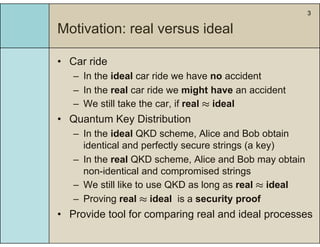
Motivation: real versus ideal
• Car rideCar ride
– In the ideal car ride we have no accident
– In the real car ride we might have an accidentg
– We still take the car, if real ≈ ideal
• Quantum Key Distributiony
– In the ideal QKD scheme, Alice and Bob obtain
identical and perfectly secure strings (a key)
– In the real QKD scheme, Alice and Bob may obtain
non-identical and compromised strings
We still like to use QKD as long as real ≈ ideal– We still like to use QKD as long as real ≈ ideal
– Proving real ≈ ideal is a security proof
• Provide tool for comparing real and ideal processes• Provide tool for comparing real and ideal processes
4
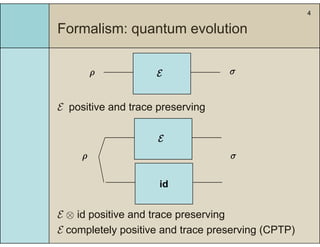
Formalism: quantum evolutionq
Eρ σ
E positive and trace preserving
E
ρ σ
id
E ⊗ id positive and trace preserving
id
E ⊗ id positive and trace preserving
E completely positive and trace preserving (CPTP)
5
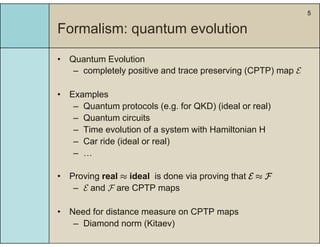
Formalism: quantum evolutionq
• Quantum Evolution
– completely positive and trace preserving (CPTP) map E
• Examples• Examples
– Quantum protocols (e.g. for QKD) (ideal or real)
– Quantum circuits
– Time evolution of a system with Hamiltonian H
– Car ride (ideal or real)
–– …
• Proving real ≈ ideal is done via proving that E ≈ F
– E and F are CPTP maps
• Need for distance measure on CPTP mapsNeed for distance measure on CPTP maps
– Diamond norm (Kitaev)
6
Formalism: diamond norm
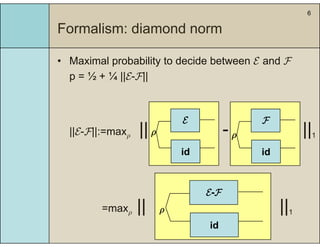
• Maximal probability to decide between E and FMaximal probability to decide between E and F
p = ½ + ¼ ||E-F||
|| ||
E F
||E-F||:=maxρ || - ||1
E
id
F
id
ρ ρ
id id
=maxρ || ||1
E-F
ρρ || ||1
id
ρ
7
Formalism: diamond norm
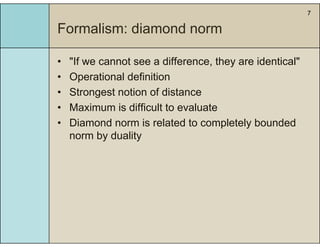
• "If we cannot see a difference they are identical"If we cannot see a difference, they are identical
• Operational definition
• Strongest notion of distanceStrongest notion of distance
• Maximum is difficult to evaluate
• Diamond norm is related to completely bounded• Diamond norm is related to completely bounded
norm by duality
8
Our situation: map on n particlesp p
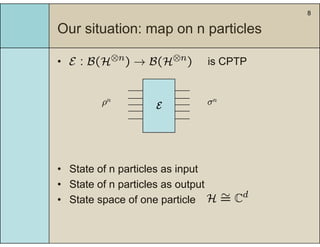
• is CPTPE : B(H⊗n) → B(H⊗n) is CPTPE : B(H ) → B(H )
Eρn σn
• State of n particles as input
• State of n particles as output• State of n particles as output
• State space of one particle H ∼= Cd
9
Our situation: permutation-covariancep
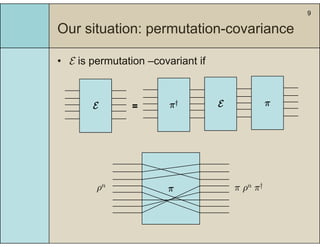
• E is permutation –covariant ifE is permutation covariant if
E = π† E π
†
πρn π ρn π†
10
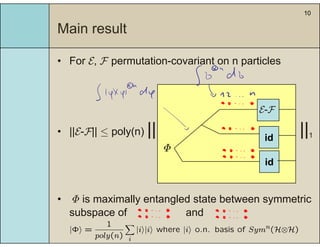
Main result
• For E, F permutation-covariant on n particlesFor E, F permutation covariant on n particles
|| ||
E-F
• ||E-F|| ≤ poly(n) || ||1
Φ
id
id
• Φ is maximally entangled state between symmetric
subspace of andsubspace of and
|Φi =
1
poly(n)
X
i
|ii|ii where |ii o.n. basis of Symn(H⊗H)
11
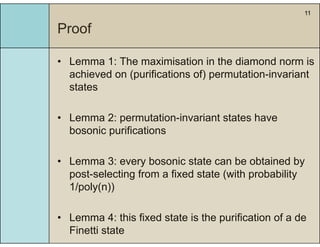
Proof
• Lemma 1: The maximisation in the diamond norm isLemma 1: The maximisation in the diamond norm is
achieved on (purifications of) permutation-invariant
states
• Lemma 2: permutation-invariant states have
bosonic purifications
• Lemma 3: every bosonic state can be obtained by
post-selecting from a fixed state (with probability
1/ l ( ))1/poly(n))
f f f• Lemma 4: this fixed state is the purification of a de
Finetti state
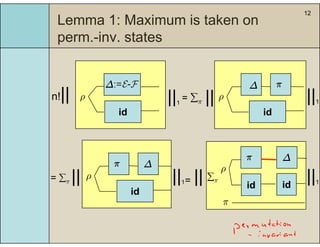
12
Lemma 1: Maximum is taken on
i t tperm.-inv. states
∆:=
!|| || || ||
π∆E-F
id
ρn!|| ||1
id
ρ|| ||1= π
ρ|| ||1
π ∆
= π || π
id
π ∆
id
||1=
ρ
id
|| ||1 || id id
π
||1
13
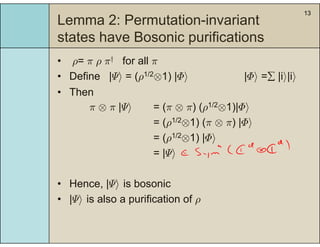
Lemma 2: Permutation-invariant
t t h B i ifi tistates have Bosonic purifications
• ρ= π ρ π† for all πρ π ρ π for all π
• Define |Ψi = (ρ1/2⊗1) |Φi |Φi = |ii|ii
• ThenThen
π ⊗ π |Ψi = (π ⊗ π) (ρ1/2⊗1)|Φi
= (ρ1/2⊗1) (π ⊗ π) |Φi= (ρ ⊗1) (π ⊗ π) |Φi
= (ρ1/2⊗1) |Φi
= |Ψi= |Ψi
• Hence |Ψi is bosonic• Hence, |Ψi is bosonic
• |Ψi is also a purification of ρ
14
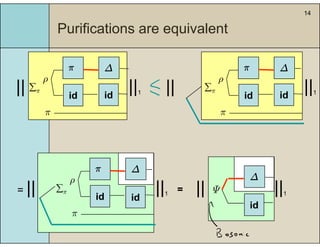
Purifications are equivalentq
|| π
id
π ∆
id
||1
ρ
|| π
id
π ∆
id
||1
ρ
|| id id
π
||1 || id id
π
||1
||
∆
||||
π
||
ρ
∆
||
id
||1= Ψ= || π
id id
π
||1
ρ
π
15
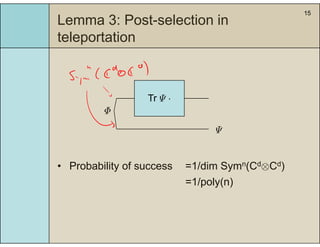
Lemma 3: Post-selection in
t l t titeleportation
Tr Ψ ·
Φ
Ψ
• Probability of success =1/dim Symn(Cd⊗Cd)
=1/poly(n)1/poly(n)
16
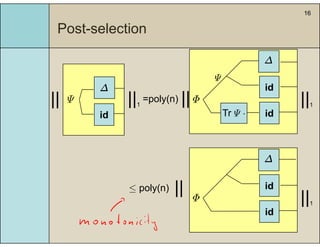
Post-selection
∆
||
∆
||
Ψ
|| ||
id
||
id
||1
Ψ
Tr Ψ ·
||
id
||1
=poly(n) Φ
||
∆
id||≤ poly(n)
id
||1
Φ
id
id
17
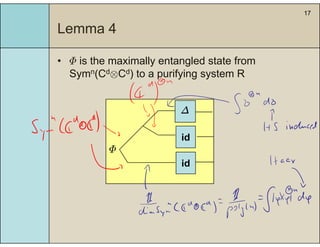
Lemma 4
• Φ is the maximally entangled state fromΦ is the maximally entangled state from
Symn(Cd⊗Cd) to a purifying system R
∆
Φ
id
id
18
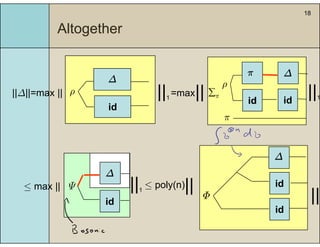
Altogetherg
∆
ρ || || 
π ∆
||
ρ
||∆||=max || =max
id
ρ ||1 || π
id id
π
||1
||∆||=max || =max
∆
∆
||Ψ ||≤ poly(n)
∆
id≤ ||
id
||1Ψ ||≤ poly(n)
id
||Φ
id≤ max ||
19
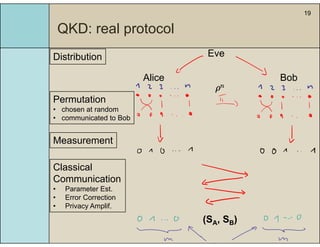
QKD: real protocolQ p
EveDistribution
BobAlice
ρn
Permutation
• chosen at random
• communicated to Bob
Measurement
Classical
Communication
• Parameter Est.
• Error Correction
• Privacy Amplif.
(SA, SB)
20
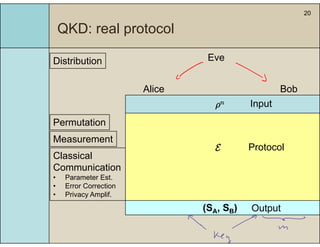
QKD: real protocolQ p
EveDistribution
BobAlice
Distribution
ρn Input
Permutation
Measurement
Cl i l
ProtocolE
Permutation
Classical
Communication
• Parameter Est.
E C ti• Error Correction
• Privacy Amplif.
(SA, SB) Output
21
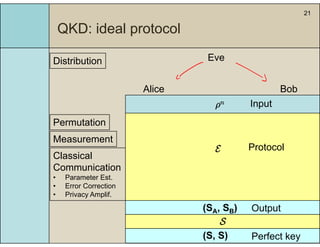
QKD: ideal protocolQ p
EveDistribution
BobAlice
Distribution
ρn Input
Permutation
Cl i l
ProtocolE
Measurement
Permutation
Classical
Communication
• Parameter Est.
E C ti• Error Correction
• Privacy Amplif.
(SA, SB) Output
S
(S, S) Perfect key
22
QKD: application of main resultQ pp
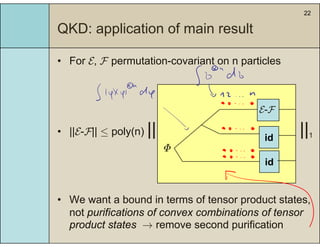
• For E, F permutation-covariant on n particlesFor E, F permutation covariant on n particles
|| ||
E-F
• ||E-F|| ≤ poly(n) || ||1
Φ
id
id
• We want a bound in terms of tensor product states,
not purifications of convex combinations of tensornot purifications of convex combinations of tensor
product states → remove second purification
23
QKD: removal of second purificationQ p
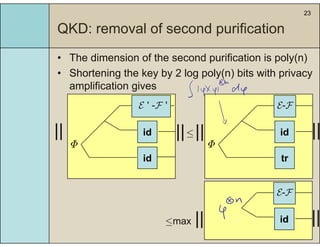
• The dimension of the second purification is poly(n)y( )
• Shortening the key by 2 log poly(n) bits with privacy
amplification gives
E-FE ' -F '
|| ||
Φ
id
Φ
id|| ||||||≤
trid
E-F
|||| id ||||≤max
24
QKD: collective vs general attacksQ g
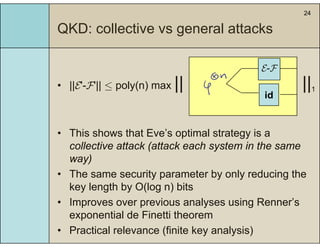
• ||E'-F'|| ≤ poly(n) max || ||1
E-F
idid
• This shows that Eve’s optimal strategy is a
collective attack (attack each system in the same
way)
• The same security parameter by only reducing the
k l th b O(l ) bitkey length by O(log n) bits
• Improves over previous analyses using Renner’s
exponential de Finetti theoremexponential de Finetti theorem
• Practical relevance (finite key analysis)
25
Summaryy
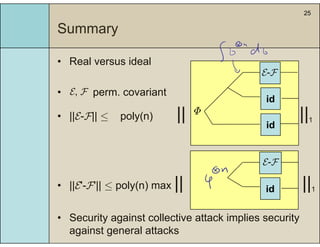
• Real versus idealReal versus ideal
• perm covariant
E-F
E F perm. covariant
• ||E-F|| ≤ poly(n) || ||1
id
Φ
id
E, F
id
E-F
||E' F'|| ≤ poly(n) max || ||id• ||E'-F'|| ≤ poly(n) max || ||1
• Security against collective attack implies security
against general attacks
26
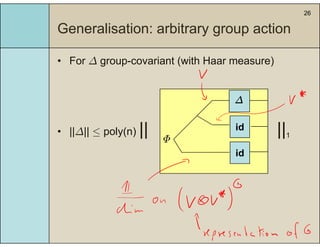
Generalisation: arbitrary group actiony g p
• For ∆ group-covariant (with Haar measure)For ∆ group covariant (with Haar measure)
|| ||
∆
id• ||∆|| ≤ poly(n) || ||1
id
Φ
id
id
27
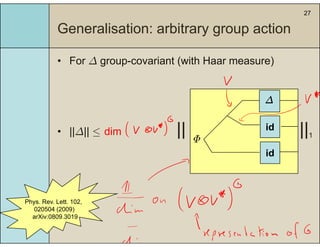
Generalisation: arbitrary group actiony g p
• For ∆ group-covariant (with Haar measure)For ∆ group covariant (with Haar measure)
|| ||
∆
id• ||∆|| ≤ dim || ||1
id
Φ
id
id
Phys. Rev. Lett. 102,
020504 (2009)
arXiv:0809.3019

Postselection technique for quantum channels and applications for qkd

  • 1.
    Postselection technique forquantum channels with application to QKDchannels with application to QKD Matthias Christandl, University of Munich joint with Robert König and Renato Renner
  • 2.
    2 Outline • MotivationMotivation • FormalismFormalism •Main Result• Main Result • Proof• Proof • Application to Quantum Cryptography• Application to Quantum Cryptography Summary and Extension• Summary and Extension
  • 3.
    3 Motivation: real versusideal • Car rideCar ride – In the ideal car ride we have no accident – In the real car ride we might have an accidentg – We still take the car, if real ≈ ideal • Quantum Key Distributiony – In the ideal QKD scheme, Alice and Bob obtain identical and perfectly secure strings (a key) – In the real QKD scheme, Alice and Bob may obtain non-identical and compromised strings We still like to use QKD as long as real ≈ ideal– We still like to use QKD as long as real ≈ ideal – Proving real ≈ ideal is a security proof • Provide tool for comparing real and ideal processes• Provide tool for comparing real and ideal processes
  • 4.
    4 Formalism: quantum evolutionq Eρσ E positive and trace preserving E ρ σ id E ⊗ id positive and trace preserving id E ⊗ id positive and trace preserving E completely positive and trace preserving (CPTP)
  • 5.
    5 Formalism: quantum evolutionq •Quantum Evolution – completely positive and trace preserving (CPTP) map E • Examples• Examples – Quantum protocols (e.g. for QKD) (ideal or real) – Quantum circuits – Time evolution of a system with Hamiltonian H – Car ride (ideal or real) –– … • Proving real ≈ ideal is done via proving that E ≈ F – E and F are CPTP maps • Need for distance measure on CPTP mapsNeed for distance measure on CPTP maps – Diamond norm (Kitaev)
  • 6.
    6 Formalism: diamond norm •Maximal probability to decide between E and FMaximal probability to decide between E and F p = ½ + ¼ ||E-F|| || || E F ||E-F||:=maxρ || - ||1 E id F id ρ ρ id id =maxρ || ||1 E-F ρρ || ||1 id ρ
  • 7.
    7 Formalism: diamond norm •"If we cannot see a difference they are identical"If we cannot see a difference, they are identical • Operational definition • Strongest notion of distanceStrongest notion of distance • Maximum is difficult to evaluate • Diamond norm is related to completely bounded• Diamond norm is related to completely bounded norm by duality
  • 8.
    8 Our situation: mapon n particlesp p • is CPTPE : B(H⊗n) → B(H⊗n) is CPTPE : B(H ) → B(H ) Eρn σn • State of n particles as input • State of n particles as output• State of n particles as output • State space of one particle H ∼= Cd
  • 9.
    9 Our situation: permutation-covariancep •E is permutation –covariant ifE is permutation covariant if E = π† E π † πρn π ρn π†
  • 10.
    10 Main result • ForE, F permutation-covariant on n particlesFor E, F permutation covariant on n particles || || E-F • ||E-F|| ≤ poly(n) || ||1 Φ id id • Φ is maximally entangled state between symmetric subspace of andsubspace of and |Φi = 1 poly(n) X i |ii|ii where |ii o.n. basis of Symn(H⊗H)
  • 11.
    11 Proof • Lemma 1:The maximisation in the diamond norm isLemma 1: The maximisation in the diamond norm is achieved on (purifications of) permutation-invariant states • Lemma 2: permutation-invariant states have bosonic purifications • Lemma 3: every bosonic state can be obtained by post-selecting from a fixed state (with probability 1/ l ( ))1/poly(n)) f f f• Lemma 4: this fixed state is the purification of a de Finetti state
  • 12.
    12 Lemma 1: Maximumis taken on i t tperm.-inv. states ∆:= !|| || || || π∆E-F id ρn!|| ||1 id ρ|| ||1= π ρ|| ||1 π ∆ = π || π id π ∆ id ||1= ρ id || ||1 || id id π ||1
  • 13.
    13 Lemma 2: Permutation-invariant tt h B i ifi tistates have Bosonic purifications • ρ= π ρ π† for all πρ π ρ π for all π • Define |Ψi = (ρ1/2⊗1) |Φi |Φi = |ii|ii • ThenThen π ⊗ π |Ψi = (π ⊗ π) (ρ1/2⊗1)|Φi = (ρ1/2⊗1) (π ⊗ π) |Φi= (ρ ⊗1) (π ⊗ π) |Φi = (ρ1/2⊗1) |Φi = |Ψi= |Ψi • Hence |Ψi is bosonic• Hence, |Ψi is bosonic • |Ψi is also a purification of ρ
  • 14.
    14 Purifications are equivalentq ||π id π ∆ id ||1 ρ || π id π ∆ id ||1 ρ || id id π ||1 || id id π ||1 || ∆ |||| π || ρ ∆ || id ||1= Ψ= || π id id π ||1 ρ π
  • 15.
    15 Lemma 3: Post-selectionin t l t titeleportation Tr Ψ · Φ Ψ • Probability of success =1/dim Symn(Cd⊗Cd) =1/poly(n)1/poly(n)
  • 16.
    16 Post-selection ∆ || ∆ || Ψ || || id || id ||1 Ψ Tr Ψ· || id ||1 =poly(n) Φ || ∆ id||≤ poly(n) id ||1 Φ id id
  • 17.
    17 Lemma 4 • Φis the maximally entangled state fromΦ is the maximally entangled state from Symn(Cd⊗Cd) to a purifying system R ∆ Φ id id
  • 18.
    18 Altogetherg ∆ ρ || || π ∆ || ρ ||∆||=max || =max id ρ ||1 || π id id π ||1 ||∆||=max || =max ∆ ∆ ||Ψ ||≤ poly(n) ∆ id≤ || id ||1Ψ ||≤ poly(n) id ||Φ id≤ max ||
  • 19.
    19 QKD: real protocolQp EveDistribution BobAlice ρn Permutation • chosen at random • communicated to Bob Measurement Classical Communication • Parameter Est. • Error Correction • Privacy Amplif. (SA, SB)
  • 20.
    20 QKD: real protocolQp EveDistribution BobAlice Distribution ρn Input Permutation Measurement Cl i l ProtocolE Permutation Classical Communication • Parameter Est. E C ti• Error Correction • Privacy Amplif. (SA, SB) Output
  • 21.
    21 QKD: ideal protocolQp EveDistribution BobAlice Distribution ρn Input Permutation Cl i l ProtocolE Measurement Permutation Classical Communication • Parameter Est. E C ti• Error Correction • Privacy Amplif. (SA, SB) Output S (S, S) Perfect key
  • 22.
    22 QKD: application ofmain resultQ pp • For E, F permutation-covariant on n particlesFor E, F permutation covariant on n particles || || E-F • ||E-F|| ≤ poly(n) || ||1 Φ id id • We want a bound in terms of tensor product states, not purifications of convex combinations of tensornot purifications of convex combinations of tensor product states → remove second purification
  • 23.
    23 QKD: removal ofsecond purificationQ p • The dimension of the second purification is poly(n)y( ) • Shortening the key by 2 log poly(n) bits with privacy amplification gives E-FE ' -F ' || || Φ id Φ id|| ||||||≤ trid E-F |||| id ||||≤max
  • 24.
    24 QKD: collective vsgeneral attacksQ g • ||E'-F'|| ≤ poly(n) max || ||1 E-F idid • This shows that Eve’s optimal strategy is a collective attack (attack each system in the same way) • The same security parameter by only reducing the k l th b O(l ) bitkey length by O(log n) bits • Improves over previous analyses using Renner’s exponential de Finetti theoremexponential de Finetti theorem • Practical relevance (finite key analysis)
  • 25.
    25 Summaryy • Real versusidealReal versus ideal • perm covariant E-F E F perm. covariant • ||E-F|| ≤ poly(n) || ||1 id Φ id E, F id E-F ||E' F'|| ≤ poly(n) max || ||id• ||E'-F'|| ≤ poly(n) max || ||1 • Security against collective attack implies security against general attacks
  • 26.
    26 Generalisation: arbitrary groupactiony g p • For ∆ group-covariant (with Haar measure)For ∆ group covariant (with Haar measure) || || ∆ id• ||∆|| ≤ poly(n) || ||1 id Φ id id
  • 27.
    27 Generalisation: arbitrary groupactiony g p • For ∆ group-covariant (with Haar measure)For ∆ group covariant (with Haar measure) || || ∆ id• ||∆|| ≤ dim || ||1 id Φ id id Phys. Rev. Lett. 102, 020504 (2009) arXiv:0809.3019