Quantum Cryptography 
Presented By 
Tabrej A.Khan 
13223006
• Classical Cryptography 
• Introduction to Quantum cryptography- 
• Classical Cryptography and Key Distribution Problem. 
• Quantum Communication . 
• Elements of Quantum Theory 
• Heisenberg Uncertainty Principle 
• Quantum Key Distribution . 
• Detecting Eavesdropper 
• Technical Challenges of QKD
. 
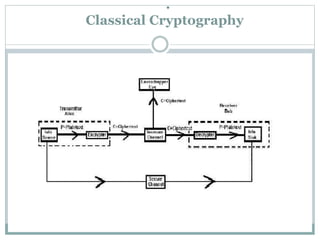
Classical Cryptography
Symmetric Algorithm 
 Usually use same key for encryption and decryption. 
 Require sender and receiver to agree on a key before 
they communicate securely. 
 Encryption key can be calculated from decryption 
key and vice versa 
 Security lies with the key. 
 Also called secret key algorithms, singlekey 
algorithms, or one-key algorithms 
 Example: DES (1977), Triple DES (1998),AES
Asymmetric Algorithm 
 Use different keys for encryption and decryption. 
 Decryption key cannot be calculated from the 
encryption key 
 Anyone can use the key to encrypt data and send it to 
the host; only the host can decrypt the data 
 Also known as public key algorithms 
 Example: Diffie-Hellman (1976) RSA (1977)
Vulnerabilities/Weakness to the 
modern/classical cryptography 
 There are three main problems with encryption 
schemes 
-first is key distribution 
-the second is key management 
-Thirdly as computing power increases, and new 
classical computational techniques are developed, 
the length of time that a message can be considered 
secure will decrease, and numerical keys will no 
longer be able to provide acceptable levels of secure 
communications
Key Distribution Problem 
 How to communicate the key securely between two 
pair of users. 
 it is not possible to check whether this medium was 
intercepted – and its content copied – or not. 
 Public key cryptography came as a solution to this, 
but these too are slow and cannot be used to encrypt 
large amount of data
Elements of Quantum Theory 
 Light waves are made up of millions of discrete 
quanta called Photons 
 They are massless and have energy, momentum 
and angular momentum called spin. 
 Spin carries the polarization.
Quantum Communication 
The Classical World 
- Bits either 0 or 1. 
- Bits can be copied. 
- Bits can be observed without changing them. (So, eavesdropping cannot 
be detected in classical cryptosystems.) 
Quantum Bits 
- A quantum bit (qubit) can be 0 or 1 at the same time. 
- It can not be copied (no cloning theorem). 
- Its state will collapse if it is observed (measured). 
 If a qubit can be 0 or 1 at the same time, how many values can n qubits 
have at the same time ?
Quantum Communication 
 Quantum cryptography solves the key distribution problem by 
allowing the exchange of a cryptographic key between two 
remote parties with absolute security, guaranteed by the laws 
of physics. 
 Quantum Communication is based on two features of 
Quantum mechanisms and photons. 
-State indeterminancy based on Heisenberg principle . 
-Entangled based protocols that means two entities can be 
defined such that their properties are entangled altering one 
effects the value of other.
Heisenberg Uncertainty Principle 
 For any two observable properties linked together 
like mass and momentum 
• According to the principle two interrelated properties 
cannot be measured individually without affecting the 
other. 
• Measuring the state of photon will affect it value
Quantum Key Distribution – BB84 
Protocol
Quantum Mechanics for Cryptography – 
Measurement Basis 
 Basis – frame of reference for quantum 
measurement 
 Example – polarization 
vertical/horizontal vs. diagonal 
 Horizontal filter, light gets through = 0 
 Vertical filter, light gets through = 1 
 45 deg. filter, light = 0 
 135 deg. filter, light = 1
Quantum Key Distribution – BB84 
Protocol
Example
Detecting Eavesdroppers 
 To check for the presence of eavesdropping Alice and 
Bob now compare a certain subset of their remaining 
bit strings. 
 If any interceptor has gained any information about 
the photons polarization, this will have introduced 
errors in Bobs' measurements 
 If more than p bits differ they abort the key and try 
again, possibly with a different quantum channel, as 
the security of the key cannot be guaranteed.
19 
Alice's Bit Sequence 
0 1 0 - 0 1 1 1 1 - 1 0 
- 1 - - 0 1 - - 1 - 1 0 
Bob's Bases 
Bob's Results 
Key 
Alice 
Bob 
Polarizers 
Horizontal - Vertical 
Diagonal (-45, +45) 
H/V Basis 
45 Basis 
BB84 protocol: Eve  25% errors
Intercept and Resend Attack
Implementing Quantum 
Cryptography(Real Case) 
 BBN, Harvard, and Boston University built the DARPA quantum network, 
the world’s first network that delivers end-to-end network security via 
high-speed quantum key distribution, and tested that network against 
sophisticated eavesdropping attacks. 
 For the Bank of Austria, the novel technology was demonstrated by the 
group of Professor Anton Zeilinger, Vienna University in collaboration with 
the group Quantum Technologies of Seibersdorf research. 
 The bank transfer was initiated by Vienna’s Mayor Dr. Michael Haupl, and 
executed by the director of the Bank Austria Creditanstalt, Dr. Erich. 
 The information was sent via a glass fiber cable from the Vienna City 
 Hall to the Bank Austria Creditanstalt branch office “Schottengasse”.
TECHNICAL CHALLENGES OF QKD AND 
FUTURE DIRECTION 
 One of the challenges for the researchers, is distance 
limitation.Currently, quantum key distribution 
distances are limited to tens of kilometers because of 
optical amplification destroys the qubit state. 
 Also to develop optical device capable of generating, 
detecting and guiding single photons; devices that 
are affordable within a commercial environment . 
 Also users need reassurance not only that QKD is 
theoretically sound, but also that it has been securely 
implemented by the vendors.
Summary 
 Realization of practical quantum information 
technologies can not be accomplished without 
involvement of the network research community. 
 The advances in computer processing power and the 
threat of limitation for today’s cryptography systems 
will remain a driving force in the continued research 
and development of quantum cryptography. 
 The technology has the potential to make a valuable 
contribution to the network security among 
government, businesses, and academic environment.
Future Prospects 
 Ground-to-satellite, satellite-to-satellite links 
 General improvement with evolving qubit-handling 
techniques, new detector technologies
Thanks

quantumcrypto

  • 1.
    Quantum Cryptography PresentedBy Tabrej A.Khan 13223006
  • 2.
    • Classical Cryptography • Introduction to Quantum cryptography- • Classical Cryptography and Key Distribution Problem. • Quantum Communication . • Elements of Quantum Theory • Heisenberg Uncertainty Principle • Quantum Key Distribution . • Detecting Eavesdropper • Technical Challenges of QKD
  • 3.
  • 4.
    Symmetric Algorithm Usually use same key for encryption and decryption.  Require sender and receiver to agree on a key before they communicate securely.  Encryption key can be calculated from decryption key and vice versa  Security lies with the key.  Also called secret key algorithms, singlekey algorithms, or one-key algorithms  Example: DES (1977), Triple DES (1998),AES
  • 6.
    Asymmetric Algorithm Use different keys for encryption and decryption.  Decryption key cannot be calculated from the encryption key  Anyone can use the key to encrypt data and send it to the host; only the host can decrypt the data  Also known as public key algorithms  Example: Diffie-Hellman (1976) RSA (1977)
  • 8.
    Vulnerabilities/Weakness to the modern/classical cryptography  There are three main problems with encryption schemes -first is key distribution -the second is key management -Thirdly as computing power increases, and new classical computational techniques are developed, the length of time that a message can be considered secure will decrease, and numerical keys will no longer be able to provide acceptable levels of secure communications
  • 9.
    Key Distribution Problem  How to communicate the key securely between two pair of users.  it is not possible to check whether this medium was intercepted – and its content copied – or not.  Public key cryptography came as a solution to this, but these too are slow and cannot be used to encrypt large amount of data
  • 10.
    Elements of QuantumTheory  Light waves are made up of millions of discrete quanta called Photons  They are massless and have energy, momentum and angular momentum called spin.  Spin carries the polarization.
  • 11.
    Quantum Communication TheClassical World - Bits either 0 or 1. - Bits can be copied. - Bits can be observed without changing them. (So, eavesdropping cannot be detected in classical cryptosystems.) Quantum Bits - A quantum bit (qubit) can be 0 or 1 at the same time. - It can not be copied (no cloning theorem). - Its state will collapse if it is observed (measured).  If a qubit can be 0 or 1 at the same time, how many values can n qubits have at the same time ?
  • 12.
    Quantum Communication Quantum cryptography solves the key distribution problem by allowing the exchange of a cryptographic key between two remote parties with absolute security, guaranteed by the laws of physics.  Quantum Communication is based on two features of Quantum mechanisms and photons. -State indeterminancy based on Heisenberg principle . -Entangled based protocols that means two entities can be defined such that their properties are entangled altering one effects the value of other.
  • 13.
    Heisenberg Uncertainty Principle  For any two observable properties linked together like mass and momentum • According to the principle two interrelated properties cannot be measured individually without affecting the other. • Measuring the state of photon will affect it value
  • 14.
    Quantum Key Distribution– BB84 Protocol
  • 15.
    Quantum Mechanics forCryptography – Measurement Basis  Basis – frame of reference for quantum measurement  Example – polarization vertical/horizontal vs. diagonal  Horizontal filter, light gets through = 0  Vertical filter, light gets through = 1  45 deg. filter, light = 0  135 deg. filter, light = 1
  • 16.
    Quantum Key Distribution– BB84 Protocol
  • 17.
  • 18.
    Detecting Eavesdroppers To check for the presence of eavesdropping Alice and Bob now compare a certain subset of their remaining bit strings.  If any interceptor has gained any information about the photons polarization, this will have introduced errors in Bobs' measurements  If more than p bits differ they abort the key and try again, possibly with a different quantum channel, as the security of the key cannot be guaranteed.
  • 19.
    19 Alice's BitSequence 0 1 0 - 0 1 1 1 1 - 1 0 - 1 - - 0 1 - - 1 - 1 0 Bob's Bases Bob's Results Key Alice Bob Polarizers Horizontal - Vertical Diagonal (-45, +45) H/V Basis 45 Basis BB84 protocol: Eve  25% errors
  • 20.
  • 21.
    Implementing Quantum Cryptography(RealCase)  BBN, Harvard, and Boston University built the DARPA quantum network, the world’s first network that delivers end-to-end network security via high-speed quantum key distribution, and tested that network against sophisticated eavesdropping attacks.  For the Bank of Austria, the novel technology was demonstrated by the group of Professor Anton Zeilinger, Vienna University in collaboration with the group Quantum Technologies of Seibersdorf research.  The bank transfer was initiated by Vienna’s Mayor Dr. Michael Haupl, and executed by the director of the Bank Austria Creditanstalt, Dr. Erich.  The information was sent via a glass fiber cable from the Vienna City  Hall to the Bank Austria Creditanstalt branch office “Schottengasse”.
  • 22.
    TECHNICAL CHALLENGES OFQKD AND FUTURE DIRECTION  One of the challenges for the researchers, is distance limitation.Currently, quantum key distribution distances are limited to tens of kilometers because of optical amplification destroys the qubit state.  Also to develop optical device capable of generating, detecting and guiding single photons; devices that are affordable within a commercial environment .  Also users need reassurance not only that QKD is theoretically sound, but also that it has been securely implemented by the vendors.
  • 23.
    Summary  Realizationof practical quantum information technologies can not be accomplished without involvement of the network research community.  The advances in computer processing power and the threat of limitation for today’s cryptography systems will remain a driving force in the continued research and development of quantum cryptography.  The technology has the potential to make a valuable contribution to the network security among government, businesses, and academic environment.
  • 24.
    Future Prospects Ground-to-satellite, satellite-to-satellite links  General improvement with evolving qubit-handling techniques, new detector technologies
  • 25.