Improving the Space-Bounded Version of
Muchnik’s Conditional Complexity Theorem via
          “Naive” Derandomization

                  Daniil Musatov1
           1 Lomonosov   Moscow State University,


          St. Petersburg, June 14th, 2011
Some disclaimers


      This talk is in some sense a continuation of the previous one
Some disclaimers


      This talk is in some sense a continuation of the previous one
      A similar technique is used to obtain a different result
Some disclaimers


      This talk is in some sense a continuation of the previous one
      A similar technique is used to obtain a different result
      Why “naive”?
Some disclaimers


      This talk is in some sense a continuation of the previous one
      A similar technique is used to obtain a different result
      Why “naive”? Because we simply replace a random object by
      a pseudo-random one and it still does the job.
Kolmogorov complexity


      Kolmogorov complexity C (a|b) of a string a conditional to b
      is the minimal length of a program p that produces a given b,
      i.e., p(b) = a
Kolmogorov complexity


      Kolmogorov complexity C (a|b) of a string a conditional to b
      is the minimal length of a program p that produces a given b,
      i.e., p(b) = a
      Space-bounded version: C s (a|b) is the minimal length of a
      program p such that p(b) = a
Kolmogorov complexity


      Kolmogorov complexity C (a|b) of a string a conditional to b
      is the minimal length of a program p that produces a given b,
      i.e., p(b) = a
      Space-bounded version: C s (a|b) is the minimal length of a
      program p such that p(b) = a and the computation of p(b)
      performs in space s.
Muchnik’s theorem


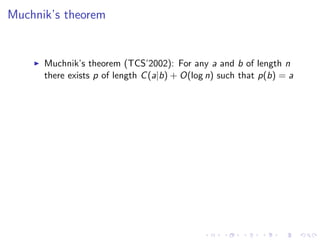
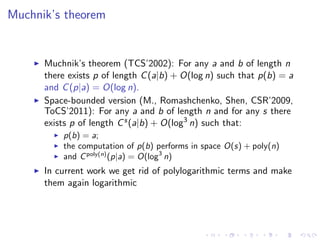
      Muchnik’s theorem (TCS’2002): For any a and b of length n
      there exists p of length C (a|b) + O(log n) such that p(b) = a
Muchnik’s theorem


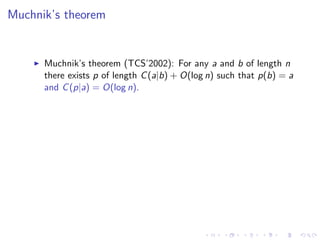
      Muchnik’s theorem (TCS’2002): For any a and b of length n
      there exists p of length C (a|b) + O(log n) such that p(b) = a
      and C (p|a) = O(log n).
Muchnik’s theorem


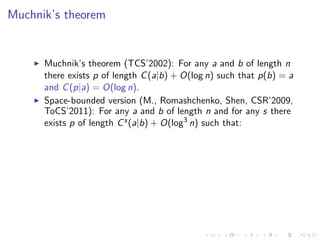
      Muchnik’s theorem (TCS’2002): For any a and b of length n
      there exists p of length C (a|b) + O(log n) such that p(b) = a
      and C (p|a) = O(log n).
      Space-bounded version (M., Romashchenko, Shen, CSR’2009,
      ToCS’2011): For any a and b of length n and for any s there
      exists p of length C s (a|b) + O(log3 n) such that:
Muchnik’s theorem


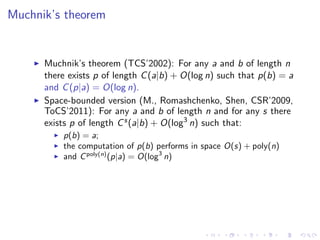
      Muchnik’s theorem (TCS’2002): For any a and b of length n
      there exists p of length C (a|b) + O(log n) such that p(b) = a
      and C (p|a) = O(log n).
      Space-bounded version (M., Romashchenko, Shen, CSR’2009,
      ToCS’2011): For any a and b of length n and for any s there
      exists p of length C s (a|b) + O(log3 n) such that:
          p(b) = a;
          the computation of p(b) performs in space O(s) + poly(n)
          and C poly(n) (p|a) = O(log3 n)
Muchnik’s theorem


      Muchnik’s theorem (TCS’2002): For any a and b of length n
      there exists p of length C (a|b) + O(log n) such that p(b) = a
      and C (p|a) = O(log n).
      Space-bounded version (M., Romashchenko, Shen, CSR’2009,
      ToCS’2011): For any a and b of length n and for any s there
      exists p of length C s (a|b) + O(log3 n) such that:
          p(b) = a;
          the computation of p(b) performs in space O(s) + poly(n)
          and C poly(n) (p|a) = O(log3 n)
      In current work we get rid of polylogarithmic terms and make
      them again logarithmic
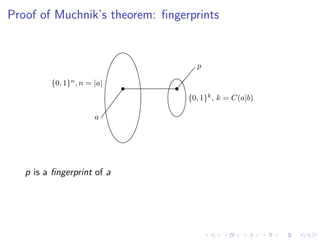
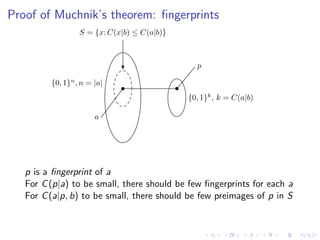
Proof of Muchnik’s theorem: fingerprints


        {0, 1}n , n = |a|
                                 {0, 1}k , k = C(a|b)

                      a
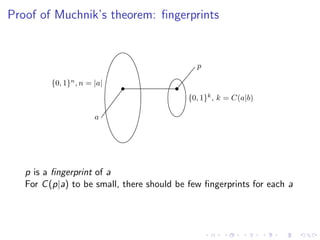
Proof of Muchnik’s theorem: fingerprints


                                   p

         {0, 1}n , n = |a|
                                 {0, 1}k , k = C(a|b)

                       a


   p is a fingerprint of a
Proof of Muchnik’s theorem: fingerprints


                                              p

         {0, 1}n , n = |a|
                                           {0, 1}k , k = C(a|b)

                       a


   p is a fingerprint of a
   For C (p|a) to be small, there should be few fingerprints for each a
Proof of Muchnik’s theorem: fingerprints
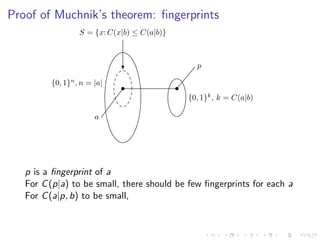
                  S = {x: C(x|b) ≤ C(a|b)}


                                               p

         {0, 1}n , n = |a|
                                             {0, 1}k , k = C(a|b)

                       a


   p is a fingerprint of a
   For C (p|a) to be small, there should be few fingerprints for each a
   For C (a|p, b) to be small,
Proof of Muchnik’s theorem: fingerprints
                  S = {x: C(x|b) ≤ C(a|b)}


                                               p

         {0, 1}n , n = |a|
                                             {0, 1}k , k = C(a|b)

                       a


   p is a fingerprint of a
   For C (p|a) to be small, there should be few fingerprints for each a
   For C (a|p, b) to be small, there should be few preimages of p in S
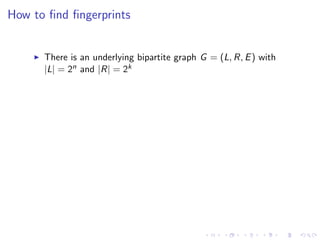
How to find fingerprints


      There is an underlying bipartite graph G = (L, R, E ) with
      |L| = 2n and |R| = 2k
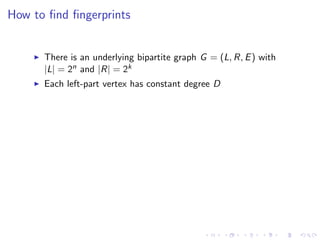
How to find fingerprints


      There is an underlying bipartite graph G = (L, R, E ) with
      |L| = 2n and |R| = 2k
      Each left-part vertex has constant degree D
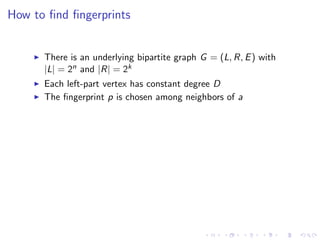
How to find fingerprints


      There is an underlying bipartite graph G = (L, R, E ) with
      |L| = 2n and |R| = 2k
      Each left-part vertex has constant degree D
      The fingerprint p is chosen among neighbors of a
How to find fingerprints


      There is an underlying bipartite graph G = (L, R, E ) with
      |L| = 2n and |R| = 2k
      Each left-part vertex has constant degree D
      The fingerprint p is chosen among neighbors of a
          This guarantees that C (p|a, G ) = O(log D)
How to find fingerprints


      There is an underlying bipartite graph G = (L, R, E ) with
      |L| = 2n and |R| = 2k
      Each left-part vertex has constant degree D
      The fingerprint p is chosen among neighbors of a
          This guarantees that C (p|a, G ) = O(log D)
      The statement that C (a|p, b, G ) is small for some p follows
      from some enumerable graph property (see later)
How to find fingerprints


      There is an underlying bipartite graph G = (L, R, E ) with
      |L| = 2n and |R| = 2k
      Each left-part vertex has constant degree D
      The fingerprint p is chosen among neighbors of a
          This guarantees that C (p|a, G ) = O(log D)
      The statement that C (a|p, b, G ) is small for some p follows
      from some enumerable graph property (see later)
      It is proven by the probabilistic method that this property is
      non-empty
How to find fingerprints


      There is an underlying bipartite graph G = (L, R, E ) with
      |L| = 2n and |R| = 2k
      Each left-part vertex has constant degree D
      The fingerprint p is chosen among neighbors of a
          This guarantees that C (p|a, G ) = O(log D)
      The statement that C (a|p, b, G ) is small for some p follows
      from some enumerable graph property (see later)
      It is proven by the probabilistic method that this property is
      non-empty
      Hence, the first graph in the enumeration has small complexity
How to find fingerprints


      There is an underlying bipartite graph G = (L, R, E ) with
      |L| = 2n and |R| = 2k
      Each left-part vertex has constant degree D
      The fingerprint p is chosen among neighbors of a
          This guarantees that C (p|a, G ) = O(log D)
      The statement that C (a|p, b, G ) is small for some p follows
      from some enumerable graph property (see later)
      It is proven by the probabilistic method that this property is
      non-empty
      Hence, the first graph in the enumeration has small complexity
      Hence, C (p|a) and C (a|p, b) are also small
What graph properties do we need?


   Some graph properties leading to Muchnik’s theorem:
       (Muchnik) Expander-like property
What graph properties do we need?


   Some graph properties leading to Muchnik’s theorem:
       (Muchnik) Expander-like property
       (MRS) Possibility of online matching
What graph properties do we need?


   Some graph properties leading to Muchnik’s theorem:
       (Muchnik) Expander-like property
       (MRS) Possibility of online matching
       (MRS) Extractor
What graph properties do we need?


   Some graph properties leading to Muchnik’s theorem:
       (Muchnik) Expander-like property
       (MRS) Possibility of online matching
       (MRS) Extractor
       (This paper) “Low-congesting”
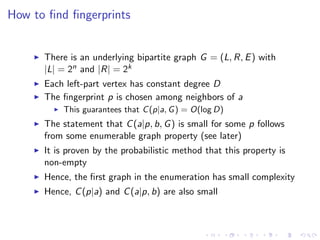
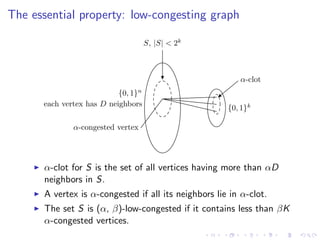
The essential property: low-congesting graph

                                     S, |S| < 2k


                           {0, 1}n
      each vertex has D neighbors
                                                   {0, 1}k
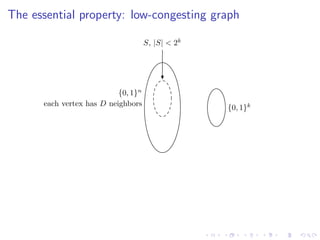
The essential property: low-congesting graph

                                    S, |S| < 2k


                                                       α-clot
                           {0, 1}
                               n

      each vertex has D neighbors
                                                    {0, 1}k


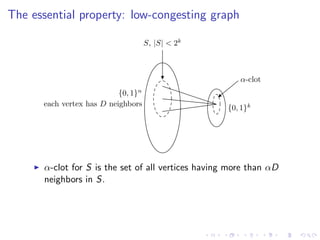
      α-clot for S is the set of all vertices having more than αD
      neighbors in S.
The essential property: low-congesting graph

                                    S, |S| < 2k


                                                         α-clot
                           {0, 1}
                               n

      each vertex has D neighbors
                                                      {0, 1}k

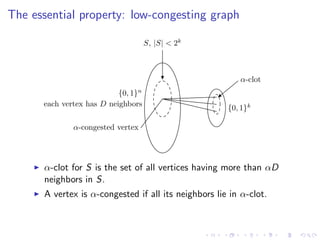
              α-congested vertex


      α-clot for S is the set of all vertices having more than αD
      neighbors in S.
      A vertex is α-congested if all its neighbors lie in α-clot.
The essential property: low-congesting graph

                                    S, |S| < 2k


                                                         α-clot
                           {0, 1}
                               n

      each vertex has D neighbors
                                                      {0, 1}k

              α-congested vertex


      α-clot for S is the set of all vertices having more than αD
      neighbors in S.
      A vertex is α-congested if all its neighbors lie in α-clot.
      The set S is (α, β)-low-congested if it contains less than βK
      α-congested vertices.
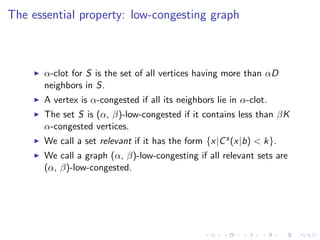
The essential property: low-congesting graph


      α-clot for S is the set of all vertices having more than αD
      neighbors in S.
      A vertex is α-congested if all its neighbors lie in α-clot.
      The set S is (α, β)-low-congested if it contains less than βK
      α-congested vertices.
      We call a set relevant if it has the form {x|C s (x|b) < k}.
      We call a graph (α, β)-low-congesting if all relevant sets are
      (α, β)-low-congested.
How to get a low-congesting graph

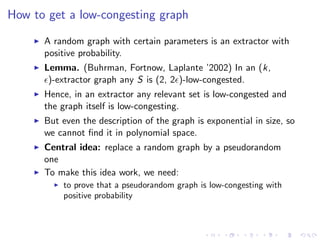
      A random graph with certain parameters is an extractor with
      positive probability.
How to get a low-congesting graph

      A random graph with certain parameters is an extractor with
      positive probability.
      Lemma. (Buhrman, Fortnow, Laplante ’2002) In an (k,
       )-extractor graph any S is (2, 2 )-low-congested.
      Hence, in an extractor any relevant set is low-congested and
      the graph itself is low-congesting.
How to get a low-congesting graph

      A random graph with certain parameters is an extractor with
      positive probability.
      Lemma. (Buhrman, Fortnow, Laplante ’2002) In an (k,
       )-extractor graph any S is (2, 2 )-low-congested.
      Hence, in an extractor any relevant set is low-congested and
      the graph itself is low-congesting.
      But even the description of the graph is exponential in size, so
      we cannot find it in polynomial space.
How to get a low-congesting graph

      A random graph with certain parameters is an extractor with
      positive probability.
      Lemma. (Buhrman, Fortnow, Laplante ’2002) In an (k,
       )-extractor graph any S is (2, 2 )-low-congested.
      Hence, in an extractor any relevant set is low-congested and
      the graph itself is low-congesting.
      But even the description of the graph is exponential in size, so
      we cannot find it in polynomial space.
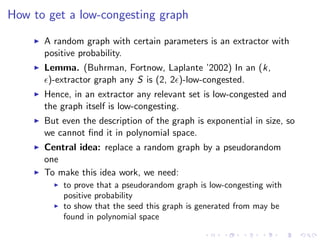
      Central idea: replace a random graph by a pseudorandom
      one
      To make this idea work, we need:
How to get a low-congesting graph

      A random graph with certain parameters is an extractor with
      positive probability.
      Lemma. (Buhrman, Fortnow, Laplante ’2002) In an (k,
       )-extractor graph any S is (2, 2 )-low-congested.
      Hence, in an extractor any relevant set is low-congested and
      the graph itself is low-congesting.
      But even the description of the graph is exponential in size, so
      we cannot find it in polynomial space.
      Central idea: replace a random graph by a pseudorandom
      one
      To make this idea work, we need:
          to prove that a pseudorandom graph is low-congesting with
          positive probability
How to get a low-congesting graph

      A random graph with certain parameters is an extractor with
      positive probability.
      Lemma. (Buhrman, Fortnow, Laplante ’2002) In an (k,
       )-extractor graph any S is (2, 2 )-low-congested.
      Hence, in an extractor any relevant set is low-congested and
      the graph itself is low-congesting.
      But even the description of the graph is exponential in size, so
      we cannot find it in polynomial space.
      Central idea: replace a random graph by a pseudorandom
      one
      To make this idea work, we need:
          to prove that a pseudorandom graph is low-congesting with
          positive probability
          to show that the seed this graph is generated from may be
          found in polynomial space
Why a pseudorandom graph fits


      We use the Nisan pseudorandom generator with polynomial
      seed length and exponential output.
Why a pseudorandom graph fits


      We use the Nisan pseudorandom generator with polynomial
      seed length and exponential output.
      It is well-known that this generator fools any circuit from AC0
Why a pseudorandom graph fits


      We use the Nisan pseudorandom generator with polynomial
      seed length and exponential output.
      It is well-known that this generator fools any circuit from AC0
          The size of a fooled circuit may be exponential since the size
          of output is exponential.
Why a pseudorandom graph fits


      We use the Nisan pseudorandom generator with polynomial
      seed length and exponential output.
      It is well-known that this generator fools any circuit from AC0
          The size of a fooled circuit may be exponential since the size
          of output is exponential.
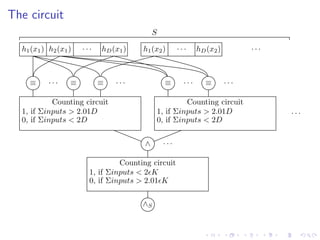
      We cannot check the low-congesting property literally, but
      using circuits for approximate counting we build a circuit C
      such that:
Why a pseudorandom graph fits


      We use the Nisan pseudorandom generator with polynomial
      seed length and exponential output.
      It is well-known that this generator fools any circuit from AC0
          The size of a fooled circuit may be exponential since the size
          of output is exponential.
      We cannot check the low-congesting property literally, but
      using circuits for approximate counting we build a circuit C
      such that:
          If G is (2, 2 )-low-congesting then C (G ) = 1;
Why a pseudorandom graph fits


      We use the Nisan pseudorandom generator with polynomial
      seed length and exponential output.
      It is well-known that this generator fools any circuit from AC0
          The size of a fooled circuit may be exponential since the size
          of output is exponential.
      We cannot check the low-congesting property literally, but
      using circuits for approximate counting we build a circuit C
      such that:
          If G is (2, 2 )-low-congesting then C (G ) = 1;
          If C (G ) = 1 then G is (2.01, 2.01 )-low-congesting.
Why a pseudorandom graph fits


      We use the Nisan pseudorandom generator with polynomial
      seed length and exponential output.
      It is well-known that this generator fools any circuit from AC0
          The size of a fooled circuit may be exponential since the size
          of output is exponential.
      We cannot check the low-congesting property literally, but
      using circuits for approximate counting we build a circuit C
      such that:
          If G is (2, 2 )-low-congesting then C (G ) = 1;
          If C (G ) = 1 then G is (2.01, 2.01 )-low-congesting.
      This circuit accepts a random graph with sufficient probability,
      hence it does the same with a pseudorandom one.
The circuit
                                            S

  h1 (x1 ) h2 (x1 )   ···   hD (x1 )   h1 (x2 )        ···     hD (x2 )         ···


    ≡      ···    ≡         ≡   ···               ≡      ···     ≡        ···

           Counting circuit                              Counting circuit
  1, if Σinputs > 2.01D                         1, if Σinputs > 2.01D                 ···
  0, if Σinputs < 2D                            0, if Σinputs < 2D


                                        ∧        ···

                                 Counting circuit
                        1, if Σinputs < 2ϵK
                        0, if Σinputs > 2.01ϵK

                                       ∧S
How to get Muchnik’s theorem


      Firstly, we search for a good seed for the generator and fix it.
      This search needs only polynomial space.
How to get Muchnik’s theorem


      Firstly, we search for a good seed for the generator and fix it.
      This search needs only polynomial space.
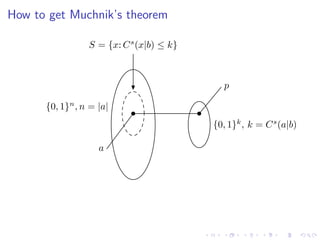
      If a is not congested in {x|C s (x|b) < k} then it has a
      neighbor p outside the clot.
      This p satisfies all requirements.
How to get Muchnik’s theorem

                 S = {x: C s (x|b) ≤ k}


                                             p

      {0, 1}n , n = |a|
                                          {0, 1}k , k = C s (a|b)

                    a
How to get Muchnik’s theorem


      Firstly, we search for a good seed for the generator and fix it.
      This search needs only polynomial space.
      If a is not congested in {x|C s (x|b) < k} then it has a
      neighbor p outside the clot.
      This p satisfies all requirements.
      If a is congested then we repeat the whole construction
      replacing the relevant sets by the sets of congested vertices in
      relevant sets.
How to get Muchnik’s theorem


      Firstly, we search for a good seed for the generator and fix it.
      This search needs only polynomial space.
      If a is not congested in {x|C s (x|b) < k} then it has a
      neighbor p outside the clot.
      This p satisfies all requirements.
      If a is congested then we repeat the whole construction
      replacing the relevant sets by the sets of congested vertices in
      relevant sets.
      There may be several iterations but since the upper bound on
      the size of a relevant set decreases exponentially there is at
      most linear number of steps, hence all polynomial bounds
      remain.
The final formulation


   For any a and b of length n and for any s there exists p of length
   C s (a|b) + O(log log s + log n) such that:
       p(b) = a;
       the computation of p(b) performs in space O(s) + poly(n)
       and C O(s)+poly(n) (p|a) = O(log log s + log n)
Summary of the technology


      Take some theorem about Kolmogorov complexity relying on
      the existence of some combinatorial object
Summary of the technology


      Take some theorem about Kolmogorov complexity relying on
      the existence of some combinatorial object
      Build a constant-depth circuit recognizing this object
Summary of the technology


      Take some theorem about Kolmogorov complexity relying on
      the existence of some combinatorial object
      Build a constant-depth circuit recognizing this object
      Replace a random object by a pseudorandom one
Summary of the technology


      Take some theorem about Kolmogorov complexity relying on
      the existence of some combinatorial object
      Build a constant-depth circuit recognizing this object
      Replace a random object by a pseudorandom one
      Obtain a space-bounded version of the theorem
Summary of the technology


      Take some theorem about Kolmogorov complexity relying on
      the existence of some combinatorial object
      Build a constant-depth circuit recognizing this object
      Replace a random object by a pseudorandom one
      Obtain a space-bounded version of the theorem
      ???????
      PROFIT
Thank you!
   mailto:musatych@gmail.com
http://musatych.livejournal.com

Csr2011 june14 15_45_musatov

  • 1.
    Improving the Space-BoundedVersion of Muchnik’s Conditional Complexity Theorem via “Naive” Derandomization Daniil Musatov1 1 Lomonosov Moscow State University, St. Petersburg, June 14th, 2011
  • 2.
    Some disclaimers This talk is in some sense a continuation of the previous one
  • 3.
    Some disclaimers This talk is in some sense a continuation of the previous one A similar technique is used to obtain a different result
  • 4.
    Some disclaimers This talk is in some sense a continuation of the previous one A similar technique is used to obtain a different result Why “naive”?
  • 5.
    Some disclaimers This talk is in some sense a continuation of the previous one A similar technique is used to obtain a different result Why “naive”? Because we simply replace a random object by a pseudo-random one and it still does the job.
  • 6.
    Kolmogorov complexity Kolmogorov complexity C (a|b) of a string a conditional to b is the minimal length of a program p that produces a given b, i.e., p(b) = a
  • 7.
    Kolmogorov complexity Kolmogorov complexity C (a|b) of a string a conditional to b is the minimal length of a program p that produces a given b, i.e., p(b) = a Space-bounded version: C s (a|b) is the minimal length of a program p such that p(b) = a
  • 8.
    Kolmogorov complexity Kolmogorov complexity C (a|b) of a string a conditional to b is the minimal length of a program p that produces a given b, i.e., p(b) = a Space-bounded version: C s (a|b) is the minimal length of a program p such that p(b) = a and the computation of p(b) performs in space s.
  • 9.
    Muchnik’s theorem Muchnik’s theorem (TCS’2002): For any a and b of length n there exists p of length C (a|b) + O(log n) such that p(b) = a
  • 10.
    Muchnik’s theorem Muchnik’s theorem (TCS’2002): For any a and b of length n there exists p of length C (a|b) + O(log n) such that p(b) = a and C (p|a) = O(log n).
  • 11.
    Muchnik’s theorem Muchnik’s theorem (TCS’2002): For any a and b of length n there exists p of length C (a|b) + O(log n) such that p(b) = a and C (p|a) = O(log n). Space-bounded version (M., Romashchenko, Shen, CSR’2009, ToCS’2011): For any a and b of length n and for any s there exists p of length C s (a|b) + O(log3 n) such that:
  • 12.
    Muchnik’s theorem Muchnik’s theorem (TCS’2002): For any a and b of length n there exists p of length C (a|b) + O(log n) such that p(b) = a and C (p|a) = O(log n). Space-bounded version (M., Romashchenko, Shen, CSR’2009, ToCS’2011): For any a and b of length n and for any s there exists p of length C s (a|b) + O(log3 n) such that: p(b) = a; the computation of p(b) performs in space O(s) + poly(n) and C poly(n) (p|a) = O(log3 n)
  • 13.
    Muchnik’s theorem Muchnik’s theorem (TCS’2002): For any a and b of length n there exists p of length C (a|b) + O(log n) such that p(b) = a and C (p|a) = O(log n). Space-bounded version (M., Romashchenko, Shen, CSR’2009, ToCS’2011): For any a and b of length n and for any s there exists p of length C s (a|b) + O(log3 n) such that: p(b) = a; the computation of p(b) performs in space O(s) + poly(n) and C poly(n) (p|a) = O(log3 n) In current work we get rid of polylogarithmic terms and make them again logarithmic
  • 14.
    Proof of Muchnik’stheorem: fingerprints {0, 1}n , n = |a| {0, 1}k , k = C(a|b) a
  • 15.
    Proof of Muchnik’stheorem: fingerprints p {0, 1}n , n = |a| {0, 1}k , k = C(a|b) a p is a fingerprint of a
  • 16.
    Proof of Muchnik’stheorem: fingerprints p {0, 1}n , n = |a| {0, 1}k , k = C(a|b) a p is a fingerprint of a For C (p|a) to be small, there should be few fingerprints for each a
  • 17.
    Proof of Muchnik’stheorem: fingerprints S = {x: C(x|b) ≤ C(a|b)} p {0, 1}n , n = |a| {0, 1}k , k = C(a|b) a p is a fingerprint of a For C (p|a) to be small, there should be few fingerprints for each a For C (a|p, b) to be small,
  • 18.
    Proof of Muchnik’stheorem: fingerprints S = {x: C(x|b) ≤ C(a|b)} p {0, 1}n , n = |a| {0, 1}k , k = C(a|b) a p is a fingerprint of a For C (p|a) to be small, there should be few fingerprints for each a For C (a|p, b) to be small, there should be few preimages of p in S
  • 19.
    How to findfingerprints There is an underlying bipartite graph G = (L, R, E ) with |L| = 2n and |R| = 2k
  • 20.
    How to findfingerprints There is an underlying bipartite graph G = (L, R, E ) with |L| = 2n and |R| = 2k Each left-part vertex has constant degree D
  • 21.
    How to findfingerprints There is an underlying bipartite graph G = (L, R, E ) with |L| = 2n and |R| = 2k Each left-part vertex has constant degree D The fingerprint p is chosen among neighbors of a
  • 22.
    How to findfingerprints There is an underlying bipartite graph G = (L, R, E ) with |L| = 2n and |R| = 2k Each left-part vertex has constant degree D The fingerprint p is chosen among neighbors of a This guarantees that C (p|a, G ) = O(log D)
  • 23.
    How to findfingerprints There is an underlying bipartite graph G = (L, R, E ) with |L| = 2n and |R| = 2k Each left-part vertex has constant degree D The fingerprint p is chosen among neighbors of a This guarantees that C (p|a, G ) = O(log D) The statement that C (a|p, b, G ) is small for some p follows from some enumerable graph property (see later)
  • 24.
    How to findfingerprints There is an underlying bipartite graph G = (L, R, E ) with |L| = 2n and |R| = 2k Each left-part vertex has constant degree D The fingerprint p is chosen among neighbors of a This guarantees that C (p|a, G ) = O(log D) The statement that C (a|p, b, G ) is small for some p follows from some enumerable graph property (see later) It is proven by the probabilistic method that this property is non-empty
  • 25.
    How to findfingerprints There is an underlying bipartite graph G = (L, R, E ) with |L| = 2n and |R| = 2k Each left-part vertex has constant degree D The fingerprint p is chosen among neighbors of a This guarantees that C (p|a, G ) = O(log D) The statement that C (a|p, b, G ) is small for some p follows from some enumerable graph property (see later) It is proven by the probabilistic method that this property is non-empty Hence, the first graph in the enumeration has small complexity
  • 26.
    How to findfingerprints There is an underlying bipartite graph G = (L, R, E ) with |L| = 2n and |R| = 2k Each left-part vertex has constant degree D The fingerprint p is chosen among neighbors of a This guarantees that C (p|a, G ) = O(log D) The statement that C (a|p, b, G ) is small for some p follows from some enumerable graph property (see later) It is proven by the probabilistic method that this property is non-empty Hence, the first graph in the enumeration has small complexity Hence, C (p|a) and C (a|p, b) are also small
  • 27.
    What graph propertiesdo we need? Some graph properties leading to Muchnik’s theorem: (Muchnik) Expander-like property
  • 28.
    What graph propertiesdo we need? Some graph properties leading to Muchnik’s theorem: (Muchnik) Expander-like property (MRS) Possibility of online matching
  • 29.
    What graph propertiesdo we need? Some graph properties leading to Muchnik’s theorem: (Muchnik) Expander-like property (MRS) Possibility of online matching (MRS) Extractor
  • 30.
    What graph propertiesdo we need? Some graph properties leading to Muchnik’s theorem: (Muchnik) Expander-like property (MRS) Possibility of online matching (MRS) Extractor (This paper) “Low-congesting”
  • 31.
    The essential property:low-congesting graph S, |S| < 2k {0, 1}n each vertex has D neighbors {0, 1}k
  • 32.
    The essential property:low-congesting graph S, |S| < 2k α-clot {0, 1} n each vertex has D neighbors {0, 1}k α-clot for S is the set of all vertices having more than αD neighbors in S.
  • 33.
    The essential property:low-congesting graph S, |S| < 2k α-clot {0, 1} n each vertex has D neighbors {0, 1}k α-congested vertex α-clot for S is the set of all vertices having more than αD neighbors in S. A vertex is α-congested if all its neighbors lie in α-clot.
  • 34.
    The essential property:low-congesting graph S, |S| < 2k α-clot {0, 1} n each vertex has D neighbors {0, 1}k α-congested vertex α-clot for S is the set of all vertices having more than αD neighbors in S. A vertex is α-congested if all its neighbors lie in α-clot. The set S is (α, β)-low-congested if it contains less than βK α-congested vertices.
  • 35.
    The essential property:low-congesting graph α-clot for S is the set of all vertices having more than αD neighbors in S. A vertex is α-congested if all its neighbors lie in α-clot. The set S is (α, β)-low-congested if it contains less than βK α-congested vertices. We call a set relevant if it has the form {x|C s (x|b) < k}. We call a graph (α, β)-low-congesting if all relevant sets are (α, β)-low-congested.
  • 36.
    How to geta low-congesting graph A random graph with certain parameters is an extractor with positive probability.
  • 37.
    How to geta low-congesting graph A random graph with certain parameters is an extractor with positive probability. Lemma. (Buhrman, Fortnow, Laplante ’2002) In an (k, )-extractor graph any S is (2, 2 )-low-congested. Hence, in an extractor any relevant set is low-congested and the graph itself is low-congesting.
  • 38.
    How to geta low-congesting graph A random graph with certain parameters is an extractor with positive probability. Lemma. (Buhrman, Fortnow, Laplante ’2002) In an (k, )-extractor graph any S is (2, 2 )-low-congested. Hence, in an extractor any relevant set is low-congested and the graph itself is low-congesting. But even the description of the graph is exponential in size, so we cannot find it in polynomial space.
  • 39.
    How to geta low-congesting graph A random graph with certain parameters is an extractor with positive probability. Lemma. (Buhrman, Fortnow, Laplante ’2002) In an (k, )-extractor graph any S is (2, 2 )-low-congested. Hence, in an extractor any relevant set is low-congested and the graph itself is low-congesting. But even the description of the graph is exponential in size, so we cannot find it in polynomial space. Central idea: replace a random graph by a pseudorandom one To make this idea work, we need:
  • 40.
    How to geta low-congesting graph A random graph with certain parameters is an extractor with positive probability. Lemma. (Buhrman, Fortnow, Laplante ’2002) In an (k, )-extractor graph any S is (2, 2 )-low-congested. Hence, in an extractor any relevant set is low-congested and the graph itself is low-congesting. But even the description of the graph is exponential in size, so we cannot find it in polynomial space. Central idea: replace a random graph by a pseudorandom one To make this idea work, we need: to prove that a pseudorandom graph is low-congesting with positive probability
  • 41.
    How to geta low-congesting graph A random graph with certain parameters is an extractor with positive probability. Lemma. (Buhrman, Fortnow, Laplante ’2002) In an (k, )-extractor graph any S is (2, 2 )-low-congested. Hence, in an extractor any relevant set is low-congested and the graph itself is low-congesting. But even the description of the graph is exponential in size, so we cannot find it in polynomial space. Central idea: replace a random graph by a pseudorandom one To make this idea work, we need: to prove that a pseudorandom graph is low-congesting with positive probability to show that the seed this graph is generated from may be found in polynomial space
  • 42.
    Why a pseudorandomgraph fits We use the Nisan pseudorandom generator with polynomial seed length and exponential output.
  • 43.
    Why a pseudorandomgraph fits We use the Nisan pseudorandom generator with polynomial seed length and exponential output. It is well-known that this generator fools any circuit from AC0
  • 44.
    Why a pseudorandomgraph fits We use the Nisan pseudorandom generator with polynomial seed length and exponential output. It is well-known that this generator fools any circuit from AC0 The size of a fooled circuit may be exponential since the size of output is exponential.
  • 45.
    Why a pseudorandomgraph fits We use the Nisan pseudorandom generator with polynomial seed length and exponential output. It is well-known that this generator fools any circuit from AC0 The size of a fooled circuit may be exponential since the size of output is exponential. We cannot check the low-congesting property literally, but using circuits for approximate counting we build a circuit C such that:
  • 46.
    Why a pseudorandomgraph fits We use the Nisan pseudorandom generator with polynomial seed length and exponential output. It is well-known that this generator fools any circuit from AC0 The size of a fooled circuit may be exponential since the size of output is exponential. We cannot check the low-congesting property literally, but using circuits for approximate counting we build a circuit C such that: If G is (2, 2 )-low-congesting then C (G ) = 1;
  • 47.
    Why a pseudorandomgraph fits We use the Nisan pseudorandom generator with polynomial seed length and exponential output. It is well-known that this generator fools any circuit from AC0 The size of a fooled circuit may be exponential since the size of output is exponential. We cannot check the low-congesting property literally, but using circuits for approximate counting we build a circuit C such that: If G is (2, 2 )-low-congesting then C (G ) = 1; If C (G ) = 1 then G is (2.01, 2.01 )-low-congesting.
  • 48.
    Why a pseudorandomgraph fits We use the Nisan pseudorandom generator with polynomial seed length and exponential output. It is well-known that this generator fools any circuit from AC0 The size of a fooled circuit may be exponential since the size of output is exponential. We cannot check the low-congesting property literally, but using circuits for approximate counting we build a circuit C such that: If G is (2, 2 )-low-congesting then C (G ) = 1; If C (G ) = 1 then G is (2.01, 2.01 )-low-congesting. This circuit accepts a random graph with sufficient probability, hence it does the same with a pseudorandom one.
  • 49.
    The circuit S h1 (x1 ) h2 (x1 ) ··· hD (x1 ) h1 (x2 ) ··· hD (x2 ) ··· ≡ ··· ≡ ≡ ··· ≡ ··· ≡ ··· Counting circuit Counting circuit 1, if Σinputs > 2.01D 1, if Σinputs > 2.01D ··· 0, if Σinputs < 2D 0, if Σinputs < 2D ∧ ··· Counting circuit 1, if Σinputs < 2ϵK 0, if Σinputs > 2.01ϵK ∧S
  • 50.
    How to getMuchnik’s theorem Firstly, we search for a good seed for the generator and fix it. This search needs only polynomial space.
  • 51.
    How to getMuchnik’s theorem Firstly, we search for a good seed for the generator and fix it. This search needs only polynomial space. If a is not congested in {x|C s (x|b) < k} then it has a neighbor p outside the clot. This p satisfies all requirements.
  • 52.
    How to getMuchnik’s theorem S = {x: C s (x|b) ≤ k} p {0, 1}n , n = |a| {0, 1}k , k = C s (a|b) a
  • 53.
    How to getMuchnik’s theorem Firstly, we search for a good seed for the generator and fix it. This search needs only polynomial space. If a is not congested in {x|C s (x|b) < k} then it has a neighbor p outside the clot. This p satisfies all requirements. If a is congested then we repeat the whole construction replacing the relevant sets by the sets of congested vertices in relevant sets.
  • 54.
    How to getMuchnik’s theorem Firstly, we search for a good seed for the generator and fix it. This search needs only polynomial space. If a is not congested in {x|C s (x|b) < k} then it has a neighbor p outside the clot. This p satisfies all requirements. If a is congested then we repeat the whole construction replacing the relevant sets by the sets of congested vertices in relevant sets. There may be several iterations but since the upper bound on the size of a relevant set decreases exponentially there is at most linear number of steps, hence all polynomial bounds remain.
  • 55.
    The final formulation For any a and b of length n and for any s there exists p of length C s (a|b) + O(log log s + log n) such that: p(b) = a; the computation of p(b) performs in space O(s) + poly(n) and C O(s)+poly(n) (p|a) = O(log log s + log n)
  • 56.
    Summary of thetechnology Take some theorem about Kolmogorov complexity relying on the existence of some combinatorial object
  • 57.
    Summary of thetechnology Take some theorem about Kolmogorov complexity relying on the existence of some combinatorial object Build a constant-depth circuit recognizing this object
  • 58.
    Summary of thetechnology Take some theorem about Kolmogorov complexity relying on the existence of some combinatorial object Build a constant-depth circuit recognizing this object Replace a random object by a pseudorandom one
  • 59.
    Summary of thetechnology Take some theorem about Kolmogorov complexity relying on the existence of some combinatorial object Build a constant-depth circuit recognizing this object Replace a random object by a pseudorandom one Obtain a space-bounded version of the theorem
  • 60.
    Summary of thetechnology Take some theorem about Kolmogorov complexity relying on the existence of some combinatorial object Build a constant-depth circuit recognizing this object Replace a random object by a pseudorandom one Obtain a space-bounded version of the theorem ??????? PROFIT
  • 61.
    Thank you! mailto:musatych@gmail.com http://musatych.livejournal.com