International Journal JOURNAL OF ADVANCED RESEARCH Technology (IJARET),
INTERNATIONAL of Advanced Research in Engineering and IN ENGINEERING
ISSN 0976 – 6480(Print), ISSNAND – 6499(Online) Volume 5, Issue 1, January (2014), © IAEME
0976 TECHNOLOGY (IJARET)
ISSN 0976 - 6480 (Print)
ISSN 0976 - 6499 (Online)
Volume 5, Issue 1, January (2014), pp. 177-181
© IAEME: www.iaeme.com/ijaret.asp
Journal Impact Factor (2013): 5.8376 (Calculated by GISI)
www.jifactor.com

IJARET
©IAEME

CANONICAL-LAPLACE TRANSFORM AND ITS VARIOUS TESTING
FUNCTION SPACES
N.V. Kalyankar,

S.B.Chavhan

Yeshwant Mahavidyalaya Nanded-431602

ABSTRACT
The linear canonical transform is a useful tool for optical analysis and signal processing. In
this paper we have defined canonical-Laplace transform and have also established some testing
functions spaces using Gelfand-shilov technique.
Index Terms: Canonical Transform, Fourier Transform, Fractional Fourier Transform, Laplace
Transform, Testing Function Space.
1. INTRODUCTION
The Fourier analysis is undoubtedly the one of the most valuable and powerful tools in signal
processing, image processing and many other branches of engineering sciences [6],[7].the fractional
Fourier transform, a special case of linear canonical transform is studied through different analysis
.Almeida[1],[2].had introduced it and proved many of its properties . The fractional Fourier
transform is a generalization of classical Fourier transform, which is introduce from the
mathematical aspect by Namias at first and has many applications in optics quickly[5]. The
definition of Laplace transform with parameter p of f ( x ) denoted by L  f ( x )  = F ( p )


∞

L  f ( x )  = ∫ e− px f ( x )


0

And definition of canonical transform with parameter s of f ( t ) denoted by

{CT f ( t )}( s ) =

1
2π ib

id 2
 s ∞

e2 b  ∫ e

s i a 2
−i  t
 t
 b  2 b 

e

−∞

177

f (t )
International Journal of Advanced Research in Engineering and Technology (IJARET),
ISSN 0976 – 6480(Print), ISSN 0976 – 6499(Online) Volume 5, Issue 1, January (2014), © IAEME

The definition of canonical-Laplace transform is given in section 2. S-type spaces using
Gelfand-shilov technique are developed in section 3.Section 4 is devoted for the results on countable
union s-type space. The notation and terminology as per Zemanian [8],[9]. Gelfand-Shilov [3],[4].
2. DEFINITION CANONICAL CANONICAL-LAPLACE TRANSFORMS
The definition of Laplace transform with parameter p of f ( x ) denoted by L  f ( x ) = F ( p )


∞

L  f ( x )  = ∫ e− px f ( x )


0

The definition of Laplace transform with parameter s of f ( t ) denoted by
id

{CT f ( t )}( s ) =

2

s

i a

2

  s ∞ −i  t
 t
1
e2 b  ∫ e  b  e2 b  f (t )
2π ib
−∞

The definition of conversional canonical -Laplace transform is defined as
i d 

CL { f ( t , x )} ( s, p ) =

s

i a

2
2
  s ∞ ∞ −i  t
 t
1
e 2  b  ∫ ∫ e  b  e 2  b  e − px f ( t , x ) dxdt
−∞ 0
2π ib

3. VARIOUS TESTING FUNCTION SPACES
3.1 The space CLa,b,γ
It is given by


t l Dtk Dxpφ ( t , x )


CLa ,b,γ = φ : φ ∈ E+ / σ l ,k , pφ ( t , x ) = sup
≤ Ckp Al .l lγ 





The constant Ck,p and A depend on φ .
3.2 The space CL
CL this space is given by
ab ,β

ab ,β

{

CLa ,b ,β = φ .φ ∈ E+ / ρl , k , pφ ( t , x ) = sup t l Dtk Dxpφ ( t , x ) ≤ Cl , p B k k k β

}

The constants Cl , p and B depend on φ .

3.3 The space CLγa ,b, β
This space is formed by combining the condition (3.1) and (3.2)

{

CLγa ,b , β = φ : φ ∈ E+ / ξl , k , pφ ( t , x ) =sup t l Dtk Dxpφ ( t , x ) ≤ C Al l lγ B k k k , β
I1

}

l , k , p = 0,1, 2............ Where A,B,C depend on φ .

3.4 The space: CLγa,,m, β
b
It is defined as,

{

l

CLγa,,m, β = φ : φ ∈ E+ / σ l , k , pφ ( t , x ) =sup t l Dtk Dxpφ ( t , x ) ≤ Ck , p , µ ( m + µ ) l lγ
b
I1

}

For any µ > 0 where m is the constant, depending on the function φ .

178
International Journal of Advanced Research in Engineering and Technology (IJARET),
ISSN 0976 – 6480(Print), ISSN 0976 – 6499(Online) Volume 5, Issue 1, January (2014), © IAEME

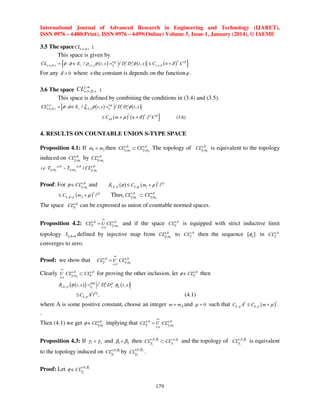
3.5 The space CLa ,b, β ,n :
This space is given by

{

k

CLa ,b , β , n = φ : φ ∈ E+ / ρl , k , pφ ( t , x ) = sup t l Dtk Dxpφ ( t , x ) ≤ Cl , p ,δ ( n + δ ) k k β
I1

}

For any δ > 0 where n the constant is depends on the function φ .
γ ,m

3.6 The space CLa , b , β , n :
This space is defined by combining the conditions in (3.4) and (3.5).

{

CLγa,,m,β ,n = φ : φ ∈ E+ / ξl ,k , pφ ( t , x ) =sup t l Dtk Dxpφ ( t , x )
b
I1
l

k

≤ Cµδ ( m + µ ) ( n + δ ) .l lγ k k β

}

(3.6)

4. RESULTS ON COUNTABLE UNION S-TYPE SPACE
Proposition 4.1: If m1 < m2 then CLa,,b 1 ⊂ CLa,,b 2 . The topology of CLa,,b 1 is equivalent to the topology
γ m
γ m
γ m
induced on CLa,,b 1 by CLa,,b 2
γ m
γ m
i.e Tγ , m1 a,b ~ Tγ ,m2 a,b / CLa ,,b
γ m

1

l

δ l , k , p (φ ) ≤ Ck , µ ( m1 + µ ) l lγ

Proof: For φ ∈ CLa,,b 1 and
γ m
l

b
b
Thus, CLa,,m1 ⊂ CLa,,m2
γ
γ

≤ C k , µ , p ( m2 + µ ) l l γ

The space CLa,,b can be expressed as union of countable normed spaces.
γ
∞

Proposition 4.2: CLa,b = U CLa,,b 1 and if the space CLa,b is equipped with strict inductive limit
γ
γ
γ m
i =1

topology Sa,b, m defined by injective map from CLa,,b 1 to CLa ,b then the sequence {φn } in CLa ,b
γ
γ
γ m
converges to zero.
Proof: we show that

∞

CLa ,b = U CLa ,.b
γ
γ m
i =1

1

∞

Clearly U CLa,.b 1 ⊂ CLa ,b for proving the other inclusion, let φ ∈ CLa,b then
γ
k
γ m
i =1

δ l ,k , p (φ ( t , x ) ) =sup t l Dtk Dxp φn ( t , x )
I1
≤ Ck , p Al l lγ ,

(4.1)

where A is some positive constant, choose an integer m = mA and µ = 0 such that Ck , p Al ≤ Ck , p ( m + µ )l .
.
∞

b
Then (4.1) we get φ ∈ CLa,,m1 implying that CLa,b = U CLa,,b 1
γ
γ m
γ
i =1

Proposition 4.3: If γ 1 < γ 2 and β1 < β 2 then CLa1,b, β1 ⊂ CLa,b, β and the topology of CLai,b, βi is equivalent
γ
γ
γ
2

2

to the topology induced on CLa1,b, β1 by CLa,2b, β 2 .
γ
γ
Proof: Let φ ∈ CLa1,b , β1
γ
179
International Journal of Advanced Research in Engineering and Technology (IJARET),
ISSN 0976 – 6480(Print), ISSN 0976 – 6499(Online) Volume 5, Issue 1, January (2014), © IAEME
ξl ,k , p (φ ) =sup t l Dtk Dxpφ ( t , x )
I1
≤ CAl l lγ 1 B k k

k β1

≤ CAl l lγ 2 . B p k
a ,b , β 2

Hence φ ∈CLγ 2

.

p,β 2

wherel , k , p = 0,1, 2,3

Consequently, CLa1,b, β1 ⊂ CLa2,b,β2 . The topology of CLa1,b, β1
γ
γ
γ

,
Is equivalent to the topology Tγa2,b, β 2 / CLa2b, β 2
γ

It is clear from the definition of topologies of these spaces.
∞

Proposition 4.4: CLa,b = U CLai,b,βi and if the space CLa ,b is equipped with the strict CLa ,b inductive
γ
γ i βi =1

limit topology defined by the injective maps from CLai,b, βi to CLa,b then the sequence {φn } in CLa ,b
γ
converges to zero iff {φn } is contained in some CLai,b, βi and converges to zero.
γ
∞

Proof: CLa,b = U CLai,b,, βi
γ
γ i βi =1

Clearly

∞

a
U CLγ ,b, βi ⊂ CLa

γ i βi =1

i

For proving other inclusion, let φ ( t , x ) ∈ CLa,b then
ηl ,k , p (φ ) =sup t l Dtk Dxpφ ( t , x ) ,
I1

is bounded by some number. We can choose integers γ m and β m such that
ηl , k , p (φ ) ≤ C Al l l ,γ B k , m , k k , β , m
∴ φ ∈ CLa ,b, βi for some integer γ i and βi
γ
i

∞

Hence CLa,b ⊂ U CLai,b, βi
γ
γ i βi =1

Thus

∞

CLa,b = U CLa,b, βi
γ
γ i βi =1

i

5. CONCLUSION
In this paper canonical-Laplace is generalized in the form the distributional sense, and proved
results on countable union s-type space. Also discussed the topological structure of some testing
function spaces.
REFERENCES
[1]
[2]
[3]
[4]
[5]
[6]

Almeida Lufs B., “The fractional Fourier transform and time frequency,” representation
IEEE trans. On Signal Processing, Vol. 42, No. 11, Nov. 1994.
Almeida Lufs B., “An introduction to the Angular Fourier transform,” IEEE, 1993.
Gelfand I.M. and Shilov G.E., “Generalized Functions,” Volume I Academic Press, New
York, 1964.
Gelfand I.M. and Shilov G.E., “Generalized Functions,” Volume II, Academic Press, New
York, 1967.
Namias Victor., “The fractional order Fourier transform and its application to quantum
mechanics,” J. Inst Math. Apptics, Vol. 25, P. 241-265, 1980.
Tatiana Alieva and BastiaansMartin j., “on fractional of fourier transform moment ,” IEEE
signal processing letters, Vol. 7, No.o11, Nov 2000.
180
International Journal of Advanced Research in Engineering and Technology (IJARET),
ISSN 0976 – 6480(Print), ISSN 0976 – 6499(Online) Volume 5, Issue 1, January (2014), © IAEME

[7]

[8]
[9]

Tatiana Alieva and BastiaansMartin j., “Winger distribution and fractional fourier
transform for 2-dimensional symmetric beams,” JUSA A, Vol. 17, No.12, Dec 2000,
P.2319-2323.
Zemanian A.H., “Distribution theory and transform analysis,” McGraw Hill, New York,
1965.
Zemanian A.H., Generalized integral transform,” Inter Science Publisher’s New York,
1968.

181

20320140501020

  • 1.
    International Journal JOURNALOF ADVANCED RESEARCH Technology (IJARET), INTERNATIONAL of Advanced Research in Engineering and IN ENGINEERING ISSN 0976 – 6480(Print), ISSNAND – 6499(Online) Volume 5, Issue 1, January (2014), © IAEME 0976 TECHNOLOGY (IJARET) ISSN 0976 - 6480 (Print) ISSN 0976 - 6499 (Online) Volume 5, Issue 1, January (2014), pp. 177-181 © IAEME: www.iaeme.com/ijaret.asp Journal Impact Factor (2013): 5.8376 (Calculated by GISI) www.jifactor.com IJARET ©IAEME CANONICAL-LAPLACE TRANSFORM AND ITS VARIOUS TESTING FUNCTION SPACES N.V. Kalyankar, S.B.Chavhan Yeshwant Mahavidyalaya Nanded-431602 ABSTRACT The linear canonical transform is a useful tool for optical analysis and signal processing. In this paper we have defined canonical-Laplace transform and have also established some testing functions spaces using Gelfand-shilov technique. Index Terms: Canonical Transform, Fourier Transform, Fractional Fourier Transform, Laplace Transform, Testing Function Space. 1. INTRODUCTION The Fourier analysis is undoubtedly the one of the most valuable and powerful tools in signal processing, image processing and many other branches of engineering sciences [6],[7].the fractional Fourier transform, a special case of linear canonical transform is studied through different analysis .Almeida[1],[2].had introduced it and proved many of its properties . The fractional Fourier transform is a generalization of classical Fourier transform, which is introduce from the mathematical aspect by Namias at first and has many applications in optics quickly[5]. The definition of Laplace transform with parameter p of f ( x ) denoted by L  f ( x )  = F ( p )   ∞ L  f ( x )  = ∫ e− px f ( x )   0 And definition of canonical transform with parameter s of f ( t ) denoted by {CT f ( t )}( s ) = 1 2π ib id 2  s ∞ e2 b  ∫ e s i a 2 −i  t  t  b  2 b  e −∞ 177 f (t )
  • 2.
    International Journal ofAdvanced Research in Engineering and Technology (IJARET), ISSN 0976 – 6480(Print), ISSN 0976 – 6499(Online) Volume 5, Issue 1, January (2014), © IAEME The definition of canonical-Laplace transform is given in section 2. S-type spaces using Gelfand-shilov technique are developed in section 3.Section 4 is devoted for the results on countable union s-type space. The notation and terminology as per Zemanian [8],[9]. Gelfand-Shilov [3],[4]. 2. DEFINITION CANONICAL CANONICAL-LAPLACE TRANSFORMS The definition of Laplace transform with parameter p of f ( x ) denoted by L  f ( x ) = F ( p )   ∞ L  f ( x )  = ∫ e− px f ( x )   0 The definition of Laplace transform with parameter s of f ( t ) denoted by id {CT f ( t )}( s ) = 2 s i a 2   s ∞ −i  t  t 1 e2 b  ∫ e  b  e2 b  f (t ) 2π ib −∞ The definition of conversional canonical -Laplace transform is defined as i d  CL { f ( t , x )} ( s, p ) = s i a 2 2   s ∞ ∞ −i  t  t 1 e 2  b  ∫ ∫ e  b  e 2  b  e − px f ( t , x ) dxdt −∞ 0 2π ib 3. VARIOUS TESTING FUNCTION SPACES 3.1 The space CLa,b,γ It is given by   t l Dtk Dxpφ ( t , x )   CLa ,b,γ = φ : φ ∈ E+ / σ l ,k , pφ ( t , x ) = sup ≤ Ckp Al .l lγ      The constant Ck,p and A depend on φ . 3.2 The space CL CL this space is given by ab ,β ab ,β { CLa ,b ,β = φ .φ ∈ E+ / ρl , k , pφ ( t , x ) = sup t l Dtk Dxpφ ( t , x ) ≤ Cl , p B k k k β } The constants Cl , p and B depend on φ . 3.3 The space CLγa ,b, β This space is formed by combining the condition (3.1) and (3.2) { CLγa ,b , β = φ : φ ∈ E+ / ξl , k , pφ ( t , x ) =sup t l Dtk Dxpφ ( t , x ) ≤ C Al l lγ B k k k , β I1 } l , k , p = 0,1, 2............ Where A,B,C depend on φ . 3.4 The space: CLγa,,m, β b It is defined as, { l CLγa,,m, β = φ : φ ∈ E+ / σ l , k , pφ ( t , x ) =sup t l Dtk Dxpφ ( t , x ) ≤ Ck , p , µ ( m + µ ) l lγ b I1 } For any µ > 0 where m is the constant, depending on the function φ . 178
  • 3.
    International Journal ofAdvanced Research in Engineering and Technology (IJARET), ISSN 0976 – 6480(Print), ISSN 0976 – 6499(Online) Volume 5, Issue 1, January (2014), © IAEME 3.5 The space CLa ,b, β ,n : This space is given by { k CLa ,b , β , n = φ : φ ∈ E+ / ρl , k , pφ ( t , x ) = sup t l Dtk Dxpφ ( t , x ) ≤ Cl , p ,δ ( n + δ ) k k β I1 } For any δ > 0 where n the constant is depends on the function φ . γ ,m 3.6 The space CLa , b , β , n : This space is defined by combining the conditions in (3.4) and (3.5). { CLγa,,m,β ,n = φ : φ ∈ E+ / ξl ,k , pφ ( t , x ) =sup t l Dtk Dxpφ ( t , x ) b I1 l k ≤ Cµδ ( m + µ ) ( n + δ ) .l lγ k k β } (3.6) 4. RESULTS ON COUNTABLE UNION S-TYPE SPACE Proposition 4.1: If m1 < m2 then CLa,,b 1 ⊂ CLa,,b 2 . The topology of CLa,,b 1 is equivalent to the topology γ m γ m γ m induced on CLa,,b 1 by CLa,,b 2 γ m γ m i.e Tγ , m1 a,b ~ Tγ ,m2 a,b / CLa ,,b γ m 1 l δ l , k , p (φ ) ≤ Ck , µ ( m1 + µ ) l lγ Proof: For φ ∈ CLa,,b 1 and γ m l b b Thus, CLa,,m1 ⊂ CLa,,m2 γ γ ≤ C k , µ , p ( m2 + µ ) l l γ The space CLa,,b can be expressed as union of countable normed spaces. γ ∞ Proposition 4.2: CLa,b = U CLa,,b 1 and if the space CLa,b is equipped with strict inductive limit γ γ γ m i =1 topology Sa,b, m defined by injective map from CLa,,b 1 to CLa ,b then the sequence {φn } in CLa ,b γ γ γ m converges to zero. Proof: we show that ∞ CLa ,b = U CLa ,.b γ γ m i =1 1 ∞ Clearly U CLa,.b 1 ⊂ CLa ,b for proving the other inclusion, let φ ∈ CLa,b then γ k γ m i =1 δ l ,k , p (φ ( t , x ) ) =sup t l Dtk Dxp φn ( t , x ) I1 ≤ Ck , p Al l lγ , (4.1) where A is some positive constant, choose an integer m = mA and µ = 0 such that Ck , p Al ≤ Ck , p ( m + µ )l . . ∞ b Then (4.1) we get φ ∈ CLa,,m1 implying that CLa,b = U CLa,,b 1 γ γ m γ i =1 Proposition 4.3: If γ 1 < γ 2 and β1 < β 2 then CLa1,b, β1 ⊂ CLa,b, β and the topology of CLai,b, βi is equivalent γ γ γ 2 2 to the topology induced on CLa1,b, β1 by CLa,2b, β 2 . γ γ Proof: Let φ ∈ CLa1,b , β1 γ 179
  • 4.
    International Journal ofAdvanced Research in Engineering and Technology (IJARET), ISSN 0976 – 6480(Print), ISSN 0976 – 6499(Online) Volume 5, Issue 1, January (2014), © IAEME ξl ,k , p (φ ) =sup t l Dtk Dxpφ ( t , x ) I1 ≤ CAl l lγ 1 B k k k β1 ≤ CAl l lγ 2 . B p k a ,b , β 2 Hence φ ∈CLγ 2 . p,β 2 wherel , k , p = 0,1, 2,3 Consequently, CLa1,b, β1 ⊂ CLa2,b,β2 . The topology of CLa1,b, β1 γ γ γ , Is equivalent to the topology Tγa2,b, β 2 / CLa2b, β 2 γ It is clear from the definition of topologies of these spaces. ∞ Proposition 4.4: CLa,b = U CLai,b,βi and if the space CLa ,b is equipped with the strict CLa ,b inductive γ γ i βi =1 limit topology defined by the injective maps from CLai,b, βi to CLa,b then the sequence {φn } in CLa ,b γ converges to zero iff {φn } is contained in some CLai,b, βi and converges to zero. γ ∞ Proof: CLa,b = U CLai,b,, βi γ γ i βi =1 Clearly ∞ a U CLγ ,b, βi ⊂ CLa γ i βi =1 i For proving other inclusion, let φ ( t , x ) ∈ CLa,b then ηl ,k , p (φ ) =sup t l Dtk Dxpφ ( t , x ) , I1 is bounded by some number. We can choose integers γ m and β m such that ηl , k , p (φ ) ≤ C Al l l ,γ B k , m , k k , β , m ∴ φ ∈ CLa ,b, βi for some integer γ i and βi γ i ∞ Hence CLa,b ⊂ U CLai,b, βi γ γ i βi =1 Thus ∞ CLa,b = U CLa,b, βi γ γ i βi =1 i 5. CONCLUSION In this paper canonical-Laplace is generalized in the form the distributional sense, and proved results on countable union s-type space. Also discussed the topological structure of some testing function spaces. REFERENCES [1] [2] [3] [4] [5] [6] Almeida Lufs B., “The fractional Fourier transform and time frequency,” representation IEEE trans. On Signal Processing, Vol. 42, No. 11, Nov. 1994. Almeida Lufs B., “An introduction to the Angular Fourier transform,” IEEE, 1993. Gelfand I.M. and Shilov G.E., “Generalized Functions,” Volume I Academic Press, New York, 1964. Gelfand I.M. and Shilov G.E., “Generalized Functions,” Volume II, Academic Press, New York, 1967. Namias Victor., “The fractional order Fourier transform and its application to quantum mechanics,” J. Inst Math. Apptics, Vol. 25, P. 241-265, 1980. Tatiana Alieva and BastiaansMartin j., “on fractional of fourier transform moment ,” IEEE signal processing letters, Vol. 7, No.o11, Nov 2000. 180
  • 5.
    International Journal ofAdvanced Research in Engineering and Technology (IJARET), ISSN 0976 – 6480(Print), ISSN 0976 – 6499(Online) Volume 5, Issue 1, January (2014), © IAEME [7] [8] [9] Tatiana Alieva and BastiaansMartin j., “Winger distribution and fractional fourier transform for 2-dimensional symmetric beams,” JUSA A, Vol. 17, No.12, Dec 2000, P.2319-2323. Zemanian A.H., “Distribution theory and transform analysis,” McGraw Hill, New York, 1965. Zemanian A.H., Generalized integral transform,” Inter Science Publisher’s New York, 1968. 181