Introduction to QuantumIntroduction to Quantum
CryptographyCryptography
Shefali Paliwal
M.Tech
CS(sem-2nd
)
Cryptography.Cryptography.
Transmitting information with access
restricted to the intended recipient even if
the message is intercepted by others.
Cryptography is of increasing importance
in our technological age using broadcast,
network communications, Internet ,e-mail,
cell phones which may transmit sensitive
information related to finances, politics,
business and private confidential matters.
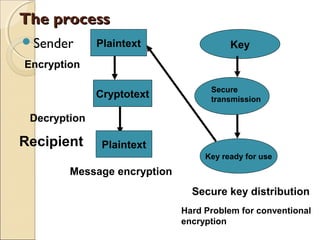
The processThe process
Sender Plaintext
Cryptotext
Decryption
PlaintextRecipient
Message encryption
Key
Key ready for use
Secure key distribution
Encryption
Secure
transmission
Hard Problem for conventional
encryption
The classic cryptographyThe classic cryptography
Encryption algorithm and related key are kept
secret.
Breaking the system is hard due to large
numbers of possible keys.
For example: for a key 128 bits long
there are 38128
102 ≈
keys to check using brute force.
The fundamental difficulty is key distribution to parties
who want to exchange messages.
PKC :the modern cryptographyPKC :the modern cryptography
In 1970s the Public Key Cryptography
emerged.
Each user has two mutually inverse
keys,
The encryption key is published;
The decryption key is kept secret.
Anybody can send a message to Bob
but only Bob can read it.
RSARSA
The most widely used PKC is the RSA
algorithm based on the difficulty of
factoring a product ot two large primes.
Easy Problem Hard Problem
qpn ×=
Given two large
primes p and q
compute
Given n
compute p and q.
Factoring a product of two large primesFactoring a product of two large primes
The best known conventional algorithm
requires the solution time proportional to:
])ln(ln)(lnexp[)( 3/23/1
nncnT =
For p & q 65 digits long T(n) is
approximately
one month using cluster of workstations.
Quantum Computing algorithm forQuantum Computing algorithm for
factoring.factoring.
In 1994 Peter Shor from the AT&T Bell
Laboratory showed that in principle a
quantum computer could factor a very long
product of primes in seconds.
Shor’s algorithm time computational
complexity is
])[(ln)( 3
nOnT =
Once a quantum computer is built
the RSA method
would not be safe.
Elements of the Quantum TheoryElements of the Quantum Theory
Light waves are propagated as discrete
quanta called photons.
They are massless and have energy,
momentum and angular momentum
called spin.
Spin carries the polarization.
If on its way we put a polarization filter
a photon may pass through it or may
not.
We can use a detector to check of a
photon has passed through a filter.
Photon polarizationPhoton polarization
Heisenberg Uncertainty PrincipleHeisenberg Uncertainty Principle
Certain pairs of physical properties are related
in such a way that measuring one property
prevents the observer from knowing the value
of the other.
When measuring the polarization of a photon,
the choice of what direction to measure affects
all subsequent measurements.
If a photon passes through a vertical filter
it will have the vertical orientation regardless of
its initial direction of polarization.
Photon PolarizationPhoton Polarization
θ
Vertical
filter
Tilted filter at
the angle
The probability of a photon appearing after the second
filter depends on the angle and becomes 0 at
= 90 degrees.
The first filter randomizes the measurements of the
second filter.
θ
θ
Polarization by a filterPolarization by a filter
A pair of orthogonal filters such as
vertical/horizontal is called a basis.
A pair of bases is conjugate if the
measurement in the first basis completely
randomizes the measurements in the
second basis.
As in the previous slide example for
=45deg.θ
Sender-receiver of photonsSender-receiver of photons
Suppose Alice uses 0-deg/90-deg polarizer
sending photons to Bob. But she does not
reveal which.
Bob can determine photons by using
filter aligned to the same basis.
But if he uses 45deg/135 deg polarizer to
measure the photon he will not be able to
determine any information about the initial
polarization of the photon.
The result of his measurement will be
completely random
EavesdropperEavesdropper EveEve
If Eve uses the filter aligned with Alice’s
she can recover the original
polarization of the photon.
If she uses the misaligned filter she will
receive no information about the
photon .
Also she will influence the original
photon and be unable to retransmit it
with the original polarization.
Bob will be able to deduce Eve’s
presence.
Binary informationBinary information
Each photon carries one qubit of information
Polarization can be used to represent a 0 or 1.
In quantum computation this is called qubit.
To determine photon’s polarization the
recipient must measure the polarization by
,for example, passing it through a filter.
Binary informationBinary information
A user can suggest a key by sending a
stream of randomly polarized photons.
This sequence can be converted to a
binary key.
If the key was intercepted it could be
discarded and a new stream of
randomly polarized photons sent.
The Main contribution of QuantumThe Main contribution of Quantum
Cryptography.Cryptography.
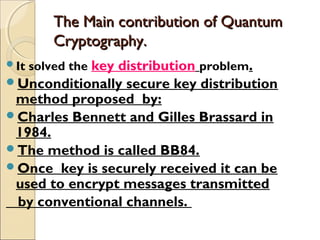
It solved the key distribution problem.
Unconditionally secure key distribution
method proposed by:
Charles Bennett and Gilles Brassard in
1984.
The method is called BB84.
Once key is securely received it can be
used to encrypt messages transmitted
by conventional channels.
Quantum key distributionQuantum key distribution
(a)Alice communicates with Bob via a
quantum channel sending him photons.
(b) Then they discuss results using a
public channel.
(c) After getting an encryption key Bob
can encrypt his messages and send them
by
any public channel.
Quantum key distributionQuantum key distribution
Both Alice and Bob have two polarizers each.

One with the 0-90 degree basis (+) and one
with 45-135 degree basis ( )
(a) Alice uses her polarizers to send randomly
photons to Bob in one of the four possible
polarizations 0,45,90,135 degree.
(b)
××××
b) Bob uses his polarizers to measure each
polarization of photons he receives.
He can use the( + )basis or the ( ) but not both
simultaneously.
××
×
Example of key distributionExample of key distribution
Security of quantum keySecurity of quantum key
distributiondistribution
Quantum cryptography obtains its
fundamental security from the fact
that each qubit is carried by a single
photon, and each photon will be
altered as soon as it is read.
This makes impossible to intercept
message without being detected.
NoiseNoise
The presence of noise can impact
detecting attacks.
Eavesdropper and noise on the quantum
channel are indistinguishable.
(1) Malicious eavesdropper can prevent
communication.
(2) Detecting eavesdropper in the
presence of noise is hard.
State of the QuantumState of the Quantum
Cryptography technology.Cryptography technology.
 Experimental implementations have
existed since 1990.
 QC is performed over distances of
30-40 kilometers using
optical fiber.
In general we need two capabilities.
(1) Single photon gun.
(2) Being able to measure single
photons.
State of the QC technology.State of the QC technology.
Efforts are being made to use Pulsed
Laser Beam with low intensity for firing
single photons.
Detecting and measuring photons is hard.
The most common method is exploiting
Avalanche Photodiodes in the
Geiger mode where single photon
triggers a detectable electron avalanche.
State of the QC technology.State of the QC technology.
Key transmissions can be achieved for about
80 km distance
(2)For longer distances we can use repeaters.
But practical repeaters are a long way in the
future.
Another option is using satellites.
Richard Hughes at LOS ALAMOS NAT LAB
(USA) works in this direction.
The satellites distance from earth is in
hundreds of kilometers.
ADVANTAGES:ADVANTAGES:
 The biggest advantage of public key
cryptography is the secure nature of the
private key. In fact, it never needs to be
transmitted or revealed to anyone.
 It enables the use of digital certificates and
digital timestamps, which is a very secure
technique of signature authorization
.
DISADVANTAGESDISADVANTAGES::
 Transmission time for documents encrypted using
public key cryptography are significantly slower then
symmetric cryptography. In fact, transmission of very
large documents is prohibitive.
 The key sizes must be significantly larger than
symmetric cryptography to achieve the same level of
protection.

quantum cryptography

  • 1.
    Introduction to QuantumIntroductionto Quantum CryptographyCryptography Shefali Paliwal M.Tech CS(sem-2nd )
  • 2.
    Cryptography.Cryptography. Transmitting information withaccess restricted to the intended recipient even if the message is intercepted by others. Cryptography is of increasing importance in our technological age using broadcast, network communications, Internet ,e-mail, cell phones which may transmit sensitive information related to finances, politics, business and private confidential matters.
  • 3.
    The processThe process SenderPlaintext Cryptotext Decryption PlaintextRecipient Message encryption Key Key ready for use Secure key distribution Encryption Secure transmission Hard Problem for conventional encryption
  • 4.
    The classic cryptographyTheclassic cryptography Encryption algorithm and related key are kept secret. Breaking the system is hard due to large numbers of possible keys. For example: for a key 128 bits long there are 38128 102 ≈ keys to check using brute force. The fundamental difficulty is key distribution to parties who want to exchange messages.
  • 5.
    PKC :the moderncryptographyPKC :the modern cryptography In 1970s the Public Key Cryptography emerged. Each user has two mutually inverse keys, The encryption key is published; The decryption key is kept secret. Anybody can send a message to Bob but only Bob can read it.
  • 6.
    RSARSA The most widelyused PKC is the RSA algorithm based on the difficulty of factoring a product ot two large primes. Easy Problem Hard Problem qpn ×= Given two large primes p and q compute Given n compute p and q.
  • 7.
    Factoring a productof two large primesFactoring a product of two large primes The best known conventional algorithm requires the solution time proportional to: ])ln(ln)(lnexp[)( 3/23/1 nncnT = For p & q 65 digits long T(n) is approximately one month using cluster of workstations.
  • 8.
    Quantum Computing algorithmforQuantum Computing algorithm for factoring.factoring. In 1994 Peter Shor from the AT&T Bell Laboratory showed that in principle a quantum computer could factor a very long product of primes in seconds. Shor’s algorithm time computational complexity is ])[(ln)( 3 nOnT = Once a quantum computer is built the RSA method would not be safe.
  • 9.
    Elements of theQuantum TheoryElements of the Quantum Theory Light waves are propagated as discrete quanta called photons. They are massless and have energy, momentum and angular momentum called spin. Spin carries the polarization. If on its way we put a polarization filter a photon may pass through it or may not. We can use a detector to check of a photon has passed through a filter.
  • 10.
  • 11.
    Heisenberg Uncertainty PrincipleHeisenbergUncertainty Principle Certain pairs of physical properties are related in such a way that measuring one property prevents the observer from knowing the value of the other. When measuring the polarization of a photon, the choice of what direction to measure affects all subsequent measurements. If a photon passes through a vertical filter it will have the vertical orientation regardless of its initial direction of polarization.
  • 12.
    Photon PolarizationPhoton Polarization θ Vertical filter Tiltedfilter at the angle The probability of a photon appearing after the second filter depends on the angle and becomes 0 at = 90 degrees. The first filter randomizes the measurements of the second filter. θ θ
  • 13.
    Polarization by afilterPolarization by a filter A pair of orthogonal filters such as vertical/horizontal is called a basis. A pair of bases is conjugate if the measurement in the first basis completely randomizes the measurements in the second basis. As in the previous slide example for =45deg.θ
  • 14.
    Sender-receiver of photonsSender-receiverof photons Suppose Alice uses 0-deg/90-deg polarizer sending photons to Bob. But she does not reveal which. Bob can determine photons by using filter aligned to the same basis. But if he uses 45deg/135 deg polarizer to measure the photon he will not be able to determine any information about the initial polarization of the photon. The result of his measurement will be completely random
  • 15.
    EavesdropperEavesdropper EveEve If Eveuses the filter aligned with Alice’s she can recover the original polarization of the photon. If she uses the misaligned filter she will receive no information about the photon . Also she will influence the original photon and be unable to retransmit it with the original polarization. Bob will be able to deduce Eve’s presence.
  • 16.
    Binary informationBinary information Eachphoton carries one qubit of information Polarization can be used to represent a 0 or 1. In quantum computation this is called qubit. To determine photon’s polarization the recipient must measure the polarization by ,for example, passing it through a filter.
  • 17.
    Binary informationBinary information Auser can suggest a key by sending a stream of randomly polarized photons. This sequence can be converted to a binary key. If the key was intercepted it could be discarded and a new stream of randomly polarized photons sent.
  • 18.
    The Main contributionof QuantumThe Main contribution of Quantum Cryptography.Cryptography. It solved the key distribution problem. Unconditionally secure key distribution method proposed by: Charles Bennett and Gilles Brassard in 1984. The method is called BB84. Once key is securely received it can be used to encrypt messages transmitted by conventional channels.
  • 19.
    Quantum key distributionQuantumkey distribution (a)Alice communicates with Bob via a quantum channel sending him photons. (b) Then they discuss results using a public channel. (c) After getting an encryption key Bob can encrypt his messages and send them by any public channel.
  • 20.
    Quantum key distributionQuantumkey distribution Both Alice and Bob have two polarizers each.  One with the 0-90 degree basis (+) and one with 45-135 degree basis ( ) (a) Alice uses her polarizers to send randomly photons to Bob in one of the four possible polarizations 0,45,90,135 degree. (b) ×××× b) Bob uses his polarizers to measure each polarization of photons he receives. He can use the( + )basis or the ( ) but not both simultaneously. ×× ×
  • 21.
    Example of keydistributionExample of key distribution
  • 22.
    Security of quantumkeySecurity of quantum key distributiondistribution Quantum cryptography obtains its fundamental security from the fact that each qubit is carried by a single photon, and each photon will be altered as soon as it is read. This makes impossible to intercept message without being detected.
  • 23.
    NoiseNoise The presence ofnoise can impact detecting attacks. Eavesdropper and noise on the quantum channel are indistinguishable. (1) Malicious eavesdropper can prevent communication. (2) Detecting eavesdropper in the presence of noise is hard.
  • 24.
    State of theQuantumState of the Quantum Cryptography technology.Cryptography technology.  Experimental implementations have existed since 1990.  QC is performed over distances of 30-40 kilometers using optical fiber. In general we need two capabilities. (1) Single photon gun. (2) Being able to measure single photons.
  • 25.
    State of theQC technology.State of the QC technology. Efforts are being made to use Pulsed Laser Beam with low intensity for firing single photons. Detecting and measuring photons is hard. The most common method is exploiting Avalanche Photodiodes in the Geiger mode where single photon triggers a detectable electron avalanche.
  • 26.
    State of theQC technology.State of the QC technology. Key transmissions can be achieved for about 80 km distance (2)For longer distances we can use repeaters. But practical repeaters are a long way in the future. Another option is using satellites. Richard Hughes at LOS ALAMOS NAT LAB (USA) works in this direction. The satellites distance from earth is in hundreds of kilometers.
  • 27.
    ADVANTAGES:ADVANTAGES:  The biggestadvantage of public key cryptography is the secure nature of the private key. In fact, it never needs to be transmitted or revealed to anyone.  It enables the use of digital certificates and digital timestamps, which is a very secure technique of signature authorization .
  • 28.
    DISADVANTAGESDISADVANTAGES::  Transmission timefor documents encrypted using public key cryptography are significantly slower then symmetric cryptography. In fact, transmission of very large documents is prohibitive.  The key sizes must be significantly larger than symmetric cryptography to achieve the same level of protection.