Rate Distortion Theory & Quantization

 Rate Distortion Theory
 Rate Distortion Function
 R(D*) for Memoryless Gaussian Sources
 R(D*) for Gaussian Sources with Memory
 Scalar Quantization
 Lloyd-Max Quantizer
 High Resolution Approximations
 Entropy-Constrained Quantization
 Vector Quantization

Thomas Wiegand: Digital Image Communication   RD Theory and Quantization 1
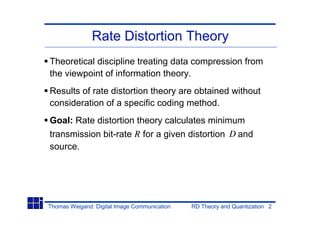
Rate Distortion Theory
Theoretical discipline treating data compression from
the viewpoint of information theory.
Results of rate distortion theory are obtained without
consideration of a specific coding method.
Goal: Rate distortion theory calculates minimum
transmission bit-rate R for a given distortion D and
source.


Thomas Wiegand: Digital Image Communication   RD Theory and Quantization 2
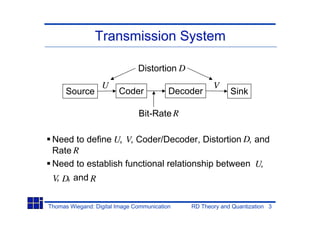
Transmission System

                               Distortion D
                  U                                  V
      Source            Coder             Decoder          Sink

                               Bit-Rate R

 Need to define U, V, Coder/Decoder, Distortion D, and
 Rate R
 Need to establish functional relationship between U,
 V, D, and R

Thomas Wiegand: Digital Image Communication   RD Theory and Quantization 3
Definitions
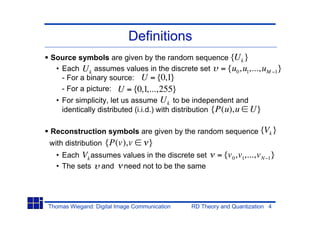
Source symbols are given by the random sequence {U k }
 • Each U k assumes values in the discrete set = {u0 ,u1,...,uM              1   }
   - For a binary source: U = {0,1}
   - For a picture: U = {0,1,...,255}
  • For simplicity, let us assume U k to be independent and
    identically distributed (i.i.d.) with distribution {P(u),u U}

Reconstruction symbols are given by the random sequence {Vk }
with distribution   {P(v),v        }
  • Each Vk assumes values in the discrete set         = {v 0 ,v1,...,v N 1}
  • The sets and need not to be the same


Thomas Wiegand: Digital Image Communication   RD Theory and Quantization 4
Coder / Decoder
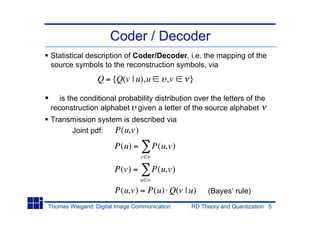
Statistical description of Coder/Decoder, i.e. the mapping of the
source symbols to the reconstruction symbols, via
                 Q = {Q(v | u),u         ,v   }

   is the conditional probability distribution over the letters of the
reconstruction alphabet given a letter of the source alphabet
Transmission system is described via
     Joint pdf:   P(u,v)
                       P(u) =       P(u,v)
                                v

                       P(v) =       P(u,v)
                                u

                       P(u,v) = P(u) Q(v | u)      (Bayes‘ rule)
Thomas Wiegand: Digital Image Communication   RD Theory and Quantization 5
Distortion
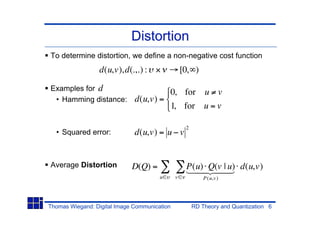
To determine distortion, we define a non-negative cost function
                 d(u,v),d(.,.) :                  [0, )

Examples for d
                                       0, for u v
 • Hamming distance:          d(u,v) =
                                       1, for u = v

                                                   2
  • Squared error:            d(u,v) = u v


Average Distortion           D(Q) =                P(u) 244 d(u,v)
                                                   14 Q(v |3
                                                      4    u)
                                       u      v            P (u,v )


Thomas Wiegand: Digital Image Communication            RD Theory and Quantization 6
Mutual Information
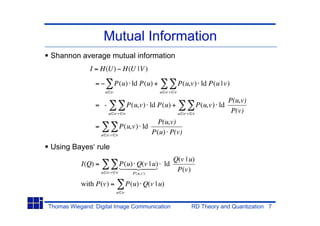
Shannon average mutual information
              I = H(U) H(U |V )
                =               P(u) ld P(u) +               P(u,v) ld P(u | v)
                        u                           u   v

                                                                                   P(u,v)
                = -                   P(u,v) ld P(u) +                 P(u,v) ld
                            u    v                           u   v
                                                                                    P(v)
                                                    P(u,v)
                =                   P(u,v) ld
                    u       v
                                                  P(u) P(v)

Using Bayes‘ rule
                                                            Q(v | u)
           I(Q) =                   14 244 ld
                                    P(u) Q(v |3
                                       4      u)
                    u       v           P(u,v )
                                                             P(v)
           with P(v) =               P(u) Q(v | u)
                                u


Thomas Wiegand: Digital Image Communication                          RD Theory and Quantization 7
Rate
Shannon average mutual information expressed via
entropy
           I(U;V ) = H(U) H(U |V )
                       Source entropy   Equivocation: conditional entropy


Equivocation:
 • The conditional entropy (uncertainty) about the
   source U given the reconstruction V
 • A measure for the amount of missing [quantized]
   information in the received signal V


Thomas Wiegand: Digital Image Communication           RD Theory and Quantization 8
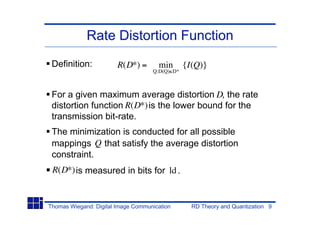
Rate Distortion Function
 Definition:            R(D*) =       min       {I(Q)}
                                    Q:D(Q) D*


 For a given maximum average distortion D, the rate
 distortion function R(D*) is the lower bound for the
 transmission bit-rate.
 The minimization is conducted for all possible
 mappings Q that satisfy the average distortion
 constraint.
 R(D*) is measured in bits for ld .


Thomas Wiegand: Digital Image Communication       RD Theory and Quantization 9
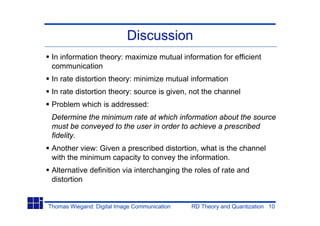
Discussion
 In information theory: maximize mutual information for efficient
 communication
 In rate distortion theory: minimize mutual information
 In rate distortion theory: source is given, not the channel
 Problem which is addressed:
 Determine the minimum rate at which information about the source
 must be conveyed to the user in order to achieve a prescribed
 fidelity.
 Another view: Given a prescribed distortion, what is the channel
 with the minimum capacity to convey the information.
 Alternative definition via interchanging the roles of rate and
 distortion


Thomas Wiegand: Digital Image Communication   RD Theory and Quantization 10
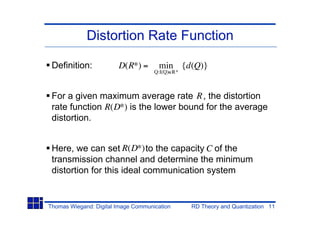
Distortion Rate Function

 Definition:            D(R*) =       min {d(Q)}
                                     Q:I(Q) R*


 For a given maximum average rate R , the distortion
 rate function R(D*) is the lower bound for the average
 distortion.


 Here, we can set R(D*) to the capacity C of the
 transmission channel and determine the minimum
 distortion for this ideal communication system


Thomas Wiegand: Digital Image Communication      RD Theory and Quantization 11
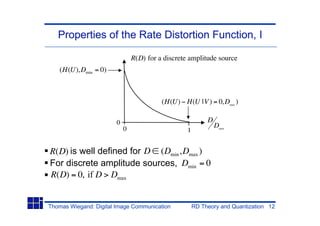
Properties of the Rate Distortion Function, I

                                R(D) for a discrete amplitude source
   (H(U),Dmin = 0)


                                          (H(U) H(U |V ) = 0,Dmax )

                        0                                   D
                            0                                   Dmax
                                                   1


R(D) is well defined for D (Dmin ,Dmax )
For discrete amplitude sources, Dmin = 0
R(D) = 0, if D > Dmax


Thomas Wiegand: Digital Image Communication            RD Theory and Quantization 12
Properties of the Rate Distortion Function, II
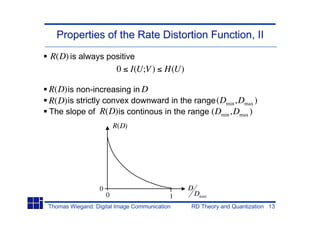
R(D) is always positive
                 0 I(U;V ) H(U)

R(D) is non-increasing in D
R(D) is strictly convex downward in the range (Dmin ,Dmax )
The slope of R(D) is continous in the range (Dmin ,Dmax )
                          R(D)


                  0                           D
                      0                   1       Dmax
Thomas Wiegand: Digital Image Communication   RD Theory and Quantization 13
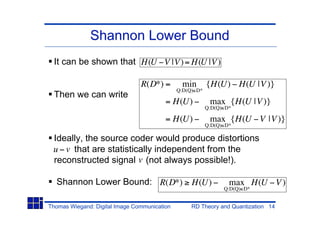
Shannon Lower Bound
  It can be shown that H(U V |V) = H(U |V )

                                R(D*) =        min        {H(U) H(U |V )}
                                              Q:D(Q) D*
  Then we can write
                                         = H(U)            max {H(U |V )}
                                                          Q:D(Q) D*

                                         = H(U)            max {H(U V |V )}
                                                          Q:D(Q) D*

 Ideally, the source coder would produce distortions
 u v that are statistically independent from the
 reconstructed signal v (not always possible!).

  Shannon Lower Bound: R(D*)                       H(U)           max H(U V )
                                                                Q:D(Q) D*


Thomas Wiegand: Digital Image Communication        RD Theory and Quantization 14
R(D*) for a Memoryless Gaussian Source
           and MSE Distortion
Gaussian source, variance 2
Mean squared error (MSE) D = E{(u v) 2 }
                     2
               1                               2       2 R*
        R(D*) = log    ; D(R*) =                   2          ,R 0
               2    D*
                                2
        SNR = 10 log10              = 10 log10 2 2 R      6R [dB]
                               D

Rule of thumb: 6 dB ~ 1 bit
The R(D*) for non-Gaussian sources with the same
variance 2 is always below this Gaussian R(D*) curve.


Thomas Wiegand: Digital Image Communication        RD Theory and Quantization 15
R(D*) Function for Gaussian Source
              with Memory I
Jointly Gaussian source with power spectrum Suu ( )
MSE: D = E{(u v) 2 }
Parametric formulation of the R(D*) function

              D= 1        min[D*,Suu ( )]d
                2
                                1    Suu ( )
              R= 1        max[0, log         ]d
                2               2     D*


R(D*) for non-Gaussian sources with the same power
spectral density is always lower.

Thomas Wiegand: Digital Image Communication   RD Theory and Quantization 16
R(D*) Function for Gaussian Source
                with Memory II
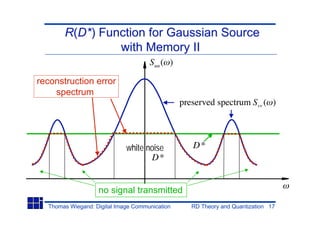
                                     Suu ( )

reconstruction error
    spectrum
                                                preserved spectrum Svv ( )


                             white noise           D*
                                    D*


                   no signal transmitted
  Thomas Wiegand: Digital Image Communication      RD Theory and Quantization 17
R(D*) Function for Gaussian Source
              with Memory III
ACF and PSD for a first order AR(1) Gauss-Markov
process:  U[n] = Z[n] + U[n 1]
                                                           2
                                    |k|   2                 (1 2 )
                  Ruu (k) =                 , Suu ( ) =                 2
                                                        1 2 cos +
Rate Distortion Function:
             1              Suu ( )     D* 1
  R(D*) =          log 2            d ,  2
            4                D*            1+
                             2
             1                   (1 2 )         1                           2
          =         log 2               d           log 2 (1 2 cos +            )d
            4                     D*           4
                      2                         2
           1              (1 2 ) 1
          = log 2               = log 2 z
           2               D*    2     D*
Thomas Wiegand: Digital Image Communication          RD Theory and Quantization 18
R(D*) Function for Gaussian Source
                with Memory IV
   SNR [dB]      45
             2
                 40                    D*      1                          =0,99
= 10 log10
             D                            2
                                               1+                         =0,95
                 35
                                                                          =0,9
                 30                                                       =0,78
                 25                                                       =0,5
                                                                          =0
                 20
                 15
                 10
                 5
                 0                                                        R [bits]
                      0   0.5 1       1.5 2         2.5 3       3.5 4
 Thomas Wiegand: Digital Image Communication        RD Theory and Quantization 19
Quantization
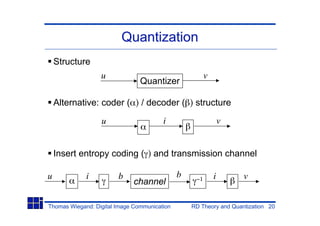
    Structure
                  u                                     v
                                Quantizer

    Alternative: coder ( ) / decoder ( ) structure

                  u                     i                       v


    Insert entropy coding ( ) and transmission channel

u            i          b                     b     1       i       v
                              channel

Thomas Wiegand: Digital Image Communication       RD Theory and Quantization 20
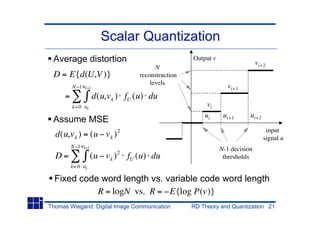
Scalar Quantization
 Average distortion                                    Output v
                                                                                 vi+2
                                            N
 D = E{d(U,V )}                       reconstruction
                                          levels
         N 1 uk+1                                                   vi+1
     =              d(u,v k ) fU (u) du
         k= 0 uk                                            vi
                                                           ui      ui+1      ui+1
 Assume MSE
                                                                                     input
  d(u,v k ) = (u v k ) 2                                                            signal u
         N 1 uk+1
                                                                  N-1 decision
                               2
  D=                (u v k )       fU (u) du                       thresholds
         k= 0 uk

  Fixed code word length vs. variable code word length
            R = logN vs. R = E{log P(v)}
Thomas Wiegand: Digital Image Communication            RD Theory and Quantization 21
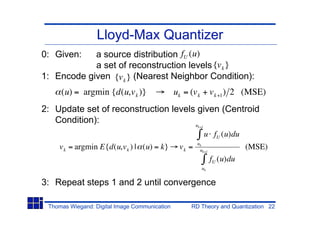
Lloyd-Max Quantizer
0: Given:   a source distribution fU (u)
            a set of reconstruction levels {v k }
1: Encode given {v k } (Nearest Neighbor Condition):
     (u) = argmin {d(u,v k )}                  uk = (v k + v k +1 ) 2 (MSE)
2: Update set of reconstruction levels given (Centroid
   Condition):                        u                k+1

                                                             u fU (u)du
                                                       uk
    v k = argmin E{d(u,v k ) | (u) = k}         vk =    uk+1
                                                                          (MSE)
                                                               fU (u)du
                                                         uk


3: Repeat steps 1 and 2 until convergence

 Thomas Wiegand: Digital Image Communication        RD Theory and Quantization 22
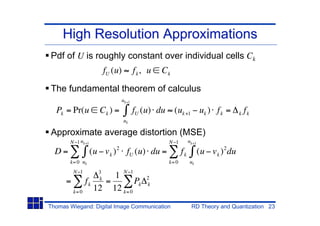
High Resolution Approximations
Pdf of U is roughly constant over individual cells Ck
                        fU (u)        fk, u   Ck

The fundamental theorem of calculus
                             uk+1

  Pk = Pr(u         Ck ) =            fU (u) du (uk +1 uk ) f k =                   f
                                                                                   k k
                                 uk

Approximate average distortion (MSE)
       N 1 uk+1                                 N 1         uk+1

  D=              (u v k ) 2 fU (u) du =               fk          (u v k ) 2 du
       k= 0 uk                                  k= 0        uk
        N 1
                    1 N1
                    3
                    k                    2
      =      fk   =        Pk            k
        k= 0
                12 12 k= 0
Thomas Wiegand: Digital Image Communication                  RD Theory and Quantization 23
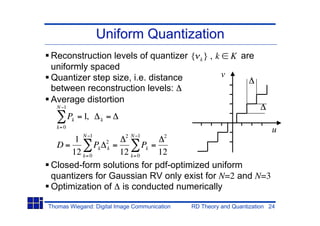
Uniform Quantization
Reconstruction levels of quantizer { k } , k K are
uniformly spaced
Quantizer step size, i.e. distance          v
between reconstruction levels:
Average distortion
   N 1
          Pk = 1,    k   =
   k= 0
                                                                         u
               N 1           2 N 1      2
      1
 D=          Pk 2k =         Pk =
     12 k= 0         12 k= 0      12
Closed-form solutions for pdf-optimized uniform
quantizers for Gaussian RV only exist for N=2 and N=3
Optimization of is conducted numerically

Thomas Wiegand: Digital Image Communication   RD Theory and Quantization 24
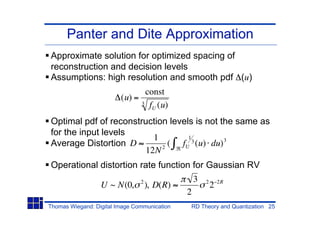
Panter and Dite Approximation
Approximate solution for optimized spacing of
reconstruction and decision levels
Assumptions: high resolution and smooth pdf (u)
                                  const
                         (u) =
                                 3 f (u)
                                    U

Optimal pdf of reconstruction levels is not the same as
for the input levels
                         1         1
Average Distortion D         ( fU 3 (u) du) 3
                       12N 2
Operational distortion rate function for Gaussian RV
                                 2                 3   2       2R
                  U ~ N(0,           ), D(R)               2
                                               2
Thomas Wiegand: Digital Image Communication    RD Theory and Quantization 25
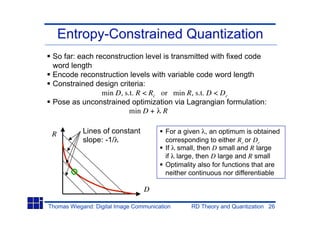
Entropy-Constrained Quantization
 So far: each reconstruction level is transmitted with fixed code
 word length
 Encode reconstruction levels with variable code word length
 Constrained design criteria:
                min D, s.t. R < Rc or min R, s.t. D < Dc
 Pose as unconstrained optimization via Lagrangian formulation:
                         min D + R


 R          Lines of constant            For a given , an optimum is obtained
            slope: -1/                   corresponding to either Rc or Dc
                                         If small, then D small and R large
                                         if large, then D large and R small
                                         Optimality also for functions that are
                                         neither continuous nor differentiable

                                 D

Thomas Wiegand: Digital Image Communication      RD Theory and Quantization 26
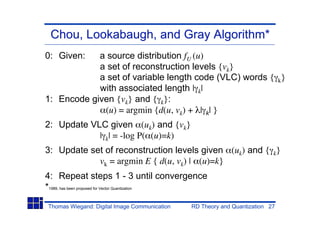
Chou, Lookabaugh, and Gray Algorithm*
0: Given:   a source distribution fU (u)
            a set of reconstruction levels {vk}
            a set of variable length code (VLC) words { k}
            with associated length | k|
1: Encode given {vk} and { k}:
             (u) = argmin {d(u, vk) + | k| }
2: Update VLC given (uk) and {vk}
            | k| = -log P( (u)=k)
3: Update set of reconstruction levels given (uk) and { k}
            vk = argmin E { d(u, vk) | (u)=k}
4: Repeat steps 1 - 3 until convergence
*1989, has been proposed for Vector Quantization

Thomas Wiegand: Digital Image Communication   RD Theory and Quantization 27
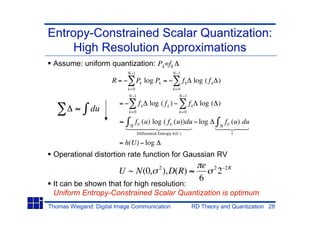
Entropy-Constrained Scalar Quantization:
    High Resolution Approximations
 Assume: uniform quantization: Pk=fk
                            N 1                          N 1
                      R=           Pk log Pk =                   f k log ( f k )
                            k= 0                         k= 0
                             N 1                            N 1
                        =           f k log ( f k )                f k log ( )
              du             k= 0                           k= 0

                             fU (u) log ( fU (u))du log  fU (u) du
                            1444 2444 3
                                   4            4       14243
                                    Differential Entropy h(U )                        1

                        = h(U) log
 Operational distortion rate function for Gaussian RV
                                                2                       e    2       2R
                        U ~ N(0,                    ),D(R)                       2
                                                                       6
 It can be shown that for high resolution:
 Uniform Entropy-Constrained Scalar Quantization is optimum
Thomas Wiegand: Digital Image Communication                         RD Theory and Quantization 28
Comparison for Gaussian Sources
                 30
   SNR [dB]              R(D*), =0.9
             2           R(D*), =0
= 10 log10       25      Lloyd-Max
             D           Uniform Fixed-Rate
                         Panter & Dite App
                         Entropy-Constrained Opt.
                 20

                 15

                 10

                 5
                                                                             R [bits]
                 0
                     0   0.5     1       1.5        2    2.5     3     3.5     4
   Thomas Wiegand: Digital Image Communication          RD Theory and Quantization 29
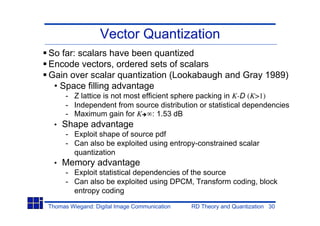
Vector Quantization
So far: scalars have been quantized
Encode vectors, ordered sets of scalars
Gain over scalar quantization (Lookabaugh and Gray 1989)
 • Space filling advantage
      - Z lattice is not most efficient sphere packing in K-D (K>1)
      - Independent from source distribution or statistical dependencies
      - Maximum gain for K : 1.53 dB
  •   Shape advantage
      - Exploit shape of source pdf
      - Can also be exploited using entropy-constrained scalar
        quantization
  •   Memory advantage
      - Exploit statistical dependencies of the source
      - Can also be exploited using DPCM, Transform coding, block
        entropy coding

Thomas Wiegand: Digital Image Communication   RD Theory and Quantization 30
Comparison for Gauss-Markov Source: =0.9
           40
SNR [dB]
           35
           30
           25
           20
           15                                         R(D*), =0.9
                                                      VQ, K=100
                                                      VQ, K=10
           10                                         VQ, K=5
                                                      VQ, K=2
            5                                         Panter & Dite App
                                                      Entropy-Constrained Opt.
                                                                                     R [bits]
            0
                0       1       2        3       4        5          6           7
   Thomas Wiegand: Digital Image Communication       RD Theory and Quantization 31
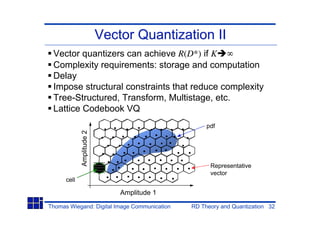
Vector Quantization II
 Vector quantizers can achieve R(D*) if K
 Complexity requirements: storage and computation
 Delay
 Impose structural constraints that reduce complexity
 Tree-Structured, Transform, Multistage, etc.
 Lattice Codebook VQ

                                 •       •                          pdf
                             •       •       • • • •
             Amplitude 2


                            • • •       • • • • •         •
                              •    • •   •  •   • •     •
                                               • •
                            • • • • •                 •    •
                               • • •     • •    • • •
                                                                     Representative
                             • • •     • •    •   •   • •
                                                                     vector
      cell                    • • • • •         •   •

                                  Amplitude 1
Thomas Wiegand: Digital Image Communication                    RD Theory and Quantization 32
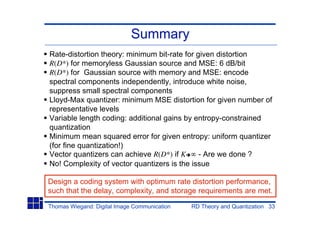
Summary
Rate-distortion theory: minimum bit-rate for given distortion
R(D*) for memoryless Gaussian source and MSE: 6 dB/bit
R(D*) for Gaussian source with memory and MSE: encode
spectral components independently, introduce white noise,
suppress small spectral components
Lloyd-Max quantizer: minimum MSE distortion for given number of
representative levels
Variable length coding: additional gains by entropy-constrained
quantization
Minimum mean squared error for given entropy: uniform quantizer
(for fine quantization!)
Vector quantizers can achieve R(D*) if K      - Are we done ?
No! Complexity of vector quantizers is the issue

Design a coding system with optimum rate distortion performance,
such that the delay, complexity, and storage requirements are met.

Thomas Wiegand: Digital Image Communication   RD Theory and Quantization 33

Dic rd theory_quantization_07

  • 1.
    Rate Distortion Theory& Quantization Rate Distortion Theory Rate Distortion Function R(D*) for Memoryless Gaussian Sources R(D*) for Gaussian Sources with Memory Scalar Quantization Lloyd-Max Quantizer High Resolution Approximations Entropy-Constrained Quantization Vector Quantization Thomas Wiegand: Digital Image Communication RD Theory and Quantization 1
  • 2.
    Rate Distortion Theory Theoreticaldiscipline treating data compression from the viewpoint of information theory. Results of rate distortion theory are obtained without consideration of a specific coding method. Goal: Rate distortion theory calculates minimum transmission bit-rate R for a given distortion D and source. Thomas Wiegand: Digital Image Communication RD Theory and Quantization 2
  • 3.
    Transmission System Distortion D U V Source Coder Decoder Sink Bit-Rate R Need to define U, V, Coder/Decoder, Distortion D, and Rate R Need to establish functional relationship between U, V, D, and R Thomas Wiegand: Digital Image Communication RD Theory and Quantization 3
  • 4.
    Definitions Source symbols aregiven by the random sequence {U k } • Each U k assumes values in the discrete set = {u0 ,u1,...,uM 1 } - For a binary source: U = {0,1} - For a picture: U = {0,1,...,255} • For simplicity, let us assume U k to be independent and identically distributed (i.i.d.) with distribution {P(u),u U} Reconstruction symbols are given by the random sequence {Vk } with distribution {P(v),v } • Each Vk assumes values in the discrete set = {v 0 ,v1,...,v N 1} • The sets and need not to be the same Thomas Wiegand: Digital Image Communication RD Theory and Quantization 4
  • 5.
    Coder / Decoder Statisticaldescription of Coder/Decoder, i.e. the mapping of the source symbols to the reconstruction symbols, via Q = {Q(v | u),u ,v } is the conditional probability distribution over the letters of the reconstruction alphabet given a letter of the source alphabet Transmission system is described via Joint pdf: P(u,v) P(u) = P(u,v) v P(v) = P(u,v) u P(u,v) = P(u) Q(v | u) (Bayes‘ rule) Thomas Wiegand: Digital Image Communication RD Theory and Quantization 5
  • 6.
    Distortion To determine distortion,we define a non-negative cost function d(u,v),d(.,.) : [0, ) Examples for d 0, for u v • Hamming distance: d(u,v) = 1, for u = v 2 • Squared error: d(u,v) = u v Average Distortion D(Q) = P(u) 244 d(u,v) 14 Q(v |3 4 u) u v P (u,v ) Thomas Wiegand: Digital Image Communication RD Theory and Quantization 6
  • 7.
    Mutual Information Shannon averagemutual information I = H(U) H(U |V ) = P(u) ld P(u) + P(u,v) ld P(u | v) u u v P(u,v) = - P(u,v) ld P(u) + P(u,v) ld u v u v P(v) P(u,v) = P(u,v) ld u v P(u) P(v) Using Bayes‘ rule Q(v | u) I(Q) = 14 244 ld P(u) Q(v |3 4 u) u v P(u,v ) P(v) with P(v) = P(u) Q(v | u) u Thomas Wiegand: Digital Image Communication RD Theory and Quantization 7
  • 8.
    Rate Shannon average mutualinformation expressed via entropy I(U;V ) = H(U) H(U |V ) Source entropy Equivocation: conditional entropy Equivocation: • The conditional entropy (uncertainty) about the source U given the reconstruction V • A measure for the amount of missing [quantized] information in the received signal V Thomas Wiegand: Digital Image Communication RD Theory and Quantization 8
  • 9.
    Rate Distortion Function Definition: R(D*) = min {I(Q)} Q:D(Q) D* For a given maximum average distortion D, the rate distortion function R(D*) is the lower bound for the transmission bit-rate. The minimization is conducted for all possible mappings Q that satisfy the average distortion constraint. R(D*) is measured in bits for ld . Thomas Wiegand: Digital Image Communication RD Theory and Quantization 9
  • 10.
    Discussion In informationtheory: maximize mutual information for efficient communication In rate distortion theory: minimize mutual information In rate distortion theory: source is given, not the channel Problem which is addressed: Determine the minimum rate at which information about the source must be conveyed to the user in order to achieve a prescribed fidelity. Another view: Given a prescribed distortion, what is the channel with the minimum capacity to convey the information. Alternative definition via interchanging the roles of rate and distortion Thomas Wiegand: Digital Image Communication RD Theory and Quantization 10
  • 11.
    Distortion Rate Function Definition: D(R*) = min {d(Q)} Q:I(Q) R* For a given maximum average rate R , the distortion rate function R(D*) is the lower bound for the average distortion. Here, we can set R(D*) to the capacity C of the transmission channel and determine the minimum distortion for this ideal communication system Thomas Wiegand: Digital Image Communication RD Theory and Quantization 11
  • 12.
    Properties of theRate Distortion Function, I R(D) for a discrete amplitude source (H(U),Dmin = 0) (H(U) H(U |V ) = 0,Dmax ) 0 D 0 Dmax 1 R(D) is well defined for D (Dmin ,Dmax ) For discrete amplitude sources, Dmin = 0 R(D) = 0, if D > Dmax Thomas Wiegand: Digital Image Communication RD Theory and Quantization 12
  • 13.
    Properties of theRate Distortion Function, II R(D) is always positive 0 I(U;V ) H(U) R(D) is non-increasing in D R(D) is strictly convex downward in the range (Dmin ,Dmax ) The slope of R(D) is continous in the range (Dmin ,Dmax ) R(D) 0 D 0 1 Dmax Thomas Wiegand: Digital Image Communication RD Theory and Quantization 13
  • 14.
    Shannon Lower Bound It can be shown that H(U V |V) = H(U |V ) R(D*) = min {H(U) H(U |V )} Q:D(Q) D* Then we can write = H(U) max {H(U |V )} Q:D(Q) D* = H(U) max {H(U V |V )} Q:D(Q) D* Ideally, the source coder would produce distortions u v that are statistically independent from the reconstructed signal v (not always possible!). Shannon Lower Bound: R(D*) H(U) max H(U V ) Q:D(Q) D* Thomas Wiegand: Digital Image Communication RD Theory and Quantization 14
  • 15.
    R(D*) for aMemoryless Gaussian Source and MSE Distortion Gaussian source, variance 2 Mean squared error (MSE) D = E{(u v) 2 } 2 1 2 2 R* R(D*) = log ; D(R*) = 2 ,R 0 2 D* 2 SNR = 10 log10 = 10 log10 2 2 R 6R [dB] D Rule of thumb: 6 dB ~ 1 bit The R(D*) for non-Gaussian sources with the same variance 2 is always below this Gaussian R(D*) curve. Thomas Wiegand: Digital Image Communication RD Theory and Quantization 15
  • 16.
    R(D*) Function forGaussian Source with Memory I Jointly Gaussian source with power spectrum Suu ( ) MSE: D = E{(u v) 2 } Parametric formulation of the R(D*) function D= 1 min[D*,Suu ( )]d 2 1 Suu ( ) R= 1 max[0, log ]d 2 2 D* R(D*) for non-Gaussian sources with the same power spectral density is always lower. Thomas Wiegand: Digital Image Communication RD Theory and Quantization 16
  • 17.
    R(D*) Function forGaussian Source with Memory II Suu ( ) reconstruction error spectrum preserved spectrum Svv ( ) white noise D* D* no signal transmitted Thomas Wiegand: Digital Image Communication RD Theory and Quantization 17
  • 18.
    R(D*) Function forGaussian Source with Memory III ACF and PSD for a first order AR(1) Gauss-Markov process: U[n] = Z[n] + U[n 1] 2 |k| 2 (1 2 ) Ruu (k) = , Suu ( ) = 2 1 2 cos + Rate Distortion Function: 1 Suu ( ) D* 1 R(D*) = log 2 d , 2 4 D* 1+ 2 1 (1 2 ) 1 2 = log 2 d log 2 (1 2 cos + )d 4 D* 4 2 2 1 (1 2 ) 1 = log 2 = log 2 z 2 D* 2 D* Thomas Wiegand: Digital Image Communication RD Theory and Quantization 18
  • 19.
    R(D*) Function forGaussian Source with Memory IV SNR [dB] 45 2 40 D* 1 =0,99 = 10 log10 D 2 1+ =0,95 35 =0,9 30 =0,78 25 =0,5 =0 20 15 10 5 0 R [bits] 0 0.5 1 1.5 2 2.5 3 3.5 4 Thomas Wiegand: Digital Image Communication RD Theory and Quantization 19
  • 20.
    Quantization Structure u v Quantizer Alternative: coder ( ) / decoder ( ) structure u i v Insert entropy coding ( ) and transmission channel u i b b 1 i v channel Thomas Wiegand: Digital Image Communication RD Theory and Quantization 20
  • 21.
    Scalar Quantization Averagedistortion Output v vi+2 N D = E{d(U,V )} reconstruction levels N 1 uk+1 vi+1 = d(u,v k ) fU (u) du k= 0 uk vi ui ui+1 ui+1 Assume MSE input d(u,v k ) = (u v k ) 2 signal u N 1 uk+1 N-1 decision 2 D= (u v k ) fU (u) du thresholds k= 0 uk Fixed code word length vs. variable code word length R = logN vs. R = E{log P(v)} Thomas Wiegand: Digital Image Communication RD Theory and Quantization 21
  • 22.
    Lloyd-Max Quantizer 0: Given: a source distribution fU (u) a set of reconstruction levels {v k } 1: Encode given {v k } (Nearest Neighbor Condition): (u) = argmin {d(u,v k )} uk = (v k + v k +1 ) 2 (MSE) 2: Update set of reconstruction levels given (Centroid Condition): u k+1 u fU (u)du uk v k = argmin E{d(u,v k ) | (u) = k} vk = uk+1 (MSE) fU (u)du uk 3: Repeat steps 1 and 2 until convergence Thomas Wiegand: Digital Image Communication RD Theory and Quantization 22
  • 23.
    High Resolution Approximations Pdfof U is roughly constant over individual cells Ck fU (u) fk, u Ck The fundamental theorem of calculus uk+1 Pk = Pr(u Ck ) = fU (u) du (uk +1 uk ) f k = f k k uk Approximate average distortion (MSE) N 1 uk+1 N 1 uk+1 D= (u v k ) 2 fU (u) du = fk (u v k ) 2 du k= 0 uk k= 0 uk N 1 1 N1 3 k 2 = fk = Pk k k= 0 12 12 k= 0 Thomas Wiegand: Digital Image Communication RD Theory and Quantization 23
  • 24.
    Uniform Quantization Reconstruction levelsof quantizer { k } , k K are uniformly spaced Quantizer step size, i.e. distance v between reconstruction levels: Average distortion N 1 Pk = 1, k = k= 0 u N 1 2 N 1 2 1 D= Pk 2k = Pk = 12 k= 0 12 k= 0 12 Closed-form solutions for pdf-optimized uniform quantizers for Gaussian RV only exist for N=2 and N=3 Optimization of is conducted numerically Thomas Wiegand: Digital Image Communication RD Theory and Quantization 24
  • 25.
    Panter and DiteApproximation Approximate solution for optimized spacing of reconstruction and decision levels Assumptions: high resolution and smooth pdf (u) const (u) = 3 f (u) U Optimal pdf of reconstruction levels is not the same as for the input levels 1 1 Average Distortion D ( fU 3 (u) du) 3 12N 2 Operational distortion rate function for Gaussian RV 2 3 2 2R U ~ N(0, ), D(R) 2 2 Thomas Wiegand: Digital Image Communication RD Theory and Quantization 25
  • 26.
    Entropy-Constrained Quantization Sofar: each reconstruction level is transmitted with fixed code word length Encode reconstruction levels with variable code word length Constrained design criteria: min D, s.t. R < Rc or min R, s.t. D < Dc Pose as unconstrained optimization via Lagrangian formulation: min D + R R Lines of constant For a given , an optimum is obtained slope: -1/ corresponding to either Rc or Dc If small, then D small and R large if large, then D large and R small Optimality also for functions that are neither continuous nor differentiable D Thomas Wiegand: Digital Image Communication RD Theory and Quantization 26
  • 27.
    Chou, Lookabaugh, andGray Algorithm* 0: Given: a source distribution fU (u) a set of reconstruction levels {vk} a set of variable length code (VLC) words { k} with associated length | k| 1: Encode given {vk} and { k}: (u) = argmin {d(u, vk) + | k| } 2: Update VLC given (uk) and {vk} | k| = -log P( (u)=k) 3: Update set of reconstruction levels given (uk) and { k} vk = argmin E { d(u, vk) | (u)=k} 4: Repeat steps 1 - 3 until convergence *1989, has been proposed for Vector Quantization Thomas Wiegand: Digital Image Communication RD Theory and Quantization 27
  • 28.
    Entropy-Constrained Scalar Quantization: High Resolution Approximations Assume: uniform quantization: Pk=fk N 1 N 1 R= Pk log Pk = f k log ( f k ) k= 0 k= 0 N 1 N 1 = f k log ( f k ) f k log ( ) du k= 0 k= 0 fU (u) log ( fU (u))du log fU (u) du 1444 2444 3 4 4 14243 Differential Entropy h(U ) 1 = h(U) log Operational distortion rate function for Gaussian RV 2 e 2 2R U ~ N(0, ),D(R) 2 6 It can be shown that for high resolution: Uniform Entropy-Constrained Scalar Quantization is optimum Thomas Wiegand: Digital Image Communication RD Theory and Quantization 28
  • 29.
    Comparison for GaussianSources 30 SNR [dB] R(D*), =0.9 2 R(D*), =0 = 10 log10 25 Lloyd-Max D Uniform Fixed-Rate Panter & Dite App Entropy-Constrained Opt. 20 15 10 5 R [bits] 0 0 0.5 1 1.5 2 2.5 3 3.5 4 Thomas Wiegand: Digital Image Communication RD Theory and Quantization 29
  • 30.
    Vector Quantization So far:scalars have been quantized Encode vectors, ordered sets of scalars Gain over scalar quantization (Lookabaugh and Gray 1989) • Space filling advantage - Z lattice is not most efficient sphere packing in K-D (K>1) - Independent from source distribution or statistical dependencies - Maximum gain for K : 1.53 dB • Shape advantage - Exploit shape of source pdf - Can also be exploited using entropy-constrained scalar quantization • Memory advantage - Exploit statistical dependencies of the source - Can also be exploited using DPCM, Transform coding, block entropy coding Thomas Wiegand: Digital Image Communication RD Theory and Quantization 30
  • 31.
    Comparison for Gauss-MarkovSource: =0.9 40 SNR [dB] 35 30 25 20 15 R(D*), =0.9 VQ, K=100 VQ, K=10 10 VQ, K=5 VQ, K=2 5 Panter & Dite App Entropy-Constrained Opt. R [bits] 0 0 1 2 3 4 5 6 7 Thomas Wiegand: Digital Image Communication RD Theory and Quantization 31
  • 32.
    Vector Quantization II Vector quantizers can achieve R(D*) if K Complexity requirements: storage and computation Delay Impose structural constraints that reduce complexity Tree-Structured, Transform, Multistage, etc. Lattice Codebook VQ • • pdf • • • • • • Amplitude 2 • • • • • • • • • • • • • • • • • • • • • • • • • • • • • • • • • • Representative • • • • • • • • • vector cell • • • • • • • Amplitude 1 Thomas Wiegand: Digital Image Communication RD Theory and Quantization 32
  • 33.
    Summary Rate-distortion theory: minimumbit-rate for given distortion R(D*) for memoryless Gaussian source and MSE: 6 dB/bit R(D*) for Gaussian source with memory and MSE: encode spectral components independently, introduce white noise, suppress small spectral components Lloyd-Max quantizer: minimum MSE distortion for given number of representative levels Variable length coding: additional gains by entropy-constrained quantization Minimum mean squared error for given entropy: uniform quantizer (for fine quantization!) Vector quantizers can achieve R(D*) if K - Are we done ? No! Complexity of vector quantizers is the issue Design a coding system with optimum rate distortion performance, such that the delay, complexity, and storage requirements are met. Thomas Wiegand: Digital Image Communication RD Theory and Quantization 33