Quantum Entanglement:
Cryptography and Communication
(for information only)
Chih-Yun Lo cylo112@iii.org.tw, grimmg@ee.tku.edu.tw
Yi-Hsueh Tsai lucas@iii.org.tw
3GPP TSG-SA WG1 Meeting #71 ad hoc on SMARTER (5G) S1-153007
Vancouver, Canada, 19 – 21, October, 2015
Agenda Item: 3.6 Other contributions to 22.891
Source: Institute for Information Industry (III)
1
Outline
1. Introduction
2. Quantum Entanglement
3. Quantum Cryptography - Quantum Key Distribution
4. Physical Limit for E2E Time Delay - Speed of Light
5. Shorten E2E Delay - Faster-Than-Light Communication
6. Conclusions
2
Introduction
• Quantum entanglement is a quantum mechanical phenomenon in
which the quantum states of two or more objects have to be described
with reference to each other, even though the individual objects may be
spatially separated.
• This leads to correlations between observable physical properties of the
systems. It is possible to prepare two particles in a single quantum
state such that when one is observed to be spin-up, the other one will
always be observed to be spin-down and vice versa, this despite the
fact that it is impossible to predict, according to quantum mechanics,
which set of measurements will be observed.
• As a result, measurements performed on one system seem to be
instantaneously influencing other systems entangled with it.
3Source: http://www.sciencedaily.com/terms/quantum_entanglement.htm
Quantum Entanglement
• Quantum entanglement has applications in the emerging
technologies of quantum computing and quantum
cryptography, and has been used to realize quantum
teleportation experimentally.
• At the same time, it prompts some of the more philosophically
oriented discussions concerning quantum theory.
• The correlations predicted by quantum mechanics, and
observed in experiment, reject the principle of local realism,
which is that information about the state of a system should
only be mediated by interactions in its immediate surroundings.
4Source: http://www.sciencedaily.com/terms/quantum_entanglement.htm
Quantum Cryptography - Quantum Key Distribution
The principle of operation of a Quantum Key Distribution (QKD) system:
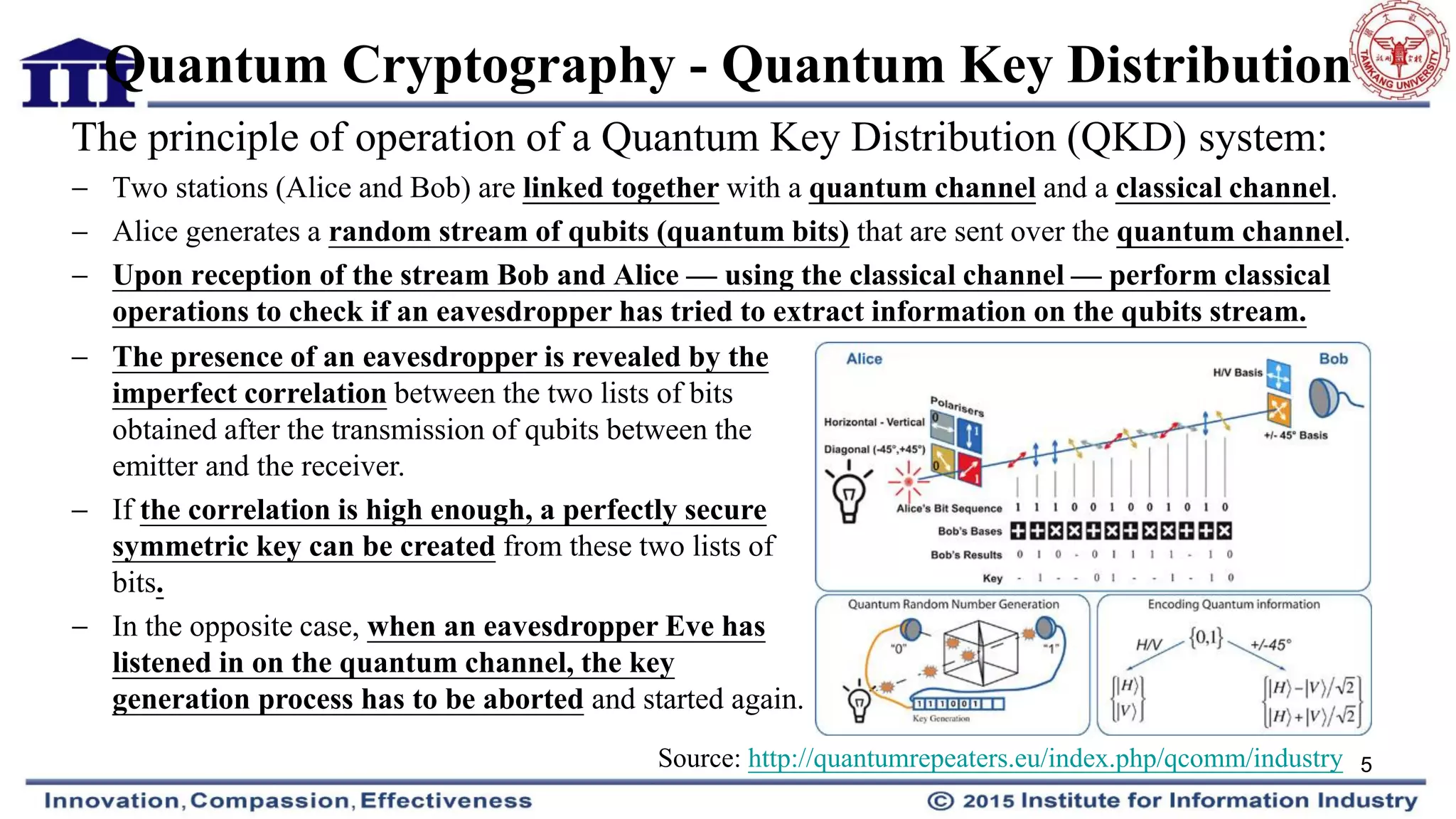
 Two stations (Alice and Bob) are linked together with a quantum channel and a classical channel.
 Alice generates a random stream of qubits (quantum bits) that are sent over the quantum channel.
 Upon reception of the stream Bob and Alice — using the classical channel — perform classical
operations to check if an eavesdropper has tried to extract information on the qubits stream.
5
 The presence of an eavesdropper is revealed by the
imperfect correlation between the two lists of bits
obtained after the transmission of qubits between the
emitter and the receiver.
 If the correlation is high enough, a perfectly secure
symmetric key can be created from these two lists of
bits.
 In the opposite case, when an eavesdropper Eve has
listened in on the quantum channel, the key
generation process has to be aborted and started again.
Source: http://quantumrepeaters.eu/index.php/qcomm/industry
Physical Limit for E2E Time Delay - Speed of Light
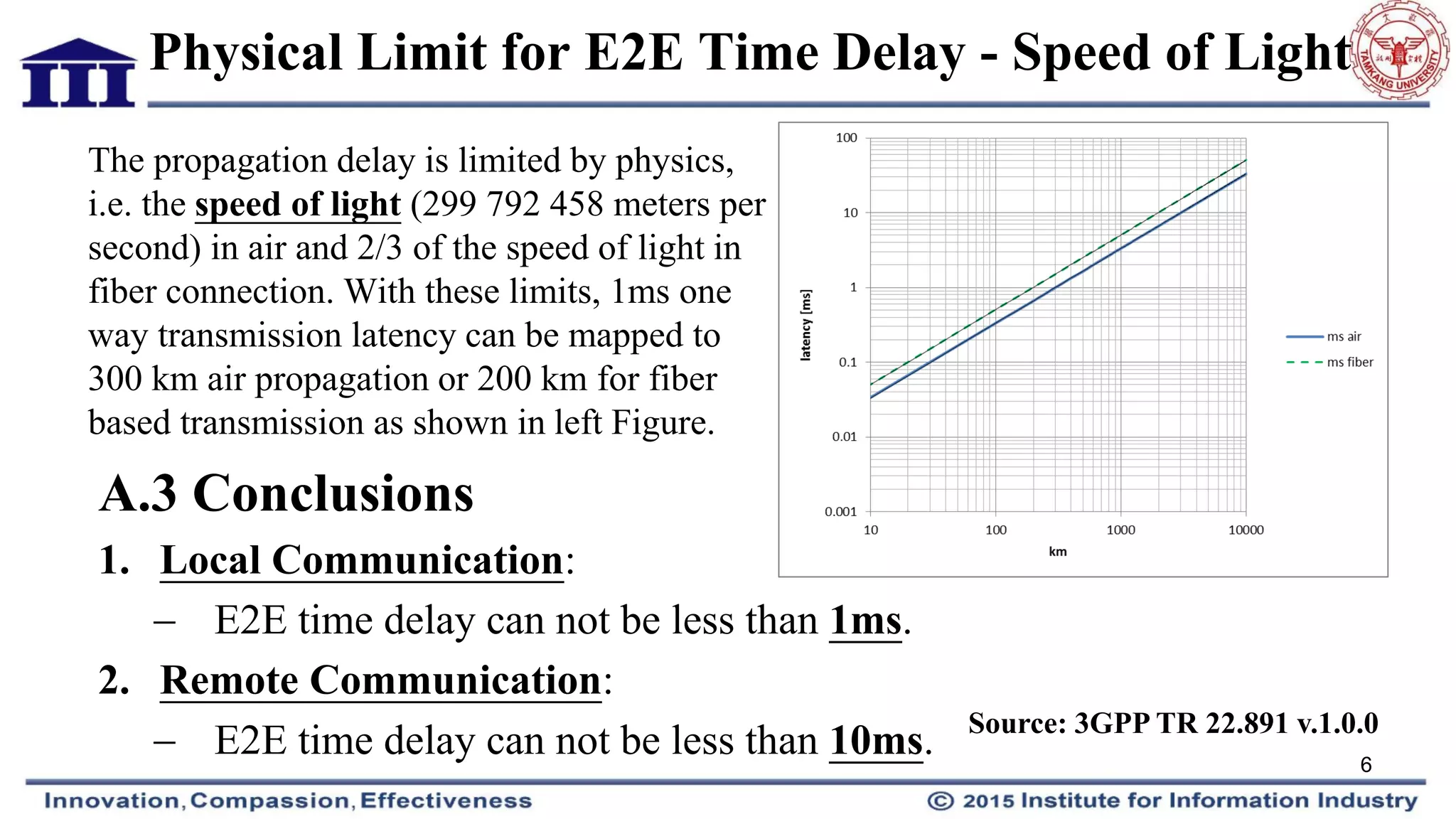
The propagation delay is limited by physics,
i.e. the speed of light (299 792 458 meters per
second) in air and 2/3 of the speed of light in
fiber connection. With these limits, 1ms one
way transmission latency can be mapped to
300 km air propagation or 200 km for fiber
based transmission as shown in left Figure.
6
A.3 Conclusions
1. Local Communication:
 E2E time delay can not be less than 1ms.
2. Remote Communication:
 E2E time delay can not be less than 10ms. Source: 3GPP TR 22.891 v.1.0.0
Shorten E2E Delay - FTL Communication
In order to shorten E2E delay, technology regarding Faster-
Than-Light (FTL) communication is required.
– FTL communication refer to the propagation of information
faster than the speed of light.
– Quantum entanglement might give the superficial
impression of allowing communication of information faster
than light.
– In fact, it does not enable the transmission of classical
information faster than the speed of light.
7Source: http://math.ucr.edu/home/baez/physics/Relativity/SpeedOfLight/FTL.html
Conclusions
1. To improve communication security, quantum cryptography
could be considered.
2. To shorten E2E delay, technology regarding Faster-Than-
Light (FTL) communication is required.
Need a Nobel Prizes Winner in Physics!
8
9

Quantum Entanglement - Cryptography and Communication

  • 1.
    Quantum Entanglement: Cryptography andCommunication (for information only) Chih-Yun Lo cylo112@iii.org.tw, grimmg@ee.tku.edu.tw Yi-Hsueh Tsai lucas@iii.org.tw 3GPP TSG-SA WG1 Meeting #71 ad hoc on SMARTER (5G) S1-153007 Vancouver, Canada, 19 – 21, October, 2015 Agenda Item: 3.6 Other contributions to 22.891 Source: Institute for Information Industry (III) 1
  • 2.
    Outline 1. Introduction 2. QuantumEntanglement 3. Quantum Cryptography - Quantum Key Distribution 4. Physical Limit for E2E Time Delay - Speed of Light 5. Shorten E2E Delay - Faster-Than-Light Communication 6. Conclusions 2
  • 3.
    Introduction • Quantum entanglementis a quantum mechanical phenomenon in which the quantum states of two or more objects have to be described with reference to each other, even though the individual objects may be spatially separated. • This leads to correlations between observable physical properties of the systems. It is possible to prepare two particles in a single quantum state such that when one is observed to be spin-up, the other one will always be observed to be spin-down and vice versa, this despite the fact that it is impossible to predict, according to quantum mechanics, which set of measurements will be observed. • As a result, measurements performed on one system seem to be instantaneously influencing other systems entangled with it. 3Source: http://www.sciencedaily.com/terms/quantum_entanglement.htm
  • 4.
    Quantum Entanglement • Quantumentanglement has applications in the emerging technologies of quantum computing and quantum cryptography, and has been used to realize quantum teleportation experimentally. • At the same time, it prompts some of the more philosophically oriented discussions concerning quantum theory. • The correlations predicted by quantum mechanics, and observed in experiment, reject the principle of local realism, which is that information about the state of a system should only be mediated by interactions in its immediate surroundings. 4Source: http://www.sciencedaily.com/terms/quantum_entanglement.htm
  • 5.
    Quantum Cryptography -Quantum Key Distribution The principle of operation of a Quantum Key Distribution (QKD) system:  Two stations (Alice and Bob) are linked together with a quantum channel and a classical channel.  Alice generates a random stream of qubits (quantum bits) that are sent over the quantum channel.  Upon reception of the stream Bob and Alice — using the classical channel — perform classical operations to check if an eavesdropper has tried to extract information on the qubits stream. 5  The presence of an eavesdropper is revealed by the imperfect correlation between the two lists of bits obtained after the transmission of qubits between the emitter and the receiver.  If the correlation is high enough, a perfectly secure symmetric key can be created from these two lists of bits.  In the opposite case, when an eavesdropper Eve has listened in on the quantum channel, the key generation process has to be aborted and started again. Source: http://quantumrepeaters.eu/index.php/qcomm/industry
  • 6.
    Physical Limit forE2E Time Delay - Speed of Light The propagation delay is limited by physics, i.e. the speed of light (299 792 458 meters per second) in air and 2/3 of the speed of light in fiber connection. With these limits, 1ms one way transmission latency can be mapped to 300 km air propagation or 200 km for fiber based transmission as shown in left Figure. 6 A.3 Conclusions 1. Local Communication:  E2E time delay can not be less than 1ms. 2. Remote Communication:  E2E time delay can not be less than 10ms. Source: 3GPP TR 22.891 v.1.0.0
  • 7.
    Shorten E2E Delay- FTL Communication In order to shorten E2E delay, technology regarding Faster- Than-Light (FTL) communication is required. – FTL communication refer to the propagation of information faster than the speed of light. – Quantum entanglement might give the superficial impression of allowing communication of information faster than light. – In fact, it does not enable the transmission of classical information faster than the speed of light. 7Source: http://math.ucr.edu/home/baez/physics/Relativity/SpeedOfLight/FTL.html
  • 8.
    Conclusions 1. To improvecommunication security, quantum cryptography could be considered. 2. To shorten E2E delay, technology regarding Faster-Than- Light (FTL) communication is required. Need a Nobel Prizes Winner in Physics! 8
  • 9.