Quantum conditional states, Bayes’ rule, and
           state compatibility

                 M. S. Leifer (UCL)
     Joint work with R. W. Spekkens (Perimeter)


            Imperial College QI Seminar
               14th December 2010
Outline


   1   Quantum conditional states


   2   Hybrid quantum-classical systems


   3   Quantum Bayes’ rule


   4   Quantum state compatibility


   5   Further results and open questions
Topic


   1    Quantum conditional states


   2    Hybrid quantum-classical systems


   3    Quantum Bayes’ rule


   4    Quantum state compatibility


   5    Further results and open questions
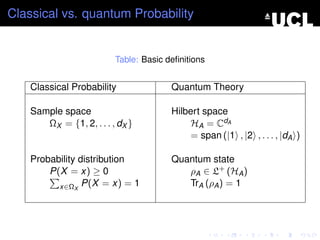
Classical vs. quantum Probability
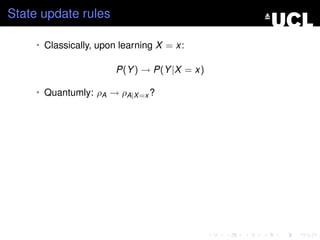

                          Table: Basic definitions


    Classical Probability               Quantum Theory

    Sample space                        Hilbert space
       ΩX = {1, 2, . . . , dX }             HA = CdA
                                            = span (|1 , |2 , . . . , |dA )

    Probability distribution            Quantum state
        P(X = x) ≥ 0                       ρA ∈ L+ (HA )
          x∈ΩX P(X = x) = 1                TrA (ρA ) = 1
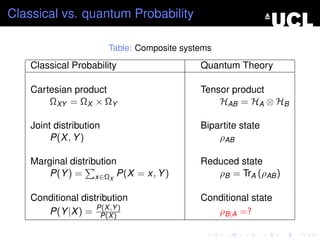
Classical vs. quantum Probability

                         Table: Composite systems

    Classical Probability                     Quantum Theory

    Cartesian product                         Tensor product
        ΩXY = ΩX × ΩY                             HAB = HA ⊗ HB

    Joint distribution                        Bipartite state
         P(X , Y )                                ρAB

    Marginal distribution                     Reduced state
       P(Y ) = x∈ΩX P(X = x, Y )                 ρB = TrA (ρAB )

    Conditional distribution                  Conditional state
       P(Y |X ) = P(X ,Y )
                     P(X )                       ρB|A =?
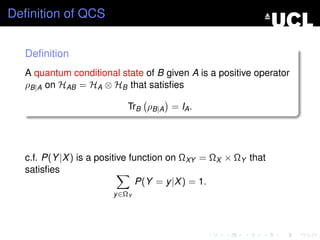
Definition of QCS


  Definition
  A quantum conditional state of B given A is a positive operator
  ρB|A on HAB = HA ⊗ HB that satisfies

                          TrB ρB|A = IA .


  c.f. P(Y |X ) is a positive function on ΩXY = ΩX × ΩY that
  satisfies
                                P(Y = y |X ) = 1.
                       y ∈ΩY
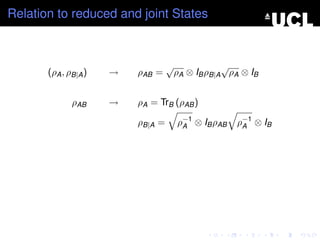
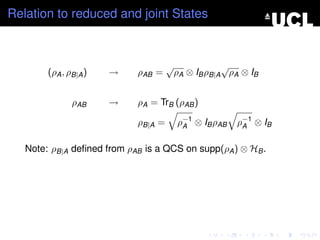
Relation to reduced and joint States


                                   √               √
       (ρA , ρB|A )   →   ρAB =        ρA ⊗ IB ρB|A ρA ⊗ IB


              ρAB     →   ρA = TrB (ρAB )

                          ρB|A =       ρ−1 ⊗ IB ρAB
                                        A             ρ−1 ⊗ IB
                                                       A
Relation to reduced and joint States


                                     √               √
        (ρA , ρB|A )   →    ρAB =        ρA ⊗ IB ρB|A ρA ⊗ IB


               ρAB     →    ρA = TrB (ρAB )

                            ρB|A =       ρ−1 ⊗ IB ρAB
                                          A             ρ−1 ⊗ IB
                                                         A


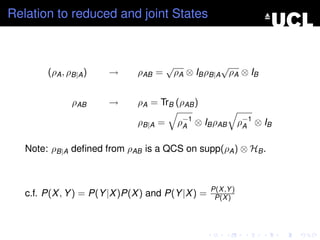
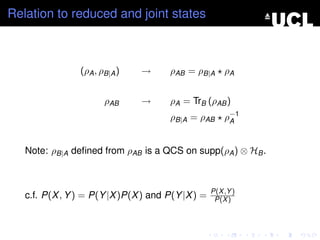
   Note: ρB|A defined from ρAB is a QCS on supp(ρA ) ⊗ HB .
Relation to reduced and joint States


                                       √               √
        (ρA , ρB|A )   →      ρAB =        ρA ⊗ IB ρB|A ρA ⊗ IB


               ρAB     →      ρA = TrB (ρAB )

                              ρB|A =       ρ−1 ⊗ IB ρAB
                                            A                 ρ−1 ⊗ IB
                                                               A


   Note: ρB|A defined from ρAB is a QCS on supp(ρA ) ⊗ HB .


                                                   P(X ,Y )
   c.f. P(X , Y ) = P(Y |X )P(X ) and P(Y |X ) =    P(X )
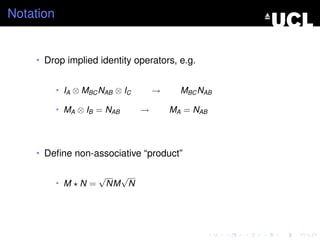
Notation


    • Drop implied identity operators, e.g.


           • IA ⊗ MBC NAB ⊗ IC       →     MBC NAB

           • MA ⊗ IB = NAB       →       MA = NAB


    • Define non-associative “product”

                      √     √
           • M   N=       NM N
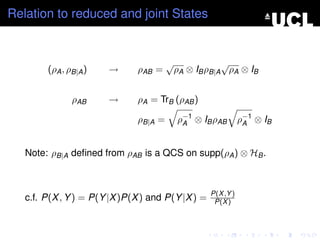
Relation to reduced and joint States


                                       √               √
        (ρA , ρB|A )   →      ρAB =        ρA ⊗ IB ρB|A ρA ⊗ IB


               ρAB     →      ρA = TrB (ρAB )

                              ρB|A =       ρ−1 ⊗ IB ρAB
                                            A                 ρ−1 ⊗ IB
                                                               A


   Note: ρB|A defined from ρAB is a QCS on supp(ρA ) ⊗ HB .


                                                   P(X ,Y )
   c.f. P(X , Y ) = P(Y |X )P(X ) and P(Y |X ) =    P(X )
Relation to reduced and joint states


                (ρA , ρB|A )   →      ρAB = ρB|A ρA


                       ρAB     →      ρA = TrB (ρAB )
                                      ρB|A = ρAB       ρ−1
                                                        A


   Note: ρB|A defined from ρAB is a QCS on supp(ρA ) ⊗ HB .


                                                   P(X ,Y )
   c.f. P(X , Y ) = P(Y |X )P(X ) and P(Y |X ) =    P(X )
Classical conditional probabilities

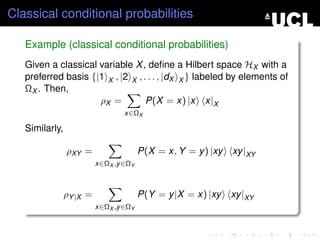
   Example (classical conditional probabilities)
   Given a classical variable X , define a Hilbert space HX with a
   preferred basis {|1 X , |2 X , . . . , |dX X } labeled by elements of
   ΩX . Then,
                     ρX =          P(X = x) |x x|X
                                  x∈ΩX

   Similarly,

                ρXY =                   P(X = x, Y = y ) |xy   xy |XY
                          x∈ΩX ,y ∈ΩY


                ρY |X =                 P(Y = y |X = x) |xy    xy |XY
                          x∈ΩX ,y ∈ΩY
Topic


   1    Quantum conditional states


   2    Hybrid quantum-classical systems


   3    Quantum Bayes’ rule


   4    Quantum state compatibility


   5    Further results and open questions
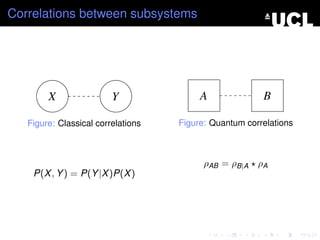
Correlations between subsystems


        X                Y               A              B

   Figure: Classical correlations   Figure: Quantum correlations


                                          ρAB = ρB|A ρA
    P(X , Y ) = P(Y |X )P(X )
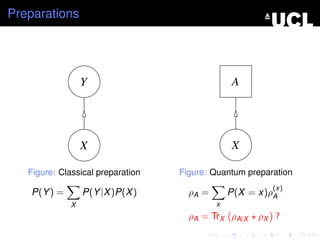
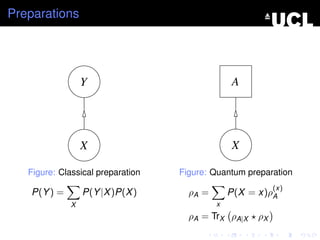
Preparations


                  Y                             A


                  X                             X

   Figure: Classical preparation   Figure: Quantum preparation
                                                         (x)
    P(Y ) =       P(Y |X )P(X )      ρA =       P(X = x)ρA
              X                             x
                                     ρA = TrX ρA|X    ρX ?
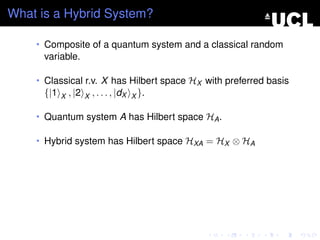
What is a Hybrid System?

    • Composite of a quantum system and a classical random
      variable.

    • Classical r.v. X has Hilbert space HX with preferred basis
      {|1   X   , |2   X   , . . . , |dX   X }.

    • Quantum system A has Hilbert space HA .

    • Hybrid system has Hilbert space HXA = HX ⊗ HA
What is a Hybrid System?

    • Composite of a quantum system and a classical random
      variable.

    • Classical r.v. X has Hilbert space HX with preferred basis
      {|1   X   , |2   X   , . . . , |dX   X }.

    • Quantum system A has Hilbert space HA .

    • Hybrid system has Hilbert space HXA = HX ⊗ HA

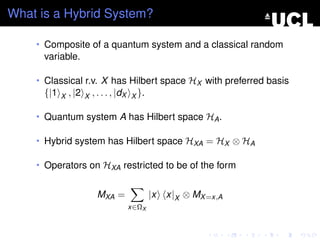
    • Operators on HXA restricted to be of the form


                            MXA =                 |x   x|X ⊗ MX =x,A
                                           x∈ΩX
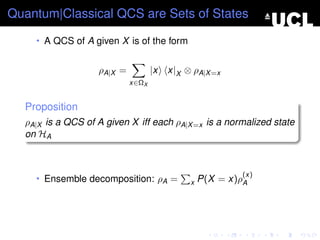
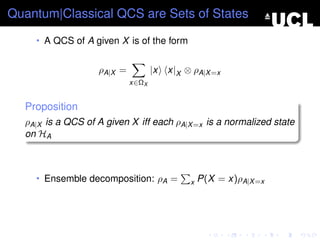
Quantum|Classical QCS are Sets of States

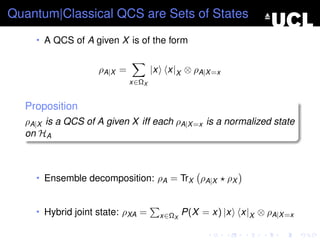
    • A QCS of A given X is of the form


                   ρA|X =          |x   x|X ⊗ ρA|X =x
                            x∈ΩX


  Proposition
  ρA|X is a QCS of A given X iff each ρA|X =x is a normalized state
  on HA


                                                          (x)
    • Ensemble decomposition: ρA =           x   P(X = x)ρA
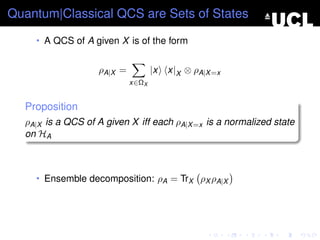
Quantum|Classical QCS are Sets of States

    • A QCS of A given X is of the form


                   ρA|X =          |x   x|X ⊗ ρA|X =x
                            x∈ΩX


  Proposition
  ρA|X is a QCS of A given X iff each ρA|X =x is a normalized state
  on HA


    • Ensemble decomposition: ρA =           x   P(X = x)ρA|X =x
Quantum|Classical QCS are Sets of States

    • A QCS of A given X is of the form


                   ρA|X =          |x   x|X ⊗ ρA|X =x
                            x∈ΩX


  Proposition
  ρA|X is a QCS of A given X iff each ρA|X =x is a normalized state
  on HA


    • Ensemble decomposition: ρA = TrX ρX ρA|X
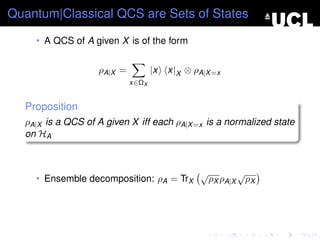
Quantum|Classical QCS are Sets of States

    • A QCS of A given X is of the form


                   ρA|X =          |x   x|X ⊗ ρA|X =x
                            x∈ΩX


  Proposition
  ρA|X is a QCS of A given X iff each ρA|X =x is a normalized state
  on HA


                                                √          √
    • Ensemble decomposition: ρA = TrX              ρX ρA|X ρX
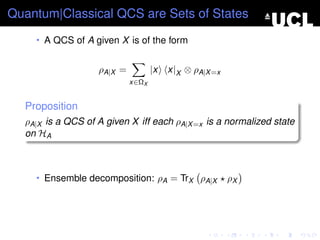
Quantum|Classical QCS are Sets of States
    • A QCS of A given X is of the form


                   ρA|X =          |x   x|X ⊗ ρA|X =x
                            x∈ΩX


  Proposition
  ρA|X is a QCS of A given X iff each ρA|X =x is a normalized state
  on HA


    • Ensemble decomposition: ρA = TrX ρA|X             ρX
Quantum|Classical QCS are Sets of States
    • A QCS of A given X is of the form


                   ρA|X =          |x    x|X ⊗ ρA|X =x
                            x∈ΩX


  Proposition
  ρA|X is a QCS of A given X iff each ρA|X =x is a normalized state
  on HA


    • Ensemble decomposition: ρA = TrX ρA|X              ρX


    • Hybrid joint state: ρXA =         x∈ΩX   P(X = x) |x    x|X ⊗ ρA|X =x
Preparations


                  Y                             A


                  X                             X

   Figure: Classical preparation   Figure: Quantum preparation
                                                           (x)
    P(Y ) =       P(Y |X )P(X )      ρA =       P(X = x)ρA
              X                             x
                                     ρA = TrX ρA|X    ρX
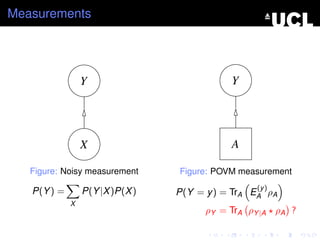
Measurements


                 Y                          Y


                 X                          A

   Figure: Noisy measurement     Figure: POVM measurement
                                                 (y )
   P(Y ) =       P(Y |X )P(X )   P(Y = y ) = TrA EA ρA
             X
                                       ρY = TrA ρY |A ρA ?
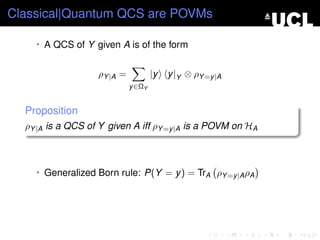
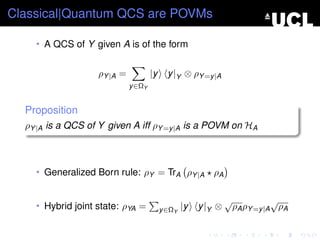
Classical|Quantum QCS are POVMs

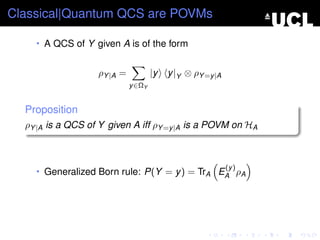
    • A QCS of Y given A is of the form


                   ρY |A =           |y   y |Y ⊗ ρY =y |A
                             y ∈ΩY


  Proposition
  ρY |A is a QCS of Y given A iff ρY =y |A is a POVM on HA


                                                            (y )
    • Generalized Born rule: P(Y = y ) = TrA EA ρA
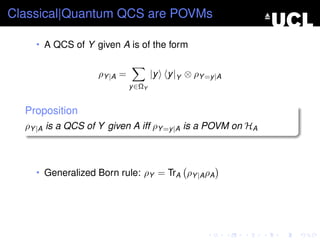
Classical|Quantum QCS are POVMs

    • A QCS of Y given A is of the form


                   ρY |A =           |y   y |Y ⊗ ρY =y |A
                             y ∈ΩY


  Proposition
  ρY |A is a QCS of Y given A iff ρY =y |A is a POVM on HA


    • Generalized Born rule: P(Y = y ) = TrA ρY =y |A ρA
Classical|Quantum QCS are POVMs

    • A QCS of Y given A is of the form


                   ρY |A =           |y   y |Y ⊗ ρY =y |A
                             y ∈ΩY


  Proposition
  ρY |A is a QCS of Y given A iff ρY =y |A is a POVM on HA


    • Generalized Born rule: ρY = TrA ρY |A ρA
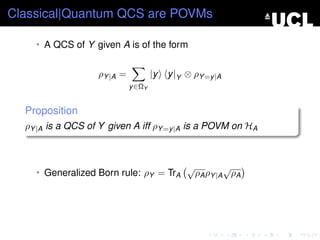
Classical|Quantum QCS are POVMs

    • A QCS of Y given A is of the form


                   ρY |A =           |y   y |Y ⊗ ρY =y |A
                             y ∈ΩY


  Proposition
  ρY |A is a QCS of Y given A iff ρY =y |A is a POVM on HA


                                               √           √
    • Generalized Born rule: ρY = TrA              ρA ρY |A ρA
Classical|Quantum QCS are POVMs

    • A QCS of Y given A is of the form


                   ρY |A =           |y   y |Y ⊗ ρY =y |A
                             y ∈ΩY


  Proposition
  ρY |A is a QCS of Y given A iff ρY =y |A is a POVM on HA


    • Generalized Born rule: ρY = TrA ρY |A           ρA
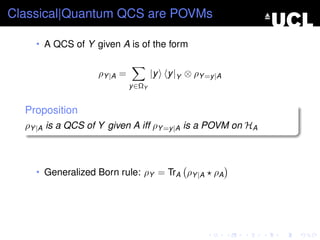
Classical|Quantum QCS are POVMs

    • A QCS of Y given A is of the form


                   ρY |A =           |y     y |Y ⊗ ρY =y |A
                             y ∈ΩY


  Proposition
  ρY |A is a QCS of Y given A iff ρY =y |A is a POVM on HA


    • Generalized Born rule: ρY = TrA ρY |A               ρA

                                                                √              √
    • Hybrid joint state: ρYA =           y ∈ΩY   |y   y |Y ⊗       ρA ρY =y |A ρA
Topic


   1    Quantum conditional states


   2    Hybrid quantum-classical systems


   3    Quantum Bayes’ rule


   4    Quantum state compatibility


   5    Further results and open questions
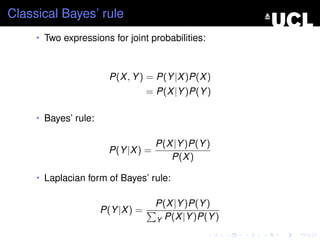
Classical Bayes’ rule
     • Two expressions for joint probabilities:


                        P(X , Y ) = P(Y |X )P(X )
                                   = P(X |Y )P(Y )

     • Bayes’ rule:

                                     P(X |Y )P(Y )
                        P(Y |X ) =
                                        P(X )

     • Laplacian form of Bayes’ rule:

                                     P(X |Y )P(Y )
                      P(Y |X ) =
                                     Y P(X |Y )P(Y )
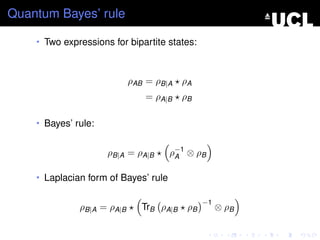
Quantum Bayes’ rule

    • Two expressions for bipartite states:


                            ρAB = ρB|A ρA
                               = ρA|B    ρB

    • Bayes’ rule:


                     ρB|A = ρA|B      ρ−1 ⊗ ρB
                                       A


    • Laplacian form of Bayes’ rule

                                               −1
              ρB|A = ρA|B     TrB ρA|B    ρB        ⊗ ρB
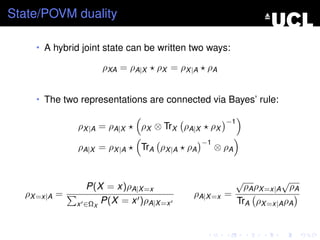
State/POVM duality

    • A hybrid joint state can be written two ways:

                      ρXA = ρA|X   ρX = ρX |A ρA


    • The two representations are connected via Bayes’ rule:

                                                      −1
              ρX |A = ρA|X     ρX ⊗ TrX ρA|X    ρX
                                               −1
              ρA|X = ρX |A     TrA ρX |A ρA         ⊗ ρA


                                                           √             √
                   P(X = x)ρA|X =x                             ρA ρX =x|A ρA
  ρX =x|A =                               ρA|X =x =
              x   ∈ΩX P(X = x )ρA|X =x                     TrA ρX =x|A ρA
State update rules

     • Classically, upon learning X = x:

                       P(Y ) → P(Y |X = x)

     • Quantumly: ρA → ρA|X =x ?
State update rules

     • Classically, upon learning X = x:

                         P(Y ) → P(Y |X = x)

     • Quantumly: ρA → ρA|X =x ?


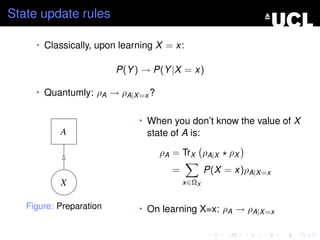
                              • When you don’t know the value of X
           A                   state of A is:

                                   ρA = TrX ρA|X     ρX
                                     =          P(X = x)ρA|X =x
           X                             x∈ΩX


   Figure: Preparation        • On learning X=x: ρA → ρA|X =x
State update rules

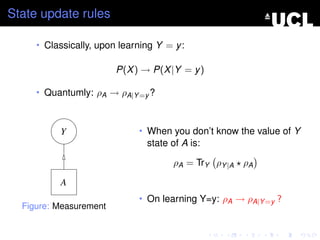
     • Classically, upon learning Y = y :

                        P(X ) → P(X |Y = y )

     • Quantumly: ρA → ρA|Y =y ?


          Y                   • When you don’t know the value of Y
                               state of A is:

                                      ρA = TrY ρY |A ρA

          A
                              • On learning Y=y: ρA → ρA|Y =y ?
  Figure: Measurement
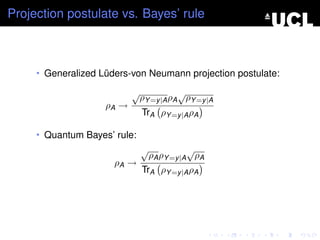
Projection postulate vs. Bayes’ rule


     • Generalized Lüders-von Neumann projection postulate:

                           √              √
                               ρY =y |A ρA ρY =y |A
                    ρA →
                               TrA ρY =y |A ρA

     • Quantum Bayes’ rule:
                               √              √
                                   ρA ρY =y |A ρA
                      ρA →
                               TrA ρY =y |A ρA
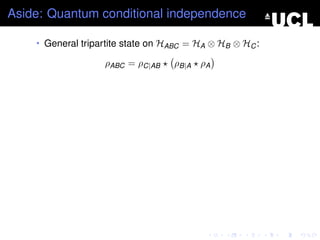
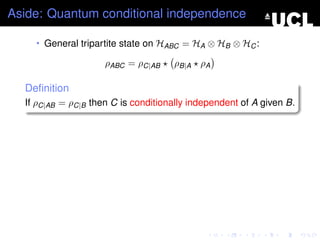
Aside: Quantum conditional independence

    • General tripartite state on HABC = HA ⊗ HB ⊗ HC :

                   ρABC = ρC|AB    ρB|A ρA
Aside: Quantum conditional independence

    • General tripartite state on HABC = HA ⊗ HB ⊗ HC :

                     ρABC = ρC|AB    ρB|A ρA

  Definition
  If ρC|AB = ρC|B then C is conditionally independent of A given B.
Aside: Quantum conditional independence

    • General tripartite state on HABC = HA ⊗ HB ⊗ HC :

                     ρABC = ρC|AB    ρB|A ρA

  Definition
  If ρC|AB = ρC|B then C is conditionally independent of A given B.

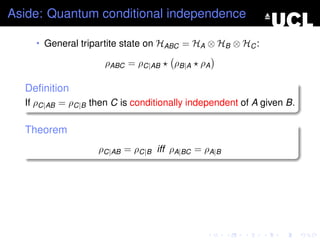
  Theorem
                   ρC|AB = ρC|B iff ρA|BC = ρA|B
Aside: Quantum conditional independence

    • General tripartite state on HABC = HA ⊗ HB ⊗ HC :

                     ρABC = ρC|AB    ρB|A ρA

  Definition
  If ρC|AB = ρC|B then C is conditionally independent of A given B.

  Theorem
                    ρC|AB = ρC|B iff ρA|BC = ρA|B

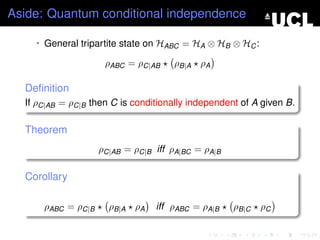
  Corollary

      ρABC = ρC|B     ρB|A ρA    iff ρABC = ρA|B    ρB|C   ρC
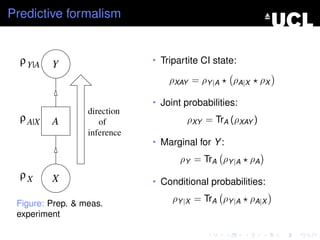
Predictive formalism


  ρ Y|A   Y                   • Tripartite CI state:

                                  ρXAY = ρY |A     ρA|X    ρX

                              • Joint probabilities:
                  direction
  ρ A|X   A          of                ρXY = TrA (ρXAY )
                  inference
                              • Marginal for Y :
                                     ρY = TrA ρY |A ρA
  ρX      X                   • Conditional probabilities:

 Figure: Prep. & meas.
                                   ρY |X = TrA ρY |A ρA|X
 experiment
Retrodictive formalism
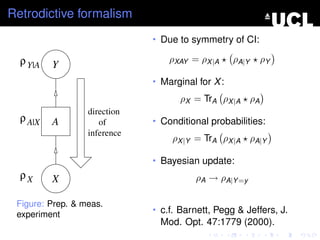
                              • Due to symmetry of CI:

  ρ Y|A   Y
                                  ρXAY = ρX |A     ρA|Y   ρY

                              • Marginal for X :
                                    ρX = TrA ρX |A ρA
                  direction
  ρ A|X   A          of       • Conditional probabilities:
                  inference
                                  ρX |Y = TrA ρX |A ρA|Y

                              • Bayesian update:
  ρX      X                             ρA → ρA|Y =y

 Figure: Prep. & meas.
                              • c.f. Barnett, Pegg & Jeffers, J.
 experiment
                               Mod. Opt. 47:1779 (2000).
Remote state updates


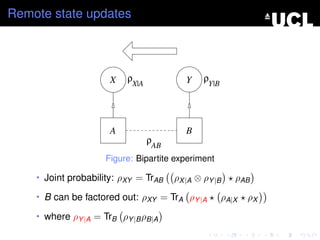
                      X   ρX|A           Y    ρY|B


                      A                  B
                                 ρ
                                 AB
                     Figure: Bipartite experiment

    • Joint probability: ρXY = TrAB   ρX |A ⊗ ρY |B     ρAB
    • B can be factored out: ρXY = TrA ρY |A         ρA|X   ρX
    • where ρY |A = TrB ρY |B ρB|A
Summary of state update rules


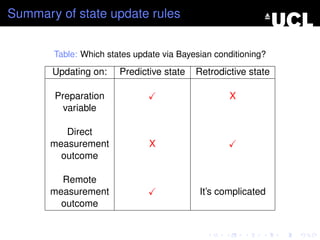
       Table: Which states update via Bayesian conditioning?

       Updating on:    Predictive state   Retrodictive state

       Preparation                                X
         variable

          Direct
       measurement            X
         outcome

         Remote
       measurement                         It’s complicated
         outcome
Topic


   1    Quantum conditional states


   2    Hybrid quantum-classical systems


   3    Quantum Bayes’ rule


   4    Quantum state compatibility


   5    Further results and open questions
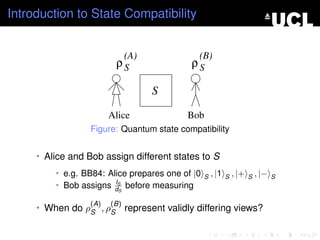
Introduction to State Compatibility


                             (A)               (B)
                         ρS                  ρS

                                   S

                       Alice                Bob
                  Figure: Quantum state compatibility


     • Alice and Bob assign different states to S
         • e.g. BB84: Alice prepares one of |0    S   , |1   S   , |+   S   , |−   S
                        I
         • Bob assigns dS before measuring
                         S


                 (A)   (B)
     • When do ρS , ρS       represent validly differing views?
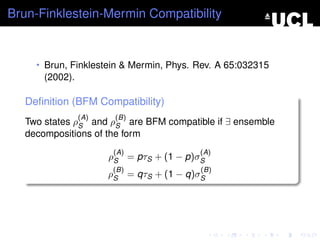
Brun-Finklestein-Mermin Compatibility


     • Brun, Finklestein & Mermin, Phys. Rev. A 65:032315
       (2002).

   Definition (BFM Compatibility)
                 (A)    (B)
   Two states ρS and ρS are BFM compatible if ∃ ensemble
   decompositions of the form
                        (A)               (A)
                       ρS = pτS + (1 − p)σS
                        (B)               (B)
                       ρS = qτS + (1 − q)σS
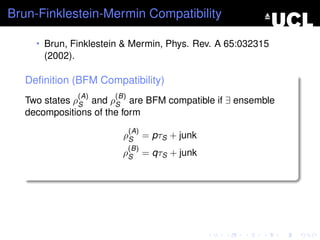
Brun-Finklestein-Mermin Compatibility

     • Brun, Finklestein & Mermin, Phys. Rev. A 65:032315
       (2002).

   Definition (BFM Compatibility)
                 (A)   (B)
   Two states ρS and ρS are BFM compatible if ∃ ensemble
   decompositions of the form
                             (A)
                         ρS = pτS + junk
                             (B)
                         ρS = qτS + junk
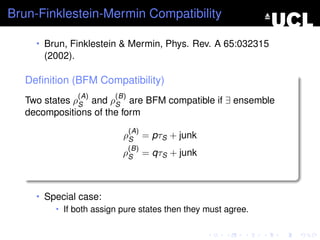
Brun-Finklestein-Mermin Compatibility

     • Brun, Finklestein & Mermin, Phys. Rev. A 65:032315
       (2002).

   Definition (BFM Compatibility)
                 (A)     (B)
   Two states ρS and ρS are BFM compatible if ∃ ensemble
   decompositions of the form
                               (A)
                           ρS = pτS + junk
                               (B)
                           ρS = qτS + junk


     • Special case:
         • If both assign pure states then they must agree.
Objective vs. Subjective Approaches

    • Objective: States represent knowledge or information.
        • If Alice and Bob disagree it is because they have access to
          different data.
        • BFM & Jacobs (QIP 1:73 (2002)) provide objective
          justifications of BFM.
Objective vs. Subjective Approaches

    • Objective: States represent knowledge or information.
        • If Alice and Bob disagree it is because they have access to
          different data.
        • BFM & Jacobs (QIP 1:73 (2002)) provide objective
          justifications of BFM.


    • Subjective: States represent degrees of belief.
        • There can be no unilateral requirement for states to be
          compatible.
        • Caves, Fuchs & Shack Phys. Rev. A 66:062111 (2002).
Objective vs. Subjective Approaches

    • Objective: States represent knowledge or information.
        • If Alice and Bob disagree it is because they have access to
          different data.
        • BFM & Jacobs (QIP 1:73 (2002)) provide objective
          justifications of BFM.


    • Subjective: States represent degrees of belief.
        • There can be no unilateral requirement for states to be
          compatible.
        • Caves, Fuchs & Shack Phys. Rev. A 66:062111 (2002).


        • However, we are still interested in whether Alice and Bob
          can reach intersubjective agreement.
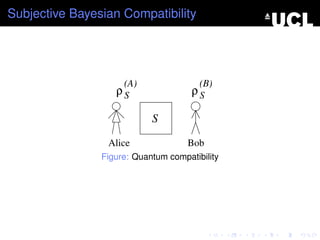
Subjective Bayesian Compatibility


                     (A)                (B)
                   ρS                 ρS

                            S

                 Alice               Bob
                Figure: Quantum compatibility
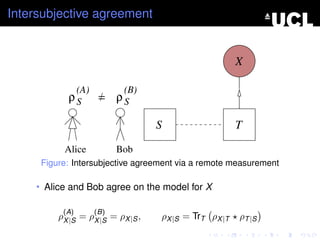
Intersubjective agreement


                                                       X

                (A)          (B)
           ρS          = ρS

                                   S                   T

          Alice             Bob
     Figure: Intersubjective agreement via a remote measurement

    • Alice and Bob agree on the model for X

          (A)         (B)
         ρX |S = ρX |S = ρX |S ,   ρX |S = TrT ρX |T   ρT |S
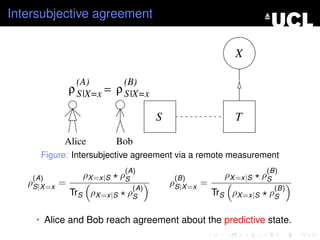
Intersubjective agreement


                                                             X

                (A)          (B)
               ρ S |X=x = ρ S |X=x

                                        S                    T

           Alice            Bob
      Figure: Intersubjective agreement via a remote measurement
                              (A)                                      (B)
    (A)           ρX =x|S    ρS              (B)           ρX =x|S    ρS
   ρS|X =x =                                ρS|X =x =
                                  (A)                                      (B)
               TrS ρX =x|S    ρS                        TrS ρX =x|S    ρS

     • Alice and Bob reach agreement about the predictive state.
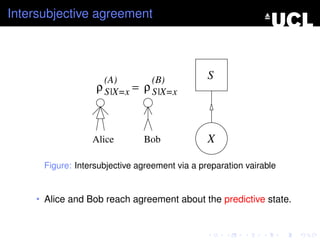
Intersubjective agreement


                     (A)         (B)            S
                   ρ S |X=x = ρ S |X=x


                  Alice        Bob              X

      Figure: Intersubjective agreement via a preparation vairable


    • Alice and Bob reach agreement about the predictive state.
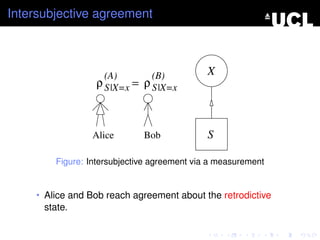
Intersubjective agreement


                   (A)         (B)           X
                 ρ S |X=x = ρ S |X=x


                Alice        Bob             S

        Figure: Intersubjective agreement via a measurement


    • Alice and Bob reach agreement about the retrodictive
      state.
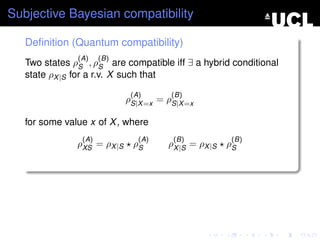
Subjective Bayesian compatibility

   Definition (Quantum compatibility)
               (A)    (B)
   Two states ρS , ρS are compatible iff ∃ a hybrid conditional
   state ρX |S for a r.v. X such that

                              (A)       (B)
                             ρS|X =x = ρS|X =x

   for some value x of X , where
                (A)             (A)     (B)             (B)
               ρXS = ρX |S    ρS       ρX |S = ρX |S   ρS
Subjective Bayesian compatibility

   Definition (Quantum compatibility)
               (A)       (B)
   Two states ρS , ρS are compatible iff ∃ a hybrid conditional
   state ρX |S for a r.v. X such that

                                (A)       (B)
                               ρS|X =x = ρS|X =x

   for some value x of X , where
                   (A)            (A)     (B)             (B)
               ρXS = ρX |S      ρS       ρX |S = ρX |S   ρS


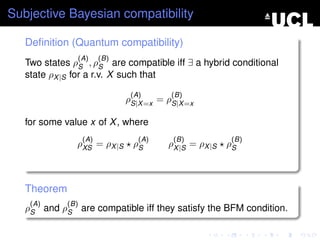
   Theorem
    (A)      (B)
   ρS and ρS are compatible iff they satisfy the BFM condition.
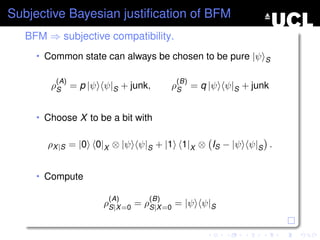
Subjective Bayesian justification of BFM
   BFM ⇒ subjective compatibility.
     • Common state can always be chosen to be pure |ψ S

         (A)                          (B)
        ρS = p |ψ ψ|S + junk,        ρS = q |ψ ψ|S + junk


     • Choose X to be a bit with


       ρX |S = |0 0|X ⊗ |ψ ψ|S + |1 1|X ⊗ IS − |ψ ψ|S .


     • Compute

                     (A)       (B)
                    ρS|X =0 = ρS|X =0 = |ψ ψ|S
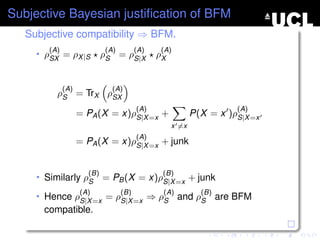
Subjective Bayesian justification of BFM
   Subjective compatibility ⇒ BFM.
        (A)                 (A)         (A)    (A)
     • ρSX = ρX |S          ρS = ρS|X         ρX


              (A)             (A)
          ρS = TrX ρSX
                                        (A)                         (A)
                    = PA (X = x)ρS|X =x +                 P(X = x )ρS|X =x
                                                   x =x
                                     (A)
                    = PA (X =     x)ρS|X =x    + junk


                      (B)                      (B)
     • Similarly ρS         = PB (X = x)ρS|X =x + junk
                    (A)           (B)          (A)          (B)
     • Hence ρS|X =x = ρS|X =x ⇒ ρS                  and ρS are BFM
      compatible.
Topic


   1    Quantum conditional states


   2    Hybrid quantum-classical systems


   3    Quantum Bayes’ rule


   4    Quantum state compatibility


   5    Further results and open questions
Further results
   Forthcoming paper(s) with R. W. Spekkens also include:
     • Dynamics (CPT maps, instruments)
     • Temporal joint states
     • Quantum conditional independence
     • Quantum sufficient statistics
     • Quantum state pooling


   Earlier papers with related ideas:
     • M. Asorey et. al., Open.Syst.Info.Dyn. 12:319–329 (2006).
     • M. S. Leifer, Phys. Rev. A 74:042310 (2006).
     • M. S. Leifer, AIP Conference Proceedings 889:172–186
       (2007).
     • M. S. Leifer & D. Poulin, Ann. Phys. 323:1899 (2008).
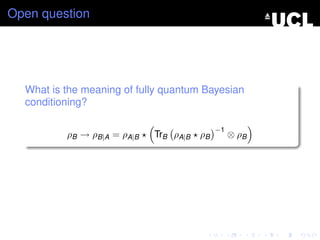
Open question


  What is the meaning of fully quantum Bayesian
  conditioning?

                                             −1
          ρB → ρB|A = ρA|B   TrB ρA|B   ρB        ⊗ ρB
Thanks for your attention!


   People who gave me money
     • Foundational Questions Institute (FQXi) Grant
      RFP1-06-006

   People who gave me office space when I didn’t have any
   money
     • Perimeter Institute
     • University College London

Quantum conditional states, bayes' rule, and state compatibility

  • 1.
    Quantum conditional states,Bayes’ rule, and state compatibility M. S. Leifer (UCL) Joint work with R. W. Spekkens (Perimeter) Imperial College QI Seminar 14th December 2010
  • 2.
    Outline 1 Quantum conditional states 2 Hybrid quantum-classical systems 3 Quantum Bayes’ rule 4 Quantum state compatibility 5 Further results and open questions
  • 3.
    Topic 1 Quantum conditional states 2 Hybrid quantum-classical systems 3 Quantum Bayes’ rule 4 Quantum state compatibility 5 Further results and open questions
  • 4.
    Classical vs. quantumProbability Table: Basic definitions Classical Probability Quantum Theory Sample space Hilbert space ΩX = {1, 2, . . . , dX } HA = CdA = span (|1 , |2 , . . . , |dA ) Probability distribution Quantum state P(X = x) ≥ 0 ρA ∈ L+ (HA ) x∈ΩX P(X = x) = 1 TrA (ρA ) = 1
  • 5.
    Classical vs. quantumProbability Table: Composite systems Classical Probability Quantum Theory Cartesian product Tensor product ΩXY = ΩX × ΩY HAB = HA ⊗ HB Joint distribution Bipartite state P(X , Y ) ρAB Marginal distribution Reduced state P(Y ) = x∈ΩX P(X = x, Y ) ρB = TrA (ρAB ) Conditional distribution Conditional state P(Y |X ) = P(X ,Y ) P(X ) ρB|A =?
  • 6.
    Definition of QCS Definition A quantum conditional state of B given A is a positive operator ρB|A on HAB = HA ⊗ HB that satisfies TrB ρB|A = IA . c.f. P(Y |X ) is a positive function on ΩXY = ΩX × ΩY that satisfies P(Y = y |X ) = 1. y ∈ΩY
  • 7.
    Relation to reducedand joint States √ √ (ρA , ρB|A ) → ρAB = ρA ⊗ IB ρB|A ρA ⊗ IB ρAB → ρA = TrB (ρAB ) ρB|A = ρ−1 ⊗ IB ρAB A ρ−1 ⊗ IB A
  • 8.
    Relation to reducedand joint States √ √ (ρA , ρB|A ) → ρAB = ρA ⊗ IB ρB|A ρA ⊗ IB ρAB → ρA = TrB (ρAB ) ρB|A = ρ−1 ⊗ IB ρAB A ρ−1 ⊗ IB A Note: ρB|A defined from ρAB is a QCS on supp(ρA ) ⊗ HB .
  • 9.
    Relation to reducedand joint States √ √ (ρA , ρB|A ) → ρAB = ρA ⊗ IB ρB|A ρA ⊗ IB ρAB → ρA = TrB (ρAB ) ρB|A = ρ−1 ⊗ IB ρAB A ρ−1 ⊗ IB A Note: ρB|A defined from ρAB is a QCS on supp(ρA ) ⊗ HB . P(X ,Y ) c.f. P(X , Y ) = P(Y |X )P(X ) and P(Y |X ) = P(X )
  • 10.
    Notation • Drop implied identity operators, e.g. • IA ⊗ MBC NAB ⊗ IC → MBC NAB • MA ⊗ IB = NAB → MA = NAB • Define non-associative “product” √ √ • M N= NM N
  • 11.
    Relation to reducedand joint States √ √ (ρA , ρB|A ) → ρAB = ρA ⊗ IB ρB|A ρA ⊗ IB ρAB → ρA = TrB (ρAB ) ρB|A = ρ−1 ⊗ IB ρAB A ρ−1 ⊗ IB A Note: ρB|A defined from ρAB is a QCS on supp(ρA ) ⊗ HB . P(X ,Y ) c.f. P(X , Y ) = P(Y |X )P(X ) and P(Y |X ) = P(X )
  • 12.
    Relation to reducedand joint states (ρA , ρB|A ) → ρAB = ρB|A ρA ρAB → ρA = TrB (ρAB ) ρB|A = ρAB ρ−1 A Note: ρB|A defined from ρAB is a QCS on supp(ρA ) ⊗ HB . P(X ,Y ) c.f. P(X , Y ) = P(Y |X )P(X ) and P(Y |X ) = P(X )
  • 13.
    Classical conditional probabilities Example (classical conditional probabilities) Given a classical variable X , define a Hilbert space HX with a preferred basis {|1 X , |2 X , . . . , |dX X } labeled by elements of ΩX . Then, ρX = P(X = x) |x x|X x∈ΩX Similarly, ρXY = P(X = x, Y = y ) |xy xy |XY x∈ΩX ,y ∈ΩY ρY |X = P(Y = y |X = x) |xy xy |XY x∈ΩX ,y ∈ΩY
  • 14.
    Topic 1 Quantum conditional states 2 Hybrid quantum-classical systems 3 Quantum Bayes’ rule 4 Quantum state compatibility 5 Further results and open questions
  • 15.
    Correlations between subsystems X Y A B Figure: Classical correlations Figure: Quantum correlations ρAB = ρB|A ρA P(X , Y ) = P(Y |X )P(X )
  • 16.
    Preparations Y A X X Figure: Classical preparation Figure: Quantum preparation (x) P(Y ) = P(Y |X )P(X ) ρA = P(X = x)ρA X x ρA = TrX ρA|X ρX ?
  • 17.
    What is aHybrid System? • Composite of a quantum system and a classical random variable. • Classical r.v. X has Hilbert space HX with preferred basis {|1 X , |2 X , . . . , |dX X }. • Quantum system A has Hilbert space HA . • Hybrid system has Hilbert space HXA = HX ⊗ HA
  • 18.
    What is aHybrid System? • Composite of a quantum system and a classical random variable. • Classical r.v. X has Hilbert space HX with preferred basis {|1 X , |2 X , . . . , |dX X }. • Quantum system A has Hilbert space HA . • Hybrid system has Hilbert space HXA = HX ⊗ HA • Operators on HXA restricted to be of the form MXA = |x x|X ⊗ MX =x,A x∈ΩX
  • 19.
    Quantum|Classical QCS areSets of States • A QCS of A given X is of the form ρA|X = |x x|X ⊗ ρA|X =x x∈ΩX Proposition ρA|X is a QCS of A given X iff each ρA|X =x is a normalized state on HA (x) • Ensemble decomposition: ρA = x P(X = x)ρA
  • 20.
    Quantum|Classical QCS areSets of States • A QCS of A given X is of the form ρA|X = |x x|X ⊗ ρA|X =x x∈ΩX Proposition ρA|X is a QCS of A given X iff each ρA|X =x is a normalized state on HA • Ensemble decomposition: ρA = x P(X = x)ρA|X =x
  • 21.
    Quantum|Classical QCS areSets of States • A QCS of A given X is of the form ρA|X = |x x|X ⊗ ρA|X =x x∈ΩX Proposition ρA|X is a QCS of A given X iff each ρA|X =x is a normalized state on HA • Ensemble decomposition: ρA = TrX ρX ρA|X
  • 22.
    Quantum|Classical QCS areSets of States • A QCS of A given X is of the form ρA|X = |x x|X ⊗ ρA|X =x x∈ΩX Proposition ρA|X is a QCS of A given X iff each ρA|X =x is a normalized state on HA √ √ • Ensemble decomposition: ρA = TrX ρX ρA|X ρX
  • 23.
    Quantum|Classical QCS areSets of States • A QCS of A given X is of the form ρA|X = |x x|X ⊗ ρA|X =x x∈ΩX Proposition ρA|X is a QCS of A given X iff each ρA|X =x is a normalized state on HA • Ensemble decomposition: ρA = TrX ρA|X ρX
  • 24.
    Quantum|Classical QCS areSets of States • A QCS of A given X is of the form ρA|X = |x x|X ⊗ ρA|X =x x∈ΩX Proposition ρA|X is a QCS of A given X iff each ρA|X =x is a normalized state on HA • Ensemble decomposition: ρA = TrX ρA|X ρX • Hybrid joint state: ρXA = x∈ΩX P(X = x) |x x|X ⊗ ρA|X =x
  • 25.
    Preparations Y A X X Figure: Classical preparation Figure: Quantum preparation (x) P(Y ) = P(Y |X )P(X ) ρA = P(X = x)ρA X x ρA = TrX ρA|X ρX
  • 26.
    Measurements Y Y X A Figure: Noisy measurement Figure: POVM measurement (y ) P(Y ) = P(Y |X )P(X ) P(Y = y ) = TrA EA ρA X ρY = TrA ρY |A ρA ?
  • 27.
    Classical|Quantum QCS arePOVMs • A QCS of Y given A is of the form ρY |A = |y y |Y ⊗ ρY =y |A y ∈ΩY Proposition ρY |A is a QCS of Y given A iff ρY =y |A is a POVM on HA (y ) • Generalized Born rule: P(Y = y ) = TrA EA ρA
  • 28.
    Classical|Quantum QCS arePOVMs • A QCS of Y given A is of the form ρY |A = |y y |Y ⊗ ρY =y |A y ∈ΩY Proposition ρY |A is a QCS of Y given A iff ρY =y |A is a POVM on HA • Generalized Born rule: P(Y = y ) = TrA ρY =y |A ρA
  • 29.
    Classical|Quantum QCS arePOVMs • A QCS of Y given A is of the form ρY |A = |y y |Y ⊗ ρY =y |A y ∈ΩY Proposition ρY |A is a QCS of Y given A iff ρY =y |A is a POVM on HA • Generalized Born rule: ρY = TrA ρY |A ρA
  • 30.
    Classical|Quantum QCS arePOVMs • A QCS of Y given A is of the form ρY |A = |y y |Y ⊗ ρY =y |A y ∈ΩY Proposition ρY |A is a QCS of Y given A iff ρY =y |A is a POVM on HA √ √ • Generalized Born rule: ρY = TrA ρA ρY |A ρA
  • 31.
    Classical|Quantum QCS arePOVMs • A QCS of Y given A is of the form ρY |A = |y y |Y ⊗ ρY =y |A y ∈ΩY Proposition ρY |A is a QCS of Y given A iff ρY =y |A is a POVM on HA • Generalized Born rule: ρY = TrA ρY |A ρA
  • 32.
    Classical|Quantum QCS arePOVMs • A QCS of Y given A is of the form ρY |A = |y y |Y ⊗ ρY =y |A y ∈ΩY Proposition ρY |A is a QCS of Y given A iff ρY =y |A is a POVM on HA • Generalized Born rule: ρY = TrA ρY |A ρA √ √ • Hybrid joint state: ρYA = y ∈ΩY |y y |Y ⊗ ρA ρY =y |A ρA
  • 33.
    Topic 1 Quantum conditional states 2 Hybrid quantum-classical systems 3 Quantum Bayes’ rule 4 Quantum state compatibility 5 Further results and open questions
  • 34.
    Classical Bayes’ rule • Two expressions for joint probabilities: P(X , Y ) = P(Y |X )P(X ) = P(X |Y )P(Y ) • Bayes’ rule: P(X |Y )P(Y ) P(Y |X ) = P(X ) • Laplacian form of Bayes’ rule: P(X |Y )P(Y ) P(Y |X ) = Y P(X |Y )P(Y )
  • 35.
    Quantum Bayes’ rule • Two expressions for bipartite states: ρAB = ρB|A ρA = ρA|B ρB • Bayes’ rule: ρB|A = ρA|B ρ−1 ⊗ ρB A • Laplacian form of Bayes’ rule −1 ρB|A = ρA|B TrB ρA|B ρB ⊗ ρB
  • 36.
    State/POVM duality • A hybrid joint state can be written two ways: ρXA = ρA|X ρX = ρX |A ρA • The two representations are connected via Bayes’ rule: −1 ρX |A = ρA|X ρX ⊗ TrX ρA|X ρX −1 ρA|X = ρX |A TrA ρX |A ρA ⊗ ρA √ √ P(X = x)ρA|X =x ρA ρX =x|A ρA ρX =x|A = ρA|X =x = x ∈ΩX P(X = x )ρA|X =x TrA ρX =x|A ρA
  • 37.
    State update rules • Classically, upon learning X = x: P(Y ) → P(Y |X = x) • Quantumly: ρA → ρA|X =x ?
  • 38.
    State update rules • Classically, upon learning X = x: P(Y ) → P(Y |X = x) • Quantumly: ρA → ρA|X =x ? • When you don’t know the value of X A state of A is: ρA = TrX ρA|X ρX = P(X = x)ρA|X =x X x∈ΩX Figure: Preparation • On learning X=x: ρA → ρA|X =x
  • 39.
    State update rules • Classically, upon learning Y = y : P(X ) → P(X |Y = y ) • Quantumly: ρA → ρA|Y =y ? Y • When you don’t know the value of Y state of A is: ρA = TrY ρY |A ρA A • On learning Y=y: ρA → ρA|Y =y ? Figure: Measurement
  • 40.
    Projection postulate vs.Bayes’ rule • Generalized Lüders-von Neumann projection postulate: √ √ ρY =y |A ρA ρY =y |A ρA → TrA ρY =y |A ρA • Quantum Bayes’ rule: √ √ ρA ρY =y |A ρA ρA → TrA ρY =y |A ρA
  • 41.
    Aside: Quantum conditionalindependence • General tripartite state on HABC = HA ⊗ HB ⊗ HC : ρABC = ρC|AB ρB|A ρA
  • 42.
    Aside: Quantum conditionalindependence • General tripartite state on HABC = HA ⊗ HB ⊗ HC : ρABC = ρC|AB ρB|A ρA Definition If ρC|AB = ρC|B then C is conditionally independent of A given B.
  • 43.
    Aside: Quantum conditionalindependence • General tripartite state on HABC = HA ⊗ HB ⊗ HC : ρABC = ρC|AB ρB|A ρA Definition If ρC|AB = ρC|B then C is conditionally independent of A given B. Theorem ρC|AB = ρC|B iff ρA|BC = ρA|B
  • 44.
    Aside: Quantum conditionalindependence • General tripartite state on HABC = HA ⊗ HB ⊗ HC : ρABC = ρC|AB ρB|A ρA Definition If ρC|AB = ρC|B then C is conditionally independent of A given B. Theorem ρC|AB = ρC|B iff ρA|BC = ρA|B Corollary ρABC = ρC|B ρB|A ρA iff ρABC = ρA|B ρB|C ρC
  • 45.
    Predictive formalism ρ Y|A Y • Tripartite CI state: ρXAY = ρY |A ρA|X ρX • Joint probabilities: direction ρ A|X A of ρXY = TrA (ρXAY ) inference • Marginal for Y : ρY = TrA ρY |A ρA ρX X • Conditional probabilities: Figure: Prep. & meas. ρY |X = TrA ρY |A ρA|X experiment
  • 46.
    Retrodictive formalism • Due to symmetry of CI: ρ Y|A Y ρXAY = ρX |A ρA|Y ρY • Marginal for X : ρX = TrA ρX |A ρA direction ρ A|X A of • Conditional probabilities: inference ρX |Y = TrA ρX |A ρA|Y • Bayesian update: ρX X ρA → ρA|Y =y Figure: Prep. & meas. • c.f. Barnett, Pegg & Jeffers, J. experiment Mod. Opt. 47:1779 (2000).
  • 47.
    Remote state updates X ρX|A Y ρY|B A B ρ AB Figure: Bipartite experiment • Joint probability: ρXY = TrAB ρX |A ⊗ ρY |B ρAB • B can be factored out: ρXY = TrA ρY |A ρA|X ρX • where ρY |A = TrB ρY |B ρB|A
  • 48.
    Summary of stateupdate rules Table: Which states update via Bayesian conditioning? Updating on: Predictive state Retrodictive state Preparation X variable Direct measurement X outcome Remote measurement It’s complicated outcome
  • 49.
    Topic 1 Quantum conditional states 2 Hybrid quantum-classical systems 3 Quantum Bayes’ rule 4 Quantum state compatibility 5 Further results and open questions
  • 50.
    Introduction to StateCompatibility (A) (B) ρS ρS S Alice Bob Figure: Quantum state compatibility • Alice and Bob assign different states to S • e.g. BB84: Alice prepares one of |0 S , |1 S , |+ S , |− S I • Bob assigns dS before measuring S (A) (B) • When do ρS , ρS represent validly differing views?
  • 51.
    Brun-Finklestein-Mermin Compatibility • Brun, Finklestein & Mermin, Phys. Rev. A 65:032315 (2002). Definition (BFM Compatibility) (A) (B) Two states ρS and ρS are BFM compatible if ∃ ensemble decompositions of the form (A) (A) ρS = pτS + (1 − p)σS (B) (B) ρS = qτS + (1 − q)σS
  • 52.
    Brun-Finklestein-Mermin Compatibility • Brun, Finklestein & Mermin, Phys. Rev. A 65:032315 (2002). Definition (BFM Compatibility) (A) (B) Two states ρS and ρS are BFM compatible if ∃ ensemble decompositions of the form (A) ρS = pτS + junk (B) ρS = qτS + junk
  • 53.
    Brun-Finklestein-Mermin Compatibility • Brun, Finklestein & Mermin, Phys. Rev. A 65:032315 (2002). Definition (BFM Compatibility) (A) (B) Two states ρS and ρS are BFM compatible if ∃ ensemble decompositions of the form (A) ρS = pτS + junk (B) ρS = qτS + junk • Special case: • If both assign pure states then they must agree.
  • 54.
    Objective vs. SubjectiveApproaches • Objective: States represent knowledge or information. • If Alice and Bob disagree it is because they have access to different data. • BFM & Jacobs (QIP 1:73 (2002)) provide objective justifications of BFM.
  • 55.
    Objective vs. SubjectiveApproaches • Objective: States represent knowledge or information. • If Alice and Bob disagree it is because they have access to different data. • BFM & Jacobs (QIP 1:73 (2002)) provide objective justifications of BFM. • Subjective: States represent degrees of belief. • There can be no unilateral requirement for states to be compatible. • Caves, Fuchs & Shack Phys. Rev. A 66:062111 (2002).
  • 56.
    Objective vs. SubjectiveApproaches • Objective: States represent knowledge or information. • If Alice and Bob disagree it is because they have access to different data. • BFM & Jacobs (QIP 1:73 (2002)) provide objective justifications of BFM. • Subjective: States represent degrees of belief. • There can be no unilateral requirement for states to be compatible. • Caves, Fuchs & Shack Phys. Rev. A 66:062111 (2002). • However, we are still interested in whether Alice and Bob can reach intersubjective agreement.
  • 57.
    Subjective Bayesian Compatibility (A) (B) ρS ρS S Alice Bob Figure: Quantum compatibility
  • 58.
    Intersubjective agreement X (A) (B) ρS = ρS S T Alice Bob Figure: Intersubjective agreement via a remote measurement • Alice and Bob agree on the model for X (A) (B) ρX |S = ρX |S = ρX |S , ρX |S = TrT ρX |T ρT |S
  • 59.
    Intersubjective agreement X (A) (B) ρ S |X=x = ρ S |X=x S T Alice Bob Figure: Intersubjective agreement via a remote measurement (A) (B) (A) ρX =x|S ρS (B) ρX =x|S ρS ρS|X =x = ρS|X =x = (A) (B) TrS ρX =x|S ρS TrS ρX =x|S ρS • Alice and Bob reach agreement about the predictive state.
  • 60.
    Intersubjective agreement (A) (B) S ρ S |X=x = ρ S |X=x Alice Bob X Figure: Intersubjective agreement via a preparation vairable • Alice and Bob reach agreement about the predictive state.
  • 61.
    Intersubjective agreement (A) (B) X ρ S |X=x = ρ S |X=x Alice Bob S Figure: Intersubjective agreement via a measurement • Alice and Bob reach agreement about the retrodictive state.
  • 62.
    Subjective Bayesian compatibility Definition (Quantum compatibility) (A) (B) Two states ρS , ρS are compatible iff ∃ a hybrid conditional state ρX |S for a r.v. X such that (A) (B) ρS|X =x = ρS|X =x for some value x of X , where (A) (A) (B) (B) ρXS = ρX |S ρS ρX |S = ρX |S ρS
  • 63.
    Subjective Bayesian compatibility Definition (Quantum compatibility) (A) (B) Two states ρS , ρS are compatible iff ∃ a hybrid conditional state ρX |S for a r.v. X such that (A) (B) ρS|X =x = ρS|X =x for some value x of X , where (A) (A) (B) (B) ρXS = ρX |S ρS ρX |S = ρX |S ρS Theorem (A) (B) ρS and ρS are compatible iff they satisfy the BFM condition.
  • 64.
    Subjective Bayesian justificationof BFM BFM ⇒ subjective compatibility. • Common state can always be chosen to be pure |ψ S (A) (B) ρS = p |ψ ψ|S + junk, ρS = q |ψ ψ|S + junk • Choose X to be a bit with ρX |S = |0 0|X ⊗ |ψ ψ|S + |1 1|X ⊗ IS − |ψ ψ|S . • Compute (A) (B) ρS|X =0 = ρS|X =0 = |ψ ψ|S
  • 65.
    Subjective Bayesian justificationof BFM Subjective compatibility ⇒ BFM. (A) (A) (A) (A) • ρSX = ρX |S ρS = ρS|X ρX (A) (A) ρS = TrX ρSX (A) (A) = PA (X = x)ρS|X =x + P(X = x )ρS|X =x x =x (A) = PA (X = x)ρS|X =x + junk (B) (B) • Similarly ρS = PB (X = x)ρS|X =x + junk (A) (B) (A) (B) • Hence ρS|X =x = ρS|X =x ⇒ ρS and ρS are BFM compatible.
  • 66.
    Topic 1 Quantum conditional states 2 Hybrid quantum-classical systems 3 Quantum Bayes’ rule 4 Quantum state compatibility 5 Further results and open questions
  • 67.
    Further results Forthcoming paper(s) with R. W. Spekkens also include: • Dynamics (CPT maps, instruments) • Temporal joint states • Quantum conditional independence • Quantum sufficient statistics • Quantum state pooling Earlier papers with related ideas: • M. Asorey et. al., Open.Syst.Info.Dyn. 12:319–329 (2006). • M. S. Leifer, Phys. Rev. A 74:042310 (2006). • M. S. Leifer, AIP Conference Proceedings 889:172–186 (2007). • M. S. Leifer & D. Poulin, Ann. Phys. 323:1899 (2008).
  • 68.
    Open question What is the meaning of fully quantum Bayesian conditioning? −1 ρB → ρB|A = ρA|B TrB ρA|B ρB ⊗ ρB
  • 69.
    Thanks for yourattention! People who gave me money • Foundational Questions Institute (FQXi) Grant RFP1-06-006 People who gave me office space when I didn’t have any money • Perimeter Institute • University College London