
Contents
• Cryptography
• Photon Polarization
• Quantum Key Distribution
• BB84 Protocol
• Security of Quantum Cryptography
• Milestones
• Applications
• Advantages
• Disadvantages
• Conclusion
• References
Introduction
Cryptography
•Transmitting information with access restricted to the intended
recipient even if the message is intercepted by others.
Quantum
•An indivisible elementary particle, usually a photon.
Quantum Cryptography
•The use of quantum mechanics to guarantee secure
communication.
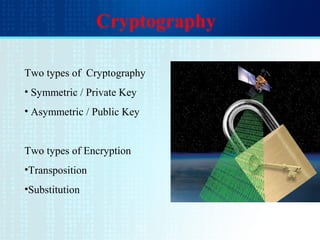
Cryptography
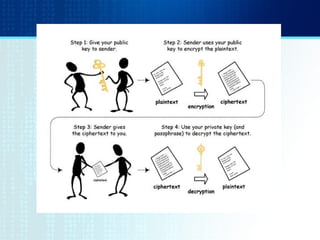
Two types of Cryptography
• Symmetric / Private Key
• Asymmetric / Public Key
Two types of Encryption
•Transposition
•Substitution
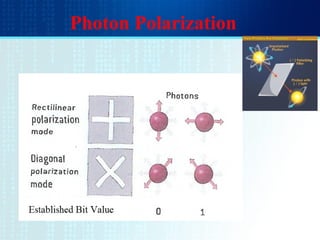
Photon Polarization
Quantum Key Distribution
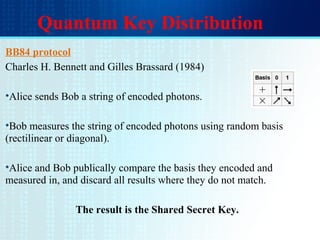
BB84 protocol
Charles H. Bennett and Gilles Brassard (1984)
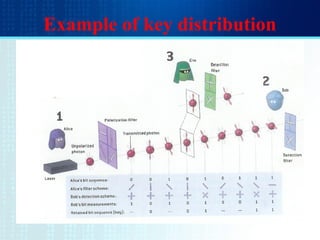
•Alice sends Bob a string of encoded photons.
•Bob measures the string of encoded photons using random basis
(rectilinear or diagonal).
•Alice and Bob publically compare the basis they encoded and
measured in, and discard all results where they do not match.
The result is the Shared Secret Key.
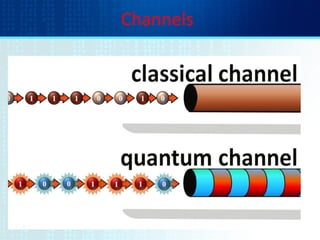
Channels
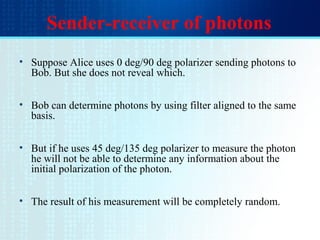
Sender-receiver of photons
• Suppose Alice uses 0 deg/90 deg polarizer sending photons to
Bob. But she does not reveal which.
• Bob can determine photons by using filter aligned to the same
basis.
• But if he uses 45 deg/135 deg polarizer to measure the photon
he will not be able to determine any information about the
initial polarization of the photon.
• The result of his measurement will be completely random.
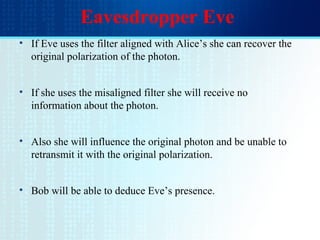
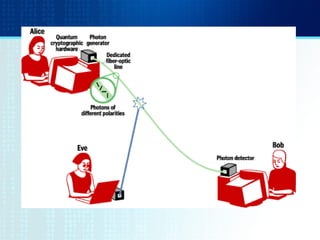
Eavesdropper Eve
• If Eve uses the filter aligned with Alice’s she can recover the
original polarization of the photon.
• If she uses the misaligned filter she will receive no
information about the photon.
• Also she will influence the original photon and be unable to
retransmit it with the original polarization.
• Bob will be able to deduce Eve’s presence.
Example of key distribution
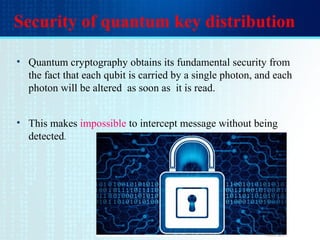
Security of quantum key distribution
• Quantum cryptography obtains its fundamental security from
the fact that each qubit is carried by a single photon, and each
photon will be altered as soon as it is read.
• This makes impossible to intercept message without being
detected.
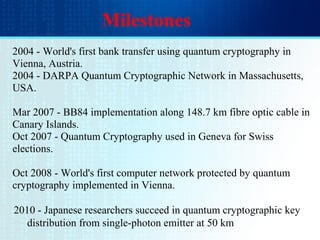
Milestones
2004 - World's first bank transfer using quantum cryptography in
Vienna, Austria.
2004 - DARPA Quantum Cryptographic Network in Massachusetts,
USA.
Mar 2007 - BB84 implementation along 148.7 km fibre optic cable in
Canary Islands.
Oct 2007 - Quantum Cryptography used in Geneva for Swiss
elections.
Oct 2008 - World's first computer network protected by quantum
cryptography implemented in Vienna.
2010 - Japanese researchers succeed in quantum cryptographic key
distribution from single-photon emitter at 50 km
Applications
Cryptography is of increasing importance in our technological
age using :
•broadcast
•network communications
•Internet Banking
•e-mail
•cell phones
which may transmit sensitive information related to finances,
politics, business and private confidential matters.
ADVANTAGES
• Based on natural quantum laws
• Perfect for public communication
• Easy to detect an eavesdropper
• Security provided by QKD is future proofed
DISADVANTAGES
• Practical systems are limited by distance
• Photon emitters and detectors are far from perfect ,
causing errors
• Detecting eavesdropper in the presence of noise is
difficult.
Conclusion
Quantum cryptography is a major achievement in security engineering.
References
• Ekert, A. 1995. What is quantum cryptography.
http://www.qubit.org/index.html
• Ford, J. Quantum cryptography tutorial.
http://www.cs.dartmouth.edu/~jford/crypto.html.
• Wikipedia
http://en.wikipedia.org/wiki/Quantum_cryptography
• Quantum Key Distribution Protocols and Applications –
Sheila Cobourne
 
Thank You

Quantum cryptography data

  • 2.
    Contents • Cryptography • PhotonPolarization • Quantum Key Distribution • BB84 Protocol • Security of Quantum Cryptography • Milestones • Applications • Advantages • Disadvantages • Conclusion • References
  • 3.
    Introduction Cryptography •Transmitting information withaccess restricted to the intended recipient even if the message is intercepted by others. Quantum •An indivisible elementary particle, usually a photon. Quantum Cryptography •The use of quantum mechanics to guarantee secure communication.
  • 4.
    Cryptography Two types ofCryptography • Symmetric / Private Key • Asymmetric / Public Key Two types of Encryption •Transposition •Substitution
  • 6.
  • 7.
    Quantum Key Distribution BB84protocol Charles H. Bennett and Gilles Brassard (1984) •Alice sends Bob a string of encoded photons. •Bob measures the string of encoded photons using random basis (rectilinear or diagonal). •Alice and Bob publically compare the basis they encoded and measured in, and discard all results where they do not match. The result is the Shared Secret Key.
  • 8.
  • 9.
    Sender-receiver of photons •Suppose Alice uses 0 deg/90 deg polarizer sending photons to Bob. But she does not reveal which. • Bob can determine photons by using filter aligned to the same basis. • But if he uses 45 deg/135 deg polarizer to measure the photon he will not be able to determine any information about the initial polarization of the photon. • The result of his measurement will be completely random.
  • 10.
    Eavesdropper Eve • IfEve uses the filter aligned with Alice’s she can recover the original polarization of the photon. • If she uses the misaligned filter she will receive no information about the photon. • Also she will influence the original photon and be unable to retransmit it with the original polarization. • Bob will be able to deduce Eve’s presence.
  • 12.
    Example of keydistribution
  • 13.
    Security of quantumkey distribution • Quantum cryptography obtains its fundamental security from the fact that each qubit is carried by a single photon, and each photon will be altered as soon as it is read. • This makes impossible to intercept message without being detected.
  • 14.
    Milestones 2004 - World'sfirst bank transfer using quantum cryptography in Vienna, Austria. 2004 - DARPA Quantum Cryptographic Network in Massachusetts, USA. Mar 2007 - BB84 implementation along 148.7 km fibre optic cable in Canary Islands. Oct 2007 - Quantum Cryptography used in Geneva for Swiss elections. Oct 2008 - World's first computer network protected by quantum cryptography implemented in Vienna. 2010 - Japanese researchers succeed in quantum cryptographic key distribution from single-photon emitter at 50 km
  • 15.
    Applications Cryptography is ofincreasing importance in our technological age using : •broadcast •network communications •Internet Banking •e-mail •cell phones which may transmit sensitive information related to finances, politics, business and private confidential matters.
  • 16.
    ADVANTAGES • Based onnatural quantum laws • Perfect for public communication • Easy to detect an eavesdropper • Security provided by QKD is future proofed
  • 17.
    DISADVANTAGES • Practical systemsare limited by distance • Photon emitters and detectors are far from perfect , causing errors • Detecting eavesdropper in the presence of noise is difficult.
  • 18.
    Conclusion Quantum cryptography isa major achievement in security engineering.
  • 19.
    References • Ekert, A.1995. What is quantum cryptography. http://www.qubit.org/index.html • Ford, J. Quantum cryptography tutorial. http://www.cs.dartmouth.edu/~jford/crypto.html. • Wikipedia http://en.wikipedia.org/wiki/Quantum_cryptography • Quantum Key Distribution Protocols and Applications – Sheila Cobourne  
  • 20.