Shyam Mohan
S4 – MCA
NO: 43
College of Engineering,
Trivandrum
OUTLINE
• Basics of Cryptography
• Basics of Quantum Computing
• Need for Quantum Cryptography
• Implementation of Quantum Cryptography
• Quantum Key Distribution protocol BB84
• BB84 with Eavesdropping
• Research and Innovation
• Conclusion
• Interaction
1/10
Basics of Cryptography
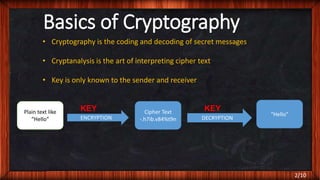
• Cryptography is the coding and decoding of secret messages
• Cryptanalysis is the art of interpreting cipher text
• Key is only known to the sender and receiver
2/10
Plain text like
“Hello”
Cipher Text
-.h7ib.v84%t9n
“Hello”
ENCRYPTION
KEY KEY
DECRYPTION
Basics of Quantum Computing
• Quantum computers use quantum bits (QUBITS)
• n bits can represent only one state from 2n possible states
• n qubits can represent 2n quantum states simultaneously
• A single qubit can represent 1 or 0 like a bit
3/10
Need of Quantum Cryptography
• Bits in classical cryptography can be copied anonymously
• Quantum computer can use Shor’s algorithm to break RSA encryptions
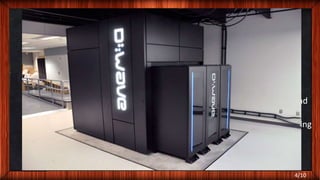
• Commercial Quantum Computers by D-Wave
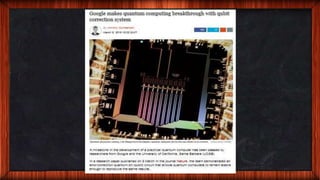
• QuAIL (Quantum Artificial Intelligence Lab ) set up by NASA, Google, and
the Universities Space Research Association (USRA)
• Unknown qubits cannot be accessed and copied like bits without changing
its values (Non-cloning quantum theorem)
4/10
Implementation of Quantum Cryptography
• Implemented by using optical fiber cables which act as a quantum
channel
• Or can be implemented aerially using laser and satellites
5/10
Quantum Key Distribution protocol BB84
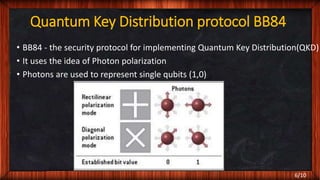
• BB84 - the security protocol for implementing Quantum Key Distribution(QKD)
• It uses the idea of Photon polarization
• Photons are used to represent single qubits (1,0)
6/10
Steps in BB84 Protocol
7/10
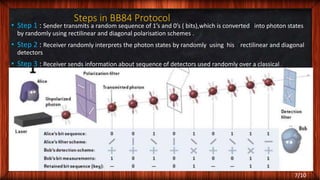
• Step 1 : Sender transmits a random sequence of 1’s and 0’s ( bits),which is converted into photon states
by randomly using rectilinear and diagonal polarisation schemes .
• Step 2 : Receiver randomly interprets the photon states by randomly using his rectilinear and diagonal
detectors
• Step 3 : Receiver sends information about sequence of detectors used randomly over a classical
channel.
Steps in BB84 Protocol (contd..)
7/10
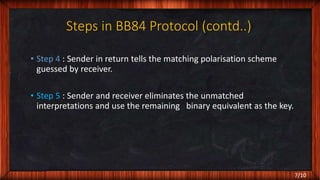
• Step 4 : Sender in return tells the matching polarisation scheme
guessed by receiver.
• Step 5 : Sender and receiver eliminates the unmatched
interpretations and use the remaining binary equivalent as the key.
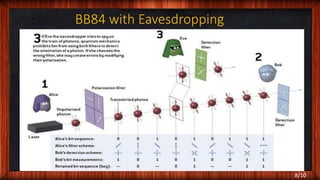
BB84 with Eavesdropping
8/10
BB84 with Eavesdropping
8/10
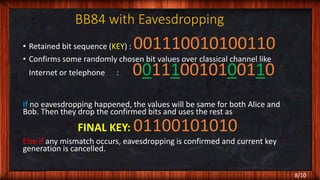
• Retained bit sequence (KEY) : 001110010100110
• Confirms some randomly chosen bit values over classical channel like
Internet or telephone : 001110010100110
If no eavesdropping happened, the values will be same for both Alice and
Bob. Then they drop the confirmed bits and uses the rest as
FINAL KEY: 01100101010
Else if any mismatch occurs, eavesdropping is confirmed and current key
generation is cancelled.
9/10
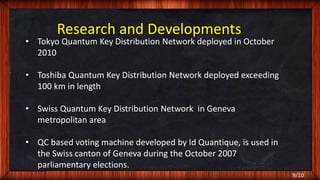
Research and Developments
• Tokyo Quantum Key Distribution Network deployed in October
2010
• Toshiba Quantum Key Distribution Network deployed exceeding
100 km in length
• Swiss Quantum Key Distribution Network in Geneva
metropolitan area
• QC based voting machine developed by Id Quantique, is used in
the Swiss canton of Geneva during the October 2007
parliamentary elections.
In a Nutshell
• Quantum cryptography (or quantum key distribution) is a state-of-the-art
technique that exploits the properties of quantum mechanics to guarantee
the secure exchange of secret keys.
10/10
Interaction , Discussion , Analysis
What… ?
Why? How ?
Who ?
Can We…?
why can't ?
Why not ?
ALL

Quantum Cryptography

  • 1.
    Shyam Mohan S4 –MCA NO: 43 College of Engineering, Trivandrum
  • 2.
    OUTLINE • Basics ofCryptography • Basics of Quantum Computing • Need for Quantum Cryptography • Implementation of Quantum Cryptography • Quantum Key Distribution protocol BB84 • BB84 with Eavesdropping • Research and Innovation • Conclusion • Interaction 1/10
  • 3.
    Basics of Cryptography •Cryptography is the coding and decoding of secret messages • Cryptanalysis is the art of interpreting cipher text • Key is only known to the sender and receiver 2/10 Plain text like “Hello” Cipher Text -.h7ib.v84%t9n “Hello” ENCRYPTION KEY KEY DECRYPTION
  • 4.
    Basics of QuantumComputing • Quantum computers use quantum bits (QUBITS) • n bits can represent only one state from 2n possible states • n qubits can represent 2n quantum states simultaneously • A single qubit can represent 1 or 0 like a bit 3/10
  • 5.
    Need of QuantumCryptography • Bits in classical cryptography can be copied anonymously • Quantum computer can use Shor’s algorithm to break RSA encryptions • Commercial Quantum Computers by D-Wave • QuAIL (Quantum Artificial Intelligence Lab ) set up by NASA, Google, and the Universities Space Research Association (USRA) • Unknown qubits cannot be accessed and copied like bits without changing its values (Non-cloning quantum theorem) 4/10
  • 6.
    Implementation of QuantumCryptography • Implemented by using optical fiber cables which act as a quantum channel • Or can be implemented aerially using laser and satellites 5/10
  • 7.
    Quantum Key Distributionprotocol BB84 • BB84 - the security protocol for implementing Quantum Key Distribution(QKD) • It uses the idea of Photon polarization • Photons are used to represent single qubits (1,0) 6/10
  • 8.
    Steps in BB84Protocol 7/10 • Step 1 : Sender transmits a random sequence of 1’s and 0’s ( bits),which is converted into photon states by randomly using rectilinear and diagonal polarisation schemes . • Step 2 : Receiver randomly interprets the photon states by randomly using his rectilinear and diagonal detectors • Step 3 : Receiver sends information about sequence of detectors used randomly over a classical channel.
  • 9.
    Steps in BB84Protocol (contd..) 7/10 • Step 4 : Sender in return tells the matching polarisation scheme guessed by receiver. • Step 5 : Sender and receiver eliminates the unmatched interpretations and use the remaining binary equivalent as the key.
  • 10.
  • 11.
    BB84 with Eavesdropping 8/10 •Retained bit sequence (KEY) : 001110010100110 • Confirms some randomly chosen bit values over classical channel like Internet or telephone : 001110010100110 If no eavesdropping happened, the values will be same for both Alice and Bob. Then they drop the confirmed bits and uses the rest as FINAL KEY: 01100101010 Else if any mismatch occurs, eavesdropping is confirmed and current key generation is cancelled.
  • 12.
    9/10 Research and Developments •Tokyo Quantum Key Distribution Network deployed in October 2010 • Toshiba Quantum Key Distribution Network deployed exceeding 100 km in length • Swiss Quantum Key Distribution Network in Geneva metropolitan area • QC based voting machine developed by Id Quantique, is used in the Swiss canton of Geneva during the October 2007 parliamentary elections.
  • 13.
    In a Nutshell •Quantum cryptography (or quantum key distribution) is a state-of-the-art technique that exploits the properties of quantum mechanics to guarantee the secure exchange of secret keys. 10/10
  • 14.
    Interaction , Discussion, Analysis What… ? Why? How ? Who ? Can We…? why can't ? Why not ?
  • 16.

Editor's Notes

  • #10 Cryptographic HF are mathematical operations run on digital data, by comparing the computed hash (created by SHA 256 ). Original data cannot be processed from hash.Just Validation is possible.
  • #11 ASICS- Application Specific Integrated Circuits