MICROPHONE (MIC)
Atul Mishra
M. Tech (ST-01)
Dept. of Applied Physics
Microphone
• Microphone is a type of acoustic transducer or sensor.
• A microphone, is an acoustic-to-electrical transducer
or sensor that converts sound in air into an electrical signal.
Microphone Frequency Response:
• A microphone ability to hear tones (high and low) across the
audible spectrum.
• The human ear can hear the range of 20Hz (low bass notes) to
20,000Hz (high notes).
2
History
• Early microphones were invented for communication
purposes.
• In 1665 Robert Hooke the first to experiment with a
medium other than air Tin can telephone
• The first microphone Carbon Microphone in 1876
Independently developed by David Edward Hughes in
England and Emile Berliner and Thomas Edison in the US.
• Later modifications were made to design as the microphone
was used more in entertainment industry.
3
• The three main types of microphones (according to their
principles of operation) are:
1. Dynamic Microphone (Moving Coil Microphone)
2. Condenser Microphone (Capacitor Microphone)
3. Ribbon Microphone
4
Directional Characteristics
A Microphone can be designed to react to:
• Absolute changes in pressure
• (i.e. pressure transducer)
• The difference between pressure at the front and rear
of the diaphragm
• (i.e. pressure gradient),
• or force & direction of the sound wave
• (i.e. velocity)
This determines its “pickup pattern”
5
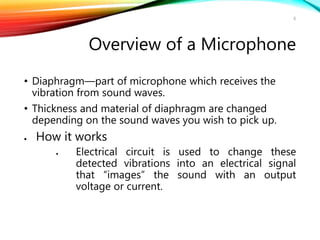
Overview of a Microphone
• Diaphragm—part of microphone which receives the
vibration from sound waves.
• Thickness and material of diaphragm are changed
depending on the sound waves you wish to pick up.
 How it works
 Electrical circuit is used to change these
detected vibrations into an electrical signal
that “images” the sound with an output
voltage or current.
6
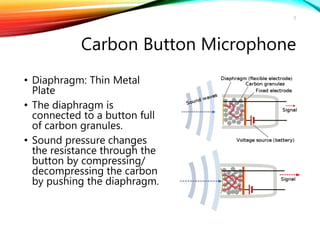
Carbon Button Microphone
• Diaphragm: Thin Metal
Plate
• The diaphragm is
connected to a button full
of carbon granules.
• Sound pressure changes
the resistance through the
button by compressing/
decompressing the carbon
by pushing the diaphragm.
7
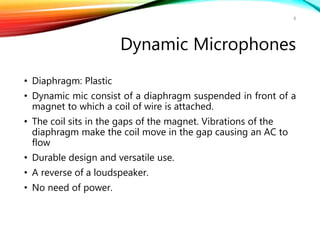
Dynamic Microphones
• Diaphragm: Plastic
• Dynamic mic consist of a diaphragm suspended in front of a
magnet to which a coil of wire is attached.
• The coil sits in the gaps of the magnet. Vibrations of the
diaphragm make the coil move in the gap causing an AC to
flow
• Durable design and versatile use.
• A reverse of a loudspeaker.
• No need of power.
8
Loudspeaker
9
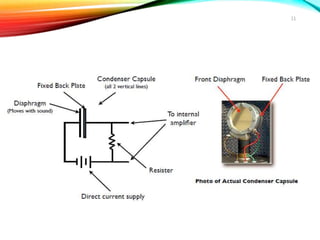
Condenser microphone
• Condenser is the British word for capacitor.
• Diaphragm: Thin metal strip suspended next to a charged electric
plate.
• In a condenser microphone, the diaphragm is one side of a
capacitor which moves in reaction to changes in a sound field.
• Since the two plates are charged, the motion changes the voltage
between the two plates and these voltage changes induce electron
flow.
• Condenser mic’s require some sort of external power source (a
battery or “phantom power”)
• Because the diaphragm is very light, condenser mic’s can have a
highly detailed response and tend to be much more sensitive than
a dynamic mic
10
11
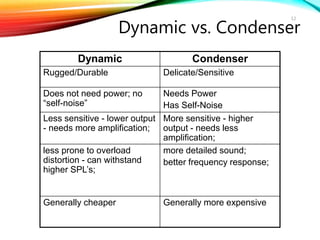
Dynamic vs. Condenser
Dynamic Condenser
Rugged/Durable Delicate/Sensitive
Does not need power; no
“self-noise”
Needs Power
Has Self-Noise
Less sensitive - lower output
- needs more amplification;
More sensitive - higher
output - needs less
amplification;
less prone to overload
distortion - can withstand
higher SPL’s;
more detailed sound;
better frequency response;
Generally cheaper Generally more expensive
12
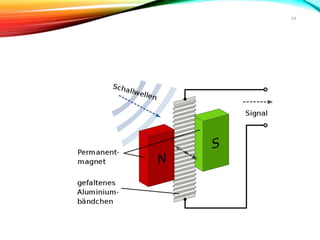
Ribbon Microphone
• Diaphragm: Thin piece of metal
(usually aluminum) foil
suspended in a magnetic field.
• Vibrations in ribbon produce a
small voltage which is then
stepped up by a transformer.
• Diaphragm is very easily
damaged by wind or loud
incoming sounds.
13
14
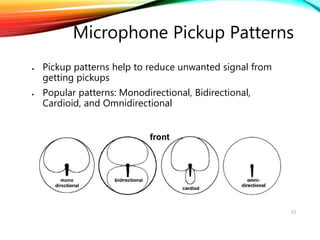
Microphone Pickup Patterns
 Pickup patterns help to reduce unwanted signal from
getting pickups
 Popular patterns: Monodirectional, Bidirectional,
Cardioid, and Omnidirectional
15
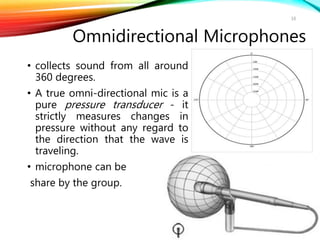
Omnidirectional Microphones
• collects sound from all around
360 degrees.
• A true omni-directional mic is a
pure pressure transducer - it
strictly measures changes in
pressure without any regard to
the direction that the wave is
traveling.
• microphone can be
share by the group.
16
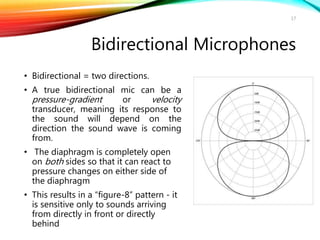
Bidirectional Microphones
• Bidirectional = two directions.
• A true bidirectional mic can be a
pressure-gradient or velocity
transducer, meaning its response to
the sound will depend on the
direction the sound wave is coming
from.
• The diaphragm is completely open
on both sides so that it can react to
pressure changes on either side of
the diaphragm
• This results in a “figure-8” pattern - it
is sensitive only to sounds arriving
from directly in front or directly
behind
17
Unidirectional/Cardioid
• Unidirectional = one direction
• collects most of the sound
from the front, and very little
from the back and sides.
• The microphone has a null at
180-degrees - it will not
respond to sound
approaching directly from the
rear.
• This results in a “heart-
shaped” pattern
(cardio=heart)
18
Other patterns
• Super- and Hyper-cardioid mic’s are cardioids that use more
bidirectional in the “recipe.” This results in a more narrow pickup
in the front and a small pickup lobe in the rear. The nulls are
moved to 120 or 110 degrees.
• Shotgun - uses an interference tube to get a very narrow forward
pickup. The longer the tube, the more narrow the pickup.
19
Shotgun
Types of Microphone
• Handheld Microphone
• Lavaliere (Tie-Pin) Microphone
• Surface Mount Microphone
• Shotgun Microphone
• Wireless Microphone System
20
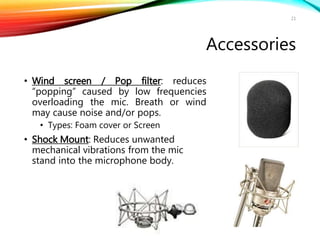
Accessories
• Wind screen / Pop filter: reduces
“popping” caused by low frequencies
overloading the mic. Breath or wind
may cause noise and/or pops.
• Types: Foam cover or Screen
• Shock Mount: Reduces unwanted
mechanical vibrations from the mic
stand into the microphone body.
21
Applications
• Telephones,
• Hearing aids,
• Public address systems for concert halls and public events,
• Motion picture production,
• Live and recorded audio engineering,
• Two-way radios
• Megaphones, radio and television broadcasting
• In computers for recording voice, speech recognition
22
“THANK YOU”

Microphone

  • 1.
    MICROPHONE (MIC) Atul Mishra M.Tech (ST-01) Dept. of Applied Physics
  • 2.
    Microphone • Microphone isa type of acoustic transducer or sensor. • A microphone, is an acoustic-to-electrical transducer or sensor that converts sound in air into an electrical signal. Microphone Frequency Response: • A microphone ability to hear tones (high and low) across the audible spectrum. • The human ear can hear the range of 20Hz (low bass notes) to 20,000Hz (high notes). 2
  • 3.
    History • Early microphoneswere invented for communication purposes. • In 1665 Robert Hooke the first to experiment with a medium other than air Tin can telephone • The first microphone Carbon Microphone in 1876 Independently developed by David Edward Hughes in England and Emile Berliner and Thomas Edison in the US. • Later modifications were made to design as the microphone was used more in entertainment industry. 3
  • 4.
    • The threemain types of microphones (according to their principles of operation) are: 1. Dynamic Microphone (Moving Coil Microphone) 2. Condenser Microphone (Capacitor Microphone) 3. Ribbon Microphone 4
  • 5.
    Directional Characteristics A Microphonecan be designed to react to: • Absolute changes in pressure • (i.e. pressure transducer) • The difference between pressure at the front and rear of the diaphragm • (i.e. pressure gradient), • or force & direction of the sound wave • (i.e. velocity) This determines its “pickup pattern” 5
  • 6.
    Overview of aMicrophone • Diaphragm—part of microphone which receives the vibration from sound waves. • Thickness and material of diaphragm are changed depending on the sound waves you wish to pick up.  How it works  Electrical circuit is used to change these detected vibrations into an electrical signal that “images” the sound with an output voltage or current. 6
  • 7.
    Carbon Button Microphone •Diaphragm: Thin Metal Plate • The diaphragm is connected to a button full of carbon granules. • Sound pressure changes the resistance through the button by compressing/ decompressing the carbon by pushing the diaphragm. 7
  • 8.
    Dynamic Microphones • Diaphragm:Plastic • Dynamic mic consist of a diaphragm suspended in front of a magnet to which a coil of wire is attached. • The coil sits in the gaps of the magnet. Vibrations of the diaphragm make the coil move in the gap causing an AC to flow • Durable design and versatile use. • A reverse of a loudspeaker. • No need of power. 8
  • 9.
  • 10.
    Condenser microphone • Condenseris the British word for capacitor. • Diaphragm: Thin metal strip suspended next to a charged electric plate. • In a condenser microphone, the diaphragm is one side of a capacitor which moves in reaction to changes in a sound field. • Since the two plates are charged, the motion changes the voltage between the two plates and these voltage changes induce electron flow. • Condenser mic’s require some sort of external power source (a battery or “phantom power”) • Because the diaphragm is very light, condenser mic’s can have a highly detailed response and tend to be much more sensitive than a dynamic mic 10
  • 11.
  • 12.
    Dynamic vs. Condenser DynamicCondenser Rugged/Durable Delicate/Sensitive Does not need power; no “self-noise” Needs Power Has Self-Noise Less sensitive - lower output - needs more amplification; More sensitive - higher output - needs less amplification; less prone to overload distortion - can withstand higher SPL’s; more detailed sound; better frequency response; Generally cheaper Generally more expensive 12
  • 13.
    Ribbon Microphone • Diaphragm:Thin piece of metal (usually aluminum) foil suspended in a magnetic field. • Vibrations in ribbon produce a small voltage which is then stepped up by a transformer. • Diaphragm is very easily damaged by wind or loud incoming sounds. 13
  • 14.
  • 15.
    Microphone Pickup Patterns Pickup patterns help to reduce unwanted signal from getting pickups  Popular patterns: Monodirectional, Bidirectional, Cardioid, and Omnidirectional 15
  • 16.
    Omnidirectional Microphones • collectssound from all around 360 degrees. • A true omni-directional mic is a pure pressure transducer - it strictly measures changes in pressure without any regard to the direction that the wave is traveling. • microphone can be share by the group. 16
  • 17.
    Bidirectional Microphones • Bidirectional= two directions. • A true bidirectional mic can be a pressure-gradient or velocity transducer, meaning its response to the sound will depend on the direction the sound wave is coming from. • The diaphragm is completely open on both sides so that it can react to pressure changes on either side of the diaphragm • This results in a “figure-8” pattern - it is sensitive only to sounds arriving from directly in front or directly behind 17
  • 18.
    Unidirectional/Cardioid • Unidirectional =one direction • collects most of the sound from the front, and very little from the back and sides. • The microphone has a null at 180-degrees - it will not respond to sound approaching directly from the rear. • This results in a “heart- shaped” pattern (cardio=heart) 18
  • 19.
    Other patterns • Super-and Hyper-cardioid mic’s are cardioids that use more bidirectional in the “recipe.” This results in a more narrow pickup in the front and a small pickup lobe in the rear. The nulls are moved to 120 or 110 degrees. • Shotgun - uses an interference tube to get a very narrow forward pickup. The longer the tube, the more narrow the pickup. 19 Shotgun
  • 20.
    Types of Microphone •Handheld Microphone • Lavaliere (Tie-Pin) Microphone • Surface Mount Microphone • Shotgun Microphone • Wireless Microphone System 20
  • 21.
    Accessories • Wind screen/ Pop filter: reduces “popping” caused by low frequencies overloading the mic. Breath or wind may cause noise and/or pops. • Types: Foam cover or Screen • Shock Mount: Reduces unwanted mechanical vibrations from the mic stand into the microphone body. 21
  • 22.
    Applications • Telephones, • Hearingaids, • Public address systems for concert halls and public events, • Motion picture production, • Live and recorded audio engineering, • Two-way radios • Megaphones, radio and television broadcasting • In computers for recording voice, speech recognition 22
  • 23.