Obj. 45 Circles & Polygons
The student is able to (I can):
• Develop and use formulas to find the areas of circles and
regular polygons
• Develop and use formulas to find arc length and sector
area of circles
circle

The set of all points in a plane that are a
fixed distance from a point, called the
center.
A circle is named by the symbol
center.

•
A

A

and its
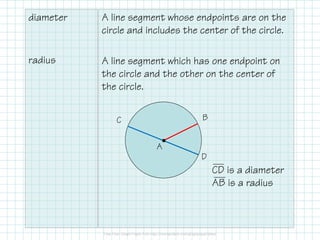
diameter

A line segment whose endpoints are on the
circle and includes the center of the circle.

radius

A line segment which has one endpoint on
the circle and the other on the center of
the circle.
B

C
•
A

D

CD is a diameter
AB is a radius
π (pi)

The ratio of the circumference to the
diameter.
C
π=
d
which becomes C = πd

Since the diameter is twice the radius, this
formula can also be written as:
C = 2πr
π is an irrational number — it never repeats
and it never ends. The symbol π is an exact
number; 3.1415926… is an approximation.
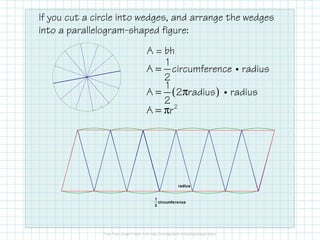
If you cut a circle into wedges, and arrange the wedges
into a parallelogram-shaped figure:
A = bh
1
A = circumference i radius
2
1
A = ( 2πradius ) i radius
22
A = πr

radius
1
2

circumference
Examples

1. Find the exact circumference and area
of a circle whose diameter is 18.
C = πd = π(18) = 18π
A = πr2 = π(92) = 81π
2. Find the diameter and area of a circle
whose circumference is 22π.
22π = πd
d = 22
A = π(112) = 121π
3. Find the radius of a circle whose area
is 81π.
81π = πr2
81 = r2
r=9
central angle
of a circle

An angle whose vertex is on the center of
the circle, and whose sides intersect the
circle.

sector of a
circle

A region bounded by a central angle.
R

A•
G

∠RAG is a central angle
RAG is a sector
The area of a sector is proportional to the
area of the circle containing the sector.
Area of sector central angle
=
Area of circle
360°
S
m°
=
2
πr
360°

Formula:

 m° 
S = πr 

 360° 
2
Examples

Find the area of each sector. Leave
answers in terms of π.
120°
S = π (2 )
360°
 4 i120 
= π

360 

4
= π in.2
3
2  72° 
S = π ( 10 ) 

360° 

 7200 
= π

 360 
2

1.
120º 2"
•

2.
• 72º
10m

= 20 π m2
chord

A line segment whose endpoints are on the
circle.

arc

A portion of a circle.

K

KY is a chord.
E•

Y

KY is an arc.
arc measure

The measure of the central angle that
intercepts the arc.

arc length

The distance along an arc. It is
proportional to the circumference of the
circle.
arc length
central angle
=
circumference
360°
mº
•

mº

 m° 
L = C

360° 

where C is the
circumference (either
C=πd or C=2πr).
Example

Find each exact arc length.
1.

120º
• 3′

2.

8m
• 72º

120 
L = 2π ( 3 ) 


 360 
= 2 π ft.

72 
L = 2π ( 8 ) 


 360 

=

16
π or 3.2 π m
5
apothem

The distance from the center of a polygon
to one of the sides.

central angle

An angle whose vertex is at the center and
whose sides go through consecutive
vertices.

•

central angle
For regular polygons, likewise, we can cut out a regular
polygon and arrange the halves as shown:
A = bh
1
A = perimeter i apothem
2
1
A = aP
2

apothem

1
2

perimeter
Since all of the central angles have to add
up to 360˚, the measure of a central angle
is
360
n
central angle

apothem
If we look at the isosceles triangle created
by a central angle (the apothem is the
height), one of the triangle’s base angle is
½ the interior angle.
central angle

interior angle

apothem

½ interior angle
What this means is that on any regular
polygon, we can set up a right triangle, with
one leg as the apothem and one leg as half
the length of a side.
½ central angle

apothem
½ interior angle

½ side

When you are calculating areas, you will
almost always be using the tangent ratio
(opposite/adjacent).
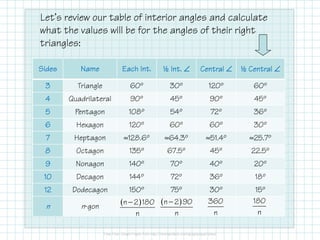
Let’s review our table of interior angles and calculate
what the values will be for the angles of their right
triangles:
Sides

Name

Each Int.

½ Int. ∠

Central ∠

½ Central ∠

3

Triangle

60º

30º

120º

60º

4

Quadrilateral

90º

45º

90º

45º

5

Pentagon

108º

54º

72º

36º

6

Hexagon

120º

60º

60º

30º

7

Heptagon

≈128.6º

≈64.3º

≈51.4º

≈25.7º

8

Octagon

135º

67.5º

45º

22.5º

9

Nonagon

140º

70º

40º

20º

10

Decagon

144º

72º

36º

18º

12

Dodecagon

150º

75º

n

n-gon

30º
360
n

15º
180
n

(n − 2 ) 180 (n − 2 ) 90
n

n
Examples

1. Find the area of the regular pentagon:
10

Let’s sketch in our
right triangle:

•

36º
a
54°
5

To find the apothem (a), we can use the
tangent ratio:
5
a
tan 36° =
tan54° =
or
5
a
Thus, a ≈ 6.88. The perimeter = 50, so
1
A = (6.88)(50) = 172
2
Examples

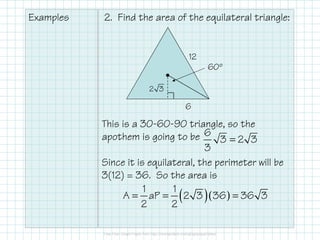
2. Find the area of the equilateral triangle:

12
60º

•
2 3

6

This is a 30-60-90 triangle, so the
apothem is going to be 6 3 = 2 3
3
Since it is equilateral, the perimeter will be
3(12) = 36. So the area is
1
1
A = aP = 2 3 ( 36 ) = 36 3
2
2

(

)
Because the central angle of an equilateral
triangle forms a special right triangle, we
also have a special formula for the area of
an equilateral triangle:
s2 3
(Where s is the
A=
side length.)
4
Looking at the previous example, if we plug
in 12 for s, we get:
122 3 144 3
A=
=
= 36 3
4
4
The advantage of this is that we don’t have
to try to draw in that tiny 30-60-90
triangle. Remember this as “s-2-3-4”.
Likewise, because the hexagon is composed
of 6 equilateral triangles, we have a special
formula for the area of a hexagon:
 s2 3 
A = 6

4 


Example: What is the area of a hexagon
with a side length of 14?

 14 2 3 
 196 3 
A = 6
 = 6

4 
4 



(

)

= 6 49 3 = 294 3
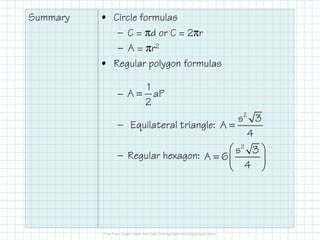
Summary

• Circle formulas
— C = πd or C = 2πr
— A = πr2
• Regular polygon formulas
1
— A = aP
2
s2 3
— Equilateral triangle: A =
4

 s2 3 
— Regular hexagon: A = 6 
4 



Obj. 45 Circles and Polygons

  • 1.
    Obj. 45 Circles& Polygons The student is able to (I can): • Develop and use formulas to find the areas of circles and regular polygons • Develop and use formulas to find arc length and sector area of circles
  • 2.
    circle The set ofall points in a plane that are a fixed distance from a point, called the center. A circle is named by the symbol center. • A A and its
  • 3.
    diameter A line segmentwhose endpoints are on the circle and includes the center of the circle. radius A line segment which has one endpoint on the circle and the other on the center of the circle. B C • A D CD is a diameter AB is a radius
  • 4.
    π (pi) The ratioof the circumference to the diameter. C π= d which becomes C = πd Since the diameter is twice the radius, this formula can also be written as: C = 2πr π is an irrational number — it never repeats and it never ends. The symbol π is an exact number; 3.1415926… is an approximation.
  • 5.
    If you cuta circle into wedges, and arrange the wedges into a parallelogram-shaped figure: A = bh 1 A = circumference i radius 2 1 A = ( 2πradius ) i radius 22 A = πr radius 1 2 circumference
  • 6.
    Examples 1. Find theexact circumference and area of a circle whose diameter is 18. C = πd = π(18) = 18π A = πr2 = π(92) = 81π 2. Find the diameter and area of a circle whose circumference is 22π. 22π = πd d = 22 A = π(112) = 121π 3. Find the radius of a circle whose area is 81π. 81π = πr2 81 = r2 r=9
  • 7.
    central angle of acircle An angle whose vertex is on the center of the circle, and whose sides intersect the circle. sector of a circle A region bounded by a central angle. R A• G ∠RAG is a central angle RAG is a sector
  • 8.
    The area ofa sector is proportional to the area of the circle containing the sector. Area of sector central angle = Area of circle 360° S m° = 2 πr 360° Formula:  m°  S = πr    360°  2
  • 9.
    Examples Find the areaof each sector. Leave answers in terms of π. 120° S = π (2 ) 360°  4 i120  = π  360   4 = π in.2 3 2  72°  S = π ( 10 )   360°    7200  = π   360  2 1. 120º 2" • 2. • 72º 10m = 20 π m2
  • 10.
    chord A line segmentwhose endpoints are on the circle. arc A portion of a circle. K KY is a chord. E• Y KY is an arc.
  • 11.
    arc measure The measureof the central angle that intercepts the arc. arc length The distance along an arc. It is proportional to the circumference of the circle. arc length central angle = circumference 360° mº • mº  m°  L = C  360°   where C is the circumference (either C=πd or C=2πr).
  • 12.
    Example Find each exactarc length. 1. 120º • 3′ 2. 8m • 72º 120  L = 2π ( 3 )     360  = 2 π ft. 72  L = 2π ( 8 )     360  = 16 π or 3.2 π m 5
  • 13.
    apothem The distance fromthe center of a polygon to one of the sides. central angle An angle whose vertex is at the center and whose sides go through consecutive vertices. • central angle
  • 14.
    For regular polygons,likewise, we can cut out a regular polygon and arrange the halves as shown: A = bh 1 A = perimeter i apothem 2 1 A = aP 2 apothem 1 2 perimeter
  • 15.
    Since all ofthe central angles have to add up to 360˚, the measure of a central angle is 360 n central angle apothem
  • 16.
    If we lookat the isosceles triangle created by a central angle (the apothem is the height), one of the triangle’s base angle is ½ the interior angle. central angle interior angle apothem ½ interior angle
  • 17.
    What this meansis that on any regular polygon, we can set up a right triangle, with one leg as the apothem and one leg as half the length of a side. ½ central angle apothem ½ interior angle ½ side When you are calculating areas, you will almost always be using the tangent ratio (opposite/adjacent).
  • 18.
    Let’s review ourtable of interior angles and calculate what the values will be for the angles of their right triangles: Sides Name Each Int. ½ Int. ∠ Central ∠ ½ Central ∠ 3 Triangle 60º 30º 120º 60º 4 Quadrilateral 90º 45º 90º 45º 5 Pentagon 108º 54º 72º 36º 6 Hexagon 120º 60º 60º 30º 7 Heptagon ≈128.6º ≈64.3º ≈51.4º ≈25.7º 8 Octagon 135º 67.5º 45º 22.5º 9 Nonagon 140º 70º 40º 20º 10 Decagon 144º 72º 36º 18º 12 Dodecagon 150º 75º n n-gon 30º 360 n 15º 180 n (n − 2 ) 180 (n − 2 ) 90 n n
  • 19.
    Examples 1. Find thearea of the regular pentagon: 10 Let’s sketch in our right triangle: • 36º a 54° 5 To find the apothem (a), we can use the tangent ratio: 5 a tan 36° = tan54° = or 5 a Thus, a ≈ 6.88. The perimeter = 50, so 1 A = (6.88)(50) = 172 2
  • 20.
    Examples 2. Find thearea of the equilateral triangle: 12 60º • 2 3 6 This is a 30-60-90 triangle, so the apothem is going to be 6 3 = 2 3 3 Since it is equilateral, the perimeter will be 3(12) = 36. So the area is 1 1 A = aP = 2 3 ( 36 ) = 36 3 2 2 ( )
  • 21.
    Because the centralangle of an equilateral triangle forms a special right triangle, we also have a special formula for the area of an equilateral triangle: s2 3 (Where s is the A= side length.) 4 Looking at the previous example, if we plug in 12 for s, we get: 122 3 144 3 A= = = 36 3 4 4 The advantage of this is that we don’t have to try to draw in that tiny 30-60-90 triangle. Remember this as “s-2-3-4”.
  • 22.
    Likewise, because thehexagon is composed of 6 equilateral triangles, we have a special formula for the area of a hexagon:  s2 3  A = 6  4   Example: What is the area of a hexagon with a side length of 14?  14 2 3   196 3  A = 6  = 6  4  4    ( ) = 6 49 3 = 294 3
  • 23.
    Summary • Circle formulas —C = πd or C = 2πr — A = πr2 • Regular polygon formulas 1 — A = aP 2 s2 3 — Equilateral triangle: A = 4  s2 3  — Regular hexagon: A = 6  4   