Square root and Cube roots
Extracting Square Roots
Mentally
A square is a number multiplied by
itself. For example, 3 squared (32) is 3
* 3, or 9.
A square root is the number that, when
squared, results in a given number.
For example, the square root of 9 (√9)
is 3.
Properties of a Perfect Square
No perfect square ends with 2,3,7,8.
No perfect square ends with an odd
number of zeros.
The square of a number other than unity
is either a multiple of 4 or exceeds a
multiple of 4 by 1.
To extract square roots mentally, you
must know the first 10 squares:
12=1 22=4
32=9 42=16
52=25 62=36
72=49 82=64
92=81 102=100
Extracting Square Roots
Mentally
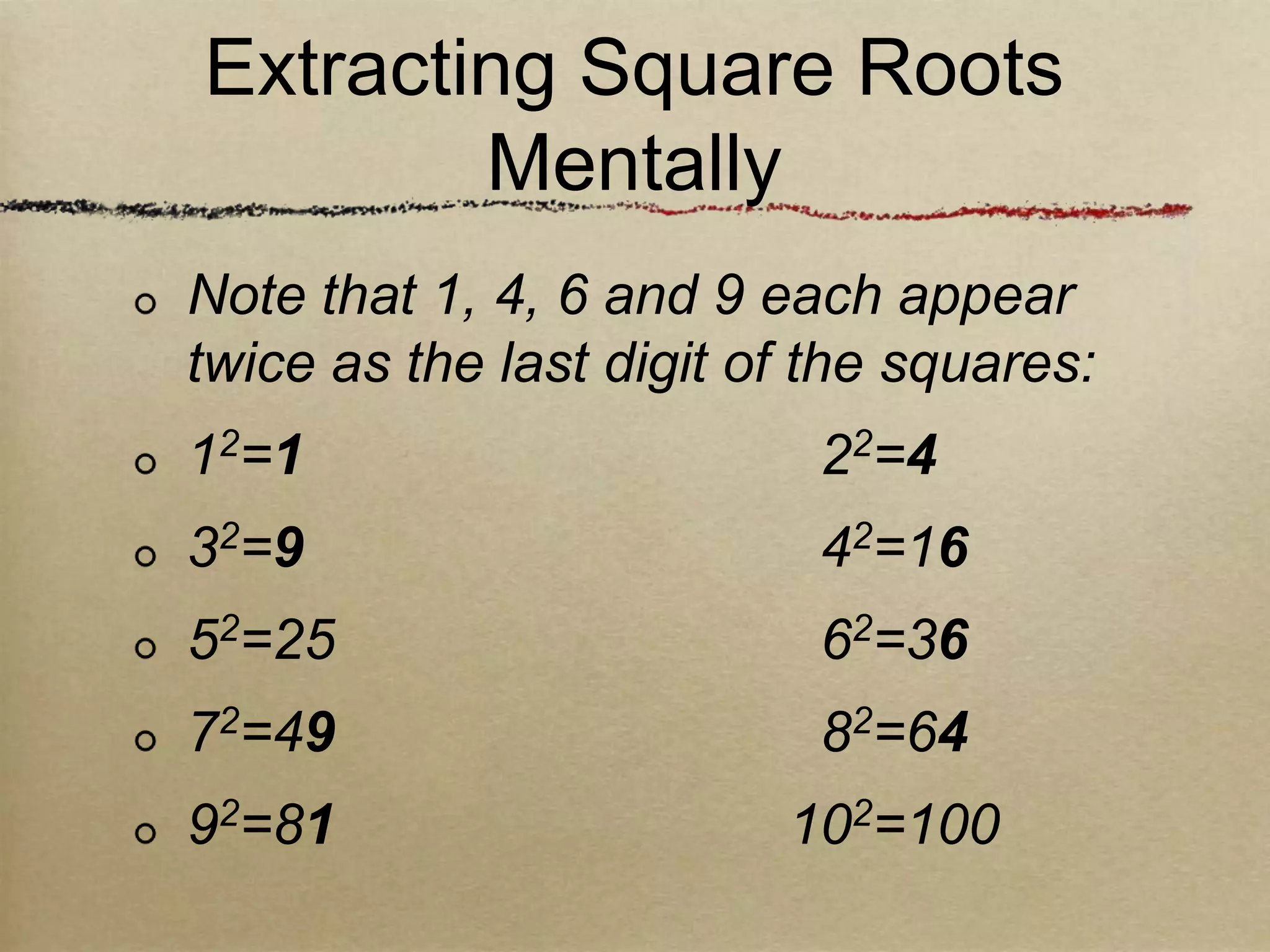
Note that 1, 4, 6 and 9 each appear
twice as the last digit of the squares:
12=1 22=4
32=9 42=16
52=25 62=36
72=49 82=64
92=81 102=100
Extracting Square Roots
Mentally
Also note that 1, 4, 6 and 9 each
appear once below and once above 5:
12=1 22=4
32=9 42=16
52=25 62=36
72=49 82=64
92=81 102=100
Extracting Square Roots
Mentally
Finally, note that the squares for 5 and
0 end in their respective numbers:
12=1 22=4
32=9 42=16
52=25 62=36
72=49 82=64
92=81 102=100
Extracting Square Roots
Mentally
If you’re given one of the squares
you’ve memorized from this chart,
simply give the square root you’ve
remembered.
Extracting Square Roots
Mentally
If you’re given a number that ranges
from 100 (102) to 10,000 (1002), you’ll
need to go through the following steps.
Extracting Square Roots
Mentally
First, split the number into two parts,
with the rightmost two digits in one
part, and the rest in the other.
As an example, let’s say you’re given
the number 1,764.
You would mentally split it into “17”
and “64”.
Extracting Square Roots
Mentally
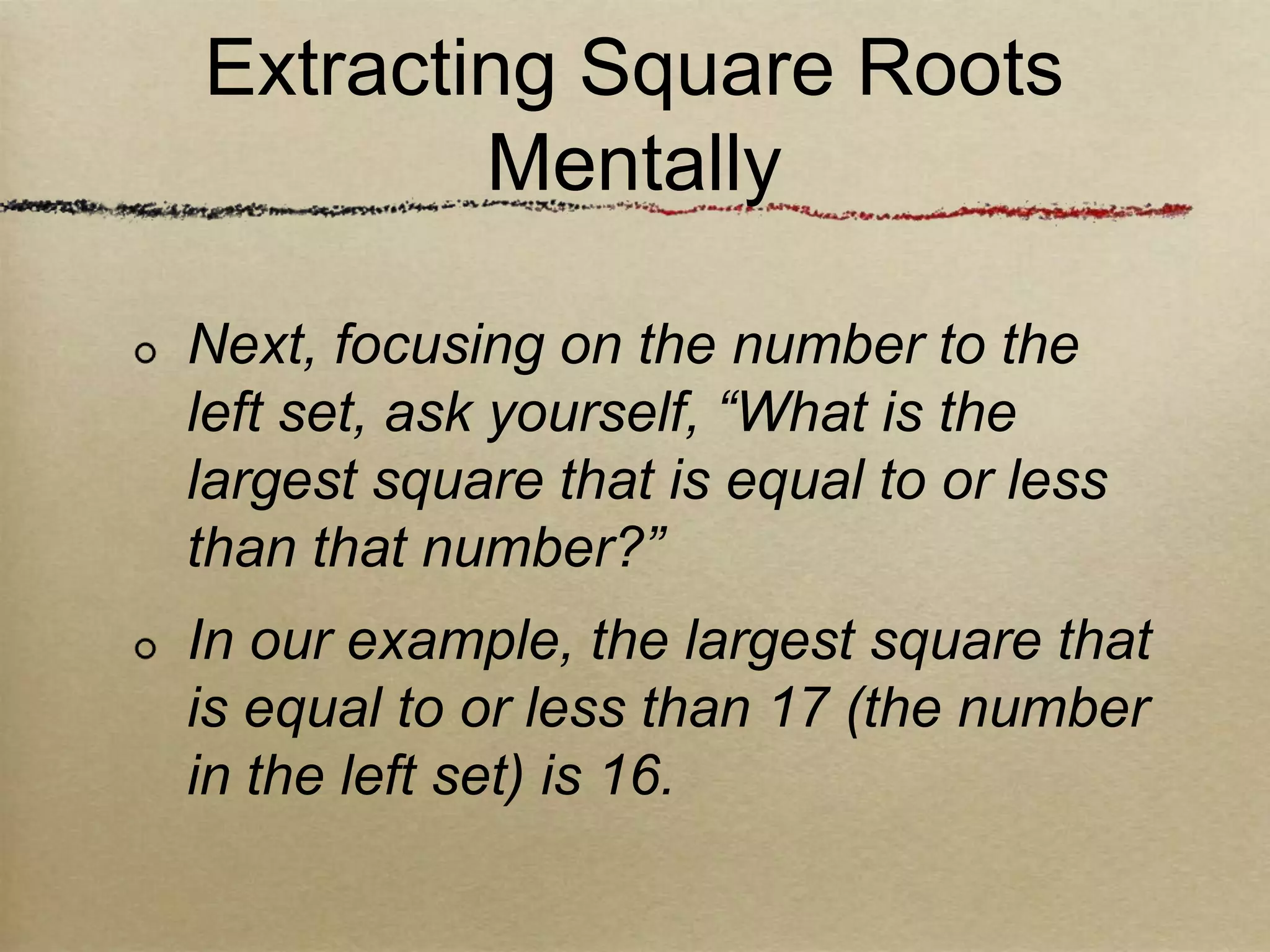
Next, focusing on the number to the
left set, ask yourself, “What is the
largest square that is equal to or less
than that number?”
In our example, the largest square that
is equal to or less than 17 (the number
in the left set) is 16.
Extracting Square Roots
Mentally
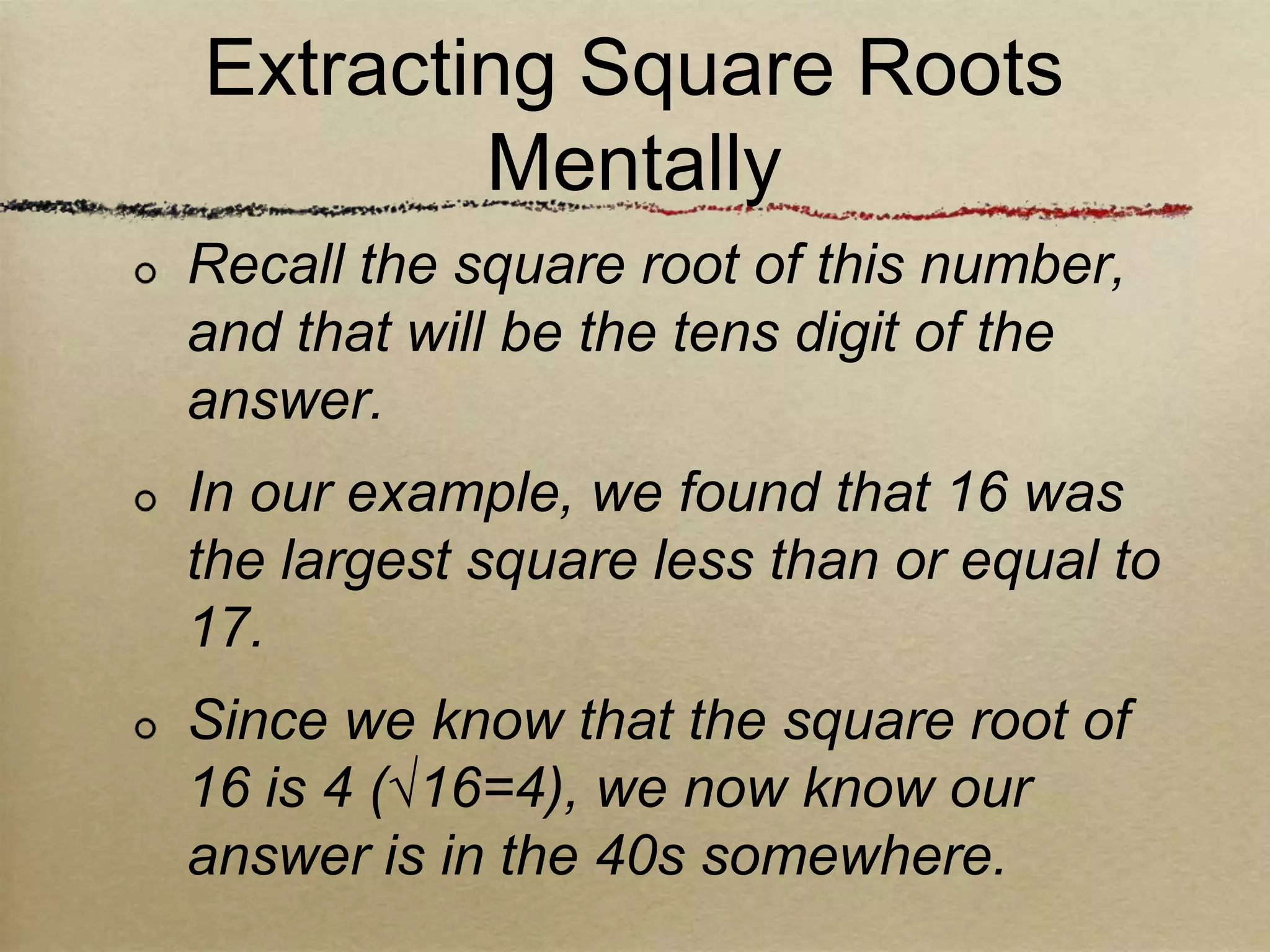
Recall the square root of this number,
and that will be the tens digit of the
answer.
In our example, we found that 16 was
the largest square less than or equal to
17.
Since we know that the square root of
16 is 4 (√16=4), we now know our
answer is in the 40s somewhere.
Extracting Square Roots
Mentally
Now, focus on the number in the right
set. In our example of 1,764, this
would be the “64”.
Extracting Square Roots
Mentally
Look at just the rightmost digit, and ask
yourself, “Which digits, from 0-9, when
squared, would result in that digit?”
In our example of 1,764, we see that
the rightmost digit is a 4. However,
both 22 (4) and 82 (64) end in 4, so
how do we know whether 2 or 8 is the
right digit?
Extracting Square Roots
Mentally
This is where the trick of squaring
numbers ending in 5 comes in handy.
Using the tens digit discovered earlier,
set 5 as the ones digit and square it.
In our “1764” example, we know that
the root is in the 40s, so we square 45,
which is 2,025.
Extracting Square Roots
Mentally
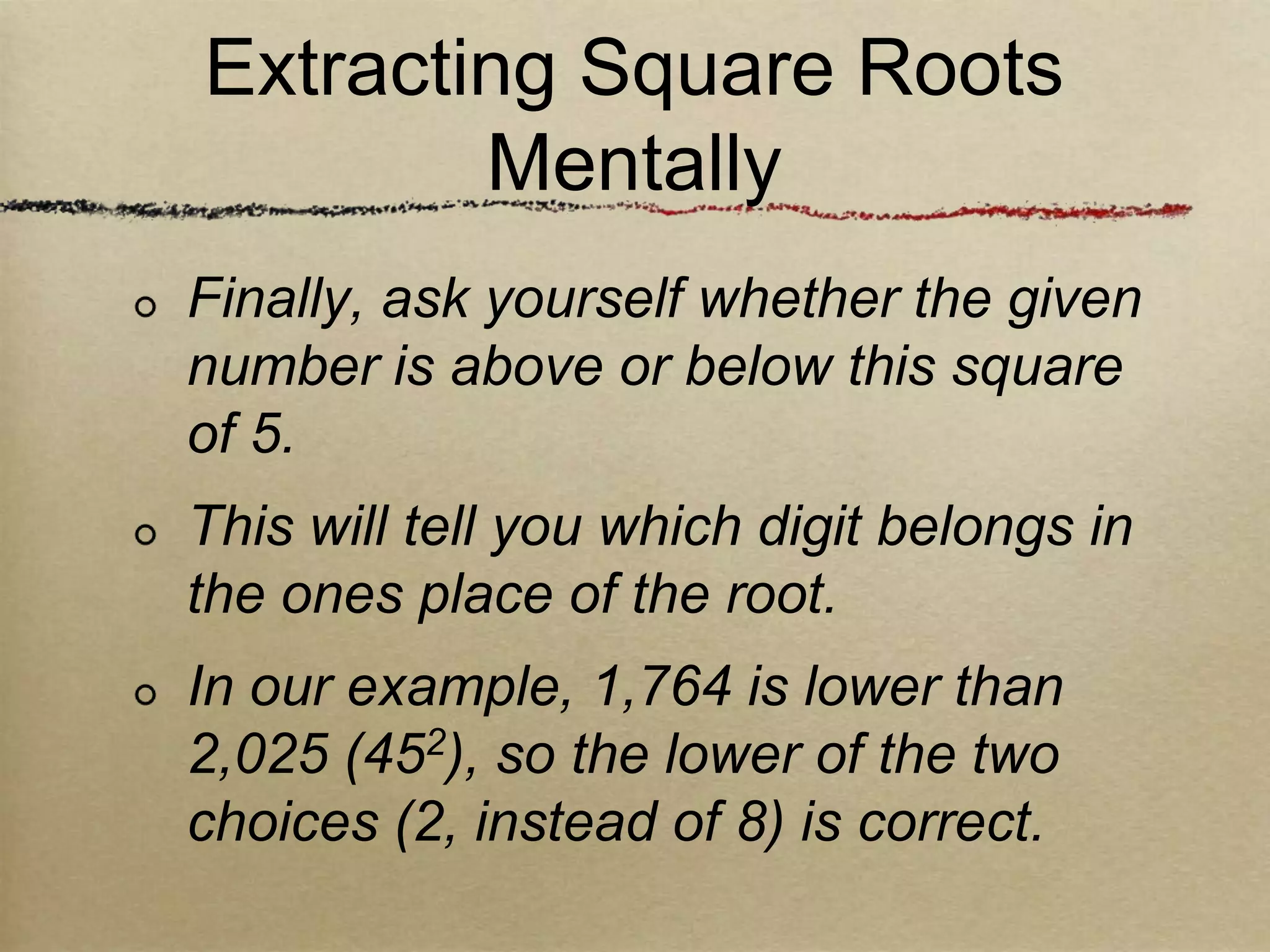
Finally, ask yourself whether the given
number is above or below this square
of 5.
This will tell you which digit belongs in
the ones place of the root.
In our example, 1,764 is lower than
2,025 (452), so the lower of the two
choices (2, instead of 8) is correct.
Extracting Square Roots
Mentally
Finally, put the tens digit together with
the ones digit, and you have the
answer.
In our example, we determined that
1,764 was in the 40s somewhere, and
that 2 was the correct digit for the ones
place, so the answer is 42!
Extracting Square Roots
Mentally
For squares that end in 5 or 0, you’ll
known that they end in 5 or 0,
respectively.
Extracting Square Roots
Mentally
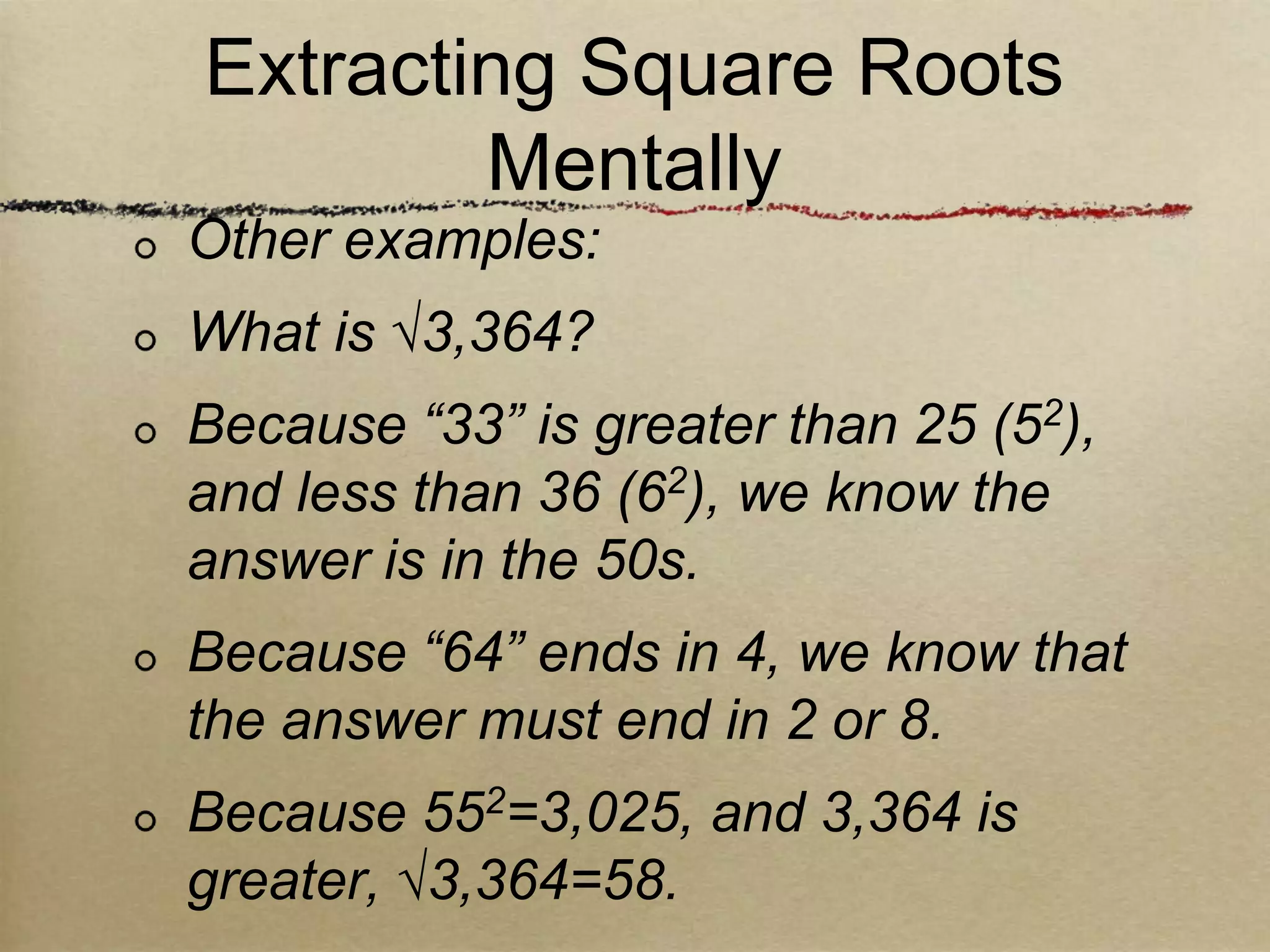
Other examples:
What is √3,364?
Because “33” is greater than 25 (52),
and less than 36 (62), we know the
answer is in the 50s.
Because “64” ends in 4, we know that
the answer must end in 2 or 8.
Because 552=3,025, and 3,364 is
greater, √3,364=58.
Extracting Square Roots
Mentally
Other examples:
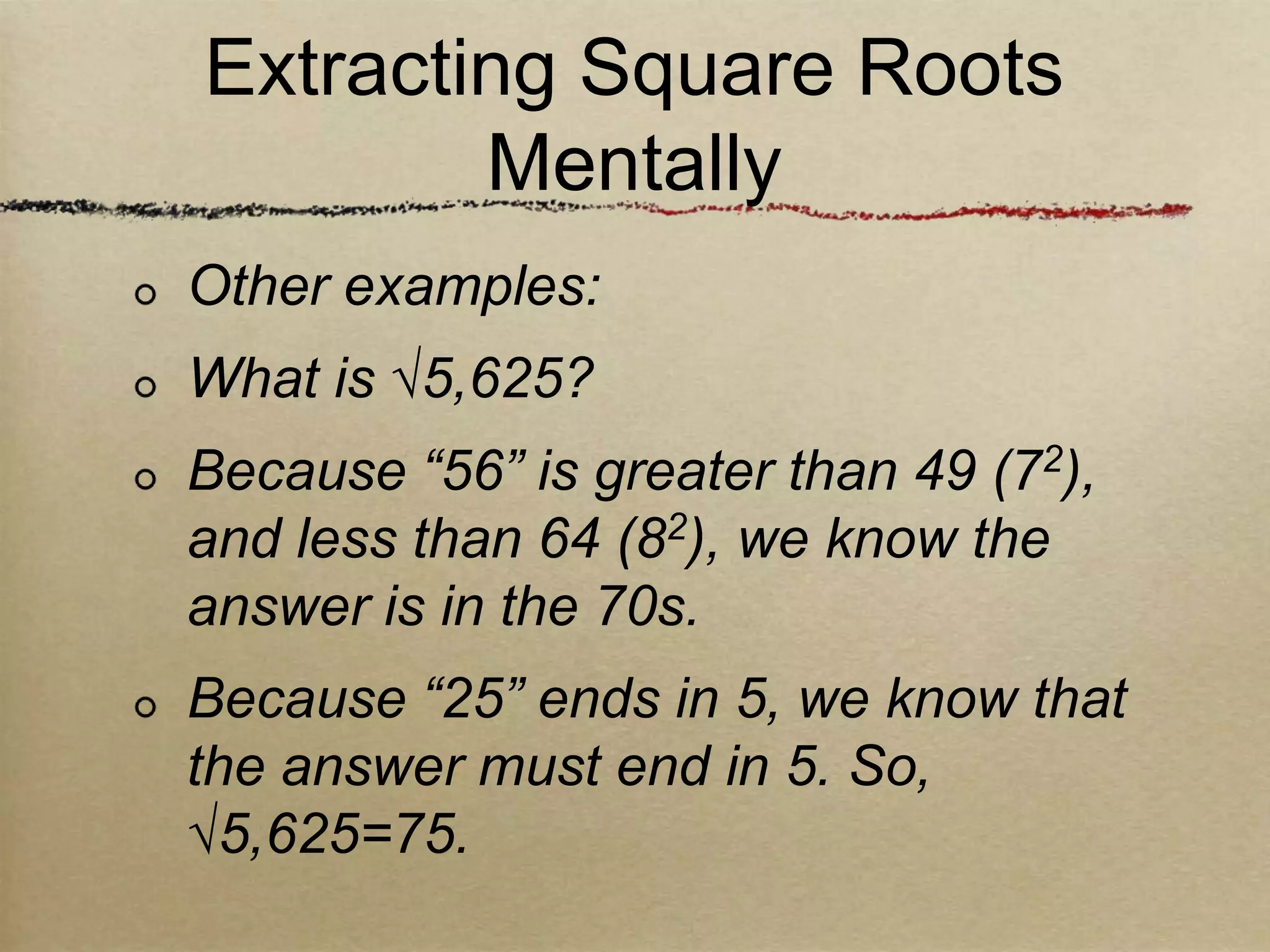
What is √5,625?
Because “56” is greater than 49 (72),
and less than 64 (82), we know the
answer is in the 70s.
Because “25” ends in 5, we know that
the answer must end in 5. So,
√5,625=75.
Extracting Square Roots
Mentally
Other examples:
What is √4,761?
Because “47” is greater than 36 (62),
and less than 49 (72), we know the
answer is in the 60s.
Because “61” ends in 1, we know that
the answer must end in 1 or 9.
Because 652=4,225, and 4,761 is
greater, √4,761=69.
Extracting Square Roots
Mentally
Extracting Square Roots
Mentally
Extracting Cube Roots
Mentally
Extracting Cube Roots
Mentally
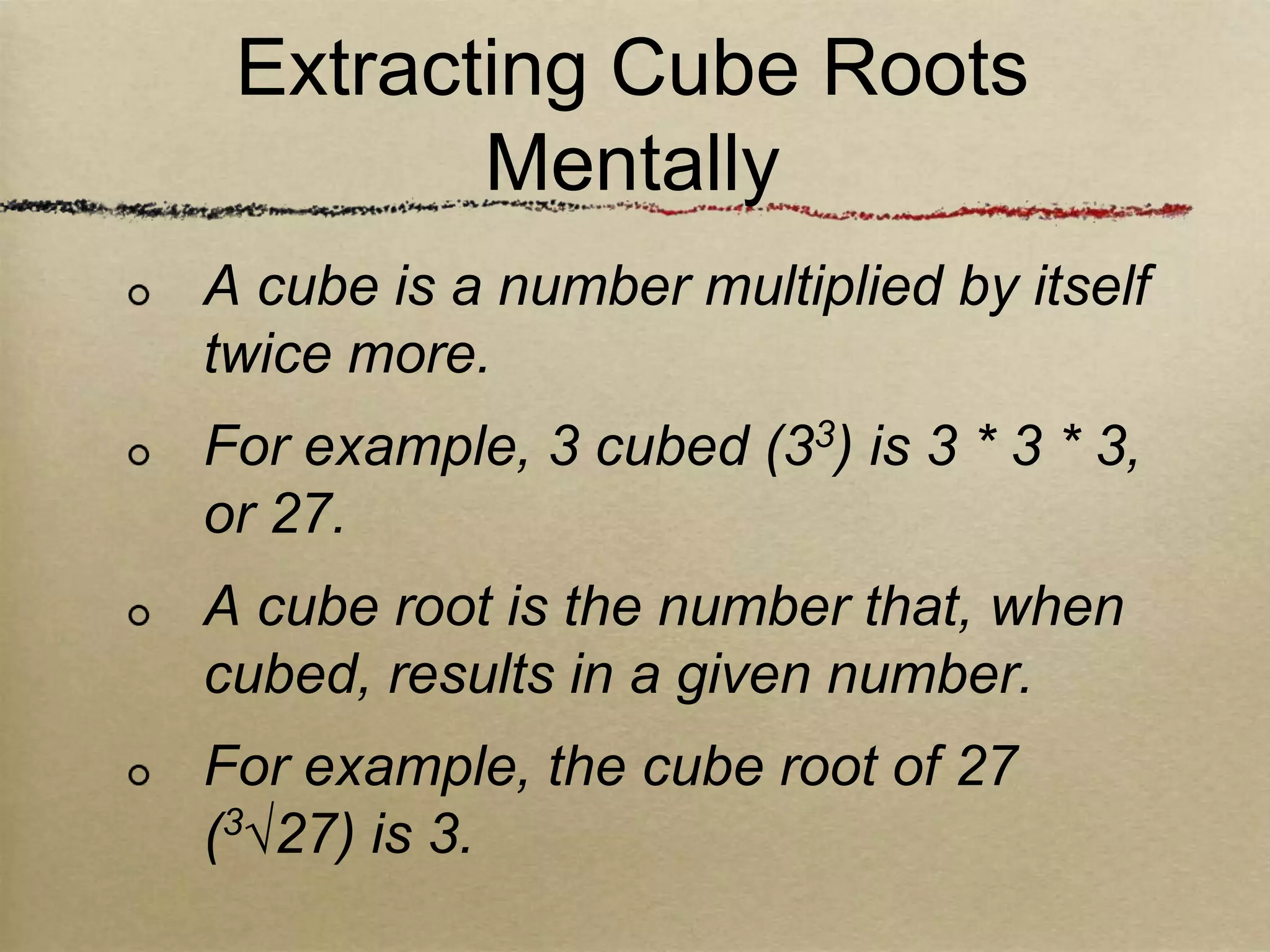
A cube is a number multiplied by itself
twice more.
For example, 3 cubed (33) is 3 * 3 * 3,
or 27.
A cube root is the number that, when
cubed, results in a given number.
For example, the cube root of 27
(3√27) is 3.
Extracting Cube Roots
Mentally
To be able to extract cube roots
mentally, you must know the first 10
cubes mentally:
13=1 23=8
33=27 43=64
53=125 63=216
73=343 83=512
93=729 103=1000
Extracting Cube Roots
Mentally
Note that no two cubes end in the
same digit:
13=1 23=8
33=27 43=64
53=125 63=216
73=343 83=512
93=729 103=1000
Extracting Cube Roots
Mentally
Also notice that the cubes of 1, 4, 5, 6,
9 and 0 end in those same digits:
13=1 23=8
33=27 43=64
53=125 63=216
73=343 83=512
93=729 103=1000
Extracting Cube Roots
Mentally
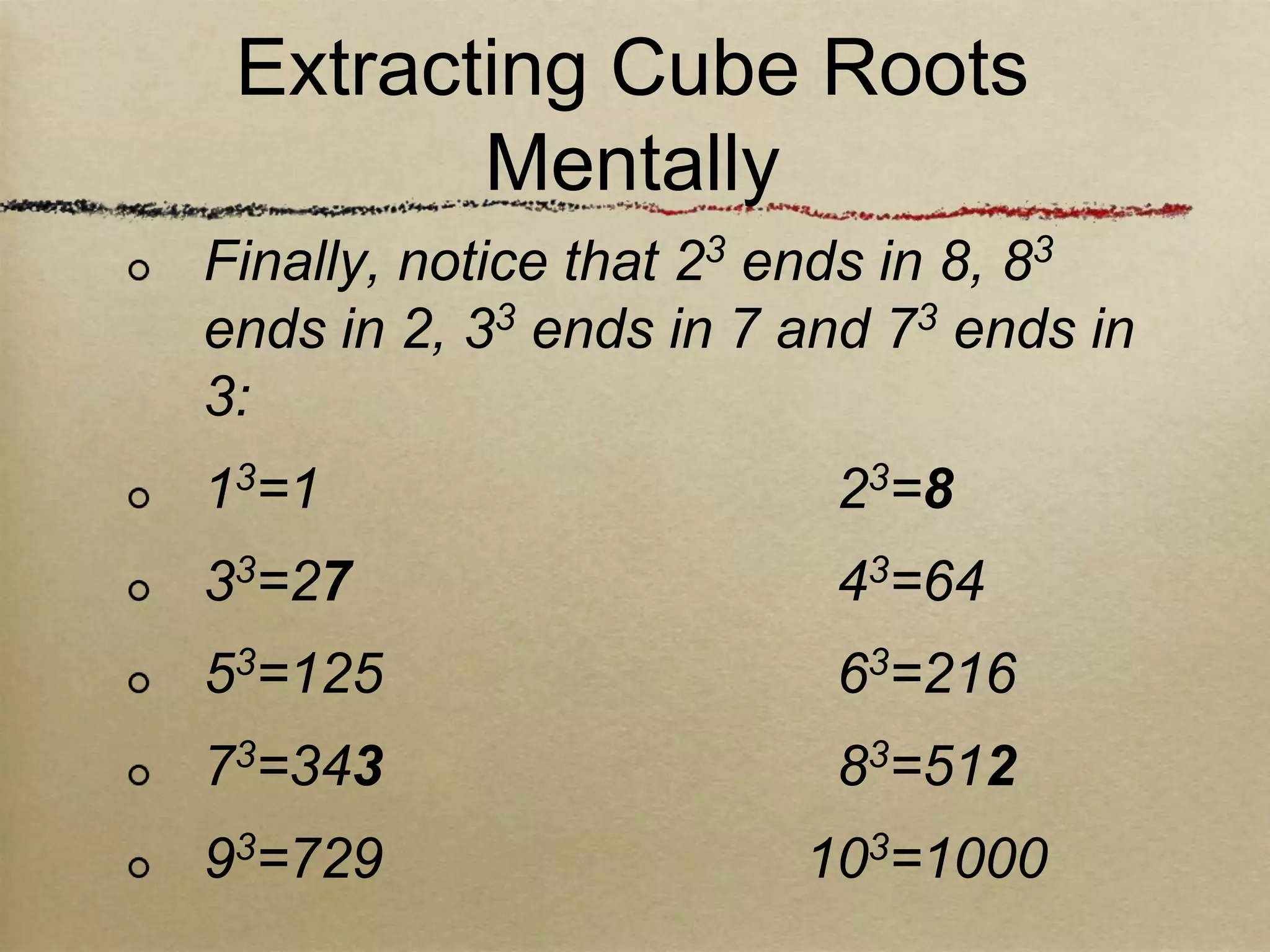
Finally, notice that 23 ends in 8, 83
ends in 2, 33 ends in 7 and 73 ends in
3:
13=1 23=8
33=27 43=64
53=125 63=216
73=343 83=512
93=729 103=1000
Extracting Cube Roots
Mentally
If you’re given one of the cubes you’ve
memorized from this chart, simply give
the cube root you’ve remembered.
Extracting Cube Roots
Mentally
If you’re given a number that ranges
from 1,000 (103) to 1,000,000 (1003),
you’ll need to go through the following
steps.
Extracting Cube Roots
Mentally
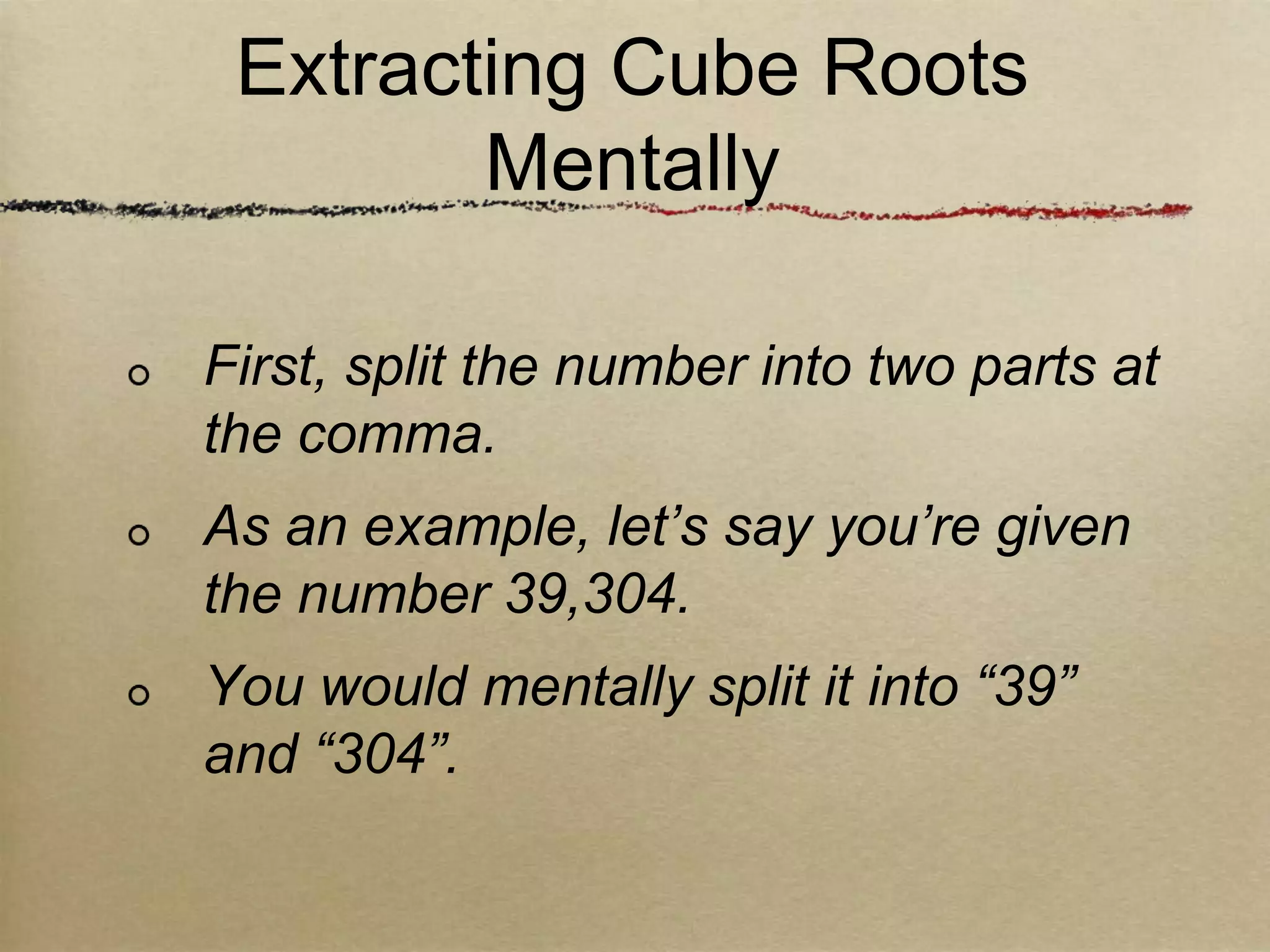
First, split the number into two parts at
the comma.
As an example, let’s say you’re given
the number 39,304.
You would mentally split it into “39”
and “304”.
Extracting Cube Roots
Mentally
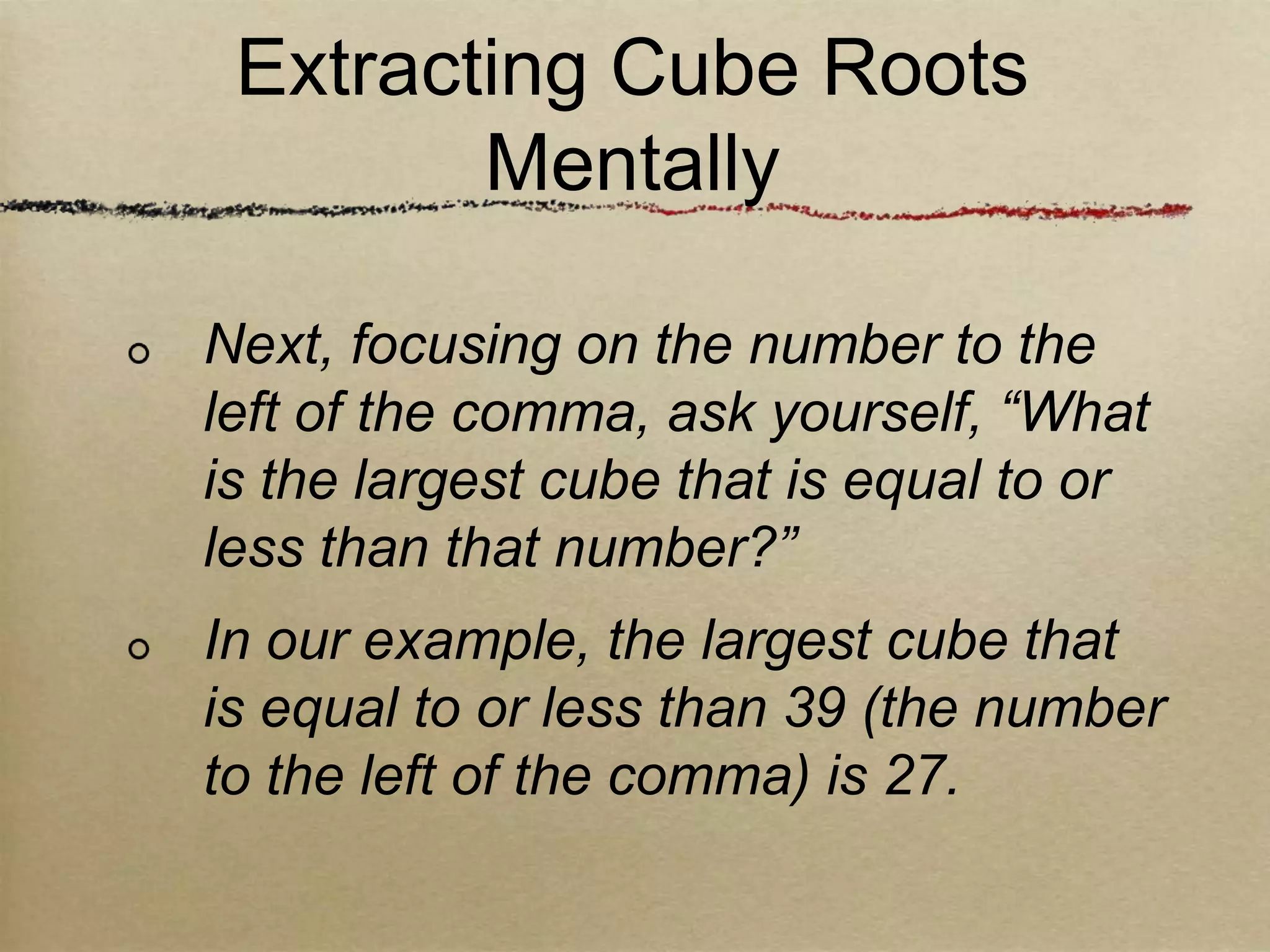
Next, focusing on the number to the
left of the comma, ask yourself, “What
is the largest cube that is equal to or
less than that number?”
In our example, the largest cube that
is equal to or less than 39 (the number
to the left of the comma) is 27.
Extracting Cube Roots
Mentally
Recall the cube root of this number,
and that will be the tens digit of the
answer.
In our example, we found that 27 was
the largest cube less than or equal to
39.
Since we know that the cube root of
27 is 3 (3√27=3), we now know our
answer is in the 30s somewhere.
Extracting Cube Roots
Mentally
Now, focus on the number to the right
of the comma.
In our example of 39,304, this would
be the “304”.
Extracting Cube Roots
MentallyLook at just the rightmost digit, and
ask yourself, “Which digit, from 0-9,
when cubed, would result in that
digit?”
This will be the ones digit of the
answer.
In our example of 39,304, we see that
the rightmost digit is a 4.
Remembering that 4 is the only cube
that ends in a 4 (43=64), this must be
Extracting Cube Roots
Mentally
Once you know both the tens digit and
the ones digit of the answer, put them
together and you have the cube root.
In our example, we determined that
the answer for “39,304” is in the 30s,
and that it ends in 4, so we give 34 as
the cube root!
Extracting Cube Roots
Mentally
Other examples:
What is 3√50,653?
Because “50” is greater than 27 (33),
and less than 64 (43), we know the
answer is in the 30s.
Because “653” ends in 3, we know
that the answer must end in 7, as only
73 (343) ends in 3.
Therefore, 3√50,653=37.
Extracting Cube Roots
Mentally
Other examples:
What is 3√314,432?
Because “314” is greater than 216
(63), and less than 343 (73), we know
the answer is in the 60s.
Because “432” ends in 2, we know
that the answer must end in 8, as only
83 (512) ends in 2.
Therefore, 3√314,432=68.
Extracting Cube Roots
Mentally
Other examples:
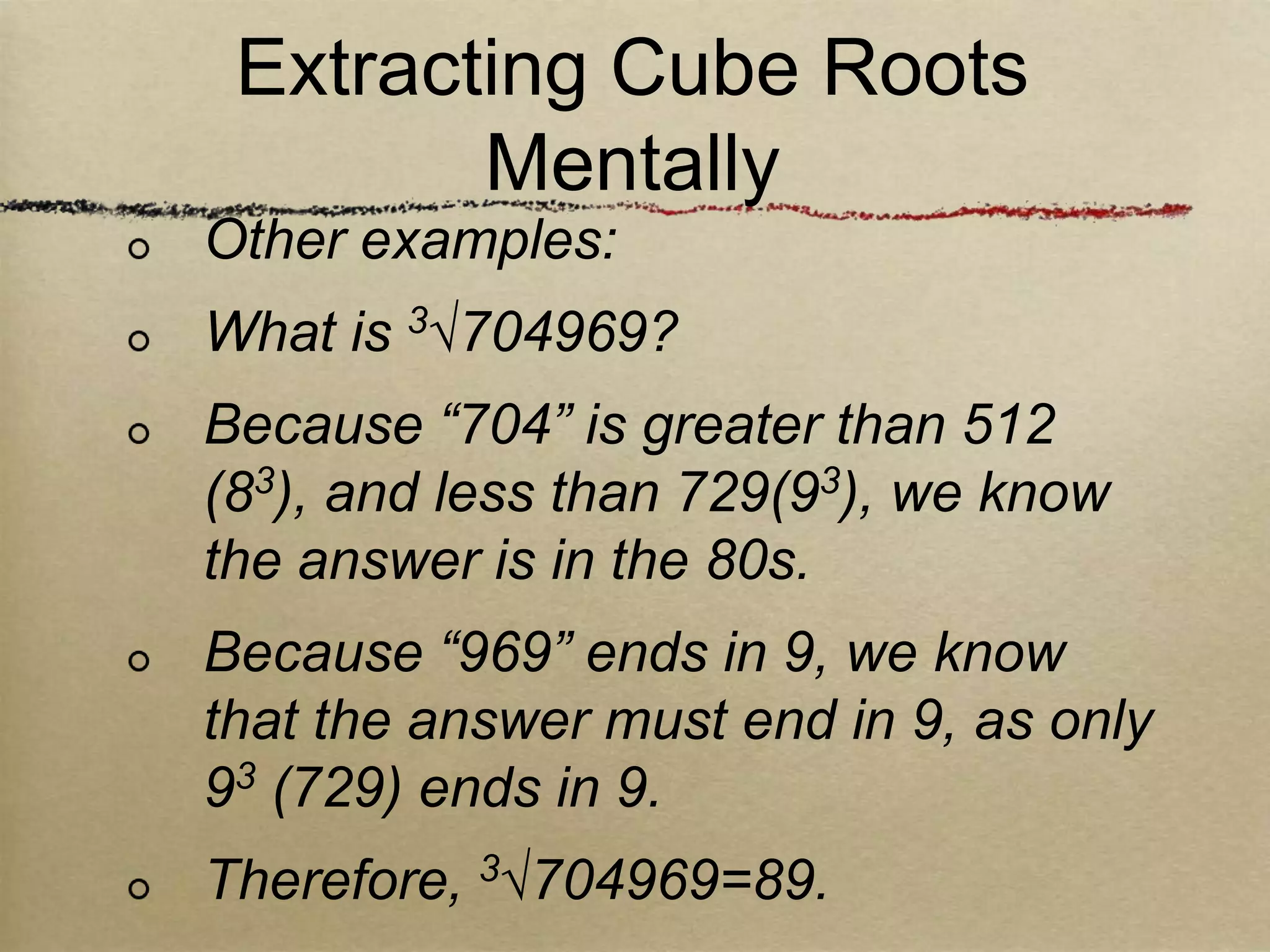
What is 3√704969?
Because “704” is greater than 512
(83), and less than 729(93), we know
the answer is in the 80s.
Because “969” ends in 9, we know
that the answer must end in 9, as only
93 (729) ends in 9.
Therefore, 3√704969=89.
Digits Powers
1 1 2 3 4 5 6 7 8 9
2 2 4 8 6 2 4 8 6 2
3 3 9 7 1 3 9 7 1 3
4 4 6 4 6 4 6 4 6 4
5 5 5 5 5 5 5 5 5 5
6 6 6 6 6 6 6 6 6 6
7 7 9 3 1 7 9 3 1 7
8 8 4 2 6 8 4 2 6 8
9 9 1 9 1 9 1 9 1 9
For every digit unit place digits of increasing powers repeat after 4th power.
This means unit place digit for power=5 is same as unit place digit for power=1
for every number.
2) For digits 2, 4 & 8 any power will have either 2 or 4 or 6 or 8 at unit place.
3) For digits 3 & 7 any power will have either 1 or 3 or 7 or 9 at unit place.
4) For digit 9 any power will have either 1 or 9 at unit place.
5) And for digits 5 & 6 every power will have 5 & 6 at unit place respectively.

Qa05 square root and cube root

  • 1.
    Square root andCube roots
  • 2.
    Extracting Square Roots Mentally Asquare is a number multiplied by itself. For example, 3 squared (32) is 3 * 3, or 9. A square root is the number that, when squared, results in a given number. For example, the square root of 9 (√9) is 3.
  • 3.
    Properties of aPerfect Square No perfect square ends with 2,3,7,8. No perfect square ends with an odd number of zeros. The square of a number other than unity is either a multiple of 4 or exceeds a multiple of 4 by 1.
  • 4.
    To extract squareroots mentally, you must know the first 10 squares: 12=1 22=4 32=9 42=16 52=25 62=36 72=49 82=64 92=81 102=100 Extracting Square Roots Mentally
  • 5.
    Note that 1,4, 6 and 9 each appear twice as the last digit of the squares: 12=1 22=4 32=9 42=16 52=25 62=36 72=49 82=64 92=81 102=100 Extracting Square Roots Mentally
  • 6.
    Also note that1, 4, 6 and 9 each appear once below and once above 5: 12=1 22=4 32=9 42=16 52=25 62=36 72=49 82=64 92=81 102=100 Extracting Square Roots Mentally
  • 7.
    Finally, note thatthe squares for 5 and 0 end in their respective numbers: 12=1 22=4 32=9 42=16 52=25 62=36 72=49 82=64 92=81 102=100 Extracting Square Roots Mentally
  • 8.
    If you’re givenone of the squares you’ve memorized from this chart, simply give the square root you’ve remembered. Extracting Square Roots Mentally
  • 9.
    If you’re givena number that ranges from 100 (102) to 10,000 (1002), you’ll need to go through the following steps. Extracting Square Roots Mentally
  • 10.
    First, split thenumber into two parts, with the rightmost two digits in one part, and the rest in the other. As an example, let’s say you’re given the number 1,764. You would mentally split it into “17” and “64”. Extracting Square Roots Mentally
  • 11.
    Next, focusing onthe number to the left set, ask yourself, “What is the largest square that is equal to or less than that number?” In our example, the largest square that is equal to or less than 17 (the number in the left set) is 16. Extracting Square Roots Mentally
  • 12.
    Recall the squareroot of this number, and that will be the tens digit of the answer. In our example, we found that 16 was the largest square less than or equal to 17. Since we know that the square root of 16 is 4 (√16=4), we now know our answer is in the 40s somewhere. Extracting Square Roots Mentally
  • 13.
    Now, focus onthe number in the right set. In our example of 1,764, this would be the “64”. Extracting Square Roots Mentally
  • 14.
    Look at justthe rightmost digit, and ask yourself, “Which digits, from 0-9, when squared, would result in that digit?” In our example of 1,764, we see that the rightmost digit is a 4. However, both 22 (4) and 82 (64) end in 4, so how do we know whether 2 or 8 is the right digit? Extracting Square Roots Mentally
  • 15.
    This is wherethe trick of squaring numbers ending in 5 comes in handy. Using the tens digit discovered earlier, set 5 as the ones digit and square it. In our “1764” example, we know that the root is in the 40s, so we square 45, which is 2,025. Extracting Square Roots Mentally
  • 16.
    Finally, ask yourselfwhether the given number is above or below this square of 5. This will tell you which digit belongs in the ones place of the root. In our example, 1,764 is lower than 2,025 (452), so the lower of the two choices (2, instead of 8) is correct. Extracting Square Roots Mentally
  • 17.
    Finally, put thetens digit together with the ones digit, and you have the answer. In our example, we determined that 1,764 was in the 40s somewhere, and that 2 was the correct digit for the ones place, so the answer is 42! Extracting Square Roots Mentally
  • 18.
    For squares thatend in 5 or 0, you’ll known that they end in 5 or 0, respectively. Extracting Square Roots Mentally
  • 19.
    Other examples: What is√3,364? Because “33” is greater than 25 (52), and less than 36 (62), we know the answer is in the 50s. Because “64” ends in 4, we know that the answer must end in 2 or 8. Because 552=3,025, and 3,364 is greater, √3,364=58. Extracting Square Roots Mentally
  • 20.
    Other examples: What is√5,625? Because “56” is greater than 49 (72), and less than 64 (82), we know the answer is in the 70s. Because “25” ends in 5, we know that the answer must end in 5. So, √5,625=75. Extracting Square Roots Mentally
  • 21.
    Other examples: What is√4,761? Because “47” is greater than 36 (62), and less than 49 (72), we know the answer is in the 60s. Because “61” ends in 1, we know that the answer must end in 1 or 9. Because 652=4,225, and 4,761 is greater, √4,761=69. Extracting Square Roots Mentally
  • 22.
  • 23.
  • 24.
    Extracting Cube Roots Mentally Acube is a number multiplied by itself twice more. For example, 3 cubed (33) is 3 * 3 * 3, or 27. A cube root is the number that, when cubed, results in a given number. For example, the cube root of 27 (3√27) is 3.
  • 25.
    Extracting Cube Roots Mentally Tobe able to extract cube roots mentally, you must know the first 10 cubes mentally: 13=1 23=8 33=27 43=64 53=125 63=216 73=343 83=512 93=729 103=1000
  • 26.
    Extracting Cube Roots Mentally Notethat no two cubes end in the same digit: 13=1 23=8 33=27 43=64 53=125 63=216 73=343 83=512 93=729 103=1000
  • 27.
    Extracting Cube Roots Mentally Alsonotice that the cubes of 1, 4, 5, 6, 9 and 0 end in those same digits: 13=1 23=8 33=27 43=64 53=125 63=216 73=343 83=512 93=729 103=1000
  • 28.
    Extracting Cube Roots Mentally Finally,notice that 23 ends in 8, 83 ends in 2, 33 ends in 7 and 73 ends in 3: 13=1 23=8 33=27 43=64 53=125 63=216 73=343 83=512 93=729 103=1000
  • 29.
    Extracting Cube Roots Mentally Ifyou’re given one of the cubes you’ve memorized from this chart, simply give the cube root you’ve remembered.
  • 30.
    Extracting Cube Roots Mentally Ifyou’re given a number that ranges from 1,000 (103) to 1,000,000 (1003), you’ll need to go through the following steps.
  • 31.
    Extracting Cube Roots Mentally First,split the number into two parts at the comma. As an example, let’s say you’re given the number 39,304. You would mentally split it into “39” and “304”.
  • 32.
    Extracting Cube Roots Mentally Next,focusing on the number to the left of the comma, ask yourself, “What is the largest cube that is equal to or less than that number?” In our example, the largest cube that is equal to or less than 39 (the number to the left of the comma) is 27.
  • 33.
    Extracting Cube Roots Mentally Recallthe cube root of this number, and that will be the tens digit of the answer. In our example, we found that 27 was the largest cube less than or equal to 39. Since we know that the cube root of 27 is 3 (3√27=3), we now know our answer is in the 30s somewhere.
  • 34.
    Extracting Cube Roots Mentally Now,focus on the number to the right of the comma. In our example of 39,304, this would be the “304”.
  • 35.
    Extracting Cube Roots MentallyLookat just the rightmost digit, and ask yourself, “Which digit, from 0-9, when cubed, would result in that digit?” This will be the ones digit of the answer. In our example of 39,304, we see that the rightmost digit is a 4. Remembering that 4 is the only cube that ends in a 4 (43=64), this must be
  • 36.
    Extracting Cube Roots Mentally Onceyou know both the tens digit and the ones digit of the answer, put them together and you have the cube root. In our example, we determined that the answer for “39,304” is in the 30s, and that it ends in 4, so we give 34 as the cube root!
  • 37.
    Extracting Cube Roots Mentally Otherexamples: What is 3√50,653? Because “50” is greater than 27 (33), and less than 64 (43), we know the answer is in the 30s. Because “653” ends in 3, we know that the answer must end in 7, as only 73 (343) ends in 3. Therefore, 3√50,653=37.
  • 38.
    Extracting Cube Roots Mentally Otherexamples: What is 3√314,432? Because “314” is greater than 216 (63), and less than 343 (73), we know the answer is in the 60s. Because “432” ends in 2, we know that the answer must end in 8, as only 83 (512) ends in 2. Therefore, 3√314,432=68.
  • 39.
    Extracting Cube Roots Mentally Otherexamples: What is 3√704969? Because “704” is greater than 512 (83), and less than 729(93), we know the answer is in the 80s. Because “969” ends in 9, we know that the answer must end in 9, as only 93 (729) ends in 9. Therefore, 3√704969=89.
  • 40.
    Digits Powers 1 12 3 4 5 6 7 8 9 2 2 4 8 6 2 4 8 6 2 3 3 9 7 1 3 9 7 1 3 4 4 6 4 6 4 6 4 6 4 5 5 5 5 5 5 5 5 5 5 6 6 6 6 6 6 6 6 6 6 7 7 9 3 1 7 9 3 1 7 8 8 4 2 6 8 4 2 6 8 9 9 1 9 1 9 1 9 1 9 For every digit unit place digits of increasing powers repeat after 4th power. This means unit place digit for power=5 is same as unit place digit for power=1 for every number. 2) For digits 2, 4 & 8 any power will have either 2 or 4 or 6 or 8 at unit place. 3) For digits 3 & 7 any power will have either 1 or 3 or 7 or 9 at unit place. 4) For digit 9 any power will have either 1 or 9 at unit place. 5) And for digits 5 & 6 every power will have 5 & 6 at unit place respectively.