


*Polygons And
Circles
this presentation is written G
As your can see here……
There are triangles,
squares,rectangles,circles,
and other plane figures.
These plane figures are
called polygons.
A polygons is a closed
plane figure bounded by
line segments. A circle is
an exception. It is not a
polygon since it is not
bounded by line segments.
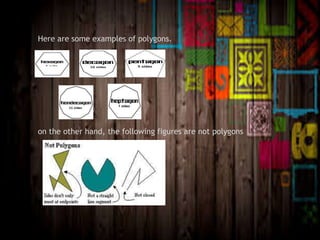
Here are some examples of polygons.
on the other hand, the following figures are not polygons
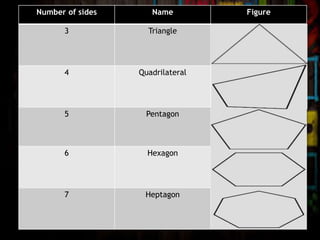
Number of sides Name Figure
3 Triangle
4 Quadrilateral
5 Pentagon
6 Hexagon
7 Heptagon
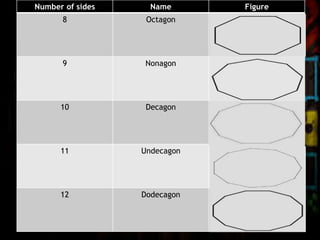
Number of sides Name Figure
8 Octagon
9 Nonagon
10 Decagon
11 Undecagon
12 Dodecagon
* Triangles and
quadrilaterals are further
classified into different
kinds.
Triangles are polygons with three sides, three angles, and
three vertices. The sum of the interior angles of a
triangle is 180°. Triangles are classified in two
ways…
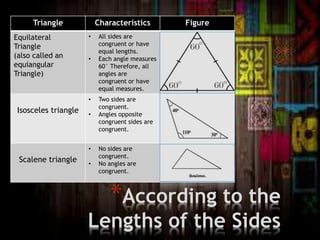
*According to the
Lengths of the Sides
Triangle Characteristics Figure
Equilateral
Triangle
(also called an
equiangular
Triangle)
• All sides are
congruent or have
equal lengths.
• Each angle measures
60° Therefore, all
angles are
congruent or have
equal measures.
Isosceles triangle
• Two sides are
congruent.
• Angles opposite
congruent sides are
congruent.
Scalene triangle
• No sides are
congruent.
• No angles are
congruent.
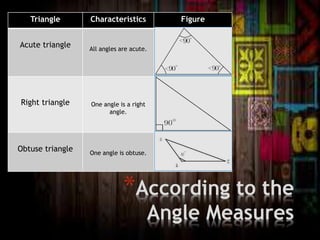
*According to the
Angle Measures
Triangle Characteristics Figure
Acute triangle All angles are acute.
Right triangle One angle is a right
angle.
Obtuse triangle One angle is obtuse.
* are polygons
with four sides, four
angles, and four vertices.
The sum of the interior
angles of a quadrilateral is
360°
* Quadrilaterals
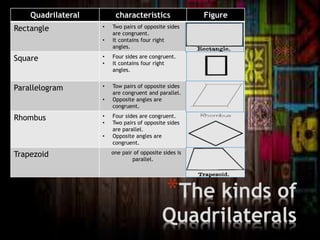
*The kinds of
Quadrilaterals
Quadrilateral characteristics Figure
Rectangle • Two pairs of opposite sides
are congruent.
• It contains four right
angles.
Square • Four sides are congruent.
• It contains four right
angles.
Parallelogram • Tow pairs of opposite sides
are congruent and parallel.
• Opposite angles are
congruent.
Rhombus • Four sides are congruent.
• Two pairs of opposite sides
are parallel.
• Opposite angles are
congruent.
Trapezoid one pair of opposite sides is
parallel.
A circle is a set of all points in a plane
equidistant from a fixed point. The
fixed point is called the center and the
fixed distance from the center to a
point on the circle Is the radius. A
circle is named after its center. Recall
that a circle is not a polygon because it
is not bounded by line segments.
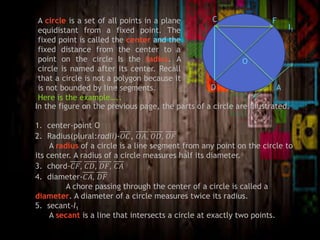
Here is the example…..
A
O
C
D
F
I1
In the figure on the previous page, the parts of a circle are illustrated.
1. center-point O
2. Radius(plural:radii)-𝑂𝐶, 𝑂𝐴, 𝑂𝐷, 𝑂𝐹
A radius of a circle is a line segment from any point on the circle to
its center. A radius of a circle measures half its diameter.
3. chord-𝐶𝐹, 𝐶𝐷, 𝐷𝐹, 𝐶𝐴
4. diameter-𝐶𝐴, 𝐷𝐹
A chore passing through the center of a circle is called a
diameter. A diameter of a circle measures twice its radius.
5. secant-I1
A secant is a line that intersects a circle at exactly two points.
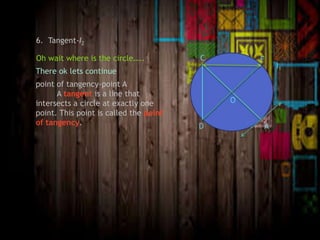
6. Tangent-I2
Oh wait where is the circle…..
There ok lets continue
point of tangency-point A
A tangent is a line that
intersects a circle at exactly one
point. This point is called the point
of tangency.
By: Marigold So
Thaaaanks…
THE END

Polygons and Circles (Project in Mathematics)

  • 1.
  • 2.
    As your cansee here…… There are triangles, squares,rectangles,circles, and other plane figures. These plane figures are called polygons. A polygons is a closed plane figure bounded by line segments. A circle is an exception. It is not a polygon since it is not bounded by line segments.
  • 3.
    Here are someexamples of polygons. on the other hand, the following figures are not polygons
  • 4.
    Number of sidesName Figure 3 Triangle 4 Quadrilateral 5 Pentagon 6 Hexagon 7 Heptagon
  • 5.
    Number of sidesName Figure 8 Octagon 9 Nonagon 10 Decagon 11 Undecagon 12 Dodecagon
  • 6.
    * Triangles and quadrilateralsare further classified into different kinds. Triangles are polygons with three sides, three angles, and three vertices. The sum of the interior angles of a triangle is 180°. Triangles are classified in two ways…
  • 7.
    *According to the Lengthsof the Sides Triangle Characteristics Figure Equilateral Triangle (also called an equiangular Triangle) • All sides are congruent or have equal lengths. • Each angle measures 60° Therefore, all angles are congruent or have equal measures. Isosceles triangle • Two sides are congruent. • Angles opposite congruent sides are congruent. Scalene triangle • No sides are congruent. • No angles are congruent.
  • 8.
    *According to the AngleMeasures Triangle Characteristics Figure Acute triangle All angles are acute. Right triangle One angle is a right angle. Obtuse triangle One angle is obtuse.
  • 9.
    * are polygons withfour sides, four angles, and four vertices. The sum of the interior angles of a quadrilateral is 360° * Quadrilaterals
  • 10.
    *The kinds of Quadrilaterals Quadrilateralcharacteristics Figure Rectangle • Two pairs of opposite sides are congruent. • It contains four right angles. Square • Four sides are congruent. • It contains four right angles. Parallelogram • Tow pairs of opposite sides are congruent and parallel. • Opposite angles are congruent. Rhombus • Four sides are congruent. • Two pairs of opposite sides are parallel. • Opposite angles are congruent. Trapezoid one pair of opposite sides is parallel.
  • 11.
    A circle isa set of all points in a plane equidistant from a fixed point. The fixed point is called the center and the fixed distance from the center to a point on the circle Is the radius. A circle is named after its center. Recall that a circle is not a polygon because it is not bounded by line segments. Here is the example….. A O C D F I1 In the figure on the previous page, the parts of a circle are illustrated. 1. center-point O 2. Radius(plural:radii)-𝑂𝐶, 𝑂𝐴, 𝑂𝐷, 𝑂𝐹 A radius of a circle is a line segment from any point on the circle to its center. A radius of a circle measures half its diameter. 3. chord-𝐶𝐹, 𝐶𝐷, 𝐷𝐹, 𝐶𝐴 4. diameter-𝐶𝐴, 𝐷𝐹 A chore passing through the center of a circle is called a diameter. A diameter of a circle measures twice its radius. 5. secant-I1 A secant is a line that intersects a circle at exactly two points.
  • 12.
    6. Tangent-I2 Oh waitwhere is the circle….. There ok lets continue point of tangency-point A A tangent is a line that intersects a circle at exactly one point. This point is called the point of tangency.
  • 13.