Areas of Regular Polygons Section 11.6
Lesson Focus The focus of this lesson is on applying the formula for finding the area of a regular polygon.
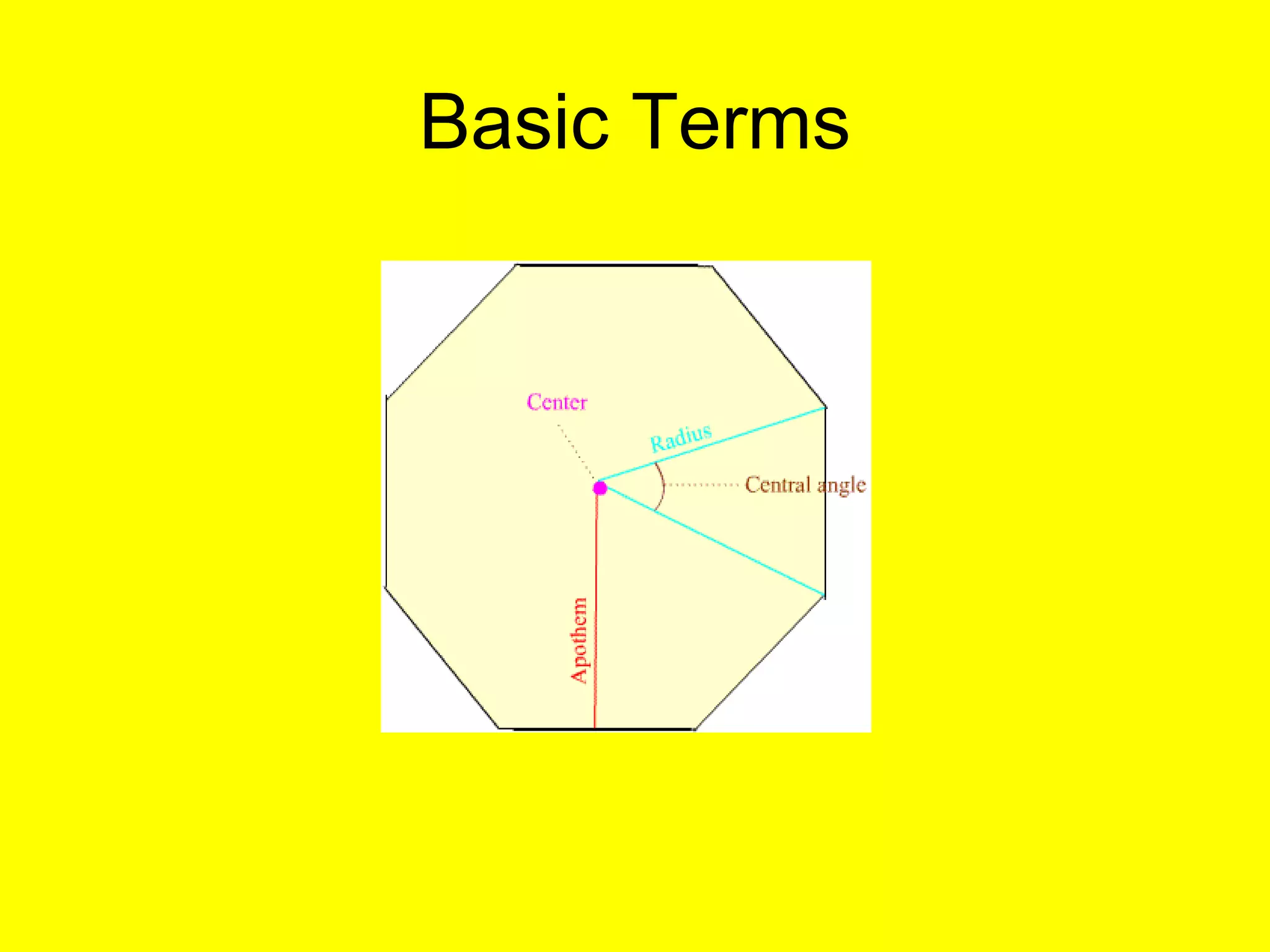
Basic Terms Center of a Regular Polygon the center of the circumscribed circle Radius of a Regular Polygon the distance from the center to a vertex Central Angle of a Regular Polygon  an angle formed by two radii drawn to consecutive vertices Apothem of a Regular Polygon the (perpendicular) distance from the center of a regular polygon to a side
Basic Terms
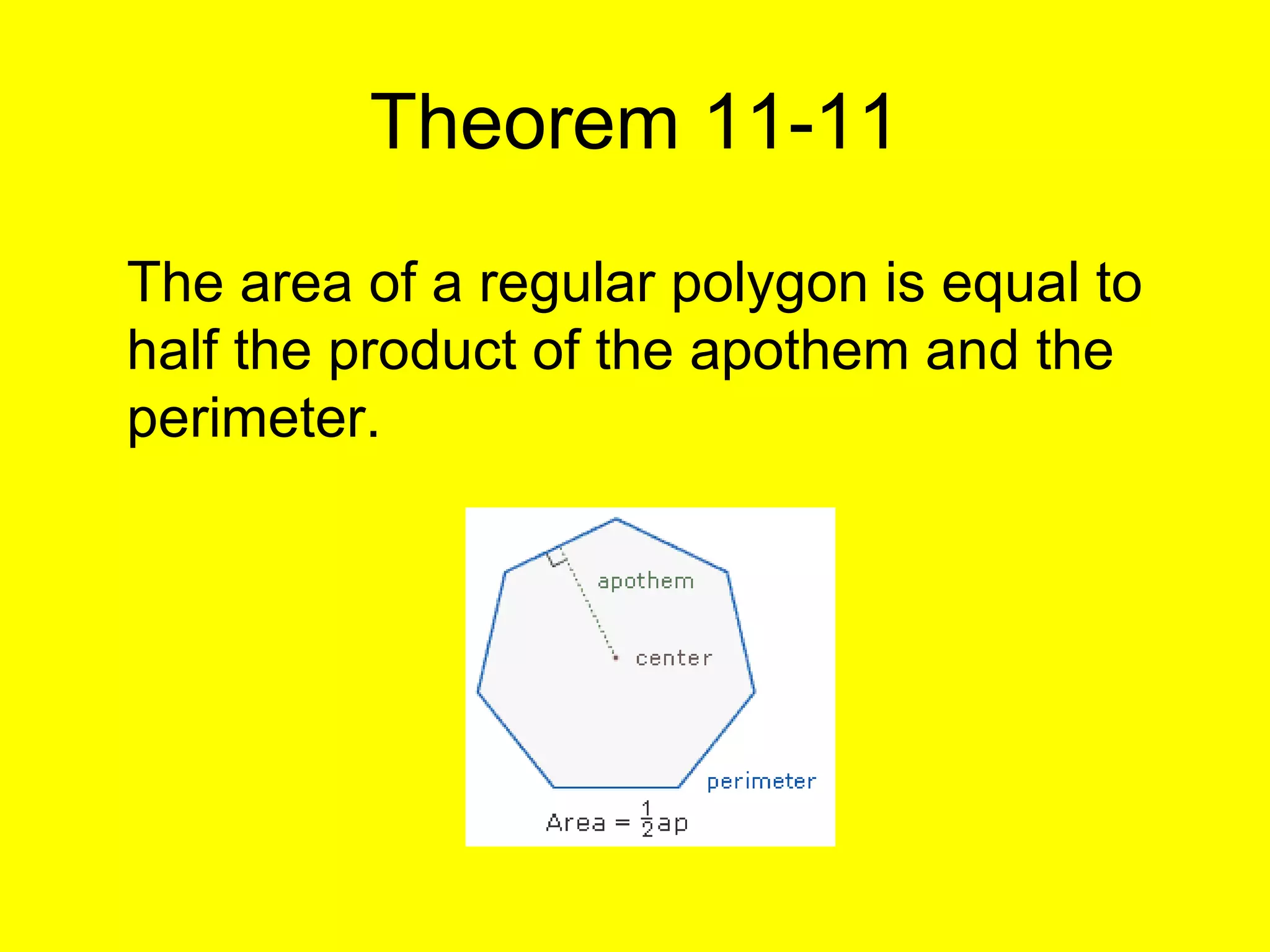
Theorem 11-11 The area of a regular polygon is equal to half the product of the apothem and the perimeter.
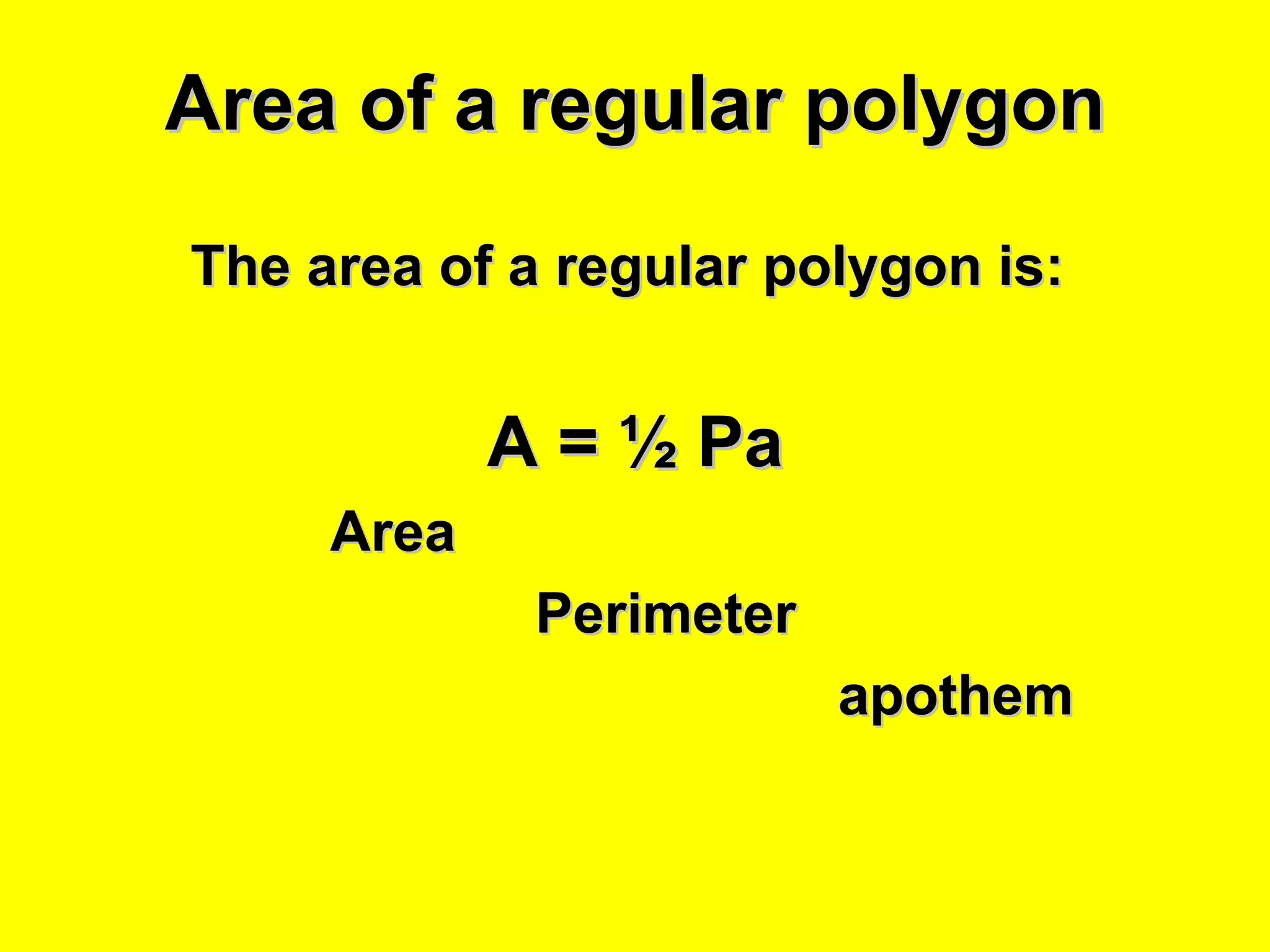
Area of a regular polygon The area of a regular polygon is:  A = ½ Pa Area    Perimeter  apothem
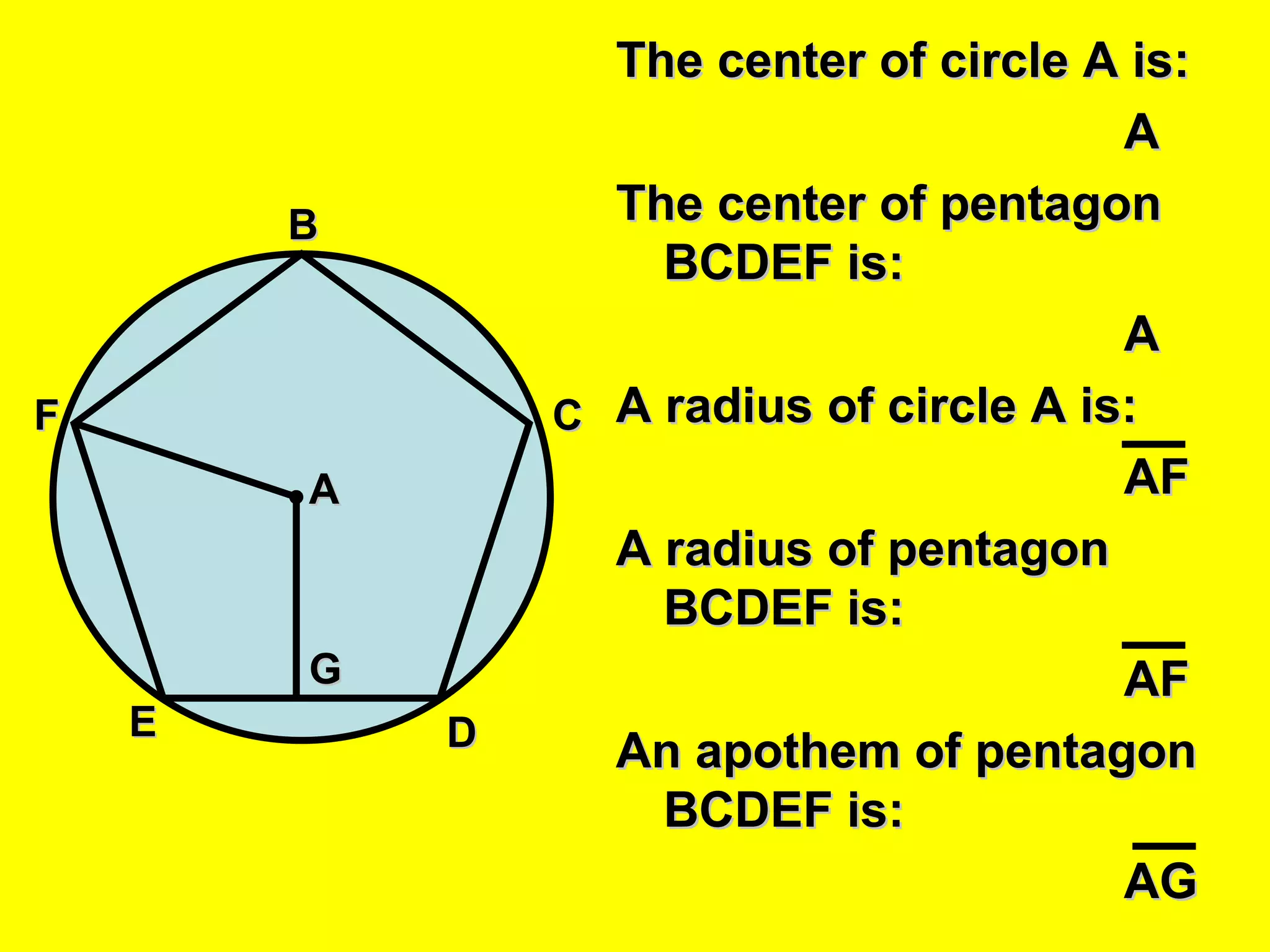
The center of circle A is: A The center of pentagon BCDEF is: A A radius of circle A is: AF A radius of pentagon BCDEF is: AF An apothem of pentagon BCDEF is: AG B C D E F A G
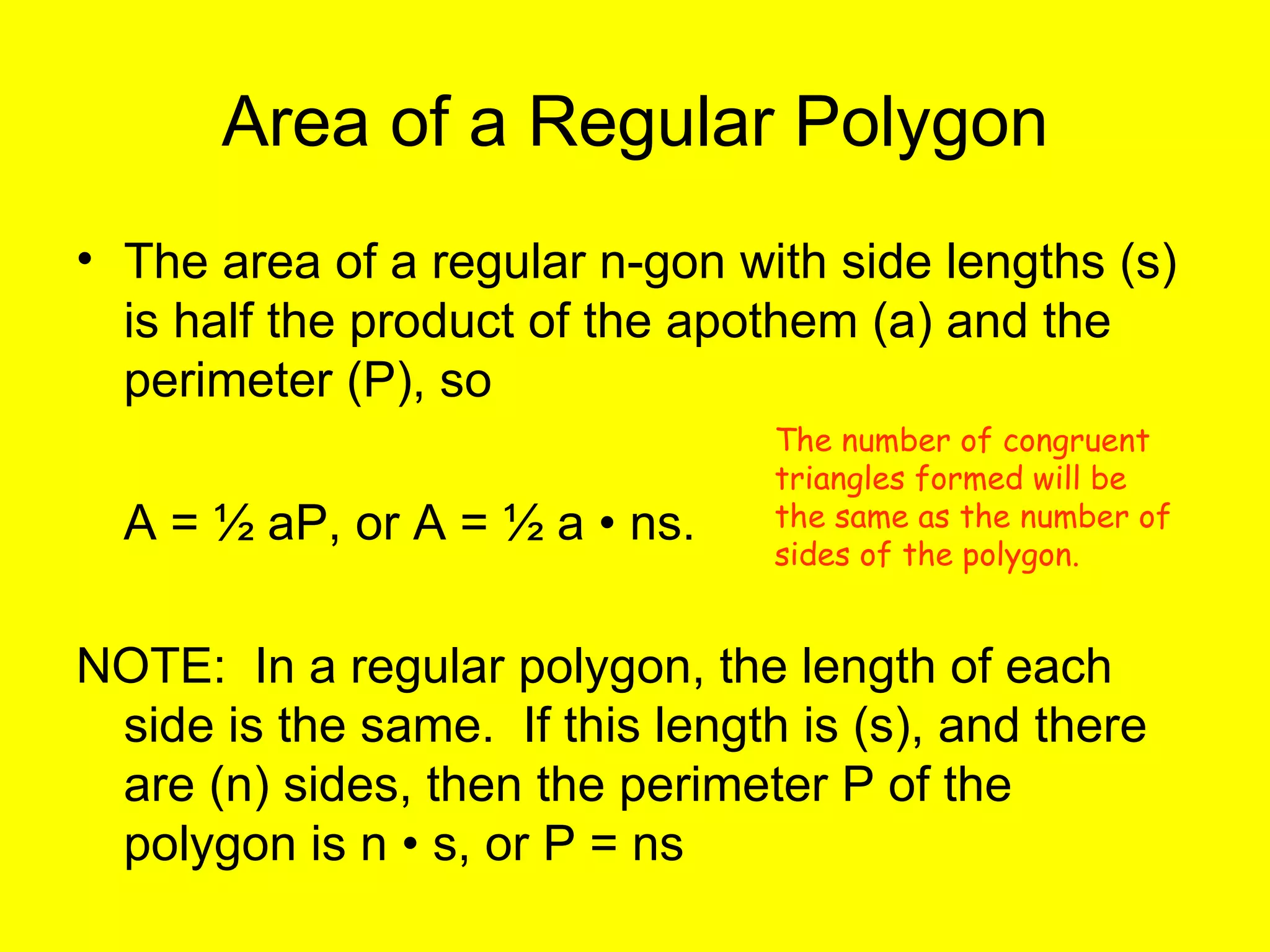
Area of a Regular Polygon The area of a regular n-gon with side lengths (s) is half the product of the apothem (a) and the perimeter (P), so  A = ½ aP, or A = ½ a • ns. NOTE:  In a regular polygon, the length of each side is the same.  If this length is (s), and there are (n) sides, then the perimeter P of the polygon is n • s, or P = ns The number of congruent triangles formed will be the same as the number of sides of the polygon.
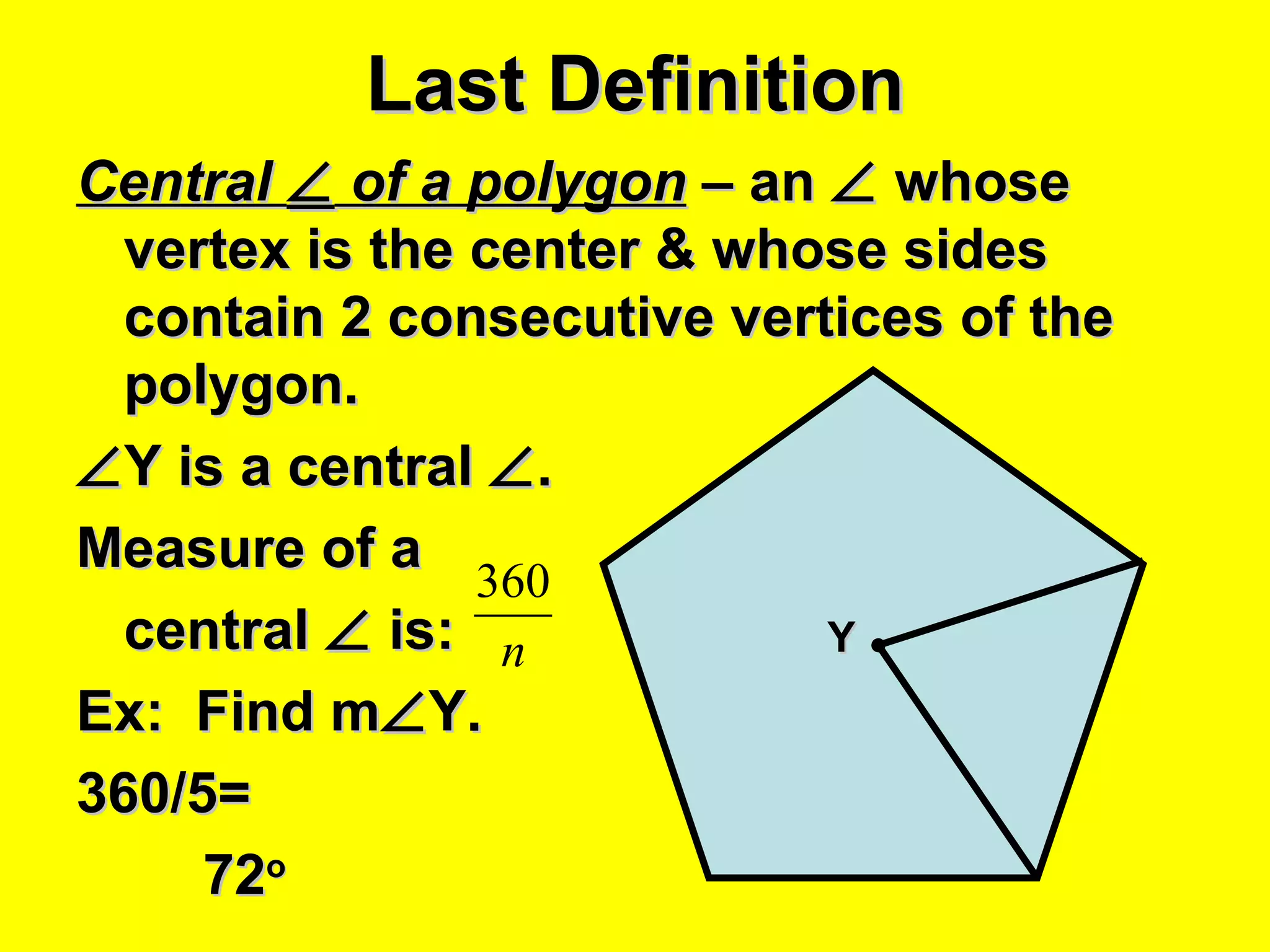
More . . .  A central angle of a regular polygon is an angle whose vertex is the center and whose sides contain two consecutive vertices of the polygon.  You can divide 360 ° by the number of sides to find the measure of each central angle of the polygon. 360/n = central angle
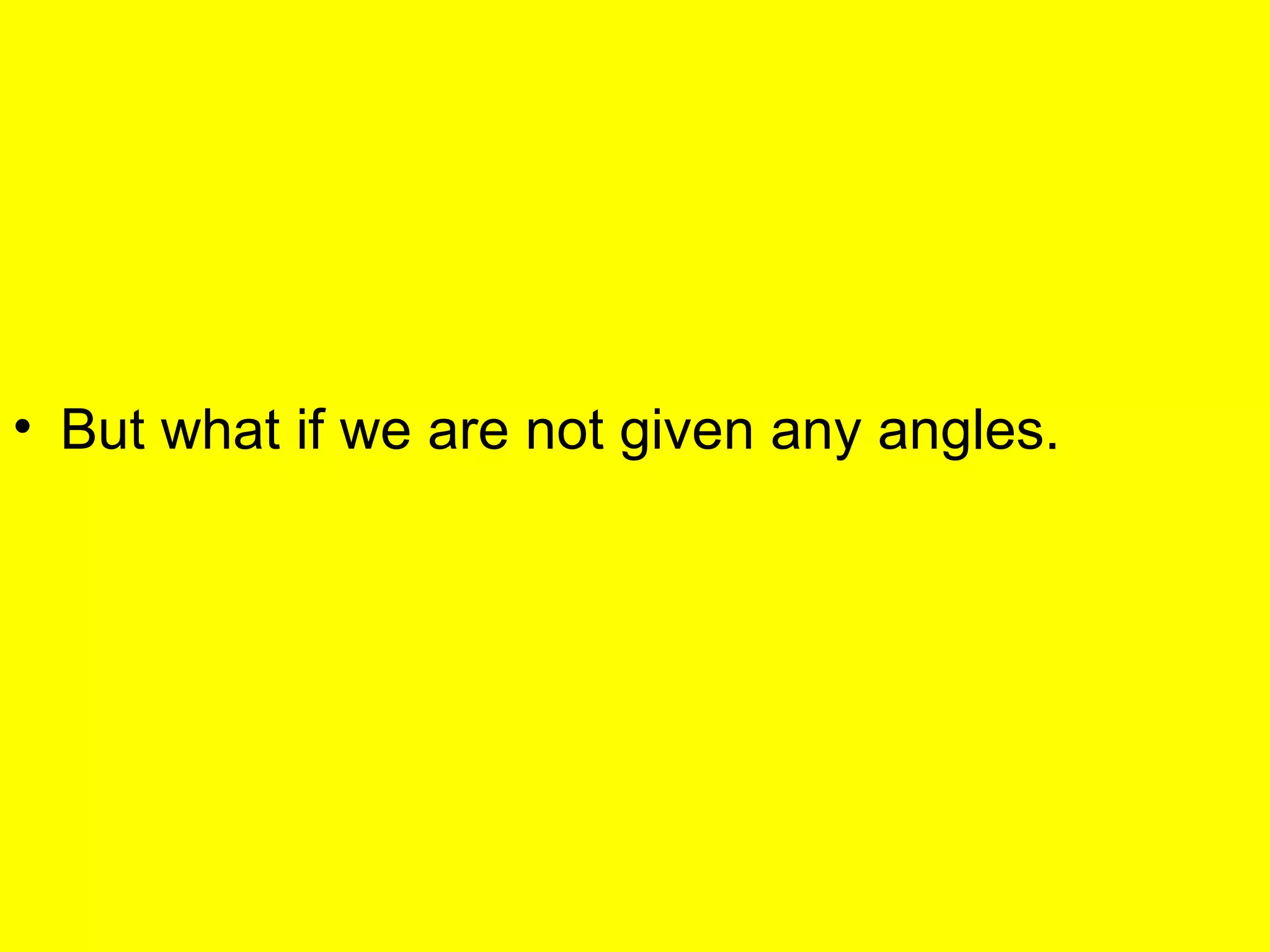
Areas of Regular Polygons Center of a regular polygon:  center of the circumscribed circle. Radius:  distance from the center to a vertex. Apothem:  Perpendicular distance from the center to a side. Example 1:  Find the measure of each numbered angle. • 1 2 3 360/5 = 72 ½ (72) = 36 L 2 = 36 L 3 =  54 L 1 = 72  Example 2:  Find the area of a regular decagon with a 12.3 in apothem and 8 in sides. Area of a regular polygon:  A  = ½ a p where a is the apothem  and p is the perimeter. Perimeter:  80 in A = ½  • 12.3 • 80  A = 492 in 2 Example 3:  Find the area.  10 mm • A = ½ a p p = 60 mm 5 mm LL =  √3 • 5 = 8.66 a A = ½  • 8.66 • 60 A = 259.8 mm 2
But what if we are not given any angles.
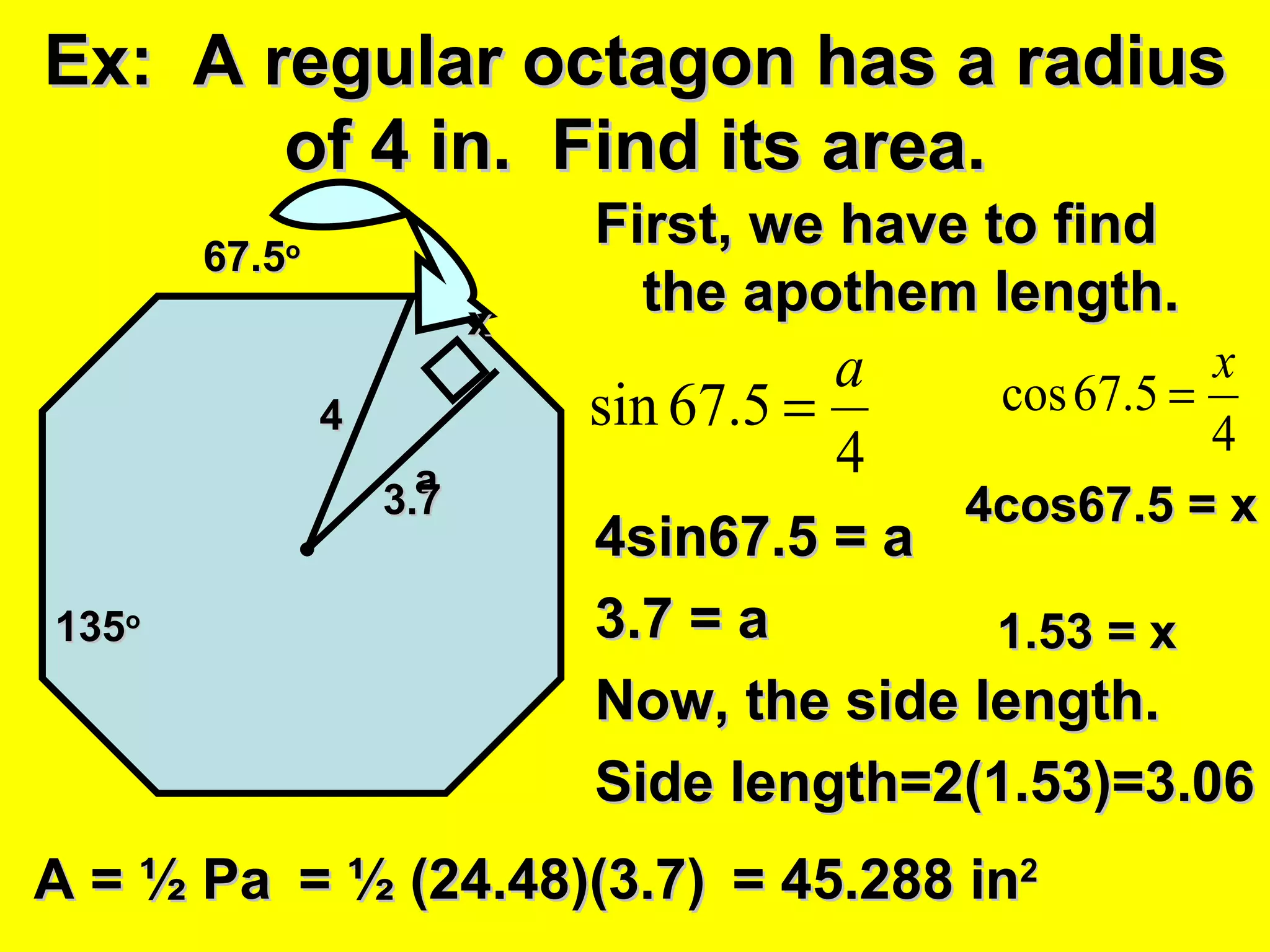
Ex:  A regular octagon has a radius of 4 in.  Find its area. First, we have to find the apothem length. 4sin67.5 = a 3.7 = a Now, the side length. Side length=2(1.53)=3.06 4 a 135 o 67.5 o 3.7 x 4cos67.5 = x 1.53 = x A = ½ Pa = ½ (24.48)(3.7) = 45.288 in 2
Last Definition Central    of a polygon  – an    whose vertex is the center & whose sides contain 2 consecutive vertices of the polygon.  Y is a central   . Measure of a  central    is: Ex:  Find m  Y. 360/5= 72 o Y
Check out! http://www.mathopenref.com/polygonregulararea.html

11.6 area of reg polygons

  • 1.
    Areas of RegularPolygons Section 11.6
  • 2.
    Lesson Focus Thefocus of this lesson is on applying the formula for finding the area of a regular polygon.
  • 3.
    Basic Terms Centerof a Regular Polygon the center of the circumscribed circle Radius of a Regular Polygon the distance from the center to a vertex Central Angle of a Regular Polygon an angle formed by two radii drawn to consecutive vertices Apothem of a Regular Polygon the (perpendicular) distance from the center of a regular polygon to a side
  • 4.
  • 5.
    Theorem 11-11 Thearea of a regular polygon is equal to half the product of the apothem and the perimeter.
  • 6.
    Area of aregular polygon The area of a regular polygon is: A = ½ Pa Area Perimeter apothem
  • 7.
    The center ofcircle A is: A The center of pentagon BCDEF is: A A radius of circle A is: AF A radius of pentagon BCDEF is: AF An apothem of pentagon BCDEF is: AG B C D E F A G
  • 8.
    Area of aRegular Polygon The area of a regular n-gon with side lengths (s) is half the product of the apothem (a) and the perimeter (P), so A = ½ aP, or A = ½ a • ns. NOTE: In a regular polygon, the length of each side is the same. If this length is (s), and there are (n) sides, then the perimeter P of the polygon is n • s, or P = ns The number of congruent triangles formed will be the same as the number of sides of the polygon.
  • 9.
    More . .. A central angle of a regular polygon is an angle whose vertex is the center and whose sides contain two consecutive vertices of the polygon. You can divide 360 ° by the number of sides to find the measure of each central angle of the polygon. 360/n = central angle
  • 10.
    Areas of RegularPolygons Center of a regular polygon: center of the circumscribed circle. Radius: distance from the center to a vertex. Apothem: Perpendicular distance from the center to a side. Example 1: Find the measure of each numbered angle. • 1 2 3 360/5 = 72 ½ (72) = 36 L 2 = 36 L 3 = 54 L 1 = 72 Example 2: Find the area of a regular decagon with a 12.3 in apothem and 8 in sides. Area of a regular polygon: A = ½ a p where a is the apothem and p is the perimeter. Perimeter: 80 in A = ½ • 12.3 • 80 A = 492 in 2 Example 3: Find the area. 10 mm • A = ½ a p p = 60 mm 5 mm LL = √3 • 5 = 8.66 a A = ½ • 8.66 • 60 A = 259.8 mm 2
  • 11.
    But what ifwe are not given any angles.
  • 12.
    Ex: Aregular octagon has a radius of 4 in. Find its area. First, we have to find the apothem length. 4sin67.5 = a 3.7 = a Now, the side length. Side length=2(1.53)=3.06 4 a 135 o 67.5 o 3.7 x 4cos67.5 = x 1.53 = x A = ½ Pa = ½ (24.48)(3.7) = 45.288 in 2
  • 13.
    Last Definition Central  of a polygon – an  whose vertex is the center & whose sides contain 2 consecutive vertices of the polygon.  Y is a central  . Measure of a central  is: Ex: Find m  Y. 360/5= 72 o Y
  • 14.