1
2
Port Said University
Faculty of Science
Chemistry& Biochemistry Department
Hormones in relation to
obesity
(Obesity and Hormones)
Presented by/
Mai Hisham Ahmed BerBer
supervised by/
Dr. Lamiaa Abdou Lateaf Ali Barakat
2013
3
Port Said University
Faculty of Science
Chemistry& Biochemistry Department
Hormones in relation to
obesity
(Obesity and Hormones)
Presented by/
Mai Hisham Ahmed BerBer
supervised by/
Dr. Lamiaa Abdou Lateaf Ali Barakat
Presented to
Port Said University
Faculty of Science
Biochemistry Department
4th
level
2013
4
Table of content
1 . Overview.
2. Introduction
3. CAUSES OF OBESITY
3.1. Energy Balance in the Development of Obesity
3.2. Dietary Intake
3.2.1. Macronutrient composition of the diet
3.2.2. High fat diets
3.2.3.Energy dense foods and drinks
3.2.4. Fibre content in the diet
3.2.5. Food palatability
3.3. Energy Expenditure
3.4. Physical Activity
3.4.1. Exercise and appetite
3.4.2. Health benefits of physical activity
3.5. Psychosocial Factors contributing to Obesity
3.5.1. Introduction
3.5.2. Hunger and appetite
4. Body mass index
4.1 .Calculation of BMI
4.2. Classification of BMI
5. Hypothalamus
5.1. Hypothalamic nuclei involved in appetite control
5.1.1. Arcuate nucleus (ARC)
5.1.2. Para ventricular nucleus (PVN)
5.1.3. Lateral hypothalamic area (LHA)
5.1.4. Dorsomedial nucleus (DMN)
5.1.5. Ventromedial nucleus (VMN)
5.2. Adiposity signals acting on the hypothalamus
5.3. Interactions between the brainstem and Hypothalamus
6. Gut hormones
6.1. Orexigenic peripheral neuropeptides
5.1.2. Ghrelin
6.2. Anorectic peripheral peptides
5.2.1. Cholecystokinin (CCK)
6.5.2.2. Leptin
6.2.3. Peptide YY (PYY)
6.5. Oxyntomodulin
6.6.Pancreatic polypeptide (PP)
7. The Central Effects of Thyroid Hormones on Appetite
5
7.1. Introduction
7.1.1. Effects of Thyroid Hormones on Food Intake
7.1.2. Effects of Nutritional State on Thyroid Hormones
7.1.3. Thyroid Dysfunction and Body Weight State on Thyroid
Hormones
7.3. Thyroid Dysfunction and Body Weight
8. Growth Hormone (GH) secretion
8.1. Metabolic and nutritional factors
8.1.1Glucose
8.1.2. Insulin
8.1.3. Aminoacids
9. Sex hormones
10. Treatment alternatives for obesity
11. Surgery for the treatment of obesity
12 .References
6
List of figure
Fig1………….The fundamental principles of energy balance and
regulation.
Fig2………………………………………… anatomy of Hypothalamus.
Fig3……… Pathways are shown between the brainstem, hypothalamus,
cortical areas and reward circuitry known to regulate appetite control.
Fig4...............................................................The main hypothalamic
nuclei, neuropeptides and pathways involved in the regulation of
appetite.
Fig5...........................................................Chemical structure of Ghrelin.
Fig6…………………. Chemical structure of Cholecystokinin (CCK).
Fig7…………………………………….. Chemical structure of Leptin.
Fig8………………………………..Chemical structure of Peptide YY.
Fig9………………………………….. Chemical structure of Amylin.
Fig10…………………………………… Chemical structure of Insulin.
Fig11…………………………………. Chemical structure of Bombesin.
Fig12…………………… Chemical structure of Glucagon like peptide-1.
Fig13……………………………………Chemical structure of Serotonin.
Fig14…………………………… Chemical structure of Neuropeptide Y.
Fig15…………………………………… Chemical structure of Orexins.
Fig16…………………………………… Chemical structure of Galanin.
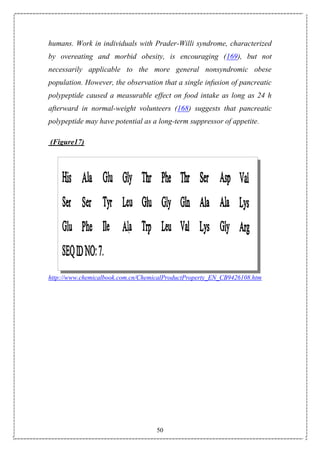
Fig17……………………. Chemical structure of Pancreatic polypeptide.
Fig18………………... Schematic diagram of central appetite regulation.
Fig19………. Effect of fasting on the hypothalamo-pituitary-thyroid axis.
Fig20………... Central neuroendocrinological control of appetite and food intake.
7
1.Overview:
Obesity is a serious medical condition whose prevalence is increasing in
developing countries also. This growing incidence represents a pandemic
that needs urgent attention if the potential morbidity, mortality, and
economic tolls that will be left in its wake are to be avoided. Obesity
predisposes to increased risk of a number of medical conditions including
type II diabetes mellitus, hypertension, coronary heart disease,
osteoarthritis, respiratory problems and cancers of breast, endometrium,
prostate, bowel cancers (1,2). Obesity represents a state of excess storage
of body fat. Although very similar, the term overweight is defined as an
excess body weight for height.
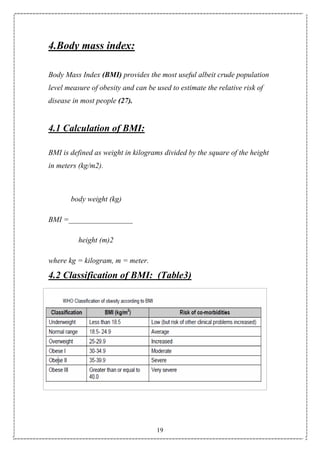
The body mass index (BMI), also known as the Quetelet index is a WHO
accepted index for classifying the degree of obesity. Standards defining
overweight and obesity on the basis of BMI were developed by the
International Obesity Task Force of the World Health Organization. BMI
= (weight [kg])/ (height[m] 2). Under this convention for adults, grade 1
overweight (commonly and simply called overweight) is a BMI of 25–
29.9 kg/m2. Grade 2 overweight (commonly called obesity) is a BMI of
30–39.9 kg/m2. Grade 3 overweight (commonly called severe or morbid
obesity) is a BMI greater than or equal to 40 kg/m2.
The laws of thermodynamics are applicable here also because if energy
expenditure by the body is less than the consumption, it will be stored in
the body in the form of adipose tissue. Appetite regulation is important
because it modulates the energy consumption side of the equation.
Appetite includes various aspects of eating patterns such as frequency
and size of eating episodes (gorging versus nibbling), choices of high fat
8
or low fat foods, energy density of foods consumed, variety of foods
accepted, palatability of diet and variability in day-today intake. Feeding
behavior is controlled by a series of short-term hormonal, psychological
and neural signals that derive from the gastrointestinal tract, such as
cholecystokinin whereas other signals may initiate meals, such as the
recently discovered hormone, ghrelin. Other hormones such as insulin
and leptin, together with circulating nutrients, indicate long-term energy
stores. All these signals act at several central nervous system (CNS) sites
but the pathways converge on the hypothalamus, which contains a large
number of peptides and other neurotransmitters that influence food
intake. As energy deficit is most likely to compromise survival, it is not
surprising that the most powerful of these pathways are those that
increase food intake and decrease energy expenditure when stores are
depleted. When energy stores are low, production of leptin from adipose
tissue, and thus circulating leptin concentrations fall, leading to
increased production of hypothalamic neurotransmitters that strongly
increase food intake, such as neuropeptide Y (NPY), galanin and agouti-
related protein (AGRP) and decreased levels of a-melanocyte-stimulating
hormone (a-MSH), cocaine and amphetamine-regulated transcript
(CART). The hypothalamus has been recognized as a central region of
feeding regulation (3,2) . The appetite control system of the brain
normally establishes a weight ‘set-point’ and tries to maintain it even
when food supplies vary a great deal.
9
2.Introduction:
Obesity is one of the major health challenges throughout the world, due
to its association with an array of vascular, metabolic, and psychosocial
complications (4, 5). Obesity is traditionally associated with populations
in Europe and North America; however Asian countries such as Japan
have recently may reflect changes in dietary patterns and lifestyles (6, 7)
reported increasing pre valences of obesity, which Obesity is a state in
which energy intake chronically exceeds energy expenditure. Body weight
is tightly regulated by complex homeostatic mechanisms involving the
hypothalamus and brainstem which integrate inputs from higher cortical
centres with peripherally derived signals of the body’s nutritional and
energy status. In the hypothalamic arcuate nucleus (ARC), there are two
neuronal populations with opposing effects on food intake: neurons
which co express neuropeptideY (NPY) and agouti-related peptide
(AgRP) which stimulate food intake, whereas neurons coexpressing
proopiomelanocortin (POMC) and cocaine- and amphetamine-regulated
transcript (CART) suppress food intake (Figure 1). Within the brainstem,
the dorsal vagal complex (DVC) consisting of the dorsal motor nucleus of
vagus (DVN), area postrema (AP), and the nucleus of the tractus
solitarius (NTS) plays a pivotal role in relaying of peripheral signals
such as vagal afferents from the gut to the hypothalamus (8). In human,
higher cortical centres are implicated in psychological and emotional
factors which can drive food intake beyond homeostatic requirements. In
addition, the corticolimbic pathways are responsible for reward-
associated feeding behaviour. This article summarises our current
understanding of the role of gut hormones in appetite regulation and its
potential as therapeutic targets for obesity.
10
3.CAUSES OF OBESITY:
3.1. Energy Balance in the Development of Obesity:
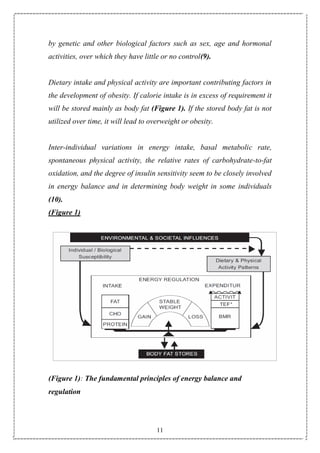
Obesity can result from a minor energy imbalance, which lead to a
gradual but persistent weight gain over a considerable period. Some
researchers have hypothesized that energy imbalance is the result of
inherited metabolic characteristics; whereas others believe it is caused
by poor eating and lifestyle habits, that is “gluttony and sloth”.
Positive energy balance occurs when energy intake is greater than energy
expenditure and promotes weight gain (Figure 1). Conversely, negative
energy balance promotes decrease in body fat stores and weight loss.
Body weight is regulated by a series of physiological Processes, which
have the capacity to maintain weight within a relatively narrow range
stable weight). It is thought that the body exerts a stronger defense
against under nutrition and weight loss than it does against over-
consumption and weight gain.
Figure 4 also suggests that positive energy balance and weight gains are
influenced by powerful societal and environmental forces which may
overwhelm the physiological regulatory mechanisms that operate to keep
weight stable. These include increasing automation, lack of recreational
facilities and opportunities, increase in food variety and availability.
Moreover, the susceptibility of individuals to these influences is affected
11
by genetic and other biological factors such as sex, age and hormonal
activities, over which they have little or no control(9).
Dietary intake and physical activity are important contributing factors in
the development of obesity. If calorie intake is in excess of requirement it
will be stored mainly as body fat (Figure 1). If the stored body fat is not
utilized over time, it will lead to overweight or obesity.
Inter-individual variations in energy intake, basal metabolic rate,
spontaneous physical activity, the relative rates of carbohydrate-to-fat
oxidation, and the degree of insulin sensitivity seem to be closely involved
in energy balance and in determining body weight in some individuals
(10).
(Figure 1)
(Figure 1): The fundamental principles of energy balance and
regulation
12
* TEF = thermic effect of food; BMR = basal metabolic rate; CHO =
carbohydrate.
Source: WHO (1998)
3.2. Dietary Intake:
3.2.1. Macronutrient composition of the diet:
The association between energy intake and body weight relies on the ease
with which excess macronutrients can be deposited as adipose tissue. The
energy cost of nutrient storage is not identical for all macronutrients. The
cost of fat storage from dietary fat is the lowest, followed by
carbohydrate and protein (11). Macronutrients with a low storage
capacity such as protein and carbohydrate will be preferentially oxidized
when intakes exceeded requirements. Hence, excess dietary fat is more
likely to be stored in the body and this capacity is unlimited (12,13). The
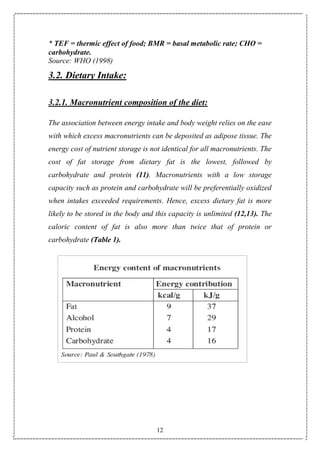
caloric content of fat is also more than twice that of protein or
carbohydrate (Table 1).
13
In summary, after a meal the body has a specific order in which it burns
up the fuels, that is, alcohol, followed by protein then carbohydrate and
finally fat.
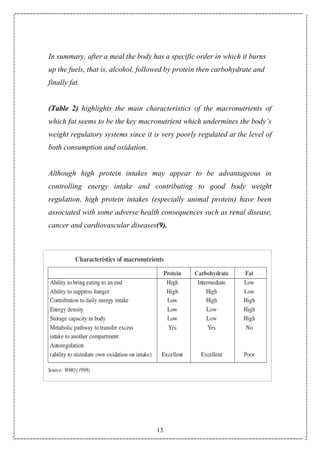
(Table 2) highlights the main characteristics of the macronutrients of
which fat seems to be the key macronutrient which undermines the body’s
weight regulatory systems since it is very poorly regulated at the level of
both consumption and oxidation.
Although high protein intakes may appear to be advantageous in
controlling energy intake and contributing to good body weight
regulation, high protein intakes (especially animal protein) have been
associated with some adverse health consequences such as renal disease,
cancer and cardiovascular diseases(9).
14
3.2.2. High fat diets:
Foods or meals that are high in fat are smaller in weight or volume than
high carbohydrate foods or meals of similar energy content (14). Dietary
fat content is directly correlated with energy intake, produces only weak
satiation in comparison with protein and carbohydrate, and is thought to
be processed efficiently by the body. A number of studies found that
individuals on a high-fat diet are more prone to become overweight (15).
3.2.3.Energy dense foods and drinks:
Consuming too much or too often high calorie foods and drinks may
increase the total calories and thus result in obesity (15). The energy
density of foods may be contributed by its macronutrient contents. A high
fat food will often be labelled as energy-dense. Low fat food products
may also be high in calories and therefore should not be eaten in excess.
Beverages containing substantial amounts of sugar or alcohol can also
contribute to excessive calorie intake.
3.2.4. Fibre content in the diet:
A diet with adequate amounts of fibre-containing foods is usually less
energy dense. Its greater bulk has a short-term satiety effect, can help to
prevent overeating and reduce risk of obesity(16). This can be achieved
by including fruits, vegetables, whole grain cereals, pulses and legumes
in the diet. Efforts to increase dietary fibre intake should be gradual to
15
minimize discomfort such as bloating and flatulence. It is important to
drink a lot of water when increasing fibre intake.
3.2.5 .Food palatability:
Palatability is defined as the momentary subjective orosensory
pleasantness of a food, which indicates the sensory stimulation to eat. It
is one of the most powerful influences in promoting calorie over-
consumption (positive energy balance) by increasing both the rate of
eating and the sense of hunger during and between meals. Perceived
palatability of foods plays a major role in determining which foods are
selected over others (17). It has also been argued that palatability is
associated with the energy density of foods. Foods that are energy dense
are more palatable than those of lower energy density (18). Fat is
associated with palatability and pleasurable mouth-feel that can induce
behaviour which favours over-consumption leading to obesity (19).
3.3. Energy Expenditure:
Total energy expenditure has three main components, namely, basal
metabolic rate (BMR), thermogenesis or thermic effect of food (TEF)
and physical activity (Figure 1).
Basal metabolic rate is the energy expended by a person who is fasting
and at rest in the morning under comfortable ambient conditions. The key
variable of energy output in an individual is the degree of physical
activity. In a dynamic phase, in which an individual gains weight as a
result of energy intake exceeding energy expenditure over a prolonged
16
period, BMR will increase due to the larger fat-free mass (including that
of the expanded adipose tissue) as well as to an additional energy cost of
activity imposed by the extra weight(20).
Thermogenesis is the increase in basal metabolic rate in response to
stimuli such as food intake, cold or heat exposure, psychological
influences such as fear or stress, or the administration of drugs or
hormones. The thermic effect of food (the major form of thermogenesis)
accounts for approximately 10% of the total daily energy expenditure.
Physical activity is defined as any bodily movement produced by skeletal
muscles that result in a substantial increase over the resting energy
expenditure (21) .It is the most variable component of daily energy
expenditure, which may account for a significant number of calories in
very active individuals. Sedentary adults however, exhibit a range of
physical activity that still represents about 20% to 30% of the total
calorie expenditure.
3.4. Physical Activity:
3.4.1. Exercise and appetite:
Obese women did not compensate the higher energy expenditure induced
by exercise with increased intake, and thereby obtained a significant
negative energy balance on exercise (22). This suggests that those who
have an excess amount of energy stored may particularly benefit from
regular exercise. Hunger can be temporarily suppressed by intense
exercise, and possibly by low-intensity exercise of long duration. Hence,
there is no supporting evidence for the common perception that exercise
17
stimulates appetite, leading to an increased food intake that even exceeds
the energy cost of the preceding activities.
3.4.2. Health benefits of physical activity:
Physical activity has been shown to improve the physiological aspects of
our body system such as cardiovascular, respiratory, metabolic and
weight control. There is convincing evidence that physical activity
reduces risks of obesity, type 2 diabetes, certain cancers and
osteoporosis.
Other benefits of physical activity includes becoming more energetic,
improved self esteem, increased resistance to stress, build stronger
muscles and joints, increased fitness and flexibility, and living a healthier
and longer independent life. On the other hand, physical inactivity and
sedentary lifestyle increase risk of obesity (16).
3.5.Psychosocial Factors contributing to Obesity:
3.5.1. Introduction:
Psychosocial factors take precedence in terms of contribution to obesity
because genetic changes do not occur quick enough to warrant the
increase of obesity cases around the world (23). Calorie intake and use
largely depend on behaviour, which are food-related and non-food
related. The significance of behavioural factors in weight gain is that it
can be modified more easily than genetics.
18
3.5.2.Hunger and appetite:
Hunger is a physiological response to a need for food triggered by stimuli
acting on the brain (24). It can be affected by a number of factors such as
the size and composition of preceding meal, habitual eating pattern,
exercise, physical and mental states(25) .In a normal eating pattern
hunger begins after four to six hours after eating, when food has left the
stomach and much of it has been absorbed by the body. This pattern is
highly influenced by psycho physiological factors such as smell, as well
as environmental interactions (26).
Individuals who restrict food consumption at each meal may feel extra
hungry for a few days, but then hunger diminishes for a time. However, at
some point of food deprivation, hunger can be uncontrollable and lead to
bouts of overeating that more than make up for the calories lost. The
stomach capacity can also adapt to larger food quantities and until a
normal meal size no longer feel satisfying.
At some point during a meal, the brain receives stimuli from several
sources that enough food has been eaten. This process is called satiation
(25). A lack of satiety between meals can lead to overeating when a
mealtime arrives. In some cases this sets up a cycle of starvation and
binging, which lead to overeating. The choice of food may affect satiety –
some foods seem to sustain satiety for longer period than others. In
general foods high in protein and fibre sustain satiety longer than those
high in fat or sugar.
19
4.Body mass index:
Body Mass Index (BMI) provides the most useful albeit crude population
level measure of obesity and can be used to estimate the relative risk of
disease in most people (27).
4.1 Calculation of BMI:
BMI is defined as weight in kilograms divided by the square of the height
in meters (kg/m2).
body weight (kg)
BMI =_________________
height (m)2
where kg = kilogram, m = meter.
4.2 Classification of BMI: (Table3)
20
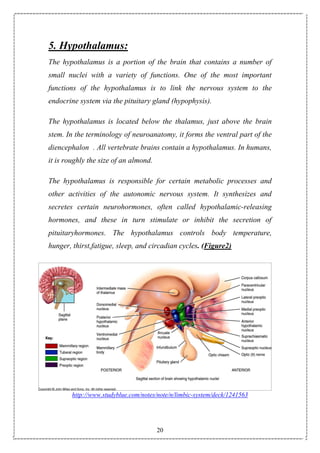
5. Hypothalamus:
The hypothalamus is a portion of the brain that contains a number of
small nuclei with a variety of functions. One of the most important
functions of the hypothalamus is to link the nervous system to the
endocrine system via the pituitary gland (hypophysis).
The hypothalamus is located below the thalamus, just above the brain
stem. In the terminology of neuroanatomy, it forms the ventral part of the
diencephalon . All vertebrate brains contain a hypothalamus. In humans,
it is roughly the size of an almond.
The hypothalamus is responsible for certain metabolic processes and
other activities of the autonomic nervous system. It synthesizes and
secretes certain neurohormones, often called hypothalamic-releasing
hormones, and these in turn stimulate or inhibit the secretion of
pituitaryhormones. The hypothalamus controls body temperature,
hunger, thirst,fatigue, sleep, and circadian cycles. (Figure2)
http://www.studyblue.com/notes/note/n/limbic-system/deck/1241563
21
5.1.Hypothalamic nuclei involved in appetite control:
The main regions of hypothalamus involved in feeding and satiety are:
5.1.1.Arcuate nucleus (ARC):
The ARC is a key hypothalamic nucleus in the regulation of appetite. In
mice, lesions of the ARC result in obesity and hyperphagia (28). Its
proximity to the median eminence and the fact that the ARC is not fully
insulated from the circulation by the blood brain barrier means it is
strategically positioned to integrate a number of peripheral signals
controlling food intake. There are two major neuronal populations in the
ARC implicated in the regulation of feeding. One population increases
food intake and co-expresses neuropeptide Y (NPY) and agouti-related
protein (AgRP). The second population of neurons co-expresses cocaine-
and amphetamine-related transcript (CART) and pro-opiomelanocortin
(POMC) and inhibits food intake. Neuronal projections from these two
populations then communicate with other hypothalamic areas involved in
appetite regulation such as the PVN, DMN and LHA (29).
5.1.2.Para ventricular nucleus (PVN):
Para ventricular nucleus (PVN) is the main site of orticotrophin
releasing hormone (CRH) and thyrotropin releasing hormone (TRH)
secretion. Numerous neuronal pathways implicated in energy balance
converge in PVN, including major projections from NPY neurons of the
ARC, Orexins, POMC derivative a-melanocyte stimulating hormone (a-
MSH) and the appetite stimulating peptide galanin. Thus PVN plays a
22
role in the integration of nutritional signals with the thyroid and
hypothalamic- pituitary axis (1).
Microinjection of almost all known orexigenic peptides into the PVN,
including NPY and AgRP stimulate feeding (30, 31). NPY/AgRP neurons
from the ARC communicate with PVN neurons containing thyrotrophin
releasing hormone (TRH) (32) which has been implicated in the control
of energy balance, by contributions to both food intake and energy
expenditure (33).
5.1.3.Lateral hypothalamic area (LHA):
Lateral hypothalamic area (LHA)is the classical ‘feeding centre’, also
contains glucose-sensitive neurons that are stimulated by hypoglycemia
(by ascending pathways from brainstem) and it is crucial in mediating the
marked hyperphagia which is normally induced by hypoglycemia(34).
The LHA receives neuronal projections from the ARC and contains the
orexigenic neuropeptides melanin concentrating hormone (MCH) and
orexins. NPY, AgRP and α-MSH immune reactive terminals are extensive
in the LHA and are in contact with MCH and orexin expressing cells
(35). MCH immune reactive fibers also project to the cortex, brainstem
and spinal cord (36). In humans, two MCH receptors have been cloned in
humans, Mchr1 and Mchr2 whereas in rodents only Mchr1 has been
identified. Mchr1 knockout mice have increased energy expenditure, loco
motor activity and are resistant to diet-induced obesity (37). In contrast,
injection of Mch into the lateral ventricle of rats increases food intake
and fasting increases the expression of Mch mRNA (39). Orexin A and B
act via two receptors, OX1R and OX2R and ICV administration of these
23
peptides increases food intake (39). However, subsequent studies have
proposed that this may reflect associated heightened arousal and reduced
sleep (40).
5.1.4.Dorsomedial nucleus (DMN):
Destruction of the DMN results in hyperphagia and obesity (41). The
DMN contains a high level of NPY terminals (42) and α-MSH terminals
originating in the ARC (43). Α-MSH fibers also project from the DMN to
the PVN terminating on TRH-containing neurons (44). In diet-induced
obesity, obese agouti mice and Mc4r knockout mice, NPY mRNA
expression is increased in the DMN (45, 46).
5.1.5.Ventromedial nucleus (VMN):
Ventromedial nucleus (VMN) is mainly acting as satiety centre. It has
been identified as a key target for leptin, which acts on the hypothalamus
to inhibit feeding, stimulate energy expenditure and cause weight loss.
Lesions of either ventromedial hypothalamic nuclei or PVN produce
syndromes of hyperphagia and obesity (47).
Neuroimaging studies in humans have shown increased signal in the area
of the VMN following an oral glucose load (48). The VMN contains a
large population of glucoresponsive neurons and receives NPY, AgRP
and POMC neuronal projections from the ARC. Brain-derived
neurotrophic factor (BDNF) is highly expressed in the VMN and lateral
ventricle administration of BDNF reduces food intake and body weight
24
(49). It is thought that ARC POMC neurons have a role in activating
VMN BDNF neurons to decrease food intake (50).
5.2.Adiposity signals acting on the hypothalamus:
Adipokines are secreted by adipose tissue and include leptin, adiponectin
and resistin. They have been shown to act via the hypothalamus to affect
food intake and energy expenditure (51). Leptin is secreted by adipocytes
and circulates at concentrations proportional to fat mass. Rodents
lacking leptin (ob/ob mice) or the leptin receptor (db/db mice and Zucker
fa/fa rats) are obese and hyperphagic. In humans, the rare condition of
leptin deficiency causes severe obesity which can be ameliorated by
peripheral leptin administration (52).
Circulating leptin crosses the blood brain barrier and binds to the long
form of the leptin receptor, Ob- Rb, in the hypothalamus (53). The Obr
receptor is expressed widely within the hypothalamus but particularly in
the ARC, VMN, DMN and LHA. Using viral mediated gene expression,
chronic leptin over-expression in the ARC, PVN and VMN results in
reduced food intake (54). In the ARC, Ob-Rb mRNA is expressed by both
NPY/AgRP and CART/POMC neurons. Leptin directly activates anorectic
POMC neurons and inhibits orexigenic AgRP/NPY neurons resulting in
an overall reduction in food intake (55).
Circulating insulin rises in response to a glucose load and like leptin,
circulating levels reflect fat mass. Insulin crosses the blood brain barrier
via receptor-mediated transport. Insulin receptors are widely distributed
in the brain particularly in hypothalamic nuclei involved in the regulation
of food intake. Insulin has an anorectic effect when administered ICV or
25
directly into the VMN, an effect which is reversed by insulin antibodies
(56). The precise mechanism by which insulin inhibits food intake is still
unclear although administration of insulin into the 3rd ventricle of fasted
rats increases ARC POMC mRNA expression and reduces food intake
(57). This anorexigenic effect of insulin is blocked by melanocortin
antagonists (57).
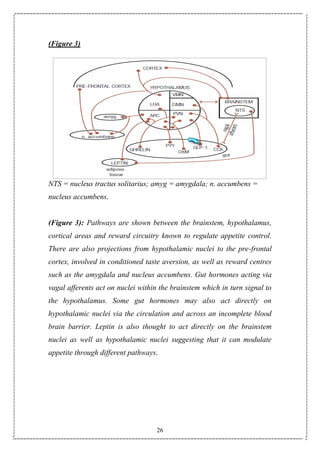
5.3Interactions between the brainstem and Hypothalamus:
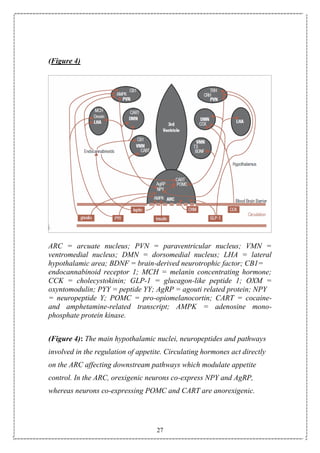
The hypothalamus is often regarded as the “gate keeper” of appetite
signalling as it also receives input from the cortex, brain stem and the
periphery (Figures 3,4)milarly to the ARC, the area postrema of the brain
stem also possesses an incomplete blood brain barrier. As such,
peripheral satiety signals can also act directly on brainstem structures.
Extensive reciprocal neuronal pathways exist between brainstem and
hypothalamic appetite circuits to provide an alternative pathway through
which circulating satiety factors can communicate with the hypothalamus
(58,59). An additional major link between the gastrointestinal tract and
the brain exists via the vagus nerve. Cell bodies of afferent fibers of the
abdominal vagus nerve are located in the nodose ganglia, which project
onto the brainstem. Here, the dorsal vagal complex (DVC) (consisting of
the dorsal motor nucleus, the area postrema, and the sensory nucleus of
the tractus solitarius (NTS)) contains projections to hypothalamic and
higher centers (58,59).
26
(Figure 3)
NTS = nucleus tractus solitarius; amyg = amygdala; n. accumbens =
nucleus accumbens.
(Figure 3): Pathways are shown between the brainstem, hypothalamus,
cortical areas and reward circuitry known to regulate appetite control.
There are also projections from hypothalamic nuclei to the pre-frontal
cortex, involved in conditioned taste aversion, as well as reward centres
such as the amygdala and nucleus accumbens. Gut hormones acting via
vagal afferents act on nuclei within the brainstem which in turn signal to
the hypothalamus. Some gut hormones may also act directly on
hypothalamic nuclei via the circulation and across an incomplete blood
brain barrier. Leptin is also thought to act directly on the brainstem
nuclei as well as hypothalamic nuclei suggesting that it can modulate
appetite through different pathways.
27
(Figure 4)
ARC = arcuate nucleus; PVN = paraventricular nucleus; VMN =
ventromedial nucleus; DMN = dorsomedial nucleus; LHA = lateral
hypothalamic area; BDNF = brain-derived neurotrophic factor; CB1=
endocannabinoid receptor 1; MCH = melanin concentrating hormone;
CCK = cholecystokinin; GLP-1 = glucagon-like peptide 1; OXM =
oxyntomodulin; PYY = peptide YY; AgRP = agouti related protein; NPY
= neuropeptide Y; POMC = pro-opiomelanocortin; CART = cocaine-
and amphetamine-related transcript; AMPK = adenosine mono-
phosphate protein kinase.
(Figure 4): The main hypothalamic nuclei, neuropeptides and pathways
involved in the regulation of appetite. Circulating hormones act directly
on the ARC affecting downstream pathways which modulate appetite
control. In the ARC, orexigenic neurons co-express NPY and AgRP,
whereas neurons co-expressing POMC and CART are anorexigenic.
28
6.Gut hormones :
The GI-pancreatic complex is the largest endocrine organ in the body
and a source of important regulatory peptides. Cholecystokinin was the
first to be implicated in the short-term control of food intake (60), and
other appetite-regulating hormones have subsequently been
characterized. Of these, ghrelin is the only known orexigenic gut
hormone, whereas a number of satiety factors exist, including glucagon-
like peptide (GLP)-1, oxyntomodulin (OXM), peptide YY (PYY), and
pancreatic polypeptide (PP) (61). Unlike leptin, which is thought to
signal longer-term energy status, these gut hormones appear to act as
meal initiators and terminators. Alterations in levels of gut hormones
after bariatric surgery may contribute to the appetite suppression and
sustained weight loss seen in patients undergoing this procedure and
supports the development of these hormones as therapeutic targets
(62,63).
6.1. Orexigenic peripheral neuropeptides:
6.1.2.Ghrelin:
This 28–amino acid peptide is synthesized principally in the stomach
(64). It acts via the growth hormone secretagogue receptor to increase
food intake in rodents (65) and also acts to stimulate food intake in
humans (66,67). Clinical studies have thus far concentrated on its use as
an orexigenic agent in conditions characterized by anorexia and
cachexia (68–71). Antagonists to ghrelin have been used in preclinical
29
studies, however, paving the way for possible future evaluation as a
therapy for obesity in humans (72).
Ghrelin is produced by the stomach and acts as an endogenous ligand on
the growth hormone secretagogue(GHS) receptor. Although the majority
of ghrelin is produced peripherally, there are ghrelin immunoreactive
neurons within the hypothalamus that have terminals on hypothalamic
NPY/AgRP, POMC and CRH neurons (73), as well as orexin fibres in the
LHA (74). Ghrelin initiates hunger prior to a meal and stimulates food
intake when injected directly into the PVN (75). Peripheral and central
administration of ghrelin increases c-fos expression in ARC NPY/AgRP
neurons and increases hypothalamic NPY mRNA expression (76).
Although, ghrelin has potent actions on appetite, ghrelin null mice have
normal appetite and body weight whenfed a standard diet however do
resist diet-induced obesity (77). This may be due to up-regulation of
alternative systems controlling appetite or perhaps ghrelin has only short
term effects on food intake, playing a smaller role in the overall
regulation of appetite.
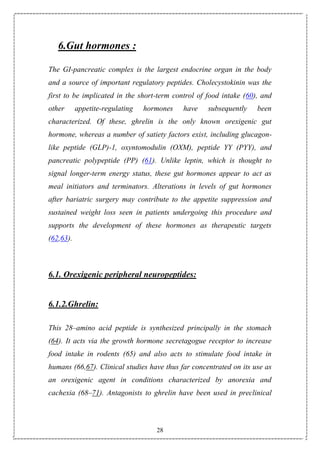
(Figure5)
http://www.chemicalbook.com/ChemicalProductProperty_EN_CB124063
8.htm
30
6.2.Anorectic peripheral peptides:
6.2.1.Cholecystokinin (CCK):
CCK was the first gut hormone demonstrated to have an effect on food
intake. CCK is released post-prandially and in addition to local effects
within the gut, inhibits food intake in rodents and humans (78,79). CCK1
receptor knockout rats and intraperitoneal delivery of CCK1 antagonists
results in obesity, partly due to hyperphagia (80). The anorectic effects of
peripherally administered CCK are thought to be mediated via CCK 1
receptors on vagal afferent fibres that relay to the brainstem.
Interestingly, intraperitoneal CCK administration also increases c-fos
expression in the DMN and PVN of the hypothalamus (81). Direct
administration of CCK into the DMN decreases food intake and down-
regulates NPY gene expression (81).
Cholecystokinin (CCK) is a gut peptide that has long been established to
act as a postprandial satiety signal (82).It is released into the circulation
from enteroendocrine cells of the duodenum and jejunum in response to
fatty acids. CCK acts at receptors on peripheral vagal afferent terminals,
which transmit signal to appetite centers, such as the nucleus of the
solitary tract, contained within the brainstem. Peripheral administration
of CCK also activates mouse POMC neurons in the nucleus of the
solitary tracts with signaling via MC4Rs in this region appearing to be
crucial in bringing about the satiety effects of CCK. This peptide is
ineffective in reducing food intake in mice lacking MC4R and in mice in
which brainstem melanocortin receptorsare blocked pharmacologically
(83).hus in addition to integrating long-term adipostatic signals like
31
leptin, the melanocortin system may also be important in integrating
short-term gut-derived satiety signals.
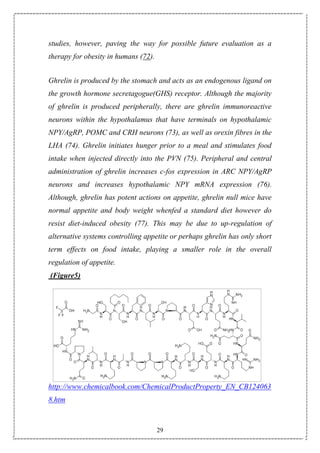
(Figure6)
http://www.pharmacology2000.com/Central/Opioids/opioidiv3.htm
6.2.2. Leptin:
Leptin (also termed OB protein), a product of leptin gene (Lep(ob) was
discovered in 1994 by Friedman and colleagues. It is a protein of
molecular weight 18,000, containing a signal sequence which is cleaved
to produce the mature hormone of molecular weight 16,000 (84).Initial
studies suggested that leptin was only synthesized by the White adipose
tissue, but it is now recognized that the hormone is produced in several
other sites like brown adipose tissue, stomach, placenta, mammary gland,
ovarian follicles and certain fetal organs such as heart and bone or
cartilage and perhaps even the brain (85,86,87).
Circulating leptin is transported across the blood– brain barrier via a
saturable process (88).egulation of transport may be an important
modulator of the effects of leptin on food intake. Starvation reduces
32
transport, whereas refeeding increases the transport of leptin across the
blood–brain barrier (89).
Production of leptin correlates positively with adipose tissue mass (90).
Independent of the adiposity leptin levels are higher in women than in
men (91).Leptin has a dual regulation in human physiology. During the
periods of weight maintenance, when energy intake and output are equal,
leptin levels reflect total body fat mass. However, in conditions of
negative (weight loss programs) and positive(weight-gain programs)
energy balances the dynamic changes in plasma leptin concentration
function as a sensor of energy imbalance and influences the efferent
energy regulation pathways (91).Rising levels of leptin signal the brain
that excess energy is being stored, and this signal brings about
adaptations of decreased appetite and increased energy expenditure that
resist obesity. About 5% of obese populations can be regarded as
‘‘relatively’’ leptin deficient which could benefit from leptin therapy (91).
33
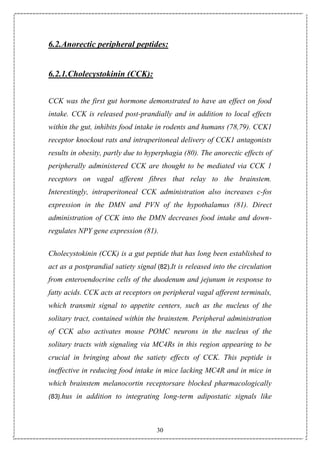
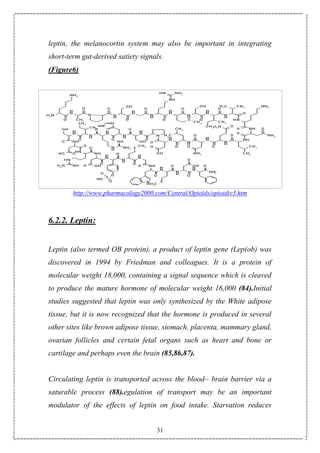
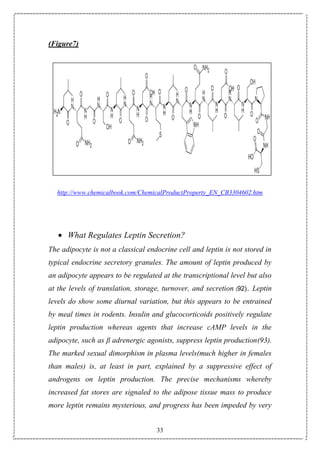
(Figure7)
http://www.chemicalbook.com/ChemicalProductProperty_EN_CB3304602.htm
 What Regulates Leptin Secretion?
The adipocyte is not a classical endocrine cell and leptin is not stored in
typical endocrine secretory granules. The amount of leptin produced by
an adipocyte appears to be regulated at the transcriptional level but also
at the levels of translation, storage, turnover, and secretion (92).. Leptin
levels do show some diurnal variation, but this appears to be entrained
by meal times in rodents. Insulin and glucocorticoids positively regulate
leptin production whereas agents that increase cAMP levels in the
adipocyte, such as β adrenergic agonists, suppress leptin production(93).
The marked sexual dimorphism in plasma levels(much higher in females
than males) is, at least in part, explained by a suppressive effect of
androgens on leptin production. The precise mechanisms whereby
increased fat stores are signaled to the adipose tissue mass to produce
more leptin remains mysterious, and progress has been impeded by very
34
low levels of leptin made in the otherwise very useful adipocyte cell lines
in which much adipocyte cell biology has been established.
6.2.3.Peptide YY (PYY):
Peptide YY (PYY) is a 36 amino acid peptide secreted from the endocrine
L cells of the gut. Circulating PYY levels are low in the fasting state and
rapidly increase post prandially when two forms, PYY1–36 and PYY3–36,
are released into the circulation. Both peptides have local effects on gut
motility and both have the ability to increase food intake if administered
directly into the cerebrospinal fluid of animals. In contrast, peripherally
administered PYY3–36 can reduce food intake (82). Like leptin, the
appetite-suppressing effectsof PYY3–36 were initially thought to be
mediated indirectly through the central melanocortin system. However,
this appears not to be the case as a disrupted melancortinergic system
still permits the full anorexigenic effects of PYY3–36(94). Some groups
have reported difficulty in reliably reproducing the anorexigenic effects
of PYY3–36,(95) a phenomenon that may reflect the influence of
environmental stimuli on the ability of the animals to respond. It has been
suggested that the inhibition of food intake by PYY3–36 is dependent, at
least in part, on the induction of an aversive response. (96)
In humans, PYY3–36 levels are elevated in many disease states that are
characterized by weight loss. Overweight subjects have been reported to
have a relative deficiency of postprandial PYY3–36 release associated
with reduced satiety(97) and bariatric surgery results in an exaggerated
postprandial PYY3–36 surge, potentially explaining the effectiveness of
such surgery in maintaining a prolonged reduction in postoperative
weight(98).. Whether or not PYY3–36 is a true endogenous physiological
35
regulator of food intake, longterm trials of PYY3–36 as an antiobesity
agent are ongoing, and the results are awaited with great interest.
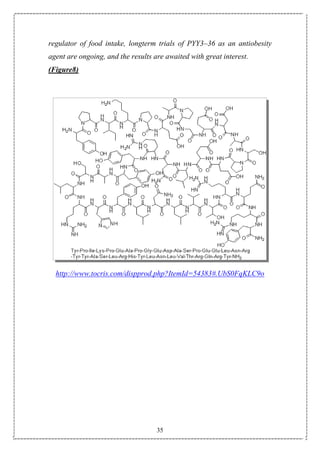
(Figure8)
http://www.tocris.com/dispprod.php?ItemId=54383#.UbS0FqKLC9o
36
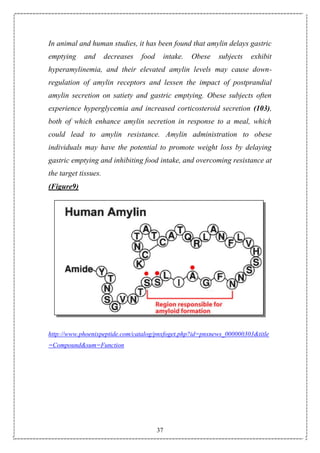
6.2.4. Amylin:
Amylin consisting of 37 amino acids, also known as islet amyloid
polypeptide was identified in 1987 (99). Amylin is a member of a family
of structurally related peptides, which includes calcitonin gene-related
peptide (CGRP) and calcitonin (CT). In mammals, amylin is co-released
with insulin from pancreatic b-cells in response to food intake and has an
anorectic effect (100). Amylin seems to decrease food intake through both
central and peripheral mechanisms and indirectly by slowing gastric
emptying. The mean basal amylin concentration is higher in obese than in
lean human subjects. Amylin and CCK-8 have been reported to reduce
food intake in rodents when given centrally as well as peripherally (100).
One mechanism by which amylin appears to reduce food intake is by
augmenting the actions of other peptides such as CCK, glucagon, and
bombesin, all of which also increase amylin secretion. However, the CCK
antagonists failed attenuate amylin’s reduction of food intake, suggesting
that amylin does not produce its effect through the release of CCK (101).
Instead it appears to be the converse that the anorectic effects of CCK
and bombesin depend partly on the presence of amylin or the calcitonin
gene -related peptide (CGRP) (102).
There is evidence that amylin may also exert its effects through
serotonergic, histaminergic, and dopaminergic systems. Amylin may
induce anorexia through its effect on brain serotonin by increasing the
transport of the precursor tryptophan into the brain (2), to inhibit feeding
by serotonin action in the paraventricular nucleus.
37
In animal and human studies, it has been found that amylin delays gastric
emptying and decreases food intake. Obese subjects exhibit
hyperamylinemia, and their elevated amylin levels may cause down-
regulation of amylin receptors and lessen the impact of postprandial
amylin secretion on satiety and gastric emptying. Obese subjects often
experience hyperglycemia and increased corticosteroid secretion (103),
both of which enhance amylin secretion in response to a meal, which
could lead to amylin resistance. Amylin administration to obese
individuals may have the potential to promote weight loss by delaying
gastric emptying and inhibiting food intake, and overcoming resistance at
the target tissues.
(Figure9)
http://www.phoenixpeptide.com/catalog/pnxfoget.php?id=pnxnews_000000303&title
=Compound&sum=Function
38
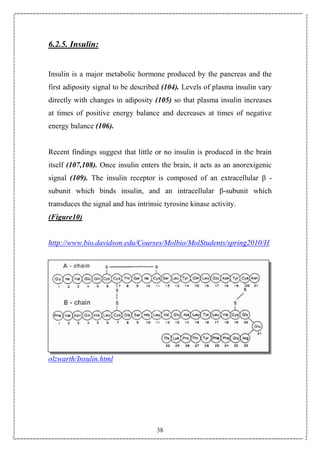
6.2.5. Insulin:
Insulin is a major metabolic hormone produced by the pancreas and the
first adiposity signal to be described (104). Levels of plasma insulin vary
directly with changes in adiposity (105) so that plasma insulin increases
at times of positive energy balance and decreases at times of negative
energy balance (106).
Recent findings suggest that little or no insulin is produced in the brain
itself (107,108). Once insulin enters the brain, it acts as an anorexigenic
signal (109). The insulin receptor is composed of an extracellular β -
subunit which binds insulin, and an intracellular β-subunit which
transduces the signal and has intrinsic tyrosine kinase activity.
(Figure10)
http://www.bio.davidson.edu/Courses/Molbio/MolStudents/spring2010/H
olzwarth/Insulin.html
39
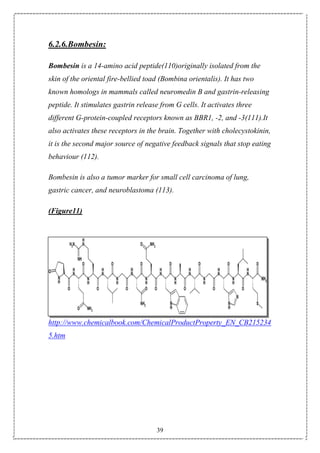
6.2.6.Bombesin:
Bombesin is a 14-amino acid peptide(110)originally isolated from the
skin of the oriental fire-bellied toad (Bombina orientalis). It has two
known homologs in mammals called neuromedin B and gastrin-releasing
peptide. It stimulates gastrin release from G cells. It activates three
different G-protein-coupled receptors known as BBR1, -2, and -3(111).It
also activates these receptors in the brain. Together with cholecystokinin,
it is the second major source of negative feedback signals that stop eating
behaviour (112).
Bombesin is also a tumor marker for small cell carcinoma of lung,
gastric cancer, and neuroblastoma (113).
(Figure11)
http://www.chemicalbook.com/ChemicalProductProperty_EN_CB215234
5.htm
40
6.3.Anorectic neuropeptides secreted by hypothalamus:
6.3.1. Glucagon like peptide-1 (GLP-1):
The pre-pro-glucagon gene is widely expressed in the enteroendocrine L
cells of the intestine, pancreas and brainstem. It is cleaved by pro-
hormone convertases 1 and 2 to produce mainly glucagon in the
pancreas, and GLP-1, GLP-2 and oxyntomodulin in the CNS and
intestine.
GLP-1 is released into the circulation following a meal in proportion to
the calories consumed and acts via the vagus nerve to inhibit food intake
(54). Central administration of GLP-1 to rats inhibits food intake and
activates c-fos expression in the ARC, amygdala and PVN (114,115).
GLP-1 receptor mRNA is densely expressed in the ARC and over 60%
appears to be co-localized with POMC neurons (116). Peripherally
injected GLP-1 also induces expression of c-fos in the ARC and has an
anorectic effect (117). However, this is thought to be mediated, in part,
via the vagus nerve since vagotomy or ablation of the brainstem-
hypothalamus pathways attenuates the anorectic effect of GLP-1 (117).
41
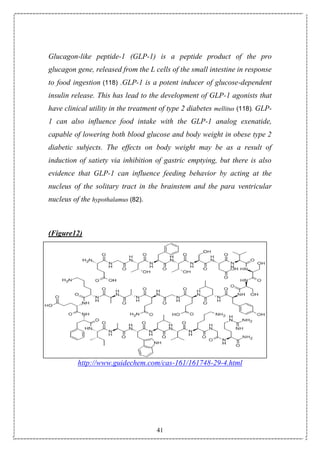
Glucagon-like peptide-1 (GLP-1) is a peptide product of the pro
glucagon gene, released from the L cells of the small intestine in response
to food ingestion (118) .GLP-1 is a potent inducer of glucose-dependent
insulin release. This has lead to the development of GLP-1 agonists that
have clinical utility in the treatment of type 2 diabetes mellitus (118). GLP-
1 can also influence food intake with the GLP-1 analog exenatide,
capable of lowering both blood glucose and body weight in obese type 2
diabetic subjects. The effects on body weight may be as a result of
induction of satiety via inhibition of gastric emptying, but there is also
evidence that GLP-1 can influence feeding behavior by acting at the
nucleus of the solitary tract in the brainstem and the para ventricular
nucleus of the hypothalamus (82).
(Figure12)
http://www.guidechem.com/cas-161/161748-29-4.html
42
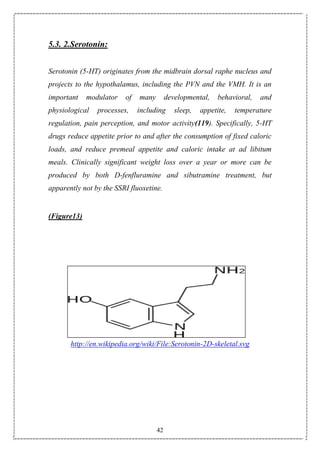
5.3. 2.Serotonin:
Serotonin (5-HT) originates from the midbrain dorsal raphe nucleus and
projects to the hypothalamus, including the PVN and the VMH. It is an
important modulator of many developmental, behavioral, and
physiological processes, including sleep, appetite, temperature
regulation, pain perception, and motor activity(119). Specifically, 5-HT
drugs reduce appetite prior to and after the consumption of fixed caloric
loads, and reduce premeal appetite and caloric intake at ad libitum
meals. Clinically significant weight loss over a year or more can be
produced by both D-fenfluramine and sibutramine treatment, but
apparently not by the SSRI fluoxetine.
(Figure13)
http://en.wikipedia.org/wiki/File:Serotonin-2D-skeletal.svg
43
6.4. Orexigenic neuropeptides secreted by hypothalamus:
6.4.1 Melanin-Concentrating Hormone:
Melanin-concentrating hormone (MCH) is an Orexigenic cyclic 19 amino
acid neuro peptide. It is cleaved from its precursor pre pro-MCH (pp
MCH) along with several other neuro peptides whose roles are not fully
defined (120).
The melanin-concentrating hormone system is thought to play a role in
arousal in correlation with specific goal oriented behaviors such as
feeding or reproduction (121). Several lines of investigation suggest that
the hypothalamic MCH regulates body weight in mammals. Obese mice
lacking functional leptin over express the MCH message in the fed or
fasted state. Acute Intra cerebro ventricular injection of MCH increases
energy intake in rats and decreases energy expenditure. On the other
hand, the MCH- or MCH-1R-deficient mice showed the resistance to
high-fat diet induced obesity (122). Moreover, MCH-transgenic mice
exhibit obese syndromes when fed on high fat diet.
Non-peptide antagonists for MCH-1R prevented the high-fat diet-induced
obesity, and possess anti-anxiety and antidepressant effect. These finding
indicate the involvement of MCH in the development of obesity, memory
and emotion. MCH receptor antagonist might be useful for the treatment
of obese syndrome including psychological disorder-related obesity (123,
124, 125, 126).
44
6.4.2.Neuropeptide Y:
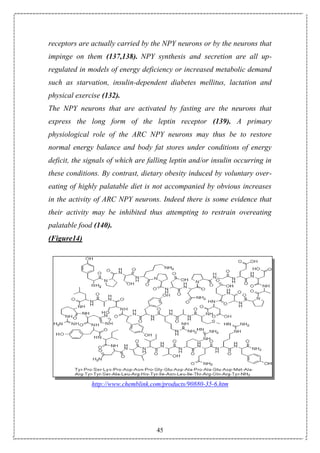
Neuropeptide Y (NPY) contains 36 amino acid residues, including a
tyrosine at each end (hence ‘Y’, the code for Tyrosine) (127). NPY is one
of the most abundant peptides of the hypothalamus (128) and one of the
most potent orexigenic factors (129,130). It has been functionally
implicated in feeding behavior, cardiovascular regulation, and control of
neuroendocrine axes, affective disorders, seizures, and memory retention
(131). The ARC is the major site of expression for NPY within neurons in
the hypothalamus that project to PVN, DMH, LHA, and other
hypothalamic sites. Although NPY can produce diverse effects on
behavior and other functions, its most noticeable effect is the stimulation
of feeding after central administration (132). When administered intra
cerebro ventricularly (ICV) in rats, it produces a powerful and prolonged
increase in food intake (133). When administered chronically, NPY
produces hyperphagia, decreased thermogenesis and obesity (134). NPY
gene expression in the hypothalamus is found to be increased compared
to controls in many different rodent models of altered feeding (135,136).
NPY synthesis in the ARC and its release into the PVN, the most
abundant projection, are regulated by afferent signals such as leptin,
insulin (both inhibitory), and glucocorticoids (stimulatory). The NPY
neurons are potential hypothalamic targets for leptin and as discussed
later, inhibition of the synthesis (probably release) of NPY seems to
partly explain the ability of leptin to induce hypophagia and weight loss.
Insulin receptors are expressed in the mediobasal hypothalamus, and
median eminence, and insulin has been shown to inhibit NPY synthesis
and secretion in the PVN: however, it is not clear whether insulin
45
receptors are actually carried by the NPY neurons or by the neurons that
impinge on them (137,138). NPY synthesis and secretion are all up-
regulated in models of energy deficiency or increased metabolic demand
such as starvation, insulin-dependent diabetes mellitus, lactation and
physical exercise (132).
The NPY neurons that are activated by fasting are the neurons that
express the long form of the leptin receptor (139). A primary
physiological role of the ARC NPY neurons may thus be to restore
normal energy balance and body fat stores under conditions of energy
deficit, the signals of which are falling leptin and/or insulin occurring in
these conditions. By contrast, dietary obesity induced by voluntary over-
eating of highly palatable diet is not accompanied by obvious increases
in the activity of ARC NPY neurons. Indeed there is some evidence that
their activity may be inhibited thus attempting to restrain overeating
palatable food (140).
(Figure14)
http://www.chemblink.com/products/90880-35-6.htm
46
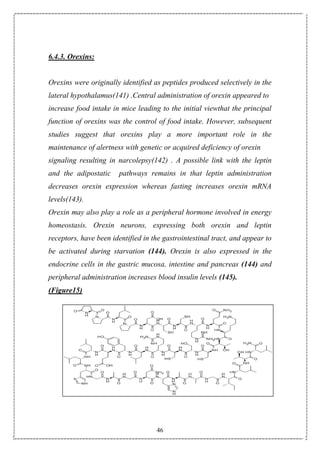
6.4.3. Orexins:
Orexins were originally identified as peptides produced selectively in the
lateral hypothalamus(141) .Central administration of orexin appeared to
increase food intake in mice leading to the initial viewthat the principal
function of orexins was the control of food intake. However, subsequent
studies suggest that orexins play a more important role in the
maintenance of alertness with genetic or acquired deficiency of orexin
signaling resulting in narcolepsy(142) . A possible link with the leptin
and the adipostatic pathways remains in that leptin administration
decreases orexin expression whereas fasting increases orexin mRNA
levels(143).
Orexin may also play a role as a peripheral hormone involved in energy
homeostasis. Orexin neurons, expressing both orexin and leptin
receptors, have been identified in the gastrointestinal tract, and appear to
be activated during starvation (144). Orexin is also expressed in the
endocrine cells in the gastric mucosa, intestine and pancreas (144) and
peripheral administration increases blood insulin levels (145).
(Figure15)
47
http://www.chemicalbook.com/ChemicalProductProperty_EN_CB9355020.htm
6.4.4 Agouti-related peptide:
AGRP is 132-amino acid peptide that has generated intense interest
because of evidence of its role in the regulation of feeding and body
weight (146). Like NPY, expression of AGRP is up-regulated in leptin
deficiency due to fasting or mutation. Chronic administration of AGRP in
rodents has been shown to cause sustained hyperphagia and leads to
obesity (147).
6.4.5Galanin:
Galanin is a neuropeptide which is not a member of any known family of
neuropeptides, despite repeated efforts to discover related peptides. It is a
29 amino acid C-terminally amidated (30 amino acid, non-amidated in
humans), highly conserved but unique neuroendocrine peptide originally
isolated from intestine. The first 14 AA are fully conserved in almost all
species. The first 16 N-terminal amino acids appear to contain
galaninagonist activity on increasing food consumption (148). Galanin is
found in the brain and the gut. It modulates a variety of physiological
processes including cognition/memory, sensory/pain processing,
neurotransmitter/ hormone secretion, and feeding behavior (149,150).
Acute central administration of galanin has been reported to increase fat
consumption. One of the studies has shown that repeated central
infusions of galanin stimulates daytime intake of both diets, they failed to
increase total daily energy intake or body weight in the rat (151).
48
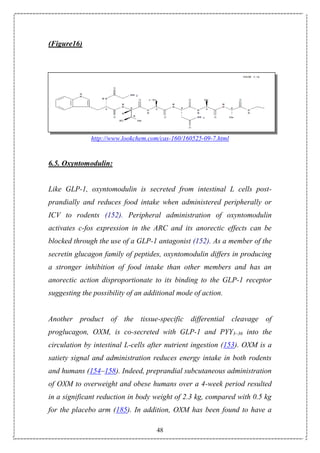
(Figure16)
http://www.lookchem.com/cas-160/160525-09-7.html
6.5. Oxyntomodulin:
Like GLP-1, oxyntomodulin is secreted from intestinal L cells post-
prandially and reduces food intake when administered peripherally or
ICV to rodents (152). Peripheral administration of oxyntomodulin
activates c-fos expression in the ARC and its anorectic effects can be
blocked through the use of a GLP-1 antagonist (152). As a member of the
secretin glucagon family of peptides, oxyntomodulin differs in producing
a stronger inhibition of food intake than other members and has an
anorectic action disproportionate to its binding to the GLP-1 receptor
suggesting the possibility of an additional mode of action.
Another product of the tissue-specific differential cleavage of
proglucagon, OXM, is co-secreted with GLP-1 and PYY3–36 into the
circulation by intestinal L-cells after nutrient ingestion (153). OXM is a
satiety signal and administration reduces energy intake in both rodents
and humans (154–158). Indeed, preprandial subcutaneous administration
of OXM to overweight and obese humans over a 4-week period resulted
in a significant reduction in body weight of 2.3 kg, compared with 0.5 kg
for the placebo arm (185). In addition, OXM has been found to have a
49
beneficial effect on energy usage, in that it increased activity levels back
toward normal in overweight and obese volunteers (159). Oxyntomodulin
administration was well tolerated in these studies. Longer-term trials are
now required to determine whether its beneficial combination of
properties can be sustained. Like GLP-1, OXM is inactivated in large
part by DPP-IV, and its advancement as a clinically useful treatment will
be reliant on the development of a breakdown-resistant analog. In the
process of developing novel analogs of oxyntomodulin for the treatment
of obesity.
6.6.Pancreatic polypeptide (PP):
The panorectic gut hormone PP is released from the pancreas into the
circulation after a meal and like PYY, is released in proportion to
calories ingested. Peripheral injection of PP to rodents and humans
reduces food intake (160,161). Peripheral PP administration activates
neurons in the area postrema of the brainstem, an area with a high
density of Y4 receptors and reduces hypothalamic NPY and orexin mRNA
expression (160). Like PYY, the reduction of food intake by
intraperitoneal PP is abolished by vagotomy in rodents (160).
The role of pancreatic polypeptide in the regulation of energy balance is
unclear. Studies have shown that circulating levels are reduced in the
context of obesity, and there is a reduced second phase release after a
meal (162), whereas in anorexic patients, levels are elevated (163).
However, these findings have not been universally replicated (164,165).
PP reduces food intake when administered to rodents and humans(166–
168). It remains to be evaluated whether this effect is preserved in obese
50
humans. Work in individuals with Prader-Willi syndrome, characterized
by overeating and morbid obesity, is encouraging (169), but not
necessarily applicable to the more general nonsyndromic obese
population. However, the observation that a single infusion of pancreatic
polypeptide caused a measurable effect on food intake as long as 24 h
afterward in normal-weight volunteers (168) suggests that pancreatic
polypeptide may have potential as a long-term suppressor of appetite.
(Figure17)
http://www.chemicalbook.com.cn/ChemicalProductProperty_EN_CB9426108.htm
51
7.The Central Effects of Thyroid Hormones on Appetite:
7.1. Introduction:
Obesity, its complications, and the associated mortality are major public
health issues worldwide. The major central nervous system (CNS) areas
important in the regulation of appetite are the hypothalamus and
brainstem. The hypothalamus interprets and integrates afferent signals
from the periphery and that regulate food intake and energy expenditure.
brainstem to modulate efferent signals Neural and hormonal peripheral
signals communicate information including acute nutritional states and
energy stores. The hypothalamus is subdivided into a number of
interconnecting nuclei, including the paraventricular nucleus (PVN), the
ventromedial nucleus (VMN), and the arcuate nucleus(ARC), which are
particularly important in regulating energy homeostasis. The ARC is
located near the median eminence, where the blood-brain barrier is
incomplete, and is thus well positioned to respond to circulating factors
involved in appetite and food intake [170].
Recent evidence suggests that thyroid hormones may access the ARC and
other regions of the hypothalamus to regulate appetite (Figure 18). It is
well established that the hypothalamic-pituitary thyroid(HPT) axis
regulates body weight. Thyroid hormones are known to effect metabolic
rate. Thyroid dysfunction can have clinically significant consequences on
appetite and body weight. Hypothyroidism classically causes reduced
basal energy expenditure [171] with weight gain[172, 173]. Conversely,
hyperthyroidism increases energy expenditure and reduces body weight
[174–176]. Traditionally, it has been assumed that it is this reduced body
weight that drives the hyperphagia that can be a presenting feature in
52
hyperthyroidism. However, recent evidence suggests that the HPT axis
may play a direct role in the hypothalamic regulation of appetite,
independent of effects on energy expenditure. Classically, hypothalamic
thyrotropin-releasing hormone (TRH) stimulates thyroid-stimulating
hormone TSH) release from the anterior pituitary gland, which then
stimulates the release of both thyroid hormones, triiodothyronine (T3)
and thyroxine (T4). Reports suggest that all of these signalling molecules
can directly influence food intake [177–180]. Improved understanding of
the role of the HPT axis and thyroid hormone in appetite may identify
new targets for anti obesity agents.
7.1.2. Effects of Thyroid Hormones on Food Intake:
There are well-characterised effects of fasting on hypothalamic TRH
expression. This is primarily thought to down regulate the HPT axis in
periods of limited food availability, thus reducing food intake. However,
TRH has been reported to have direct anorectic effects, suggesting it may
regulate food intake independent of effects on the HPT axis. In rodents,
central administration of TRH reduces food intake[177, 181, 182];
similar effects on food intake are seen following peripheral
administration [183].
TSH has also been shown to reduce food intake when injected centrally
into rats [177]. There is evidence that TSH from the pars tuberalis is
involved in the photoperiodic response in birds and rodents, and it is thus
possible that TSH is involved with the seasonal alterations in food intake
and body weight that occur in some species [184–186].
53
The hyperphagia associated with hyperthyroidism may be a result of
thyroid hormones acting directly on CNS appetite circuits. T3 directly
stimulates food intake at the level of the hypothalamus. In rodent models,
peripheral and central hypothalamic administration of T3 increases food
intake [178–180].
There are several mechanisms postulated to mediate the orexigenic
effects of thyroid hormones. The ARC contains two distinct energy
homeostasis-regulating neuronal populations. One subpopulation
expresses the proopiomelanocortin(POMC) gene which codes for the
anorectic neuropeptide alpha-melanocyte-stimulating hormone(α-MSH).
The other expresses the orexigenic factors neuropeptide Y (NPY) and
agouti-related protein (AgRP). It has been reported that peripheral
administration of T3 increases hypothalamic NPY mRNA and that
intracerebroventricular(ICV) administration of a NPY Y1 receptor
antagonist blunts T3 induced hyperphagia, suggesting that T3 may
increase appetite via NPY [179]. T3 administration was also reported
toalso reduce hypothalamic POMC expression [179]. Another study did
not detect changes in hypothalamic neuropeptide expression in response
to peripheral administration of T3 though thismay reflect the different
doses of T3 administered[178].
54
(table 4)
However, the effects of thyroid hormones on food intake may not be
mediated directly by the ARC. Direct administration of T3 into the VMN
but not the ARC increases food intake in rats [178]. As appetite
regulating circuits in the ARC are known to be altered by changes in the
HPT, there may be an indirect effect of the ARC via the VMN allowing
intra-VMN T3 to increase food intake. In keeping with this, there are
excitatory inputs into POMC neurons that originate in the VMN [187].
55
(Figure 18)
(Figure 18): Schematic diagram of central appetite regulation. T3 can
access the hypothalamus and brainstem via the incomplete blood brain
barrier. PVN: paraventricular nucleus; ARC: arcuate nucleus; VMN:
ventromedial nucleus; BBB: blood-brain barrier; T3: triiodothyronine;
POMC: Pro-opiomelanocortin; NPY: neuropeptide Y; AgRP: agouti-
related protein; BDNF: brain-derived neurotrophic factor; HPT:
hypothalamic-pituitary thyroid; SNS: sympathetic nervous system.
7.1.3 Effects of Nutritional State on Thyroid Hormones:
Reduction in TRH in response to fasting may be important as TRH is seen
to have a direct anorectic effect when injected into the hypothalamus
[182]. It is possible there are distinct TRH neuronal populations
regulating the HPT axis and regulating appetite.
In periods of limited food availability, there is central downregulation of
the HPT axis. Serum T4 and T3 levels fall during fasting in humans [188]
56
and rodents [189, 190]. As the majority of T3 in rodents comes from the
thyroid gland, it is thought food deprivation may result in a fall in the
release of T4 and T3. This is likely secondary to a reduction in
hypothalamic TRH expression, an effect that may be mediated by the
adipose hormone lepton.
(Figure19)
(Figure19): Effect of fasting on the hypothalamo-pituitary-thyroid axis.
PVN: paraventricular nucleus; ARC: arcuate nucleus; TRH: thyrotropin
releasing hormone; TSH: Thyroid-stimulating hormone; T3:
triiodothyronine; T4: thyroxine; POMC: Pro-opiomelanocortin; NPY:
neuropeptide Y; AgRP: agouti-related protein.
57
8.Growth Hormone (GH) secretion:
8.1. Introduction
Human growth hormone (GH) is a mixture of peptides, the major
physiologic and bio active component being a 22 kDa polypeptide chain
of 191 amino acids secreted by the anterior pituitary gland . In man GH is
secreted episodically in a pulsatile fashion. The main regulatory
hormones of GH are two hypothalamic peptide hormones: GH releasing
hormone (GHRH) a 44 amino-acid peptide required for the initiation of
GH pulses and somatostatin an inhibitory peptide which modulates the
amplitude of GH pulses. However, several brain transmitter pathways as
well as sleep and several other factors seem to be involved in GH
regulation, suppressing or stimulating GH release by influencing GHRH
or somatostatin .
8.2.Metabolic and nutritional factors:
8.2.1Glucose:
An impaired GH response to hypoglycaemia is well documented in
obesity.[191-193] Moreover, recent studies performed with
hyperglycaemic clamp and oral glucose load have demonstrated that in
obese patients, contrary to normal subjects, hyperglycaemia does not
inhibit spontaneous[194] and stimulated (GHRH, arginine,
hexarelin)[195,196] GH secretion. On the contrary, the somatotropin
response to GHRH and arginine isphysiologically blunted by
58
administration of SRIH and of the cholinergic antagonist
pirenzepine.[196] These observations suggest an inability of hyper-
glycaemia to trigger hypothalamic SRIH release in obesity.
8.2.2.Insulin:
Obesity is characterized by fasting hyperinsulinemia and exaggerated
insulin release in response to a mixed and exaggerated insulin release in
response to a mixed meal or a glucose load.[197,198] and exaggerated
insulin release in response to a mixed meal or a glucose load.[197,198]
Experimental data support the existence of a negative feedback exerted
by circulating insulin on GH secretion. In normal subjects, a progressive
reduction of the GH response to hypoglycaemia[199] and GHRH[200]
has been observed with increasing insulin concentrations. The
mechanisms whereby insulin regulates GH release are not completely
clarified yet.
Insulin might act at both the hypothalamic and the pituitary level via its
multiple metabolic pathways. By binding to specific hypothalamic
receptors,[201 – 203] insulin could enhance the release of
catecholamines,[204,205] which in turn might stimulate SRIH discharge
via b-adrenergic receptors.[206]. However, in spite of the low number of
specific insulin receptors in normal pituitary cells,[207]an inhibition of
GH synthesis and release, along with a reduction of GH mRNA content in
somatotropes have been observed following exposure of these cells to
insulin in vitro.(208) Insulin might also regulate GH secretion through its
effects on aminoacid metabolism and ion transport. Lastly, insulin may
indirectly influence GH secretion by inhibition of IGFBP-1[209] and
hence by increasing the levels of free plasma IGF-I which negatively
feeds back on GH secretion. In spite of the above, the pathophysiological
59
relevance of hyperinsulinaemia in the GH hyposecretion of obesity is
challenged by the observation that GH secretion is normal in diseases
other than obesity associated with high insulin levels[210] and that in
obese subjects, normalization of serum insulin is not followed by
restoration of normal GH secretion.
8.2.3.Aminoacids:
GH is known to stimulate aminoacid uptake and protein synthesis.[211]
In turn, aminoacids participate in the regulation of GH release. Indeed,
high protein meals and administration of basic (arginine and ornithine)
and aromatic (tryptophan) aminoacids, stimulate GH secretion in normal
subjects,[212,213] probably because of a decrease in hypothalamic
SRIH.114 As mentioned above, an impairment of the GH response to
arginine, alone or combined with GHRH, is well documented in obesity.
60
9. Sex hormones:
The sex hormones estrogen, progesterone and androgens are important
modulators of food intake and energy balance in mammals(Fig.) (214),
where, as in most species, food intake and reproductive function are
closely linked. Sex hormones both interact with gastrointestinal peptides
and neurotransmitters to achieve central control of appetite and energy
expenditure, while also exerting direct peripheral action on adipocytes
(214).
Ovariectomy of rats increases food intake and, concomitantly, body
weight (215) and these effects can be reversed by restoring physiological
levels of estradiol (215). There is evidence that the effects of estradiol on
food intake are mediated via estrogen receptors in the hypothalamus
(e.g., the ARC and the PVN) and in the nucleus of the solitary tract in the
brain stem (215). However, itremains unclear whether estrogen receptor
(ER) _ or _ is involved(215–217). Moreover, these effects of estradiol
appear to involve several different mechanisms. For instance, estradiol
potentiates
the effect of the satiating CCK peptide released from the small intestine in
response to food intake (218,219), while attenuating the appetite-
stimulating potency of the gastric hormone ghrelin (220).
Furthermore, estradiol stimulates anorexigenic POMC/CART activity
and inhibits orexigenic NPY/AgRP neurons in the ARC (221,222). In
contrast to estrogen, progesterone itself does not significantly influence
feeding behaviour in ovariectomized rats, except when administered in
non-physiological, pharmacological doses (215). However, in the
presence of estrogen, progesterone does stimulate appetite and promote
weight gain (223). Testosterone stimulates appetite and eating in a
manner thought to be mediated centrally(214), selectively increasing the
number of meals, but not the size of each individual meal in rats (224).
Recently, neonatal exposure of female mice to testosterone was found to
enhance food intake and attenuate the expression of anorexigenic
POMC/CART neurons in the ARC of these same animals as adults (225).
61
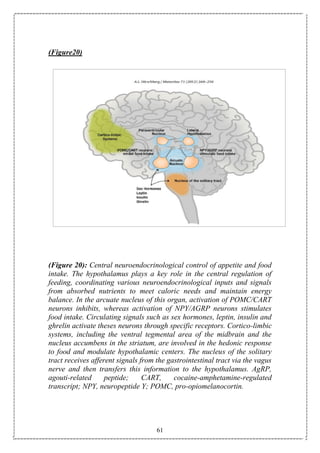
(Figure20)
(Figure 20): Central neuroendocrinological control of appetite and food
intake. The hypothalamus plays a key role in the central regulation of
feeding, coordinating various neuroendocrinological inputs and signals
from absorbed nutrients to meet caloric needs and maintain energy
balance. In the arcuate nucleus of this organ, activation of POMC/CART
neurons inhibits, whereas activation of NPY/AGRP neurons stimulates
food intake. Circulating signals such as sex hormones, leptin, insulin and
ghrelin activate theses neurons through specific receptors. Cortico-limbic
systems, including the ventral tegmental area of the midbrain and the
nucleus accumbens in the striatum, are involved in the hedonic response
to food and modulate hypothalamic centers. The nucleus of the solitary
tract receives afferent signals from the gastrointestinal tract via the vagus
nerve and then transfers this information to the hypothalamus. AgRP,
agouti-related peptide; CART, cocaine-amphetamine-regulated
transcript; NPY, neuropeptide Y; POMC, pro-opiomelanocortin.
62
10.Treatment alternatives for obesity:
Reducing energy intake and exercise is the first line treatment for
inducing weight loss. However, most people find it difficult to lose weight
despite availability of widely available choice of diets and exercise
programmes, and even more difficult to maintain weight loss (226).
Current second-line treatments available are medications and surgery.
Currently, the only obesity treatment in clinical use that has shown
significant long-term weight loss is gastrointestinal Roux-en-Y bypass
surgery (226, 227). However, because of its complications, this
procedure is restricted to patients with morbid obesity. Post-surgical
weight loss is not caused by malabsorption, but is due to a loss of
appetite which may be secondary to elevated PYY and glucagon-like
peripheral peptides like oxyntomodulin, (228,229) and suppressed
ghrelin levels (230). This suggests that therapies based on these
hormones may be effective in the long term, without the need for surgical
intervention.
Anti-obesity medicines in clinical use have been fenfluramine, D-
fenfluramine and more recently sibutramine and orlistat. Only two drugs,
sibutramine and orlistat, are approved by the Food and Drug
Administration for long-term use (231). Sibutramine, a serotonin and
nor-adrenaline reuptake inhibitor, is recommended by the National
Institute of Clinical Excellence (NICE) for the treatment of obesity in
patients with a BMI of 30 kg/m2 or the presence of an obesity-related
disease and a BMI of over27 kg/m2 (232).
63
Orlistat, an inhibitor of pancreatic and gastrointestinal lipases, prevents
the absorption of approximately30% of dietary fat (233). Orlistat reduces
low density lipoprotein and cholesterol levels independent of reductions
in body weight, decreases the progression to a diabetic state, and leads to
better glycemic control in patients with diabetes. Side effects due to the
mode of action include oily spotting, liquid stools, fecal urgency or
incontinence, flatulence, and abdominal cramping. As orlistat may impair
the absorption of fat-soluble vitamins, a multivitamin supplement should
be taken 2 h before or after the medication (232).
These drugs have all been effective at reducing and controlling patients’
body weight, a clinical effect directly related to their hypophagic action.
However, all these drugs reduced food intake by reducing pre-meal
hunger and strengthening within meal satiation to reduce meal size. They
also prevent compensatory increases in meal number and reduce the
intake of snacks between meals which is an important trigger of caloric
over consumption (2).
The main focus in development of anorexigenic anti-obesity agents has
been on small molecule agents targeting known hypothalamic signaling
pathways, an approach that has repeatedly been hampered by safety
concerns. However, recently the focus has shifted to several islet and gut
peptide hormones targeting the hindbrain that play an important
physiological role in the regulation of food intake, meal size and
parandial satiation. The discovery of leptin and how it regulates other
peptides involved in energy homeostasis has opened a new spectrum for
drug development (2).
64
11.Surgery for the treatment of obesity:
65
References
1. Neary, N.M., Goldstone, A.P. and Bloom, S.R.(2004): Appetite regulation: from gut to the
hypothalamus. Clin. Endocrinol. 60, 153–160.
2. Arora, S. and Anubhuti (2006): Role of neuropeptides in appetite regulation and obesity- A
review. Neuropeptides 40: 375-401
3. Wilding, J.P.(2002): Neuropeptides and appetite control. Diabet. Med. 19 (8), 619–627.
4. A. E. Field, E. H. Coakley, A. Must et al., “Impact of overweight on the risk of developing
common chronic diseases during a 10-year period,” Archives of Internal Medicine, vol. 161,
no. 13, pp. 1581–1586, 2001.
5. A. Must, J. Spadano, E. H. Coakley, A. E. Field, G. Colditz, and W. H. Dietz, “The disease
burden associated with overweight and obesity,” Journal of the American Medical
Association, vol. 282, no. 16, pp. 1523–1529, 1999.
6. Y. Matsuzawa, T. Nakamura, M. Takahashi et al., “New criteria for ’obesity disease’ in
Japan,” Circulation Journal, vol. 66, no. 11, pp. 987–992, 2002.
7. Y. Matsushita, Y. Takahashi, T. Mizoue, M. Inoue, M. Noda, and S. Tsugane, “Overweight
and obesity trends among Japanese adults: a 10-year follow-up of the JPHC Study,”
International Journal of Obesity, vol. 32, no. 12, pp. 1861–1867, 2008.
8. E. F. Bailey, “A tasty morsel: the role of the dorsal vagal complex in the regulation of food
intake and swallowing. Focus on “BDNF/TrkB signaling interacts with GABAergic system to
inhibit rhythmic swallowing in the rat,” by Bariohay et al,” American Journal of Physiology,
vol. 295, no. 4, pp. R1048–R1049, 2008.
9. WHO. (1998). Obesity: Preventing and managing the global epidemic. Report of a WHO
Consultation on Obesity. Geneva: World Health Organisation.
10. Ravussin E. (1993). Energy-metabolism in obesity - studies in the Pima Indians. Diabetes
Care. 16(1):232-238.
11. Flatt JP. (1978). Biochemistry of energy expenditure. In: Bray G. Ed. Recent advances in
obesity research. Westport: Techonomic.
12. Astrup A, Buemann B, Christensen NJ & Toubro S. (1994). Failure to increase lipid
oxidation in response to increasing dietary fat content in formerly obese women. American
Journal of Physiology. 266:E592-E599.
13. Horton TJ, Drougas H, Brachey A, Reed GW, Peters JC & Hill JO. (1995). Fat and
carbohydrate overfeeding in humans: different effects on energy storage. American Journal of
Clinical Nutrition. 62:19–29.
14. Popkin BM, Paeratakul S, Zhai F & Ge K. (1995). Areview of dietary and environmental
correlates of obesity with emphasis on developing countries. Obesity Research. 3(Suppl.
2):145s–153s.
15. SIGN. (1996). Obesity in Scotland: Integrating prevention with weight management.
Edinburgh: Scottish Intercollegiate Guidelines Network.
66
16. WHO. (2003). Diet, nutrition and the prevention of chronic diseases. Report of a Joint
WHO/FAO Expert Consultation. WHO Technical Report Series 916, Geneva: World Health
Organisation.
17. Drewnowski A & Popkin BM. (1997). The nutrition transition: new trends in the global
diet. Nutrition Reviews. 55(2):31-43.
18. Drewnowski A. (1998). Energy density, palatability, and satiety: implications for weight
control. Nutrition Reviews. 56:347-353.
19. Blundell JE & King NA. (1996). Overconsumption as a cause of weight gain:
behavioural-physiological interactions in the control of food intake (appetite). In. The origins
and consequences of obesity. (Ciba Foundation Symposium 2001). Chichester: Wiley.
20. Diaz EO, Prentice AM, Goldberg GR, Murgatroyd PR & Coward WA. (1992). Metabolic
response to experimental overfeeding in lean and overweight healthy volunteers. American
Journal of Clinical Nutrition. 56:641-655.
21. Bouchard C, Shepard RJ & Stephens T. (1994). Physical activity, fitness and health:
International proceedings and consensus statement. Champaign, Il: Human kinetics
22. Woo R & Pi-Sunyer FX. (1982). Effect of increased physical activity on voluntary intake
in lean women. Metabolism. 34:836-841.
23. Crawford D & Ball K. (2002). Behavioural determinants of the obesity epidemic. Asia
Pacific Journal of Clinical Nutrition. 11(Suppl):S718-S721.
24. Liebowitz SF. (1995). Central physiological determinants of eating behaviour and
weight. In Brownell KD & Fairburn CG. (Eds.) Eating disorders and obesity: a
comprehensive handbook. New York: Guilford Press. pp. 3-7.
25. Franken RE. (1994). Human motivation. 3rd Ed. Pacific Grove: California: Brooks/Cole.
26. French SA, Story M & Jeffery RW. (2001). Environmental influences on eating and
physical activity. Annual Review of Public Health, 22, 309-335.
27.World Health Organization. Obesity: preventing and managing a global epidemic. WHO
Tech Rep Ser. 2000; 894:1-4.
28. Olney JW. Brain lesions, obesity, and other disturbances in mice treated with
monosodium glutamate. Science. 1969;164(880):719-21.
29. Bouret SG, Draper SJ, Simerly RB. Formation of projection pathways from the arcuate
nucleus of the hypothalamus to hypothalamic regions implicated in the neural control of
feeding behavior in mice. J Neurosci. 2004;24(11):2797-805.
30. Kim MS, Rossi M, Abusnana S, Sunter D, Morgan DG, Small CJ, et al. Hypothalamic
localization of the feeding effect of agoutirelated peptide and alpha-melanocyte-stimulating
hormone. Diabetes. 2000;49(2):177-82.
31. Stanley BG, Chin AS, Leibowitz SF. Feeding and drinking elicited by central injection of
neuropeptide Y: evidence for a hypothalamic site(s) of action. Brain Res Bull.
1985;14(6):521-4.
32. Legradi G, Lechan RM. Agouti-related protein containing nerve terminals innervate
thyrotropin-releasing hormone neurons in the hypothalamic paraventricular nucleus.
Endocrinology. 1999;140(8):3643-52.
33. Martin NM, Smith KL, Bloom SR, Small CJ. Interactions between the melanocortin
system and the hypothalamo-pituitary-thyroid axis. Peptides. 2006;27(2):333-9.
67
34.Bernardis, L.L. and Bellinger, L.L.( 1996): The lateral hypothalamic area revisited:
Ingestion behaviour. Neurosci. Biobehav. Rev. 20, 189–287.
35. Broberger C, De LL, Sutcliffe JG, Hokfelt T. Hypocretin/orexinand melanin-
concentrating hormone-expressing cells form distinct populations in the rodent lateral
hypothalamus: relationship to the neuropeptide Y and agouti gene-related protein systems. J
Comp Neurol. 1998;402(4):460-74.
36. Bittencourt JC, Presse F, Arias C, Peto C, Vaughan J, Nahon JL, et al. The melanin-
concentrating hormone system of the rat brain: an immuno- and hybridization histochemical
characterization. J Comp Neurol. 1992;319(2):218-45.
37. Chen Y, Hu C, Hsu CK, Zhang Q, Bi C, Asnicar M, et al. Targeted disruption of the
melanin-concentrating hormone receptor-1 results in hyperphagia and resistance to diet-
induced obesity. Endocrinology. 2003;143(7):2469-77.
38. Qu D, Ludwig DS, Gammeltoft S, Piper M, Pelleymounter MA, Cullen MJ, et al. A role
for melanin-concentrating hormone in the central regulation of feeding behaviour. Nature.
1996;380(6571):243-7.
39. Sakurai T, Amemiya A, Ishii M, Matsuzaki I, Chemelli RM, Tanaka
H, et al. Orexins and orexin receptors: a family of hypothalamic neuropeptides and G protein-
coupled receptors that regulate feeding behavior. Cell. 1998;92(4):573-85.
40. Hagan JJ, Leslie RA, Patel S, Evans ML, Wattam TA, Holmes S, et al. Orexin A activates
locus coeruleus cell firing and increases arousal in the rat. Proc Natl Acad Sci USA.
1999;96(19):10911-6.
41. Bernardis LL, Bellinger LL. The dorsomedial hypothalamic nucleus
revisited: 1986 update. Brain Res. 1987;434(3):321-81.
42. Broberger C, Johansen J, Johansson C, Schalling M, Hokfelt T. The neuropeptide
Y/agouti gene-related protein (AGRP) brain circuitry in normal, anorectic, and monosodium
glutamate-treated mice. Proc Natl Acad Sci USA. 1998;95(25):15043-8.
43. Jacobowitz DM, O’DonohueT L. Alpha-melanocyte stimulating hormone:
immunohistochemical identification and mapping in neurons of rat brain. Proc Natl Acad. Sci
USA. 1978;75(12):6300-4.
44. Mihaly E, Fekete C, Legradi G, Lechan RM. Hypothalamic dorsomedial
nucleus neurons innervate thyrotropin-releasing hormone- synthesizing neurons in the
paraventricular nucleus. Brain Res. 2001;891(1-):20-31.
45. Guan XM, Yu H, Trumbauer M, Frazier E, Van der Ploeg LH, Chen H. Induction of
neuropeptide Y expression in dorsomedial hypothalamus of diet-induced obese mice.
Neuroreport. 1998;9(15):3415-9.
46. Kesterson RA, Huszar D, Lynch CA, Simerly RB, Cone RD. Induction of neuropeptide Y
gene expression in the dorsal medial hypothalamic nucleus in two models of the agouti
obesity syndrome. Mol Endocrinol. 1997;11(5):630-7.
47. Satoh, N., Ogawa, Y., Katsura, G., Tsuji, T., Masuzaki, H., Hiraoka, J., Okazaki, T.,
Tamaki, M., Hayase, M., Yoshimasa, Y., Nishi, S., Hasoda, K. and Nakao, K. (1997):
Pathophysiological significance of the obese gene product, leptin, in ventromedial
68
hypothalamus (VMH)-lesioned rats: Evidence for the loss of its satiety effect in the VMH-
lesioned rats. Endocrinology 138, 947–954.
48. Matsuda M, Liu Y, Mahankali S, Pu Y, Mahankali A, Wang J, et al. Altered
hypothalamic function in response to glucose ingestion in obese humans. Diabetes.
1999;48(9):1801-6.
49. Pelleymounter MA, Cullen MJ, Wellman CL. Characteristics of BDNF-induced weight
loss. Exp Neurol. 1995;131(2):229-38.
50. Xu B, Goulding EH, Zang K, Cepoi D, Cone RD, Jones KR, et al. Brain-derived
neurotrophic factor regulates energy balance downstream of melanocortin-4 receptor. Nat
Neurosci. 2003;6(7):736-42.
51. Ahima RS, Lazar MA. Adipokines and the peripheral and neural control of energy
balance. Mol Endocrinol. 2008;22(5):1023-31.
52. Farooqi IS, Jebb SA, Langmack G, Lawrence E, Cheetham CH, Prentice AM, et al.
Effects of recombinant leptin therapy in a child with congenital leptin deficiency. N Engl J
Med. 1999;341(12):879-84.
53. Faouzi M, Leshan R, Bjornholm M, Hennessey T, Jones J, Munzberg H. Differential
accessibility of circulating leptin to individual hypothalamic sites. Endocrinology.
2007;148(11):5414-23.
54. Bagnasco M, Dube MG, Kalra PS, Kalra SP. Evidence for the existence of distinct central
appetite, energy expenditure, and ghrelin stimulation pathways as revealed by hypothalamic
site-specific leptin gene therapy. Endocrinology. 2002;143(11):4409-21.
55. Cowley MA, Smart JL, Rubinstein M, Cerdan MG, Diano S, Horvath
TL, et al. Leptin activates anorexigenic POMC neurons through a neural
network in the arcuate nucleus. Nature. 2001;411(6836):480-4.
56. McGowan MK, Andrews KM, Grossman SP. Chronic intrahypothalamic infusions of
insulin or insulin antibodies alter body weight and food intake in the rat. Physiol Behav.
1992;51(4):753-66.
57. Benoit SC, Air EL, Coolen LM, Strauss R, Jackman A, Clegg DJ, et al. The catabolic
action of insulin in the brain is mediated by melanocortins. J Neurosci. 2002;22(20):9048-52.
58. ter Horst GJ, Luiten PG, Kuipers F. Descending pathways from hypothalamus to dorsal
motor vagus and ambiguus nuclei in the rat. J Auton Nerv Syst. 1984;11(1):59-75.
59. ter Horst GJ, de BP, Luiten PG, van Willigen JD. Ascending projections from the solitary
tract nucleus to the hypothalamus. A Phaseolus vulgaris lectin tracing study in the rat.
Neuroscience. 1989;31(3):785-97.
60. Gibbs J, Young RC, Smith GP: Cholecystokinin decreases food intake inrats. J Comp
Physiol Psychol 84:488–495, 1973
61. Stanley S, Wynne K, McGowan B, Bloom S: Hormonal regulation of food intake. Physiol
Rev 85:1131–1158, 2005.
62.Korner J, Bessler M, Cirilo LJ, Conwell IM, Daud A, Restuccia NL, Wardlaw SL: Effects
of Roux-en-Y gastric bypass surgery on fasting and postprandial concentrations of plasma
ghrelin, peptide YY, and insulin. J Clin Endocrinol Metab 90:359–365, 2005
69
63. Le Roux CW, Aylwin SJ, Batterham RL, Borg CM, Coyle F, Prasad V, Shurey S, Ghatei
MA, Patel AG, Bloom SR: Gut hormone profiles following bariatric surgery favor an
anorectic state, facilitate weight loss, and improve metabolic parameters. Ann Surg 243:108–
114, 2006
64.Kojima M, Hosoda H, Date Y, Nakazato M, Matsuo H, Kangawa K: Ghrelin is a growth-
hormone-releasing acylated peptide from stomach. Nature402:656–660, 1999
65.Wren AM, Small CJ, Abbott CR, Dhillo WS, Seal LJ, Cohen MA, Batterham RL, Taheri
S, Stanley SA, Ghatei MA, Bloom SR: Ghrelin causes hyperphagia and obesity in
rats. Diabetes 50:2540–2547, 2001
66.Wren AM, Seal LJ, Cohen MA, Brynes AE, Frost GS, Murphy KG, Dhillo WS, Ghatei
MA, Bloom SR: Ghrelin enhances appetite and increases food intake in humans. J Clin
Endocrinol Metab 86:5992, 2001
67.Neary NM, Small CJ, Druce MR, Park AJ, Ellis SM, Semjonous NM, Dakin CL, Filipsson
K, Wang F, Kent AS, Frost GS, Ghatei MA, Bloom SR: Peptide YY3-36 and glucagon-like
peptide-17-36 inhibit food intake additively.Endocrinology 146:5120–5127, 2005
68.Neary NM, Small CJ, Wren AM, Lee JL, Druce MR, Palmieri C, Frost GS, Ghatei MA,
Coombes RC, Bloom SR: Ghrelin increases energy intake in cancer patients with impaired
appetite: acute, randomized, placebo-controlled trial. J Clin Endocrinol Metab 89:2832–
2836, 2004
69.Nagaya N, Itoh T, Murakami S, Oya H, Uematsu M, Miyatake K, Kangawa K: Treatment
of cachexia with ghrelin in patients with COPD. Chest 128:1187–1193, 2005
70.Nagaya N, Moriya J, Yasumura Y, Uematsu M, Ono F, Shimizu W, Ueno K, Kitakaze M,
Miyatake K, Kangawa K: Effects of ghrelin administration on left ventricular function,
exercise capacity, and muscle wasting in patients with chronic heart
failure. Circulation 110:3674–3679, 2004
71. Wynne K, Giannitsopoulou K, Small CJ, Patterson M, Frost G, Ghatei MA, Brown EA,
Bloom SR, Choi P: Subcutaneous ghrelin enhances acute food intake in malnourished patients
who receive maintenance peritoneal dialysis: a randomized, placebo-controlled trial. J Am
Soc Nephrol16:2111–2118, 2005
72. Beck B, Richy S, Stricker-Krongrad A: Feeding response to ghrelin agonist and
antagonist in lean and obese Zucker rats. Life Sci 76:473–478,2004
73. Cowley MA, Smith RG, Diano S, Tschop M, Pronchuk N, Grove KL, et al. The
distribution and mechanism of action of ghrelin in the CNS demonstrates a novel
hypothalamic circuit regulating energy homeostasis. Neuron. 2003;37(4):649-61.
74. Toshinai K, Date Y, Murakami N, Shimada M, Mondal MS, Shimbara T, et al. Ghrelin-
induced food intake is mediated via the orexin pathway. Endocrinology. 2003;144(4):1506-
12.
75. Shrestha YB, Wickwire K, Giraudo SQ. Action of MT-II on ghrelininduced
feeding in the paraventricular nucleus of the hypothalamus. Neuroreport. 2004;15(8):1365-7.
76. Nakazato M, Murakami N, Date Y, Kojima M, Matsuo H, Kangawa K, et al. A role for
ghrelin in the central regulation of feeding. Nature. 2004;409(6817):194-8.
70
77. Sun Y, Ahmed S, Smith RG. Deletion of ghrelin impairs neither growth nor appetite. Mol
Cell Biol. 2003;23(22):7973-81.
78. Gibbs J, Young RC, Smith GP. Cholecystokinin decreases food intake in rats. J Comp
Physiol Psychol. 1973 84(3):488-95.
79. Kissileff HR, Pi-Sunyer FX, Thornton J, Smith GP. C-terminal octapeptide of
cholecystokinin decreases food intake in man. Am J Clin Nutr. 1981;34(2):154-60.
80. ilver AJ, Flood JF, Song AM, Morley JE. Evidence for a physiological role for CCK in
the regulation of food intake in mice. Am J Physiol. 1989;256(3 Pt 2):R646-R652.
81.Chen J, Scott KA, Zhao Z, Moran TH, Bi S. Characterization of the feeding inhibition and
neural activation produced by dorsomedial hypothalamic cholecystokinin administration.
Neuroscience. 2008;152(1):178-88.
82. Chaudhri, O., Small, C., and Bloom, S. (2006). Gastrointestinal hormones regulating
appetite. Philos. Trans. R. Soc. Lond. B Biol. Sci. 361, 1187–1209.
83. Ellacott, K.L., Halatchev, I.G., Takahashi, K., Yu, P., and Cone, R.D. (2004).
Cholecystokinin-mediated suppression of feeding involves the brainstem melanocortin
system. Nat. Neurosci. 7, 335–336.
84. Zhang, Y.Y., Proenca, R., Maffei, M., Barone, M., Leopold, L. and Friedman, J.M.
(1994): Positional cloning of the mouse obese gene and its human homolog. Nature 372, 425–
432.
85. Trayhurn, P., Hoggard, N., Mercer, J.G. and Rayner, D.V.(1999): Leptin: fundamental
aspects. Int. J. Obes. Relat. Metab. Disord. 23 (1), 22–28.
86. Trayhurn, P., Hoggard, N. and Rayner, D.V. (2001): White adipose tissue as a secretory
and endocrine organ: Leptin and other secreted proteins. In: Klaus, S. (Ed.), Adipose Tissue.
Landes Bioscience, Austin, TX.
87. Masuzaki, H., Ogawa, Y., Sagawa, N., Hosoda, K., Matsumoto, T., Mise, H., Nishimura,
H., Yoshimasa, Y., Tanaka, I., Mori, T. and Nakao, K. (1997): Nonadipose tissue production
of leptin: leptin as a novel placenta-derived hormone in humans. Nat. Med. 3, 1029–1033.
88.Banks, W.A.;Kastin, A.J.; Huang, W.; Jaspan, J.B. and Maness, L.M.(1996): Leptin enters
the brain by a saturable system independent of insulin. Peptides 17, 305–311.
89. Kastin, A.J. and Pan, W. (2000): Dynamic regulation of leptin entry into brain by the
blood-brain barrier. Regul. Peptides 92, 37–43.
90. Maffei, M., Halaas, J., Ravussin, E., Pratley, R.E., Lee, G.H., Zhang, Y., Fei, H., Kim, S.,
Lallone, R., Ranganathan, S. and et al.( 1995): Leptin levels in human and rodent:
measurement of plasma leptin and ob RNA in obese and weight-reduced subjects. Nat. Med.
1, 1155–1161.
91. Sinha, M.K. and Caro, J.F. (1998): Clinical aspects of leptin. Vitam. Horm. 54, 1–30.
92. Lee, M.J., and Fried, S.K. (2006). Multilevel regulation of leptin storage, turnover, and
secretion by feeding and insulin in rat adipose tissue. J. Lipid Res. 47, 1984–1993.
71
93. Ricci, M.R., Lee, M.J., Russell, C.D., Wang, Y., Sullivan, S., Schneider, S.H., Brolin,
R.E., and Fried, S.K. (2005). Isoproterenol decreases leptin release from rat and human
adipose tissue through posttranscriptional mechanisms. Am. J. Physiol. Endocrinol. Metab.
288, E798–E804.
94. Coll, A.P., Farooqi, I.S., Challis, B.G., Yeo, G.S., and O’Rahilly, S. (2004).
Proopiomelanocortin and energy balance: insights from human and murine genetics. J. Clin.
Endocrinol. Metab. 89, 2557–2562.
95. Tschop, M., Castaneda, T.R., Joost, H.G., Thone-Reineke, C., Ortmann, S., Klaus, S.,
Hagan, M.M., Chandler, P.C., Oswald, K.D., Benoit, S.C., et al. (2004). Physiology: does gut
hormone PYY3-36 decrease food intake in rodents? Nature 430, 1 p following 165;
discussion2 p following 165.
96. Halatchev, I.G., and Cone, R.D. (2005). Peripheral administration of PYY(3-36) produces
conditioned taste aversion in mice. Cell Metab. 1, 159–168.
97. le Roux, C.W., Aylwin, S.J., Batterham, R.L., Borg, C.M., Coyle, F.,
Prasad, V., Shurey, S., Ghatei, M.A., Patel, A.G., and Bloom, S.R. (2006a). Gut hormone
profiles following bariatric surgery favor an anorectic state, facilitate weight loss, and
improve metabolic parameters. Ann. Surg. 243, 108–114.
98. le Roux, C.W., Batterham, R.L., Aylwin, S.J., Patterson, M., Borg, C.M., Wynne, K.J.,
Kent, A., Vincent, R.P., Gardiner, J., Ghatei, M.A., and Bloom, S.R. (2006b). Attenuated
peptide YY release in obese subjects is associated with reduced satiety. Endocrinology 147,
3–8.
99. Reda, T.K., Geliebter, A. and Pi-Sunyer, F.X.(2002): Amylin, food intake, and obesity.
Obes. Res. 10, 1087–1091.
100. Bhavsar, S.; Watkins, J.; Young, A. (1998): Synergy between amylin and
cholecystokinin for inhibition of food intake in mice. Physiol. Behav. 64 (4), 557–561
101. Morley, J.E. (1987): Neuropeptide regulation of appetite and weight. Endocr. Rev. 8,
256–287.
102. Morris, M.J. and Nguyen, T. (2001): Does neuropeptide Y contribute to the anorectic
action of amylin? Peptides 22, 541–546.
103. Leibowitz, S.F. and Shor-Posner, G. (1986): Hypothalamic monoamine systems for
control of food intake: analysis of meal patterns and macronutrient selection. In: Carube,
M.O., Blundell, J.E. (Eds.), Psychopharmacology of Eating Disorders: Theoretical and
Clinical Advances, 29. Raven Press, New York.
104. Schwartz, M.W., Sipols, A.J., Marks, J.L., Sanacora, G., White, J.D., Scheurink, A.,
Kahn, S.E., Baskin, D.G., Woods, S.C., Figlewicz, D.P., et al. (1992b): Inhibition of
hypothalamic neuropeptide Y gene expression by insulin. Endocrinology 130, 3608–3616.
105. Bagdade, J.D.; Bierman, E.L. and Porte, D.J. (1967): The significance of basal insulin
levels in the evaluation of the insulin response to glucose in diabetic and nondiabetic subjects.
J. Clin. Invest. 46, 1549–1557.
106. Woods, S.C., Decke, E. and Vasselli, J.R.(1974): Metabolic hormones and regulation of
body weight. Psychol. Rev. 81, 26–43.
72
107. Woods, S.C., Seeley, R.J., Baskin, D.G. and Schwartz, M.W. (2003): Insulin and the
blood–brain barrier. Curr. Pharmaceut. Design 9, 795–800.
108. Banks, W.A. (2004): The source of cerebral insulin. Eur. J. Pharmacol. 490, 5–12.
109. Marks, J.L., Porte Jr., D., Stahl, W.L. and Baskin, D.G.(1990): Localization of insulin
receptor mRNA in rat brain by in situ hybridization. Endocrinology 127, 3234–3236
110. Gonzalez N, Moody TW, Igarashi H, Ito T, Jensen RT (February 2008). "Bombesin-
related peptides and their receptors: recent advances in their role in physiology and disease
states". Current Opinion in Endocrinology, Diabetes, and Obesity 15 (1): 58–
64.doi:10.1097/MED.0b013e3282f3709b. PMC 2631407.PMID 18185064.
111. Weber HC (February 2009). "Regulation and signaling of human bombesin receptors
and their biological effects".Current Opinion in Endocrinology, Diabetes, and Obesity 16(1):
66–71. PMID 19115523.
112. Yamada K, Wada E, Wada K (November 2000). "Bombesin-like peptides: studies on
food intake and social behaviour with receptor knock-out mice". Annals of Medicine32 (8):
519–29. PMID 11127929.
113. Ohlsson B, Fredäng N, Axelson J (December 1999). "The effect of bombesin,
cholecystokinin, gastrin, and their antagonists on proliferation of pancreatic cancer cell
lines".Scandinavian Journal of Gastroenterology 34 (12): 1224–9.PMID 10636070.
114. Turton MD, O’Shea D, Gunn I, Beak SA, Edwards CM, Meeran K,
et al. A role for glucagon-like peptide-1 in the central regulation of feeding. Nature.
1996;379(6560):69-72.
115. Larsen PJ, Tang-Christensen M, Jessop DS. Central administration of glucagon-like
peptide-1 activates hypothalamic neuroendocrine neurons in the rat. Endocrinology.
1997;138(10):4445-55.
116. Sandoval DA, Bagnol D, Woods SC, D’Alessio DA, Seeley RJ. Arcuate
GLP-1 receptors regulate glucose homeostasis but not food intake. Diabetes.
2008;57(8):2046-54.
117. Abbott CR, Monteiro M, Small CJ, Sajedi A, Smith KL, Parkinson JR, et al. The
inhibitory effects of peripheral administration of peptide YY(3-36) and glucagon-like peptide-
1 on food intake are attenuated by ablation of the vagal-brainstem-hypothalamic pathway.
Brain Res. 2005;1044(1):127-31.
118. Drucker, D.J. (2006). The biology of incretin hormones. Cell Metab. 3, 153–165.
119. Vanhoutte, P.M., Saxena, P.R., Paoletti, R., Brunello, N., Jackson, N. and Jackson,
A.S.(1993): Serotonin: From Cell Biology to Pharmacology and Therapeutics. Kluwer
Academic, Dordrecht, The Netherlands.
120. Lieberman, G.S., Rubinfeld, H., Glick, M., Kronfeld-Schor, N. and Shimon, I. ( 2006):
Melanin-concentrating hormone stimulates human growth hormone secretion: a novel effect
of MCH on the hypothalamic-pituitary axis. Am. J. Physiol. Endocrinol. Metab. 290, E982–
E988. doi:10.1152/ajpendo.00138.2005.
73
121. Cvetkovic, V.; Brischoux, F.; Griffond, B.; Bernard, G.; Jacquemard, C.;Fellmann, D.
and Risold, P.Y.(2003): Evidence of melanin concentrating hormone-containing neurons
supplying both cortical and neuroendocrine projections. Neuroscience 116 (1), 31–35.
122. Ludwig, D.S., Tritos, N.A., Mastaitis, J.W., Kulkarni, R., Kokkotou, E.G., Elmquist,
J.L., Bradford, F., Jeffrey, S. and Maratos-Flier, E. (2001): Melanin-concentrating hormone
over-expression in transgenic mice leads to obesity and insulin resistance. J. Clin. Invest. 107,
379–386.
123. Katsuura, G. and Inui, A. (2003): Melanin-concentrating hormone as a metabolic and
cognitive regulatory factor. Curr. Med. Chem. – Central Nervous System Agents 3 (3), 217–
227.
124. Xu, R., Li, S., Paruchova, J., McBriar, M.D., Guzik, H., Palani, A., Clader, J.W., Cox,
K., Greenlee, W.J., Hawes, B.E., Kowalski, T.J., O’Neill, K., Spar, B.D., Weig, B. and
Weston, D.J.(2006): Bicyclic[4.1.0]heptanes as phenyl replacements for melanin
concentrating hormone receptor antagonists. Bioorg. Med. Chem. 14(10), 3285–3299.
125. Kowalski, T.J.; Spar, B.D.; Weig, B.; Farley, C.; Cook, J.; Ghibaudi, L.; Fried, S.,
O’Neill, K.; Del Vecchio, R.A.; McBriar, M.; Guzik, H.; Clader, J.; Hawes, B.E. and Hwa,
J.( 2006): Effects of a selective melanin-concentrating hormone 1 receptor antagonist on food
intake and energy homeostasis in diet-induced obese mice. Eur. J. Pharmacol. 535(1–3), 182-
191.
126. McBriar, M.D., Guzik, H., Shapiro, S., Paruchova, J., Xu, R., Palani, A., Clader, J.W.,
Cox, K., Greenlee, W.J., Hawes, B.E., Kowalski, T.J., O’neill, K., Spar, B.D., Weig, B.,
Weston, D.J., Farley, C. and Cook, J.(2006): Discovery of orally efficacious melanin-
concentrating hormone receptor-1 antagonists as antiobesity agents. Synthesis, SAR, and
biological evaluation of bicyclo[3.1.0]hexyl ureas. J. Med. Chem. 49 (7), 2294–2310.
127. Williams, G., Joanne, A., Harrold and Cutler, D.J. (2000): The hypothalamus and the
regulation of energy homeostasis: Lifting the lid on the black box. Proc. Nutr. Soc. 59, 385–
396.
128. Allen, Y.S.; Adrian, T.E.; Allen, J.M.; Tatemoto, K.; Crow, T.J.; Bloom, S.R. and Polak
, J.M. (1983): Neuropeptide Y distribution in the rat brain. Science 221, 877–879.
129. Edwards, C.M.; Abusnana, S.; Sunter, D.; Murphy, K.G.; Ghatei, M.A. and Bloom, S.R.
(1999): The effect of the orexins on food intake: comparison with neuropeptide Y, melanin-
concentrating hormone and galanin. J. Endocrinol. 3, R7–R12.
130. Kalra, S.P. and Kalra, P.S. (2004): NPY and cohorts in regulating appetite, obesity and
metabolic syndrome: beneficial effects of gene therapy. Neuropeptides 38 (4), 201–211.
131. Pedrazzini, T. (2004): Importance of NPY Y1 receptor-mediated pathways: assessment
using NPY Y1 receptor knockouts. Neuropeptides 38 (4), 267–275.
132. Inui, A. (2000): Transgenic approach to the study of body weight regulation. Pharmacol.
Rev. 52 (1), 35–62.
133. Clark, J.T.; Kalra, P.S.; Crowley, W.R. and Kalra, S.P.( 1984): Neuropeptide Y and
human pancreatic polypeptide stimulate feeding behavior in rats. Endocrinology 115, 427–
429.
74
134. Stanley, B.G., Kyrkouli, S.E., Lampert, S., Leibowitz, S.F. (1986): Neuropeptide Y
chronically injected into the hypothalamus: a powerful neurochemical inducer of hyperphagia
and obesity. Peptides 7, 1189–1192.
135. Williams, G., Gill, J.S., Lee, Y.C., Cardoso, H.M., Okpere, B.E. and Bloom, S.R.
(1989): Increased neuropeptide Y concentrations in specific hypothalamic regions of
streptozocin-induced diabetic rats. Diabetes 38, 321–327.
136. Wilding, J.P., Gilbey, S.G., Bailey, C.J., Batt, R.A., Williams, G., Ghatei, M.A. and
Bloom, S.R. (1993): Increased neuropeptide-Y mRNA and decreased neurotensin mRNA in
the hypothalamus of the ob/ob mouse. Endocrinology 132, 1939–1944.
137. Schwartz, M.W., Figlewicz, D.P., Baskin, D.G., Woods, S.C. and Porte, D.J. (1992a):
Insulin in the brain: A hormonal regulator of energy balance. Endocr. Rev. 13, 387–414.
138. Kalra, S.P., Dube, M.G., Sahu, A., Phelps, C. and Kalra, P.S.(1991): Neuropeptide Y
secretion increases in the paraventricular nucleus in association with increased appetite for
food. Proc. Natl. Acad. Sci. USA 38, 10931–10935.
139. Baskin, D.G.; Breininger, J.F. and Schwartz, M.W. (1999): Leptin-receptor mRNA
identifies a subpopulation of neuropeptide Y neurons activated by fasting in rat
hypothalamus. Diabetes 48 (4), 828–833.
140. Widdowson, P.S., Upton, R., Henderson, L., Buckingham, R., Wilson, S. and Williams,
G. (1997): Reciprocal regional changes in brain NPY receptor density during dietary
restriction and dietary-induced obesity in the rat. Brain Res. 774, 1–10.
141. Sakurai, T., Amemiya, A., Ishii, M., Matsuzaki, I., Chemelli, R.M., Tanaka, H.,
Williams, S.C., Richardson, J.A., Kozlowski, G.P., Wilson, S., et al. (1998). Orexins and
orexin receptors: a family of hypothalamic neuropeptides and G protein-coupled receptors
that regulate feeding behavior. Cell 92, 573–585.
142. Saper, C.B., Scammell, T.E., and Lu, J. (2005). Hypothalamic regulation
of sleep and circadian rhythms. Nature 437, 1257–1263.
143. Yamanaka, A., Beuckmann, C.T., Willie, J.T., Hara, J., Tsujino, N., Mieda,
M., Tominaga, M., Yagami, K., Sugiyama, F., Goto, K., et al. (2003).
144. Kirchgessner, A.L. and Liu, M. (1999): Orexin synthesis and response in the gut. Neuron
24, 941–951.
145. Nowak, K.W., Mackowiak, P., Switonska, M.M., Fabis, M. and Malendowicz, L.K.(
2000): Acute orexin effects on insulin secretion in the rat: in vivo and in vitro studies. Life
Sci. 66, 449–454.
146. Wilson, B.D., Ollmann, M.M. and Barsh, G.S. (1999): The role of agouti-related protein
(Agrp) in regulation of body weight. Mol. Med. Today 5, 250–256.
147. Small, C.J., Kim, M.S., Stanley, S.A., Mitchell, J.R.; Murphy, K., Morgan, D.G., Ghatei,
M.A. and Bloom, S.R. (2001): Effects of chronic central nervous system administration of
Agouti-related protein in pair-fed animals. Diabetes 50, 248–254.
148. Crawley, J.N.; Austin, M.C.; Fiske, S.M.; Martin, B.; Consolo, S.; Berthold, M.; Langel,
U.; Fisone, G. and Bartfai, T.( 1990): Activity of centrally administered galanin fragments on
75
stimulation of feeding behavior and on galanin receptor binding in the rat hypothalamus. J.
Neurosci. 10, 3695–3700.
149. Leibowitz, S.F., Akabayashi, A. and Wang, J. (1998): Obesity on a high-fat diet: Role of
hypothalamic galanin in neurons of the anterior paraventricular nucleus projecting to the
median eminence. J. Neurosci. 18 (7), 2709–2719.
150. Leibowitz, S.F. (1995): Brain peptides and obesity: Pharmacologic treatment. Obes. Res.
3, 573S–589S.
151. Smith, B.K., York, D.A. and Bray, G.A. (1994): Chronic cerebroventricular galanin does
not induce sustained hyperphagia or obesity. Peptides 15 (7), 1267–1272.
152. Dakin CL, Small CJ, Batterham RL, Neary NM, Cohen MA, Patterson
M, et al. Peripheral oxyntomodulin reduces food intake and body weight gain in rats.
Endocrinology. 2004;145(6):2687-95.
153. Druce MR, Bloom SR: Oxyntomodulin: a novel potential treatment for obesity. Treat
Endocrinol 5:265–272, 2006
154. Dakin CL, Gunn I, Small CJ, Edwards CM, Hay DL, Smith DM, Ghatei MA, Bloom SR:
Oxyntomodulin inhibits food intake in the rat. Endocrinology142:4244–4250, 2001
155. Dakin CL, Small CJ, Park AJ, Seth A, Ghatei MA, Bloom SR: Repeated ICV
administration of oxyntomodulin causes a greater reduction in body weight gain than in pair-
fed rats. Am J Physiol Endocrinol Metab283:E1173–E1177, 2002
156. Dakin CL, Small CJ, Batterham RL, Neary NM, Cohen MA, Patterson M, Ghatei MA,
Bloom SR: Peripheral oxyntomodulin reduces food intake and body weight gain in
rats. Endocrinology 145:2687–2695, 2004
157. Cohen MA, Ellis SM, Le Roux CW, Batterham RL, Park A, Patterson M, Frost GS,
Ghatei MA, Bloom SR: Oxyntomodulin suppresses appetite and reduces food intake in
humans. J Clin Endocrinol Metab 88:4696–4701,2003
158. Wynne K, Park AJ, Small CJ, Patterson M, Ellis SM, Murphy KG, Wren AM, Frost GS,
Meeran K, Ghatei MA, Bloom SR: Subcutaneous oxyntomodulin reduces body weight in
overweight and obese subjects: a double-blind, randomized, controlled
trial. Diabetes 54:2390–2395, 2005
159. Wynne K, Park AJ, Small CJ, Meeran K, Ghatei MA, Frost GS, Bloom SR:
Oxyntomodulin increases energy expenditure in addition to decreasing energy intake in
overweight and obese humans: a randomised controlled trial. Int J Obes (Lond) 30:1729–
1736, 2006
160. Asakawa A, Inui A, Yuzuriha H, Ueno N, Katsuura G, Fujimiya M, et al.
Characterization of the effects of pancreatic polypeptide in the regulation of energy balance.
Gastroenterology. 2003;124(5):1325-36.
161. Batterham RL, Le Roux CW, Cohen MA, Park AJ, Ellis SM, Patterson M, et al.
Pancreatic polypeptide reduces appetite and food
intake in humans. J Clin Endocrinol Metab. 2003;88(8):3989-92.
162. Lassmann V, Vague P, Vialettes B, Simon MC: Low plasma levels of pancreatic
polypeptide in obesity. Diabetes 29:428–430, 1980
76
163. Fujimoto S, Inui A, Kiyota N, Seki W, Koide K, Takamiya S, Uemoto M, Nakajima Y,
Baba S, Kasuga M: Increased cholecystokinin and pancreatic polypeptide responses to a fat-
rich meal in patients with restrictive but not bulimic anorexia nervosa. Biol
Psychiatry 41:1068–1070, 1997
164. Jorde R, Burhol PG: Fasting and postprandial plasma pancreatic polypeptide (PP) levels
in obesity. Int J Obes 8:393–397, 1984
165. Wisen O, Bjorvell H, Cantor P, Johansson C, Theodorsson E: Plasma concentrations of
regulatory peptides in obesity following modified sham feeding (MSF) and a liquid test
meal. Regul Pept 39:43–54, 1992
166. McLaughlin CL, Baile CA: Obese mice and the satiety effects of cholecystokinin,
bombesin and pancreatic polypeptide. Physiol Behav26:433–437, 1981
167. Asakawa A, Inui A, Ueno N, Fujimiya M, Fujino MA, Kasuga M: Mouse pancreatic
polypeptide modulates food intake, while not influencing anxiety in mice. Peptides 20:1445–
1448, 1999
168. Batterham RL, Le Roux CW, Cohen MA, Park AJ, Ellis SM, Patterson M, Frost GS,
Ghatei MA, Bloom SR: Pancreatic polypeptide reduces appetite and food intake in humans. J
Clin Endocrinol Metab 88:3989–3992, 2003
169. Zipf WB, O'Dorisio TM, Cataland S, Dixon K: Pancreatic polypeptide responses to
protein meal challenges in obese but otherwise normal children and obese children with
Prader-Willi syndrome. J Clin Endocrinol Metab 57:1074–1080, 1983
170. M. Fry and A. V. Ferguson, “The sensory circumventricular organs: brain targets for
circulating signals controlling ingestive behavior,” Physiology and Behavior, vol. 91, no. 4,
pp. 413–423, 2007.
171. M. Wolf, A. Weigert, and G. Kreymann, “Body composition and energy expenditure in
thyroidectomized patients during short-term hypothyroidism and thyrotropin-suppressive
thyroxine therapy,” European Journal of Endocrinology, vol. 134, no. 2, pp. 168–173, 1996.
172. N. Manji, K. Boelaert, M. C. Sheppard, R. L. Holder, S. C. Gough, and J. A. Franklyn,
“Lack of association between serum TSH or free T4 and body mass index in euthyroid
subjects,” Clinical Endocrinology, vol. 64, no. 2, pp. 125–128, 2006.
173. S. Iossa, L. Lionetti, M. P.Mollica, A. Barletta, and G. Liverini, “Thermic effect of food
in hypothyroid rats,” Journal of Endocrinology, vol. 148, no. 1, pp. 167–174, 1996.
174. S. Alton and B. P. O’Malley, “Dietary intake in thyrotoxicosis before and after adequate
carbimazole therapy; The impact of dietary advice,” Clinical Endocrinology, vol. 23, no. 5,
pp. 517–520, 1985.
175. H. Pijl, P. H. E. M. De Meijer, J. Langius et al., “Food choice in hyperthyroidism:
potential influence of the autonomic nervous system and brain serotonin precursor
availability,” Journal of Clinical Endocrinology and Metabolism, vol. 86, no. 12, pp. 5848–
5853, 2001.
176. L. P. Klieverik, C. P. Coomans, E. Endert et al., “Thyroid hormone effects on whole-
body energy homeostasis and tissue-specific fatty acid uptake in vivo,” Endocrinology, vol.
150, no. 12, pp. 5639–5648, 2009.
77
177. M. T. Lin, P. C. Chu, and S. Y. Leu, “Effects of TSH, TRH, LH
and LHRH on thermoregulation and food and water intake in the rat,” Neuroendocrinology,
vol. 37, no. 3, pp. 206–211, 1983.
178. W. M. Kong, N. M. Martin, K. L. Smith et al., “Triiodothyronine
stimulates food intake via the hypothalamic ventromedial nucleus independent of changes in
energy expenditure,” Endocrinology, vol. 145, no. 11, pp. 5252–5258, 2004.
179. S. Ishii, J. Kamegai, H. Tamura, T. Shimizu, H. Sugihara, and S. Oikawa,
“Hypothalamic neuropeptide Y/Y1 receptor pathway activated by a reduction in circulating
leptin, but not by an increase in circulating ghrelin, contributes to hyperphagia associated with
triiodothyronine-induced thyrotoxicosis,” Neuroendocrinology, vol. 78, no. 6, pp. 321–330,
2003.
180. S. Ishii, J. Kamegai, H. Tamura, T. Shimizu, H. Sugihara, and S. Oikawa,
“Triiodothyronine (T3) stimulates food intake via enhanced hypothalamic AMP-activated
kinase activity,” Regulatory Peptides, vol. 151, no. 1–3, pp. 164–169, 2008.
181. E. Vijayan and S. M. McCann, “Suppression of feeding and drinking activity in rats
following intraventricular injection of thyrotropin releasing hormone (TRH),” Endocrinology,
vol. 100, no. 6, pp. 1727–1729, 1977.
182. T. Suzuki, H. Kohno, T. Sakurada, T. Tadano, and K. Kisara,
“Intracranial injection of thyrotropin releasing hormone (TRH) suppresses starvation-induced
feeding and drinking in rats,” Pharmacology Biochemistry and Behavior, vol. 17, no. 2, pp.
249–253, 1982.
183. Y. H. Choi, D. Hartzell, M. J. Azain, and C. A. Baile, “TRH decreases food intake and
increases water intake and body temperature in rats,” Physiology and Behavior, vol. 77, no. 1,
pp. 1–4, 2002.
184. L. C. Drickamer, “Seasonal variation in litter size, bodyweight and sexual maturation in
juvenile female house mice (Mus musculus),” Laboratory Animals, vol. 11, no. 3, pp. 159–
162, 1977.
185. H. Ono, Y. Hoshino, S. Yasuo et al., “Involvement of thyrotropin in photoperiodic signal
transduction in mice,” Proceedings of the National Academy of Sciences of the United States
of America, vol. 105, no. 47, pp. 18238–18242, 2008.
186. N. Nakao, H. Ono, T. Yamamura et al., “Thyrotrophin in the pars tuberalis triggers
photoperiodic response,” Nature, vol. 452, no. 7185, pp. 317–322, 2008.
187. S. M. Sternson, G. M. G. Shepherd, and J. M. Friedman, “Topographic mapping of
VMH → arcuate nucleus microcircuits and their reorganization by fasting,” Nature
Neuroscience, vol. 8, no. 10, pp. 1356–1363, 2005.
188. J. L. Chan, K. Heist, A. M. DePaoli, J. D. Veldhuis, and C. S. Mantzoros, “The role of
falling leptin levels in the neuroendocrine and metabolic adaptation to short-term starvation in
healthy men,” Journal of Clinical Investigation, vol. 111, no. 9,
pp. 1409–1421, 2003.
189. R. S. Ahlma, D. Prabakaran, C. Mantzoros et al., “Role of leptin in the neuroendocrine
response to fasting,” Nature, vol. 382, no. 6588, pp. 250–252, 1996.
78
190. G. L´egr`adi, C. H. Emerson, R. S. Ahima, J. S. Flier, and R. M. Lechan, “Leptin
prevents fasting-induced suppression of prothyrotropin-releasing hormone messenger
ribonucleic acid in neurons of the hypothalamic paraventricular nucleus,” Endocrinology, vol.
138, no. 6, pp. 2569–2576, 1997.
191. Topper E, Gil-Ad I, Bauman B, Josefsberg Z, Laron Z. Plasma growth hormone
response to oral clonidine as compared to insulin hypoglycemia in obese children and
adolescents. Horm Metab Res 1984; 16: 127 ± 130.
192. Kopelman PG, Noonan K, Goulton R, Forrest AJ. Impaired growth hormone response to
growth hormone releasing factor and insulin-hypoglycaemia in obesity. Clin Endocrinol
1985; 23: 87 ± 94.
193. Finer N, Price P, Grossman A, Besser GM. The effect of enkephalin analogue on
pituitary hormone release in human obesity. Horm Metab Res 1987; 19: 68 ± 70.
194. Bonora E, Moghetti P, Zenere M, Querena M, Tosi F, Corgnati A, Muggeo M. Plasma
concentrations of growth hormone during hyperglycemic clamp with or without somatostatin
infusion in obese subjects. J Clin Endocrinol Metab1990; 70: 1732 ± 1734.
195. Grottoli S, Maccario M, Procopio M, Oleandri SE, Arvat E, Gianotti L, Deghenghi R,
Camanni F, Ghigo E. Somatotrope responsiveness to hexarelin, a synthetic hexapeptide, is
refractory to the inhibitory effect of glucose in obesity. Eur J Endocrinol 1996; 135: 678 ±
682.
196. Maccario M, Procopio M, Grottoli S, Oleandri SE, Razzore P, Camanni F, Ghigo E. In
obesity the somatotrope response to either growth hormone-releasing hormone or arginine is
inhibited by somatostatin or pirenzepine but not by glucose. J Clin Endocrinol Metab 1995;
80: 3774 ± 3778.
197. Polonsky KS, Given BD, van Cauter E. Twenty-four-hour pro®les and pulsatile patterns
of insulin secretion in normal and obese subjects. J Clin Invest 1988; 81: 442 ± 448.
198. Klauser R, Prager R, Schernthaner G, Olefsky JM. Contribution of postprandial insulin
and glucose to glucose disposal in normal and insulin-resistant obese subjects. J Clin
Endocrinol Metab 1991; 73: 758 ± 764.
199. Diamond MP, Hallarman L, Starick-Zych K, Jones TW, Connolly-Howard M,
Tamborlane WV, Sherwin RS. Suppression of counterregulatory hormone response to
hypoglycemia by insulin per se. J Clin Endocrinol Metab 1991; 72: 1388 ± 1390.
200. Lanzi R, Manzoni MF, Andreotti AC, Malighetti ME, Bianchi E, Piceni Sereni L,
Caumo A, Luzi L, Pontiroli AE. Evidence for an inhibitory effect of physiological levels of
insulin on the growth hormone (GH) response to GH-releasing hormone in healthy subjects. J
Clin Endocrinol Metab1997; 82: 2239 ± 2243.
201. Schwartz MW, Figlewicz DP, Baskin DG, Woods SC, Porte DJ. Insulin in the brain: a
hormonal regulator of energy balance. Endocr Rev 1992; 13: 387 ± 414. of insulin in the rat
brain. Endocrinology 1983; 112: 898 ± 903.
202. Folli F, Bonfanti L, Renard E, Kahn CR, Merighi A. Insulin receptor substrate-1 (IRS-1)
distribution in the rat central nervous system. J Neurosci 1994; 14: 6412 ± 6422.
203. McCaleb ML, Myers RD. 2-Deoxy-D-glucose and insulin modify release of
norepinephrine from rat hypothalamus. Am J Physiol 1982; 242: R596 ± R603.
79
204. Sauter A, Goldstein M, Engel J, Ueta K. Effect of insulin on central catecholamines.
Brain Res 1983; 260: 330 ± 333.
205. Chihara K, Kodama H, Kaji H, Kita T, Kashio Y, Okimura Y, Abe H, Fujita T.
Augmentation by propranolol of growth hormone-releasing hormone-(1 ± 44)-NH2-induced
growth hormone release in normal short and normal children. J Clin Endocrinol Metab 1985;
61: 229 ± 233.
206. Rosenfeld RG, Ceda G, Cutler CW, Dollar LA, Hoffman AR. Insulin and insulin-like
growth factor (somatomedin) receptors on cloned rat pituitary tumor cells. Endocrinology
1985; 117: 2008 ± 2016.
207. Yamashita S, Melmed S. Effects of insulin on rat anterior pituitary cells. Inhibition of
growth hormone secretion and mRNA levels. Diabetes 1986; 35: 440 ± 447. 97 Cohen P,
Rosenfeld RG. The IGF axis. In: Rosenbloom AL (ed). Human growth hormone, basic and
scienti®c aspects. CRC Press: Boca Raton, FL, 1995, 43 ± 58.
208. Kelley KM, Oh Y, Gargosky SE, Gucev Z, Matsumoto T, Hwa V, Ng L, Simpson DM,
Rosenfeld RG. Insulin like growth factor-binding proteins (IGFBPs) and their regulatory
dynamics. Int J Biochem Cell Biol 1996; 28: 619 ± 637.
209. Maccario M, Grottoli S, Razzore P, Procopio M, Oleandri SE, Ciccarelli E, Camanni F,
Ghigo E. Effects of glucose load and=or arginine on insulin and growth hormone secretion in
hyperprolactinemia and obesity. Eur J Endocrinol1996; 135: 205 ± 210.
210. Chalew SA, Lozano RA, Armour KM, Kowarski AA. Reduction of plasma insulin levels
does not restore integrated concentration of growth hormone to normal in obese children. Int J
Obes 1992; 16: 459 ± 463.
211. Kostyo JL. Rapid effects of growth hormone on amino acid transport and protein
synthesis. Ann NY Acad Sci 1968; 148: 389 ± 407.
212. Cuttler L. The regulation of growth hormone secretion. Endocrinol Metab Clin North
Am 1996; 25: 541 ± 571.
213. MuÈller EE, Brambilla F, Cavagnini F, Peracchi M, Panerai A. Slight effect of L-
tryptophan on growth hormone release in normal human subjects. J Clin Endocrinol Metab
1974; 39: 1 ± 5.
214. Asarian L, Geary N. Modulation of appetite by gonadal steroid hormones. Phil
Trans R Soc B 2006;361:1251–63.
215. Butera PC. Estradiol and the control of food intake. Physiol Behav2010;99:175–80.
216. Liang YQ, Akishita M, Kim S, et al. Estrogen receptor _ is involved in the anorectic
action of estrogen. Int J Obes 2002;26:1103–9.
217. Santollo J, Katzenellenbogen BS, Katzenellenbogen JA, Eckel LA. Activation of ER_ is
necessary for estradiol’s anorexigenic effect in female rats. Horm Behav2010;58:872–7.
218. Lindén A, Uvnäs-Moberg K, Forsberg G, Bednar I, Södersten P. Involvement of
cholecystokinin in food intake: III. Oestradiol potentiates the inhibitory effect of
cholecystokinin octapeptide on food intake in ovariectomized rats. J
Neuroendocrinol1990;2:797–801.
80
219. Geary N. Estradiol, CCK and satiation. Peptides 2001;22:1251–63.
220. Clegg DJ, Brown LM, Zigman JM, et al. Estradiol-dependent decrease in the orexigenic
potency of ghrelin in female rats. Diabetes 2007;56:1051–8.
221. Sotonyi P, Gao Q, Bechmann I, Horvath TL. Estrogen promotes parvalbumin expression
in arcuate nucleus POMC neurons. Reprod Sci 2010;17:1077–80.
222. Olofsson LE, Pierce AA, Xu AW. Functional requirement of AgRP and NPY neurons in
ovarian cycle-dependent regulation of food intake. Proc Nat Acad Sci
USA 2009;106:15932–7.
223. Wade GN, Schneider JE. Metabolic fuels and reproduction in female mammals.
Neurosci Biobehav Rev 1992;16:235–72.
224. Chai JK, Blaha V, Meguid MM, Laviano A, Yang ZJ, Varma M. Use of orchiectomy
and testosterone replacement to explore meal number-to-meal size relationship in male rats.
Am J Physiol 1999;276:R1366–73.
225. Nohara K, Zhang Y, Waraich RS, et al. Early-life exposure to testosterone
programs the hypothalamic melanocortin system. Endocrinology
2011;152:1661–9
226. Frandsen, J.; Pedersen, S.B. and Richelsen, B. (1998): Long term follow up of patients
who underwent jejunoileal bypass for morbid obesity. Eur. J. Surg. 164 (4), 281–286.
227. Mitchell, J.E., Lancaster, K.L., Burgard, M.A., Howell, L.M., Krahn, D.D., Crosby,
R.D., Wonderlich, S.A. and Gosnell, B.A.(2001): Longterm follow-up of patients’ status after
gastric bypass. Obes. Surg. 11, 464–468.
228. Naslund, E., Gryback, P., Hellstrom, P.M., Jacobsson, H., Holst, J.J., Theodorsson, E.
and Backman, L. (1997): Gastrointestinal hormones and gastric emptying 20 years after
jejunoileal bypass for massive obesity. Int. J. Obes. Relat. Metab. Disord. 21, 387– 392.
229. Sarson, D.L., Scopinaro, N. and Bloom, S.R.(1981): Gut hormone changes after
jejunoileal (JIB) or biliopancreatic (BPB) bypass surgery for morbid obesity. Int. J. Obes. 5,
471–480.
230. Cummings, D.E.;, Weigle, D.S.; Frayo, R.S.; Breen, P.A.; Ma, M.K.; Dellinger, E.P. and
Purnell, J.Q. (2002): Plasma ghrelin levels after diet-induced weight loss or gastric bypass
surgery. NEJM 346, 1623–1630.
231. Hines, S. (2004): Words into action-promoting successful weight loss in overweight
patients. JAAPA 17, 19–28.
232. Korner, J. and Aronne, L.J. (2004): Pharmacological approaches to weight reduction:
Therapeutic targets. J. Clin. Endocrinol. Metab. 89 (6), 2616–2621.
233. Padwal, R., Li, S.K. and Lau, D.C. (2003): Long-term pharmacotherapy for overweight
and obesity: a systematic review and meta-analysis of randomized controlled trials. Int. J.
Obes. Relat. Metab. Disord. 27, 1437–1446.

Obesity

  • 1.
  • 2.
    2 Port Said University Facultyof Science Chemistry& Biochemistry Department Hormones in relation to obesity (Obesity and Hormones) Presented by/ Mai Hisham Ahmed BerBer supervised by/ Dr. Lamiaa Abdou Lateaf Ali Barakat 2013
  • 3.
    3 Port Said University Facultyof Science Chemistry& Biochemistry Department Hormones in relation to obesity (Obesity and Hormones) Presented by/ Mai Hisham Ahmed BerBer supervised by/ Dr. Lamiaa Abdou Lateaf Ali Barakat Presented to Port Said University Faculty of Science Biochemistry Department 4th level 2013
  • 4.
    4 Table of content 1. Overview. 2. Introduction 3. CAUSES OF OBESITY 3.1. Energy Balance in the Development of Obesity 3.2. Dietary Intake 3.2.1. Macronutrient composition of the diet 3.2.2. High fat diets 3.2.3.Energy dense foods and drinks 3.2.4. Fibre content in the diet 3.2.5. Food palatability 3.3. Energy Expenditure 3.4. Physical Activity 3.4.1. Exercise and appetite 3.4.2. Health benefits of physical activity 3.5. Psychosocial Factors contributing to Obesity 3.5.1. Introduction 3.5.2. Hunger and appetite 4. Body mass index 4.1 .Calculation of BMI 4.2. Classification of BMI 5. Hypothalamus 5.1. Hypothalamic nuclei involved in appetite control 5.1.1. Arcuate nucleus (ARC) 5.1.2. Para ventricular nucleus (PVN) 5.1.3. Lateral hypothalamic area (LHA) 5.1.4. Dorsomedial nucleus (DMN) 5.1.5. Ventromedial nucleus (VMN) 5.2. Adiposity signals acting on the hypothalamus 5.3. Interactions between the brainstem and Hypothalamus 6. Gut hormones 6.1. Orexigenic peripheral neuropeptides 5.1.2. Ghrelin 6.2. Anorectic peripheral peptides 5.2.1. Cholecystokinin (CCK) 6.5.2.2. Leptin 6.2.3. Peptide YY (PYY) 6.5. Oxyntomodulin 6.6.Pancreatic polypeptide (PP) 7. The Central Effects of Thyroid Hormones on Appetite
  • 5.
    5 7.1. Introduction 7.1.1. Effectsof Thyroid Hormones on Food Intake 7.1.2. Effects of Nutritional State on Thyroid Hormones 7.1.3. Thyroid Dysfunction and Body Weight State on Thyroid Hormones 7.3. Thyroid Dysfunction and Body Weight 8. Growth Hormone (GH) secretion 8.1. Metabolic and nutritional factors 8.1.1Glucose 8.1.2. Insulin 8.1.3. Aminoacids 9. Sex hormones 10. Treatment alternatives for obesity 11. Surgery for the treatment of obesity 12 .References
  • 6.
    6 List of figure Fig1………….Thefundamental principles of energy balance and regulation. Fig2………………………………………… anatomy of Hypothalamus. Fig3……… Pathways are shown between the brainstem, hypothalamus, cortical areas and reward circuitry known to regulate appetite control. Fig4...............................................................The main hypothalamic nuclei, neuropeptides and pathways involved in the regulation of appetite. Fig5...........................................................Chemical structure of Ghrelin. Fig6…………………. Chemical structure of Cholecystokinin (CCK). Fig7…………………………………….. Chemical structure of Leptin. Fig8………………………………..Chemical structure of Peptide YY. Fig9………………………………….. Chemical structure of Amylin. Fig10…………………………………… Chemical structure of Insulin. Fig11…………………………………. Chemical structure of Bombesin. Fig12…………………… Chemical structure of Glucagon like peptide-1. Fig13……………………………………Chemical structure of Serotonin. Fig14…………………………… Chemical structure of Neuropeptide Y. Fig15…………………………………… Chemical structure of Orexins. Fig16…………………………………… Chemical structure of Galanin. Fig17……………………. Chemical structure of Pancreatic polypeptide. Fig18………………... Schematic diagram of central appetite regulation. Fig19………. Effect of fasting on the hypothalamo-pituitary-thyroid axis. Fig20………... Central neuroendocrinological control of appetite and food intake.
  • 7.
    7 1.Overview: Obesity is aserious medical condition whose prevalence is increasing in developing countries also. This growing incidence represents a pandemic that needs urgent attention if the potential morbidity, mortality, and economic tolls that will be left in its wake are to be avoided. Obesity predisposes to increased risk of a number of medical conditions including type II diabetes mellitus, hypertension, coronary heart disease, osteoarthritis, respiratory problems and cancers of breast, endometrium, prostate, bowel cancers (1,2). Obesity represents a state of excess storage of body fat. Although very similar, the term overweight is defined as an excess body weight for height. The body mass index (BMI), also known as the Quetelet index is a WHO accepted index for classifying the degree of obesity. Standards defining overweight and obesity on the basis of BMI were developed by the International Obesity Task Force of the World Health Organization. BMI = (weight [kg])/ (height[m] 2). Under this convention for adults, grade 1 overweight (commonly and simply called overweight) is a BMI of 25– 29.9 kg/m2. Grade 2 overweight (commonly called obesity) is a BMI of 30–39.9 kg/m2. Grade 3 overweight (commonly called severe or morbid obesity) is a BMI greater than or equal to 40 kg/m2. The laws of thermodynamics are applicable here also because if energy expenditure by the body is less than the consumption, it will be stored in the body in the form of adipose tissue. Appetite regulation is important because it modulates the energy consumption side of the equation. Appetite includes various aspects of eating patterns such as frequency and size of eating episodes (gorging versus nibbling), choices of high fat
  • 8.
    8 or low fatfoods, energy density of foods consumed, variety of foods accepted, palatability of diet and variability in day-today intake. Feeding behavior is controlled by a series of short-term hormonal, psychological and neural signals that derive from the gastrointestinal tract, such as cholecystokinin whereas other signals may initiate meals, such as the recently discovered hormone, ghrelin. Other hormones such as insulin and leptin, together with circulating nutrients, indicate long-term energy stores. All these signals act at several central nervous system (CNS) sites but the pathways converge on the hypothalamus, which contains a large number of peptides and other neurotransmitters that influence food intake. As energy deficit is most likely to compromise survival, it is not surprising that the most powerful of these pathways are those that increase food intake and decrease energy expenditure when stores are depleted. When energy stores are low, production of leptin from adipose tissue, and thus circulating leptin concentrations fall, leading to increased production of hypothalamic neurotransmitters that strongly increase food intake, such as neuropeptide Y (NPY), galanin and agouti- related protein (AGRP) and decreased levels of a-melanocyte-stimulating hormone (a-MSH), cocaine and amphetamine-regulated transcript (CART). The hypothalamus has been recognized as a central region of feeding regulation (3,2) . The appetite control system of the brain normally establishes a weight ‘set-point’ and tries to maintain it even when food supplies vary a great deal.
  • 9.
    9 2.Introduction: Obesity is oneof the major health challenges throughout the world, due to its association with an array of vascular, metabolic, and psychosocial complications (4, 5). Obesity is traditionally associated with populations in Europe and North America; however Asian countries such as Japan have recently may reflect changes in dietary patterns and lifestyles (6, 7) reported increasing pre valences of obesity, which Obesity is a state in which energy intake chronically exceeds energy expenditure. Body weight is tightly regulated by complex homeostatic mechanisms involving the hypothalamus and brainstem which integrate inputs from higher cortical centres with peripherally derived signals of the body’s nutritional and energy status. In the hypothalamic arcuate nucleus (ARC), there are two neuronal populations with opposing effects on food intake: neurons which co express neuropeptideY (NPY) and agouti-related peptide (AgRP) which stimulate food intake, whereas neurons coexpressing proopiomelanocortin (POMC) and cocaine- and amphetamine-regulated transcript (CART) suppress food intake (Figure 1). Within the brainstem, the dorsal vagal complex (DVC) consisting of the dorsal motor nucleus of vagus (DVN), area postrema (AP), and the nucleus of the tractus solitarius (NTS) plays a pivotal role in relaying of peripheral signals such as vagal afferents from the gut to the hypothalamus (8). In human, higher cortical centres are implicated in psychological and emotional factors which can drive food intake beyond homeostatic requirements. In addition, the corticolimbic pathways are responsible for reward- associated feeding behaviour. This article summarises our current understanding of the role of gut hormones in appetite regulation and its potential as therapeutic targets for obesity.
  • 10.
    10 3.CAUSES OF OBESITY: 3.1.Energy Balance in the Development of Obesity: Obesity can result from a minor energy imbalance, which lead to a gradual but persistent weight gain over a considerable period. Some researchers have hypothesized that energy imbalance is the result of inherited metabolic characteristics; whereas others believe it is caused by poor eating and lifestyle habits, that is “gluttony and sloth”. Positive energy balance occurs when energy intake is greater than energy expenditure and promotes weight gain (Figure 1). Conversely, negative energy balance promotes decrease in body fat stores and weight loss. Body weight is regulated by a series of physiological Processes, which have the capacity to maintain weight within a relatively narrow range stable weight). It is thought that the body exerts a stronger defense against under nutrition and weight loss than it does against over- consumption and weight gain. Figure 4 also suggests that positive energy balance and weight gains are influenced by powerful societal and environmental forces which may overwhelm the physiological regulatory mechanisms that operate to keep weight stable. These include increasing automation, lack of recreational facilities and opportunities, increase in food variety and availability. Moreover, the susceptibility of individuals to these influences is affected
  • 11.
    11 by genetic andother biological factors such as sex, age and hormonal activities, over which they have little or no control(9). Dietary intake and physical activity are important contributing factors in the development of obesity. If calorie intake is in excess of requirement it will be stored mainly as body fat (Figure 1). If the stored body fat is not utilized over time, it will lead to overweight or obesity. Inter-individual variations in energy intake, basal metabolic rate, spontaneous physical activity, the relative rates of carbohydrate-to-fat oxidation, and the degree of insulin sensitivity seem to be closely involved in energy balance and in determining body weight in some individuals (10). (Figure 1) (Figure 1): The fundamental principles of energy balance and regulation
  • 12.
    12 * TEF =thermic effect of food; BMR = basal metabolic rate; CHO = carbohydrate. Source: WHO (1998) 3.2. Dietary Intake: 3.2.1. Macronutrient composition of the diet: The association between energy intake and body weight relies on the ease with which excess macronutrients can be deposited as adipose tissue. The energy cost of nutrient storage is not identical for all macronutrients. The cost of fat storage from dietary fat is the lowest, followed by carbohydrate and protein (11). Macronutrients with a low storage capacity such as protein and carbohydrate will be preferentially oxidized when intakes exceeded requirements. Hence, excess dietary fat is more likely to be stored in the body and this capacity is unlimited (12,13). The caloric content of fat is also more than twice that of protein or carbohydrate (Table 1).
  • 13.
    13 In summary, aftera meal the body has a specific order in which it burns up the fuels, that is, alcohol, followed by protein then carbohydrate and finally fat. (Table 2) highlights the main characteristics of the macronutrients of which fat seems to be the key macronutrient which undermines the body’s weight regulatory systems since it is very poorly regulated at the level of both consumption and oxidation. Although high protein intakes may appear to be advantageous in controlling energy intake and contributing to good body weight regulation, high protein intakes (especially animal protein) have been associated with some adverse health consequences such as renal disease, cancer and cardiovascular diseases(9).
  • 14.
    14 3.2.2. High fatdiets: Foods or meals that are high in fat are smaller in weight or volume than high carbohydrate foods or meals of similar energy content (14). Dietary fat content is directly correlated with energy intake, produces only weak satiation in comparison with protein and carbohydrate, and is thought to be processed efficiently by the body. A number of studies found that individuals on a high-fat diet are more prone to become overweight (15). 3.2.3.Energy dense foods and drinks: Consuming too much or too often high calorie foods and drinks may increase the total calories and thus result in obesity (15). The energy density of foods may be contributed by its macronutrient contents. A high fat food will often be labelled as energy-dense. Low fat food products may also be high in calories and therefore should not be eaten in excess. Beverages containing substantial amounts of sugar or alcohol can also contribute to excessive calorie intake. 3.2.4. Fibre content in the diet: A diet with adequate amounts of fibre-containing foods is usually less energy dense. Its greater bulk has a short-term satiety effect, can help to prevent overeating and reduce risk of obesity(16). This can be achieved by including fruits, vegetables, whole grain cereals, pulses and legumes in the diet. Efforts to increase dietary fibre intake should be gradual to
  • 15.
    15 minimize discomfort suchas bloating and flatulence. It is important to drink a lot of water when increasing fibre intake. 3.2.5 .Food palatability: Palatability is defined as the momentary subjective orosensory pleasantness of a food, which indicates the sensory stimulation to eat. It is one of the most powerful influences in promoting calorie over- consumption (positive energy balance) by increasing both the rate of eating and the sense of hunger during and between meals. Perceived palatability of foods plays a major role in determining which foods are selected over others (17). It has also been argued that palatability is associated with the energy density of foods. Foods that are energy dense are more palatable than those of lower energy density (18). Fat is associated with palatability and pleasurable mouth-feel that can induce behaviour which favours over-consumption leading to obesity (19). 3.3. Energy Expenditure: Total energy expenditure has three main components, namely, basal metabolic rate (BMR), thermogenesis or thermic effect of food (TEF) and physical activity (Figure 1). Basal metabolic rate is the energy expended by a person who is fasting and at rest in the morning under comfortable ambient conditions. The key variable of energy output in an individual is the degree of physical activity. In a dynamic phase, in which an individual gains weight as a result of energy intake exceeding energy expenditure over a prolonged
  • 16.
    16 period, BMR willincrease due to the larger fat-free mass (including that of the expanded adipose tissue) as well as to an additional energy cost of activity imposed by the extra weight(20). Thermogenesis is the increase in basal metabolic rate in response to stimuli such as food intake, cold or heat exposure, psychological influences such as fear or stress, or the administration of drugs or hormones. The thermic effect of food (the major form of thermogenesis) accounts for approximately 10% of the total daily energy expenditure. Physical activity is defined as any bodily movement produced by skeletal muscles that result in a substantial increase over the resting energy expenditure (21) .It is the most variable component of daily energy expenditure, which may account for a significant number of calories in very active individuals. Sedentary adults however, exhibit a range of physical activity that still represents about 20% to 30% of the total calorie expenditure. 3.4. Physical Activity: 3.4.1. Exercise and appetite: Obese women did not compensate the higher energy expenditure induced by exercise with increased intake, and thereby obtained a significant negative energy balance on exercise (22). This suggests that those who have an excess amount of energy stored may particularly benefit from regular exercise. Hunger can be temporarily suppressed by intense exercise, and possibly by low-intensity exercise of long duration. Hence, there is no supporting evidence for the common perception that exercise
  • 17.
    17 stimulates appetite, leadingto an increased food intake that even exceeds the energy cost of the preceding activities. 3.4.2. Health benefits of physical activity: Physical activity has been shown to improve the physiological aspects of our body system such as cardiovascular, respiratory, metabolic and weight control. There is convincing evidence that physical activity reduces risks of obesity, type 2 diabetes, certain cancers and osteoporosis. Other benefits of physical activity includes becoming more energetic, improved self esteem, increased resistance to stress, build stronger muscles and joints, increased fitness and flexibility, and living a healthier and longer independent life. On the other hand, physical inactivity and sedentary lifestyle increase risk of obesity (16). 3.5.Psychosocial Factors contributing to Obesity: 3.5.1. Introduction: Psychosocial factors take precedence in terms of contribution to obesity because genetic changes do not occur quick enough to warrant the increase of obesity cases around the world (23). Calorie intake and use largely depend on behaviour, which are food-related and non-food related. The significance of behavioural factors in weight gain is that it can be modified more easily than genetics.
  • 18.
    18 3.5.2.Hunger and appetite: Hungeris a physiological response to a need for food triggered by stimuli acting on the brain (24). It can be affected by a number of factors such as the size and composition of preceding meal, habitual eating pattern, exercise, physical and mental states(25) .In a normal eating pattern hunger begins after four to six hours after eating, when food has left the stomach and much of it has been absorbed by the body. This pattern is highly influenced by psycho physiological factors such as smell, as well as environmental interactions (26). Individuals who restrict food consumption at each meal may feel extra hungry for a few days, but then hunger diminishes for a time. However, at some point of food deprivation, hunger can be uncontrollable and lead to bouts of overeating that more than make up for the calories lost. The stomach capacity can also adapt to larger food quantities and until a normal meal size no longer feel satisfying. At some point during a meal, the brain receives stimuli from several sources that enough food has been eaten. This process is called satiation (25). A lack of satiety between meals can lead to overeating when a mealtime arrives. In some cases this sets up a cycle of starvation and binging, which lead to overeating. The choice of food may affect satiety – some foods seem to sustain satiety for longer period than others. In general foods high in protein and fibre sustain satiety longer than those high in fat or sugar.
  • 19.
    19 4.Body mass index: BodyMass Index (BMI) provides the most useful albeit crude population level measure of obesity and can be used to estimate the relative risk of disease in most people (27). 4.1 Calculation of BMI: BMI is defined as weight in kilograms divided by the square of the height in meters (kg/m2). body weight (kg) BMI =_________________ height (m)2 where kg = kilogram, m = meter. 4.2 Classification of BMI: (Table3)
  • 20.
    20 5. Hypothalamus: The hypothalamusis a portion of the brain that contains a number of small nuclei with a variety of functions. One of the most important functions of the hypothalamus is to link the nervous system to the endocrine system via the pituitary gland (hypophysis). The hypothalamus is located below the thalamus, just above the brain stem. In the terminology of neuroanatomy, it forms the ventral part of the diencephalon . All vertebrate brains contain a hypothalamus. In humans, it is roughly the size of an almond. The hypothalamus is responsible for certain metabolic processes and other activities of the autonomic nervous system. It synthesizes and secretes certain neurohormones, often called hypothalamic-releasing hormones, and these in turn stimulate or inhibit the secretion of pituitaryhormones. The hypothalamus controls body temperature, hunger, thirst,fatigue, sleep, and circadian cycles. (Figure2) http://www.studyblue.com/notes/note/n/limbic-system/deck/1241563
  • 21.
    21 5.1.Hypothalamic nuclei involvedin appetite control: The main regions of hypothalamus involved in feeding and satiety are: 5.1.1.Arcuate nucleus (ARC): The ARC is a key hypothalamic nucleus in the regulation of appetite. In mice, lesions of the ARC result in obesity and hyperphagia (28). Its proximity to the median eminence and the fact that the ARC is not fully insulated from the circulation by the blood brain barrier means it is strategically positioned to integrate a number of peripheral signals controlling food intake. There are two major neuronal populations in the ARC implicated in the regulation of feeding. One population increases food intake and co-expresses neuropeptide Y (NPY) and agouti-related protein (AgRP). The second population of neurons co-expresses cocaine- and amphetamine-related transcript (CART) and pro-opiomelanocortin (POMC) and inhibits food intake. Neuronal projections from these two populations then communicate with other hypothalamic areas involved in appetite regulation such as the PVN, DMN and LHA (29). 5.1.2.Para ventricular nucleus (PVN): Para ventricular nucleus (PVN) is the main site of orticotrophin releasing hormone (CRH) and thyrotropin releasing hormone (TRH) secretion. Numerous neuronal pathways implicated in energy balance converge in PVN, including major projections from NPY neurons of the ARC, Orexins, POMC derivative a-melanocyte stimulating hormone (a- MSH) and the appetite stimulating peptide galanin. Thus PVN plays a
  • 22.
    22 role in theintegration of nutritional signals with the thyroid and hypothalamic- pituitary axis (1). Microinjection of almost all known orexigenic peptides into the PVN, including NPY and AgRP stimulate feeding (30, 31). NPY/AgRP neurons from the ARC communicate with PVN neurons containing thyrotrophin releasing hormone (TRH) (32) which has been implicated in the control of energy balance, by contributions to both food intake and energy expenditure (33). 5.1.3.Lateral hypothalamic area (LHA): Lateral hypothalamic area (LHA)is the classical ‘feeding centre’, also contains glucose-sensitive neurons that are stimulated by hypoglycemia (by ascending pathways from brainstem) and it is crucial in mediating the marked hyperphagia which is normally induced by hypoglycemia(34). The LHA receives neuronal projections from the ARC and contains the orexigenic neuropeptides melanin concentrating hormone (MCH) and orexins. NPY, AgRP and α-MSH immune reactive terminals are extensive in the LHA and are in contact with MCH and orexin expressing cells (35). MCH immune reactive fibers also project to the cortex, brainstem and spinal cord (36). In humans, two MCH receptors have been cloned in humans, Mchr1 and Mchr2 whereas in rodents only Mchr1 has been identified. Mchr1 knockout mice have increased energy expenditure, loco motor activity and are resistant to diet-induced obesity (37). In contrast, injection of Mch into the lateral ventricle of rats increases food intake and fasting increases the expression of Mch mRNA (39). Orexin A and B act via two receptors, OX1R and OX2R and ICV administration of these
  • 23.
    23 peptides increases foodintake (39). However, subsequent studies have proposed that this may reflect associated heightened arousal and reduced sleep (40). 5.1.4.Dorsomedial nucleus (DMN): Destruction of the DMN results in hyperphagia and obesity (41). The DMN contains a high level of NPY terminals (42) and α-MSH terminals originating in the ARC (43). Α-MSH fibers also project from the DMN to the PVN terminating on TRH-containing neurons (44). In diet-induced obesity, obese agouti mice and Mc4r knockout mice, NPY mRNA expression is increased in the DMN (45, 46). 5.1.5.Ventromedial nucleus (VMN): Ventromedial nucleus (VMN) is mainly acting as satiety centre. It has been identified as a key target for leptin, which acts on the hypothalamus to inhibit feeding, stimulate energy expenditure and cause weight loss. Lesions of either ventromedial hypothalamic nuclei or PVN produce syndromes of hyperphagia and obesity (47). Neuroimaging studies in humans have shown increased signal in the area of the VMN following an oral glucose load (48). The VMN contains a large population of glucoresponsive neurons and receives NPY, AgRP and POMC neuronal projections from the ARC. Brain-derived neurotrophic factor (BDNF) is highly expressed in the VMN and lateral ventricle administration of BDNF reduces food intake and body weight
  • 24.
    24 (49). It isthought that ARC POMC neurons have a role in activating VMN BDNF neurons to decrease food intake (50). 5.2.Adiposity signals acting on the hypothalamus: Adipokines are secreted by adipose tissue and include leptin, adiponectin and resistin. They have been shown to act via the hypothalamus to affect food intake and energy expenditure (51). Leptin is secreted by adipocytes and circulates at concentrations proportional to fat mass. Rodents lacking leptin (ob/ob mice) or the leptin receptor (db/db mice and Zucker fa/fa rats) are obese and hyperphagic. In humans, the rare condition of leptin deficiency causes severe obesity which can be ameliorated by peripheral leptin administration (52). Circulating leptin crosses the blood brain barrier and binds to the long form of the leptin receptor, Ob- Rb, in the hypothalamus (53). The Obr receptor is expressed widely within the hypothalamus but particularly in the ARC, VMN, DMN and LHA. Using viral mediated gene expression, chronic leptin over-expression in the ARC, PVN and VMN results in reduced food intake (54). In the ARC, Ob-Rb mRNA is expressed by both NPY/AgRP and CART/POMC neurons. Leptin directly activates anorectic POMC neurons and inhibits orexigenic AgRP/NPY neurons resulting in an overall reduction in food intake (55). Circulating insulin rises in response to a glucose load and like leptin, circulating levels reflect fat mass. Insulin crosses the blood brain barrier via receptor-mediated transport. Insulin receptors are widely distributed in the brain particularly in hypothalamic nuclei involved in the regulation of food intake. Insulin has an anorectic effect when administered ICV or
  • 25.
    25 directly into theVMN, an effect which is reversed by insulin antibodies (56). The precise mechanism by which insulin inhibits food intake is still unclear although administration of insulin into the 3rd ventricle of fasted rats increases ARC POMC mRNA expression and reduces food intake (57). This anorexigenic effect of insulin is blocked by melanocortin antagonists (57). 5.3Interactions between the brainstem and Hypothalamus: The hypothalamus is often regarded as the “gate keeper” of appetite signalling as it also receives input from the cortex, brain stem and the periphery (Figures 3,4)milarly to the ARC, the area postrema of the brain stem also possesses an incomplete blood brain barrier. As such, peripheral satiety signals can also act directly on brainstem structures. Extensive reciprocal neuronal pathways exist between brainstem and hypothalamic appetite circuits to provide an alternative pathway through which circulating satiety factors can communicate with the hypothalamus (58,59). An additional major link between the gastrointestinal tract and the brain exists via the vagus nerve. Cell bodies of afferent fibers of the abdominal vagus nerve are located in the nodose ganglia, which project onto the brainstem. Here, the dorsal vagal complex (DVC) (consisting of the dorsal motor nucleus, the area postrema, and the sensory nucleus of the tractus solitarius (NTS)) contains projections to hypothalamic and higher centers (58,59).
  • 26.
    26 (Figure 3) NTS =nucleus tractus solitarius; amyg = amygdala; n. accumbens = nucleus accumbens. (Figure 3): Pathways are shown between the brainstem, hypothalamus, cortical areas and reward circuitry known to regulate appetite control. There are also projections from hypothalamic nuclei to the pre-frontal cortex, involved in conditioned taste aversion, as well as reward centres such as the amygdala and nucleus accumbens. Gut hormones acting via vagal afferents act on nuclei within the brainstem which in turn signal to the hypothalamus. Some gut hormones may also act directly on hypothalamic nuclei via the circulation and across an incomplete blood brain barrier. Leptin is also thought to act directly on the brainstem nuclei as well as hypothalamic nuclei suggesting that it can modulate appetite through different pathways.
  • 27.
    27 (Figure 4) ARC =arcuate nucleus; PVN = paraventricular nucleus; VMN = ventromedial nucleus; DMN = dorsomedial nucleus; LHA = lateral hypothalamic area; BDNF = brain-derived neurotrophic factor; CB1= endocannabinoid receptor 1; MCH = melanin concentrating hormone; CCK = cholecystokinin; GLP-1 = glucagon-like peptide 1; OXM = oxyntomodulin; PYY = peptide YY; AgRP = agouti related protein; NPY = neuropeptide Y; POMC = pro-opiomelanocortin; CART = cocaine- and amphetamine-related transcript; AMPK = adenosine mono- phosphate protein kinase. (Figure 4): The main hypothalamic nuclei, neuropeptides and pathways involved in the regulation of appetite. Circulating hormones act directly on the ARC affecting downstream pathways which modulate appetite control. In the ARC, orexigenic neurons co-express NPY and AgRP, whereas neurons co-expressing POMC and CART are anorexigenic.
  • 28.
    28 6.Gut hormones : TheGI-pancreatic complex is the largest endocrine organ in the body and a source of important regulatory peptides. Cholecystokinin was the first to be implicated in the short-term control of food intake (60), and other appetite-regulating hormones have subsequently been characterized. Of these, ghrelin is the only known orexigenic gut hormone, whereas a number of satiety factors exist, including glucagon- like peptide (GLP)-1, oxyntomodulin (OXM), peptide YY (PYY), and pancreatic polypeptide (PP) (61). Unlike leptin, which is thought to signal longer-term energy status, these gut hormones appear to act as meal initiators and terminators. Alterations in levels of gut hormones after bariatric surgery may contribute to the appetite suppression and sustained weight loss seen in patients undergoing this procedure and supports the development of these hormones as therapeutic targets (62,63). 6.1. Orexigenic peripheral neuropeptides: 6.1.2.Ghrelin: This 28–amino acid peptide is synthesized principally in the stomach (64). It acts via the growth hormone secretagogue receptor to increase food intake in rodents (65) and also acts to stimulate food intake in humans (66,67). Clinical studies have thus far concentrated on its use as an orexigenic agent in conditions characterized by anorexia and cachexia (68–71). Antagonists to ghrelin have been used in preclinical
  • 29.
    29 studies, however, pavingthe way for possible future evaluation as a therapy for obesity in humans (72). Ghrelin is produced by the stomach and acts as an endogenous ligand on the growth hormone secretagogue(GHS) receptor. Although the majority of ghrelin is produced peripherally, there are ghrelin immunoreactive neurons within the hypothalamus that have terminals on hypothalamic NPY/AgRP, POMC and CRH neurons (73), as well as orexin fibres in the LHA (74). Ghrelin initiates hunger prior to a meal and stimulates food intake when injected directly into the PVN (75). Peripheral and central administration of ghrelin increases c-fos expression in ARC NPY/AgRP neurons and increases hypothalamic NPY mRNA expression (76). Although, ghrelin has potent actions on appetite, ghrelin null mice have normal appetite and body weight whenfed a standard diet however do resist diet-induced obesity (77). This may be due to up-regulation of alternative systems controlling appetite or perhaps ghrelin has only short term effects on food intake, playing a smaller role in the overall regulation of appetite. (Figure5) http://www.chemicalbook.com/ChemicalProductProperty_EN_CB124063 8.htm
  • 30.
    30 6.2.Anorectic peripheral peptides: 6.2.1.Cholecystokinin(CCK): CCK was the first gut hormone demonstrated to have an effect on food intake. CCK is released post-prandially and in addition to local effects within the gut, inhibits food intake in rodents and humans (78,79). CCK1 receptor knockout rats and intraperitoneal delivery of CCK1 antagonists results in obesity, partly due to hyperphagia (80). The anorectic effects of peripherally administered CCK are thought to be mediated via CCK 1 receptors on vagal afferent fibres that relay to the brainstem. Interestingly, intraperitoneal CCK administration also increases c-fos expression in the DMN and PVN of the hypothalamus (81). Direct administration of CCK into the DMN decreases food intake and down- regulates NPY gene expression (81). Cholecystokinin (CCK) is a gut peptide that has long been established to act as a postprandial satiety signal (82).It is released into the circulation from enteroendocrine cells of the duodenum and jejunum in response to fatty acids. CCK acts at receptors on peripheral vagal afferent terminals, which transmit signal to appetite centers, such as the nucleus of the solitary tract, contained within the brainstem. Peripheral administration of CCK also activates mouse POMC neurons in the nucleus of the solitary tracts with signaling via MC4Rs in this region appearing to be crucial in bringing about the satiety effects of CCK. This peptide is ineffective in reducing food intake in mice lacking MC4R and in mice in which brainstem melanocortin receptorsare blocked pharmacologically (83).hus in addition to integrating long-term adipostatic signals like
  • 31.
    31 leptin, the melanocortinsystem may also be important in integrating short-term gut-derived satiety signals. (Figure6) http://www.pharmacology2000.com/Central/Opioids/opioidiv3.htm 6.2.2. Leptin: Leptin (also termed OB protein), a product of leptin gene (Lep(ob) was discovered in 1994 by Friedman and colleagues. It is a protein of molecular weight 18,000, containing a signal sequence which is cleaved to produce the mature hormone of molecular weight 16,000 (84).Initial studies suggested that leptin was only synthesized by the White adipose tissue, but it is now recognized that the hormone is produced in several other sites like brown adipose tissue, stomach, placenta, mammary gland, ovarian follicles and certain fetal organs such as heart and bone or cartilage and perhaps even the brain (85,86,87). Circulating leptin is transported across the blood– brain barrier via a saturable process (88).egulation of transport may be an important modulator of the effects of leptin on food intake. Starvation reduces
  • 32.
    32 transport, whereas refeedingincreases the transport of leptin across the blood–brain barrier (89). Production of leptin correlates positively with adipose tissue mass (90). Independent of the adiposity leptin levels are higher in women than in men (91).Leptin has a dual regulation in human physiology. During the periods of weight maintenance, when energy intake and output are equal, leptin levels reflect total body fat mass. However, in conditions of negative (weight loss programs) and positive(weight-gain programs) energy balances the dynamic changes in plasma leptin concentration function as a sensor of energy imbalance and influences the efferent energy regulation pathways (91).Rising levels of leptin signal the brain that excess energy is being stored, and this signal brings about adaptations of decreased appetite and increased energy expenditure that resist obesity. About 5% of obese populations can be regarded as ‘‘relatively’’ leptin deficient which could benefit from leptin therapy (91).
  • 33.
    33 (Figure7) http://www.chemicalbook.com/ChemicalProductProperty_EN_CB3304602.htm  What RegulatesLeptin Secretion? The adipocyte is not a classical endocrine cell and leptin is not stored in typical endocrine secretory granules. The amount of leptin produced by an adipocyte appears to be regulated at the transcriptional level but also at the levels of translation, storage, turnover, and secretion (92).. Leptin levels do show some diurnal variation, but this appears to be entrained by meal times in rodents. Insulin and glucocorticoids positively regulate leptin production whereas agents that increase cAMP levels in the adipocyte, such as β adrenergic agonists, suppress leptin production(93). The marked sexual dimorphism in plasma levels(much higher in females than males) is, at least in part, explained by a suppressive effect of androgens on leptin production. The precise mechanisms whereby increased fat stores are signaled to the adipose tissue mass to produce more leptin remains mysterious, and progress has been impeded by very
  • 34.
    34 low levels ofleptin made in the otherwise very useful adipocyte cell lines in which much adipocyte cell biology has been established. 6.2.3.Peptide YY (PYY): Peptide YY (PYY) is a 36 amino acid peptide secreted from the endocrine L cells of the gut. Circulating PYY levels are low in the fasting state and rapidly increase post prandially when two forms, PYY1–36 and PYY3–36, are released into the circulation. Both peptides have local effects on gut motility and both have the ability to increase food intake if administered directly into the cerebrospinal fluid of animals. In contrast, peripherally administered PYY3–36 can reduce food intake (82). Like leptin, the appetite-suppressing effectsof PYY3–36 were initially thought to be mediated indirectly through the central melanocortin system. However, this appears not to be the case as a disrupted melancortinergic system still permits the full anorexigenic effects of PYY3–36(94). Some groups have reported difficulty in reliably reproducing the anorexigenic effects of PYY3–36,(95) a phenomenon that may reflect the influence of environmental stimuli on the ability of the animals to respond. It has been suggested that the inhibition of food intake by PYY3–36 is dependent, at least in part, on the induction of an aversive response. (96) In humans, PYY3–36 levels are elevated in many disease states that are characterized by weight loss. Overweight subjects have been reported to have a relative deficiency of postprandial PYY3–36 release associated with reduced satiety(97) and bariatric surgery results in an exaggerated postprandial PYY3–36 surge, potentially explaining the effectiveness of such surgery in maintaining a prolonged reduction in postoperative weight(98).. Whether or not PYY3–36 is a true endogenous physiological
  • 35.
    35 regulator of foodintake, longterm trials of PYY3–36 as an antiobesity agent are ongoing, and the results are awaited with great interest. (Figure8) http://www.tocris.com/dispprod.php?ItemId=54383#.UbS0FqKLC9o
  • 36.
    36 6.2.4. Amylin: Amylin consistingof 37 amino acids, also known as islet amyloid polypeptide was identified in 1987 (99). Amylin is a member of a family of structurally related peptides, which includes calcitonin gene-related peptide (CGRP) and calcitonin (CT). In mammals, amylin is co-released with insulin from pancreatic b-cells in response to food intake and has an anorectic effect (100). Amylin seems to decrease food intake through both central and peripheral mechanisms and indirectly by slowing gastric emptying. The mean basal amylin concentration is higher in obese than in lean human subjects. Amylin and CCK-8 have been reported to reduce food intake in rodents when given centrally as well as peripherally (100). One mechanism by which amylin appears to reduce food intake is by augmenting the actions of other peptides such as CCK, glucagon, and bombesin, all of which also increase amylin secretion. However, the CCK antagonists failed attenuate amylin’s reduction of food intake, suggesting that amylin does not produce its effect through the release of CCK (101). Instead it appears to be the converse that the anorectic effects of CCK and bombesin depend partly on the presence of amylin or the calcitonin gene -related peptide (CGRP) (102). There is evidence that amylin may also exert its effects through serotonergic, histaminergic, and dopaminergic systems. Amylin may induce anorexia through its effect on brain serotonin by increasing the transport of the precursor tryptophan into the brain (2), to inhibit feeding by serotonin action in the paraventricular nucleus.
  • 37.
    37 In animal andhuman studies, it has been found that amylin delays gastric emptying and decreases food intake. Obese subjects exhibit hyperamylinemia, and their elevated amylin levels may cause down- regulation of amylin receptors and lessen the impact of postprandial amylin secretion on satiety and gastric emptying. Obese subjects often experience hyperglycemia and increased corticosteroid secretion (103), both of which enhance amylin secretion in response to a meal, which could lead to amylin resistance. Amylin administration to obese individuals may have the potential to promote weight loss by delaying gastric emptying and inhibiting food intake, and overcoming resistance at the target tissues. (Figure9) http://www.phoenixpeptide.com/catalog/pnxfoget.php?id=pnxnews_000000303&title =Compound&sum=Function
  • 38.
    38 6.2.5. Insulin: Insulin isa major metabolic hormone produced by the pancreas and the first adiposity signal to be described (104). Levels of plasma insulin vary directly with changes in adiposity (105) so that plasma insulin increases at times of positive energy balance and decreases at times of negative energy balance (106). Recent findings suggest that little or no insulin is produced in the brain itself (107,108). Once insulin enters the brain, it acts as an anorexigenic signal (109). The insulin receptor is composed of an extracellular β - subunit which binds insulin, and an intracellular β-subunit which transduces the signal and has intrinsic tyrosine kinase activity. (Figure10) http://www.bio.davidson.edu/Courses/Molbio/MolStudents/spring2010/H olzwarth/Insulin.html
  • 39.
    39 6.2.6.Bombesin: Bombesin is a14-amino acid peptide(110)originally isolated from the skin of the oriental fire-bellied toad (Bombina orientalis). It has two known homologs in mammals called neuromedin B and gastrin-releasing peptide. It stimulates gastrin release from G cells. It activates three different G-protein-coupled receptors known as BBR1, -2, and -3(111).It also activates these receptors in the brain. Together with cholecystokinin, it is the second major source of negative feedback signals that stop eating behaviour (112). Bombesin is also a tumor marker for small cell carcinoma of lung, gastric cancer, and neuroblastoma (113). (Figure11) http://www.chemicalbook.com/ChemicalProductProperty_EN_CB215234 5.htm
  • 40.
    40 6.3.Anorectic neuropeptides secretedby hypothalamus: 6.3.1. Glucagon like peptide-1 (GLP-1): The pre-pro-glucagon gene is widely expressed in the enteroendocrine L cells of the intestine, pancreas and brainstem. It is cleaved by pro- hormone convertases 1 and 2 to produce mainly glucagon in the pancreas, and GLP-1, GLP-2 and oxyntomodulin in the CNS and intestine. GLP-1 is released into the circulation following a meal in proportion to the calories consumed and acts via the vagus nerve to inhibit food intake (54). Central administration of GLP-1 to rats inhibits food intake and activates c-fos expression in the ARC, amygdala and PVN (114,115). GLP-1 receptor mRNA is densely expressed in the ARC and over 60% appears to be co-localized with POMC neurons (116). Peripherally injected GLP-1 also induces expression of c-fos in the ARC and has an anorectic effect (117). However, this is thought to be mediated, in part, via the vagus nerve since vagotomy or ablation of the brainstem- hypothalamus pathways attenuates the anorectic effect of GLP-1 (117).
  • 41.
    41 Glucagon-like peptide-1 (GLP-1)is a peptide product of the pro glucagon gene, released from the L cells of the small intestine in response to food ingestion (118) .GLP-1 is a potent inducer of glucose-dependent insulin release. This has lead to the development of GLP-1 agonists that have clinical utility in the treatment of type 2 diabetes mellitus (118). GLP- 1 can also influence food intake with the GLP-1 analog exenatide, capable of lowering both blood glucose and body weight in obese type 2 diabetic subjects. The effects on body weight may be as a result of induction of satiety via inhibition of gastric emptying, but there is also evidence that GLP-1 can influence feeding behavior by acting at the nucleus of the solitary tract in the brainstem and the para ventricular nucleus of the hypothalamus (82). (Figure12) http://www.guidechem.com/cas-161/161748-29-4.html
  • 42.
    42 5.3. 2.Serotonin: Serotonin (5-HT)originates from the midbrain dorsal raphe nucleus and projects to the hypothalamus, including the PVN and the VMH. It is an important modulator of many developmental, behavioral, and physiological processes, including sleep, appetite, temperature regulation, pain perception, and motor activity(119). Specifically, 5-HT drugs reduce appetite prior to and after the consumption of fixed caloric loads, and reduce premeal appetite and caloric intake at ad libitum meals. Clinically significant weight loss over a year or more can be produced by both D-fenfluramine and sibutramine treatment, but apparently not by the SSRI fluoxetine. (Figure13) http://en.wikipedia.org/wiki/File:Serotonin-2D-skeletal.svg
  • 43.
    43 6.4. Orexigenic neuropeptidessecreted by hypothalamus: 6.4.1 Melanin-Concentrating Hormone: Melanin-concentrating hormone (MCH) is an Orexigenic cyclic 19 amino acid neuro peptide. It is cleaved from its precursor pre pro-MCH (pp MCH) along with several other neuro peptides whose roles are not fully defined (120). The melanin-concentrating hormone system is thought to play a role in arousal in correlation with specific goal oriented behaviors such as feeding or reproduction (121). Several lines of investigation suggest that the hypothalamic MCH regulates body weight in mammals. Obese mice lacking functional leptin over express the MCH message in the fed or fasted state. Acute Intra cerebro ventricular injection of MCH increases energy intake in rats and decreases energy expenditure. On the other hand, the MCH- or MCH-1R-deficient mice showed the resistance to high-fat diet induced obesity (122). Moreover, MCH-transgenic mice exhibit obese syndromes when fed on high fat diet. Non-peptide antagonists for MCH-1R prevented the high-fat diet-induced obesity, and possess anti-anxiety and antidepressant effect. These finding indicate the involvement of MCH in the development of obesity, memory and emotion. MCH receptor antagonist might be useful for the treatment of obese syndrome including psychological disorder-related obesity (123, 124, 125, 126).
  • 44.
    44 6.4.2.Neuropeptide Y: Neuropeptide Y(NPY) contains 36 amino acid residues, including a tyrosine at each end (hence ‘Y’, the code for Tyrosine) (127). NPY is one of the most abundant peptides of the hypothalamus (128) and one of the most potent orexigenic factors (129,130). It has been functionally implicated in feeding behavior, cardiovascular regulation, and control of neuroendocrine axes, affective disorders, seizures, and memory retention (131). The ARC is the major site of expression for NPY within neurons in the hypothalamus that project to PVN, DMH, LHA, and other hypothalamic sites. Although NPY can produce diverse effects on behavior and other functions, its most noticeable effect is the stimulation of feeding after central administration (132). When administered intra cerebro ventricularly (ICV) in rats, it produces a powerful and prolonged increase in food intake (133). When administered chronically, NPY produces hyperphagia, decreased thermogenesis and obesity (134). NPY gene expression in the hypothalamus is found to be increased compared to controls in many different rodent models of altered feeding (135,136). NPY synthesis in the ARC and its release into the PVN, the most abundant projection, are regulated by afferent signals such as leptin, insulin (both inhibitory), and glucocorticoids (stimulatory). The NPY neurons are potential hypothalamic targets for leptin and as discussed later, inhibition of the synthesis (probably release) of NPY seems to partly explain the ability of leptin to induce hypophagia and weight loss. Insulin receptors are expressed in the mediobasal hypothalamus, and median eminence, and insulin has been shown to inhibit NPY synthesis and secretion in the PVN: however, it is not clear whether insulin
  • 45.
    45 receptors are actuallycarried by the NPY neurons or by the neurons that impinge on them (137,138). NPY synthesis and secretion are all up- regulated in models of energy deficiency or increased metabolic demand such as starvation, insulin-dependent diabetes mellitus, lactation and physical exercise (132). The NPY neurons that are activated by fasting are the neurons that express the long form of the leptin receptor (139). A primary physiological role of the ARC NPY neurons may thus be to restore normal energy balance and body fat stores under conditions of energy deficit, the signals of which are falling leptin and/or insulin occurring in these conditions. By contrast, dietary obesity induced by voluntary over- eating of highly palatable diet is not accompanied by obvious increases in the activity of ARC NPY neurons. Indeed there is some evidence that their activity may be inhibited thus attempting to restrain overeating palatable food (140). (Figure14) http://www.chemblink.com/products/90880-35-6.htm
  • 46.
    46 6.4.3. Orexins: Orexins wereoriginally identified as peptides produced selectively in the lateral hypothalamus(141) .Central administration of orexin appeared to increase food intake in mice leading to the initial viewthat the principal function of orexins was the control of food intake. However, subsequent studies suggest that orexins play a more important role in the maintenance of alertness with genetic or acquired deficiency of orexin signaling resulting in narcolepsy(142) . A possible link with the leptin and the adipostatic pathways remains in that leptin administration decreases orexin expression whereas fasting increases orexin mRNA levels(143). Orexin may also play a role as a peripheral hormone involved in energy homeostasis. Orexin neurons, expressing both orexin and leptin receptors, have been identified in the gastrointestinal tract, and appear to be activated during starvation (144). Orexin is also expressed in the endocrine cells in the gastric mucosa, intestine and pancreas (144) and peripheral administration increases blood insulin levels (145). (Figure15)
  • 47.
    47 http://www.chemicalbook.com/ChemicalProductProperty_EN_CB9355020.htm 6.4.4 Agouti-related peptide: AGRPis 132-amino acid peptide that has generated intense interest because of evidence of its role in the regulation of feeding and body weight (146). Like NPY, expression of AGRP is up-regulated in leptin deficiency due to fasting or mutation. Chronic administration of AGRP in rodents has been shown to cause sustained hyperphagia and leads to obesity (147). 6.4.5Galanin: Galanin is a neuropeptide which is not a member of any known family of neuropeptides, despite repeated efforts to discover related peptides. It is a 29 amino acid C-terminally amidated (30 amino acid, non-amidated in humans), highly conserved but unique neuroendocrine peptide originally isolated from intestine. The first 14 AA are fully conserved in almost all species. The first 16 N-terminal amino acids appear to contain galaninagonist activity on increasing food consumption (148). Galanin is found in the brain and the gut. It modulates a variety of physiological processes including cognition/memory, sensory/pain processing, neurotransmitter/ hormone secretion, and feeding behavior (149,150). Acute central administration of galanin has been reported to increase fat consumption. One of the studies has shown that repeated central infusions of galanin stimulates daytime intake of both diets, they failed to increase total daily energy intake or body weight in the rat (151).
  • 48.
    48 (Figure16) http://www.lookchem.com/cas-160/160525-09-7.html 6.5. Oxyntomodulin: Like GLP-1,oxyntomodulin is secreted from intestinal L cells post- prandially and reduces food intake when administered peripherally or ICV to rodents (152). Peripheral administration of oxyntomodulin activates c-fos expression in the ARC and its anorectic effects can be blocked through the use of a GLP-1 antagonist (152). As a member of the secretin glucagon family of peptides, oxyntomodulin differs in producing a stronger inhibition of food intake than other members and has an anorectic action disproportionate to its binding to the GLP-1 receptor suggesting the possibility of an additional mode of action. Another product of the tissue-specific differential cleavage of proglucagon, OXM, is co-secreted with GLP-1 and PYY3–36 into the circulation by intestinal L-cells after nutrient ingestion (153). OXM is a satiety signal and administration reduces energy intake in both rodents and humans (154–158). Indeed, preprandial subcutaneous administration of OXM to overweight and obese humans over a 4-week period resulted in a significant reduction in body weight of 2.3 kg, compared with 0.5 kg for the placebo arm (185). In addition, OXM has been found to have a
  • 49.
    49 beneficial effect onenergy usage, in that it increased activity levels back toward normal in overweight and obese volunteers (159). Oxyntomodulin administration was well tolerated in these studies. Longer-term trials are now required to determine whether its beneficial combination of properties can be sustained. Like GLP-1, OXM is inactivated in large part by DPP-IV, and its advancement as a clinically useful treatment will be reliant on the development of a breakdown-resistant analog. In the process of developing novel analogs of oxyntomodulin for the treatment of obesity. 6.6.Pancreatic polypeptide (PP): The panorectic gut hormone PP is released from the pancreas into the circulation after a meal and like PYY, is released in proportion to calories ingested. Peripheral injection of PP to rodents and humans reduces food intake (160,161). Peripheral PP administration activates neurons in the area postrema of the brainstem, an area with a high density of Y4 receptors and reduces hypothalamic NPY and orexin mRNA expression (160). Like PYY, the reduction of food intake by intraperitoneal PP is abolished by vagotomy in rodents (160). The role of pancreatic polypeptide in the regulation of energy balance is unclear. Studies have shown that circulating levels are reduced in the context of obesity, and there is a reduced second phase release after a meal (162), whereas in anorexic patients, levels are elevated (163). However, these findings have not been universally replicated (164,165). PP reduces food intake when administered to rodents and humans(166– 168). It remains to be evaluated whether this effect is preserved in obese
  • 50.
    50 humans. Work inindividuals with Prader-Willi syndrome, characterized by overeating and morbid obesity, is encouraging (169), but not necessarily applicable to the more general nonsyndromic obese population. However, the observation that a single infusion of pancreatic polypeptide caused a measurable effect on food intake as long as 24 h afterward in normal-weight volunteers (168) suggests that pancreatic polypeptide may have potential as a long-term suppressor of appetite. (Figure17) http://www.chemicalbook.com.cn/ChemicalProductProperty_EN_CB9426108.htm
  • 51.
    51 7.The Central Effectsof Thyroid Hormones on Appetite: 7.1. Introduction: Obesity, its complications, and the associated mortality are major public health issues worldwide. The major central nervous system (CNS) areas important in the regulation of appetite are the hypothalamus and brainstem. The hypothalamus interprets and integrates afferent signals from the periphery and that regulate food intake and energy expenditure. brainstem to modulate efferent signals Neural and hormonal peripheral signals communicate information including acute nutritional states and energy stores. The hypothalamus is subdivided into a number of interconnecting nuclei, including the paraventricular nucleus (PVN), the ventromedial nucleus (VMN), and the arcuate nucleus(ARC), which are particularly important in regulating energy homeostasis. The ARC is located near the median eminence, where the blood-brain barrier is incomplete, and is thus well positioned to respond to circulating factors involved in appetite and food intake [170]. Recent evidence suggests that thyroid hormones may access the ARC and other regions of the hypothalamus to regulate appetite (Figure 18). It is well established that the hypothalamic-pituitary thyroid(HPT) axis regulates body weight. Thyroid hormones are known to effect metabolic rate. Thyroid dysfunction can have clinically significant consequences on appetite and body weight. Hypothyroidism classically causes reduced basal energy expenditure [171] with weight gain[172, 173]. Conversely, hyperthyroidism increases energy expenditure and reduces body weight [174–176]. Traditionally, it has been assumed that it is this reduced body weight that drives the hyperphagia that can be a presenting feature in
  • 52.
    52 hyperthyroidism. However, recentevidence suggests that the HPT axis may play a direct role in the hypothalamic regulation of appetite, independent of effects on energy expenditure. Classically, hypothalamic thyrotropin-releasing hormone (TRH) stimulates thyroid-stimulating hormone TSH) release from the anterior pituitary gland, which then stimulates the release of both thyroid hormones, triiodothyronine (T3) and thyroxine (T4). Reports suggest that all of these signalling molecules can directly influence food intake [177–180]. Improved understanding of the role of the HPT axis and thyroid hormone in appetite may identify new targets for anti obesity agents. 7.1.2. Effects of Thyroid Hormones on Food Intake: There are well-characterised effects of fasting on hypothalamic TRH expression. This is primarily thought to down regulate the HPT axis in periods of limited food availability, thus reducing food intake. However, TRH has been reported to have direct anorectic effects, suggesting it may regulate food intake independent of effects on the HPT axis. In rodents, central administration of TRH reduces food intake[177, 181, 182]; similar effects on food intake are seen following peripheral administration [183]. TSH has also been shown to reduce food intake when injected centrally into rats [177]. There is evidence that TSH from the pars tuberalis is involved in the photoperiodic response in birds and rodents, and it is thus possible that TSH is involved with the seasonal alterations in food intake and body weight that occur in some species [184–186].
  • 53.
    53 The hyperphagia associatedwith hyperthyroidism may be a result of thyroid hormones acting directly on CNS appetite circuits. T3 directly stimulates food intake at the level of the hypothalamus. In rodent models, peripheral and central hypothalamic administration of T3 increases food intake [178–180]. There are several mechanisms postulated to mediate the orexigenic effects of thyroid hormones. The ARC contains two distinct energy homeostasis-regulating neuronal populations. One subpopulation expresses the proopiomelanocortin(POMC) gene which codes for the anorectic neuropeptide alpha-melanocyte-stimulating hormone(α-MSH). The other expresses the orexigenic factors neuropeptide Y (NPY) and agouti-related protein (AgRP). It has been reported that peripheral administration of T3 increases hypothalamic NPY mRNA and that intracerebroventricular(ICV) administration of a NPY Y1 receptor antagonist blunts T3 induced hyperphagia, suggesting that T3 may increase appetite via NPY [179]. T3 administration was also reported toalso reduce hypothalamic POMC expression [179]. Another study did not detect changes in hypothalamic neuropeptide expression in response to peripheral administration of T3 though thismay reflect the different doses of T3 administered[178].
  • 54.
    54 (table 4) However, theeffects of thyroid hormones on food intake may not be mediated directly by the ARC. Direct administration of T3 into the VMN but not the ARC increases food intake in rats [178]. As appetite regulating circuits in the ARC are known to be altered by changes in the HPT, there may be an indirect effect of the ARC via the VMN allowing intra-VMN T3 to increase food intake. In keeping with this, there are excitatory inputs into POMC neurons that originate in the VMN [187].
  • 55.
    55 (Figure 18) (Figure 18):Schematic diagram of central appetite regulation. T3 can access the hypothalamus and brainstem via the incomplete blood brain barrier. PVN: paraventricular nucleus; ARC: arcuate nucleus; VMN: ventromedial nucleus; BBB: blood-brain barrier; T3: triiodothyronine; POMC: Pro-opiomelanocortin; NPY: neuropeptide Y; AgRP: agouti- related protein; BDNF: brain-derived neurotrophic factor; HPT: hypothalamic-pituitary thyroid; SNS: sympathetic nervous system. 7.1.3 Effects of Nutritional State on Thyroid Hormones: Reduction in TRH in response to fasting may be important as TRH is seen to have a direct anorectic effect when injected into the hypothalamus [182]. It is possible there are distinct TRH neuronal populations regulating the HPT axis and regulating appetite. In periods of limited food availability, there is central downregulation of the HPT axis. Serum T4 and T3 levels fall during fasting in humans [188]
  • 56.
    56 and rodents [189,190]. As the majority of T3 in rodents comes from the thyroid gland, it is thought food deprivation may result in a fall in the release of T4 and T3. This is likely secondary to a reduction in hypothalamic TRH expression, an effect that may be mediated by the adipose hormone lepton. (Figure19) (Figure19): Effect of fasting on the hypothalamo-pituitary-thyroid axis. PVN: paraventricular nucleus; ARC: arcuate nucleus; TRH: thyrotropin releasing hormone; TSH: Thyroid-stimulating hormone; T3: triiodothyronine; T4: thyroxine; POMC: Pro-opiomelanocortin; NPY: neuropeptide Y; AgRP: agouti-related protein.
  • 57.
    57 8.Growth Hormone (GH)secretion: 8.1. Introduction Human growth hormone (GH) is a mixture of peptides, the major physiologic and bio active component being a 22 kDa polypeptide chain of 191 amino acids secreted by the anterior pituitary gland . In man GH is secreted episodically in a pulsatile fashion. The main regulatory hormones of GH are two hypothalamic peptide hormones: GH releasing hormone (GHRH) a 44 amino-acid peptide required for the initiation of GH pulses and somatostatin an inhibitory peptide which modulates the amplitude of GH pulses. However, several brain transmitter pathways as well as sleep and several other factors seem to be involved in GH regulation, suppressing or stimulating GH release by influencing GHRH or somatostatin . 8.2.Metabolic and nutritional factors: 8.2.1Glucose: An impaired GH response to hypoglycaemia is well documented in obesity.[191-193] Moreover, recent studies performed with hyperglycaemic clamp and oral glucose load have demonstrated that in obese patients, contrary to normal subjects, hyperglycaemia does not inhibit spontaneous[194] and stimulated (GHRH, arginine, hexarelin)[195,196] GH secretion. On the contrary, the somatotropin response to GHRH and arginine isphysiologically blunted by
  • 58.
    58 administration of SRIHand of the cholinergic antagonist pirenzepine.[196] These observations suggest an inability of hyper- glycaemia to trigger hypothalamic SRIH release in obesity. 8.2.2.Insulin: Obesity is characterized by fasting hyperinsulinemia and exaggerated insulin release in response to a mixed and exaggerated insulin release in response to a mixed meal or a glucose load.[197,198] and exaggerated insulin release in response to a mixed meal or a glucose load.[197,198] Experimental data support the existence of a negative feedback exerted by circulating insulin on GH secretion. In normal subjects, a progressive reduction of the GH response to hypoglycaemia[199] and GHRH[200] has been observed with increasing insulin concentrations. The mechanisms whereby insulin regulates GH release are not completely clarified yet. Insulin might act at both the hypothalamic and the pituitary level via its multiple metabolic pathways. By binding to specific hypothalamic receptors,[201 – 203] insulin could enhance the release of catecholamines,[204,205] which in turn might stimulate SRIH discharge via b-adrenergic receptors.[206]. However, in spite of the low number of specific insulin receptors in normal pituitary cells,[207]an inhibition of GH synthesis and release, along with a reduction of GH mRNA content in somatotropes have been observed following exposure of these cells to insulin in vitro.(208) Insulin might also regulate GH secretion through its effects on aminoacid metabolism and ion transport. Lastly, insulin may indirectly influence GH secretion by inhibition of IGFBP-1[209] and hence by increasing the levels of free plasma IGF-I which negatively feeds back on GH secretion. In spite of the above, the pathophysiological
  • 59.
    59 relevance of hyperinsulinaemiain the GH hyposecretion of obesity is challenged by the observation that GH secretion is normal in diseases other than obesity associated with high insulin levels[210] and that in obese subjects, normalization of serum insulin is not followed by restoration of normal GH secretion. 8.2.3.Aminoacids: GH is known to stimulate aminoacid uptake and protein synthesis.[211] In turn, aminoacids participate in the regulation of GH release. Indeed, high protein meals and administration of basic (arginine and ornithine) and aromatic (tryptophan) aminoacids, stimulate GH secretion in normal subjects,[212,213] probably because of a decrease in hypothalamic SRIH.114 As mentioned above, an impairment of the GH response to arginine, alone or combined with GHRH, is well documented in obesity.
  • 60.
    60 9. Sex hormones: Thesex hormones estrogen, progesterone and androgens are important modulators of food intake and energy balance in mammals(Fig.) (214), where, as in most species, food intake and reproductive function are closely linked. Sex hormones both interact with gastrointestinal peptides and neurotransmitters to achieve central control of appetite and energy expenditure, while also exerting direct peripheral action on adipocytes (214). Ovariectomy of rats increases food intake and, concomitantly, body weight (215) and these effects can be reversed by restoring physiological levels of estradiol (215). There is evidence that the effects of estradiol on food intake are mediated via estrogen receptors in the hypothalamus (e.g., the ARC and the PVN) and in the nucleus of the solitary tract in the brain stem (215). However, itremains unclear whether estrogen receptor (ER) _ or _ is involved(215–217). Moreover, these effects of estradiol appear to involve several different mechanisms. For instance, estradiol potentiates the effect of the satiating CCK peptide released from the small intestine in response to food intake (218,219), while attenuating the appetite- stimulating potency of the gastric hormone ghrelin (220). Furthermore, estradiol stimulates anorexigenic POMC/CART activity and inhibits orexigenic NPY/AgRP neurons in the ARC (221,222). In contrast to estrogen, progesterone itself does not significantly influence feeding behaviour in ovariectomized rats, except when administered in non-physiological, pharmacological doses (215). However, in the presence of estrogen, progesterone does stimulate appetite and promote weight gain (223). Testosterone stimulates appetite and eating in a manner thought to be mediated centrally(214), selectively increasing the number of meals, but not the size of each individual meal in rats (224). Recently, neonatal exposure of female mice to testosterone was found to enhance food intake and attenuate the expression of anorexigenic POMC/CART neurons in the ARC of these same animals as adults (225).
  • 61.
    61 (Figure20) (Figure 20): Centralneuroendocrinological control of appetite and food intake. The hypothalamus plays a key role in the central regulation of feeding, coordinating various neuroendocrinological inputs and signals from absorbed nutrients to meet caloric needs and maintain energy balance. In the arcuate nucleus of this organ, activation of POMC/CART neurons inhibits, whereas activation of NPY/AGRP neurons stimulates food intake. Circulating signals such as sex hormones, leptin, insulin and ghrelin activate theses neurons through specific receptors. Cortico-limbic systems, including the ventral tegmental area of the midbrain and the nucleus accumbens in the striatum, are involved in the hedonic response to food and modulate hypothalamic centers. The nucleus of the solitary tract receives afferent signals from the gastrointestinal tract via the vagus nerve and then transfers this information to the hypothalamus. AgRP, agouti-related peptide; CART, cocaine-amphetamine-regulated transcript; NPY, neuropeptide Y; POMC, pro-opiomelanocortin.
  • 62.
    62 10.Treatment alternatives forobesity: Reducing energy intake and exercise is the first line treatment for inducing weight loss. However, most people find it difficult to lose weight despite availability of widely available choice of diets and exercise programmes, and even more difficult to maintain weight loss (226). Current second-line treatments available are medications and surgery. Currently, the only obesity treatment in clinical use that has shown significant long-term weight loss is gastrointestinal Roux-en-Y bypass surgery (226, 227). However, because of its complications, this procedure is restricted to patients with morbid obesity. Post-surgical weight loss is not caused by malabsorption, but is due to a loss of appetite which may be secondary to elevated PYY and glucagon-like peripheral peptides like oxyntomodulin, (228,229) and suppressed ghrelin levels (230). This suggests that therapies based on these hormones may be effective in the long term, without the need for surgical intervention. Anti-obesity medicines in clinical use have been fenfluramine, D- fenfluramine and more recently sibutramine and orlistat. Only two drugs, sibutramine and orlistat, are approved by the Food and Drug Administration for long-term use (231). Sibutramine, a serotonin and nor-adrenaline reuptake inhibitor, is recommended by the National Institute of Clinical Excellence (NICE) for the treatment of obesity in patients with a BMI of 30 kg/m2 or the presence of an obesity-related disease and a BMI of over27 kg/m2 (232).
  • 63.
    63 Orlistat, an inhibitorof pancreatic and gastrointestinal lipases, prevents the absorption of approximately30% of dietary fat (233). Orlistat reduces low density lipoprotein and cholesterol levels independent of reductions in body weight, decreases the progression to a diabetic state, and leads to better glycemic control in patients with diabetes. Side effects due to the mode of action include oily spotting, liquid stools, fecal urgency or incontinence, flatulence, and abdominal cramping. As orlistat may impair the absorption of fat-soluble vitamins, a multivitamin supplement should be taken 2 h before or after the medication (232). These drugs have all been effective at reducing and controlling patients’ body weight, a clinical effect directly related to their hypophagic action. However, all these drugs reduced food intake by reducing pre-meal hunger and strengthening within meal satiation to reduce meal size. They also prevent compensatory increases in meal number and reduce the intake of snacks between meals which is an important trigger of caloric over consumption (2). The main focus in development of anorexigenic anti-obesity agents has been on small molecule agents targeting known hypothalamic signaling pathways, an approach that has repeatedly been hampered by safety concerns. However, recently the focus has shifted to several islet and gut peptide hormones targeting the hindbrain that play an important physiological role in the regulation of food intake, meal size and parandial satiation. The discovery of leptin and how it regulates other peptides involved in energy homeostasis has opened a new spectrum for drug development (2).
  • 64.
    64 11.Surgery for thetreatment of obesity:
  • 65.
    65 References 1. Neary, N.M.,Goldstone, A.P. and Bloom, S.R.(2004): Appetite regulation: from gut to the hypothalamus. Clin. Endocrinol. 60, 153–160. 2. Arora, S. and Anubhuti (2006): Role of neuropeptides in appetite regulation and obesity- A review. Neuropeptides 40: 375-401 3. Wilding, J.P.(2002): Neuropeptides and appetite control. Diabet. Med. 19 (8), 619–627. 4. A. E. Field, E. H. Coakley, A. Must et al., “Impact of overweight on the risk of developing common chronic diseases during a 10-year period,” Archives of Internal Medicine, vol. 161, no. 13, pp. 1581–1586, 2001. 5. A. Must, J. Spadano, E. H. Coakley, A. E. Field, G. Colditz, and W. H. Dietz, “The disease burden associated with overweight and obesity,” Journal of the American Medical Association, vol. 282, no. 16, pp. 1523–1529, 1999. 6. Y. Matsuzawa, T. Nakamura, M. Takahashi et al., “New criteria for ’obesity disease’ in Japan,” Circulation Journal, vol. 66, no. 11, pp. 987–992, 2002. 7. Y. Matsushita, Y. Takahashi, T. Mizoue, M. Inoue, M. Noda, and S. Tsugane, “Overweight and obesity trends among Japanese adults: a 10-year follow-up of the JPHC Study,” International Journal of Obesity, vol. 32, no. 12, pp. 1861–1867, 2008. 8. E. F. Bailey, “A tasty morsel: the role of the dorsal vagal complex in the regulation of food intake and swallowing. Focus on “BDNF/TrkB signaling interacts with GABAergic system to inhibit rhythmic swallowing in the rat,” by Bariohay et al,” American Journal of Physiology, vol. 295, no. 4, pp. R1048–R1049, 2008. 9. WHO. (1998). Obesity: Preventing and managing the global epidemic. Report of a WHO Consultation on Obesity. Geneva: World Health Organisation. 10. Ravussin E. (1993). Energy-metabolism in obesity - studies in the Pima Indians. Diabetes Care. 16(1):232-238. 11. Flatt JP. (1978). Biochemistry of energy expenditure. In: Bray G. Ed. Recent advances in obesity research. Westport: Techonomic. 12. Astrup A, Buemann B, Christensen NJ & Toubro S. (1994). Failure to increase lipid oxidation in response to increasing dietary fat content in formerly obese women. American Journal of Physiology. 266:E592-E599. 13. Horton TJ, Drougas H, Brachey A, Reed GW, Peters JC & Hill JO. (1995). Fat and carbohydrate overfeeding in humans: different effects on energy storage. American Journal of Clinical Nutrition. 62:19–29. 14. Popkin BM, Paeratakul S, Zhai F & Ge K. (1995). Areview of dietary and environmental correlates of obesity with emphasis on developing countries. Obesity Research. 3(Suppl. 2):145s–153s. 15. SIGN. (1996). Obesity in Scotland: Integrating prevention with weight management. Edinburgh: Scottish Intercollegiate Guidelines Network.
  • 66.
    66 16. WHO. (2003).Diet, nutrition and the prevention of chronic diseases. Report of a Joint WHO/FAO Expert Consultation. WHO Technical Report Series 916, Geneva: World Health Organisation. 17. Drewnowski A & Popkin BM. (1997). The nutrition transition: new trends in the global diet. Nutrition Reviews. 55(2):31-43. 18. Drewnowski A. (1998). Energy density, palatability, and satiety: implications for weight control. Nutrition Reviews. 56:347-353. 19. Blundell JE & King NA. (1996). Overconsumption as a cause of weight gain: behavioural-physiological interactions in the control of food intake (appetite). In. The origins and consequences of obesity. (Ciba Foundation Symposium 2001). Chichester: Wiley. 20. Diaz EO, Prentice AM, Goldberg GR, Murgatroyd PR & Coward WA. (1992). Metabolic response to experimental overfeeding in lean and overweight healthy volunteers. American Journal of Clinical Nutrition. 56:641-655. 21. Bouchard C, Shepard RJ & Stephens T. (1994). Physical activity, fitness and health: International proceedings and consensus statement. Champaign, Il: Human kinetics 22. Woo R & Pi-Sunyer FX. (1982). Effect of increased physical activity on voluntary intake in lean women. Metabolism. 34:836-841. 23. Crawford D & Ball K. (2002). Behavioural determinants of the obesity epidemic. Asia Pacific Journal of Clinical Nutrition. 11(Suppl):S718-S721. 24. Liebowitz SF. (1995). Central physiological determinants of eating behaviour and weight. In Brownell KD & Fairburn CG. (Eds.) Eating disorders and obesity: a comprehensive handbook. New York: Guilford Press. pp. 3-7. 25. Franken RE. (1994). Human motivation. 3rd Ed. Pacific Grove: California: Brooks/Cole. 26. French SA, Story M & Jeffery RW. (2001). Environmental influences on eating and physical activity. Annual Review of Public Health, 22, 309-335. 27.World Health Organization. Obesity: preventing and managing a global epidemic. WHO Tech Rep Ser. 2000; 894:1-4. 28. Olney JW. Brain lesions, obesity, and other disturbances in mice treated with monosodium glutamate. Science. 1969;164(880):719-21. 29. Bouret SG, Draper SJ, Simerly RB. Formation of projection pathways from the arcuate nucleus of the hypothalamus to hypothalamic regions implicated in the neural control of feeding behavior in mice. J Neurosci. 2004;24(11):2797-805. 30. Kim MS, Rossi M, Abusnana S, Sunter D, Morgan DG, Small CJ, et al. Hypothalamic localization of the feeding effect of agoutirelated peptide and alpha-melanocyte-stimulating hormone. Diabetes. 2000;49(2):177-82. 31. Stanley BG, Chin AS, Leibowitz SF. Feeding and drinking elicited by central injection of neuropeptide Y: evidence for a hypothalamic site(s) of action. Brain Res Bull. 1985;14(6):521-4. 32. Legradi G, Lechan RM. Agouti-related protein containing nerve terminals innervate thyrotropin-releasing hormone neurons in the hypothalamic paraventricular nucleus. Endocrinology. 1999;140(8):3643-52. 33. Martin NM, Smith KL, Bloom SR, Small CJ. Interactions between the melanocortin system and the hypothalamo-pituitary-thyroid axis. Peptides. 2006;27(2):333-9.
  • 67.
    67 34.Bernardis, L.L. andBellinger, L.L.( 1996): The lateral hypothalamic area revisited: Ingestion behaviour. Neurosci. Biobehav. Rev. 20, 189–287. 35. Broberger C, De LL, Sutcliffe JG, Hokfelt T. Hypocretin/orexinand melanin- concentrating hormone-expressing cells form distinct populations in the rodent lateral hypothalamus: relationship to the neuropeptide Y and agouti gene-related protein systems. J Comp Neurol. 1998;402(4):460-74. 36. Bittencourt JC, Presse F, Arias C, Peto C, Vaughan J, Nahon JL, et al. The melanin- concentrating hormone system of the rat brain: an immuno- and hybridization histochemical characterization. J Comp Neurol. 1992;319(2):218-45. 37. Chen Y, Hu C, Hsu CK, Zhang Q, Bi C, Asnicar M, et al. Targeted disruption of the melanin-concentrating hormone receptor-1 results in hyperphagia and resistance to diet- induced obesity. Endocrinology. 2003;143(7):2469-77. 38. Qu D, Ludwig DS, Gammeltoft S, Piper M, Pelleymounter MA, Cullen MJ, et al. A role for melanin-concentrating hormone in the central regulation of feeding behaviour. Nature. 1996;380(6571):243-7. 39. Sakurai T, Amemiya A, Ishii M, Matsuzaki I, Chemelli RM, Tanaka H, et al. Orexins and orexin receptors: a family of hypothalamic neuropeptides and G protein- coupled receptors that regulate feeding behavior. Cell. 1998;92(4):573-85. 40. Hagan JJ, Leslie RA, Patel S, Evans ML, Wattam TA, Holmes S, et al. Orexin A activates locus coeruleus cell firing and increases arousal in the rat. Proc Natl Acad Sci USA. 1999;96(19):10911-6. 41. Bernardis LL, Bellinger LL. The dorsomedial hypothalamic nucleus revisited: 1986 update. Brain Res. 1987;434(3):321-81. 42. Broberger C, Johansen J, Johansson C, Schalling M, Hokfelt T. The neuropeptide Y/agouti gene-related protein (AGRP) brain circuitry in normal, anorectic, and monosodium glutamate-treated mice. Proc Natl Acad Sci USA. 1998;95(25):15043-8. 43. Jacobowitz DM, O’DonohueT L. Alpha-melanocyte stimulating hormone: immunohistochemical identification and mapping in neurons of rat brain. Proc Natl Acad. Sci USA. 1978;75(12):6300-4. 44. Mihaly E, Fekete C, Legradi G, Lechan RM. Hypothalamic dorsomedial nucleus neurons innervate thyrotropin-releasing hormone- synthesizing neurons in the paraventricular nucleus. Brain Res. 2001;891(1-):20-31. 45. Guan XM, Yu H, Trumbauer M, Frazier E, Van der Ploeg LH, Chen H. Induction of neuropeptide Y expression in dorsomedial hypothalamus of diet-induced obese mice. Neuroreport. 1998;9(15):3415-9. 46. Kesterson RA, Huszar D, Lynch CA, Simerly RB, Cone RD. Induction of neuropeptide Y gene expression in the dorsal medial hypothalamic nucleus in two models of the agouti obesity syndrome. Mol Endocrinol. 1997;11(5):630-7. 47. Satoh, N., Ogawa, Y., Katsura, G., Tsuji, T., Masuzaki, H., Hiraoka, J., Okazaki, T., Tamaki, M., Hayase, M., Yoshimasa, Y., Nishi, S., Hasoda, K. and Nakao, K. (1997): Pathophysiological significance of the obese gene product, leptin, in ventromedial
  • 68.
    68 hypothalamus (VMH)-lesioned rats:Evidence for the loss of its satiety effect in the VMH- lesioned rats. Endocrinology 138, 947–954. 48. Matsuda M, Liu Y, Mahankali S, Pu Y, Mahankali A, Wang J, et al. Altered hypothalamic function in response to glucose ingestion in obese humans. Diabetes. 1999;48(9):1801-6. 49. Pelleymounter MA, Cullen MJ, Wellman CL. Characteristics of BDNF-induced weight loss. Exp Neurol. 1995;131(2):229-38. 50. Xu B, Goulding EH, Zang K, Cepoi D, Cone RD, Jones KR, et al. Brain-derived neurotrophic factor regulates energy balance downstream of melanocortin-4 receptor. Nat Neurosci. 2003;6(7):736-42. 51. Ahima RS, Lazar MA. Adipokines and the peripheral and neural control of energy balance. Mol Endocrinol. 2008;22(5):1023-31. 52. Farooqi IS, Jebb SA, Langmack G, Lawrence E, Cheetham CH, Prentice AM, et al. Effects of recombinant leptin therapy in a child with congenital leptin deficiency. N Engl J Med. 1999;341(12):879-84. 53. Faouzi M, Leshan R, Bjornholm M, Hennessey T, Jones J, Munzberg H. Differential accessibility of circulating leptin to individual hypothalamic sites. Endocrinology. 2007;148(11):5414-23. 54. Bagnasco M, Dube MG, Kalra PS, Kalra SP. Evidence for the existence of distinct central appetite, energy expenditure, and ghrelin stimulation pathways as revealed by hypothalamic site-specific leptin gene therapy. Endocrinology. 2002;143(11):4409-21. 55. Cowley MA, Smart JL, Rubinstein M, Cerdan MG, Diano S, Horvath TL, et al. Leptin activates anorexigenic POMC neurons through a neural network in the arcuate nucleus. Nature. 2001;411(6836):480-4. 56. McGowan MK, Andrews KM, Grossman SP. Chronic intrahypothalamic infusions of insulin or insulin antibodies alter body weight and food intake in the rat. Physiol Behav. 1992;51(4):753-66. 57. Benoit SC, Air EL, Coolen LM, Strauss R, Jackman A, Clegg DJ, et al. The catabolic action of insulin in the brain is mediated by melanocortins. J Neurosci. 2002;22(20):9048-52. 58. ter Horst GJ, Luiten PG, Kuipers F. Descending pathways from hypothalamus to dorsal motor vagus and ambiguus nuclei in the rat. J Auton Nerv Syst. 1984;11(1):59-75. 59. ter Horst GJ, de BP, Luiten PG, van Willigen JD. Ascending projections from the solitary tract nucleus to the hypothalamus. A Phaseolus vulgaris lectin tracing study in the rat. Neuroscience. 1989;31(3):785-97. 60. Gibbs J, Young RC, Smith GP: Cholecystokinin decreases food intake inrats. J Comp Physiol Psychol 84:488–495, 1973 61. Stanley S, Wynne K, McGowan B, Bloom S: Hormonal regulation of food intake. Physiol Rev 85:1131–1158, 2005. 62.Korner J, Bessler M, Cirilo LJ, Conwell IM, Daud A, Restuccia NL, Wardlaw SL: Effects of Roux-en-Y gastric bypass surgery on fasting and postprandial concentrations of plasma ghrelin, peptide YY, and insulin. J Clin Endocrinol Metab 90:359–365, 2005
  • 69.
    69 63. Le RouxCW, Aylwin SJ, Batterham RL, Borg CM, Coyle F, Prasad V, Shurey S, Ghatei MA, Patel AG, Bloom SR: Gut hormone profiles following bariatric surgery favor an anorectic state, facilitate weight loss, and improve metabolic parameters. Ann Surg 243:108– 114, 2006 64.Kojima M, Hosoda H, Date Y, Nakazato M, Matsuo H, Kangawa K: Ghrelin is a growth- hormone-releasing acylated peptide from stomach. Nature402:656–660, 1999 65.Wren AM, Small CJ, Abbott CR, Dhillo WS, Seal LJ, Cohen MA, Batterham RL, Taheri S, Stanley SA, Ghatei MA, Bloom SR: Ghrelin causes hyperphagia and obesity in rats. Diabetes 50:2540–2547, 2001 66.Wren AM, Seal LJ, Cohen MA, Brynes AE, Frost GS, Murphy KG, Dhillo WS, Ghatei MA, Bloom SR: Ghrelin enhances appetite and increases food intake in humans. J Clin Endocrinol Metab 86:5992, 2001 67.Neary NM, Small CJ, Druce MR, Park AJ, Ellis SM, Semjonous NM, Dakin CL, Filipsson K, Wang F, Kent AS, Frost GS, Ghatei MA, Bloom SR: Peptide YY3-36 and glucagon-like peptide-17-36 inhibit food intake additively.Endocrinology 146:5120–5127, 2005 68.Neary NM, Small CJ, Wren AM, Lee JL, Druce MR, Palmieri C, Frost GS, Ghatei MA, Coombes RC, Bloom SR: Ghrelin increases energy intake in cancer patients with impaired appetite: acute, randomized, placebo-controlled trial. J Clin Endocrinol Metab 89:2832– 2836, 2004 69.Nagaya N, Itoh T, Murakami S, Oya H, Uematsu M, Miyatake K, Kangawa K: Treatment of cachexia with ghrelin in patients with COPD. Chest 128:1187–1193, 2005 70.Nagaya N, Moriya J, Yasumura Y, Uematsu M, Ono F, Shimizu W, Ueno K, Kitakaze M, Miyatake K, Kangawa K: Effects of ghrelin administration on left ventricular function, exercise capacity, and muscle wasting in patients with chronic heart failure. Circulation 110:3674–3679, 2004 71. Wynne K, Giannitsopoulou K, Small CJ, Patterson M, Frost G, Ghatei MA, Brown EA, Bloom SR, Choi P: Subcutaneous ghrelin enhances acute food intake in malnourished patients who receive maintenance peritoneal dialysis: a randomized, placebo-controlled trial. J Am Soc Nephrol16:2111–2118, 2005 72. Beck B, Richy S, Stricker-Krongrad A: Feeding response to ghrelin agonist and antagonist in lean and obese Zucker rats. Life Sci 76:473–478,2004 73. Cowley MA, Smith RG, Diano S, Tschop M, Pronchuk N, Grove KL, et al. The distribution and mechanism of action of ghrelin in the CNS demonstrates a novel hypothalamic circuit regulating energy homeostasis. Neuron. 2003;37(4):649-61. 74. Toshinai K, Date Y, Murakami N, Shimada M, Mondal MS, Shimbara T, et al. Ghrelin- induced food intake is mediated via the orexin pathway. Endocrinology. 2003;144(4):1506- 12. 75. Shrestha YB, Wickwire K, Giraudo SQ. Action of MT-II on ghrelininduced feeding in the paraventricular nucleus of the hypothalamus. Neuroreport. 2004;15(8):1365-7. 76. Nakazato M, Murakami N, Date Y, Kojima M, Matsuo H, Kangawa K, et al. A role for ghrelin in the central regulation of feeding. Nature. 2004;409(6817):194-8.
  • 70.
    70 77. Sun Y,Ahmed S, Smith RG. Deletion of ghrelin impairs neither growth nor appetite. Mol Cell Biol. 2003;23(22):7973-81. 78. Gibbs J, Young RC, Smith GP. Cholecystokinin decreases food intake in rats. J Comp Physiol Psychol. 1973 84(3):488-95. 79. Kissileff HR, Pi-Sunyer FX, Thornton J, Smith GP. C-terminal octapeptide of cholecystokinin decreases food intake in man. Am J Clin Nutr. 1981;34(2):154-60. 80. ilver AJ, Flood JF, Song AM, Morley JE. Evidence for a physiological role for CCK in the regulation of food intake in mice. Am J Physiol. 1989;256(3 Pt 2):R646-R652. 81.Chen J, Scott KA, Zhao Z, Moran TH, Bi S. Characterization of the feeding inhibition and neural activation produced by dorsomedial hypothalamic cholecystokinin administration. Neuroscience. 2008;152(1):178-88. 82. Chaudhri, O., Small, C., and Bloom, S. (2006). Gastrointestinal hormones regulating appetite. Philos. Trans. R. Soc. Lond. B Biol. Sci. 361, 1187–1209. 83. Ellacott, K.L., Halatchev, I.G., Takahashi, K., Yu, P., and Cone, R.D. (2004). Cholecystokinin-mediated suppression of feeding involves the brainstem melanocortin system. Nat. Neurosci. 7, 335–336. 84. Zhang, Y.Y., Proenca, R., Maffei, M., Barone, M., Leopold, L. and Friedman, J.M. (1994): Positional cloning of the mouse obese gene and its human homolog. Nature 372, 425– 432. 85. Trayhurn, P., Hoggard, N., Mercer, J.G. and Rayner, D.V.(1999): Leptin: fundamental aspects. Int. J. Obes. Relat. Metab. Disord. 23 (1), 22–28. 86. Trayhurn, P., Hoggard, N. and Rayner, D.V. (2001): White adipose tissue as a secretory and endocrine organ: Leptin and other secreted proteins. In: Klaus, S. (Ed.), Adipose Tissue. Landes Bioscience, Austin, TX. 87. Masuzaki, H., Ogawa, Y., Sagawa, N., Hosoda, K., Matsumoto, T., Mise, H., Nishimura, H., Yoshimasa, Y., Tanaka, I., Mori, T. and Nakao, K. (1997): Nonadipose tissue production of leptin: leptin as a novel placenta-derived hormone in humans. Nat. Med. 3, 1029–1033. 88.Banks, W.A.;Kastin, A.J.; Huang, W.; Jaspan, J.B. and Maness, L.M.(1996): Leptin enters the brain by a saturable system independent of insulin. Peptides 17, 305–311. 89. Kastin, A.J. and Pan, W. (2000): Dynamic regulation of leptin entry into brain by the blood-brain barrier. Regul. Peptides 92, 37–43. 90. Maffei, M., Halaas, J., Ravussin, E., Pratley, R.E., Lee, G.H., Zhang, Y., Fei, H., Kim, S., Lallone, R., Ranganathan, S. and et al.( 1995): Leptin levels in human and rodent: measurement of plasma leptin and ob RNA in obese and weight-reduced subjects. Nat. Med. 1, 1155–1161. 91. Sinha, M.K. and Caro, J.F. (1998): Clinical aspects of leptin. Vitam. Horm. 54, 1–30. 92. Lee, M.J., and Fried, S.K. (2006). Multilevel regulation of leptin storage, turnover, and secretion by feeding and insulin in rat adipose tissue. J. Lipid Res. 47, 1984–1993.
  • 71.
    71 93. Ricci, M.R.,Lee, M.J., Russell, C.D., Wang, Y., Sullivan, S., Schneider, S.H., Brolin, R.E., and Fried, S.K. (2005). Isoproterenol decreases leptin release from rat and human adipose tissue through posttranscriptional mechanisms. Am. J. Physiol. Endocrinol. Metab. 288, E798–E804. 94. Coll, A.P., Farooqi, I.S., Challis, B.G., Yeo, G.S., and O’Rahilly, S. (2004). Proopiomelanocortin and energy balance: insights from human and murine genetics. J. Clin. Endocrinol. Metab. 89, 2557–2562. 95. Tschop, M., Castaneda, T.R., Joost, H.G., Thone-Reineke, C., Ortmann, S., Klaus, S., Hagan, M.M., Chandler, P.C., Oswald, K.D., Benoit, S.C., et al. (2004). Physiology: does gut hormone PYY3-36 decrease food intake in rodents? Nature 430, 1 p following 165; discussion2 p following 165. 96. Halatchev, I.G., and Cone, R.D. (2005). Peripheral administration of PYY(3-36) produces conditioned taste aversion in mice. Cell Metab. 1, 159–168. 97. le Roux, C.W., Aylwin, S.J., Batterham, R.L., Borg, C.M., Coyle, F., Prasad, V., Shurey, S., Ghatei, M.A., Patel, A.G., and Bloom, S.R. (2006a). Gut hormone profiles following bariatric surgery favor an anorectic state, facilitate weight loss, and improve metabolic parameters. Ann. Surg. 243, 108–114. 98. le Roux, C.W., Batterham, R.L., Aylwin, S.J., Patterson, M., Borg, C.M., Wynne, K.J., Kent, A., Vincent, R.P., Gardiner, J., Ghatei, M.A., and Bloom, S.R. (2006b). Attenuated peptide YY release in obese subjects is associated with reduced satiety. Endocrinology 147, 3–8. 99. Reda, T.K., Geliebter, A. and Pi-Sunyer, F.X.(2002): Amylin, food intake, and obesity. Obes. Res. 10, 1087–1091. 100. Bhavsar, S.; Watkins, J.; Young, A. (1998): Synergy between amylin and cholecystokinin for inhibition of food intake in mice. Physiol. Behav. 64 (4), 557–561 101. Morley, J.E. (1987): Neuropeptide regulation of appetite and weight. Endocr. Rev. 8, 256–287. 102. Morris, M.J. and Nguyen, T. (2001): Does neuropeptide Y contribute to the anorectic action of amylin? Peptides 22, 541–546. 103. Leibowitz, S.F. and Shor-Posner, G. (1986): Hypothalamic monoamine systems for control of food intake: analysis of meal patterns and macronutrient selection. In: Carube, M.O., Blundell, J.E. (Eds.), Psychopharmacology of Eating Disorders: Theoretical and Clinical Advances, 29. Raven Press, New York. 104. Schwartz, M.W., Sipols, A.J., Marks, J.L., Sanacora, G., White, J.D., Scheurink, A., Kahn, S.E., Baskin, D.G., Woods, S.C., Figlewicz, D.P., et al. (1992b): Inhibition of hypothalamic neuropeptide Y gene expression by insulin. Endocrinology 130, 3608–3616. 105. Bagdade, J.D.; Bierman, E.L. and Porte, D.J. (1967): The significance of basal insulin levels in the evaluation of the insulin response to glucose in diabetic and nondiabetic subjects. J. Clin. Invest. 46, 1549–1557. 106. Woods, S.C., Decke, E. and Vasselli, J.R.(1974): Metabolic hormones and regulation of body weight. Psychol. Rev. 81, 26–43.
  • 72.
    72 107. Woods, S.C.,Seeley, R.J., Baskin, D.G. and Schwartz, M.W. (2003): Insulin and the blood–brain barrier. Curr. Pharmaceut. Design 9, 795–800. 108. Banks, W.A. (2004): The source of cerebral insulin. Eur. J. Pharmacol. 490, 5–12. 109. Marks, J.L., Porte Jr., D., Stahl, W.L. and Baskin, D.G.(1990): Localization of insulin receptor mRNA in rat brain by in situ hybridization. Endocrinology 127, 3234–3236 110. Gonzalez N, Moody TW, Igarashi H, Ito T, Jensen RT (February 2008). "Bombesin- related peptides and their receptors: recent advances in their role in physiology and disease states". Current Opinion in Endocrinology, Diabetes, and Obesity 15 (1): 58– 64.doi:10.1097/MED.0b013e3282f3709b. PMC 2631407.PMID 18185064. 111. Weber HC (February 2009). "Regulation and signaling of human bombesin receptors and their biological effects".Current Opinion in Endocrinology, Diabetes, and Obesity 16(1): 66–71. PMID 19115523. 112. Yamada K, Wada E, Wada K (November 2000). "Bombesin-like peptides: studies on food intake and social behaviour with receptor knock-out mice". Annals of Medicine32 (8): 519–29. PMID 11127929. 113. Ohlsson B, Fredäng N, Axelson J (December 1999). "The effect of bombesin, cholecystokinin, gastrin, and their antagonists on proliferation of pancreatic cancer cell lines".Scandinavian Journal of Gastroenterology 34 (12): 1224–9.PMID 10636070. 114. Turton MD, O’Shea D, Gunn I, Beak SA, Edwards CM, Meeran K, et al. A role for glucagon-like peptide-1 in the central regulation of feeding. Nature. 1996;379(6560):69-72. 115. Larsen PJ, Tang-Christensen M, Jessop DS. Central administration of glucagon-like peptide-1 activates hypothalamic neuroendocrine neurons in the rat. Endocrinology. 1997;138(10):4445-55. 116. Sandoval DA, Bagnol D, Woods SC, D’Alessio DA, Seeley RJ. Arcuate GLP-1 receptors regulate glucose homeostasis but not food intake. Diabetes. 2008;57(8):2046-54. 117. Abbott CR, Monteiro M, Small CJ, Sajedi A, Smith KL, Parkinson JR, et al. The inhibitory effects of peripheral administration of peptide YY(3-36) and glucagon-like peptide- 1 on food intake are attenuated by ablation of the vagal-brainstem-hypothalamic pathway. Brain Res. 2005;1044(1):127-31. 118. Drucker, D.J. (2006). The biology of incretin hormones. Cell Metab. 3, 153–165. 119. Vanhoutte, P.M., Saxena, P.R., Paoletti, R., Brunello, N., Jackson, N. and Jackson, A.S.(1993): Serotonin: From Cell Biology to Pharmacology and Therapeutics. Kluwer Academic, Dordrecht, The Netherlands. 120. Lieberman, G.S., Rubinfeld, H., Glick, M., Kronfeld-Schor, N. and Shimon, I. ( 2006): Melanin-concentrating hormone stimulates human growth hormone secretion: a novel effect of MCH on the hypothalamic-pituitary axis. Am. J. Physiol. Endocrinol. Metab. 290, E982– E988. doi:10.1152/ajpendo.00138.2005.
  • 73.
    73 121. Cvetkovic, V.;Brischoux, F.; Griffond, B.; Bernard, G.; Jacquemard, C.;Fellmann, D. and Risold, P.Y.(2003): Evidence of melanin concentrating hormone-containing neurons supplying both cortical and neuroendocrine projections. Neuroscience 116 (1), 31–35. 122. Ludwig, D.S., Tritos, N.A., Mastaitis, J.W., Kulkarni, R., Kokkotou, E.G., Elmquist, J.L., Bradford, F., Jeffrey, S. and Maratos-Flier, E. (2001): Melanin-concentrating hormone over-expression in transgenic mice leads to obesity and insulin resistance. J. Clin. Invest. 107, 379–386. 123. Katsuura, G. and Inui, A. (2003): Melanin-concentrating hormone as a metabolic and cognitive regulatory factor. Curr. Med. Chem. – Central Nervous System Agents 3 (3), 217– 227. 124. Xu, R., Li, S., Paruchova, J., McBriar, M.D., Guzik, H., Palani, A., Clader, J.W., Cox, K., Greenlee, W.J., Hawes, B.E., Kowalski, T.J., O’Neill, K., Spar, B.D., Weig, B. and Weston, D.J.(2006): Bicyclic[4.1.0]heptanes as phenyl replacements for melanin concentrating hormone receptor antagonists. Bioorg. Med. Chem. 14(10), 3285–3299. 125. Kowalski, T.J.; Spar, B.D.; Weig, B.; Farley, C.; Cook, J.; Ghibaudi, L.; Fried, S., O’Neill, K.; Del Vecchio, R.A.; McBriar, M.; Guzik, H.; Clader, J.; Hawes, B.E. and Hwa, J.( 2006): Effects of a selective melanin-concentrating hormone 1 receptor antagonist on food intake and energy homeostasis in diet-induced obese mice. Eur. J. Pharmacol. 535(1–3), 182- 191. 126. McBriar, M.D., Guzik, H., Shapiro, S., Paruchova, J., Xu, R., Palani, A., Clader, J.W., Cox, K., Greenlee, W.J., Hawes, B.E., Kowalski, T.J., O’neill, K., Spar, B.D., Weig, B., Weston, D.J., Farley, C. and Cook, J.(2006): Discovery of orally efficacious melanin- concentrating hormone receptor-1 antagonists as antiobesity agents. Synthesis, SAR, and biological evaluation of bicyclo[3.1.0]hexyl ureas. J. Med. Chem. 49 (7), 2294–2310. 127. Williams, G., Joanne, A., Harrold and Cutler, D.J. (2000): The hypothalamus and the regulation of energy homeostasis: Lifting the lid on the black box. Proc. Nutr. Soc. 59, 385– 396. 128. Allen, Y.S.; Adrian, T.E.; Allen, J.M.; Tatemoto, K.; Crow, T.J.; Bloom, S.R. and Polak , J.M. (1983): Neuropeptide Y distribution in the rat brain. Science 221, 877–879. 129. Edwards, C.M.; Abusnana, S.; Sunter, D.; Murphy, K.G.; Ghatei, M.A. and Bloom, S.R. (1999): The effect of the orexins on food intake: comparison with neuropeptide Y, melanin- concentrating hormone and galanin. J. Endocrinol. 3, R7–R12. 130. Kalra, S.P. and Kalra, P.S. (2004): NPY and cohorts in regulating appetite, obesity and metabolic syndrome: beneficial effects of gene therapy. Neuropeptides 38 (4), 201–211. 131. Pedrazzini, T. (2004): Importance of NPY Y1 receptor-mediated pathways: assessment using NPY Y1 receptor knockouts. Neuropeptides 38 (4), 267–275. 132. Inui, A. (2000): Transgenic approach to the study of body weight regulation. Pharmacol. Rev. 52 (1), 35–62. 133. Clark, J.T.; Kalra, P.S.; Crowley, W.R. and Kalra, S.P.( 1984): Neuropeptide Y and human pancreatic polypeptide stimulate feeding behavior in rats. Endocrinology 115, 427– 429.
  • 74.
    74 134. Stanley, B.G.,Kyrkouli, S.E., Lampert, S., Leibowitz, S.F. (1986): Neuropeptide Y chronically injected into the hypothalamus: a powerful neurochemical inducer of hyperphagia and obesity. Peptides 7, 1189–1192. 135. Williams, G., Gill, J.S., Lee, Y.C., Cardoso, H.M., Okpere, B.E. and Bloom, S.R. (1989): Increased neuropeptide Y concentrations in specific hypothalamic regions of streptozocin-induced diabetic rats. Diabetes 38, 321–327. 136. Wilding, J.P., Gilbey, S.G., Bailey, C.J., Batt, R.A., Williams, G., Ghatei, M.A. and Bloom, S.R. (1993): Increased neuropeptide-Y mRNA and decreased neurotensin mRNA in the hypothalamus of the ob/ob mouse. Endocrinology 132, 1939–1944. 137. Schwartz, M.W., Figlewicz, D.P., Baskin, D.G., Woods, S.C. and Porte, D.J. (1992a): Insulin in the brain: A hormonal regulator of energy balance. Endocr. Rev. 13, 387–414. 138. Kalra, S.P., Dube, M.G., Sahu, A., Phelps, C. and Kalra, P.S.(1991): Neuropeptide Y secretion increases in the paraventricular nucleus in association with increased appetite for food. Proc. Natl. Acad. Sci. USA 38, 10931–10935. 139. Baskin, D.G.; Breininger, J.F. and Schwartz, M.W. (1999): Leptin-receptor mRNA identifies a subpopulation of neuropeptide Y neurons activated by fasting in rat hypothalamus. Diabetes 48 (4), 828–833. 140. Widdowson, P.S., Upton, R., Henderson, L., Buckingham, R., Wilson, S. and Williams, G. (1997): Reciprocal regional changes in brain NPY receptor density during dietary restriction and dietary-induced obesity in the rat. Brain Res. 774, 1–10. 141. Sakurai, T., Amemiya, A., Ishii, M., Matsuzaki, I., Chemelli, R.M., Tanaka, H., Williams, S.C., Richardson, J.A., Kozlowski, G.P., Wilson, S., et al. (1998). Orexins and orexin receptors: a family of hypothalamic neuropeptides and G protein-coupled receptors that regulate feeding behavior. Cell 92, 573–585. 142. Saper, C.B., Scammell, T.E., and Lu, J. (2005). Hypothalamic regulation of sleep and circadian rhythms. Nature 437, 1257–1263. 143. Yamanaka, A., Beuckmann, C.T., Willie, J.T., Hara, J., Tsujino, N., Mieda, M., Tominaga, M., Yagami, K., Sugiyama, F., Goto, K., et al. (2003). 144. Kirchgessner, A.L. and Liu, M. (1999): Orexin synthesis and response in the gut. Neuron 24, 941–951. 145. Nowak, K.W., Mackowiak, P., Switonska, M.M., Fabis, M. and Malendowicz, L.K.( 2000): Acute orexin effects on insulin secretion in the rat: in vivo and in vitro studies. Life Sci. 66, 449–454. 146. Wilson, B.D., Ollmann, M.M. and Barsh, G.S. (1999): The role of agouti-related protein (Agrp) in regulation of body weight. Mol. Med. Today 5, 250–256. 147. Small, C.J., Kim, M.S., Stanley, S.A., Mitchell, J.R.; Murphy, K., Morgan, D.G., Ghatei, M.A. and Bloom, S.R. (2001): Effects of chronic central nervous system administration of Agouti-related protein in pair-fed animals. Diabetes 50, 248–254. 148. Crawley, J.N.; Austin, M.C.; Fiske, S.M.; Martin, B.; Consolo, S.; Berthold, M.; Langel, U.; Fisone, G. and Bartfai, T.( 1990): Activity of centrally administered galanin fragments on
  • 75.
    75 stimulation of feedingbehavior and on galanin receptor binding in the rat hypothalamus. J. Neurosci. 10, 3695–3700. 149. Leibowitz, S.F., Akabayashi, A. and Wang, J. (1998): Obesity on a high-fat diet: Role of hypothalamic galanin in neurons of the anterior paraventricular nucleus projecting to the median eminence. J. Neurosci. 18 (7), 2709–2719. 150. Leibowitz, S.F. (1995): Brain peptides and obesity: Pharmacologic treatment. Obes. Res. 3, 573S–589S. 151. Smith, B.K., York, D.A. and Bray, G.A. (1994): Chronic cerebroventricular galanin does not induce sustained hyperphagia or obesity. Peptides 15 (7), 1267–1272. 152. Dakin CL, Small CJ, Batterham RL, Neary NM, Cohen MA, Patterson M, et al. Peripheral oxyntomodulin reduces food intake and body weight gain in rats. Endocrinology. 2004;145(6):2687-95. 153. Druce MR, Bloom SR: Oxyntomodulin: a novel potential treatment for obesity. Treat Endocrinol 5:265–272, 2006 154. Dakin CL, Gunn I, Small CJ, Edwards CM, Hay DL, Smith DM, Ghatei MA, Bloom SR: Oxyntomodulin inhibits food intake in the rat. Endocrinology142:4244–4250, 2001 155. Dakin CL, Small CJ, Park AJ, Seth A, Ghatei MA, Bloom SR: Repeated ICV administration of oxyntomodulin causes a greater reduction in body weight gain than in pair- fed rats. Am J Physiol Endocrinol Metab283:E1173–E1177, 2002 156. Dakin CL, Small CJ, Batterham RL, Neary NM, Cohen MA, Patterson M, Ghatei MA, Bloom SR: Peripheral oxyntomodulin reduces food intake and body weight gain in rats. Endocrinology 145:2687–2695, 2004 157. Cohen MA, Ellis SM, Le Roux CW, Batterham RL, Park A, Patterson M, Frost GS, Ghatei MA, Bloom SR: Oxyntomodulin suppresses appetite and reduces food intake in humans. J Clin Endocrinol Metab 88:4696–4701,2003 158. Wynne K, Park AJ, Small CJ, Patterson M, Ellis SM, Murphy KG, Wren AM, Frost GS, Meeran K, Ghatei MA, Bloom SR: Subcutaneous oxyntomodulin reduces body weight in overweight and obese subjects: a double-blind, randomized, controlled trial. Diabetes 54:2390–2395, 2005 159. Wynne K, Park AJ, Small CJ, Meeran K, Ghatei MA, Frost GS, Bloom SR: Oxyntomodulin increases energy expenditure in addition to decreasing energy intake in overweight and obese humans: a randomised controlled trial. Int J Obes (Lond) 30:1729– 1736, 2006 160. Asakawa A, Inui A, Yuzuriha H, Ueno N, Katsuura G, Fujimiya M, et al. Characterization of the effects of pancreatic polypeptide in the regulation of energy balance. Gastroenterology. 2003;124(5):1325-36. 161. Batterham RL, Le Roux CW, Cohen MA, Park AJ, Ellis SM, Patterson M, et al. Pancreatic polypeptide reduces appetite and food intake in humans. J Clin Endocrinol Metab. 2003;88(8):3989-92. 162. Lassmann V, Vague P, Vialettes B, Simon MC: Low plasma levels of pancreatic polypeptide in obesity. Diabetes 29:428–430, 1980
  • 76.
    76 163. Fujimoto S,Inui A, Kiyota N, Seki W, Koide K, Takamiya S, Uemoto M, Nakajima Y, Baba S, Kasuga M: Increased cholecystokinin and pancreatic polypeptide responses to a fat- rich meal in patients with restrictive but not bulimic anorexia nervosa. Biol Psychiatry 41:1068–1070, 1997 164. Jorde R, Burhol PG: Fasting and postprandial plasma pancreatic polypeptide (PP) levels in obesity. Int J Obes 8:393–397, 1984 165. Wisen O, Bjorvell H, Cantor P, Johansson C, Theodorsson E: Plasma concentrations of regulatory peptides in obesity following modified sham feeding (MSF) and a liquid test meal. Regul Pept 39:43–54, 1992 166. McLaughlin CL, Baile CA: Obese mice and the satiety effects of cholecystokinin, bombesin and pancreatic polypeptide. Physiol Behav26:433–437, 1981 167. Asakawa A, Inui A, Ueno N, Fujimiya M, Fujino MA, Kasuga M: Mouse pancreatic polypeptide modulates food intake, while not influencing anxiety in mice. Peptides 20:1445– 1448, 1999 168. Batterham RL, Le Roux CW, Cohen MA, Park AJ, Ellis SM, Patterson M, Frost GS, Ghatei MA, Bloom SR: Pancreatic polypeptide reduces appetite and food intake in humans. J Clin Endocrinol Metab 88:3989–3992, 2003 169. Zipf WB, O'Dorisio TM, Cataland S, Dixon K: Pancreatic polypeptide responses to protein meal challenges in obese but otherwise normal children and obese children with Prader-Willi syndrome. J Clin Endocrinol Metab 57:1074–1080, 1983 170. M. Fry and A. V. Ferguson, “The sensory circumventricular organs: brain targets for circulating signals controlling ingestive behavior,” Physiology and Behavior, vol. 91, no. 4, pp. 413–423, 2007. 171. M. Wolf, A. Weigert, and G. Kreymann, “Body composition and energy expenditure in thyroidectomized patients during short-term hypothyroidism and thyrotropin-suppressive thyroxine therapy,” European Journal of Endocrinology, vol. 134, no. 2, pp. 168–173, 1996. 172. N. Manji, K. Boelaert, M. C. Sheppard, R. L. Holder, S. C. Gough, and J. A. Franklyn, “Lack of association between serum TSH or free T4 and body mass index in euthyroid subjects,” Clinical Endocrinology, vol. 64, no. 2, pp. 125–128, 2006. 173. S. Iossa, L. Lionetti, M. P.Mollica, A. Barletta, and G. Liverini, “Thermic effect of food in hypothyroid rats,” Journal of Endocrinology, vol. 148, no. 1, pp. 167–174, 1996. 174. S. Alton and B. P. O’Malley, “Dietary intake in thyrotoxicosis before and after adequate carbimazole therapy; The impact of dietary advice,” Clinical Endocrinology, vol. 23, no. 5, pp. 517–520, 1985. 175. H. Pijl, P. H. E. M. De Meijer, J. Langius et al., “Food choice in hyperthyroidism: potential influence of the autonomic nervous system and brain serotonin precursor availability,” Journal of Clinical Endocrinology and Metabolism, vol. 86, no. 12, pp. 5848– 5853, 2001. 176. L. P. Klieverik, C. P. Coomans, E. Endert et al., “Thyroid hormone effects on whole- body energy homeostasis and tissue-specific fatty acid uptake in vivo,” Endocrinology, vol. 150, no. 12, pp. 5639–5648, 2009.
  • 77.
    77 177. M. T.Lin, P. C. Chu, and S. Y. Leu, “Effects of TSH, TRH, LH and LHRH on thermoregulation and food and water intake in the rat,” Neuroendocrinology, vol. 37, no. 3, pp. 206–211, 1983. 178. W. M. Kong, N. M. Martin, K. L. Smith et al., “Triiodothyronine stimulates food intake via the hypothalamic ventromedial nucleus independent of changes in energy expenditure,” Endocrinology, vol. 145, no. 11, pp. 5252–5258, 2004. 179. S. Ishii, J. Kamegai, H. Tamura, T. Shimizu, H. Sugihara, and S. Oikawa, “Hypothalamic neuropeptide Y/Y1 receptor pathway activated by a reduction in circulating leptin, but not by an increase in circulating ghrelin, contributes to hyperphagia associated with triiodothyronine-induced thyrotoxicosis,” Neuroendocrinology, vol. 78, no. 6, pp. 321–330, 2003. 180. S. Ishii, J. Kamegai, H. Tamura, T. Shimizu, H. Sugihara, and S. Oikawa, “Triiodothyronine (T3) stimulates food intake via enhanced hypothalamic AMP-activated kinase activity,” Regulatory Peptides, vol. 151, no. 1–3, pp. 164–169, 2008. 181. E. Vijayan and S. M. McCann, “Suppression of feeding and drinking activity in rats following intraventricular injection of thyrotropin releasing hormone (TRH),” Endocrinology, vol. 100, no. 6, pp. 1727–1729, 1977. 182. T. Suzuki, H. Kohno, T. Sakurada, T. Tadano, and K. Kisara, “Intracranial injection of thyrotropin releasing hormone (TRH) suppresses starvation-induced feeding and drinking in rats,” Pharmacology Biochemistry and Behavior, vol. 17, no. 2, pp. 249–253, 1982. 183. Y. H. Choi, D. Hartzell, M. J. Azain, and C. A. Baile, “TRH decreases food intake and increases water intake and body temperature in rats,” Physiology and Behavior, vol. 77, no. 1, pp. 1–4, 2002. 184. L. C. Drickamer, “Seasonal variation in litter size, bodyweight and sexual maturation in juvenile female house mice (Mus musculus),” Laboratory Animals, vol. 11, no. 3, pp. 159– 162, 1977. 185. H. Ono, Y. Hoshino, S. Yasuo et al., “Involvement of thyrotropin in photoperiodic signal transduction in mice,” Proceedings of the National Academy of Sciences of the United States of America, vol. 105, no. 47, pp. 18238–18242, 2008. 186. N. Nakao, H. Ono, T. Yamamura et al., “Thyrotrophin in the pars tuberalis triggers photoperiodic response,” Nature, vol. 452, no. 7185, pp. 317–322, 2008. 187. S. M. Sternson, G. M. G. Shepherd, and J. M. Friedman, “Topographic mapping of VMH → arcuate nucleus microcircuits and their reorganization by fasting,” Nature Neuroscience, vol. 8, no. 10, pp. 1356–1363, 2005. 188. J. L. Chan, K. Heist, A. M. DePaoli, J. D. Veldhuis, and C. S. Mantzoros, “The role of falling leptin levels in the neuroendocrine and metabolic adaptation to short-term starvation in healthy men,” Journal of Clinical Investigation, vol. 111, no. 9, pp. 1409–1421, 2003. 189. R. S. Ahlma, D. Prabakaran, C. Mantzoros et al., “Role of leptin in the neuroendocrine response to fasting,” Nature, vol. 382, no. 6588, pp. 250–252, 1996.
  • 78.
    78 190. G. L´egr`adi,C. H. Emerson, R. S. Ahima, J. S. Flier, and R. M. Lechan, “Leptin prevents fasting-induced suppression of prothyrotropin-releasing hormone messenger ribonucleic acid in neurons of the hypothalamic paraventricular nucleus,” Endocrinology, vol. 138, no. 6, pp. 2569–2576, 1997. 191. Topper E, Gil-Ad I, Bauman B, Josefsberg Z, Laron Z. Plasma growth hormone response to oral clonidine as compared to insulin hypoglycemia in obese children and adolescents. Horm Metab Res 1984; 16: 127 ± 130. 192. Kopelman PG, Noonan K, Goulton R, Forrest AJ. Impaired growth hormone response to growth hormone releasing factor and insulin-hypoglycaemia in obesity. Clin Endocrinol 1985; 23: 87 ± 94. 193. Finer N, Price P, Grossman A, Besser GM. The effect of enkephalin analogue on pituitary hormone release in human obesity. Horm Metab Res 1987; 19: 68 ± 70. 194. Bonora E, Moghetti P, Zenere M, Querena M, Tosi F, Corgnati A, Muggeo M. Plasma concentrations of growth hormone during hyperglycemic clamp with or without somatostatin infusion in obese subjects. J Clin Endocrinol Metab1990; 70: 1732 ± 1734. 195. Grottoli S, Maccario M, Procopio M, Oleandri SE, Arvat E, Gianotti L, Deghenghi R, Camanni F, Ghigo E. Somatotrope responsiveness to hexarelin, a synthetic hexapeptide, is refractory to the inhibitory effect of glucose in obesity. Eur J Endocrinol 1996; 135: 678 ± 682. 196. Maccario M, Procopio M, Grottoli S, Oleandri SE, Razzore P, Camanni F, Ghigo E. In obesity the somatotrope response to either growth hormone-releasing hormone or arginine is inhibited by somatostatin or pirenzepine but not by glucose. J Clin Endocrinol Metab 1995; 80: 3774 ± 3778. 197. Polonsky KS, Given BD, van Cauter E. Twenty-four-hour pro®les and pulsatile patterns of insulin secretion in normal and obese subjects. J Clin Invest 1988; 81: 442 ± 448. 198. Klauser R, Prager R, Schernthaner G, Olefsky JM. Contribution of postprandial insulin and glucose to glucose disposal in normal and insulin-resistant obese subjects. J Clin Endocrinol Metab 1991; 73: 758 ± 764. 199. Diamond MP, Hallarman L, Starick-Zych K, Jones TW, Connolly-Howard M, Tamborlane WV, Sherwin RS. Suppression of counterregulatory hormone response to hypoglycemia by insulin per se. J Clin Endocrinol Metab 1991; 72: 1388 ± 1390. 200. Lanzi R, Manzoni MF, Andreotti AC, Malighetti ME, Bianchi E, Piceni Sereni L, Caumo A, Luzi L, Pontiroli AE. Evidence for an inhibitory effect of physiological levels of insulin on the growth hormone (GH) response to GH-releasing hormone in healthy subjects. J Clin Endocrinol Metab1997; 82: 2239 ± 2243. 201. Schwartz MW, Figlewicz DP, Baskin DG, Woods SC, Porte DJ. Insulin in the brain: a hormonal regulator of energy balance. Endocr Rev 1992; 13: 387 ± 414. of insulin in the rat brain. Endocrinology 1983; 112: 898 ± 903. 202. Folli F, Bonfanti L, Renard E, Kahn CR, Merighi A. Insulin receptor substrate-1 (IRS-1) distribution in the rat central nervous system. J Neurosci 1994; 14: 6412 ± 6422. 203. McCaleb ML, Myers RD. 2-Deoxy-D-glucose and insulin modify release of norepinephrine from rat hypothalamus. Am J Physiol 1982; 242: R596 ± R603.
  • 79.
    79 204. Sauter A,Goldstein M, Engel J, Ueta K. Effect of insulin on central catecholamines. Brain Res 1983; 260: 330 ± 333. 205. Chihara K, Kodama H, Kaji H, Kita T, Kashio Y, Okimura Y, Abe H, Fujita T. Augmentation by propranolol of growth hormone-releasing hormone-(1 ± 44)-NH2-induced growth hormone release in normal short and normal children. J Clin Endocrinol Metab 1985; 61: 229 ± 233. 206. Rosenfeld RG, Ceda G, Cutler CW, Dollar LA, Hoffman AR. Insulin and insulin-like growth factor (somatomedin) receptors on cloned rat pituitary tumor cells. Endocrinology 1985; 117: 2008 ± 2016. 207. Yamashita S, Melmed S. Effects of insulin on rat anterior pituitary cells. Inhibition of growth hormone secretion and mRNA levels. Diabetes 1986; 35: 440 ± 447. 97 Cohen P, Rosenfeld RG. The IGF axis. In: Rosenbloom AL (ed). Human growth hormone, basic and scienti®c aspects. CRC Press: Boca Raton, FL, 1995, 43 ± 58. 208. Kelley KM, Oh Y, Gargosky SE, Gucev Z, Matsumoto T, Hwa V, Ng L, Simpson DM, Rosenfeld RG. Insulin like growth factor-binding proteins (IGFBPs) and their regulatory dynamics. Int J Biochem Cell Biol 1996; 28: 619 ± 637. 209. Maccario M, Grottoli S, Razzore P, Procopio M, Oleandri SE, Ciccarelli E, Camanni F, Ghigo E. Effects of glucose load and=or arginine on insulin and growth hormone secretion in hyperprolactinemia and obesity. Eur J Endocrinol1996; 135: 205 ± 210. 210. Chalew SA, Lozano RA, Armour KM, Kowarski AA. Reduction of plasma insulin levels does not restore integrated concentration of growth hormone to normal in obese children. Int J Obes 1992; 16: 459 ± 463. 211. Kostyo JL. Rapid effects of growth hormone on amino acid transport and protein synthesis. Ann NY Acad Sci 1968; 148: 389 ± 407. 212. Cuttler L. The regulation of growth hormone secretion. Endocrinol Metab Clin North Am 1996; 25: 541 ± 571. 213. MuÈller EE, Brambilla F, Cavagnini F, Peracchi M, Panerai A. Slight effect of L- tryptophan on growth hormone release in normal human subjects. J Clin Endocrinol Metab 1974; 39: 1 ± 5. 214. Asarian L, Geary N. Modulation of appetite by gonadal steroid hormones. Phil Trans R Soc B 2006;361:1251–63. 215. Butera PC. Estradiol and the control of food intake. Physiol Behav2010;99:175–80. 216. Liang YQ, Akishita M, Kim S, et al. Estrogen receptor _ is involved in the anorectic action of estrogen. Int J Obes 2002;26:1103–9. 217. Santollo J, Katzenellenbogen BS, Katzenellenbogen JA, Eckel LA. Activation of ER_ is necessary for estradiol’s anorexigenic effect in female rats. Horm Behav2010;58:872–7. 218. Lindén A, Uvnäs-Moberg K, Forsberg G, Bednar I, Södersten P. Involvement of cholecystokinin in food intake: III. Oestradiol potentiates the inhibitory effect of cholecystokinin octapeptide on food intake in ovariectomized rats. J Neuroendocrinol1990;2:797–801.
  • 80.
    80 219. Geary N.Estradiol, CCK and satiation. Peptides 2001;22:1251–63. 220. Clegg DJ, Brown LM, Zigman JM, et al. Estradiol-dependent decrease in the orexigenic potency of ghrelin in female rats. Diabetes 2007;56:1051–8. 221. Sotonyi P, Gao Q, Bechmann I, Horvath TL. Estrogen promotes parvalbumin expression in arcuate nucleus POMC neurons. Reprod Sci 2010;17:1077–80. 222. Olofsson LE, Pierce AA, Xu AW. Functional requirement of AgRP and NPY neurons in ovarian cycle-dependent regulation of food intake. Proc Nat Acad Sci USA 2009;106:15932–7. 223. Wade GN, Schneider JE. Metabolic fuels and reproduction in female mammals. Neurosci Biobehav Rev 1992;16:235–72. 224. Chai JK, Blaha V, Meguid MM, Laviano A, Yang ZJ, Varma M. Use of orchiectomy and testosterone replacement to explore meal number-to-meal size relationship in male rats. Am J Physiol 1999;276:R1366–73. 225. Nohara K, Zhang Y, Waraich RS, et al. Early-life exposure to testosterone programs the hypothalamic melanocortin system. Endocrinology 2011;152:1661–9 226. Frandsen, J.; Pedersen, S.B. and Richelsen, B. (1998): Long term follow up of patients who underwent jejunoileal bypass for morbid obesity. Eur. J. Surg. 164 (4), 281–286. 227. Mitchell, J.E., Lancaster, K.L., Burgard, M.A., Howell, L.M., Krahn, D.D., Crosby, R.D., Wonderlich, S.A. and Gosnell, B.A.(2001): Longterm follow-up of patients’ status after gastric bypass. Obes. Surg. 11, 464–468. 228. Naslund, E., Gryback, P., Hellstrom, P.M., Jacobsson, H., Holst, J.J., Theodorsson, E. and Backman, L. (1997): Gastrointestinal hormones and gastric emptying 20 years after jejunoileal bypass for massive obesity. Int. J. Obes. Relat. Metab. Disord. 21, 387– 392. 229. Sarson, D.L., Scopinaro, N. and Bloom, S.R.(1981): Gut hormone changes after jejunoileal (JIB) or biliopancreatic (BPB) bypass surgery for morbid obesity. Int. J. Obes. 5, 471–480. 230. Cummings, D.E.;, Weigle, D.S.; Frayo, R.S.; Breen, P.A.; Ma, M.K.; Dellinger, E.P. and Purnell, J.Q. (2002): Plasma ghrelin levels after diet-induced weight loss or gastric bypass surgery. NEJM 346, 1623–1630. 231. Hines, S. (2004): Words into action-promoting successful weight loss in overweight patients. JAAPA 17, 19–28. 232. Korner, J. and Aronne, L.J. (2004): Pharmacological approaches to weight reduction: Therapeutic targets. J. Clin. Endocrinol. Metab. 89 (6), 2616–2621. 233. Padwal, R., Li, S.K. and Lau, D.C. (2003): Long-term pharmacotherapy for overweight and obesity: a systematic review and meta-analysis of randomized controlled trials. Int. J. Obes. Relat. Metab. Disord. 27, 1437–1446.