Metabolic abnormalities in obesityBari Siddiqui M AShyam Prasad B R
Energy MetabolismObesity is caused by excessive intake of calories in relation to energy expenditure over a long period of time.The gastro intestinal tract has the capacity to absorb large amounts of nutrients.Large increases in body fat can result from even minor but chronic differences between energy intake and energy expenditure
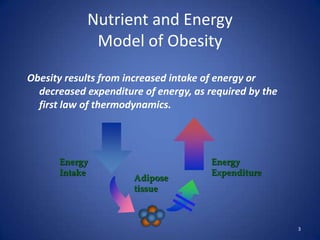
Nutrient and Energy Model of Obesity3Obesity results from increased intake of energy or decreased expenditure of energy, as required by the first law of thermodynamics.Energy IntakeEnergy ExpenditureAdipose tissue
Total energy expenditure(TEE) Resting energy expenditure(REE)- represents the energy expended for normal cellular and organ function under post absorptive resting conditions- 70% of total TEEEnergy expended in physical activity – includes both volitional activity like exercise and non volitional activity like  muscle contractions, maintaining posture- 20% of TEEThermic effect of food(TEF) – the energy expended in digestion, absorption and sympathetic nervous system activation after a meal
Obese individuals have a greater rate of REE due to increased adipose tissue cell mass.During non weight bearing activities obese individuals spend the same amount of energy as lean individuals but during weight bearing activities obese individuals spend greater energy on physical activity.There is reduction in thermic effect of food due to insulin resistance and blunted sympathetic nervous system activity in obesityDiet induced weight loss reduces REE by 15 to 30%
Adipose tissueEnergy depots that store triglycerides during feeding and release fatty acids during fastingFunctions as endocrine organ and secretes    - leptin   - resistin   - estrogens   - tumor necrosis factor α
Adipocyte formationObesity is associated with increased number of adipocytes.Adipocytes are formed from fibroblast precursor by extra nuclear factors and signal transduction pathways for differentiation Very early – Lipo protein lipase(LPL)Early          -  Methyl Isobutyl Xanthine(MIX)                  -  Dexamethasone                  -  Insulin                  -  Enhancer Binding Protein(EBP)Intermediate – Peroxisome Proliferator Activated Receptor(PRAR)Late – EBPand adipocyte specific gene expression
Triglyceride storageThe major function of adipocytes is storage of triglycerides Triglycerides stored within adipose tissue constitute the body’s major energy reserveTriglycerides yield 9.3 kcal/g upon oxidation Stored as oil inside the fat cellMost of the triglycerides in adipocytes is derived from chylomicrons and VLDL
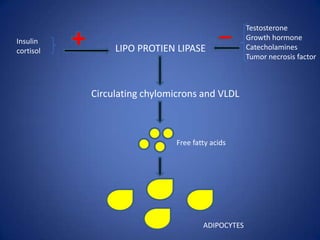
Regulation of storageLipo protein lipase(LPL) – is a key regulator of fat cell triglyceride uptake from circulating triglycerides.LPL is synthesized by adipocytes.The interaction of LPL with chylomicrons and VLDL release fatty acids from plasma triglycerides, which are then taken up by local adipocytes
TestosteroneGrowth hormoneCatecholaminesTumor necrosis factorInsulincortisolLIPO PROTIEN LIPASECirculating chylomicrons and VLDLFree fatty acidsADIPOCYTES
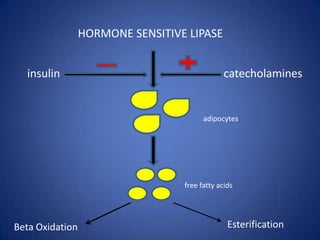
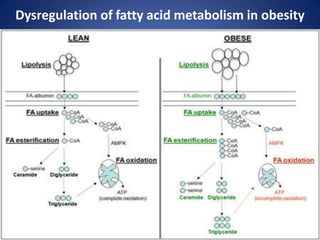
LIPOLYSIS    Alterations in adipocyte lipolysis (triglyceride breakdown) is observed in obesity and results in increased release of fatty acids into the circulation by1. Hormone sensitive lipase (HSL)2. Adipose triglyceride lipase (ATGL)-ATGL is highly expressed in white adipose tissue with less expression in skeletal muscle, accounts for 60-70% of triglyceride lipase activity in adipose and appears to be essential for the control of normal weight
HORMONE SENSITIVE LIPASEinsulincatecholaminesadipocytesfree fatty acidsEsterificationBeta Oxidation
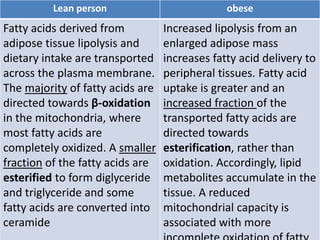
Dysregulation of fatty acid metabolism in obesity
ENDOCRINE FUNCTIONThe adipocyte produces and secretes a wide variety of hormones and cytokines (termed ‘adipokines’) that influence many biological processes, including substrate metabolism. Adipose tissue uses adipokines as a communication tool to signal changes in its mass and energy status to other organs that control fuel usage, such as skeletal muscle and liver.
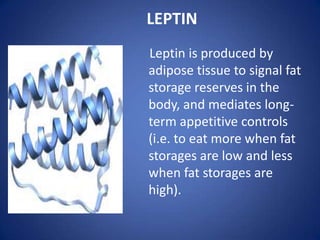
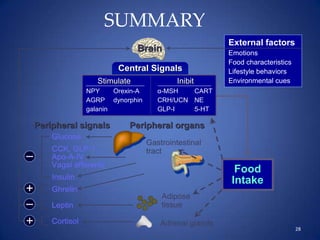
LEPTIN    Leptin is produced by adipose tissue to signal fat storage reserves in the body, and mediates long-term appetitive controls (i.e. to eat more when fat storages are low and less when fat storages are high).
    Leptin acts on receptors in the hypothalamus of the brain where it inhibits appetite by 1. counteracting the effects of neuropeptideY      (a potent feeding stimulant secreted by cells     in the gut and in the hypothalamus)
 2.  Counteracting the effects of Anandamide (another potent feeding stimulant that binds to the same receptors as THC, the active ingredient of marijuana); and  3.  promoting the synthesis of α-MSH, an appetite suppressant. This inhibition is long-term, in contrast to the rapid inhibition of eating by cholecystokinin (CCK) and the slower suppression of hunger between meals mediated by PYY3-36.
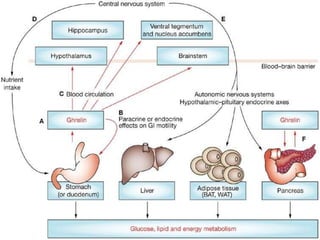
GhrelinGhrelin is produced by the stomach modulating short-term appetitive control (i.e. to eat when the stomach is empty and to stop when the stomach is stretched)
Ghrelin is secreted mainly by the stomach,  Has paracrine or endocrine effects on GI motilityCirculate in the blood and act on CNS growth hormone secretagogue receptors (GHS-Rs) inside and outside the blood–brain barrier. Known target areas in the CNS include the hypothalamus, the ventral tegmentum and nucleus accumbens, the hippocampus and GHS-R populations in the brainstem area. The actions of ghrelin in the CNS contribute to the control of food intake and co-regulate tissue-specific cellular pathways in the periphery, thereby governing glucose, lipid and energy metabolism.
Central pathwayWhile Leptin and Ghrelinare produced peripherally, they control appetite through their actions on the central nervous system. In particular, they act on the hypothalamus, a region of the brain central to the regulation of food intake and energy expenditure.
    There are several circuits within the hypothalamus that contribute to its role in integrating appetite.The melanocortin pathway being the most well understood. The circuit begins with an area of the hypothalamus, the arcuate nucleus, that has outputs to the lateral hypothalamus (LH) and ventromedial hypothalamus (VMH), the brain's feeding and satiety centers, respectively.
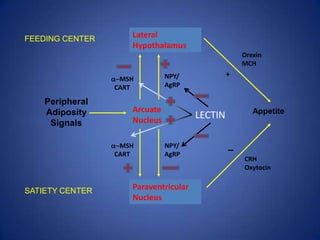
The Arcuatenucleus contains two distinct groups of neurons.    The first group co-expresses NeuropeptideY (NPY) and Agouti-related peptide (AgRP) and has stimulatory inputs to the LH and inhibitory inputs to the VMH
The second group coexpressespro-opiomelanocortin (POMC) and cocaine- and amphetamine-regulated transcript(CART) and has stimulatory inputs to the VMH and inhibitory inputs to the LH
Consequently, NPY/AgRP neurons stimulate feeding and inhibit satiety, while POMC/CART neurons stimulate satiety and inhibit feedingBoth groups of arcuate nucleus neurons are regulated in part by leptin. Leptin inhibits the NPY/AgRP group while stimulating the POMC/CART group
Lateral HypothalamusArcuate NucleusParaventricular NucleusFEEDING CENTEROrexinMCH+NPY/AgRPa-MSH  CARTPeripheralAdipositySignalsAppetiteLECTINNPY/AgRPa-MSH  CARTCRHOxytocinSATIETY CENTER
SUMMARY28
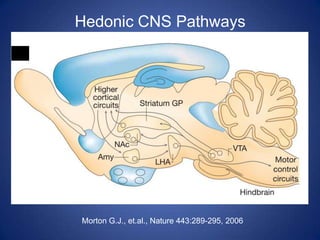
Hedonic CNS PathwaysMorton G.J., et.al., Nature 443:289-295, 2006
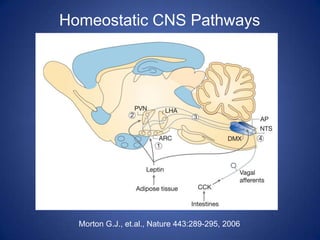
Homeostatic CNS PathwaysMorton G.J., et.al., Nature 443:289-295, 2006
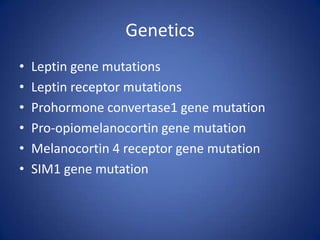
GeneticsLeptin gene mutationsLeptin receptor mutationsProhormone convertase1 gene mutationPro-opiomelanocortin gene mutationMelanocortin 4 receptor gene mutationSIM1 gene mutation
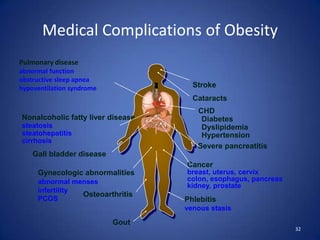
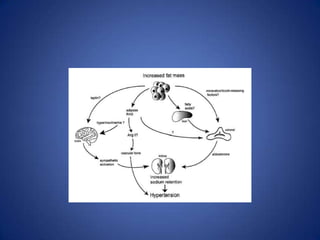
Medical Complications of ObesityPulmonary diseaseabnormal functionobstructive sleep apneahypoventilation syndrome32StrokeCataractsCHDDiabetesDyslipidemia   HypertensionNonalcoholic fatty liver diseasesteatosissteatohepatitiscirrhosisSevere pancreatitisGall bladderdiseaseCancerbreast, uterus, cervixcolon, esophagus, pancreaskidney, prostateGynecologic abnormalitiesabnormal mensesinfertilityPCOSOsteoarthritisPhlebitisvenous stasisGout
Metabolic abnormalities in obesity

Metabolic abnormalities in obesity

  • 1.
    Metabolic abnormalities inobesityBari Siddiqui M AShyam Prasad B R
  • 2.
    Energy MetabolismObesity iscaused by excessive intake of calories in relation to energy expenditure over a long period of time.The gastro intestinal tract has the capacity to absorb large amounts of nutrients.Large increases in body fat can result from even minor but chronic differences between energy intake and energy expenditure
  • 3.
    Nutrient and EnergyModel of Obesity3Obesity results from increased intake of energy or decreased expenditure of energy, as required by the first law of thermodynamics.Energy IntakeEnergy ExpenditureAdipose tissue
  • 4.
    Total energy expenditure(TEE)Resting energy expenditure(REE)- represents the energy expended for normal cellular and organ function under post absorptive resting conditions- 70% of total TEEEnergy expended in physical activity – includes both volitional activity like exercise and non volitional activity like muscle contractions, maintaining posture- 20% of TEEThermic effect of food(TEF) – the energy expended in digestion, absorption and sympathetic nervous system activation after a meal
  • 5.
    Obese individuals havea greater rate of REE due to increased adipose tissue cell mass.During non weight bearing activities obese individuals spend the same amount of energy as lean individuals but during weight bearing activities obese individuals spend greater energy on physical activity.There is reduction in thermic effect of food due to insulin resistance and blunted sympathetic nervous system activity in obesityDiet induced weight loss reduces REE by 15 to 30%
  • 6.
    Adipose tissueEnergy depotsthat store triglycerides during feeding and release fatty acids during fastingFunctions as endocrine organ and secretes - leptin - resistin - estrogens - tumor necrosis factor α
  • 7.
    Adipocyte formationObesity isassociated with increased number of adipocytes.Adipocytes are formed from fibroblast precursor by extra nuclear factors and signal transduction pathways for differentiation Very early – Lipo protein lipase(LPL)Early - Methyl Isobutyl Xanthine(MIX) - Dexamethasone - Insulin - Enhancer Binding Protein(EBP)Intermediate – Peroxisome Proliferator Activated Receptor(PRAR)Late – EBPand adipocyte specific gene expression
  • 8.
    Triglyceride storageThe majorfunction of adipocytes is storage of triglycerides Triglycerides stored within adipose tissue constitute the body’s major energy reserveTriglycerides yield 9.3 kcal/g upon oxidation Stored as oil inside the fat cellMost of the triglycerides in adipocytes is derived from chylomicrons and VLDL
  • 9.
    Regulation of storageLipoprotein lipase(LPL) – is a key regulator of fat cell triglyceride uptake from circulating triglycerides.LPL is synthesized by adipocytes.The interaction of LPL with chylomicrons and VLDL release fatty acids from plasma triglycerides, which are then taken up by local adipocytes
  • 10.
    TestosteroneGrowth hormoneCatecholaminesTumor necrosisfactorInsulincortisolLIPO PROTIEN LIPASECirculating chylomicrons and VLDLFree fatty acidsADIPOCYTES
  • 11.
    LIPOLYSIS Alterations in adipocyte lipolysis (triglyceride breakdown) is observed in obesity and results in increased release of fatty acids into the circulation by1. Hormone sensitive lipase (HSL)2. Adipose triglyceride lipase (ATGL)-ATGL is highly expressed in white adipose tissue with less expression in skeletal muscle, accounts for 60-70% of triglyceride lipase activity in adipose and appears to be essential for the control of normal weight
  • 12.
  • 14.
    Dysregulation of fattyacid metabolism in obesity
  • 15.
    ENDOCRINE FUNCTIONThe adipocyteproduces and secretes a wide variety of hormones and cytokines (termed ‘adipokines’) that influence many biological processes, including substrate metabolism. Adipose tissue uses adipokines as a communication tool to signal changes in its mass and energy status to other organs that control fuel usage, such as skeletal muscle and liver.
  • 16.
    LEPTIN Leptin is produced by adipose tissue to signal fat storage reserves in the body, and mediates long-term appetitive controls (i.e. to eat more when fat storages are low and less when fat storages are high).
  • 17.
    Leptin acts on receptors in the hypothalamus of the brain where it inhibits appetite by 1. counteracting the effects of neuropeptideY (a potent feeding stimulant secreted by cells in the gut and in the hypothalamus)
  • 18.
    2. Counteracting the effects of Anandamide (another potent feeding stimulant that binds to the same receptors as THC, the active ingredient of marijuana); and 3. promoting the synthesis of α-MSH, an appetite suppressant. This inhibition is long-term, in contrast to the rapid inhibition of eating by cholecystokinin (CCK) and the slower suppression of hunger between meals mediated by PYY3-36.
  • 19.
    GhrelinGhrelin is producedby the stomach modulating short-term appetitive control (i.e. to eat when the stomach is empty and to stop when the stomach is stretched)
  • 20.
    Ghrelin is secretedmainly by the stomach, Has paracrine or endocrine effects on GI motilityCirculate in the blood and act on CNS growth hormone secretagogue receptors (GHS-Rs) inside and outside the blood–brain barrier. Known target areas in the CNS include the hypothalamus, the ventral tegmentum and nucleus accumbens, the hippocampus and GHS-R populations in the brainstem area. The actions of ghrelin in the CNS contribute to the control of food intake and co-regulate tissue-specific cellular pathways in the periphery, thereby governing glucose, lipid and energy metabolism.
  • 22.
    Central pathwayWhile Leptinand Ghrelinare produced peripherally, they control appetite through their actions on the central nervous system. In particular, they act on the hypothalamus, a region of the brain central to the regulation of food intake and energy expenditure.
  • 23.
    There are several circuits within the hypothalamus that contribute to its role in integrating appetite.The melanocortin pathway being the most well understood. The circuit begins with an area of the hypothalamus, the arcuate nucleus, that has outputs to the lateral hypothalamus (LH) and ventromedial hypothalamus (VMH), the brain's feeding and satiety centers, respectively.
  • 24.
    The Arcuatenucleus containstwo distinct groups of neurons. The first group co-expresses NeuropeptideY (NPY) and Agouti-related peptide (AgRP) and has stimulatory inputs to the LH and inhibitory inputs to the VMH
  • 25.
    The second groupcoexpressespro-opiomelanocortin (POMC) and cocaine- and amphetamine-regulated transcript(CART) and has stimulatory inputs to the VMH and inhibitory inputs to the LH
  • 26.
    Consequently, NPY/AgRP neuronsstimulate feeding and inhibit satiety, while POMC/CART neurons stimulate satiety and inhibit feedingBoth groups of arcuate nucleus neurons are regulated in part by leptin. Leptin inhibits the NPY/AgRP group while stimulating the POMC/CART group
  • 27.
    Lateral HypothalamusArcuate NucleusParaventricularNucleusFEEDING CENTEROrexinMCH+NPY/AgRPa-MSH CARTPeripheralAdipositySignalsAppetiteLECTINNPY/AgRPa-MSH CARTCRHOxytocinSATIETY CENTER
  • 28.
  • 29.
    Hedonic CNS PathwaysMortonG.J., et.al., Nature 443:289-295, 2006
  • 30.
    Homeostatic CNS PathwaysMortonG.J., et.al., Nature 443:289-295, 2006
  • 31.
    GeneticsLeptin gene mutationsLeptinreceptor mutationsProhormone convertase1 gene mutationPro-opiomelanocortin gene mutationMelanocortin 4 receptor gene mutationSIM1 gene mutation
  • 32.
    Medical Complications ofObesityPulmonary diseaseabnormal functionobstructive sleep apneahypoventilation syndrome32StrokeCataractsCHDDiabetesDyslipidemia HypertensionNonalcoholic fatty liver diseasesteatosissteatohepatitiscirrhosisSevere pancreatitisGall bladderdiseaseCancerbreast, uterus, cervixcolon, esophagus, pancreaskidney, prostateGynecologic abnormalitiesabnormal mensesinfertilityPCOSOsteoarthritisPhlebitisvenous stasisGout