Chapter 7  Energy Balance and Weight Control     Lecture and Animation PowerPoint   Copyright © The McGraw-Hill Companies, Inc. Permission required for reproduction or display. To run the animations you must be in  Slideshow View .  Use the buttons on the animation to play, pause, and turn audio/text on or off.  Please Note : Once you have used any of the animation controls ,  you must click   in the white background before advancing to the next slide.
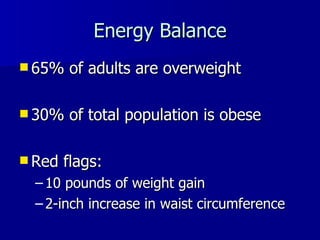
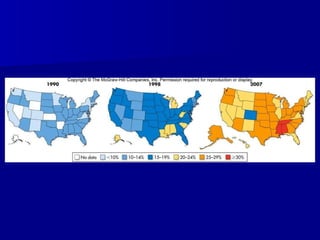
Energy Balance 65% of adults are overweight 30% of total population is obese Red flags:  10 pounds of weight gain  2-inch increase in waist circumference
 
Energy Balance
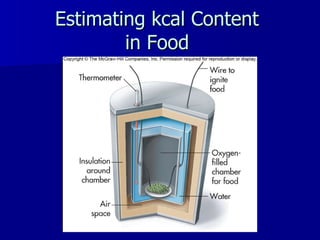
Estimating kcal Content  in Food
Bomb Calorimeter
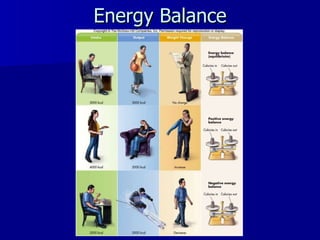
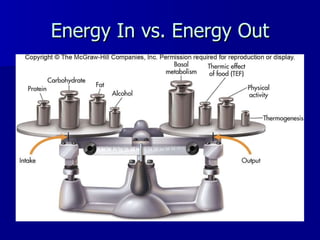
Energy In vs. Energy Out
Basal Metabolism   Minimum energy expended to keep a resting, awake body alive ~60-70% of total energy needs Includes energy needed for maintaining heartbeat, respiration, body temperature Amount of energy needed for basal metabolism varies between individuals Approximately 1 kcal/minute
Factors that Influence   Basal Metabolism Body surface area (weight, height) Lean body mass Gender Body temperature Thyroid hormone Nervous system activity Age Calorie intake Pregnancy Use of caffeine and tobacco
Physical Activity Increases energy expenditure More activity, more energy burned Lack of activity is a major cause of obesity
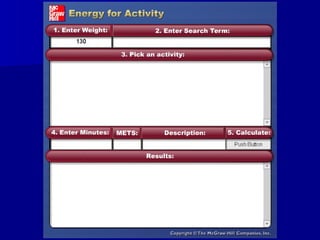
Energy for Activity
Thermic Effect of Food (TEF) Energy used to digest, absorb, and metabolize food nutrients “ Sales tax” of total energy consumed ~5-10% above the total calories consumed TEF is highest for protein > carbohydrate > fat
Adaptive Thermogenesis Nonvoluntary physical activity Triggered by overeating Fidgeting and shivering Maintenance of muscle tone Maintenance of posture Overeating  Increases sympathetic nervous system activity Resists weight gain Brown Adipose Tissue Participates in thermogenesis
Determination of Energy Needs Direct calorimetry Measures heat output  Expensive and complex Indirect calorimetry Measures the amount of oxygen consumed Oxygen consumed is related to energy expended
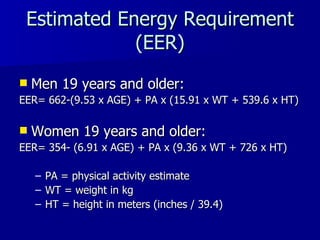
Estimated Energy Requirement (EER) Men 19 years and older: EER= 662-(9.53 x AGE) + PA x (15.91 x WT + 539.6 x HT) Women 19 years and older: EER= 354- (6.91 x AGE) + PA x (9.36 x WT + 726 x HT) PA = physical activity estimate WT = weight in kg HT = height in meters (inches / 39.4)
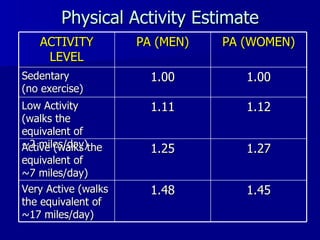
Physical Activity Estimate ACTIVITY LEVEL PA (MEN) PA (WOMEN) Sedentary  (no exercise) 1.00 1.00 Low Activity (walks the equivalent of  ~2 miles/day) 1.11 1.12 Active (walks the equivalent of  ~7 miles/day) 1.25 1.27 Very Active (walks the equivalent of ~17 miles/day) 1.48 1.45
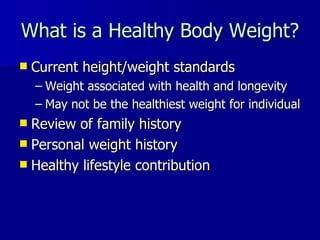
What is a Healthy Body Weight? Current height/weight standards Weight associated with health and longevity May not be the healthiest weight for individual Review of family history  Personal weight history Healthy lifestyle contribution
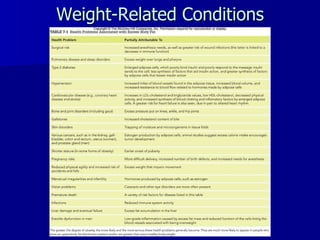
Weight-Related Conditions
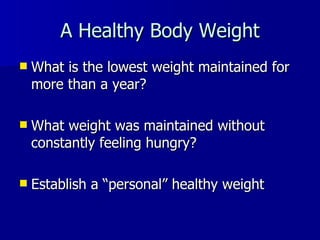
A Healthy Body Weight What is the lowest weight maintained for more than a year? What weight was maintained without constantly feeling hungry? Establish a  “personal” healthy weight
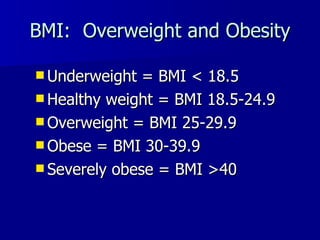
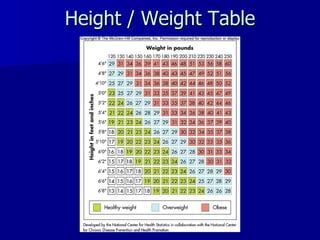
BMI:  Overweight and Obesity Underweight = BMI < 18.5 Healthy weight = BMI 18.5-24.9 Overweight = BMI 25-29.9 Obese = BMI 30-39.9 Severely obese = BMI >40
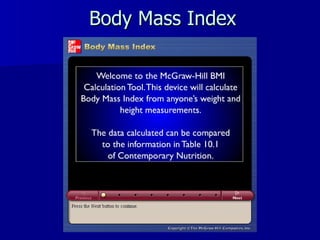
Body Mass Index
Height / Weight Table
Perspective on Weight Aim for personal healthy weight Avoid unrealistic goals Listen to body ’s cues (for hunger) Eat a healthy diet Be physically active “ Size acceptance”
Obesity Excessive amount of body fat Women  > 35% body fat Men  > 24% body fat Increased risk for health problems  Are usually truly overweight
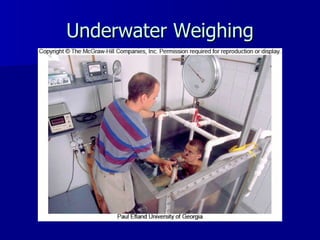
Estimation of Body Fat Underwater weighing Very accurate Fat is less dense than lean tissue Fat floats
Underwater Weighing
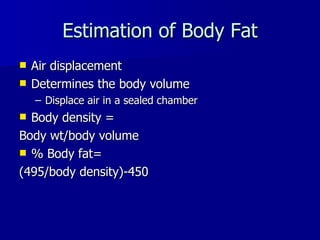
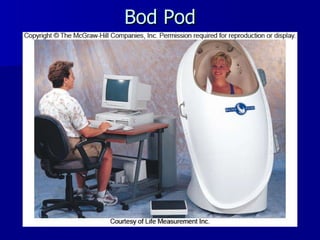
Estimation of Body Fat Air displacement Determines the body volume Displace air in a sealed chamber Body density = Body wt/body volume % Body fat= (495/body density)-450
Bod Pod
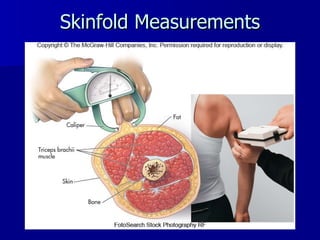
Skinfold Measurements
 
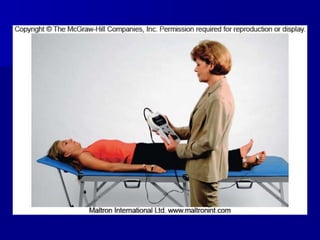
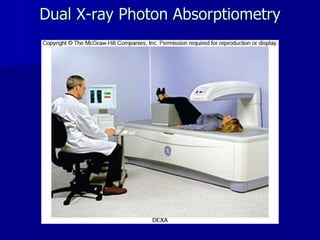
Estimation of Body Fat Bioelectrical impedance Low-energy current that measures the resistance of electrical flow Fat is resistant to electrical flow; the more the resistance, the more body fat  DEXA (dual x-ray photon absorptiometry) X-ray body scan that allows for the determination of body fat Most accurate but expensive
Dual X-ray Photon Absorptiometry
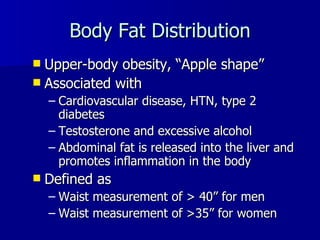
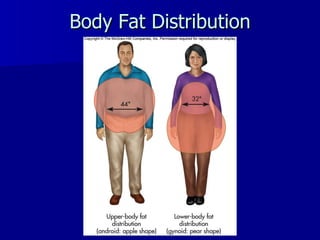
Body Fat Distribution Upper-body obesity,  “Apple shape” Associated with  Cardiovascular disease, HTN, type 2 diabetes Testosterone and excessive alcohol Abdominal fat is released into the liver and promotes inflammation in the body Defined as  Waist measurement of > 40 ” for men  Waist measurement of >35 ” for women
Body Fat Distribution
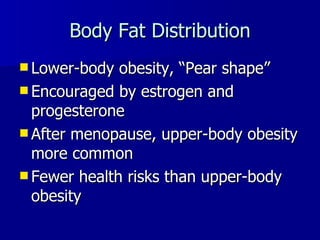
Body Fat Distribution Lower-body obesity,  “Pear shape” Encouraged by estrogen and progesterone After menopause, upper-body obesity more common Fewer health risks than upper-body obesity
Juvenile-Onset Obesity Develops in infancy or childhood Increase in the number of adipose cells Adipose cells have long lifespan and need to store fat Makes it difficult to lose fat (weight loss)
War on obesity
Adult-Onset Obesity Develops in adulthood Fewer (number of) adipose cells Adipose cells are larger (store excess amount of fat) If weight gain continues, the number of adipose cells can increase
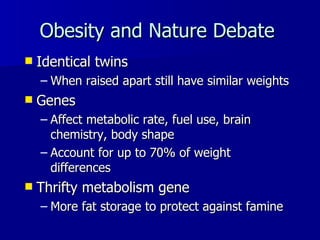
Obesity and Nature Debate   Identical twins   When raised apart still have similar weights Genes  Affect metabolic rate, fuel use, brain chemistry, body shape Account for up to 70% of weight differences Thrifty metabolism gene  More fat storage to protect against famine
Set-Point Theory Weight is regulated by the body Genetically predetermined body weight Body resists weight change Leptin assists in weight regulation Reduction in calorie intake results in lower metabolic rate Ability to shift the set-point weight?
Opponents of Set-Point Theory Weight does not remain constant Different environments can alter weight People settle into a particular weight based on current circumstances
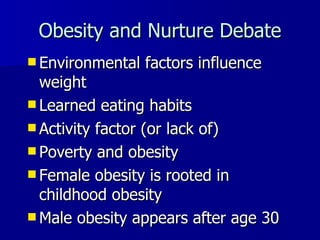
Obesity and Nurture Debate Environmental factors influence weight Learned eating habits Activity factor (or lack of) Poverty and obesity Female obesity is rooted in childhood obesity Male obesity appears after age 30
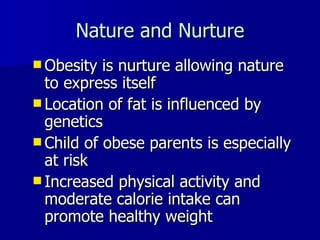
Nature and Nurture Obesity is nurture allowing nature to express itself Location of fat is influenced by genetics Child of obese parents is especially at risk  Increased physical activity and moderate calorie intake can promote healthy weight
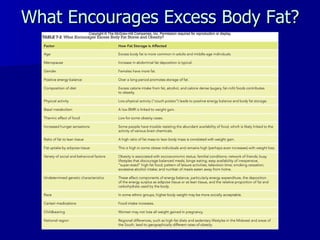
What Encourages Excess Body Fat?
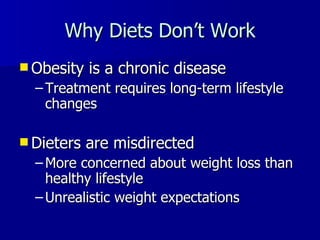
Why Diets Don ’t Work Obesity is a chronic disease Treatment requires long-term lifestyle changes Dieters are misdirected More concerned about weight loss than healthy lifestyle Unrealistic weight expectations
Looking for a Sound  Weight-Loss Program? Seek advice from a Registered Dietitian  Control calorie intake Increase physical activity Acknowledge need for lifelong changes to maintain healthy weight
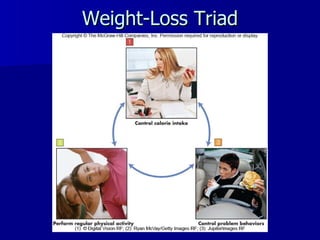
Weight-Loss Triad
Control Calories Sedentary society---requires less calories Low-fat, high-fiber approaches Most successful in long-term studies No diet has a  “metabolic advantage” Read food labels Keep a food log (portion size awareness)
Regular Physical Activity Important for weight maintenance Promotes steady weight loss Expends 100-300 kcal while controlling calories Boosts self-esteem Add weight resistance Increase lean body mass  Increase fat use Increase bone health Increase metabolic rate
Physical Activity Recommendations 60 minutes/day to maintain body weight 60-90 minutes/day for maintenance of weight loss Pedometer Goal 10,000 steps a day
What it Takes to Lose a Pound Body fat contains 3500 kcal per pound Fat storage (body fat plus supporting lean tissues) contains 3300 kcal per pound Must have an energy deficit of about 3300 kcal to lose a pound per week
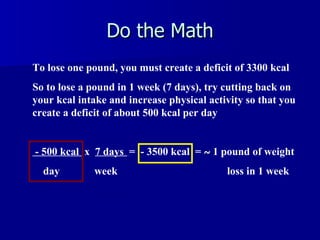
Do the Math To lose one pound, you must create a deficit of 3300 kcal So to lose a pound in 1 week (7 days), try cutting back on your kcal intake and increase physical activity so that you create a deficit of about 500 kcal per day - 500 kcal  x  7 days  =  - 3500 kcal  =  ~   1 pound of weight day  week  loss in 1 week
Sound Weight Loss Program Rate of loss Flexibility Intake Behavior modification Overall health
Behavior Modification Modify problem (eating) behaviors Chain-breaking Stimulus control Cognitive restructuring Contingency management Self-monitoring
Chain-Breaking Breaking the link between two behaviors These links can lead to excessive intake
Stimulus Control Altering the environment   Minimize the stimuli for eating Putting  you  in charge of temptations
Cognitive Restructuring Changing your frame of mind regarding eating Replacing eating due to stress with  “walking”
Contingency Management Forming a plan of action  Response to a situation Rehearsing appropriate responses   The pressure of eating at parties
Self-Monitoring Tracking foods eaten and conditions affecting eating Understanding your eating habits
Weight Maintenance Prevent relapse Occasional lapse is fine, but take charge immediately Continue to practice newly learned behavior Requires  “motivation, movement, and monitoring” Have social support Encouragement from friends/ family/ professionals
Diet Drugs Amphetamine (Phenteramine) Prolongs the activity of epinephrine and norepinephrine in the brain Decreases appetite Not recommended for long-term use (dependency) Sibutramine (Meridia) Enhances norepinephrine and serotonin activity Decreases appetite  Not recommended for people with HTN
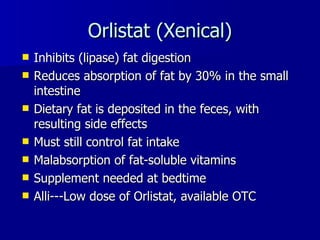
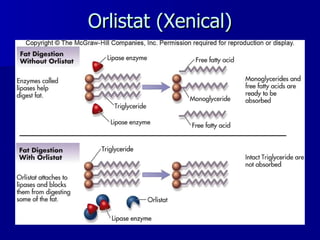
Orlistat (Xenical) Inhibits (lipase) fat digestion Reduces absorption of fat by 30% in the small intestine Dietary fat is deposited in the feces, with resulting side effects Must still control fat intake Malabsorption of fat-soluble vitamins Supplement needed at bedtime Alli---Low dose of Orlistat, available OTC
Orlistat (Xenical)
Treatment of Severe Obesity
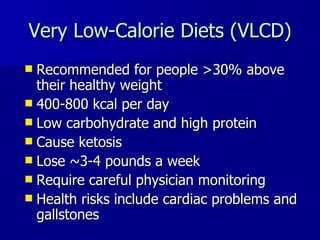
Very Low-Calorie Diets (VLCD) Recommended for people >30% above their healthy weight 400-800 kcal per day Low carbohydrate and high protein Cause ketosis Lose ~3-4 pounds a week Require careful physician monitoring Health risks include cardiac problems and gallstones
Bariatric Surgery
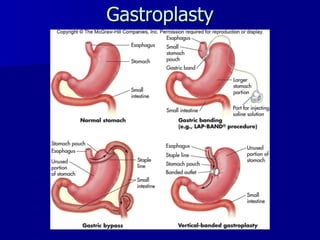
Adjustable Gastric Banding Reduces opening from esophagus to stomach by gastric band Decreases amount of food eaten Band can be inflated or deflated
Gastroplasty - Stomach Stapling Most common surgical procedure for treating severe obesity Reduces the stomach size  From 4 cups to 1 oz (shot glass size) Overeating will result in rapid vomiting Smaller stomach promotes satiety earlier 75% will lose ~50% of excess body weight
Gastroplasty
Criteria for Gastroplasty BMI > 40 Obese for > 5 years No history of alcoholism No history of major psychiatric disorder Costly procedure Follow-up needed after procedure loss Requires major lifestyle changes
Underweight is Also a Problem BMI of <18.5 Associated with increased deaths, menstrual dysfunction, pregnancy complications, slower recovery from illness/surgery
Treatment for Underweight Intake of energy-dense foods (energy input) Encourage regular meals and snacks Reduce activity (energy output) Increase portion size Strength training
Fad Diets Promote quick weight loss Limited food selections Use of testimonials Cure-alls Recommend expensive supplements No permanent lifestyle changes advocated Critical of the scientific community
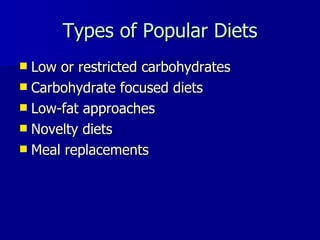
Types of Popular Diets Low or restricted carbohydrates Carbohydrate focused diets Low-fat approaches Novelty diets Meal replacements
Low-carb diets take off pounds but at what risk?
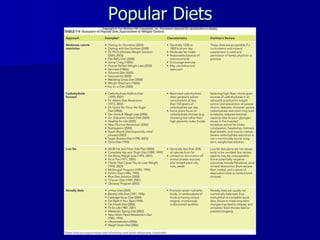
Popular Diets

Ch7 Energy Balance and Weight Control

  • 1.
    Chapter 7 Energy Balance and Weight Control Lecture and Animation PowerPoint Copyright © The McGraw-Hill Companies, Inc. Permission required for reproduction or display. To run the animations you must be in Slideshow View . Use the buttons on the animation to play, pause, and turn audio/text on or off. Please Note : Once you have used any of the animation controls , you must click in the white background before advancing to the next slide.
  • 2.
    Energy Balance 65%of adults are overweight 30% of total population is obese Red flags: 10 pounds of weight gain 2-inch increase in waist circumference
  • 3.
  • 4.
  • 5.
  • 6.
  • 7.
    Energy In vs.Energy Out
  • 8.
    Basal Metabolism Minimum energy expended to keep a resting, awake body alive ~60-70% of total energy needs Includes energy needed for maintaining heartbeat, respiration, body temperature Amount of energy needed for basal metabolism varies between individuals Approximately 1 kcal/minute
  • 9.
    Factors that Influence Basal Metabolism Body surface area (weight, height) Lean body mass Gender Body temperature Thyroid hormone Nervous system activity Age Calorie intake Pregnancy Use of caffeine and tobacco
  • 10.
    Physical Activity Increasesenergy expenditure More activity, more energy burned Lack of activity is a major cause of obesity
  • 11.
  • 12.
    Thermic Effect ofFood (TEF) Energy used to digest, absorb, and metabolize food nutrients “ Sales tax” of total energy consumed ~5-10% above the total calories consumed TEF is highest for protein > carbohydrate > fat
  • 13.
    Adaptive Thermogenesis Nonvoluntaryphysical activity Triggered by overeating Fidgeting and shivering Maintenance of muscle tone Maintenance of posture Overeating Increases sympathetic nervous system activity Resists weight gain Brown Adipose Tissue Participates in thermogenesis
  • 14.
    Determination of EnergyNeeds Direct calorimetry Measures heat output Expensive and complex Indirect calorimetry Measures the amount of oxygen consumed Oxygen consumed is related to energy expended
  • 15.
    Estimated Energy Requirement(EER) Men 19 years and older: EER= 662-(9.53 x AGE) + PA x (15.91 x WT + 539.6 x HT) Women 19 years and older: EER= 354- (6.91 x AGE) + PA x (9.36 x WT + 726 x HT) PA = physical activity estimate WT = weight in kg HT = height in meters (inches / 39.4)
  • 16.
    Physical Activity EstimateACTIVITY LEVEL PA (MEN) PA (WOMEN) Sedentary (no exercise) 1.00 1.00 Low Activity (walks the equivalent of ~2 miles/day) 1.11 1.12 Active (walks the equivalent of ~7 miles/day) 1.25 1.27 Very Active (walks the equivalent of ~17 miles/day) 1.48 1.45
  • 17.
    What is aHealthy Body Weight? Current height/weight standards Weight associated with health and longevity May not be the healthiest weight for individual Review of family history Personal weight history Healthy lifestyle contribution
  • 18.
  • 19.
    A Healthy BodyWeight What is the lowest weight maintained for more than a year? What weight was maintained without constantly feeling hungry? Establish a “personal” healthy weight
  • 20.
    BMI: Overweightand Obesity Underweight = BMI < 18.5 Healthy weight = BMI 18.5-24.9 Overweight = BMI 25-29.9 Obese = BMI 30-39.9 Severely obese = BMI >40
  • 21.
  • 22.
  • 23.
    Perspective on WeightAim for personal healthy weight Avoid unrealistic goals Listen to body ’s cues (for hunger) Eat a healthy diet Be physically active “ Size acceptance”
  • 24.
    Obesity Excessive amountof body fat Women > 35% body fat Men > 24% body fat Increased risk for health problems Are usually truly overweight
  • 25.
    Estimation of BodyFat Underwater weighing Very accurate Fat is less dense than lean tissue Fat floats
  • 26.
  • 27.
    Estimation of BodyFat Air displacement Determines the body volume Displace air in a sealed chamber Body density = Body wt/body volume % Body fat= (495/body density)-450
  • 28.
  • 29.
  • 30.
  • 31.
    Estimation of BodyFat Bioelectrical impedance Low-energy current that measures the resistance of electrical flow Fat is resistant to electrical flow; the more the resistance, the more body fat DEXA (dual x-ray photon absorptiometry) X-ray body scan that allows for the determination of body fat Most accurate but expensive
  • 32.
    Dual X-ray PhotonAbsorptiometry
  • 33.
    Body Fat DistributionUpper-body obesity, “Apple shape” Associated with Cardiovascular disease, HTN, type 2 diabetes Testosterone and excessive alcohol Abdominal fat is released into the liver and promotes inflammation in the body Defined as Waist measurement of > 40 ” for men Waist measurement of >35 ” for women
  • 34.
  • 35.
    Body Fat DistributionLower-body obesity, “Pear shape” Encouraged by estrogen and progesterone After menopause, upper-body obesity more common Fewer health risks than upper-body obesity
  • 36.
    Juvenile-Onset Obesity Developsin infancy or childhood Increase in the number of adipose cells Adipose cells have long lifespan and need to store fat Makes it difficult to lose fat (weight loss)
  • 37.
  • 38.
    Adult-Onset Obesity Developsin adulthood Fewer (number of) adipose cells Adipose cells are larger (store excess amount of fat) If weight gain continues, the number of adipose cells can increase
  • 39.
    Obesity and NatureDebate Identical twins When raised apart still have similar weights Genes Affect metabolic rate, fuel use, brain chemistry, body shape Account for up to 70% of weight differences Thrifty metabolism gene More fat storage to protect against famine
  • 40.
    Set-Point Theory Weightis regulated by the body Genetically predetermined body weight Body resists weight change Leptin assists in weight regulation Reduction in calorie intake results in lower metabolic rate Ability to shift the set-point weight?
  • 41.
    Opponents of Set-PointTheory Weight does not remain constant Different environments can alter weight People settle into a particular weight based on current circumstances
  • 42.
    Obesity and NurtureDebate Environmental factors influence weight Learned eating habits Activity factor (or lack of) Poverty and obesity Female obesity is rooted in childhood obesity Male obesity appears after age 30
  • 43.
    Nature and NurtureObesity is nurture allowing nature to express itself Location of fat is influenced by genetics Child of obese parents is especially at risk Increased physical activity and moderate calorie intake can promote healthy weight
  • 44.
  • 45.
    Why Diets Don’t Work Obesity is a chronic disease Treatment requires long-term lifestyle changes Dieters are misdirected More concerned about weight loss than healthy lifestyle Unrealistic weight expectations
  • 46.
    Looking for aSound Weight-Loss Program? Seek advice from a Registered Dietitian Control calorie intake Increase physical activity Acknowledge need for lifelong changes to maintain healthy weight
  • 47.
  • 48.
    Control Calories Sedentarysociety---requires less calories Low-fat, high-fiber approaches Most successful in long-term studies No diet has a “metabolic advantage” Read food labels Keep a food log (portion size awareness)
  • 49.
    Regular Physical ActivityImportant for weight maintenance Promotes steady weight loss Expends 100-300 kcal while controlling calories Boosts self-esteem Add weight resistance Increase lean body mass Increase fat use Increase bone health Increase metabolic rate
  • 50.
    Physical Activity Recommendations60 minutes/day to maintain body weight 60-90 minutes/day for maintenance of weight loss Pedometer Goal 10,000 steps a day
  • 51.
    What it Takesto Lose a Pound Body fat contains 3500 kcal per pound Fat storage (body fat plus supporting lean tissues) contains 3300 kcal per pound Must have an energy deficit of about 3300 kcal to lose a pound per week
  • 52.
    Do the MathTo lose one pound, you must create a deficit of 3300 kcal So to lose a pound in 1 week (7 days), try cutting back on your kcal intake and increase physical activity so that you create a deficit of about 500 kcal per day - 500 kcal x 7 days = - 3500 kcal = ~ 1 pound of weight day week loss in 1 week
  • 53.
    Sound Weight LossProgram Rate of loss Flexibility Intake Behavior modification Overall health
  • 54.
    Behavior Modification Modifyproblem (eating) behaviors Chain-breaking Stimulus control Cognitive restructuring Contingency management Self-monitoring
  • 55.
    Chain-Breaking Breaking thelink between two behaviors These links can lead to excessive intake
  • 56.
    Stimulus Control Alteringthe environment Minimize the stimuli for eating Putting you in charge of temptations
  • 57.
    Cognitive Restructuring Changingyour frame of mind regarding eating Replacing eating due to stress with “walking”
  • 58.
    Contingency Management Forminga plan of action Response to a situation Rehearsing appropriate responses The pressure of eating at parties
  • 59.
    Self-Monitoring Tracking foodseaten and conditions affecting eating Understanding your eating habits
  • 60.
    Weight Maintenance Preventrelapse Occasional lapse is fine, but take charge immediately Continue to practice newly learned behavior Requires “motivation, movement, and monitoring” Have social support Encouragement from friends/ family/ professionals
  • 61.
    Diet Drugs Amphetamine(Phenteramine) Prolongs the activity of epinephrine and norepinephrine in the brain Decreases appetite Not recommended for long-term use (dependency) Sibutramine (Meridia) Enhances norepinephrine and serotonin activity Decreases appetite Not recommended for people with HTN
  • 62.
    Orlistat (Xenical) Inhibits(lipase) fat digestion Reduces absorption of fat by 30% in the small intestine Dietary fat is deposited in the feces, with resulting side effects Must still control fat intake Malabsorption of fat-soluble vitamins Supplement needed at bedtime Alli---Low dose of Orlistat, available OTC
  • 63.
  • 64.
  • 65.
    Very Low-Calorie Diets(VLCD) Recommended for people >30% above their healthy weight 400-800 kcal per day Low carbohydrate and high protein Cause ketosis Lose ~3-4 pounds a week Require careful physician monitoring Health risks include cardiac problems and gallstones
  • 66.
  • 67.
    Adjustable Gastric BandingReduces opening from esophagus to stomach by gastric band Decreases amount of food eaten Band can be inflated or deflated
  • 68.
    Gastroplasty - StomachStapling Most common surgical procedure for treating severe obesity Reduces the stomach size From 4 cups to 1 oz (shot glass size) Overeating will result in rapid vomiting Smaller stomach promotes satiety earlier 75% will lose ~50% of excess body weight
  • 69.
  • 70.
    Criteria for GastroplastyBMI > 40 Obese for > 5 years No history of alcoholism No history of major psychiatric disorder Costly procedure Follow-up needed after procedure loss Requires major lifestyle changes
  • 71.
    Underweight is Alsoa Problem BMI of <18.5 Associated with increased deaths, menstrual dysfunction, pregnancy complications, slower recovery from illness/surgery
  • 72.
    Treatment for UnderweightIntake of energy-dense foods (energy input) Encourage regular meals and snacks Reduce activity (energy output) Increase portion size Strength training
  • 73.
    Fad Diets Promotequick weight loss Limited food selections Use of testimonials Cure-alls Recommend expensive supplements No permanent lifestyle changes advocated Critical of the scientific community
  • 74.
    Types of PopularDiets Low or restricted carbohydrates Carbohydrate focused diets Low-fat approaches Novelty diets Meal replacements
  • 75.
    Low-carb diets takeoff pounds but at what risk?
  • 76.