
Robbins & Judge
Organizational Behavior
14th Edition
Personality and ValuesPersonality and Values
4-1
• What is Personality?
PersonalityPersonality
• The sum total of ways in which an
individual reacts and interacts with
others, the measurable traits a
person exhibits
PersonalityPersonality
Personality embraces a person's
moods, attitudes, opinions,
motivations, and style of thinking,
perceiving, speaking, and acting.
It is part of what makes each
individual distinct.
PersonalityPersonality
The combination of characteristics or
qualities that form an individual's
distinctive character.
Totality of an individual's behavioral
and emotional characteristics.
PersonalityPersonality
Investigating individual differences,
that is, how people can differ from
one another.
Investigating human nature, that is,
how all people's behaviour is
similar.
• The combination of psychological
traits we use to classify & describe a
person in terms of characteristics
such as quiet, passive, loud,
aggressive, etc.
PersonalityPersonality
A dynamic and organized set of
characteristics possessed by a person
that uniquely influences his or her
cognitions, motivations, and behaviors
in various situations.
1. Self-reporting surveys
2. Observer-ratings surveys
3. Projective Measures
a) Rorschach Inkblot Test
b) Thematic Apperception Test
Measuring Personality
Assessing the Unconscious -- RorschachAssessing the Unconscious -- Rorschach
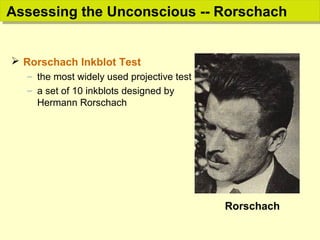
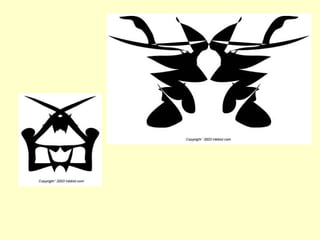
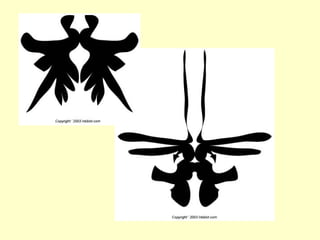
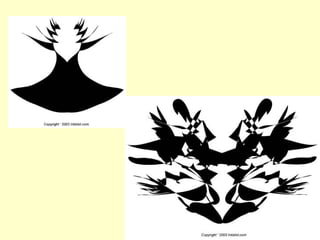
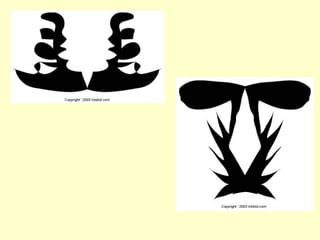
 Rorschach Inkblot Test
– the most widely used projective test
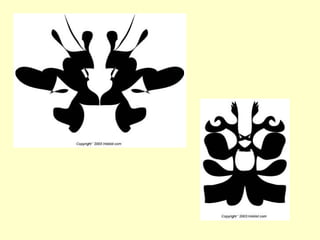
– a set of 10 inkblots designed by
Hermann Rorschach
Rorschach
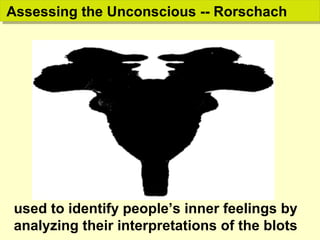
used to identify people’s inner feelings by
analyzing their interpretations of the blots
Assessing the Unconscious -- RorschachAssessing the Unconscious -- Rorschach
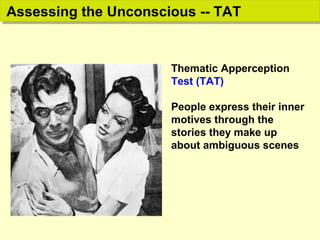
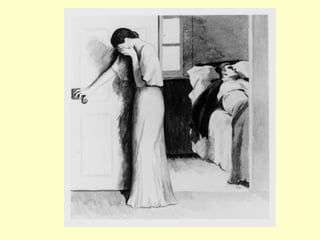
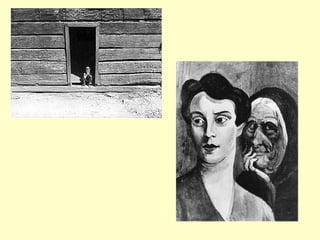
Thematic Apperception
Test (TAT)
People express their inner
motives through the
stories they make up
about ambiguous scenes
Assessing the Unconscious -- TATAssessing the Unconscious -- TAT
3-22
Personality TraitsPersonality Traits
 Particular tendencies to feel, think, and act
in certain ways that can be used to
describe the personality of every
individual
 Manager’s personalities influence their
behavior and approach to managing
people and resources
3-23
Manager’s and TraitsManager’s and Traits
 No single trait is right or wrong for being an
effective manager
 Effectiveness is determined by a complex
interaction between the characteristics of
managers and the nature of the job and
organization in which they are working
3-24
Manager’s and TraitsManager’s and Traits
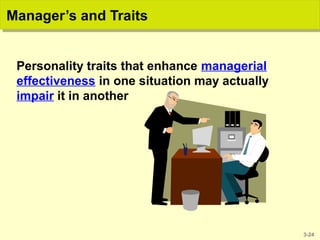
Personality traits that enhance managerial
effectiveness in one situation may actually
impair it in another
 Personality Tests;
1. Screening
2. Selection
3. Succession Planning
4. Career Planning
5. Team Building
6. Management Development
Personality Tests Can help in;Personality Tests Can help in;
Personality DeterminantsPersonality Determinants
Heredity
– Factors determined at conception: physical
stature, facial attractiveness, gender, temperament,
muscle composition and reflexes, energy level, and
bio-rhythms
– This “Heredity Approach” argues that genes are
the source of personality
– Twin studies: raised apart but very similar
personalities
– There is some personality change over long time
periods
Heredity;
 It includes physical stature, facial attractiveness,
gender, temperament, muscle composition, reflexes,
energy level, biological rhythms are influenced by the
parents biological, physiological and psychological
make up.
Environment;
 Culture establishes the norms, attitudes and values that
plays an important role in shaping our personality.
Situation;
 Situation influences the effects of heredity and
environment.
Personality DeterminantsPersonality Determinants
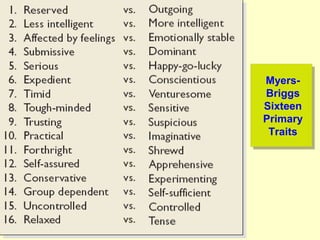
Myers-
Briggs
Sixteen
Primary
Traits
Myers-
Briggs
Sixteen
Primary
Traits
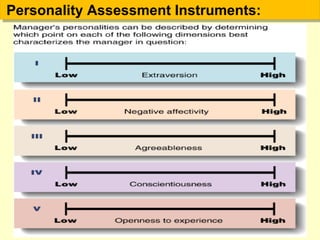
Personality Assessment Instruments:Personality Assessment Instruments:
 Enduring characteristics that describe an
individual’s behavior
 Two dominant frameworks used to describe
personality
1) Myers-Briggs Type Indicator (MBTI®
)
2) Big Five Model
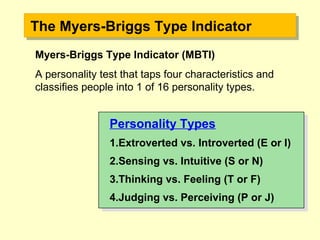
The Myers-Briggs Type IndicatorThe Myers-Briggs Type Indicator
Personality Types
1.Extroverted vs. Introverted (E or I)
2.Sensing vs. Intuitive (S or N)
3.Thinking vs. Feeling (T or F)
4.Judging vs. Perceiving (P or J)
Personality Types
1.Extroverted vs. Introverted (E or I)
2.Sensing vs. Intuitive (S or N)
3.Thinking vs. Feeling (T or F)
4.Judging vs. Perceiving (P or J)
Myers-Briggs Type Indicator (MBTI)
A personality test that taps four characteristics and
classifies people into 1 of 16 personality types.
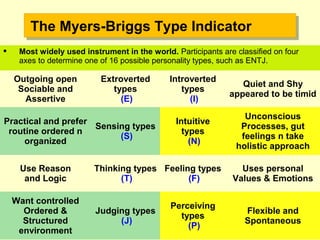
 Most widely used instrument in the world. Participants are classified on four
axes to determine one of 16 possible personality types, such as ENTJ.
Outgoing open
Sociable and
Assertive
Extroverted
types
(E)
Introverted
types
(I)
Quiet and Shy
appeared to be timid
Practical and prefer
routine ordered n
organized
Sensing types
(S)
Intuitive
types
(N)
Unconscious
Processes, gut
feelings n take
holistic approach
Use Reason
and Logic
Thinking types
(T)
Feeling types
(F)
Uses personal
Values & Emotions
Want controlled
Ordered &
Structured
environment
Judging types
(J)
Perceiving
types
(P)
Flexible and
Spontaneous
The Myers-Briggs Type IndicatorThe Myers-Briggs Type Indicator
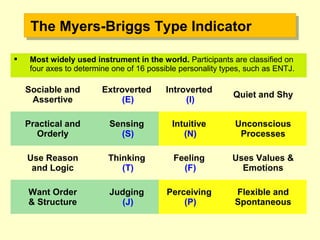
 Most widely used instrument in the world. Participants are classified on
four axes to determine one of 16 possible personality types, such as ENTJ.
Sociable and
Assertive
Extroverted
(E)
Introverted
(I)
Quiet and Shy
Practical and
Orderly
Sensing
(S)
Intuitive
(N)
Unconscious
Processes
Use Reason
and Logic
Thinking
(T)
Feeling
(F)
Uses Values &
Emotions
Want Order
& Structure
Judging
(J)
Perceiving
(P)
Flexible and
Spontaneous
The Myers-Briggs Type IndicatorThe Myers-Briggs Type Indicator
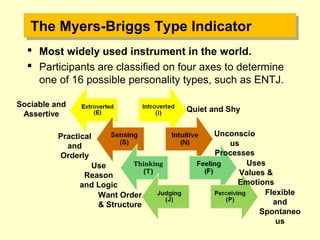
 Most widely used instrument in the world.
 Participants are classified on four axes to determine
one of 16 possible personality types, such as ENTJ.
Flexible
and
Spontaneo
us
Sociable and
Assertive
Quiet and Shy
Unconscio
us
Processes
Uses
Values &
Emotions
Practical
and
Orderly
Use
Reason
and Logic
Want Order
& Structure
The Types and Their UsesThe Types and Their Uses
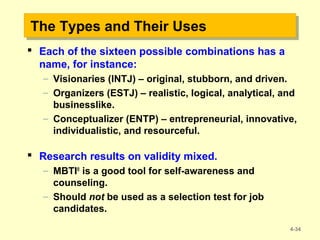
 Each of the sixteen possible combinations has a
name, for instance:
– Visionaries (INTJ) – original, stubborn, and driven.
– Organizers (ESTJ) – realistic, logical, analytical, and
businesslike.
– Conceptualizer (ENTP) – entrepreneurial, innovative,
individualistic, and resourceful.
 Research results on validity mixed.
– MBTI®
is a good tool for self-awareness and
counseling.
– Should not be used as a selection test for job
candidates.
4-34
Personality Assessment Instruments:Personality Assessment Instruments:
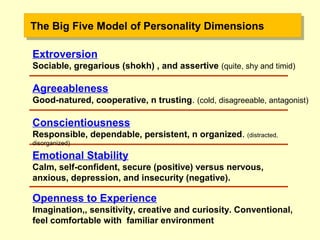
The Big Five Model of Personality DimensionsThe Big Five Model of Personality Dimensions
Extroversion
Sociable, gregarious (shokh) , and assertive (quite, shy and timid)
Agreeableness
Good-natured, cooperative, n trusting. (cold, disagreeable, antagonist)
Conscientiousness
Responsible, dependable, persistent, n organized. (distracted,
disorganized)
Openness to Experience
Imagination,, sensitivity, creative and curiosity. Conventional,
feel comfortable with familiar environment
Emotional Stability
Calm, self-confident, secure (positive) versus nervous,
anxious, depression, and insecurity (negative).
3-37
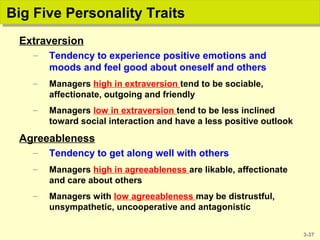
Big Five Personality TraitsBig Five Personality Traits
Extraversion
– Tendency to experience positive emotions and
moods and feel good about oneself and others
– Managers high in extraversion tend to be sociable,
affectionate, outgoing and friendly
– Managers low in extraversion tend to be less inclined
toward social interaction and have a less positive outlook
Agreeableness
– Tendency to get along well with others
– Managers high in agreeableness are likable, affectionate
and care about others
– Managers with low agreeableness may be distrustful,
unsympathetic, uncooperative and antagonistic
3-38
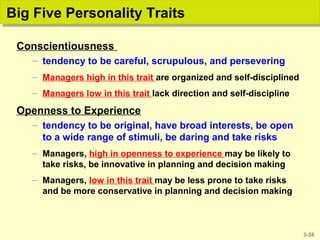
Big Five Personality TraitsBig Five Personality Traits
Conscientiousness
– tendency to be careful, scrupulous, and persevering
– Managers high in this trait are organized and self-disciplined
– Managers low in this trait lack direction and self-discipline
Openness to Experience
– tendency to be original, have broad interests, be open
to a wide range of stimuli, be daring and take risks
– Managers, high in openness to experience may be likely to
take risks, be innovative in planning and decision making
– Managers, low in this trait may be less prone to take risks
and be more conservative in planning and decision making
3-39
Big Five Personality TraitsBig Five Personality Traits
Emotional Stability
– Tendency to experience negative emotions and moods,
feel distressed, and be critical of oneself and others
– Managers high in negative affectivity may often feel
angry and dissatisfied and complain about their own and
others’ lack of progress
– Managers who are low in negative affectivity do not tend
to experience many negative emotions and moods and
are less pessimistic and critical of themselves and
others
How Do the Big Five Traits Predict Behavior?How Do the Big Five Traits Predict Behavior?
 Research has shown this to be a better framework.
 Certain traits have been shown to strongly relate to
higher job performance:
• Highly conscientious people develop more job knowledge,
exert greater effort, and have better performance.
• Other Big Five Traits also have implications for work.
• Emotional stability is related to job satisfaction.
• Extroverts tend to be happier in their jobs and have good
social skills.
• Open people are more creative and can be good leaders.
• Agreeable people are good in social settings.
Major Personality Attributes Influencing OBMajor Personality Attributes Influencing OB
 Core Self-evaluation
 Machiavellianism
 Narcissism
 Self-monitoring
 Risk taking
 Type A personality
Other personality traits influence OBOther personality traits influence OB
Core Self-Evaluation
The degree to which people like or dislike themselves
Positive self-evaluation leads to higher job performance
MachiavellianismMachiavellianism
Conditions Favoring High Machs
1.Direct interaction
2.Minimal rules and regulations
3.Emotions distract for others
Conditions Favoring High Machs
1.Direct interaction
2.Minimal rules and regulations
3.Emotions distract for others
Machiavellianism (Mach)
Degree to which an individual is pragmatic,
maintains emotional distance, and believes that
ends can justify means.
Machiavellianism:
• Abbreviated as Mach, it is named after Niccolo Machiavelli,
a sixteenth century prince.
• Machiavellianism is the degree to which an individual is
pragmatic, maintains emotional distance, and believes that
ends can justify means.
• High Mach individuals manipulate more, persuade more and
win more than low Machs.
• The success and job satisfaction depends mainly on
situational factors and the type of job.
Other personality traits influence OBOther personality traits influence OB
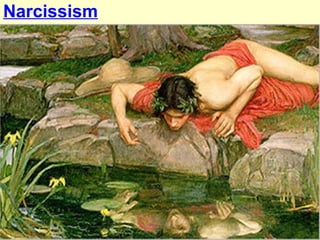
Narcissism
Other personality traits influence OBOther personality traits influence OB
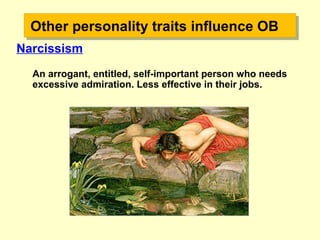
Narcissism
An arrogant, entitled, self-important person who needs
excessive admiration. Less effective in their jobs.
Other personality traits influence OBOther personality traits influence OB
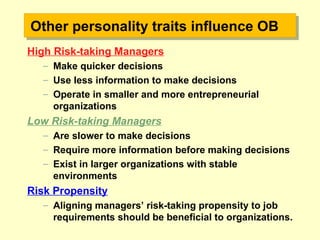
High Risk-taking Managers
– Make quicker decisions
– Use less information to make decisions
– Operate in smaller and more entrepreneurial
organizations
Low Risk-taking Managers
– Are slower to make decisions
– Require more information before making decisions
– Exist in larger organizations with stable
environments
Risk Propensity
– Aligning managers’ risk-taking propensity to job
requirements should be beneficial to organizations.
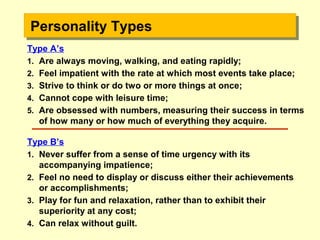
Type A’s
1. Are always moving, walking, and eating rapidly;
2. Feel impatient with the rate at which most events take place;
3. Strive to think or do two or more things at once;
4. Cannot cope with leisure time;
5. Are obsessed with numbers, measuring their success in terms
of how many or how much of everything they acquire.
Type B’s
1. Never suffer from a sense of time urgency with its
accompanying impatience;
2. Feel no need to display or discuss either their achievements
or accomplishments;
3. Play for fun and relaxation, rather than to exhibit their
superiority at any cost;
4. Can relax without guilt.
Personality TypesPersonality TypesPersonality TypesPersonality Types
Other Personality Traits Relevant to OBOther Personality Traits Relevant to OB
Proactive Personality
• Identifies opportunities, shows initiative, takes
action, and perseveres to completion
• Creates positive change in the environment
4-51
© 2005 Prentice Hall Inc. All
rights reserved.3–52
ValuesValues
Basic conviction:Basic conviction: ““A specificA specific
mode of conduct or end-state
of existence isof existence is personally orpersonally or
socially preferable
socially preferable to anto an
opposite or converse mode
of conduct or end-state of
existence.”existence.”
ValuesValues
Judgmental Element:
Values have a judgmental element as they represent an
individual’s ideas about something being good, bad or
desirable.
Content Attribute:
The content attribute shows that a certain mode of conduct
or end-state of existence is important.
Intensity Attribute:
The intensity attribute specifies how important is the
desired mode of conduct or end-state of existence.
Value System:
The hierarchical ranking of an individual’s values in terms
of their intensity is that person’s value system.
Important Features of Values:
 Values are relatively stable and enduring
 Most values are established in early years of human
development
 Some values might change over a period of time for any
given individual.
Values: Definition and ImportanceValues: Definition and Importance
Values are classified based on the Rokeach Value Survey.
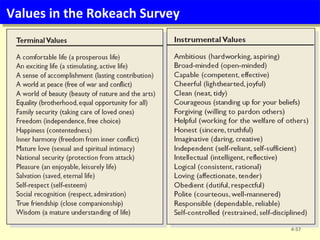
Rokeach Value Survey (RVS):
 The RVS consists of two sets of values (terminal values
and instrumental values), each containing 18 individual
value items.
 Terminal Values are desirable end-states of existence
and represent the life goals of individuals.
 Instrumental Values are the desirable modes of
behavior that become the means for achieving the
terminal values.
 The RVS values tend to vary from one group of
individuals to another, as well as from culture to culture.
Classifying Values – Rokeach Value SurveyClassifying Values – Rokeach Value Survey
Values in the Rokeach SurveyValues in the Rokeach Survey
4-57
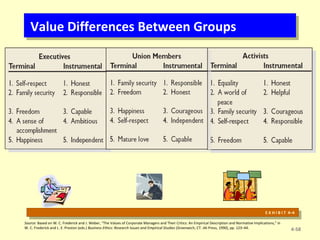
Value Differences Between GroupsValue Differences Between Groups
4-58
Source: Based on W. C. Frederick and J. Weber, “The Values of Corporate Managers and Their Critics: An Empirical Description and Normative Implications,” in
W. C. Frederick and L. E. Preston (eds.) Business Ethics: Research Issues and Empirical Studies (Greenwich, CT: JAI Press, 1990), pp. 123–44.
E X H I B I T 4–4
E X H I B I T 4–4
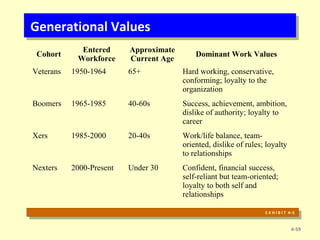
Generational ValuesGenerational Values
Cohort
Entered
Workforce
Approximate
Current Age
Dominant Work Values
Veterans 1950-1964 65+ Hard working, conservative,
conforming; loyalty to the
organization
Boomers 1965-1985 40-60s Success, achievement, ambition,
dislike of authority; loyalty to
career
Xers 1985-2000 20-40s Work/life balance, team-
oriented, dislike of rules; loyalty
to relationships
Nexters 2000-Present Under 30 Confident, financial success,
self-reliant but team-oriented;
loyalty to both self and
relationships
4-59
E X H I B I T 4–5
E X H I B I T 4–5
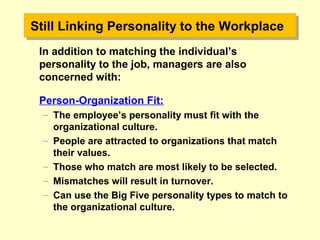
Still Linking Personality to the WorkplaceStill Linking Personality to the Workplace
In addition to matching the individual’s
personality to the job, managers are also
concerned with:
Person-Organization Fit:
– The employee’s personality must fit with the
organizational culture.
– People are attracted to organizations that match
their values.
– Those who match are most likely to be selected.
– Mismatches will result in turnover.
– Can use the Big Five personality types to match to
the organizational culture.
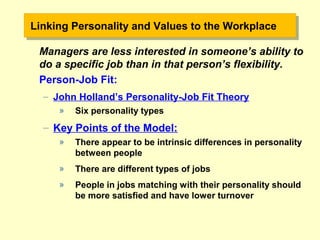
Linking Personality and Values to the WorkplaceLinking Personality and Values to the Workplace
Managers are less interested in someone’s ability to
do a specific job than in that person’s flexibility.
Person-Job Fit:
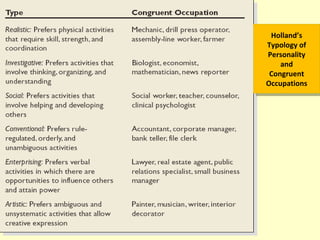
– John Holland’s Personality-Job Fit Theory
» Six personality types
– Key Points of the Model:
» There appear to be intrinsic differences in personality
between people
» There are different types of jobs
» People in jobs matching with their personality should
be more satisfied and have lower turnover
Holland’s
Typology of
Personality
and
Congruent
Occupations
Holland’s
Typology of
Personality
and
Congruent
Occupations
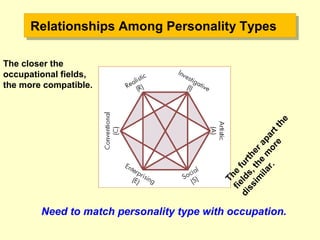
Relationships Among Personality TypesRelationships Among Personality Types
The closer the
occupational fields,
the more compatible.
The
furtherapartthe
fields,the
m
ore
dissim
ilar.
Need to match personality type with occupation.
Global ImplicationsGlobal Implications
Personality
– Do frameworks like Big Five transfer across cultures?
– Yes, but the frequency of type in the culture may vary.
– Better in individualistic than collectivist cultures.
Values
– Values differ across cultures.
– Hofstede’s Framework for assessing culture – five value
dimensions:
• Power Distance
• Individualism vs. Collectivism
• Masculinity vs. Femininity
• Uncertainty Avoidance
• Long-term vs. Short-term Orientation
4-65
Hofstede’s Framework: Power DistanceHofstede’s Framework: Power Distance
The extent to which a society accepts that power in
institutions and organizations is distributed unequally.
4-66
Low distance
1. Relatively equal power between those
with status/wealth and those without
status/wealth
High distance
1. Extremely unequal power distribution
between those with status/wealth and
those without status/wealth
See E X H I B I T 4–6
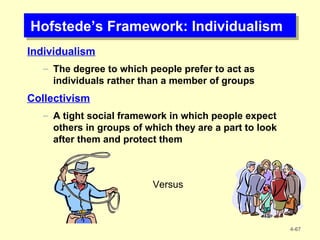
Hofstede’s Framework: IndividualismHofstede’s Framework: Individualism
Individualism
– The degree to which people prefer to act as
individuals rather than a member of groups
Collectivism
– A tight social framework in which people expect
others in groups of which they are a part to look
after them and protect them
Versus
4-67
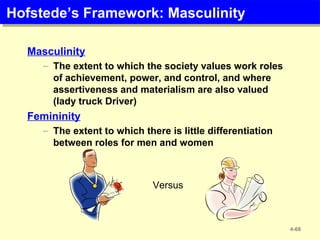
Hofstede’s Framework: MasculinityHofstede’s Framework: Masculinity
Masculinity
– The extent to which the society values work roles
of achievement, power, and control, and where
assertiveness and materialism are also valued
(lady truck Driver)
Femininity
– The extent to which there is little differentiation
between roles for men and women
Versus
4-68
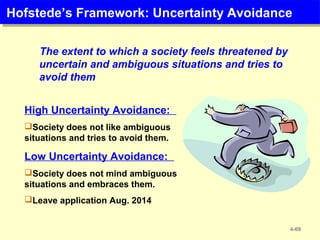
Hofstede’s Framework: Uncertainty AvoidanceHofstede’s Framework: Uncertainty Avoidance
The extent to which a society feels threatened by
uncertain and ambiguous situations and tries to
avoid them
4-69
High Uncertainty Avoidance:
Society does not like ambiguous
situations and tries to avoid them.
Low Uncertainty Avoidance:
Society does not mind ambiguous
situations and embraces them.
Leave application Aug. 2014
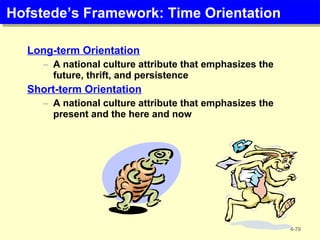
Long-term Orientation
– A national culture attribute that emphasizes the
future, thrift, and persistence
Short-term Orientation
– A national culture attribute that emphasizes the
present and the here and now
Hofstede’s Framework: Time OrientationHofstede’s Framework: Time Orientation
4-70
Hofstede’s Framework: An AssessmentHofstede’s Framework: An Assessment
1. There are regional differences within countries
2. The original data is old and based on only one
company
3. Hofstede had to make many judgment calls while
doing the research
4. Some results don’t match what is believed to be true
about given countries
5. Despite these problems it remains a very popular
framework
4-71
GLOBE Framework for Assessing CulturesGLOBE Framework for Assessing Cultures
 Global Leadership and Organizational Behavior
Effectiveness (GLOBE) research program.
– Nine dimensions of national culture
 Similar to Hofstede’s framework with these
additional dimensions:
– Humane Orientation: how much society rewards
people for being humane, generous, and kind.
– Performance Orientation: how much society
encourages and rewards performance
improvement and excellence.
4-72
Values Across Cultures
The GLOBE Framework for Assessing Cultures: National cultures
vary on ten dimensions:
1. Assertiveness
2. Future orientation
3. Gender differentiation
4. Uncertainty avoidance
5. Power distance
6. Individualism vs. collectivism
7. In-group collectivism
8. Performance orientation
9. Humane orientation
GLOBE Framework for Assessing CulturesGLOBE Framework for Assessing Cultures
Summary and Managerial ImplicationsSummary and Managerial Implications
Personality
– Screen for the Big Five trait of conscientiousness
– Take into account the situational factors as well
– MBTI®
can help with training and development
Values
– Often explain attitudes, behaviors, and perceptions
– Higher performance and satisfaction achieved when
the individual’s values match those of the organization.
4-74
All rights reserved. No part of this publication may be reproduced,
stored in a retrieval system, or transmitted, in any form or by any
means, electronic, mechanical, photocopying, recording, or otherwise,
without the prior written permission of the publisher. Printed in the
United States of America.
Copyright ©2009 Pearson Education, Inc.
Publishing as Prentice Hall

Ob 14e 5 personality & values

  • 1.
    Robbins & Judge OrganizationalBehavior 14th Edition Personality and ValuesPersonality and Values 4-1
  • 2.
    • What isPersonality? PersonalityPersonality
  • 3.
    • The sumtotal of ways in which an individual reacts and interacts with others, the measurable traits a person exhibits PersonalityPersonality
  • 4.
    PersonalityPersonality Personality embraces aperson's moods, attitudes, opinions, motivations, and style of thinking, perceiving, speaking, and acting. It is part of what makes each individual distinct.
  • 5.
    PersonalityPersonality The combination ofcharacteristics or qualities that form an individual's distinctive character. Totality of an individual's behavioral and emotional characteristics.
  • 6.
    PersonalityPersonality Investigating individual differences, thatis, how people can differ from one another. Investigating human nature, that is, how all people's behaviour is similar.
  • 7.
    • The combinationof psychological traits we use to classify & describe a person in terms of characteristics such as quiet, passive, loud, aggressive, etc. PersonalityPersonality
  • 8.
    PersonalityPersonality A dynamic andorganized set of characteristics possessed by a person that uniquely influences his or her cognitions, motivations, and behaviors in various situations.
  • 9.
    1. Self-reporting surveys 2.Observer-ratings surveys 3. Projective Measures a) Rorschach Inkblot Test b) Thematic Apperception Test Measuring Personality Measuring Personality
  • 10.
    Assessing the Unconscious-- RorschachAssessing the Unconscious -- Rorschach  Rorschach Inkblot Test – the most widely used projective test – a set of 10 inkblots designed by Hermann Rorschach Rorschach
  • 11.
    used to identifypeople’s inner feelings by analyzing their interpretations of the blots Assessing the Unconscious -- RorschachAssessing the Unconscious -- Rorschach
  • 17.
    Thematic Apperception Test (TAT) Peopleexpress their inner motives through the stories they make up about ambiguous scenes Assessing the Unconscious -- TATAssessing the Unconscious -- TAT
  • 20.
    3-22 Personality TraitsPersonality Traits Particular tendencies to feel, think, and act in certain ways that can be used to describe the personality of every individual  Manager’s personalities influence their behavior and approach to managing people and resources
  • 21.
    3-23 Manager’s and TraitsManager’sand Traits  No single trait is right or wrong for being an effective manager  Effectiveness is determined by a complex interaction between the characteristics of managers and the nature of the job and organization in which they are working
  • 22.
    3-24 Manager’s and TraitsManager’sand Traits Personality traits that enhance managerial effectiveness in one situation may actually impair it in another
  • 23.
     Personality Tests; 1.Screening 2. Selection 3. Succession Planning 4. Career Planning 5. Team Building 6. Management Development Personality Tests Can help in;Personality Tests Can help in;
  • 24.
    Personality DeterminantsPersonality Determinants Heredity –Factors determined at conception: physical stature, facial attractiveness, gender, temperament, muscle composition and reflexes, energy level, and bio-rhythms – This “Heredity Approach” argues that genes are the source of personality – Twin studies: raised apart but very similar personalities – There is some personality change over long time periods
  • 25.
    Heredity;  It includesphysical stature, facial attractiveness, gender, temperament, muscle composition, reflexes, energy level, biological rhythms are influenced by the parents biological, physiological and psychological make up. Environment;  Culture establishes the norms, attitudes and values that plays an important role in shaping our personality. Situation;  Situation influences the effects of heredity and environment. Personality DeterminantsPersonality Determinants
  • 26.
  • 27.
    Personality Assessment Instruments:PersonalityAssessment Instruments:  Enduring characteristics that describe an individual’s behavior  Two dominant frameworks used to describe personality 1) Myers-Briggs Type Indicator (MBTI® ) 2) Big Five Model
  • 28.
    The Myers-Briggs TypeIndicatorThe Myers-Briggs Type Indicator Personality Types 1.Extroverted vs. Introverted (E or I) 2.Sensing vs. Intuitive (S or N) 3.Thinking vs. Feeling (T or F) 4.Judging vs. Perceiving (P or J) Personality Types 1.Extroverted vs. Introverted (E or I) 2.Sensing vs. Intuitive (S or N) 3.Thinking vs. Feeling (T or F) 4.Judging vs. Perceiving (P or J) Myers-Briggs Type Indicator (MBTI) A personality test that taps four characteristics and classifies people into 1 of 16 personality types.
  • 29.
     Most widelyused instrument in the world. Participants are classified on four axes to determine one of 16 possible personality types, such as ENTJ. Outgoing open Sociable and Assertive Extroverted types (E) Introverted types (I) Quiet and Shy appeared to be timid Practical and prefer routine ordered n organized Sensing types (S) Intuitive types (N) Unconscious Processes, gut feelings n take holistic approach Use Reason and Logic Thinking types (T) Feeling types (F) Uses personal Values & Emotions Want controlled Ordered & Structured environment Judging types (J) Perceiving types (P) Flexible and Spontaneous The Myers-Briggs Type IndicatorThe Myers-Briggs Type Indicator
  • 30.
     Most widelyused instrument in the world. Participants are classified on four axes to determine one of 16 possible personality types, such as ENTJ. Sociable and Assertive Extroverted (E) Introverted (I) Quiet and Shy Practical and Orderly Sensing (S) Intuitive (N) Unconscious Processes Use Reason and Logic Thinking (T) Feeling (F) Uses Values & Emotions Want Order & Structure Judging (J) Perceiving (P) Flexible and Spontaneous The Myers-Briggs Type IndicatorThe Myers-Briggs Type Indicator
  • 31.
    The Myers-Briggs TypeIndicatorThe Myers-Briggs Type Indicator  Most widely used instrument in the world.  Participants are classified on four axes to determine one of 16 possible personality types, such as ENTJ. Flexible and Spontaneo us Sociable and Assertive Quiet and Shy Unconscio us Processes Uses Values & Emotions Practical and Orderly Use Reason and Logic Want Order & Structure
  • 32.
    The Types andTheir UsesThe Types and Their Uses  Each of the sixteen possible combinations has a name, for instance: – Visionaries (INTJ) – original, stubborn, and driven. – Organizers (ESTJ) – realistic, logical, analytical, and businesslike. – Conceptualizer (ENTP) – entrepreneurial, innovative, individualistic, and resourceful.  Research results on validity mixed. – MBTI® is a good tool for self-awareness and counseling. – Should not be used as a selection test for job candidates. 4-34
  • 33.
  • 34.
    The Big FiveModel of Personality DimensionsThe Big Five Model of Personality Dimensions Extroversion Sociable, gregarious (shokh) , and assertive (quite, shy and timid) Agreeableness Good-natured, cooperative, n trusting. (cold, disagreeable, antagonist) Conscientiousness Responsible, dependable, persistent, n organized. (distracted, disorganized) Openness to Experience Imagination,, sensitivity, creative and curiosity. Conventional, feel comfortable with familiar environment Emotional Stability Calm, self-confident, secure (positive) versus nervous, anxious, depression, and insecurity (negative).
  • 35.
    3-37 Big Five PersonalityTraitsBig Five Personality Traits Extraversion – Tendency to experience positive emotions and moods and feel good about oneself and others – Managers high in extraversion tend to be sociable, affectionate, outgoing and friendly – Managers low in extraversion tend to be less inclined toward social interaction and have a less positive outlook Agreeableness – Tendency to get along well with others – Managers high in agreeableness are likable, affectionate and care about others – Managers with low agreeableness may be distrustful, unsympathetic, uncooperative and antagonistic
  • 36.
    3-38 Big Five PersonalityTraitsBig Five Personality Traits Conscientiousness – tendency to be careful, scrupulous, and persevering – Managers high in this trait are organized and self-disciplined – Managers low in this trait lack direction and self-discipline Openness to Experience – tendency to be original, have broad interests, be open to a wide range of stimuli, be daring and take risks – Managers, high in openness to experience may be likely to take risks, be innovative in planning and decision making – Managers, low in this trait may be less prone to take risks and be more conservative in planning and decision making
  • 37.
    3-39 Big Five PersonalityTraitsBig Five Personality Traits Emotional Stability – Tendency to experience negative emotions and moods, feel distressed, and be critical of oneself and others – Managers high in negative affectivity may often feel angry and dissatisfied and complain about their own and others’ lack of progress – Managers who are low in negative affectivity do not tend to experience many negative emotions and moods and are less pessimistic and critical of themselves and others
  • 38.
    How Do theBig Five Traits Predict Behavior?How Do the Big Five Traits Predict Behavior?  Research has shown this to be a better framework.  Certain traits have been shown to strongly relate to higher job performance: • Highly conscientious people develop more job knowledge, exert greater effort, and have better performance. • Other Big Five Traits also have implications for work. • Emotional stability is related to job satisfaction. • Extroverts tend to be happier in their jobs and have good social skills. • Open people are more creative and can be good leaders. • Agreeable people are good in social settings.
  • 39.
    Major Personality AttributesInfluencing OBMajor Personality Attributes Influencing OB  Core Self-evaluation  Machiavellianism  Narcissism  Self-monitoring  Risk taking  Type A personality
  • 40.
    Other personality traitsinfluence OBOther personality traits influence OB Core Self-Evaluation The degree to which people like or dislike themselves Positive self-evaluation leads to higher job performance
  • 41.
    MachiavellianismMachiavellianism Conditions Favoring HighMachs 1.Direct interaction 2.Minimal rules and regulations 3.Emotions distract for others Conditions Favoring High Machs 1.Direct interaction 2.Minimal rules and regulations 3.Emotions distract for others Machiavellianism (Mach) Degree to which an individual is pragmatic, maintains emotional distance, and believes that ends can justify means.
  • 42.
    Machiavellianism: • Abbreviated asMach, it is named after Niccolo Machiavelli, a sixteenth century prince. • Machiavellianism is the degree to which an individual is pragmatic, maintains emotional distance, and believes that ends can justify means. • High Mach individuals manipulate more, persuade more and win more than low Machs. • The success and job satisfaction depends mainly on situational factors and the type of job. Other personality traits influence OBOther personality traits influence OB
  • 43.
  • 44.
    Other personality traitsinfluence OBOther personality traits influence OB Narcissism An arrogant, entitled, self-important person who needs excessive admiration. Less effective in their jobs.
  • 45.
    Other personality traitsinfluence OBOther personality traits influence OB High Risk-taking Managers – Make quicker decisions – Use less information to make decisions – Operate in smaller and more entrepreneurial organizations Low Risk-taking Managers – Are slower to make decisions – Require more information before making decisions – Exist in larger organizations with stable environments Risk Propensity – Aligning managers’ risk-taking propensity to job requirements should be beneficial to organizations.
  • 46.
    Type A’s 1. Arealways moving, walking, and eating rapidly; 2. Feel impatient with the rate at which most events take place; 3. Strive to think or do two or more things at once; 4. Cannot cope with leisure time; 5. Are obsessed with numbers, measuring their success in terms of how many or how much of everything they acquire. Type B’s 1. Never suffer from a sense of time urgency with its accompanying impatience; 2. Feel no need to display or discuss either their achievements or accomplishments; 3. Play for fun and relaxation, rather than to exhibit their superiority at any cost; 4. Can relax without guilt. Personality TypesPersonality TypesPersonality TypesPersonality Types
  • 47.
    Other Personality TraitsRelevant to OBOther Personality Traits Relevant to OB Proactive Personality • Identifies opportunities, shows initiative, takes action, and perseveres to completion • Creates positive change in the environment 4-51
  • 48.
    © 2005 PrenticeHall Inc. All rights reserved.3–52 ValuesValues Basic conviction:Basic conviction: ““A specificA specific mode of conduct or end-state mode of conduct or end-state of existence isof existence is personally orpersonally or socially preferable socially preferable to anto an opposite or converse mode opposite or converse mode of conduct or end-state of of conduct or end-state of existence.”existence.”
  • 49.
    ValuesValues Judgmental Element: Values havea judgmental element as they represent an individual’s ideas about something being good, bad or desirable. Content Attribute: The content attribute shows that a certain mode of conduct or end-state of existence is important. Intensity Attribute: The intensity attribute specifies how important is the desired mode of conduct or end-state of existence.
  • 50.
    Value System: The hierarchicalranking of an individual’s values in terms of their intensity is that person’s value system. Important Features of Values:  Values are relatively stable and enduring  Most values are established in early years of human development  Some values might change over a period of time for any given individual. Values: Definition and ImportanceValues: Definition and Importance
  • 51.
    Values are classifiedbased on the Rokeach Value Survey. Rokeach Value Survey (RVS):  The RVS consists of two sets of values (terminal values and instrumental values), each containing 18 individual value items.  Terminal Values are desirable end-states of existence and represent the life goals of individuals.  Instrumental Values are the desirable modes of behavior that become the means for achieving the terminal values.  The RVS values tend to vary from one group of individuals to another, as well as from culture to culture. Classifying Values – Rokeach Value SurveyClassifying Values – Rokeach Value Survey
  • 52.
    Values in theRokeach SurveyValues in the Rokeach Survey 4-57
  • 53.
    Value Differences BetweenGroupsValue Differences Between Groups 4-58 Source: Based on W. C. Frederick and J. Weber, “The Values of Corporate Managers and Their Critics: An Empirical Description and Normative Implications,” in W. C. Frederick and L. E. Preston (eds.) Business Ethics: Research Issues and Empirical Studies (Greenwich, CT: JAI Press, 1990), pp. 123–44. E X H I B I T 4–4 E X H I B I T 4–4
  • 54.
    Generational ValuesGenerational Values Cohort Entered Workforce Approximate CurrentAge Dominant Work Values Veterans 1950-1964 65+ Hard working, conservative, conforming; loyalty to the organization Boomers 1965-1985 40-60s Success, achievement, ambition, dislike of authority; loyalty to career Xers 1985-2000 20-40s Work/life balance, team- oriented, dislike of rules; loyalty to relationships Nexters 2000-Present Under 30 Confident, financial success, self-reliant but team-oriented; loyalty to both self and relationships 4-59 E X H I B I T 4–5 E X H I B I T 4–5
  • 55.
    Still Linking Personalityto the WorkplaceStill Linking Personality to the Workplace In addition to matching the individual’s personality to the job, managers are also concerned with: Person-Organization Fit: – The employee’s personality must fit with the organizational culture. – People are attracted to organizations that match their values. – Those who match are most likely to be selected. – Mismatches will result in turnover. – Can use the Big Five personality types to match to the organizational culture.
  • 56.
    Linking Personality andValues to the WorkplaceLinking Personality and Values to the Workplace Managers are less interested in someone’s ability to do a specific job than in that person’s flexibility. Person-Job Fit: – John Holland’s Personality-Job Fit Theory » Six personality types – Key Points of the Model: » There appear to be intrinsic differences in personality between people » There are different types of jobs » People in jobs matching with their personality should be more satisfied and have lower turnover
  • 57.
  • 58.
    Relationships Among PersonalityTypesRelationships Among Personality Types The closer the occupational fields, the more compatible. The furtherapartthe fields,the m ore dissim ilar. Need to match personality type with occupation.
  • 59.
    Global ImplicationsGlobal Implications Personality –Do frameworks like Big Five transfer across cultures? – Yes, but the frequency of type in the culture may vary. – Better in individualistic than collectivist cultures. Values – Values differ across cultures. – Hofstede’s Framework for assessing culture – five value dimensions: • Power Distance • Individualism vs. Collectivism • Masculinity vs. Femininity • Uncertainty Avoidance • Long-term vs. Short-term Orientation 4-65
  • 60.
    Hofstede’s Framework: PowerDistanceHofstede’s Framework: Power Distance The extent to which a society accepts that power in institutions and organizations is distributed unequally. 4-66 Low distance 1. Relatively equal power between those with status/wealth and those without status/wealth High distance 1. Extremely unequal power distribution between those with status/wealth and those without status/wealth See E X H I B I T 4–6 See E X H I B I T 4–6
  • 61.
    Hofstede’s Framework: IndividualismHofstede’sFramework: Individualism Individualism – The degree to which people prefer to act as individuals rather than a member of groups Collectivism – A tight social framework in which people expect others in groups of which they are a part to look after them and protect them Versus 4-67
  • 62.
    Hofstede’s Framework: MasculinityHofstede’sFramework: Masculinity Masculinity – The extent to which the society values work roles of achievement, power, and control, and where assertiveness and materialism are also valued (lady truck Driver) Femininity – The extent to which there is little differentiation between roles for men and women Versus 4-68
  • 63.
    Hofstede’s Framework: UncertaintyAvoidanceHofstede’s Framework: Uncertainty Avoidance The extent to which a society feels threatened by uncertain and ambiguous situations and tries to avoid them 4-69 High Uncertainty Avoidance: Society does not like ambiguous situations and tries to avoid them. Low Uncertainty Avoidance: Society does not mind ambiguous situations and embraces them. Leave application Aug. 2014
  • 64.
    Long-term Orientation – Anational culture attribute that emphasizes the future, thrift, and persistence Short-term Orientation – A national culture attribute that emphasizes the present and the here and now Hofstede’s Framework: Time OrientationHofstede’s Framework: Time Orientation 4-70
  • 65.
    Hofstede’s Framework: AnAssessmentHofstede’s Framework: An Assessment 1. There are regional differences within countries 2. The original data is old and based on only one company 3. Hofstede had to make many judgment calls while doing the research 4. Some results don’t match what is believed to be true about given countries 5. Despite these problems it remains a very popular framework 4-71
  • 66.
    GLOBE Framework forAssessing CulturesGLOBE Framework for Assessing Cultures  Global Leadership and Organizational Behavior Effectiveness (GLOBE) research program. – Nine dimensions of national culture  Similar to Hofstede’s framework with these additional dimensions: – Humane Orientation: how much society rewards people for being humane, generous, and kind. – Performance Orientation: how much society encourages and rewards performance improvement and excellence. 4-72
  • 67.
    Values Across Cultures TheGLOBE Framework for Assessing Cultures: National cultures vary on ten dimensions: 1. Assertiveness 2. Future orientation 3. Gender differentiation 4. Uncertainty avoidance 5. Power distance 6. Individualism vs. collectivism 7. In-group collectivism 8. Performance orientation 9. Humane orientation GLOBE Framework for Assessing CulturesGLOBE Framework for Assessing Cultures
  • 68.
    Summary and ManagerialImplicationsSummary and Managerial Implications Personality – Screen for the Big Five trait of conscientiousness – Take into account the situational factors as well – MBTI® can help with training and development Values – Often explain attitudes, behaviors, and perceptions – Higher performance and satisfaction achieved when the individual’s values match those of the organization. 4-74
  • 69.
    All rights reserved.No part of this publication may be reproduced, stored in a retrieval system, or transmitted, in any form or by any means, electronic, mechanical, photocopying, recording, or otherwise, without the prior written permission of the publisher. Printed in the United States of America. Copyright ©2009 Pearson Education, Inc. Publishing as Prentice Hall

Editor's Notes

  • #27 There has been a long-standing debate about whether genetics or environment are more important in determining personality. They both play an important role. The heredity approach refers to factors determined at conception such as physical stature and gender. This has been reaffirmed by studies that have looked at twins who were raised apart but still had similar personalities. Personalities can, however, change over time.