1
Personality and Values
Chapter 5
Miss.Sivalingam Neruja,
Lecturer (Probationary),
Department of Management
2
Learning
Objectives
After studying this chapter, you should be able to:
1. Describe personality, the way it is measured, and the
factors that shape it.
2. Describe the strengths and weaknesses of the Myers-
Briggs Type Indicator (MBTI) personality
framework and the Big Five model.
3. Discuss how the concepts of core self-evaluation
(CSE), self-monitoring, and proactive personality
contribute to the understanding of personality.
4. Describe how the situation affects whether
personality predicts behavior.
5. Contrast terminal and instrumental values.
6. Describe the differences between person–job fit and
person–organization fit.
7. Compare Hofstede’s five value dimensions and the
GLOBE framework.
5.1 Personality
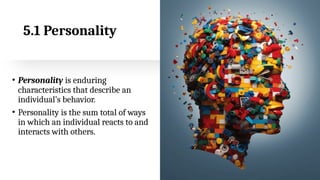
• Personality is enduring
characteristics that describe an
individual’s behavior.
• Personality is the sum total of ways
in which an individual reacts to and
interacts with others.
5.1 Personality
Measuring Personality
• The most common means of measuring personality is through self-report surveys, with
which individuals evaluate themselves on a series of factors, such as “I worry a lot about the
future.” Though self-report measures work well when well constructed, one weakness is that
the respondent might lie or practice impression management to create a good impression.
• Another problem is accuracy.
• Observer-ratings surveys - Observer-ratings surveys provide an independent assessment of
personality. Here, a co-worker or another observer does the rating (sometimes with the
subject’s knowledge and sometimes not).
• Though the results of self-report surveys and observer-ratings surveys are strongly correlated,
research suggests observer-ratings surveys are a better predictor of success on the job.
5.1 Personality
Personality Determinants
• An early debate in personality research centered on whether an
individual’s personality was the result of heredity or of environment.
• It appears to be a result of both. However, research tends to support
the importance of heredity over the environment.
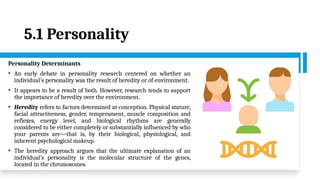
• Heredity refers to factors determined at conception. Physical stature,
facial attractiveness, gender, temperament, muscle composition and
reflexes, energy level, and biological rhythms are generally
considered to be either completely or substantially influenced by who
your parents are—that is, by their biological, physiological, and
inherent psychological makeup.
• The heredity approach argues that the ultimate explanation of an
individual’s personality is the molecular structure of the genes,
located in the chromosomes.
5.2 The Myers-Briggs Type Indicator
• The Myers-Briggs Type Indicator (MBTI) is the most widely used personality
assessment instrument in the world. It is a 100-question personality test that
asks people how they usually feel or act in particular situations. Respondents
are classified as extraverted or introverted (E or I), sensing or intuitive (S or
N), thinking or feeling (T or F), and judging or perceiving (J or P).
• These terms are defined as follows:
• Extraverted (E) versus Introverted (I) - Extraverted individuals are
outgoing, sociable, and assertive. Introverts are quiet and shy.
• Sensing (S) versus Intuitive (N) - Sensing types are practical and prefer
routine and order. They focus on details. Intuitives rely on unconscious
processes and look at the “big picture.”
• Thinking (T) versus Feeling (F) - Thinking types use reason and logic
to handle problems. Feeling types rely on their personal values and
emotions.
• Judging (J) versus Perceiving (P) - Judging types want control and
prefer their world to be ordered and structured. Perceiving types are
flexible and spontaneous.
5.2 The
Myers-Briggs
Type
Indicator
• These classifications together describe 16
personality types, identifying every person
by one trait from each of the four pairs. For
example,
Introverted/Intuitive/Thinking/Judging
people (INTJs) are visionaries with
original minds and great drive.
• One problem is that it forces a person into
one type or another; that is, you’re either
introverted or extroverted. There is no in-
between, though, in reality, people can be
both extroverted and introverted to some
degree.
5.3 The Big Five Personality Model
• Big Five Model—that five basic dimensions underlie all others and
encompass most of the significant variation in human personality.
The following are the Big Five factors:
• Extraversion - The extraversion dimension captures our
comfort level with relationships. Extraverts tend to be
gregarious, assertive, and sociable. Introverts tend to be
reserved, timid, and quiet.
• Agreeableness - The agreeableness dimension refers to an
individual’s propensity to defer to others. Highly agreeable
people are cooperative, warm, and trusting. People who score
low on agreeableness are cold, disagreeable, and antagonistic.
• Conscientiousness - The conscientiousness dimension is a
measure of reliability. A highly conscientious person is
responsible, organized, dependable, and persistent. Those
who score low on this dimension are easily distracted,
disorganized, and unreliable.
5.3 The Big Five Personality Model
• Emotional stability - The emotional stability
dimension—often labeled by its converse,
neuroticism—taps a person’s ability to withstand
stress. People with positive emotional stability
tend to be calm self-confident, and secure. Those
with high negative scores tend to be nervous,
anxious, depressed, and insecure.
• Openness to experience - The openness to
experience dimension addresses a range of
interests and fascination with novelty. Extremely
open people are creative, curious, and artistically
sensitive. Those at the other end of the category
are conventional and find comfort in the familiar.
5.4 How Do the
Big Five Traits
Predict Behavior
at Work?
5.5 Other Personality Traits Relevant to
OB
• Core self-evaluation - Bottom-line conclusions individuals have about their
capabilities, competence, and worth as a person. People who have positive core
self-evaluations like themselves and see themselves as effective, capable, and in
control of their environment.
• Those with negative core self-evaluations tend to dislike themselves, question
their capabilities, and view themselves as powerless over their environment.
• People with positive core self-evaluations perform better than others because they
set more ambitious goals, are more committed to their goals and persist longer in
attempting to reach these goals.
5.5 Other Personality Traits Relevant to
OB
• The personality characteristic of Machiavellianism (often abbreviated Mach) is named after
Niccolo Machiavelli, who wrote in the sixteenth century on how to gain and use power.
• An individual high in Machiavellianism is pragmatic, maintains emotional distance, and
believes ends can justify means. “If it works, use it” is consistent with a high-Mach perspective.
• High Machs flourish
(1) when they interact face-to-face with others rather than indirectly;
(2) when the situation has minimal rules and regulations, allowing latitude for
improvisation; and
(3) when emotional involvement with details irrelevant to winning distracts low
Machs.
5.5 Other Personality Traits
Relevant to OB
• Narcissism - In psychology, narcissism describes a person who has a grandiose sense
of self-importance, requires excessive admiration, has a sense of entitlement, and is
arrogant.
• Evidence suggests that narcissists are more charismatic and thus more likely to
emerge as leaders, and they may even display better psychological health (at least as
they self-report).
• Despite having some advantages, most evidence suggests that narcissism is
undesirable.
• A study found that while narcissists thought they were better leaders than their
colleagues, their supervisors actually rated them as worse.
5.5 Other Personality Traits
Relevant to OB
• Self-monitoring - Self-monitoring refers to an individual’s ability to adjust his or her
behavior to external, situational factors. Individuals high in self-monitoring show
considerable adaptability in adjusting their behavior to external situational factors.
• They are highly sensitive to external cues and can behave differently in different
situations, sometimes presenting striking contradictions between their public persona
and their private self.
• Low self-monitors, tend to display their true dispositions and attitudes in every situation;
hence, there is high behavioral consistency between who they are and what they do.
• Risk Taking - People differ in their willingness to take chances, a quality that affects how
much time and information they need to make a decision.
5.5 Other Personality Traits
Relevant to OB
• Proactive Personality - People who identify opportunities, show initiative, take
action, and persevere until meaningful change occurs.
• Those with a proactive personality identify opportunities, show initiative, take action,
and persevere until meaningful change occurs, compared to others who passively
react to situations. Proactives create positive change in their environment, regardless
of, or even in spite of, constraints or obstacles.
• Not surprisingly, they have many desirable behaviors that organizations covet. They
are more likely than others to be seen as leaders and to act as change agents. Proactive
individuals are more likely to be satisfied with work and help others more with their
tasks, largely because they build more relationships with others.
5.4 Personality and Situations
• We are learning that the effect of particular traits on organizational behavior depends on the situation. Two
theoretical frameworks, situation strength and trait activation, help explain how this works.
Situation strength theory
• Situation strength theory proposes that the way personality translates into behavior depends on the
strength of the situation.
• By situation strength, we mean the degree to which norms, cues, or standards dictate appropriate behavior.
• Strong situations show us what the right behavior is, pressure us to exhibit it and discourage the wrong
behavior.
• In weak situations, conversely, “anything goes,” and thus we are freer to express our personality in behavior.
Thus, personality traits better predict behavior in weak situations than in strong ones.
5.4 Personality and Situations
Situation strength theory
• Researchers have analyzed situation strength in organizations in terms of four elements:
1. Clarity, or the degree to which cues about work duties and responsibilities are available and clear. Jobs
high in clarity produce strong situations because individuals can readily determine what to do. For example,
the job of a janitor probably provides higher clarity about each task than the job of a nanny.
2. Consistency, or the extent to which cues regarding work duties and responsibilities are compatible with
one another. Jobs with high consistency represent strong situations because all the cues point toward the
same desired behavior. The job of an acute care nurse, for example, probably has higher consistency than the
job of a manager.
3. Constraints, or the extent to which individuals’ freedom to decide or act is limited by forces outside their
control. Jobs with many constraints represent strong situations because an individual has limited individual
discretion. Bank examiner, for example, is probably a job with stronger constraints than forest ranger.
4. Consequences, or the degree to which decisions or actions have important implications for the
organization or its members, clients, supplies, and so on. Jobs with important consequences represent strong
situations because the environment is probably heavily structured to guard against mistakes. A surgeon’s
job, for example, has higher consequences than a foreign language teacher’s.
5.4 Personality and Situations
Trait Activation Theory
• Another important theoretical framework toward understanding personality and situations is trait
activation theory (TAT). TAT predicts that some situations, events, or interventions “activate” a trait more
than others.
• Using TAT, we can foresee which jobs suit certain personalities.
• For example, a commission-based compensation plan would likely activate individual differences because
extraverts are more reward-sensitive, than, say, open people. Conversely, in jobs that encourage creativity,
differences in openness may better predict desired behavior than differences in extraversion.
• TAT also applies to personality tendencies. For example, a recent study found people learning online
responded differently when their behavior was being electronically monitored. Those who had a high fear
of failure had higher apprehension from the monitoring than others and learned significantly less.
• In this case, a feature of the environment (electronic monitoring) activated a trait (fear of failing), and the
combination of the two meant lowered job performance.
5.6 Values
• Values represent basic convictions that “a specific mode of conduct or end-state of existence is
personally or socially preferable to an opposite or converse mode of conduct or end-state of
existence.”
• They contain a judgmental element in that they carry an individual’s ideas as to what is right,
good, or desirable. Values have both content and intensity attributes.
• The content attribute says a mode of conduct or end-state of existence is important. The intensity
attribute specifies how important it is. When we rank an individual’s values in terms of their
intensity, we obtain that person’s value system.
• Value system is a hierarchy based on a ranking of an individual’s values in terms of their
intensity.
5.6 Values
The Importance of Values
• Values lay the foundation for our understanding of people’s attitudes and
motivation and influence our perceptions.
• We enter an organization with preconceived notions of what “ought” and “ought
not” to be. These notions are not value-free; on the contrary, they contain our
interpretations of right and wrong and our preference for certain behaviors or
outcomes over others.
• As a result, values cloud objectivity and rationality; they influence attitudes and
behavior.
5.6 Values
Terminal versus Instrumental Values
• Milton Rokeach created the Rokeach Value Survey (RVS). It consists of two sets of values, each
containing 18 individual value items. One set, called terminal values, refers to desirable end-states
of existence; the goals a person would like to achieve during his or her lifetime.
• The other set, called instrumental values, refers to preferable modes of behavior, or means of
achieving the terminal values.
• Some examples of terminal values in the Rokeach Value Survey are: Prosperity and economic
success, Freedom, Health and well-being, World peace, Social recognition, and Meaning in life.
• The types of instrumental values illustrated in RVS are Self-improvement, Autonomy and self-
reliance, Personal discipline, kindness, Ambition, and Goal-orientation.
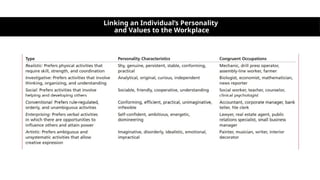
Linking an Individual’s
Personality
and Values to the Workplace
Person–Job Fit
• The effort to match job requirements
with personality characteristics is best
articulated in John Holland’s
personality–job fit theory.
• Holland presents six personality types
and proposes that satisfaction and the
propensity to leave a position depend on
how well individuals match their
personalities to a job.
Linking an Individual’s Personality
and Values to the Workplace
Linking an Individual’s
Personality
and Values to the Workplace
Person–Job Fit
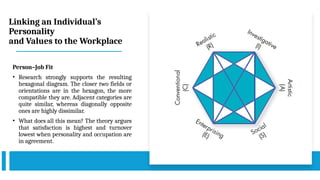
• Research strongly supports the resulting
hexagonal diagram. The closer two fields or
orientations are in the hexagon, the more
compatible they are. Adjacent categories are
quite similar, whereas diagonally opposite
ones are highly dissimilar.
• What does all this mean? The theory argues
that satisfaction is highest and turnover
lowest when personality and occupation are
in agreement.
Linking an Individual’s Personality
and Values to the Workplace
Person–Job Fit
• The key points of this model are that
(1) there do appear to be intrinsic
differences in personality among individuals,
(2) there are different types of jobs,
and
(3) people in jobs congruent with their
personality should be more satisfied
and less likely to voluntarily resign
than people in incongruent jobs.
Linking an Individual’s
Personality
and Values to the
Workplace
Person–Organization Fit
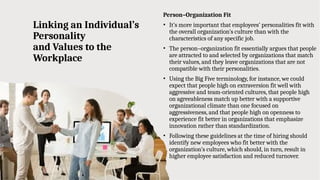
• It’s more important that employees’ personalities fit with
the overall organization’s culture than with the
characteristics of any specific job.
• The person–organization fit essentially argues that people
are attracted to and selected by organizations that match
their values, and they leave organizations that are not
compatible with their personalities.
• Using the Big Five terminology, for instance, we could
expect that people high on extraversion fit well with
aggressive and team-oriented cultures, that people high
on agreeableness match up better with a supportive
organizational climate than one focused on
aggressiveness, and that people high on openness to
experience fit better in organizations that emphasize
innovation rather than standardization.
• Following these guidelines at the time of hiring should
identify new employees who fit better with the
organization’s culture, which should, in turn, result in
higher employee satisfaction and reduced turnover.
5.8 International
Values
One of the most widely referenced approaches for analyzing variations among
cultures was done in the late 1970s by Geert Hofstede, where he found that
managers and employees vary on five value dimensions of national culture:
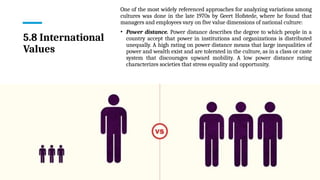
• Power distance. Power distance describes the degree to which people in a
country accept that power in institutions and organizations is distributed
unequally. A high rating on power distance means that large inequalities of
power and wealth exist and are tolerated in the culture, as in a class or caste
system that discourages upward mobility. A low power distance rating
characterizes societies that stress equality and opportunity.
5.8 International
Values
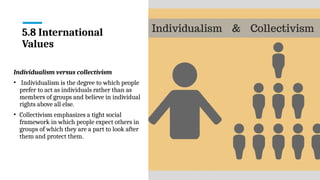
Individualism versus collectivism
• Individualism is the degree to which people
prefer to act as individuals rather than as
members of groups and believe in individual
rights above all else.
• Collectivism emphasizes a tight social
framework in which people expect others in
groups of which they are a part to look after
them and protect them.
5.8 International
Values
Masculinity versus femininity
• Hofstede’s construct of masculinity is the
degree to which the culture favors traditional
masculine roles such as achievement, power,
and control, as opposed to viewing men and
women as equals.
• A high masculinity rating indicates the
culture has separate roles for men and
women, with men dominating the society. A
high femininity rating means the culture
sees little differentiation between male and
female roles and treats women as the equals
of men in all respects.
5.8 International
Values
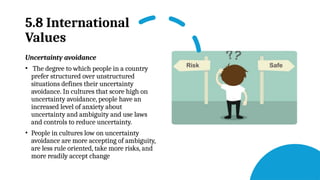
Uncertainty avoidance
• The degree to which people in a country
prefer structured over unstructured
situations defines their uncertainty
avoidance. In cultures that score high on
uncertainty avoidance, people have an
increased level of anxiety about
uncertainty and ambiguity and use laws
and controls to reduce uncertainty.
• People in cultures low on uncertainty
avoidance are more accepting of ambiguity,
are less rule oriented, take more risks, and
more readily accept change
5.8 International Values
Long-term versus short-term orientation
This newest addition to Hofstede’s typology
measures a society’s devotion to traditional
values. People in a culture with long-term
orientation look to the future and value thrift,
persistence, and tradition.
In a short-term orientation, people value the here
and now; they accept change more readily and
don’t see commitments as impediments to
change.
5.8 International Values
• Begun in 1993, the Global Leadership and Organizational Behavior Effectiveness
(GLOBE) research program is an ongoing cross-cultural investigation of leadership
and national culture.
• Using data from 825 organizations in 62 countries, the GLOBE team identified nine
dimensions on which national cultures differ. Some dimensions—such as power
distance, individualism/collectivism, uncertainty avoidance, gender differentiation
(similar to masculinity versus femininity), and future orientation (similar to long-
term versus short-term orientation)—resemble the Hofstede dimensions.
• The main difference is that the GLOBE framework added dimensions, such as
humane orientation (the degree to which a society rewards individuals for being
altruistic, generous, and kind to others) and performance orientation (the to which a
society encourages and rewards group members for performance improvement and
excellence).
33
Questions for Review
1. What is personality? How do we typically measure it? What
factors determine personality?
2. What is the Myers-Briggs Type Indicator (MBTI), and what
does it measure?
3. What are the Big Five personality traits?
4. How do the Big Five traits predict work behavior?
5. Besides the Big Five, what other personality traits are relevant
to OB?
6. What are values, why are they important, and what is the
difference between terminal and instrumental values?
7. Do values differ across generations? How so?
8. Do values differ across cultures? How so
34
Any questions?
THANK YOU

Chapter 05 - Personality and Values.pptx

  • 1.
    1 Personality and Values Chapter5 Miss.Sivalingam Neruja, Lecturer (Probationary), Department of Management
  • 2.
    2 Learning Objectives After studying thischapter, you should be able to: 1. Describe personality, the way it is measured, and the factors that shape it. 2. Describe the strengths and weaknesses of the Myers- Briggs Type Indicator (MBTI) personality framework and the Big Five model. 3. Discuss how the concepts of core self-evaluation (CSE), self-monitoring, and proactive personality contribute to the understanding of personality. 4. Describe how the situation affects whether personality predicts behavior. 5. Contrast terminal and instrumental values. 6. Describe the differences between person–job fit and person–organization fit. 7. Compare Hofstede’s five value dimensions and the GLOBE framework.
  • 3.
    5.1 Personality • Personalityis enduring characteristics that describe an individual’s behavior. • Personality is the sum total of ways in which an individual reacts to and interacts with others.
  • 4.
    5.1 Personality Measuring Personality •The most common means of measuring personality is through self-report surveys, with which individuals evaluate themselves on a series of factors, such as “I worry a lot about the future.” Though self-report measures work well when well constructed, one weakness is that the respondent might lie or practice impression management to create a good impression. • Another problem is accuracy. • Observer-ratings surveys - Observer-ratings surveys provide an independent assessment of personality. Here, a co-worker or another observer does the rating (sometimes with the subject’s knowledge and sometimes not). • Though the results of self-report surveys and observer-ratings surveys are strongly correlated, research suggests observer-ratings surveys are a better predictor of success on the job.
  • 5.
    5.1 Personality Personality Determinants •An early debate in personality research centered on whether an individual’s personality was the result of heredity or of environment. • It appears to be a result of both. However, research tends to support the importance of heredity over the environment. • Heredity refers to factors determined at conception. Physical stature, facial attractiveness, gender, temperament, muscle composition and reflexes, energy level, and biological rhythms are generally considered to be either completely or substantially influenced by who your parents are—that is, by their biological, physiological, and inherent psychological makeup. • The heredity approach argues that the ultimate explanation of an individual’s personality is the molecular structure of the genes, located in the chromosomes.
  • 6.
    5.2 The Myers-BriggsType Indicator • The Myers-Briggs Type Indicator (MBTI) is the most widely used personality assessment instrument in the world. It is a 100-question personality test that asks people how they usually feel or act in particular situations. Respondents are classified as extraverted or introverted (E or I), sensing or intuitive (S or N), thinking or feeling (T or F), and judging or perceiving (J or P). • These terms are defined as follows: • Extraverted (E) versus Introverted (I) - Extraverted individuals are outgoing, sociable, and assertive. Introverts are quiet and shy. • Sensing (S) versus Intuitive (N) - Sensing types are practical and prefer routine and order. They focus on details. Intuitives rely on unconscious processes and look at the “big picture.” • Thinking (T) versus Feeling (F) - Thinking types use reason and logic to handle problems. Feeling types rely on their personal values and emotions. • Judging (J) versus Perceiving (P) - Judging types want control and prefer their world to be ordered and structured. Perceiving types are flexible and spontaneous.
  • 7.
    5.2 The Myers-Briggs Type Indicator • Theseclassifications together describe 16 personality types, identifying every person by one trait from each of the four pairs. For example, Introverted/Intuitive/Thinking/Judging people (INTJs) are visionaries with original minds and great drive. • One problem is that it forces a person into one type or another; that is, you’re either introverted or extroverted. There is no in- between, though, in reality, people can be both extroverted and introverted to some degree.
  • 8.
    5.3 The BigFive Personality Model • Big Five Model—that five basic dimensions underlie all others and encompass most of the significant variation in human personality. The following are the Big Five factors: • Extraversion - The extraversion dimension captures our comfort level with relationships. Extraverts tend to be gregarious, assertive, and sociable. Introverts tend to be reserved, timid, and quiet. • Agreeableness - The agreeableness dimension refers to an individual’s propensity to defer to others. Highly agreeable people are cooperative, warm, and trusting. People who score low on agreeableness are cold, disagreeable, and antagonistic. • Conscientiousness - The conscientiousness dimension is a measure of reliability. A highly conscientious person is responsible, organized, dependable, and persistent. Those who score low on this dimension are easily distracted, disorganized, and unreliable.
  • 9.
    5.3 The BigFive Personality Model • Emotional stability - The emotional stability dimension—often labeled by its converse, neuroticism—taps a person’s ability to withstand stress. People with positive emotional stability tend to be calm self-confident, and secure. Those with high negative scores tend to be nervous, anxious, depressed, and insecure. • Openness to experience - The openness to experience dimension addresses a range of interests and fascination with novelty. Extremely open people are creative, curious, and artistically sensitive. Those at the other end of the category are conventional and find comfort in the familiar.
  • 10.
    5.4 How Dothe Big Five Traits Predict Behavior at Work?
  • 11.
    5.5 Other PersonalityTraits Relevant to OB • Core self-evaluation - Bottom-line conclusions individuals have about their capabilities, competence, and worth as a person. People who have positive core self-evaluations like themselves and see themselves as effective, capable, and in control of their environment. • Those with negative core self-evaluations tend to dislike themselves, question their capabilities, and view themselves as powerless over their environment. • People with positive core self-evaluations perform better than others because they set more ambitious goals, are more committed to their goals and persist longer in attempting to reach these goals.
  • 12.
    5.5 Other PersonalityTraits Relevant to OB • The personality characteristic of Machiavellianism (often abbreviated Mach) is named after Niccolo Machiavelli, who wrote in the sixteenth century on how to gain and use power. • An individual high in Machiavellianism is pragmatic, maintains emotional distance, and believes ends can justify means. “If it works, use it” is consistent with a high-Mach perspective. • High Machs flourish (1) when they interact face-to-face with others rather than indirectly; (2) when the situation has minimal rules and regulations, allowing latitude for improvisation; and (3) when emotional involvement with details irrelevant to winning distracts low Machs.
  • 13.
    5.5 Other PersonalityTraits Relevant to OB • Narcissism - In psychology, narcissism describes a person who has a grandiose sense of self-importance, requires excessive admiration, has a sense of entitlement, and is arrogant. • Evidence suggests that narcissists are more charismatic and thus more likely to emerge as leaders, and they may even display better psychological health (at least as they self-report). • Despite having some advantages, most evidence suggests that narcissism is undesirable. • A study found that while narcissists thought they were better leaders than their colleagues, their supervisors actually rated them as worse.
  • 14.
    5.5 Other PersonalityTraits Relevant to OB • Self-monitoring - Self-monitoring refers to an individual’s ability to adjust his or her behavior to external, situational factors. Individuals high in self-monitoring show considerable adaptability in adjusting their behavior to external situational factors. • They are highly sensitive to external cues and can behave differently in different situations, sometimes presenting striking contradictions between their public persona and their private self. • Low self-monitors, tend to display their true dispositions and attitudes in every situation; hence, there is high behavioral consistency between who they are and what they do. • Risk Taking - People differ in their willingness to take chances, a quality that affects how much time and information they need to make a decision.
  • 15.
    5.5 Other PersonalityTraits Relevant to OB • Proactive Personality - People who identify opportunities, show initiative, take action, and persevere until meaningful change occurs. • Those with a proactive personality identify opportunities, show initiative, take action, and persevere until meaningful change occurs, compared to others who passively react to situations. Proactives create positive change in their environment, regardless of, or even in spite of, constraints or obstacles. • Not surprisingly, they have many desirable behaviors that organizations covet. They are more likely than others to be seen as leaders and to act as change agents. Proactive individuals are more likely to be satisfied with work and help others more with their tasks, largely because they build more relationships with others.
  • 16.
    5.4 Personality andSituations • We are learning that the effect of particular traits on organizational behavior depends on the situation. Two theoretical frameworks, situation strength and trait activation, help explain how this works. Situation strength theory • Situation strength theory proposes that the way personality translates into behavior depends on the strength of the situation. • By situation strength, we mean the degree to which norms, cues, or standards dictate appropriate behavior. • Strong situations show us what the right behavior is, pressure us to exhibit it and discourage the wrong behavior. • In weak situations, conversely, “anything goes,” and thus we are freer to express our personality in behavior. Thus, personality traits better predict behavior in weak situations than in strong ones.
  • 17.
    5.4 Personality andSituations Situation strength theory • Researchers have analyzed situation strength in organizations in terms of four elements: 1. Clarity, or the degree to which cues about work duties and responsibilities are available and clear. Jobs high in clarity produce strong situations because individuals can readily determine what to do. For example, the job of a janitor probably provides higher clarity about each task than the job of a nanny. 2. Consistency, or the extent to which cues regarding work duties and responsibilities are compatible with one another. Jobs with high consistency represent strong situations because all the cues point toward the same desired behavior. The job of an acute care nurse, for example, probably has higher consistency than the job of a manager. 3. Constraints, or the extent to which individuals’ freedom to decide or act is limited by forces outside their control. Jobs with many constraints represent strong situations because an individual has limited individual discretion. Bank examiner, for example, is probably a job with stronger constraints than forest ranger. 4. Consequences, or the degree to which decisions or actions have important implications for the organization or its members, clients, supplies, and so on. Jobs with important consequences represent strong situations because the environment is probably heavily structured to guard against mistakes. A surgeon’s job, for example, has higher consequences than a foreign language teacher’s.
  • 18.
    5.4 Personality andSituations Trait Activation Theory • Another important theoretical framework toward understanding personality and situations is trait activation theory (TAT). TAT predicts that some situations, events, or interventions “activate” a trait more than others. • Using TAT, we can foresee which jobs suit certain personalities. • For example, a commission-based compensation plan would likely activate individual differences because extraverts are more reward-sensitive, than, say, open people. Conversely, in jobs that encourage creativity, differences in openness may better predict desired behavior than differences in extraversion. • TAT also applies to personality tendencies. For example, a recent study found people learning online responded differently when their behavior was being electronically monitored. Those who had a high fear of failure had higher apprehension from the monitoring than others and learned significantly less. • In this case, a feature of the environment (electronic monitoring) activated a trait (fear of failing), and the combination of the two meant lowered job performance.
  • 19.
    5.6 Values • Valuesrepresent basic convictions that “a specific mode of conduct or end-state of existence is personally or socially preferable to an opposite or converse mode of conduct or end-state of existence.” • They contain a judgmental element in that they carry an individual’s ideas as to what is right, good, or desirable. Values have both content and intensity attributes. • The content attribute says a mode of conduct or end-state of existence is important. The intensity attribute specifies how important it is. When we rank an individual’s values in terms of their intensity, we obtain that person’s value system. • Value system is a hierarchy based on a ranking of an individual’s values in terms of their intensity.
  • 20.
    5.6 Values The Importanceof Values • Values lay the foundation for our understanding of people’s attitudes and motivation and influence our perceptions. • We enter an organization with preconceived notions of what “ought” and “ought not” to be. These notions are not value-free; on the contrary, they contain our interpretations of right and wrong and our preference for certain behaviors or outcomes over others. • As a result, values cloud objectivity and rationality; they influence attitudes and behavior.
  • 21.
    5.6 Values Terminal versusInstrumental Values • Milton Rokeach created the Rokeach Value Survey (RVS). It consists of two sets of values, each containing 18 individual value items. One set, called terminal values, refers to desirable end-states of existence; the goals a person would like to achieve during his or her lifetime. • The other set, called instrumental values, refers to preferable modes of behavior, or means of achieving the terminal values. • Some examples of terminal values in the Rokeach Value Survey are: Prosperity and economic success, Freedom, Health and well-being, World peace, Social recognition, and Meaning in life. • The types of instrumental values illustrated in RVS are Self-improvement, Autonomy and self- reliance, Personal discipline, kindness, Ambition, and Goal-orientation.
  • 22.
    Linking an Individual’s Personality andValues to the Workplace Person–Job Fit • The effort to match job requirements with personality characteristics is best articulated in John Holland’s personality–job fit theory. • Holland presents six personality types and proposes that satisfaction and the propensity to leave a position depend on how well individuals match their personalities to a job.
  • 23.
    Linking an Individual’sPersonality and Values to the Workplace
  • 24.
    Linking an Individual’s Personality andValues to the Workplace Person–Job Fit • Research strongly supports the resulting hexagonal diagram. The closer two fields or orientations are in the hexagon, the more compatible they are. Adjacent categories are quite similar, whereas diagonally opposite ones are highly dissimilar. • What does all this mean? The theory argues that satisfaction is highest and turnover lowest when personality and occupation are in agreement.
  • 25.
    Linking an Individual’sPersonality and Values to the Workplace Person–Job Fit • The key points of this model are that (1) there do appear to be intrinsic differences in personality among individuals, (2) there are different types of jobs, and (3) people in jobs congruent with their personality should be more satisfied and less likely to voluntarily resign than people in incongruent jobs.
  • 26.
    Linking an Individual’s Personality andValues to the Workplace Person–Organization Fit • It’s more important that employees’ personalities fit with the overall organization’s culture than with the characteristics of any specific job. • The person–organization fit essentially argues that people are attracted to and selected by organizations that match their values, and they leave organizations that are not compatible with their personalities. • Using the Big Five terminology, for instance, we could expect that people high on extraversion fit well with aggressive and team-oriented cultures, that people high on agreeableness match up better with a supportive organizational climate than one focused on aggressiveness, and that people high on openness to experience fit better in organizations that emphasize innovation rather than standardization. • Following these guidelines at the time of hiring should identify new employees who fit better with the organization’s culture, which should, in turn, result in higher employee satisfaction and reduced turnover.
  • 27.
    5.8 International Values One ofthe most widely referenced approaches for analyzing variations among cultures was done in the late 1970s by Geert Hofstede, where he found that managers and employees vary on five value dimensions of national culture: • Power distance. Power distance describes the degree to which people in a country accept that power in institutions and organizations is distributed unequally. A high rating on power distance means that large inequalities of power and wealth exist and are tolerated in the culture, as in a class or caste system that discourages upward mobility. A low power distance rating characterizes societies that stress equality and opportunity.
  • 28.
    5.8 International Values Individualism versuscollectivism • Individualism is the degree to which people prefer to act as individuals rather than as members of groups and believe in individual rights above all else. • Collectivism emphasizes a tight social framework in which people expect others in groups of which they are a part to look after them and protect them.
  • 29.
    5.8 International Values Masculinity versusfemininity • Hofstede’s construct of masculinity is the degree to which the culture favors traditional masculine roles such as achievement, power, and control, as opposed to viewing men and women as equals. • A high masculinity rating indicates the culture has separate roles for men and women, with men dominating the society. A high femininity rating means the culture sees little differentiation between male and female roles and treats women as the equals of men in all respects.
  • 30.
    5.8 International Values Uncertainty avoidance •The degree to which people in a country prefer structured over unstructured situations defines their uncertainty avoidance. In cultures that score high on uncertainty avoidance, people have an increased level of anxiety about uncertainty and ambiguity and use laws and controls to reduce uncertainty. • People in cultures low on uncertainty avoidance are more accepting of ambiguity, are less rule oriented, take more risks, and more readily accept change
  • 31.
    5.8 International Values Long-termversus short-term orientation This newest addition to Hofstede’s typology measures a society’s devotion to traditional values. People in a culture with long-term orientation look to the future and value thrift, persistence, and tradition. In a short-term orientation, people value the here and now; they accept change more readily and don’t see commitments as impediments to change.
  • 32.
    5.8 International Values •Begun in 1993, the Global Leadership and Organizational Behavior Effectiveness (GLOBE) research program is an ongoing cross-cultural investigation of leadership and national culture. • Using data from 825 organizations in 62 countries, the GLOBE team identified nine dimensions on which national cultures differ. Some dimensions—such as power distance, individualism/collectivism, uncertainty avoidance, gender differentiation (similar to masculinity versus femininity), and future orientation (similar to long- term versus short-term orientation)—resemble the Hofstede dimensions. • The main difference is that the GLOBE framework added dimensions, such as humane orientation (the degree to which a society rewards individuals for being altruistic, generous, and kind to others) and performance orientation (the to which a society encourages and rewards group members for performance improvement and excellence).
  • 33.
    33 Questions for Review 1.What is personality? How do we typically measure it? What factors determine personality? 2. What is the Myers-Briggs Type Indicator (MBTI), and what does it measure? 3. What are the Big Five personality traits? 4. How do the Big Five traits predict work behavior? 5. Besides the Big Five, what other personality traits are relevant to OB? 6. What are values, why are they important, and what is the difference between terminal and instrumental values? 7. Do values differ across generations? How so? 8. Do values differ across cultures? How so
  • 34.
  • 36.