Chapter 4
Personality
Values and
Emotions
4–2
After studying this chapter,
you should be able to:
1. Explain the factors that determine an
individual’s personality.
2. Describe the MBTI personality framework.
3. Identify the key traits in the Big Five
personality model.
4. Explain the impact of job typology on the
personality/job performance relationship.
5. Differentiate emotions from moods.
6. Contrast felt versus displayed emotions.
LEARNINGOBJECTIVES
4–3
After studying this chapter,
you should be able to:
7. Explain gender-differences in emotions.
8. Describe external constraints on emotions.
9. Apply concepts on emotions to OB issues.
LEARNINGOBJECTIVES(cont’d)
4–4
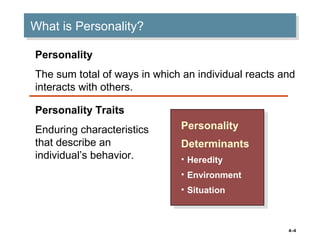
What is Personality?What is Personality?
Personality
The sum total of ways in which an individual reacts and
interacts with others.
Personality Traits
Enduring characteristics
that describe an
individual’s behavior.
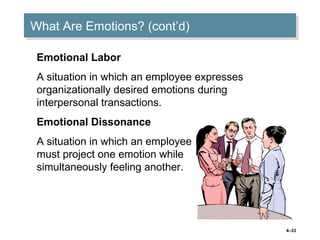
Personality
Determinants
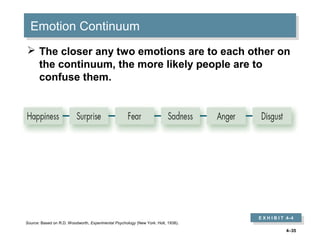
• Heredity
• Environment
• Situation
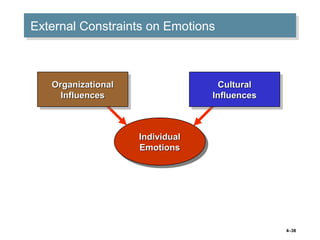
Personality
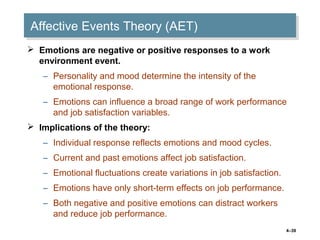
Determinants
• Heredity
• Environment
• Situation
4–5
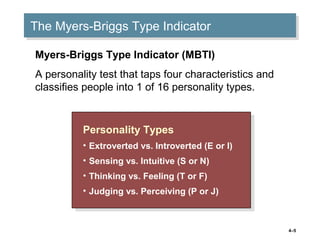
The Myers-Briggs Type IndicatorThe Myers-Briggs Type Indicator
Personality Types
• Extroverted vs. Introverted (E or I)
• Sensing vs. Intuitive (S or N)
• Thinking vs. Feeling (T or F)
• Judging vs. Perceiving (P or J)
Personality Types
• Extroverted vs. Introverted (E or I)
• Sensing vs. Intuitive (S or N)
• Thinking vs. Feeling (T or F)
• Judging vs. Perceiving (P or J)
Myers-Briggs Type Indicator (MBTI)
A personality test that taps four characteristics and
classifies people into 1 of 16 personality types.
4–6
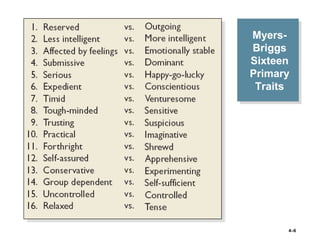
Myers-
Briggs
Sixteen
Primary
Traits
Myers-
Briggs
Sixteen
Primary
Traits
4–7
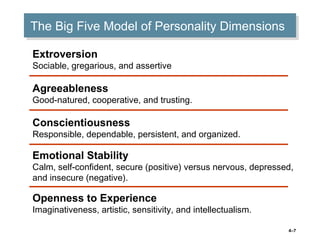
The Big Five Model of Personality DimensionsThe Big Five Model of Personality Dimensions
Extroversion
Sociable, gregarious, and assertive
Agreeableness
Good-natured, cooperative, and trusting.
Conscientiousness
Responsible, dependable, persistent, and organized.
Openness to Experience
Imaginativeness, artistic, sensitivity, and intellectualism.
Emotional Stability
Calm, self-confident, secure (positive) versus nervous, depressed,
and insecure (negative).
4–8
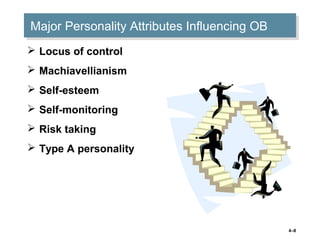
Major Personality Attributes Influencing OBMajor Personality Attributes Influencing OB
 Locus of control
 Machiavellianism
 Self-esteem
 Self-monitoring
 Risk taking
 Type A personality
4–9
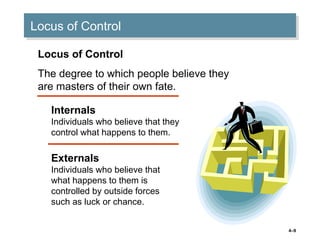
Locus of ControlLocus of Control
Locus of Control
The degree to which people believe they
are masters of their own fate.
Internals
Individuals who believe that they
control what happens to them.
Externals
Individuals who believe that
what happens to them is
controlled by outside forces
such as luck or chance.
4–10
MachiavellianismMachiavellianism
Conditions Favoring High Machs
• Direct interaction
• Minimal rules and regulations
• Emotions distract for others
Conditions Favoring High Machs
• Direct interaction
• Minimal rules and regulations
• Emotions distract for others
Machiavellianism (Mach)
Degree to which an individual is pragmatic,
maintains emotional distance, and believes
that ends can justify means.
4–11
Self-Esteem and Self-MonitoringSelf-Esteem and Self-Monitoring
Self-Esteem (SE)
Individuals’ degree of liking
or disliking themselves.
Self-Monitoring
A personality trait that measures
an individuals ability to adjust his
or her behavior to external,
situational factors.
4–12
Risk-TakingRisk-Taking
 High Risk-taking Managers
– Make quicker decisions
– Use less information to make decisions
– Operate in smaller and more entrepreneurial
organizations
 Low Risk-taking Managers
– Are slower to make decisions
– Require more information before making decisions
– Exist in larger organizations with stable environments
 Risk Propensity
– Aligning managers’ risk-taking propensity to job
requirements should be beneficial to organizations.
4–13
Personality TypesPersonality Types
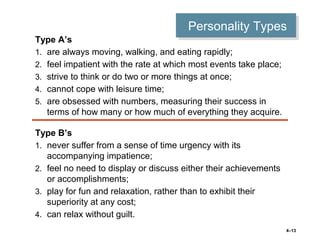
Type A’s
1. are always moving, walking, and eating rapidly;
2. feel impatient with the rate at which most events take place;
3. strive to think or do two or more things at once;
4. cannot cope with leisure time;
5. are obsessed with numbers, measuring their success in
terms of how many or how much of everything they acquire.
Type B’s
1. never suffer from a sense of time urgency with its
accompanying impatience;
2. feel no need to display or discuss either their achievements
or accomplishments;
3. play for fun and relaxation, rather than to exhibit their
superiority at any cost;
4. can relax without guilt.
4–14
Personality TypesPersonality Types
Proactive Personality
Identifies opportunities,
shows initiative, takes
action, and perseveres
until meaningful change
occurs.
Creates positive change
in the environment,
regardless or even in
spite of constraints or
obstacles.
4–15
Achieving Person-Job FitAchieving Person-Job Fit
Personality Types
• Realistic
• Investigative
• Social
• Conventional
• Enterprising
• Artistic
Personality Types
• Realistic
• Investigative
• Social
• Conventional
• Enterprising
• Artistic
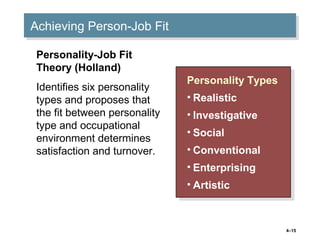
Personality-Job Fit
Theory (Holland)
Identifies six personality
types and proposes that
the fit between personality
type and occupational
environment determines
satisfaction and turnover.
4–16
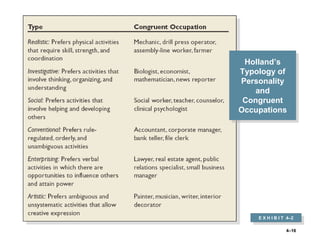
Holland’s
Typology of
Personality
and
Congruent
Occupations
Holland’s
Typology of
Personality
and
Congruent
Occupations
E X H I B I T 4–2
E X H I B I T 4–2
4–17
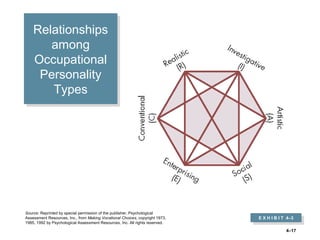
Relationships
among
Occupational
Personality
Types
Relationships
among
Occupational
Personality
Types
E X H I B I T 4–3
E X H I B I T 4–3
Source: Reprinted by special permission of the publisher, Psychological
Assessment Resources, Inc., from Making Vocational Choices, copyright 1973,
1985, 1992 by Psychological Assessment Resources, Inc. All rights reserved.
3–18
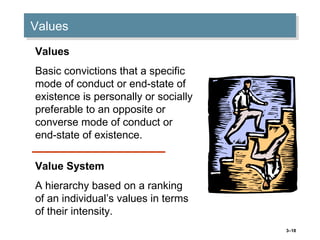
ValuesValues
Values
Basic convictions that a specific
mode of conduct or end-state of
existence is personally or socially
preferable to an opposite or
converse mode of conduct or
end-state of existence.
Value System
A hierarchy based on a ranking
of an individual’s values in terms
of their intensity.
3–19
Importance of ValuesImportance of Values
 Provide understanding of the attitudes,
motivation, and behaviors of individuals and
cultures.
 Influence our perception of the world around us.
 Represent interpretations of “right” and “wrong.”
 Imply that some behaviors or outcomes are
preferred over others.
3–20
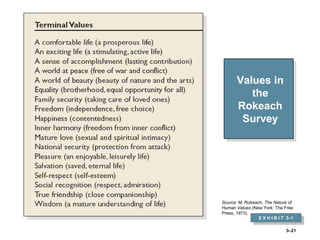
Types of Values –- Rokeach Value SurveyTypes of Values –- Rokeach Value Survey
Terminal Values
Desirable end-states of
existence; the goals that a
person would like to achieve
during his or her lifetime.
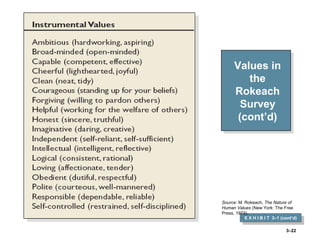
Instrumental Values
Preferable modes of behavior
or means of achieving one’s
terminal values.
3–21
Values in
the
Rokeach
Survey
Values in
the
Rokeach
Survey
E X H I B I T 3–1
E X H I B I T 3–1
Source: M. Rokeach, The Nature of
Human Values (New York: The Free
Press, 1973).
3–22
Values in
the
Rokeach
Survey
(cont’d)
Values in
the
Rokeach
Survey
(cont’d)
E X H I B I T 3–1 (cont’d)
Source: M. Rokeach, The Nature of
Human Values (New York: The Free
Press, 1973).
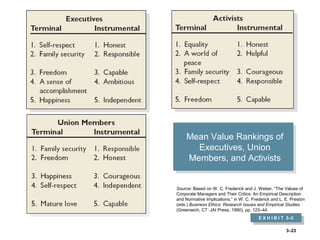
3–23
Mean Value Rankings of
Executives, Union
Members, and Activists
Mean Value Rankings of
Executives, Union
Members, and Activists
E X H I B I T 3–2
E X H I B I T 3–2
Source: Based on W. C. Frederick and J. Weber, “The Values of
Corporate Managers and Their Critics: An Empirical Description
and Normative Implications,” in W. C. Frederick and L. E. Preston
(eds.) Business Ethics: Research Issues and Empirical Studies
(Greenwich, CT: JAI Press, 1990), pp. 123–44.
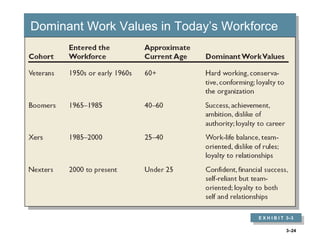
3–24
Dominant Work Values in Today’s WorkforceDominant Work Values in Today’s Workforce
E X H I B I T 3–3
E X H I B I T 3–3
3–25
Hofstede’s Framework for Assessing CulturesHofstede’s Framework for Assessing Cultures
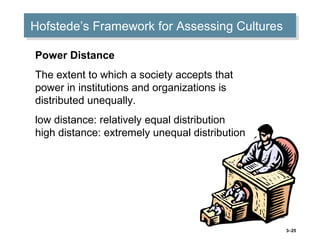
Power Distance
The extent to which a society accepts that
power in institutions and organizations is
distributed unequally.
low distance: relatively equal distribution
high distance: extremely unequal distribution
3–26
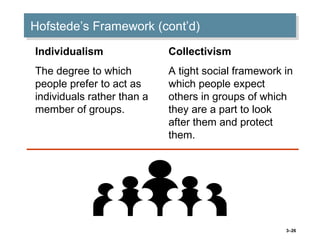
Hofstede’s Framework (cont’d)Hofstede’s Framework (cont’d)
Collectivism
A tight social framework in
which people expect
others in groups of which
they are a part to look
after them and protect
them.
Individualism
The degree to which
people prefer to act as
individuals rather than a
member of groups.
3–27
Hofstede’s Framework (cont’d)Hofstede’s Framework (cont’d)
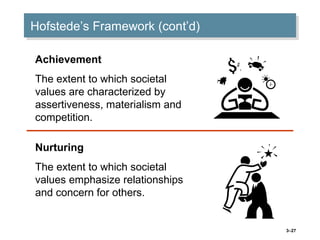
Achievement
The extent to which societal
values are characterized by
assertiveness, materialism and
competition.
Nurturing
The extent to which societal
values emphasize relationships
and concern for others.
3–28
Hofstede’s Framework (cont’d)Hofstede’s Framework (cont’d)
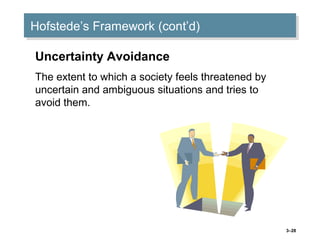
Uncertainty Avoidance
The extent to which a society feels threatened by
uncertain and ambiguous situations and tries to
avoid them.
3–29
Hofstede’s Framework (cont’d)Hofstede’s Framework (cont’d)
Long-term Orientation
A national culture attribute that
emphasizes the future, thrift,
and persistence.
Short-term Orientation
A national culture attribute that
emphasizes the past and
present, respect for tradition,
and fulfilling social obligations.
3–30
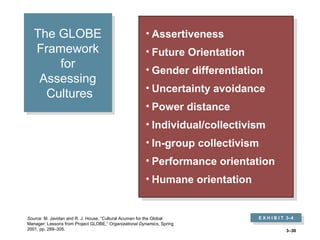
The GLOBE
Framework
for
Assessing
Cultures
The GLOBE
Framework
for
Assessing
Cultures
• Assertiveness
• Future Orientation
• Gender differentiation
• Uncertainty avoidance
• Power distance
• Individual/collectivism
• In-group collectivism
• Performance orientation
• Humane orientation
• Assertiveness
• Future Orientation
• Gender differentiation
• Uncertainty avoidance
• Power distance
• Individual/collectivism
• In-group collectivism
• Performance orientation
• Humane orientation
E X H I B I T 3–4
E X H I B I T 3–4Source: M. Javidan and R. J. House, “Cultural Acumen for the Global
Manager: Lessons from Project GLOBE,” Organizational Dynamics, Spring
2001, pp. 289–305.
4–31
Emotions- Why Emotions Were Ignored in OBEmotions- Why Emotions Were Ignored in OB
 The “myth of rationality”
– Organizations are not emotion-free.
 Emotions of any kind are disruptive to
organizations.
– Original OB focus was solely on the effects of strong
negative emotions that interfered with individual and
organizational efficiency.
4–32
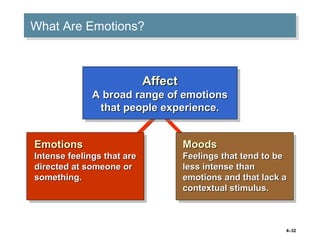
What Are Emotions?What Are Emotions?
MoodsMoods
Feelings that tend to beFeelings that tend to be
less intense thanless intense than
emotions and that lack aemotions and that lack a
contextual stimulus.contextual stimulus.
MoodsMoods
Feelings that tend to beFeelings that tend to be
less intense thanless intense than
emotions and that lack aemotions and that lack a
contextual stimulus.contextual stimulus.
EmotionsEmotions
Intense feelings that areIntense feelings that are
directed at someone ordirected at someone or
something.something.
EmotionsEmotions
Intense feelings that areIntense feelings that are
directed at someone ordirected at someone or
something.something.
AffectAffect
A broad range of emotionsA broad range of emotions
that people experience.that people experience.
AffectAffect
A broad range of emotionsA broad range of emotions
that people experience.that people experience.
4–33
What Are Emotions? (cont’d)What Are Emotions? (cont’d)
Emotional Labor
A situation in which an employee expresses
organizationally desired emotions during
interpersonal transactions.
Emotional Dissonance
A situation in which an employee
must project one emotion while
simultaneously feeling another.
4–34
Felt versus Displayed EmotionsFelt versus Displayed Emotions
Felt Emotions
An individual’s actual emotions.
Displayed Emotions
Emotions that are organizationally
required and considered appropriate
in a given job.
4–35
Emotion ContinuumEmotion Continuum
 The closer any two emotions are to each other on
the continuum, the more likely people are to
confuse them.
E X H I B I T 4–4
E X H I B I T 4–4
Source: Based on R.D. Woodworth, Experimental Psychology (New York: Holt, 1938).
4–36
Emotion DimensionsEmotion Dimensions
 Variety of emotions
– Positive
– Negative
 Intensity of emotions
– Personality
– Job Requirements
 Frequency and duration of emotions
– How often emotions are exhibited.
– How long emotions are displayed.
4–37
Gender and EmotionsGender and Emotions
 Women
– Can show greater emotional expression.
– Experience emotions more intensely.
– Display emotions more frequently.
– Are more comfortable in expressing emotions.
– Are better at reading others’ emotions.
 Men
– Believe that displaying emotions is inconsistent with
the male image.
– Are innately less able to read and to identify with
others’ emotions.
– Have less need to seek social approval by showing
positive emotions.
4–38
External Constraints on EmotionsExternal Constraints on Emotions
OrganizationalOrganizational
InfluencesInfluences
OrganizationalOrganizational
InfluencesInfluences
CulturalCultural
InfluencesInfluences
CulturalCultural
InfluencesInfluences
IndividualIndividual
EmotionsEmotions
IndividualIndividual
EmotionsEmotions
4–39
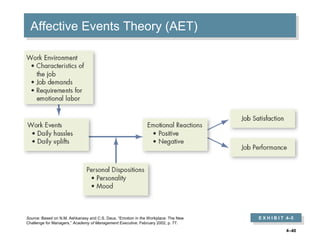
Affective Events Theory (AET)Affective Events Theory (AET)
 Emotions are negative or positive responses to a work
environment event.
– Personality and mood determine the intensity of the
emotional response.
– Emotions can influence a broad range of work performance
and job satisfaction variables.
 Implications of the theory:
– Individual response reflects emotions and mood cycles.
– Current and past emotions affect job satisfaction.
– Emotional fluctuations create variations in job satisfaction.
– Emotions have only short-term effects on job performance.
– Both negative and positive emotions can distract workers
and reduce job performance.
4–40
Affective Events Theory (AET)Affective Events Theory (AET)
E X H I B I T 4–5
E X H I B I T 4–5Source: Based on N.M. Ashkanasy and C.S. Daus, “Emotion in the Workplace: The New
Challenge for Managers,” Academy of Management Executive, February 2002, p. 77.
4–41
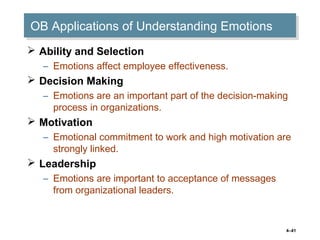
OB Applications of Understanding EmotionsOB Applications of Understanding Emotions
 Ability and Selection
– Emotions affect employee effectiveness.
 Decision Making
– Emotions are an important part of the decision-making
process in organizations.
 Motivation
– Emotional commitment to work and high motivation are
strongly linked.
 Leadership
– Emotions are important to acceptance of messages
from organizational leaders.
4–42
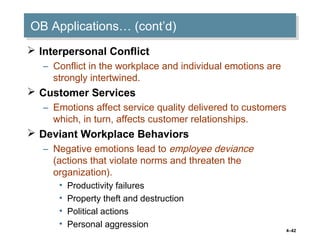
OB Applications… (cont’d)OB Applications… (cont’d)
 Interpersonal Conflict
– Conflict in the workplace and individual emotions are
strongly intertwined.
 Customer Services
– Emotions affect service quality delivered to customers
which, in turn, affects customer relationships.
 Deviant Workplace Behaviors
– Negative emotions lead to employee deviance
(actions that violate norms and threaten the
organization).
• Productivity failures
• Property theft and destruction
• Political actions
• Personal aggression
4–43
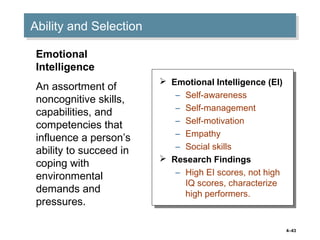
Ability and SelectionAbility and Selection
 Emotional Intelligence (EI)
– Self-awareness
– Self-management
– Self-motivation
– Empathy
– Social skills
 Research Findings
– High EI scores, not high
IQ scores, characterize
high performers.
 Emotional Intelligence (EI)
– Self-awareness
– Self-management
– Self-motivation
– Empathy
– Social skills
 Research Findings
– High EI scores, not high
IQ scores, characterize
high performers.
Emotional
Intelligence
An assortment of
noncognitive skills,
capabilities, and
competencies that
influence a person’s
ability to succeed in
coping with
environmental
demands and
pressures.

Personality Values and Emotions

  • 1.
  • 2.
    4–2 After studying thischapter, you should be able to: 1. Explain the factors that determine an individual’s personality. 2. Describe the MBTI personality framework. 3. Identify the key traits in the Big Five personality model. 4. Explain the impact of job typology on the personality/job performance relationship. 5. Differentiate emotions from moods. 6. Contrast felt versus displayed emotions. LEARNINGOBJECTIVES
  • 3.
    4–3 After studying thischapter, you should be able to: 7. Explain gender-differences in emotions. 8. Describe external constraints on emotions. 9. Apply concepts on emotions to OB issues. LEARNINGOBJECTIVES(cont’d)
  • 4.
    4–4 What is Personality?Whatis Personality? Personality The sum total of ways in which an individual reacts and interacts with others. Personality Traits Enduring characteristics that describe an individual’s behavior. Personality Determinants • Heredity • Environment • Situation Personality Determinants • Heredity • Environment • Situation
  • 5.
    4–5 The Myers-Briggs TypeIndicatorThe Myers-Briggs Type Indicator Personality Types • Extroverted vs. Introverted (E or I) • Sensing vs. Intuitive (S or N) • Thinking vs. Feeling (T or F) • Judging vs. Perceiving (P or J) Personality Types • Extroverted vs. Introverted (E or I) • Sensing vs. Intuitive (S or N) • Thinking vs. Feeling (T or F) • Judging vs. Perceiving (P or J) Myers-Briggs Type Indicator (MBTI) A personality test that taps four characteristics and classifies people into 1 of 16 personality types.
  • 6.
  • 7.
    4–7 The Big FiveModel of Personality DimensionsThe Big Five Model of Personality Dimensions Extroversion Sociable, gregarious, and assertive Agreeableness Good-natured, cooperative, and trusting. Conscientiousness Responsible, dependable, persistent, and organized. Openness to Experience Imaginativeness, artistic, sensitivity, and intellectualism. Emotional Stability Calm, self-confident, secure (positive) versus nervous, depressed, and insecure (negative).
  • 8.
    4–8 Major Personality AttributesInfluencing OBMajor Personality Attributes Influencing OB  Locus of control  Machiavellianism  Self-esteem  Self-monitoring  Risk taking  Type A personality
  • 9.
    4–9 Locus of ControlLocusof Control Locus of Control The degree to which people believe they are masters of their own fate. Internals Individuals who believe that they control what happens to them. Externals Individuals who believe that what happens to them is controlled by outside forces such as luck or chance.
  • 10.
    4–10 MachiavellianismMachiavellianism Conditions Favoring HighMachs • Direct interaction • Minimal rules and regulations • Emotions distract for others Conditions Favoring High Machs • Direct interaction • Minimal rules and regulations • Emotions distract for others Machiavellianism (Mach) Degree to which an individual is pragmatic, maintains emotional distance, and believes that ends can justify means.
  • 11.
    4–11 Self-Esteem and Self-MonitoringSelf-Esteemand Self-Monitoring Self-Esteem (SE) Individuals’ degree of liking or disliking themselves. Self-Monitoring A personality trait that measures an individuals ability to adjust his or her behavior to external, situational factors.
  • 12.
    4–12 Risk-TakingRisk-Taking  High Risk-takingManagers – Make quicker decisions – Use less information to make decisions – Operate in smaller and more entrepreneurial organizations  Low Risk-taking Managers – Are slower to make decisions – Require more information before making decisions – Exist in larger organizations with stable environments  Risk Propensity – Aligning managers’ risk-taking propensity to job requirements should be beneficial to organizations.
  • 13.
    4–13 Personality TypesPersonality Types TypeA’s 1. are always moving, walking, and eating rapidly; 2. feel impatient with the rate at which most events take place; 3. strive to think or do two or more things at once; 4. cannot cope with leisure time; 5. are obsessed with numbers, measuring their success in terms of how many or how much of everything they acquire. Type B’s 1. never suffer from a sense of time urgency with its accompanying impatience; 2. feel no need to display or discuss either their achievements or accomplishments; 3. play for fun and relaxation, rather than to exhibit their superiority at any cost; 4. can relax without guilt.
  • 14.
    4–14 Personality TypesPersonality Types ProactivePersonality Identifies opportunities, shows initiative, takes action, and perseveres until meaningful change occurs. Creates positive change in the environment, regardless or even in spite of constraints or obstacles.
  • 15.
    4–15 Achieving Person-Job FitAchievingPerson-Job Fit Personality Types • Realistic • Investigative • Social • Conventional • Enterprising • Artistic Personality Types • Realistic • Investigative • Social • Conventional • Enterprising • Artistic Personality-Job Fit Theory (Holland) Identifies six personality types and proposes that the fit between personality type and occupational environment determines satisfaction and turnover.
  • 16.
  • 17.
    4–17 Relationships among Occupational Personality Types Relationships among Occupational Personality Types E X HI B I T 4–3 E X H I B I T 4–3 Source: Reprinted by special permission of the publisher, Psychological Assessment Resources, Inc., from Making Vocational Choices, copyright 1973, 1985, 1992 by Psychological Assessment Resources, Inc. All rights reserved.
  • 18.
    3–18 ValuesValues Values Basic convictions thata specific mode of conduct or end-state of existence is personally or socially preferable to an opposite or converse mode of conduct or end-state of existence. Value System A hierarchy based on a ranking of an individual’s values in terms of their intensity.
  • 19.
    3–19 Importance of ValuesImportanceof Values  Provide understanding of the attitudes, motivation, and behaviors of individuals and cultures.  Influence our perception of the world around us.  Represent interpretations of “right” and “wrong.”  Imply that some behaviors or outcomes are preferred over others.
  • 20.
    3–20 Types of Values–- Rokeach Value SurveyTypes of Values –- Rokeach Value Survey Terminal Values Desirable end-states of existence; the goals that a person would like to achieve during his or her lifetime. Instrumental Values Preferable modes of behavior or means of achieving one’s terminal values.
  • 21.
    3–21 Values in the Rokeach Survey Values in the Rokeach Survey EX H I B I T 3–1 E X H I B I T 3–1 Source: M. Rokeach, The Nature of Human Values (New York: The Free Press, 1973).
  • 22.
    3–22 Values in the Rokeach Survey (cont’d) Values in the Rokeach Survey (cont’d) EX H I B I T 3–1 (cont’d) E X H I B I T 3–1 (cont’d) Source: M. Rokeach, The Nature of Human Values (New York: The Free Press, 1973).
  • 23.
    3–23 Mean Value Rankingsof Executives, Union Members, and Activists Mean Value Rankings of Executives, Union Members, and Activists E X H I B I T 3–2 E X H I B I T 3–2 Source: Based on W. C. Frederick and J. Weber, “The Values of Corporate Managers and Their Critics: An Empirical Description and Normative Implications,” in W. C. Frederick and L. E. Preston (eds.) Business Ethics: Research Issues and Empirical Studies (Greenwich, CT: JAI Press, 1990), pp. 123–44.
  • 24.
    3–24 Dominant Work Valuesin Today’s WorkforceDominant Work Values in Today’s Workforce E X H I B I T 3–3 E X H I B I T 3–3
  • 25.
    3–25 Hofstede’s Framework forAssessing CulturesHofstede’s Framework for Assessing Cultures Power Distance The extent to which a society accepts that power in institutions and organizations is distributed unequally. low distance: relatively equal distribution high distance: extremely unequal distribution
  • 26.
    3–26 Hofstede’s Framework (cont’d)Hofstede’sFramework (cont’d) Collectivism A tight social framework in which people expect others in groups of which they are a part to look after them and protect them. Individualism The degree to which people prefer to act as individuals rather than a member of groups.
  • 27.
    3–27 Hofstede’s Framework (cont’d)Hofstede’sFramework (cont’d) Achievement The extent to which societal values are characterized by assertiveness, materialism and competition. Nurturing The extent to which societal values emphasize relationships and concern for others.
  • 28.
    3–28 Hofstede’s Framework (cont’d)Hofstede’sFramework (cont’d) Uncertainty Avoidance The extent to which a society feels threatened by uncertain and ambiguous situations and tries to avoid them.
  • 29.
    3–29 Hofstede’s Framework (cont’d)Hofstede’sFramework (cont’d) Long-term Orientation A national culture attribute that emphasizes the future, thrift, and persistence. Short-term Orientation A national culture attribute that emphasizes the past and present, respect for tradition, and fulfilling social obligations.
  • 30.
    3–30 The GLOBE Framework for Assessing Cultures The GLOBE Framework for Assessing Cultures •Assertiveness • Future Orientation • Gender differentiation • Uncertainty avoidance • Power distance • Individual/collectivism • In-group collectivism • Performance orientation • Humane orientation • Assertiveness • Future Orientation • Gender differentiation • Uncertainty avoidance • Power distance • Individual/collectivism • In-group collectivism • Performance orientation • Humane orientation E X H I B I T 3–4 E X H I B I T 3–4Source: M. Javidan and R. J. House, “Cultural Acumen for the Global Manager: Lessons from Project GLOBE,” Organizational Dynamics, Spring 2001, pp. 289–305.
  • 31.
    4–31 Emotions- Why EmotionsWere Ignored in OBEmotions- Why Emotions Were Ignored in OB  The “myth of rationality” – Organizations are not emotion-free.  Emotions of any kind are disruptive to organizations. – Original OB focus was solely on the effects of strong negative emotions that interfered with individual and organizational efficiency.
  • 32.
    4–32 What Are Emotions?WhatAre Emotions? MoodsMoods Feelings that tend to beFeelings that tend to be less intense thanless intense than emotions and that lack aemotions and that lack a contextual stimulus.contextual stimulus. MoodsMoods Feelings that tend to beFeelings that tend to be less intense thanless intense than emotions and that lack aemotions and that lack a contextual stimulus.contextual stimulus. EmotionsEmotions Intense feelings that areIntense feelings that are directed at someone ordirected at someone or something.something. EmotionsEmotions Intense feelings that areIntense feelings that are directed at someone ordirected at someone or something.something. AffectAffect A broad range of emotionsA broad range of emotions that people experience.that people experience. AffectAffect A broad range of emotionsA broad range of emotions that people experience.that people experience.
  • 33.
    4–33 What Are Emotions?(cont’d)What Are Emotions? (cont’d) Emotional Labor A situation in which an employee expresses organizationally desired emotions during interpersonal transactions. Emotional Dissonance A situation in which an employee must project one emotion while simultaneously feeling another.
  • 34.
    4–34 Felt versus DisplayedEmotionsFelt versus Displayed Emotions Felt Emotions An individual’s actual emotions. Displayed Emotions Emotions that are organizationally required and considered appropriate in a given job.
  • 35.
    4–35 Emotion ContinuumEmotion Continuum The closer any two emotions are to each other on the continuum, the more likely people are to confuse them. E X H I B I T 4–4 E X H I B I T 4–4 Source: Based on R.D. Woodworth, Experimental Psychology (New York: Holt, 1938).
  • 36.
    4–36 Emotion DimensionsEmotion Dimensions Variety of emotions – Positive – Negative  Intensity of emotions – Personality – Job Requirements  Frequency and duration of emotions – How often emotions are exhibited. – How long emotions are displayed.
  • 37.
    4–37 Gender and EmotionsGenderand Emotions  Women – Can show greater emotional expression. – Experience emotions more intensely. – Display emotions more frequently. – Are more comfortable in expressing emotions. – Are better at reading others’ emotions.  Men – Believe that displaying emotions is inconsistent with the male image. – Are innately less able to read and to identify with others’ emotions. – Have less need to seek social approval by showing positive emotions.
  • 38.
    4–38 External Constraints onEmotionsExternal Constraints on Emotions OrganizationalOrganizational InfluencesInfluences OrganizationalOrganizational InfluencesInfluences CulturalCultural InfluencesInfluences CulturalCultural InfluencesInfluences IndividualIndividual EmotionsEmotions IndividualIndividual EmotionsEmotions
  • 39.
    4–39 Affective Events Theory(AET)Affective Events Theory (AET)  Emotions are negative or positive responses to a work environment event. – Personality and mood determine the intensity of the emotional response. – Emotions can influence a broad range of work performance and job satisfaction variables.  Implications of the theory: – Individual response reflects emotions and mood cycles. – Current and past emotions affect job satisfaction. – Emotional fluctuations create variations in job satisfaction. – Emotions have only short-term effects on job performance. – Both negative and positive emotions can distract workers and reduce job performance.
  • 40.
    4–40 Affective Events Theory(AET)Affective Events Theory (AET) E X H I B I T 4–5 E X H I B I T 4–5Source: Based on N.M. Ashkanasy and C.S. Daus, “Emotion in the Workplace: The New Challenge for Managers,” Academy of Management Executive, February 2002, p. 77.
  • 41.
    4–41 OB Applications ofUnderstanding EmotionsOB Applications of Understanding Emotions  Ability and Selection – Emotions affect employee effectiveness.  Decision Making – Emotions are an important part of the decision-making process in organizations.  Motivation – Emotional commitment to work and high motivation are strongly linked.  Leadership – Emotions are important to acceptance of messages from organizational leaders.
  • 42.
    4–42 OB Applications… (cont’d)OBApplications… (cont’d)  Interpersonal Conflict – Conflict in the workplace and individual emotions are strongly intertwined.  Customer Services – Emotions affect service quality delivered to customers which, in turn, affects customer relationships.  Deviant Workplace Behaviors – Negative emotions lead to employee deviance (actions that violate norms and threaten the organization). • Productivity failures • Property theft and destruction • Political actions • Personal aggression
  • 43.
    4–43 Ability and SelectionAbilityand Selection  Emotional Intelligence (EI) – Self-awareness – Self-management – Self-motivation – Empathy – Social skills  Research Findings – High EI scores, not high IQ scores, characterize high performers.  Emotional Intelligence (EI) – Self-awareness – Self-management – Self-motivation – Empathy – Social skills  Research Findings – High EI scores, not high IQ scores, characterize high performers. Emotional Intelligence An assortment of noncognitive skills, capabilities, and competencies that influence a person’s ability to succeed in coping with environmental demands and pressures.