Retailing in e-commerce
Chapter 2
A retailer is a “sales intermediary”, a seller
that operates between manufacturers and
customers.
Electronic retailing (e-tailing)—retailing
conducted online, over the Internet
Retailing in e-commerce
Amazon’s Competitive Structure
Some key features of the are:
 Biggest retailer
 Low prices
 Easy browsing and searching for books
 Useful product information
 One-Click order technology
 Offers several features for international customers
Features that make the online shopping experience
more enjoyable
 Gift ideas
 E-cards
Financial performance
 Annual sales for Amazon. COM have trended upward,
 From $15.7 million in 1996 to $6 billion in 2005
Overview of Electronic Market Structure
Just opening a webpage and passively waiting
for customers access, may not do well. So we
must evaluate between different available
options.
B2B vs. B2C
Direct marketing vs. indirect marketing
E-mall vs. e-broker
Global vs. regional marketing
At the end of this chapter we will able to
associate an appropriate business model for a
particular retail company.
Forecast of the B2C
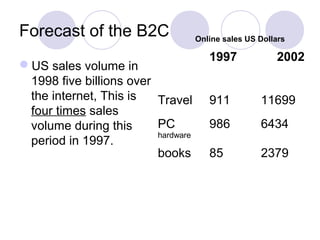
US sales volume in
1998 five billions over
the internet, This is
four times sales
volume during this
period in 1997.
1997 2002
Travel 911 11699
PC
hardware
986 6434
books 85 2379
Online sales US Dollars
Forecast of the B2C
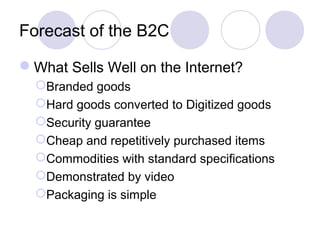
What Sells Well on the Internet?
Branded goods
Hard goods converted to Digitized goods
Security guarantee
Cheap and repetitively purchased items
Commodities with standard specifications
Demonstrated by video
Packaging is simple
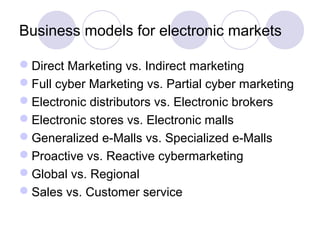
Business models for electronic markets
Direct Marketing vs. Indirect marketing
Full cyber Marketing vs. Partial cyber marketing
Electronic distributors vs. Electronic brokers
Electronic stores vs. Electronic malls
Generalized e-Malls vs. Specialized e-Malls
Proactive vs. Reactive cybermarketing
Global vs. Regional
Sales vs. Customer service
Direct Marketing by Manufacturers
or Mail-Order Companies
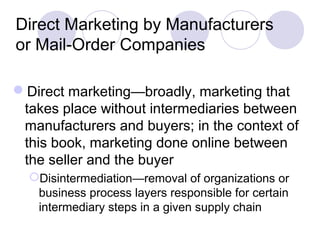
Direct marketing—broadly, marketing that
takes place without intermediaries between
manufacturers and buyers; in the context of
this book, marketing done online between
the seller and the buyer
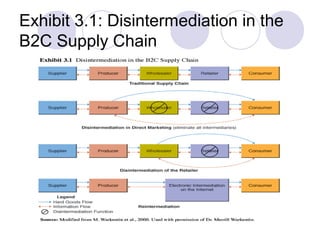
Disintermediation—removal of organizations or
business process layers responsible for certain
intermediary steps in a given supply chain
Direct Marketing
DELL manufacture, advertise and
distribute their own products to customers
via their e-store.
Dell computer corporation
Dell sells it products to both consumer and
business
Direct marketing as major business strategy.
Dell sales per day : + 15 million
Net income raise : 82 % after adapting
internet technology
Direct Marketing
Dells critical success factors
Advanced web application, Dell uses web technology
thoroughly and creatively.
Price competitiveness without longer delivery time, also
offering make-to-order (mass customization).
Database marketing and Customer Intimacy, one-to-one
advertisement, close relationship
 Global Reach: 10000 service provider around the
world, they are closely linked with dell headquarter.
Highly reliable , well reputed, firm delivery support
Direct Marketing
Partial Direct Marketing
Ford case
Auto maker cannot completely switch to e-
commerce so Ford opened its e-store as an
additional distribution channel.
An order received at e-store assigned to nearest
dealer to customer.
Dealers are become partners who are cooperating in
a new sales procedure.
Online customer service
Online Customer service can be provided
to both offline and online business.
Providing customer support and services
(troubleshooting, consulting, educating.
Etc.) using online channel can save
millions of rupees. CISCO
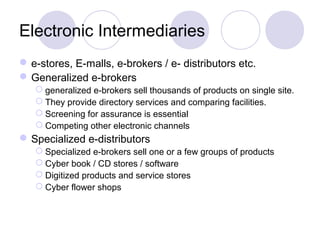
Electronic Intermediaries
e-stores, E-malls, e-brokers / e- distributors etc.
Generalized e-brokers
 generalized e-brokers sell thousands of products on single site.
 They provide directory services and comparing facilities.
 Screening for assurance is essential
 Competing other electronic channels
Specialized e-distributors
 Specialized e-brokers sell one or a few groups of products
 Cyber book / CD stores / software
 Digitized products and service stores
 Cyber flower shops
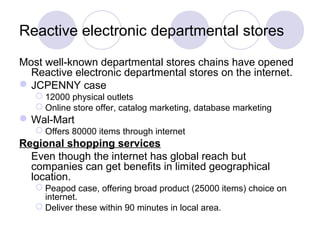
Most well-known departmental stores chains have opened
Reactive electronic departmental stores on the internet.
JCPENNY case
 12000 physical outlets
 Online store offer, catalog marketing, database marketing
Wal-Mart
 Offers 80000 items through internet
Regional shopping services
Even though the internet has global reach but
companies can get benefits in limited geographical
location.
 Peapod case, offering broad product (25000 items) choice on
internet.
 Deliver these within 90 minutes in local area.
Reactive electronic departmental stores
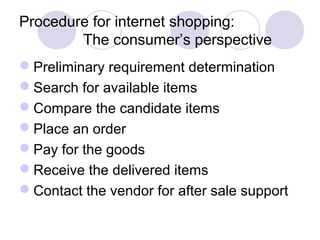
Procedure for internet shopping:
The consumer’s perspective
Preliminary requirement determination
Search for available items
Compare the candidate items
Place an order
Pay for the goods
Receive the delivered items
Contact the vendor for after sale support
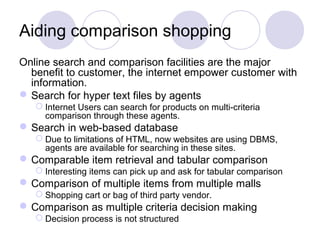
Aiding comparison shopping
Online search and comparison facilities are the major
benefit to customer, the internet empower customer with
information.
Search for hyper text files by agents
 Internet Users can search for products on multi-criteria
comparison through these agents.
Search in web-based database
 Due to limitations of HTML, now websites are using DBMS,
agents are available for searching in these sites.
Comparable item retrieval and tabular comparison
 Interesting items can pick up and ask for tabular comparison
Comparison of multiple items from multiple malls
 Shopping cart or bag of third party vendor.
Comparison as multiple criteria decision making
 Decision process is not structured
The Impact Of EC On Traditional
Retailing Systems
Disintermediation and re-intermediation
Elimination of traditional intermediaries is called
disintermediation.
Occurrence of new breed of electronics
intermediaries is called re intermediation
Impact on manufacturer distribution
strategy
Different powerful brands are adopting different
strategies towards online distribution.
Exhibit 3.1: Disintermediation in the
B2C Supply Chain
Assignment #2
Discuss the major business models of
online retailing, Explain benefits of EC to
one retailer (example) of your area.
Your answer should be at least two pages
in length, typed, single spaced, times new
roman, 12 pt.
 The cover page must contain your name
and registration number
Value of this assignment = 2 marks
Due date: 15 October 2012

Chp2 retailing in e commerce 2009

  • 1.
  • 2.
    A retailer isa “sales intermediary”, a seller that operates between manufacturers and customers. Electronic retailing (e-tailing)—retailing conducted online, over the Internet Retailing in e-commerce
  • 3.
    Amazon’s Competitive Structure Somekey features of the are:  Biggest retailer  Low prices  Easy browsing and searching for books  Useful product information  One-Click order technology  Offers several features for international customers Features that make the online shopping experience more enjoyable  Gift ideas  E-cards Financial performance  Annual sales for Amazon. COM have trended upward,  From $15.7 million in 1996 to $6 billion in 2005
  • 4.
    Overview of ElectronicMarket Structure Just opening a webpage and passively waiting for customers access, may not do well. So we must evaluate between different available options. B2B vs. B2C Direct marketing vs. indirect marketing E-mall vs. e-broker Global vs. regional marketing At the end of this chapter we will able to associate an appropriate business model for a particular retail company.
  • 5.
    Forecast of theB2C US sales volume in 1998 five billions over the internet, This is four times sales volume during this period in 1997. 1997 2002 Travel 911 11699 PC hardware 986 6434 books 85 2379 Online sales US Dollars
  • 6.
    Forecast of theB2C What Sells Well on the Internet? Branded goods Hard goods converted to Digitized goods Security guarantee Cheap and repetitively purchased items Commodities with standard specifications Demonstrated by video Packaging is simple
  • 7.
    Business models forelectronic markets Direct Marketing vs. Indirect marketing Full cyber Marketing vs. Partial cyber marketing Electronic distributors vs. Electronic brokers Electronic stores vs. Electronic malls Generalized e-Malls vs. Specialized e-Malls Proactive vs. Reactive cybermarketing Global vs. Regional Sales vs. Customer service
  • 8.
    Direct Marketing byManufacturers or Mail-Order Companies Direct marketing—broadly, marketing that takes place without intermediaries between manufacturers and buyers; in the context of this book, marketing done online between the seller and the buyer Disintermediation—removal of organizations or business process layers responsible for certain intermediary steps in a given supply chain
  • 9.
    Direct Marketing DELL manufacture,advertise and distribute their own products to customers via their e-store. Dell computer corporation Dell sells it products to both consumer and business Direct marketing as major business strategy. Dell sales per day : + 15 million Net income raise : 82 % after adapting internet technology
  • 10.
    Direct Marketing Dells criticalsuccess factors Advanced web application, Dell uses web technology thoroughly and creatively. Price competitiveness without longer delivery time, also offering make-to-order (mass customization). Database marketing and Customer Intimacy, one-to-one advertisement, close relationship  Global Reach: 10000 service provider around the world, they are closely linked with dell headquarter. Highly reliable , well reputed, firm delivery support
  • 11.
    Direct Marketing Partial DirectMarketing Ford case Auto maker cannot completely switch to e- commerce so Ford opened its e-store as an additional distribution channel. An order received at e-store assigned to nearest dealer to customer. Dealers are become partners who are cooperating in a new sales procedure.
  • 12.
    Online customer service OnlineCustomer service can be provided to both offline and online business. Providing customer support and services (troubleshooting, consulting, educating. Etc.) using online channel can save millions of rupees. CISCO
  • 13.
    Electronic Intermediaries e-stores, E-malls,e-brokers / e- distributors etc. Generalized e-brokers  generalized e-brokers sell thousands of products on single site.  They provide directory services and comparing facilities.  Screening for assurance is essential  Competing other electronic channels Specialized e-distributors  Specialized e-brokers sell one or a few groups of products  Cyber book / CD stores / software  Digitized products and service stores  Cyber flower shops
  • 14.
    Most well-known departmentalstores chains have opened Reactive electronic departmental stores on the internet. JCPENNY case  12000 physical outlets  Online store offer, catalog marketing, database marketing Wal-Mart  Offers 80000 items through internet Regional shopping services Even though the internet has global reach but companies can get benefits in limited geographical location.  Peapod case, offering broad product (25000 items) choice on internet.  Deliver these within 90 minutes in local area. Reactive electronic departmental stores
  • 15.
    Procedure for internetshopping: The consumer’s perspective Preliminary requirement determination Search for available items Compare the candidate items Place an order Pay for the goods Receive the delivered items Contact the vendor for after sale support
  • 16.
    Aiding comparison shopping Onlinesearch and comparison facilities are the major benefit to customer, the internet empower customer with information. Search for hyper text files by agents  Internet Users can search for products on multi-criteria comparison through these agents. Search in web-based database  Due to limitations of HTML, now websites are using DBMS, agents are available for searching in these sites. Comparable item retrieval and tabular comparison  Interesting items can pick up and ask for tabular comparison Comparison of multiple items from multiple malls  Shopping cart or bag of third party vendor. Comparison as multiple criteria decision making  Decision process is not structured
  • 17.
    The Impact OfEC On Traditional Retailing Systems Disintermediation and re-intermediation Elimination of traditional intermediaries is called disintermediation. Occurrence of new breed of electronics intermediaries is called re intermediation Impact on manufacturer distribution strategy Different powerful brands are adopting different strategies towards online distribution.
  • 18.
    Exhibit 3.1: Disintermediationin the B2C Supply Chain
  • 19.
    Assignment #2 Discuss themajor business models of online retailing, Explain benefits of EC to one retailer (example) of your area. Your answer should be at least two pages in length, typed, single spaced, times new roman, 12 pt.  The cover page must contain your name and registration number Value of this assignment = 2 marks Due date: 15 October 2012