Individual differences and work behavior Presented by: Mengot Nkongho Jonathan Acevedo Mohamad Skaf Okoye Chukwudi
Chapter objectives: Identify  individual variables that influence work behavior. Understand  how diversity influences the workplace. Explain  what an attitude is and identify its three components. Discuss  the relationship between job satisfaction and performance. Describe  the major forces influencing personality. Identify  the big five personality dimensions. Discuss  several important personality factors.
Why individual differences are important. Individual differences have a direct effect on behavior People who perceive things differently behave differently People with different attitudes respond differently to directives People with different personalities interact differently with bosses, coworkers, subordinates, and customers
Why individual differences are important Individual differences help explain: Why some people embrace change and others are fearful of it Why some employees will be productive only if they are closely supervised, while others will be productive if they are not Why some workers learn new tasks more effectively than others
Attraction-Selection-Attrition (ASA) Cycle Different people are attracted to different  careers and organizations as a function of their own: abilities interests personalities
Attraction-Selection-Attrition (ASA) Cycle Organizations select employees on the basis of the following: the organization’s needs (skills and abilities) individual attributes such as values and personality
Attraction-Selection-Attrition (ASA) Cycle Attrition  occurs when: individuals discover they do not like being part of the organization and elect to resign, or the organization determines an individual is not succeeding and elects to terminate
Attraction-Selection-Attrition (ASA) Cycle Each phase of the ASA cycle is significantly influenced by the  individual differences  of each person
Effective managerial practice requires that individual behavior differences be recognized, and when feasible, taken into consideration while carrying out the job of managing organizational behavior.
The basis for understanding work behavior. To understand  individual differences  a manager must:   Observe and recognize the differences Study relationships between variables that influence behavior
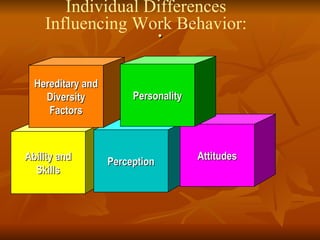
. Individual Differences Influencing Work Behavior: Ability and Skills Perception Attitudes Hereditary and Diversity Factors Personality
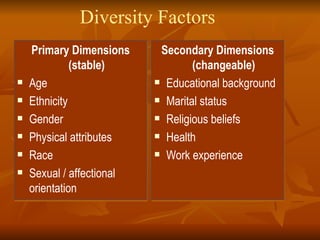
Diversity Factors Primary Dimensions (stable) Age Ethnicity Gender Physical attributes Race Sexual / affectional orientation Secondary Dimensions (changeable) Educational background Marital status Religious beliefs Health Work experience
Generational diversity Disability Diversity
Generational diversity 1- Gen Y : 20s and younger 2- Gen X: 30s to low 40s 3- baby bommers: mid 40s and older Gen X and baby bommers  can use Gen Y on virtual team projects
Disability Diversity: A disabled person is someone who has a physical or mental impairment that substantially limits one or more of his major life activities .
As managers we may be asked to : Make existing facilities accessible Restructure jobs Modify work schedules Reassign employees
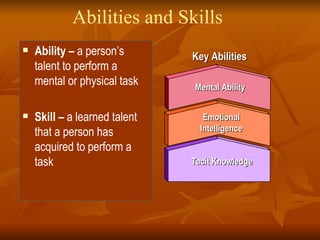
Abilities and Skills Ability –  a person’s talent to perform a mental or physical task Skill –  a learned talent that a person has acquired to perform a task Key Abilities Mental Ability Emotional Intelligence Tacit Knowledge
Attitudes Are determinates of behavior because they are linked with perception, personality, feelings, and motivation Attitude –  a mental state of readiness learned and organized through experience exerting a specific response to people, objects, and situations with which it is related
Attitudes:  Implications for the Manager Attitudes are learned Attitudes define one’s predispositions toward given aspects of the world Attitudes provide the emotional basis of one’s interpersonal relations and identification with others Attitudes are organized and are close to the core of personality
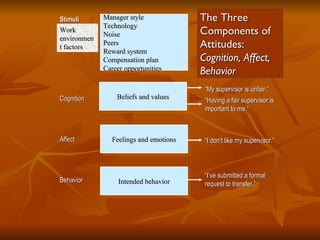
Manager style Technology Noise Peers Reward system Compensation plan Career opportunities Beliefs and values Feelings and emotions Intended behavior Stimuli Work environment factors Cognition Affect Behavior “ My supervisor is unfair.” “ Having a fair supervisor is important to me.” “ I don’t like my supervisor.” “ I’ve submitted a formal request to transfer.” The Three Components of Attitudes:  Cognition, Affect, Behavior
Cognition What individuals know about themselves and their environment Implies a conscious process of acquiring knowledge Evaluative beliefs  – favorable or unfavorable impressions that a person holds toward an object or person
Affect The emotional component of an attitude Often learned from parents teachers peer group members The part of an attitude that is associated with  “feeling”  a certain way about a person, group, or situation
Cognitive Dissonance A discrepancy between  attitudes  and  behaviors A mental state of anxiety Occurs when there is a conflict among an individual’s various  cognitions  after a decision has been made
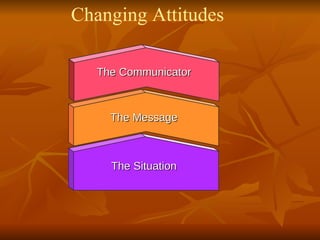
Changing Attitudes The Communicator The Message The Situation
How to Increase Your Effectiveness in Changing Attitudes:  (1 of 2) Concentrate on gradually changing the attitude over a period of time Identify the beliefs or values that are part of the attitude and provide the attitude holder with information that will alter those beliefs or values
How to Increase Your Effectiveness in Changing Attitudes:  (2 of 2) Make the setting (in which the attempted change occurs) as pleasant and enjoyable as possible Identify reasons that changing the attitude is to the advantage of the attitude holder
Attitudes and Job Satisfaction Job satisfaction –  an attitude people have about their jobs Results from people’s perception of their jobs Results from the degree of fit between the individual and the organization Key factors  associated with job satisfaction: Pay Promotion opportunities Supervision Coworkers Working conditions Job security
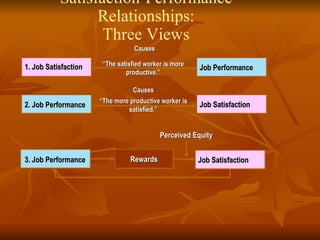
Satisfaction-Performance Relationships: Three Views 2. Job Performance 1. Job Satisfaction 3. Job Performance Job Satisfaction Job Performance Job Satisfaction Causes Causes “ The satisfied worker is more productive.” “ The more productive worker is satisfied.” Rewards Perceived Equity
Personality A relatively stable set of feelings and behaviors that have been significantly formed by genetic and environmental factors The relationship between  behavior and personality  is one of the most complex matters that managers have to understand
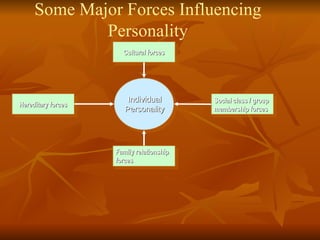
Some Major Forces Influencing Personality Individual Personality Cultural forces Hereditary forces Family relationship forces Social class / group membership forces
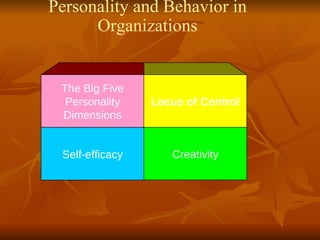
Personality and Behavior in Organizations The Big Five Personality Dimensions Locus of Control Self-efficacy Creativity
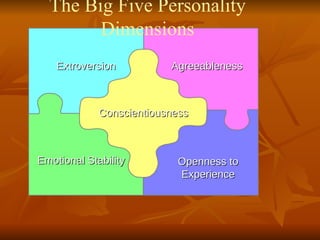
Conscientiousness Extroversion Emotional Stability Agreeableness Openness to Experience The Big Five Personality Dimensions
Locus of Control Locus of control of individuals –  Determines the degree to which they believe their behaviors influence what happens to them Internals  – believe they are masters of their own fate Externals  – believe they are helpless pawns of fate, success is due to luck or ease of task
Self-Efficacy Feelings of  self-efficacy  have managerial and organizational implications: Selection decisions Training programs Goal setting and performance
How to Develop Employee Creativity Encourage everyone to view old problems from new perspectives Make certain people know that it is OK to make mistakes Provide as many people with as many new work experiences as you can Set an example in your own approach to dealing with problems and opportunities

Individual differences and work behaviour

  • 1.
    Individual differences andwork behavior Presented by: Mengot Nkongho Jonathan Acevedo Mohamad Skaf Okoye Chukwudi
  • 2.
    Chapter objectives: Identify individual variables that influence work behavior. Understand how diversity influences the workplace. Explain what an attitude is and identify its three components. Discuss the relationship between job satisfaction and performance. Describe the major forces influencing personality. Identify the big five personality dimensions. Discuss several important personality factors.
  • 3.
    Why individual differencesare important. Individual differences have a direct effect on behavior People who perceive things differently behave differently People with different attitudes respond differently to directives People with different personalities interact differently with bosses, coworkers, subordinates, and customers
  • 4.
    Why individual differencesare important Individual differences help explain: Why some people embrace change and others are fearful of it Why some employees will be productive only if they are closely supervised, while others will be productive if they are not Why some workers learn new tasks more effectively than others
  • 5.
    Attraction-Selection-Attrition (ASA) CycleDifferent people are attracted to different careers and organizations as a function of their own: abilities interests personalities
  • 6.
    Attraction-Selection-Attrition (ASA) CycleOrganizations select employees on the basis of the following: the organization’s needs (skills and abilities) individual attributes such as values and personality
  • 7.
    Attraction-Selection-Attrition (ASA) CycleAttrition occurs when: individuals discover they do not like being part of the organization and elect to resign, or the organization determines an individual is not succeeding and elects to terminate
  • 8.
    Attraction-Selection-Attrition (ASA) CycleEach phase of the ASA cycle is significantly influenced by the individual differences of each person
  • 9.
    Effective managerial practicerequires that individual behavior differences be recognized, and when feasible, taken into consideration while carrying out the job of managing organizational behavior.
  • 10.
    The basis forunderstanding work behavior. To understand individual differences a manager must: Observe and recognize the differences Study relationships between variables that influence behavior
  • 11.
    . Individual DifferencesInfluencing Work Behavior: Ability and Skills Perception Attitudes Hereditary and Diversity Factors Personality
  • 12.
    Diversity Factors PrimaryDimensions (stable) Age Ethnicity Gender Physical attributes Race Sexual / affectional orientation Secondary Dimensions (changeable) Educational background Marital status Religious beliefs Health Work experience
  • 13.
  • 14.
    Generational diversity 1-Gen Y : 20s and younger 2- Gen X: 30s to low 40s 3- baby bommers: mid 40s and older Gen X and baby bommers can use Gen Y on virtual team projects
  • 15.
    Disability Diversity: Adisabled person is someone who has a physical or mental impairment that substantially limits one or more of his major life activities .
  • 16.
    As managers wemay be asked to : Make existing facilities accessible Restructure jobs Modify work schedules Reassign employees
  • 17.
    Abilities and SkillsAbility – a person’s talent to perform a mental or physical task Skill – a learned talent that a person has acquired to perform a task Key Abilities Mental Ability Emotional Intelligence Tacit Knowledge
  • 18.
    Attitudes Are determinatesof behavior because they are linked with perception, personality, feelings, and motivation Attitude – a mental state of readiness learned and organized through experience exerting a specific response to people, objects, and situations with which it is related
  • 19.
    Attitudes: Implicationsfor the Manager Attitudes are learned Attitudes define one’s predispositions toward given aspects of the world Attitudes provide the emotional basis of one’s interpersonal relations and identification with others Attitudes are organized and are close to the core of personality
  • 20.
    Manager style TechnologyNoise Peers Reward system Compensation plan Career opportunities Beliefs and values Feelings and emotions Intended behavior Stimuli Work environment factors Cognition Affect Behavior “ My supervisor is unfair.” “ Having a fair supervisor is important to me.” “ I don’t like my supervisor.” “ I’ve submitted a formal request to transfer.” The Three Components of Attitudes: Cognition, Affect, Behavior
  • 21.
    Cognition What individualsknow about themselves and their environment Implies a conscious process of acquiring knowledge Evaluative beliefs – favorable or unfavorable impressions that a person holds toward an object or person
  • 22.
    Affect The emotionalcomponent of an attitude Often learned from parents teachers peer group members The part of an attitude that is associated with “feeling” a certain way about a person, group, or situation
  • 23.
    Cognitive Dissonance Adiscrepancy between attitudes and behaviors A mental state of anxiety Occurs when there is a conflict among an individual’s various cognitions after a decision has been made
  • 24.
    Changing Attitudes TheCommunicator The Message The Situation
  • 25.
    How to IncreaseYour Effectiveness in Changing Attitudes: (1 of 2) Concentrate on gradually changing the attitude over a period of time Identify the beliefs or values that are part of the attitude and provide the attitude holder with information that will alter those beliefs or values
  • 26.
    How to IncreaseYour Effectiveness in Changing Attitudes: (2 of 2) Make the setting (in which the attempted change occurs) as pleasant and enjoyable as possible Identify reasons that changing the attitude is to the advantage of the attitude holder
  • 27.
    Attitudes and JobSatisfaction Job satisfaction – an attitude people have about their jobs Results from people’s perception of their jobs Results from the degree of fit between the individual and the organization Key factors associated with job satisfaction: Pay Promotion opportunities Supervision Coworkers Working conditions Job security
  • 28.
    Satisfaction-Performance Relationships: ThreeViews 2. Job Performance 1. Job Satisfaction 3. Job Performance Job Satisfaction Job Performance Job Satisfaction Causes Causes “ The satisfied worker is more productive.” “ The more productive worker is satisfied.” Rewards Perceived Equity
  • 29.
    Personality A relativelystable set of feelings and behaviors that have been significantly formed by genetic and environmental factors The relationship between behavior and personality is one of the most complex matters that managers have to understand
  • 30.
    Some Major ForcesInfluencing Personality Individual Personality Cultural forces Hereditary forces Family relationship forces Social class / group membership forces
  • 31.
    Personality and Behaviorin Organizations The Big Five Personality Dimensions Locus of Control Self-efficacy Creativity
  • 32.
    Conscientiousness Extroversion EmotionalStability Agreeableness Openness to Experience The Big Five Personality Dimensions
  • 33.
    Locus of ControlLocus of control of individuals – Determines the degree to which they believe their behaviors influence what happens to them Internals – believe they are masters of their own fate Externals – believe they are helpless pawns of fate, success is due to luck or ease of task
  • 34.
    Self-Efficacy Feelings of self-efficacy have managerial and organizational implications: Selection decisions Training programs Goal setting and performance
  • 35.
    How to DevelopEmployee Creativity Encourage everyone to view old problems from new perspectives Make certain people know that it is OK to make mistakes Provide as many people with as many new work experiences as you can Set an example in your own approach to dealing with problems and opportunities