Robbins & Judge
Organizational Behavior
14th Edition
8-1 © 2009 Prentice-Hall Inc.
All rights reserved.
Motivation: From Concepts to
Applications
Motivation: From Concepts to
Applications
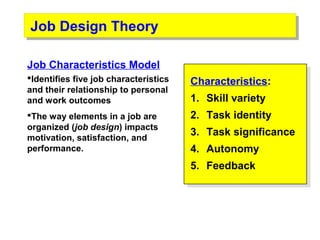
Job Design TheoryJob Design Theory
Characteristics:
1. Skill variety
2. Task identity
3. Task significance
4. Autonomy
5. Feedback
Characteristics:
1. Skill variety
2. Task identity
3. Task significance
4. Autonomy
5. Feedback
Job Characteristics Model
Identifies five job characteristics
and their relationship to personal
and work outcomes
The way elements in a job are
organized (job design) impacts
motivation, satisfaction, and
performance.
7-4
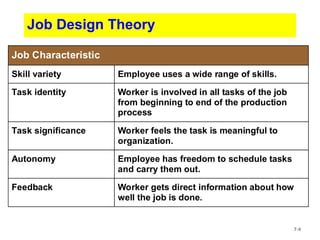
Job Characteristic
Skill variety Employee uses a wide range of skills.
Task identity Worker is involved in all tasks of the job
from beginning to end of the production
process
Task significance Worker feels the task is meaningful to
organization.
Autonomy Employee has freedom to schedule tasks
and carry them out.
Feedback Worker gets direct information about how
well the job is done.
Job Design Theory
10-5
The Job Characteristics ModelThe Job Characteristics Model
Figure 10.2
Source: Adapted from J. R. Hackman and G. R. Oldham,
Work Redesign (Reading, MA: Addison-Wesley, 1980).
Job Design Theory (cont’d)Job Design Theory (cont’d)
Job Characteristics Model
– Jobs with skill variety, task identity, task
significance, autonomy, and for which feedback of
results is given, directly affect three psychological
states of employees:
1. Knowledge of results
2. Meaningfulness of work
3. Personal feelings of responsibility for results
– Increases in these psychological states result in
increased motivation, performance, and job
satisfaction.
8–7
Examples of High & Low Job CharacteristicsExamples of High & Low Job Characteristics
Motivation by Job Design: The JCMMotivation by Job Design: The JCM
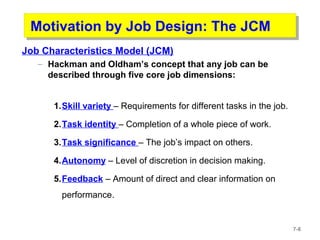
Job Characteristics Model (JCM)
– Hackman and Oldham’s concept that any job can be
described through five core job dimensions:
1.Skill variety – Requirements for different tasks in the job.
2.Task identity – Completion of a whole piece of work.
3.Task significance – The job’s impact on others.
4.Autonomy – Level of discretion in decision making.
5.Feedback – Amount of direct and clear information on
performance.
7-8
Job Design Theory (cont’d)Job Design Theory (cont’d)
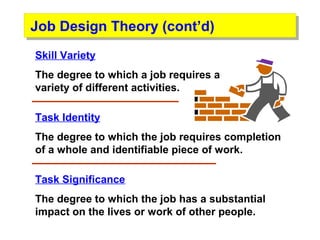
Skill Variety
The degree to which a job requires a
variety of different activities.
Task Identity
The degree to which the job requires completion
of a whole and identifiable piece of work.
Task Significance
The degree to which the job has a substantial
impact on the lives or work of other people.
Job Design Theory (cont’d)Job Design Theory (cont’d)
Autonomy
The degree to which the job provides substantial
freedom and discretion to the individual in scheduling
the work and in determining the procedures to be used
in carrying it out.
Feedback
The degree to which carrying out the work activities
required by a job results in the individual obtaining
direct and clear information about the effectiveness of
his or her performance.
The Job Characteristics ModelThe Job Characteristics Model
E X H I B I T 6–6
E X H I B I T 6–6Source: J.R. Hackman and G.R. Oldham, Work Design (excerpted from pp. 78–80). © 1980 by
Addison-Wesley Publishing Co., Inc. Reprinted by permission of Addison-Wesley Longman, Inc.
Computing a Motivating Potential ScoreComputing a Motivating Potential Score
People who work on jobs with high core dimensions are
generally more motivated, satisfied, and productive.
Job dimensions operate through the psychological states in
influencing personal and work outcome variables rather
than influencing them directly.
People who work on jobs with high core dimensions are
generally more motivated, satisfied, and productive.
Job dimensions operate through the psychological states in
influencing personal and work outcome variables rather
than influencing them directly.
The Job Characteristics ModelThe Job Characteristics Model
7-14
Employee growth-need strength moderates the relationships.
Motivating Potential Score (MPS)Motivating Potential Score (MPS)
Five dimensions combined into a single predictive
index of motivation.
– People who work on jobs with high core dimensions
are generally more motivated, satisfied, and
productive.
– Job dimensions operate through the psychological
states in influencing personal and work outcome
variables rather than influencing them directly.
While the JCM framework is supported by research,
the MPS model isn’t practical and doesn’t work well.
7-15
How Can Jobs Be Redesigned?How Can Jobs Be Redesigned?
Job Rotation
– The periodic shifting of a worker from one task to
another
Job Enlargement
– The horizontal expansion of jobs
Job Enrichment
– The vertical expansion of jobs
7-16
Guidelines for Enriching a JobGuidelines for Enriching a Job
7-17
Source: J.R. Hackman and J.L. Suttle, eds., Improving Life at Work (Glenview, IL: Scott Foresman, 1977), p. 138.
Alternative Work ArrangementsAlternative Work Arrangements
Flextime
– Employees work during a common core time
period each day but have discretion in forming
their total workday from a flexible set of hours
outside the core.
Job Sharing
– The practice of having two or more people split a
40-hour-a-week job
7-18
Another Alternative: TelecommutingAnother Alternative: Telecommuting
Telecommuting
– Employees do their work at home at least two days
a week on a computer that is linked to their office.
The Virtual Office
– Employees work out of their home on a relatively
permanent basis.
Typical Telecommuting Jobs
– Professional and other knowledge-related tasks
– Routine information-handling tasks
– Mobile activities
7-19
Reasons for and against TelecommutingReasons for and against Telecommuting
Advantages
– Larger labor pool
– Higher productivity
– Less turnover
– Improved morale
– Reduced office-space
costs
Disadvantages
Employer
– Less direct supervision
of employees
– Difficult to coordinate
teamwork
– Difficult to evaluate non-
quantitative performance
Employee
– May not be as noticed for
his or her efforts
7-20
Motivation Is Not the Whole StoryMotivation Is Not the Whole Story
7-21
P = f(A x M x O)
Employee InvolvementEmployee Involvement
A participative process that uses the input of
employees to increase their commitment to the
organization’s success.
By increasing worker autonomy and control over
work lives (involvement), organizations:
1. Increase employee motivation
2. Gain greater organizational commitment
3. Experience greater worker productivity
4. Observe higher levels of job satisfaction
7-22
Types of Employee Involvement ProgramsTypes of Employee Involvement Programs
Participative Management
– Subordinates share a significant degree of decision-
making power with their immediate superiors
Representative Participation
– Works councils
• Groups of nominated or elected employees who must
be consulted for any personnel decisions
– Board representative
• An employee sits on a company’s board of directors
and represents the interests of the firm’s employees
Quality Circle
– A work group of employees who meet regularly to
discuss their quality problems, investigate causes,
recommend solutions, and take corrective actions
7-23
Motivational Theory Links to EI ProgramsMotivational Theory Links to EI Programs
7-24
Four Major Strategic Reward DecisionsFour Major Strategic Reward Decisions
1. What to pay?
 (pay structure)
1. How to pay individuals?
 (variable pay plans and skill-based pay plans)
1. What benefits to offer? Do we offer choice of
benefits?
 (flexible benefits)
1. How to build recognition programs?
7-25
1. What to Pay – Pay Structure1. What to Pay – Pay Structure
Internal equity
– The worth of the job to the organization
– Determined by job evaluations
External equity
– The competitiveness of the company’s pay relative
to pay elsewhere in the industry
– Determined through pay surveys
Choose organizational position
– Pay leaders
• Greater employee loyalty
• Attracts better-quality employees
– Pay laggards – expect high turnover for low hourly
costs
7-26
2. How to Pay - Variable Pay Programs2. How to Pay - Variable Pay Programs
Types of Variable Pay Programs
A portion of an employee’s pay is based on some
individual and/or organizational measure of
performance
–Piece Rate:
– Workers are paid a fixed sum for each unit of
production completed
– Weakness: not feasible for many jobs
7-27
2. How to Pay - Variable Pay Programs2. How to Pay - Variable Pay Programs
Types of Variable Pay Programs
–Merit-Based:
– Based on performance appraisal ratings
– Gap increasing between average and top-performers
– Weaknesses: validity of system based on annual
appraisals, pay pool can be small, unions strongly
resist
–Bonuses:
– Rewards recent performance
– Weakness: employees consider this as a pay
7-28
2. How to Pay - Skill-Based Pay Programs2. How to Pay - Skill-Based Pay Programs
Types of Skill-Based Programs:
 Also known as competency-based or knowledge-based
pay
 Sets pay based on skills or number of jobs an employee
can perform
–Profit Sharing:
 Organization-wide programs that distribute compensation
based on some established formula designed around a
company’s profitability
7-29
2. How to Pay - Skill-Based Pay Programs2. How to Pay - Skill-Based Pay Programs
Types of Skill-Based Programs:
–Gain Sharing:
 An incentive plan in which improvements in group
productivity determine the total amount of money that is
allocated
–Employee Stock Ownership Plans (ESOPs)
 Company-established benefit plans in which employees
acquire stock as part of their benefits
7-30
Evaluation of Variable and Skill-based PayEvaluation of Variable and Skill-based Pay
To some extent, variable pay does increase
motivation and productivity
Benefits of Skill-based Pay Plans
 Provide staffing flexibility
 Facilitate communication across the organization
 Lessen “protection of territory” behaviors
 Meet the needs of employees for advancement
 Lead to performance improvements
7-31
Evaluation of Variable and Skill-based PayEvaluation of Variable and Skill-based Pay
To some extent, variable pay does increase
motivation and productivity
Drawbacks:
 Lack of additional learning opportunities
 Continuing to pay employees for obsolete skills
 Paying for skills of no immediate use to the
organization
 Paying for a skill, not for performance of the skill
7-32
3. What Benefits to Offer - Flexible Benefits3. What Benefits to Offer - Flexible Benefits
Employees tailor their benefit program to meet their personal
need by picking and choosing from a menu of benefit options.
Modular Plans
 Predesigned benefits packages for specific groups of
employees
Core-Plus Plans
 A core of essential benefits and a menu-like selection of
other benefit options
Flexible Spending Plans
 Allow employees to use their tax-free benefit dollars to
purchase benefits and pay service premiums
7-33
4. How to Build Recognition Programs4. How to Build Recognition Programs
Intrinsic Rewards: Stimulate Intrinsic Motivation
 Personal attention given to employee
 Approval and appreciation for a job well done
 Growing in popularity and usage
Benefits of Programs
 Fulfill employees’ desire for recognition
 Inexpensive to implement
 Encourage repetition of desired behaviors
Drawbacks of Programs
 Susceptible to manipulation by management
7-34
Global ImplicationsGlobal Implications
Job Characteristics and Job Enrichment
– Inconsistent results across cultures
Telecommuting
– U.S. does this more, but EU workers are interested in it
Variable Pay
– Not much research available, but some possible
hypotheses on relationships
Flexible Benefits
– This concept is becoming more prevalent globally
Employee Benefits
– Practices must be modified to match culture
7-35
Summary and Managerial ImplicationsSummary and Managerial Implications
7-36
To Motivate Employees
– Recognize individual differences
– Use goals and feedback
– Allow employees to participate in decisions that
affect them
– Link rewards to performance
– Check the reward system for equity

Ob 14e 8 concepts to application

  • 1.
    Robbins & Judge OrganizationalBehavior 14th Edition 8-1 © 2009 Prentice-Hall Inc. All rights reserved. Motivation: From Concepts to Applications Motivation: From Concepts to Applications
  • 2.
    Job Design TheoryJobDesign Theory Characteristics: 1. Skill variety 2. Task identity 3. Task significance 4. Autonomy 5. Feedback Characteristics: 1. Skill variety 2. Task identity 3. Task significance 4. Autonomy 5. Feedback Job Characteristics Model Identifies five job characteristics and their relationship to personal and work outcomes The way elements in a job are organized (job design) impacts motivation, satisfaction, and performance.
  • 3.
    7-4 Job Characteristic Skill varietyEmployee uses a wide range of skills. Task identity Worker is involved in all tasks of the job from beginning to end of the production process Task significance Worker feels the task is meaningful to organization. Autonomy Employee has freedom to schedule tasks and carry them out. Feedback Worker gets direct information about how well the job is done. Job Design Theory
  • 4.
    10-5 The Job CharacteristicsModelThe Job Characteristics Model Figure 10.2 Source: Adapted from J. R. Hackman and G. R. Oldham, Work Redesign (Reading, MA: Addison-Wesley, 1980).
  • 5.
    Job Design Theory(cont’d)Job Design Theory (cont’d) Job Characteristics Model – Jobs with skill variety, task identity, task significance, autonomy, and for which feedback of results is given, directly affect three psychological states of employees: 1. Knowledge of results 2. Meaningfulness of work 3. Personal feelings of responsibility for results – Increases in these psychological states result in increased motivation, performance, and job satisfaction.
  • 6.
    8–7 Examples of High& Low Job CharacteristicsExamples of High & Low Job Characteristics
  • 7.
    Motivation by JobDesign: The JCMMotivation by Job Design: The JCM Job Characteristics Model (JCM) – Hackman and Oldham’s concept that any job can be described through five core job dimensions: 1.Skill variety – Requirements for different tasks in the job. 2.Task identity – Completion of a whole piece of work. 3.Task significance – The job’s impact on others. 4.Autonomy – Level of discretion in decision making. 5.Feedback – Amount of direct and clear information on performance. 7-8
  • 8.
    Job Design Theory(cont’d)Job Design Theory (cont’d) Skill Variety The degree to which a job requires a variety of different activities. Task Identity The degree to which the job requires completion of a whole and identifiable piece of work. Task Significance The degree to which the job has a substantial impact on the lives or work of other people.
  • 9.
    Job Design Theory(cont’d)Job Design Theory (cont’d) Autonomy The degree to which the job provides substantial freedom and discretion to the individual in scheduling the work and in determining the procedures to be used in carrying it out. Feedback The degree to which carrying out the work activities required by a job results in the individual obtaining direct and clear information about the effectiveness of his or her performance.
  • 10.
    The Job CharacteristicsModelThe Job Characteristics Model E X H I B I T 6–6 E X H I B I T 6–6Source: J.R. Hackman and G.R. Oldham, Work Design (excerpted from pp. 78–80). © 1980 by Addison-Wesley Publishing Co., Inc. Reprinted by permission of Addison-Wesley Longman, Inc.
  • 11.
    Computing a MotivatingPotential ScoreComputing a Motivating Potential Score People who work on jobs with high core dimensions are generally more motivated, satisfied, and productive. Job dimensions operate through the psychological states in influencing personal and work outcome variables rather than influencing them directly. People who work on jobs with high core dimensions are generally more motivated, satisfied, and productive. Job dimensions operate through the psychological states in influencing personal and work outcome variables rather than influencing them directly.
  • 12.
    The Job CharacteristicsModelThe Job Characteristics Model 7-14 Employee growth-need strength moderates the relationships.
  • 13.
    Motivating Potential Score(MPS)Motivating Potential Score (MPS) Five dimensions combined into a single predictive index of motivation. – People who work on jobs with high core dimensions are generally more motivated, satisfied, and productive. – Job dimensions operate through the psychological states in influencing personal and work outcome variables rather than influencing them directly. While the JCM framework is supported by research, the MPS model isn’t practical and doesn’t work well. 7-15
  • 14.
    How Can JobsBe Redesigned?How Can Jobs Be Redesigned? Job Rotation – The periodic shifting of a worker from one task to another Job Enlargement – The horizontal expansion of jobs Job Enrichment – The vertical expansion of jobs 7-16
  • 15.
    Guidelines for Enrichinga JobGuidelines for Enriching a Job 7-17 Source: J.R. Hackman and J.L. Suttle, eds., Improving Life at Work (Glenview, IL: Scott Foresman, 1977), p. 138.
  • 16.
    Alternative Work ArrangementsAlternativeWork Arrangements Flextime – Employees work during a common core time period each day but have discretion in forming their total workday from a flexible set of hours outside the core. Job Sharing – The practice of having two or more people split a 40-hour-a-week job 7-18
  • 17.
    Another Alternative: TelecommutingAnotherAlternative: Telecommuting Telecommuting – Employees do their work at home at least two days a week on a computer that is linked to their office. The Virtual Office – Employees work out of their home on a relatively permanent basis. Typical Telecommuting Jobs – Professional and other knowledge-related tasks – Routine information-handling tasks – Mobile activities 7-19
  • 18.
    Reasons for andagainst TelecommutingReasons for and against Telecommuting Advantages – Larger labor pool – Higher productivity – Less turnover – Improved morale – Reduced office-space costs Disadvantages Employer – Less direct supervision of employees – Difficult to coordinate teamwork – Difficult to evaluate non- quantitative performance Employee – May not be as noticed for his or her efforts 7-20
  • 19.
    Motivation Is Notthe Whole StoryMotivation Is Not the Whole Story 7-21 P = f(A x M x O)
  • 20.
    Employee InvolvementEmployee Involvement Aparticipative process that uses the input of employees to increase their commitment to the organization’s success. By increasing worker autonomy and control over work lives (involvement), organizations: 1. Increase employee motivation 2. Gain greater organizational commitment 3. Experience greater worker productivity 4. Observe higher levels of job satisfaction 7-22
  • 21.
    Types of EmployeeInvolvement ProgramsTypes of Employee Involvement Programs Participative Management – Subordinates share a significant degree of decision- making power with their immediate superiors Representative Participation – Works councils • Groups of nominated or elected employees who must be consulted for any personnel decisions – Board representative • An employee sits on a company’s board of directors and represents the interests of the firm’s employees Quality Circle – A work group of employees who meet regularly to discuss their quality problems, investigate causes, recommend solutions, and take corrective actions 7-23
  • 22.
    Motivational Theory Linksto EI ProgramsMotivational Theory Links to EI Programs 7-24
  • 23.
    Four Major StrategicReward DecisionsFour Major Strategic Reward Decisions 1. What to pay?  (pay structure) 1. How to pay individuals?  (variable pay plans and skill-based pay plans) 1. What benefits to offer? Do we offer choice of benefits?  (flexible benefits) 1. How to build recognition programs? 7-25
  • 24.
    1. What toPay – Pay Structure1. What to Pay – Pay Structure Internal equity – The worth of the job to the organization – Determined by job evaluations External equity – The competitiveness of the company’s pay relative to pay elsewhere in the industry – Determined through pay surveys Choose organizational position – Pay leaders • Greater employee loyalty • Attracts better-quality employees – Pay laggards – expect high turnover for low hourly costs 7-26
  • 25.
    2. How toPay - Variable Pay Programs2. How to Pay - Variable Pay Programs Types of Variable Pay Programs A portion of an employee’s pay is based on some individual and/or organizational measure of performance –Piece Rate: – Workers are paid a fixed sum for each unit of production completed – Weakness: not feasible for many jobs 7-27
  • 26.
    2. How toPay - Variable Pay Programs2. How to Pay - Variable Pay Programs Types of Variable Pay Programs –Merit-Based: – Based on performance appraisal ratings – Gap increasing between average and top-performers – Weaknesses: validity of system based on annual appraisals, pay pool can be small, unions strongly resist –Bonuses: – Rewards recent performance – Weakness: employees consider this as a pay 7-28
  • 27.
    2. How toPay - Skill-Based Pay Programs2. How to Pay - Skill-Based Pay Programs Types of Skill-Based Programs:  Also known as competency-based or knowledge-based pay  Sets pay based on skills or number of jobs an employee can perform –Profit Sharing:  Organization-wide programs that distribute compensation based on some established formula designed around a company’s profitability 7-29
  • 28.
    2. How toPay - Skill-Based Pay Programs2. How to Pay - Skill-Based Pay Programs Types of Skill-Based Programs: –Gain Sharing:  An incentive plan in which improvements in group productivity determine the total amount of money that is allocated –Employee Stock Ownership Plans (ESOPs)  Company-established benefit plans in which employees acquire stock as part of their benefits 7-30
  • 29.
    Evaluation of Variableand Skill-based PayEvaluation of Variable and Skill-based Pay To some extent, variable pay does increase motivation and productivity Benefits of Skill-based Pay Plans  Provide staffing flexibility  Facilitate communication across the organization  Lessen “protection of territory” behaviors  Meet the needs of employees for advancement  Lead to performance improvements 7-31
  • 30.
    Evaluation of Variableand Skill-based PayEvaluation of Variable and Skill-based Pay To some extent, variable pay does increase motivation and productivity Drawbacks:  Lack of additional learning opportunities  Continuing to pay employees for obsolete skills  Paying for skills of no immediate use to the organization  Paying for a skill, not for performance of the skill 7-32
  • 31.
    3. What Benefitsto Offer - Flexible Benefits3. What Benefits to Offer - Flexible Benefits Employees tailor their benefit program to meet their personal need by picking and choosing from a menu of benefit options. Modular Plans  Predesigned benefits packages for specific groups of employees Core-Plus Plans  A core of essential benefits and a menu-like selection of other benefit options Flexible Spending Plans  Allow employees to use their tax-free benefit dollars to purchase benefits and pay service premiums 7-33
  • 32.
    4. How toBuild Recognition Programs4. How to Build Recognition Programs Intrinsic Rewards: Stimulate Intrinsic Motivation  Personal attention given to employee  Approval and appreciation for a job well done  Growing in popularity and usage Benefits of Programs  Fulfill employees’ desire for recognition  Inexpensive to implement  Encourage repetition of desired behaviors Drawbacks of Programs  Susceptible to manipulation by management 7-34
  • 33.
    Global ImplicationsGlobal Implications JobCharacteristics and Job Enrichment – Inconsistent results across cultures Telecommuting – U.S. does this more, but EU workers are interested in it Variable Pay – Not much research available, but some possible hypotheses on relationships Flexible Benefits – This concept is becoming more prevalent globally Employee Benefits – Practices must be modified to match culture 7-35
  • 34.
    Summary and ManagerialImplicationsSummary and Managerial Implications 7-36 To Motivate Employees – Recognize individual differences – Use goals and feedback – Allow employees to participate in decisions that affect them – Link rewards to performance – Check the reward system for equity